
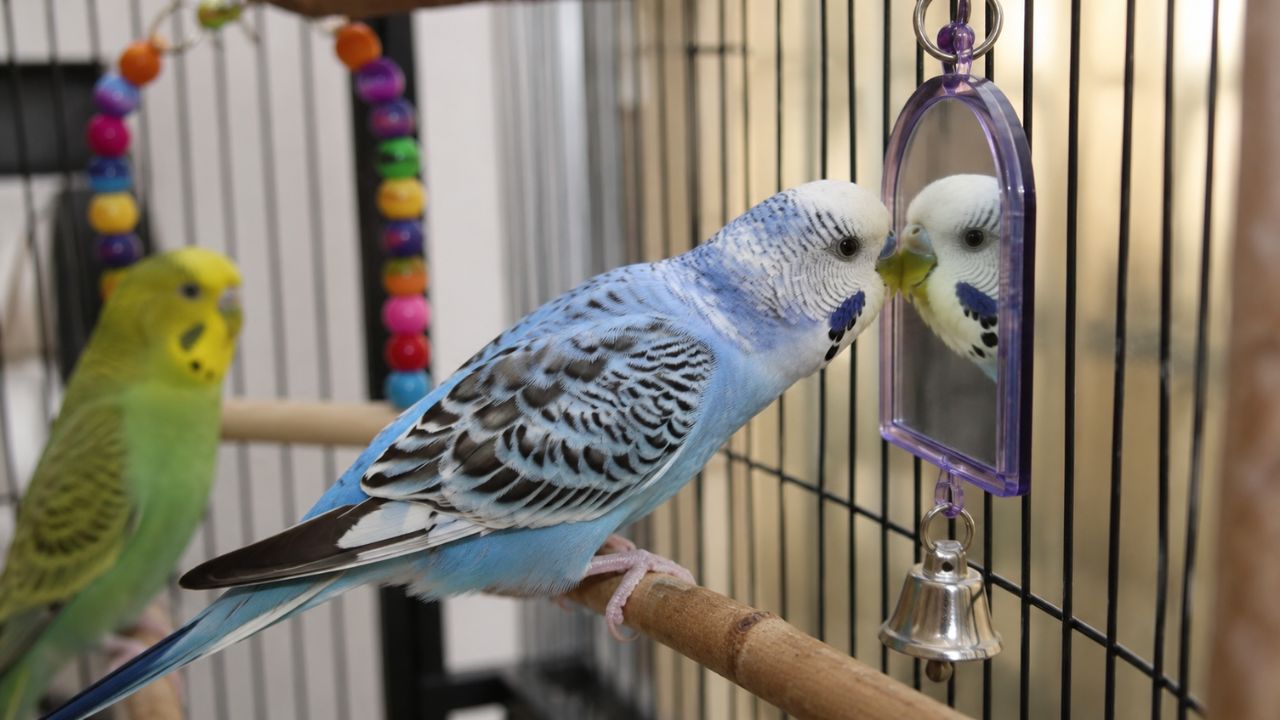

Neil has been keeping, breeding, and selling budgies at Paradise Pets Swindon since 1988 — over 35 years of daily first-hand experience with these birds and the owners who keep them. The mirror question comes up at the counter more often than almost any other budgie behaviour query — and the honest answer is more nuanced than most sources provide. This is his genuine guide to what the mirror behaviour means, when it is harmless, when it becomes a welfare concern, and what to do about it.
A young woman came into the shop one afternoon with a very specific concern. Her budgie — a single male she had owned for about eight months — spent what she described as “an embarrassing amount of time” at the mirror. Beak tapping, chattering at his reflection, regurgitating onto it, sitting pressed against it for long periods. She had read online that mirrors were either essential companionship for single birds, or psychologically damaging distractions that should be removed immediately. She had found confident, well-written sources arguing both positions.
“I just want to know the truth,” she said. “Is the mirror good or bad?”
I told her the honest answer — which is that it is neither, and both, depending on the bird, the situation, and how the mirror is being used. That answer required a longer conversation than she had expected, but she left with a clear understanding of something that most budgie owners never get explained properly.
The mirror is one of the most common items in a budgie’s cage and one of the least well understood. Most owners buy one because it came with the starter kit, or because they read that single birds need companionship and a mirror provides a substitute. Some of this is true. Some of it is considerably more complicated. And a small proportion of it — the part about mirrors being a straightforward welfare solution for lonely birds — is, in my honest opinion, wrong.
What Is Actually Happening When A Budgie Taps The Mirror
Before I get into whether the mirror is good or bad, I want to explain what is actually happening when your budgie taps its beak on it — because the behaviour makes much more sense once you understand the biology behind it.
Budgies do not recognise their own reflection. This is not a failure of intelligence. It is simply that self-recognition in a mirror requires a particular kind of metacognitive awareness that budgies, like most birds, do not possess. Your budgie is not looking at itself and thinking — there I am. It is looking at what appears to be another bird, positioned exactly where it is, performing exactly the same actions it is performing, that never moves away, never threatens, never ignores it, and is always available.
From the budgie’s perspective, it has found what appears to be the most perfectly responsive companion it has ever encountered.
The beak tapping specifically is one of the most revealing behaviours in this interaction. In budgie social life, beak tapping between birds is a contact behaviour — it is part of how bonded birds interact with each other. It appears in courtship, in gentle social play, in the kind of close physical exchange that bonded pairs engage in. When your budgie taps its beak on the mirror, it is doing what it would do to a real companion it had decided to bond with.
- Beak tapping at the mirror — social contact behaviour directed at a perceived companion; the mirror bird is reciprocating perfectly because it always does exactly what the real bird does
- Chattering or vocalising at the mirror — the bird is communicating with what it believes is another bird; vocalisation in budgies is fundamentally social
- Regurgitating onto the mirror — this is bonding behaviour; a budgie that regurgitates onto its reflection is attempting to feed a companion it has bonded to; this is the same behaviour directed at a real partner or at a trusted human
- Sitting pressed against the mirror — proximity-seeking; the bird wants to be physically close to the perceived companion
- Preening the mirror — allo-preening, which bonded birds do for each other; another clear bonding behaviour directed at the reflection
When Mirror Behaviour Is Completely Harmless
I want to be clear about this before I move on to the more complicated territory, because not every budgie that taps a mirror is developing a problem.
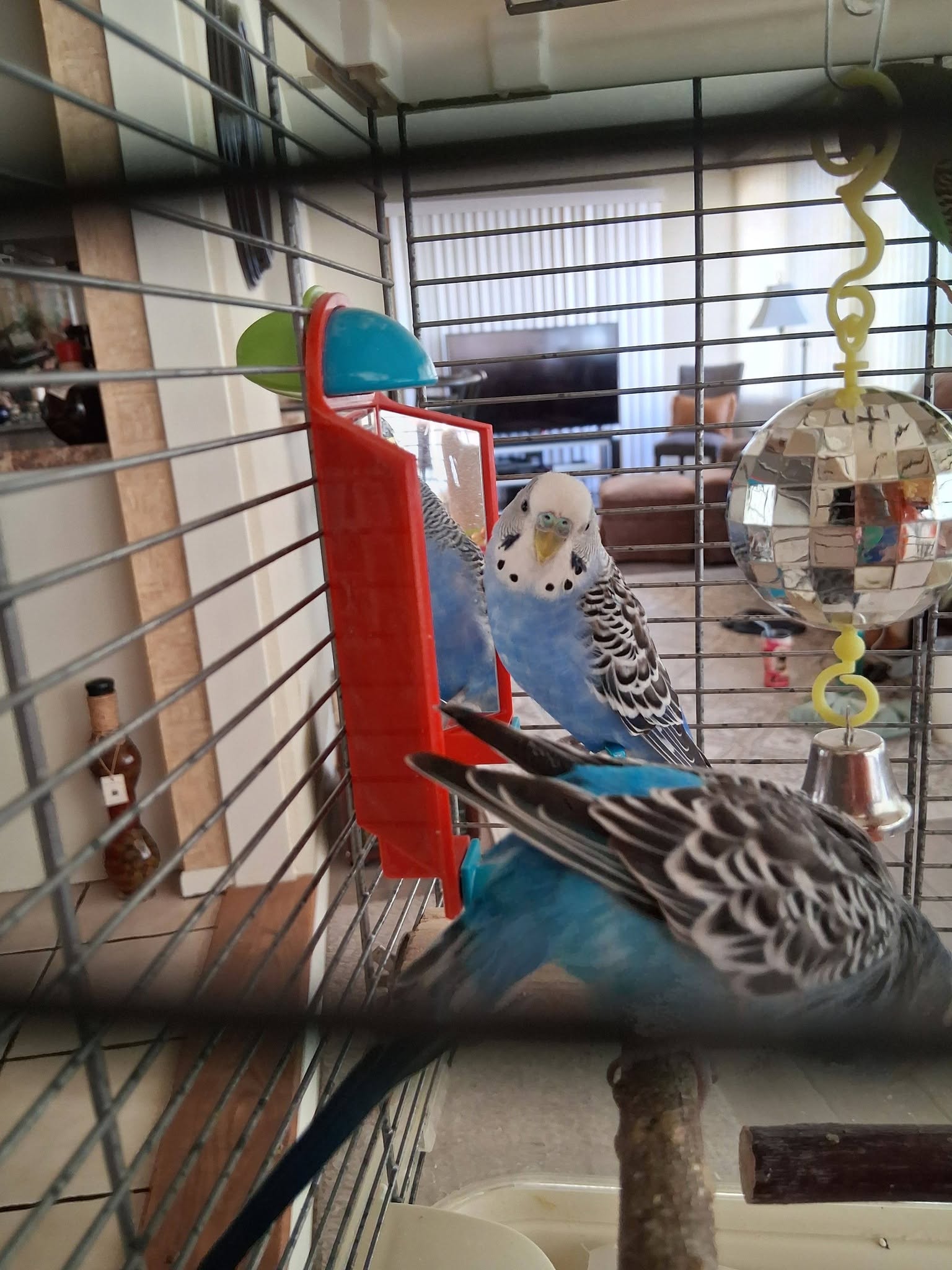
In a bird that has genuine social companionship — either another budgie to interact with, or an owner who provides substantial daily interaction — the mirror is exactly what it appears to be: an amusing object the bird plays with and occasionally interacts with. The bird is not dependent on the mirror. It does not spend excessive time there. It taps it a few times, chatters at it, moves on. It is just another item in the cage environment.
- A bird kept with another budgie — has a real social companion and is not seeking the mirror as a substitute; mirror use in this context is casual play, not compulsive bonding
- A bird with substantial daily human interaction — a single bird whose owner is home most of the day, handles it regularly, talks to it, and provides genuine engagement; for this bird the mirror is entertainment, not lifeline
- Occasional, brief mirror interactions — the bird spends a few minutes at the mirror, then moves on to other activities; eats, flies around the cage, engages with other toys; mirror time is one of many things it does
- Mirror interest that varies — sometimes engaged with the mirror, sometimes completely ignoring it; not fixated; not spending the majority of waking hours there
In these situations, the mirror is not causing harm. I would not say it is providing what a real companion provides — because it is not — but it is not producing welfare problems either. It is a neutral to mildly enriching object.
When Mirror Behaviour Becomes A Welfare Concern
This is the territory that most sources either do not address or address too briefly. After 35 years of watching single budgies with mirrors, I have seen a clear pattern that I think every single budgie owner should know about.
A single bird — one kept without another budgie and without the level of daily human interaction that substitutes for flock life — that has a mirror in its cage will, over weeks and months, increasingly direct all of its social behaviour toward the mirror. The beak tapping becomes more frequent and more sustained. The regurgitation becomes regular. The bird spends the majority of its waking hours at the mirror. It becomes, in behavioural terms, bonded to the mirror.
The problem is not the bonding itself. The problem is what the bond produces — or rather, what it does not produce.
- The mirror never meets the bird’s actual social needs — a real companion would groom the bird in return, would sleep pressed against it, would call back and forth with it, would alert it to changes in the environment; the mirror does none of these things; it only reflects
- A bird bonded to a mirror exists in a state of permanent social frustration — it is engaging all of its social behaviours and receiving none of the responses that a real companion would provide; this is not contentment; it is chronic incomplete social engagement
- The mirror bond crowds out real social development — a bird obsessively bonded to its mirror is significantly harder to tame and bond with as a human; the mirror has become the social outlet and the human has become background noise; this is the opposite of what most single-bird owners wanted when they put the mirror in
- Excessive regurgitation causes nutritional problems — a bird that is regurgitating repeatedly onto the mirror is losing significant nutrition; chronic excessive regurgitation to an inanimate object contributes to weight loss and nutritional deficiency over time
- The bird cannot disengage — a genuinely bonded real companion goes away sometimes; sleeps, forages, moves to another part of the cage; the mirror is always there, always responsive, and the bird cannot rest from it the way it would rest from a real social relationship

The Signs That The Mirror Has Become A Problem
These are the specific signs that tell you the mirror interaction has moved from harmless enrichment to a welfare concern that needs addressing.
- The bird spends the majority of its active waking hours at the mirror — not occasional visits; genuinely most of the day, repeatedly returning if moved away
- Excessive regurgitation onto the mirror, multiple times daily — occasional regurgitation is bonding behaviour and not alarming; multiple episodes daily indicates the bond has become the bird’s primary focus
- The bird appears agitated when separated from the mirror — calling repeatedly, pressing against the side of the cage nearest the mirror, restless when it cannot see the reflection
- The bird has lost interest in everything else — other toys ignored, food visited only briefly before returning to the mirror, reduced flying around the cage
- The bird ignores you or other stimulation in favour of the mirror — you approach the cage and it does not come to the front as it used to; it stays at the mirror
- Visible weight loss or poor condition — a bird losing body condition while regularly regurgitating onto the mirror is losing nutrition it cannot afford to lose

If your bird is showing several of these signs, the mirror has become a welfare problem rather than an enrichment item.
What To Do — The Honest Options
If you have identified that the mirror has become a problem for your bird, you have a small number of options. I want to be honest about all of them, including the one that most owners do not want to hear.
Option 1 — Remove The Mirror (Recommended For Problematic Cases)
This is the most direct solution and, in cases where the mirror behaviour has become genuinely problematic, the most effective one. A bird that has been obsessively bonded to a mirror and has the mirror removed will go through a period of adjustment — calling for it, searching for it, showing some agitation. This typically lasts a few days to a week, not indefinitely.
- Remove the mirror completely — not just move it; if it is in the cage the bird can see it and the behaviour continues
- Expect a short adjustment period — the bird may seem unsettled for several days; this is normal and resolves; it is not ongoing distress
- Fill the social gap with real interaction — increase the time you spend near the cage and genuinely interacting with the bird; this is what the mirror was substituting for; the mirror’s removal is only beneficial if something real fills the space it leaves
- Consider getting a second bird — this is the most honest longer-term solution to the social need the mirror was addressing; see below
Option 2 — Reduce Mirror Availability
For birds where the mirror use is approaching problematic but has not yet become the dominant welfare concern, reducing rather than eliminating mirror access can be a useful intermediate step.
- Cover the mirror for part of the day — a small cloth over the mirror for several hours daily breaks the constant availability and reduces fixation
- Move the mirror to a less prominent position — away from the bird’s main perch and food area; the bird has to make more of an effort to access it, which reduces casual obsessive visiting
- Provide alternative enrichment — foraging toys, new objects to investigate, varied perch positions; broadening the environmental stimulation reduces the proportion of attention directed at the mirror
- Monitor closely — if mirror reduction is not producing a meaningful change in behaviour within two to three weeks, full removal is the right next step
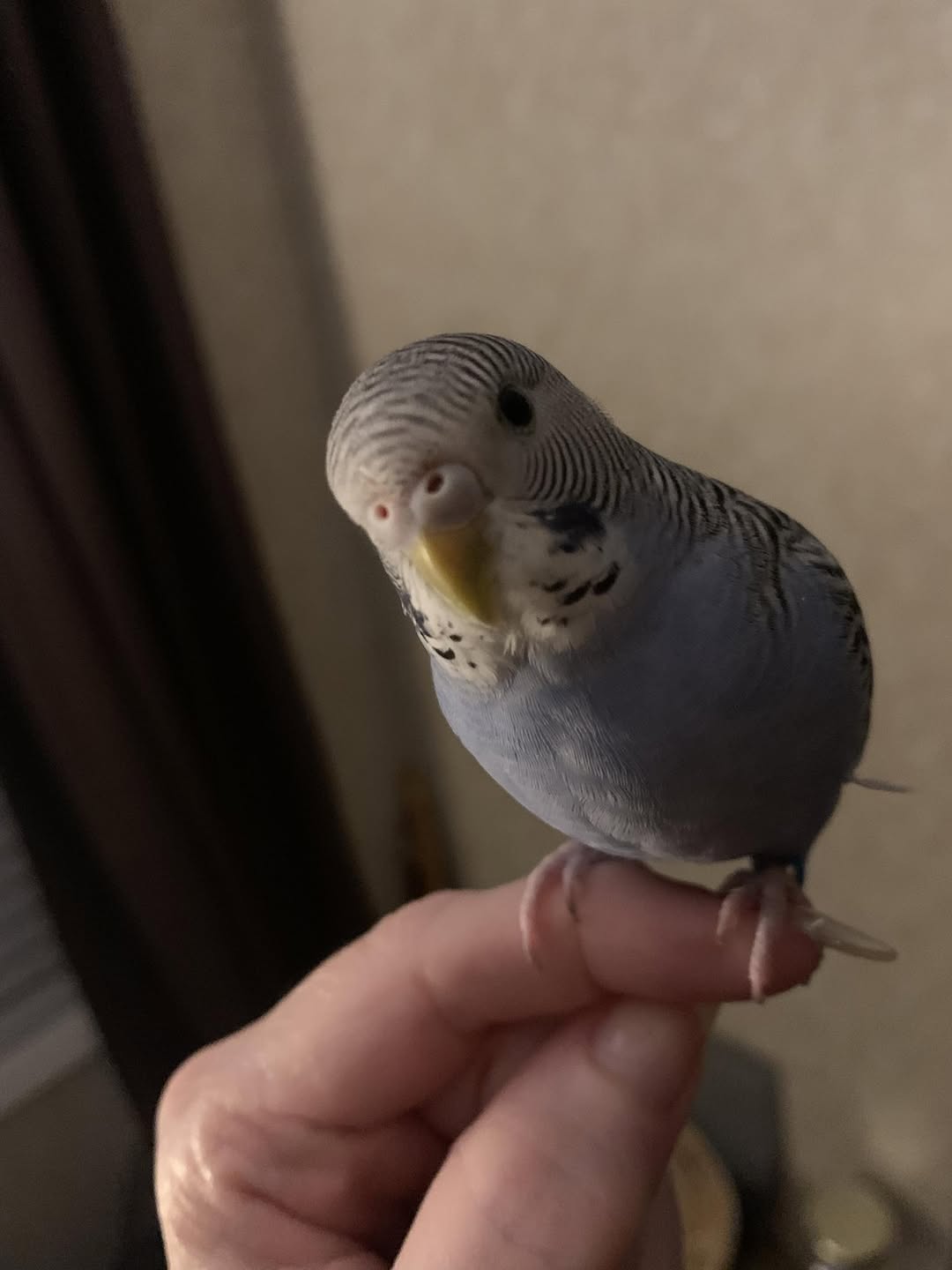
Option 3 — Get A Second Bird (The Real Solution)
This is the option I end up recommending in the majority of cases where mirror obsession is a presenting problem, because it addresses the underlying cause rather than the symptom.
The reason a single bird bonds obsessively to a mirror is that it needs social companionship of a kind that the mirror appears to provide and that nothing else in its environment does provide. The mirror is a symptom of a social need going unmet. Removing the mirror without addressing the underlying need means the bird finds another outlet — often the owner’s hand, or a toy, or itself — and the obsessive behaviour continues in a different direction.
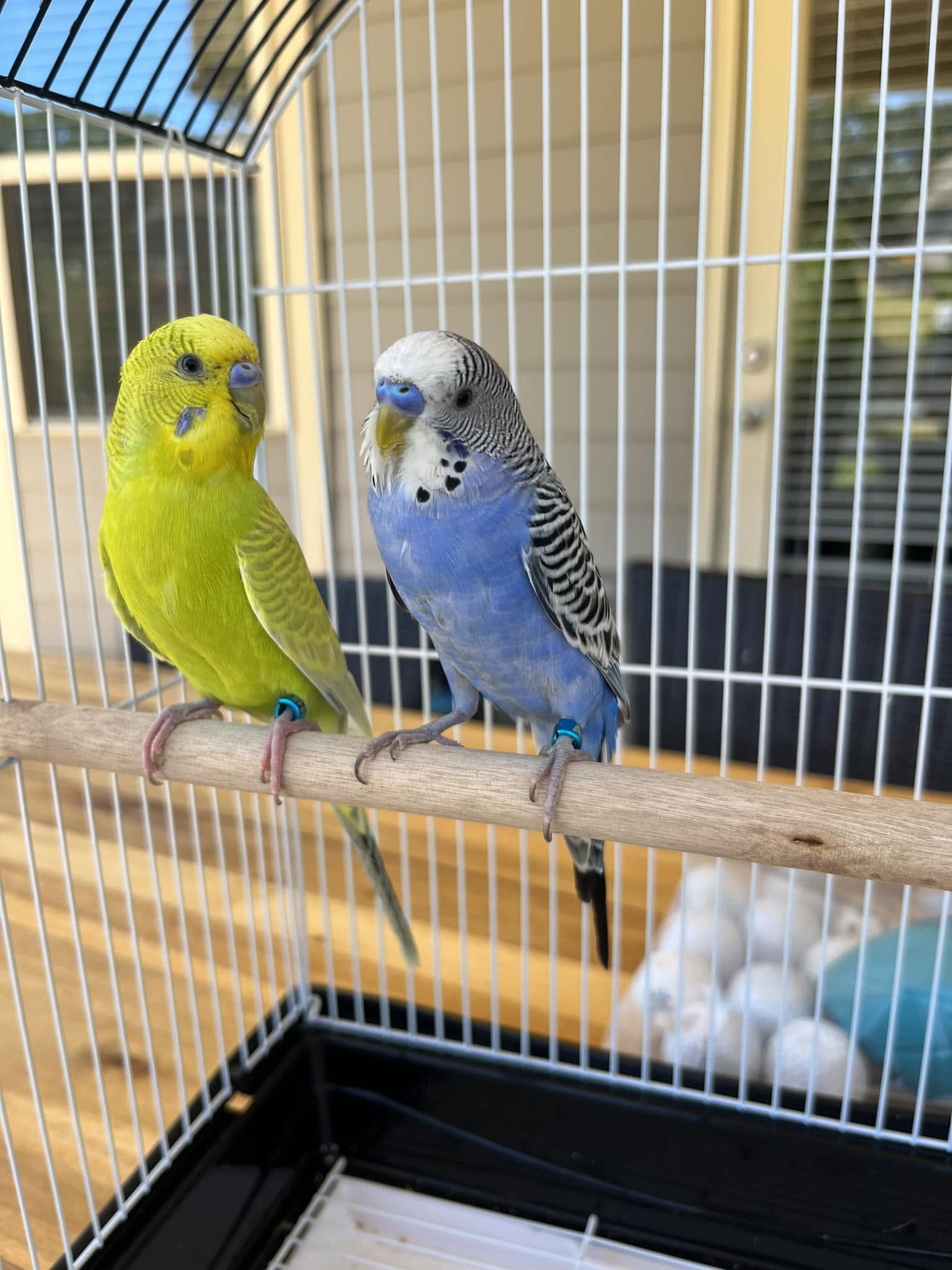
A second budgie — same sex to avoid breeding complications, ideally a young bird introduced gradually — provides what the mirror was simulating. Real social interaction. Mutual grooming. A genuine companion that responds in ways the mirror never could.
- Introduction requires patience — new birds should be quarantined separately for at least two weeks before any contact; introduced through a shared wall before sharing a cage; rushed introductions can result in fighting
- Same sex pairs avoid breeding complications — two males or two females live together well; a male and female pair will likely breed, which is a significant additional commitment
- The existing bird may be harder to tame after the second bird arrives — this is the trade-off; a bird with genuine avian companionship is less dependent on you; for most households this is acceptable; for owners whose primary goal is a hand-tame bird, it is worth knowing in advance
- The overall welfare improvement is significant — a pair of budgies in good conditions is healthier, more active, more behaviourally expressive, and longer-lived on average than a single bird; the trade-off in reduced human dependence is, in most cases, worth it
The Mirror Question For New Budgie Owners
I want to address this separately because the decision is easier to make at the start than to reverse after a bond has formed.
If you are setting up a cage for a new single budgie, my honest advice is to leave the mirror out — or to use it only temporarily while working toward getting a second bird. The reasons I have described above are easier to avoid than to resolve.
If you do include a mirror, monitor the bird’s relationship with it closely. Occasional tapping and chattering — fine. Spending the majority of its time there, regular regurgitation onto it, ignoring everything else — remove it and address the underlying social need.
| Mirror Behaviour | What It Means | What To Do |
|---|---|---|
| Occasional beak tapping and chattering, then moves on | Normal casual interaction — not problematic | Nothing. Monitor that it stays occasional. |
| Regular beak tapping, brief daily visits, bird otherwise active and engaged | Mild bonding — currently harmless | Monitor. Ensure other enrichment is available. No immediate action needed. |
| Regurgitating onto mirror occasionally | Bonding behaviour — not yet a welfare concern if infrequent | Monitor frequency. If daily or multiple times daily, consider reducing mirror access. |
| Majority of active time spent at mirror, ignoring other activities | Mirror fixation developing — welfare concern | Reduce mirror access or remove. Increase real social interaction or consider second bird. |
| Agitated when separated from mirror, daily regurgitation, weight loss | Problematic obsessive bond — welfare issue | Remove mirror. Address underlying social need. Vet check if weight loss is significant. |
| Bird kept with another budgie, occasional mirror interest | Casual play — entirely harmless | Nothing. |
Frequently Asked Questions
Should budgies have mirrors in their cage?
It depends on the bird’s situation. For a bird kept with another budgie, a mirror is harmless enrichment that the bird will interact with casually. For a single bird without substantial daily human interaction, a mirror carries a real risk of producing obsessive bonding behaviour that substitutes for genuine social contact without actually providing it. My honest advice for single birds is: either ensure you are providing the level of daily interaction that means the mirror stays a casual toy rather than a social lifeline — or skip the mirror and address the social need properly, ideally by getting a second bird.
Why does my budgie regurgitate onto the mirror?
Because it has bonded to the mirror and is performing the feeding behaviour that bonded birds perform for each other. In budgie social life, offering regurgitated food to a companion is a significant bonding behaviour — it is what a bird does for a mate or a very trusted companion. The mirror receives this behaviour because the bird has identified the reflection as a companion. Occasional regurgitation is not alarming; multiple episodes daily indicates the bond has become intense enough to warrant attention.
Is it cruel to take the mirror away?
No — in cases where the mirror has become a welfare concern, removing it is the kind thing to do. The bird will go through a short adjustment period of a few days, which looks uncomfortable but is temporary. Leaving a bird in a state of obsessive social frustration directed at an object that can never truly respond is the greater welfare cost. The adjustment period is short. The benefit of addressing the underlying social need is long-term.
My budgie taps the mirror and then looks behind it. What is it doing?
Looking for the other bird. This is one of the clearest demonstrations that budgies do not recognise themselves in mirrors — the bird expects the reflection to have a physical presence behind the glass and goes looking for it. This behaviour is entirely normal and is not a sign of confusion or distress on its own. It tells you clearly that the bird is relating to the mirror as if it were a real companion, which is useful information about the nature of the mirror bond.
Will my budgie be sad if I remove the mirror?
It will notice the change and may show some agitation for a few days. This resolves. The more important question is whether the bird will be better off without the mirror — and for a single bird that has been spending most of its time there, the honest answer is yes, if the mirror’s removal is followed by either more genuine human interaction or the introduction of a second bird. The temporary adjustment discomfort is not the same as ongoing distress, and it is considerably less concerning than the chronic social frustration of a mirror-obsessed single bird.
My budgie beak taps everything, not just the mirror. Is this normal?
Yes. Beak tapping is a general exploratory and social behaviour in budgies — they tap objects to investigate them, to test them, and in social contexts to make contact. Tapping toys, perches, the cage bars, and your hand or finger are all normal behaviours. The mirror is notable not because tapping it is unusual, but because it reliably produces a returning tap — the reflection — which reinforces the behaviour and encourages the bird to keep engaging. Other objects tapped occasionally are just exploration.
Does the mirror stop a budgie from bonding with its owner?
In cases of mirror fixation — where the bird spends the majority of its time at the mirror and has effectively made the mirror its primary social companion — yes, it does. The bird has found a social outlet and the owner’s attempts at interaction are secondary to the mirror relationship. Removing the mirror, followed by patient taming work, typically allows the human bond to develop. A bird that uses the mirror casually without fixating on it will generally still bond with a patient, consistent owner.
Where can I get honest advice about my budgie’s mirror behaviour in Swindon?
Come in to Paradise Pets at Manor Garden Centre, Cheney Manor Industrial Estate, Swindon SN2 2QJ or call us on 01793 512400. If you are not sure whether what you are seeing is casual mirror use or something that needs addressing, describe it to us and we will give you an honest assessment. We have been watching budgies interact with mirrors — and watching the effects — for 35 years. The advice is always free.
One Last Thing From Me
The young woman who came in that afternoon — the one with the bird that spent an embarrassing amount of time at the mirror — came back about three months later. She had removed the mirror after our conversation and spent the intervening time working on the bird’s relationship with her — daily interaction, millet through the bars, the slow and patient approach I describe in our taming guide.
The bird had, she said, transformed. It came to the front of the cage when she approached. It had stepped up twice. It was more active, more varied in its behaviour, more engaged with her than it had ever been when the mirror was in the cage.
“It was like he finally noticed I was there,” she said.
That is precisely what happened. The mirror had been the bird’s social world. Without it — and with her filling the space — she became the social world instead. Not a substitute for the mirror. A real companion, providing real engagement, that the bird chose to invest in because the mirror was no longer taking all of its social energy.
She has since got a second bird, incidentally. The first one was initially indignant about this, then curious, then — within about three weeks — inseparable from the newcomer. Both birds are tame. Both interact with her. Neither spends more than a few minutes at the mirror.
That is the outcome I would wish for every single budgie owner reading this article. Not necessarily an identical sequence of events. But an honest understanding of what the mirror is doing in your bird’s life — and the knowledge of how to ensure it is doing something useful rather than something harmful.
Questions About Your Budgie’s Behaviour? Come And Talk It Through
Whether it is the mirror, the taming, the diet, or something that does not seem quite right — come in or ring us. We will give you a straight answer based on 35 years of watching these birds and the owners who keep them. Free advice, no obligation.