

Neil has kept, bred, and sold budgies at Paradise Pets Swindon since 1988 — over 35 years of first-hand experience with these birds. In that time, he has watched countless UK owners do exactly the wrong things while trying to tame their budgie — usually following advice that sounded reasonable but was completely wrong. This is his honest guide to what genuinely works in taming a budgie, and the common mistakes that quietly sabotage progress.
A man came into the shop one Tuesday morning, looking properly frustrated. “Neil,” he said, “I have had my budgie for four months. I have done everything the internet told me. I take him out every day, I keep my hand in the cage to get him used to it, I tried wing clipping, I bought all the training treats. And he hates me more now than the day we got him. What am I doing wrong?”
I winced slightly as he listed each thing, because I have heard this exact conversation dozens of times over the years. The honest truth was painful — almost every single thing he had been doing was actively making it harder. The advice he had followed was wrong. The techniques he had used were the opposite of what works. And the more “effort” he put in, the further away from a tame budgie he got.
In 35 years of selling budgies and watching their owners try to tame them, I have learned which techniques genuinely produce calm, friendly, hand-tame birds — and which ones produce frightened, untrusting birds even though the owner is putting in plenty of effort. The difference is not how hard you try. It is what you actually do.
This article is the conversation I have with frustrated owners at the counter, written down for every UK budgie owner who is finding taming harder than they expected. By the end of it, you will know what genuinely works, what to stop doing immediately, and why patience matters more than any technique.
The Honest Truth About Taming — Why It Is Misunderstood
Before we get into the specifics, let me explain why so many UK owners struggle with this. Because the failure rate is genuinely high, and it is not because the owners are bad at it — it is because they are following bad advice.
The common assumption is that taming a budgie is like training a dog. You put in time, you use techniques, you reward good behaviour, and eventually the animal learns. This is partly true for some species, but it does not work the same way with budgies. Budgies are not dogs. They are prey animals. Their default response to a large mammal (you) is to assume you are a threat. Every interaction starts from that baseline.
This means the rules are different:
- Pushing harder does not help — it just confirms you are a threat
- Spending more time in the cage is often counterproductive
- Forcing contact creates lasting fear, not eventual acceptance
- The bird’s pace is the only pace that matters
- Bonding comes from reducing fear, not from showing affection
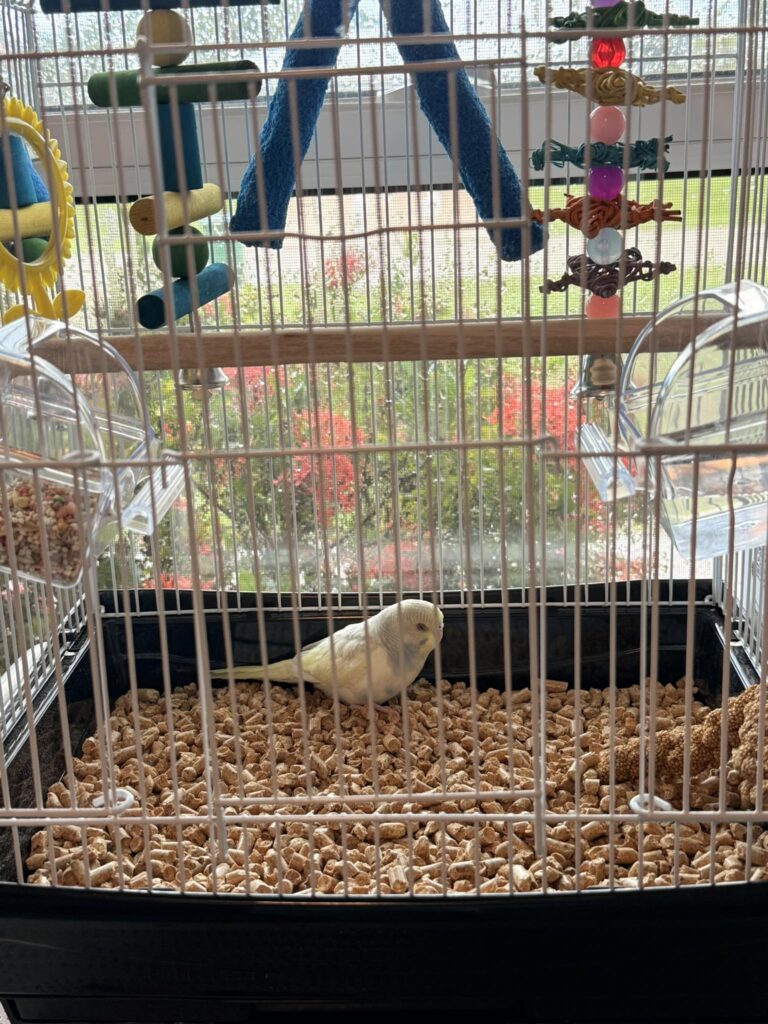
Once you understand this, the techniques that work make perfect sense — and so do the techniques that make it worse. Let me walk you through both, honestly.
Part 1 — What Genuinely Works
After 35 years of watching UK owners successfully tame budgies, I can tell you with confidence what produces tame, friendly birds. These techniques work because they respect the bird’s biology rather than fighting it.
What Works 1: Doing Nothing Near The Cage
This is genuinely the most important and most counter-intuitive technique. The first stage of taming is not interaction — it is presence without pressure. You sit near the cage, you read a book, you watch TV, you have a cup of tea. You do not look at the bird, you do not approach the cage, you do nothing that demands anything of the bird.
This phase teaches your budgie that you are not a threat. You are just part of the environment. Over days and weeks, the bird’s stress level around you drops. It starts watching you out of curiosity rather than alarm. It eats and drinks normally with you in the room. The foundation of trust is being built without any pressure on the bird.
This phase usually takes 1-2 weeks for a young, healthy budgie. Longer for older or untamed birds. The temptation is to skip it and start interacting straight away. Resist that temptation. This foundation is what everything else is built on.
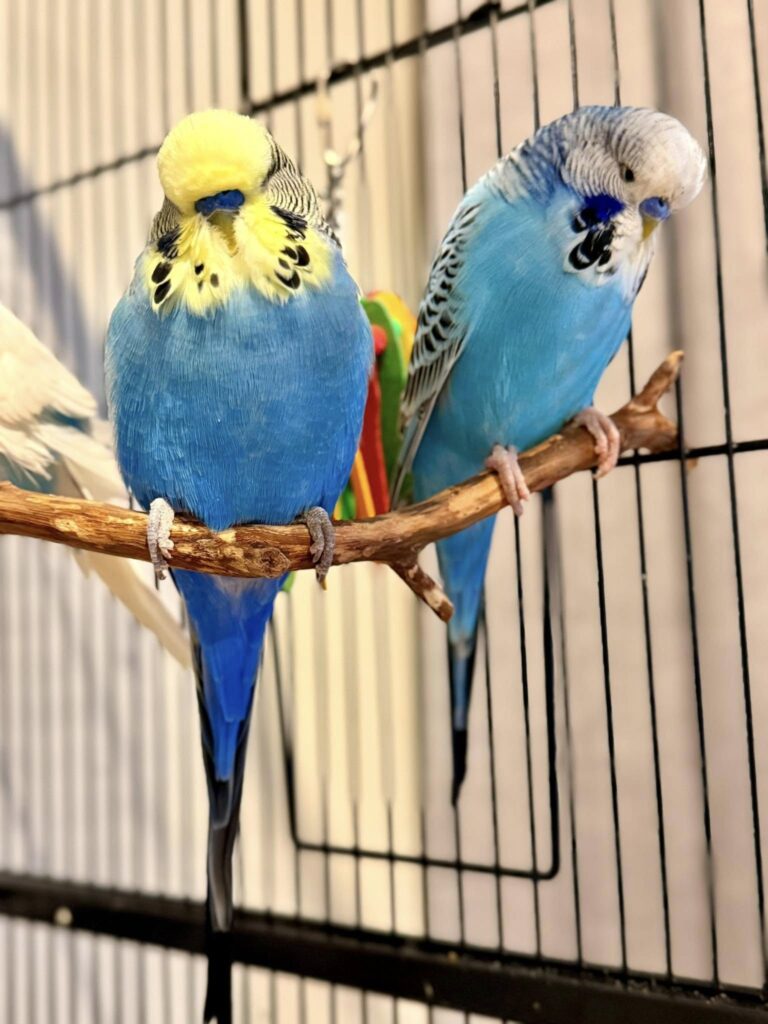
What Works 2: Soft, Steady, Predictable Talking
Talking gently to your budgie costs nothing and works powerfully. Your voice, when used calmly and consistently, becomes one of the most reassuring things in the bird’s environment. You are essentially teaching the bird that the human voice is associated with calm presence, not threat.
The right approach:
- Speak softly and slowly — never loud, never sudden
- Same tone every time — consistency builds recognition
- Daily routine — chat to the bird at regular times
- Use the bird’s name — they learn it within weeks
- Talk about ordinary things — the content does not matter, the tone does
- Read aloud near the cage — surprisingly effective
This is also where you start to notice the bird responding. A relaxed budgie will start chirping or warbling along with you. A tame-in-progress budgie will turn its head to listen. These small signs tell you the trust is building.
What Works 3: Hand In Sight, Not In Cage
This is one of the most misunderstood points. The standard advice tells owners to “leave your hand in the cage to get them used to it.” This is wrong. A hand in the cage is a threat — even a stationary one. The bird does not relax around your hand; it just freezes and waits for the threat to leave.
The right approach is to let your hand be visible, near the cage, but not inside. Rest your hand on a surface near the cage where the bird can see it. Move it slowly when you do move it. Over time, the bird learns that hands appearing near the cage do not mean trouble. This builds the foundation for hand contact later.
Only when the bird is genuinely calm around your hand near the cage should you start introducing it inside the cage, briefly and gently. The hand should never approach the bird directly — it should sit in the cage doing nothing, allowing the bird to investigate on its own terms.
What Works 4: Millet Spray As The Bridge
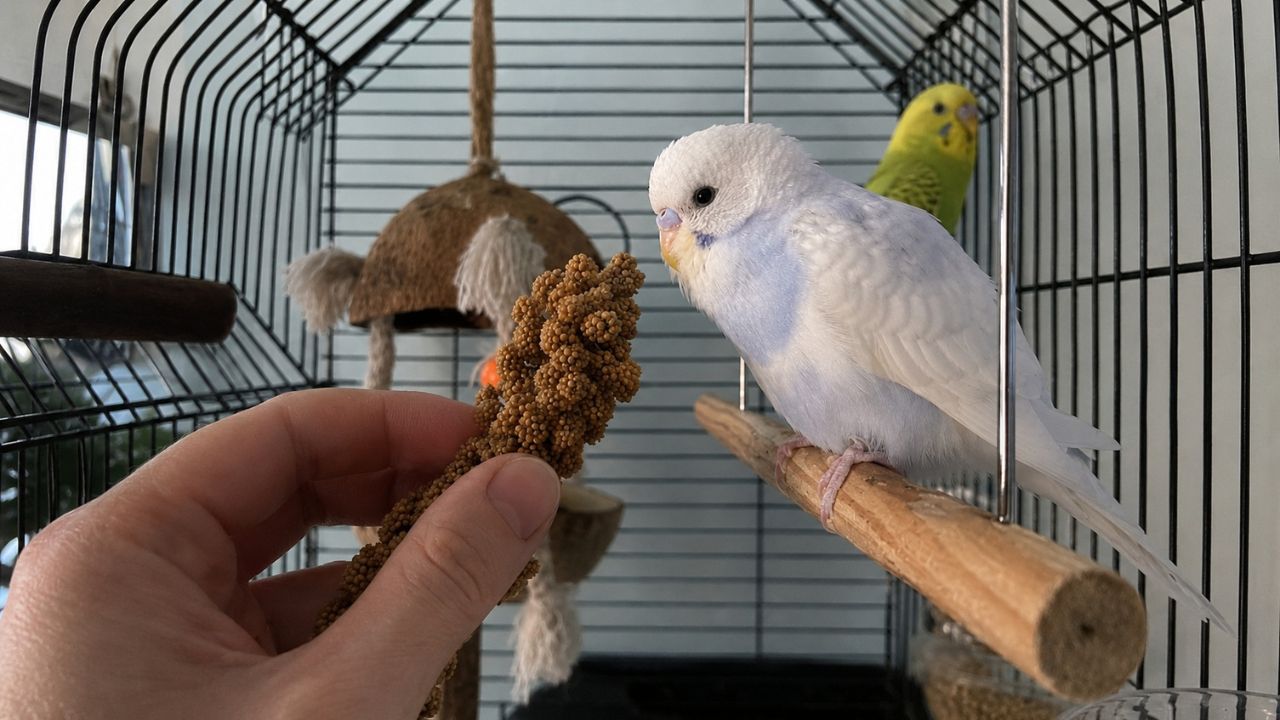
Of all the foods and treats budgies love, millet spray is the single most useful taming tool. Budgies find it almost irresistible, and it is shaped perfectly for the next stage of taming — bridging the gap between distant presence and direct interaction.
The progression that works:
- Stage 1: Clip millet spray inside the cage where the bird can reach it easily
- Stage 2: Hold millet spray through the cage bars from outside
- Stage 3: Hold millet spray inside the cage, hand resting on a perch
- Stage 4: Bird eats millet spray while your hand holds it inside the cage
- Stage 5: Hand offered as a perch with millet in the other hand as reward

Each stage takes days or weeks. Move at the bird’s pace, not yours. The millet is the bridge that helps the bird learn that hands bring good things, not bad ones.
What Works 5: The Step-Up Cue, Properly Taught
The step-up is the foundation of all hand-taming with budgies. Properly taught, it becomes the bird’s reliable way of getting onto your hand voluntarily. Improperly taught, it becomes a stressful experience that destroys trust.
The right approach:
- Wait for the bird to be calm with your hand near it inside the cage
- Position your finger horizontally just above the bird’s feet, touching the lower belly gently
- Say “step up” in your steady voice — consistent words help the bird learn
- Apply very gentle pressure — most birds will step up automatically when their balance shifts
- Praise quietly and offer a small treat
- Keep the first sessions brief — seconds, not minutes
- Practice multiple times daily — short, positive interactions

The key is that step-up should be voluntary, not forced. A bird stepped up reluctantly learns that hands lead to unwanted situations. A bird that steps up willingly learns that hands lead to positive interaction.
For a full step-by-step approach to taming a new budgie from day one, our complete UK guide to taming a new budgie covers the daily routine in detail.
What Works 6: Out-Of-Cage Time In A Safe Space
Once a bird is willing to step up reliably, out-of-cage time becomes one of the most powerful tools for building deep bonding. A budgie that experiences positive time outside the cage with you starts seeing you as a partner rather than just a giant in its environment.
The right approach:
- Bird-proof the room first — close windows, remove hazards, no other pets present
- Start with brief sessions — 10-15 minutes initially
- Let the bird explore at its own pace — do not force flying or interaction
- Use familiar perches/stands — provide safe places to land
- Have a way to return the bird to the cage easily — a familiar perch or millet bait
- Make returning to the cage positive — never traumatic capture
Daily out-of-cage time, even just 30 minutes, deepens the relationship dramatically over weeks.
What Works 7: Recognising And Respecting Stress Signals
This is perhaps the most underrated skill in taming. A budgie that is stressed cannot learn — and pushing through stress just creates lasting fear. The successful tamer is the one who recognises when the bird needs a break and stops immediately.
Stress signals to watch for:
- Rapid breathing or wide-eyed staring
- Body pressed against the back of the cage
- Beak open in defensive posture
- Repeated alarm chirps
- Frantic flying or attempted escape
- Feathers held tight against the body
- Refusing food or treats
When you see these signs, stop. Step back. End the session. Try again later or the next day. Every session you push through stress is a session that sets you back. Every session you respect the bird’s limits builds the trust further.
Part 2 — What Makes It Worse
Now the other half of this article — and arguably the more important half. These are the mistakes that quietly sabotage taming progress, even when the owner is putting in plenty of well-intentioned effort. Stop doing these and your bird will tame faster.
What Makes It Worse 1: Reaching Into The Cage Too Soon
This is the single most common mistake I see at the counter. The owner brings home a new budgie and starts reaching into the cage on day one or day two — putting fingers near the bird, trying to get it to step up, trying to “show it you are friendly.”
From the bird’s perspective, a giant hand entering its only safe space is terrifying. It does not know you mean well. It just sees a large predator-shaped thing entering the territory where it was supposed to be safe. Every time this happens, the bird’s trust in you decreases — even if you do not touch it.
The honest fix: do not put your hand inside the cage at all for the first 1-2 weeks. Cage cleaning during this time should happen when the bird is briefly out (or use long tools rather than your hand). Let the bird learn that the cage is safe and that you are a non-threatening presence in the environment first.

What Makes It Worse 2: Trying To Catch The Bird
This is the mistake that creates the most lasting damage to trust. The owner needs to clean the cage, or needs to handle the bird for some reason, and ends up chasing or grabbing the bird because there is no better option. Every time this happens, the trust built up over weeks can be erased in seconds.
- From the bird’s view, you have become the predator it always feared
- The terror is intense and the memory lasts months
- The bird becomes hand-shy and cage-defensive
- Future interactions are coloured by the catching memory
- Each catch sets taming back by weeks
The honest fix: build alternatives before you need them. Train the step-up so you can move the bird without catching it. Use familiar perches you can lift the bird on. Clean the cage when the bird is out willingly. If you absolutely must catch the bird (genuine emergency), do it quickly and gently with a soft towel, then put the bird back and let it recover for several days before any more interaction.
What Makes It Worse 3: Wing Clipping As A Shortcut
This is the mistake I argue with most often at the counter. Plenty of older sources, and some current ones, suggest wing clipping makes taming easier because the bird cannot fly away. The reality is that wing clipping almost always makes taming harder, not easier.
A clipped budgie is a budgie that cannot escape. It is also a budgie that knows it cannot escape — and that knowledge increases stress, not decreases it. Clipped birds tend to become more fearful, not less. They also lose the natural physical exercise that flight provides, and the recovery from clipping can be uncomfortable. Many UK owners regret it.
The honest fix: do not clip. Use a bird-proof room for out-of-cage time once trust has built up. The bird’s ability to fly is part of what makes them a budgie. Removing it does not speed up taming — it usually slows it down.
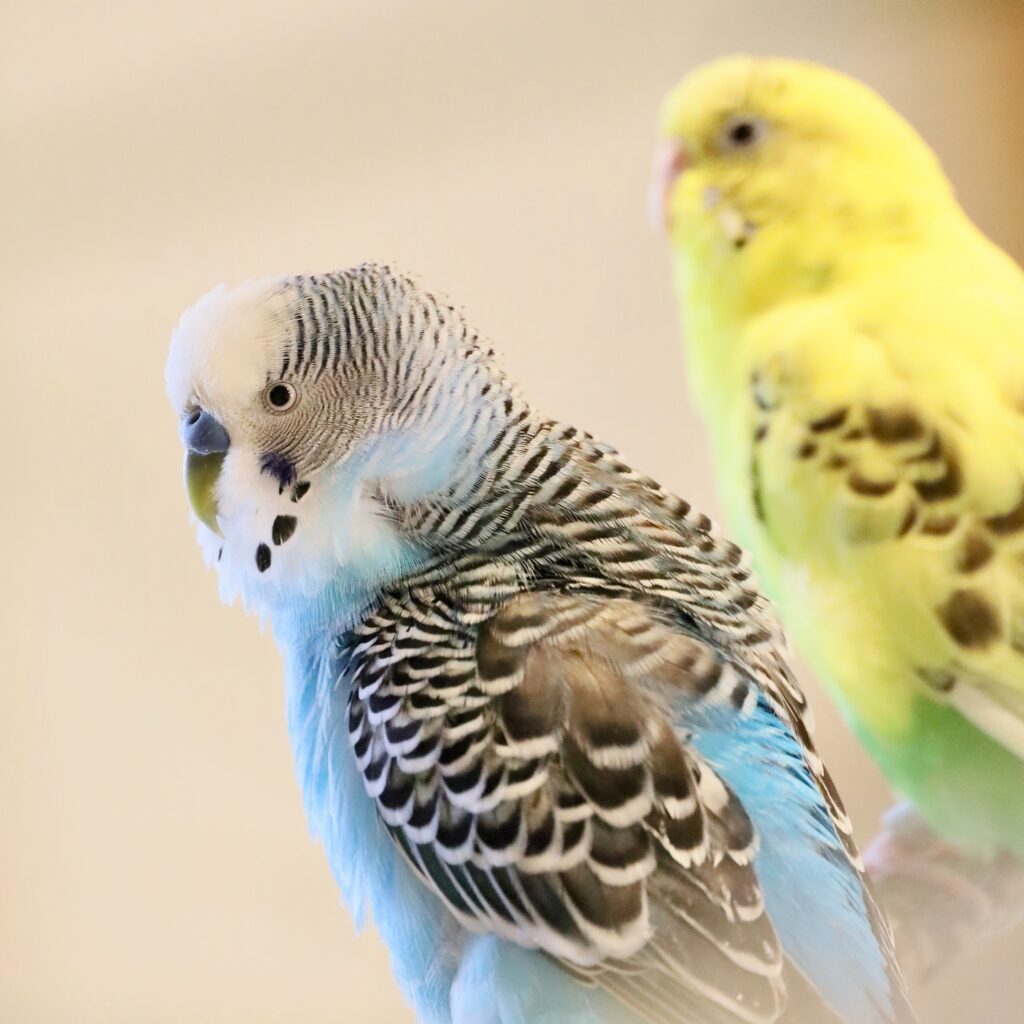
What Makes It Worse 4: Loud Noises And Sudden Movements
This is the one most owners do not realise they are doing. Slamming doors, dropping items, shouting across the room, music suddenly playing loudly, children running past the cage — all of these are alarming to a budgie that is still learning to trust the environment.
The honest fix: become aware of the noise environment your budgie experiences. Move calmly around the cage. Speak at normal indoor volumes. Warn family members and children about the importance of calm behaviour near the bird. Over time, the bird will adjust to normal household sounds — but during taming, minimising sudden disturbances helps significantly.
What Makes It Worse 5: Force-Bonding And Forced Handling
This is the well-intentioned mistake. The owner wants to bond with the bird, so they hold it for long sessions, stroke it even when it is uncomfortable, take it on their shoulder before the bird is ready, force interaction “because I love you and you need to learn that.”
The honest reality is that force-bonding does the opposite of bonding. The bird endures the contact but does not enjoy it. Trust does not build — it erodes. The bird learns that humans are creatures that make you do uncomfortable things.
The honest fix: let the bird choose to interact. Sit nearby, offer your finger as a perch option, allow the bird to come to you. The interactions the bird chooses are the ones that build trust. The interactions you impose are the ones that break it.
What Makes It Worse 6: Inconsistent Routine
Budgies thrive on predictability. A bird that has no consistent routine — interaction at different times every day, food at different times, lights on and off unpredictably — never fully settles. The constant uncertainty makes taming much slower.
The honest fix: create a daily routine and stick to it. Same time for cage uncovering each morning. Same approximate time for interaction sessions. Same time for evening cover-up. Even a basic consistent routine helps the bird feel safe enough to learn to trust you.
What Makes It Worse 7: Comparing To Other People’s Budgies
This one is psychological, not technical, but it matters. Social media is full of beautifully tame budgies sitting on people’s hands within days of arriving home. Friends might have a budgie that tamed in a week. The pressure to achieve the same speed leads to forcing the pace, skipping foundation steps, and pushing the bird beyond its comfort.
The honest reality is that every budgie has its own pace. Some come from hand-rearing background and are practically tame on arrival. Others come from less handled stock and take months. Some are naturally bold; others are naturally cautious. Comparing your bird to someone else’s bird is genuinely unhelpful.
The honest fix: focus on small daily progress. Is the bird slightly more relaxed today than yesterday? Is it eating with you in the room? Is it watching you with curiosity rather than fear? These are the meaningful signs of progress, regardless of what other people’s birds are doing.
How To Tell If Taming Is Actually Working
For UK owners trying to assess their own progress, here are the genuine signs of a budgie being successfully tamed. These build up gradually over weeks, not days.
| Stage | Signs Of Progress | Typical Timeline |
|---|---|---|
| Foundation | Eats normally with you present, no alarm calls when you enter room | 1-2 weeks |
| Curiosity | Watches you with interest, approaches cage front when you sit nearby | 2-4 weeks |
| Voice acceptance | Chirps or whistles in response to your voice, less reactive to talking | 3-5 weeks |
| Hand acceptance | Takes millet from hand through bars, then inside cage | 4-8 weeks |
| Step-up trained | Steps onto finger voluntarily inside cage | 6-12 weeks |
| Out-of-cage tame | Comfortable on hand and shoulder outside cage | 3-6 months |
| Fully bonded | Greets you, seeks interaction, vocalises with you | 6+ months |
The honest message — taming takes months, not days. The bird that reaches “fully bonded” at six months will have a deep, lifelong relationship with you. The bird that was rushed there in six weeks may be hand-tame but never fully trusting.
What I Tell Owners Who Are Struggling With Taming
When an owner comes in frustrated about slow taming progress, this is the conversation we have. It works the same way nearly every time.
- How long have you had the bird?
Less than 3 months means expectations may simply be off. Patience. - Have you been putting your hand in the cage?
The most common cause of fear-based regression. Stop for two weeks. - Have you ever had to catch the bird?
If yes, recent catching sets back taming significantly. - Are you using millet spray?
The single most useful taming tool. Use it generously through bars first. - What is the household noise like?
Loud, chaotic environments slow taming considerably. - Do you have a consistent daily routine?
Inconsistency creates ongoing uncertainty. - Are you forcing any interactions?
Stroking, holding, shoulder time before the bird is ready will all set you back. - Are you comparing to other birds?
Every budgie is different. Focus on this bird’s progress.
Five minutes of these questions almost always identifies what is going wrong, and the fix is usually simple — slow down, stop doing the things that make it worse, and trust the process.
Special Note — Taming Older Or Difficult Budgies
The advice above works best for young budgies bought from good sources. For older birds, rescues, or birds with bad early experiences, taming takes longer and works differently.
For these birds:
- Multiply timeline expectations by 2-3x — what takes 6 weeks with a young bird may take 4-6 months with an older one
- Acceptance, not full hand-taming, is sometimes the goal — some birds will never sit on hands but can be calm and content
- Past trauma may need extended foundation work — weeks of just being present with no demands
- Trust may build then suddenly regress — be patient through setbacks
- Some progress is genuine success — a previously aggressive bird that calmly takes treats is a transformation
Owners taking on rescue or older budgies should be honest with themselves about realistic outcomes. The relationship you build with such a bird can be deeply rewarding, but it requires patience that goes beyond the usual.
Frequently Asked Questions
How long does it take to tame a budgie?
For a young budgie from good stock, basic hand-taming takes 6-12 weeks of consistent gentle work. Full bonding and out-of-cage tameness takes 3-6 months. Older or untamed birds can take longer. The owners who try to rush this almost always end up with less tame birds than those who go at the bird’s pace.
Why is my budgie still scared of me after months of trying?
Usually because the techniques being used are increasing rather than decreasing fear. Common culprits — reaching into the cage too soon, attempting to catch or grab the bird, forcing handling, loud or chaotic environment, no consistent routine. Stop everything for two weeks, just sit near the cage doing nothing, and see if the bird’s stress levels drop.
Should I clip my budgie’s wings to make taming easier?
No. Despite some old advice suggesting otherwise, wing clipping almost always makes taming harder, not easier. Clipped birds are more stressed because they cannot escape, not less. They also lose the physical exercise of flying. Use a bird-proof room for out-of-cage time instead. The bird’s natural flying ability is part of healthy budgie life.
How do I know if my budgie trusts me?
A trusting budgie eats normally when you are in the room, approaches the cage front when you sit nearby, vocalises in response to your voice, takes treats from your hand willingly, steps up voluntarily without flinching, and shows curiosity rather than fear when you approach. These signs build up gradually over months.
What is the best treat for taming a budgie?
Millet spray is by far the most useful taming treat. Most budgies find it almost irresistible, it is shaped perfectly for offering through cage bars or by hand, and it is not so unhealthy that occasional use causes problems. Save it for taming sessions only — if the bird gets millet all day, it loses its value as a training reward.
Can I tame an older budgie?
Yes, but expect it to take longer — often 2-3 times longer than a young bird, sometimes more. Older budgies, particularly rescue birds or those with bad early experiences, need extended foundation work. The end goal may also be different — calm acceptance rather than full hand-taming. Many older budgies become wonderfully bonded with patient owners, even if they never sit on shoulders.
What should I do if my budgie bites me?
Do not react dramatically. Loud reactions can become reinforcement, and any reaction tells the bird that biting works. Quietly remove your hand, end the session, give the bird space. Work out why the bite happened — were you pushing too fast, ignoring stress signals, or invading the bird’s space? Adjust your approach next time.
Where can I get honest taming advice in Swindon?
Come and see us at Paradise Pets, Manor Garden Centre, Cheney Manor, Swindon SN2 2QJ. Or give us a ring on 01793 512400. We have helped countless UK owners through the taming process and we are happy to walk through your specific situation. The advice is free and we have been doing this for 35 years.
One Last Thing From Me
“How do I tame my budgie?” is the question. The honest answer, after 35 years of selling these birds, is — slower than you think, with less interference than you would expect, with patience that goes beyond what feels reasonable. And the willingness to stop doing the things that are quietly making it worse.
The man I mentioned at the start of this article? We worked through what he had been doing and the changes were significant. He stopped putting his hand in the cage entirely for two weeks. He stopped trying to catch the bird. He bought a millet spray and started offering it through the bars. He created a simple daily routine — same uncover time, same chatting time, same cover time. He stopped trying to force shoulder interactions.
About six weeks later, he came back in to tell me what had happened. “Neil, you would not believe it. After everything I tried for four months, it was the slowing down that worked. Within a fortnight he was eating from my hand through the bars. Within a month he was taking millet from my hand inside the cage. Last weekend he stepped onto my finger for the first time.” His face lit up describing it. “I had been the problem the whole time.”
That is the honest outcome you want. A bird that learns over weeks and months that you are safe, predictable, and bring good things. A relationship built on trust that the bird chose to enter, not one you forced onto it. The end result is a deeply bonded budgie that will sit with you, follow you, and treat you as part of its flock — for the rest of its life.
If you are reading this and your taming is not going well, please take the honest assessment. What might you be doing that is making it worse? What could you stop doing for two weeks to give the bird a chance to reset? Slowing down is genuinely the most powerful taming technique I know. And if you are unsure, come and see us. We will work through your specific situation and help you find the right path forward. That is what we have been doing for 35 years.
Struggling To Tame Your Budgie? Come And See Me
Bring your questions about what is happening, what you have tried, and where you feel stuck. I will help you work out what is genuinely going on and what to change. Free advice, no obligation. That is how we have done things for 35 years.