


Neil has kept, bred, and sold budgies at Paradise Pets Swindon since 1988 — over 35 years of watching owners try to do right by their birds and, occasionally, being given information that is technically correct but not actually useful. The lettuce question is one where the honest answer is more interesting than the simple yes or no that most owners get. This is the full version.
An older gentleman came in on a weekday morning last autumn, slightly puzzled.
He had been making himself a sandwich, he said. He had a few leaves of lettuce on the chopping board and his budgie — a pale yellow male he had owned for about four years — had been watching from his shoulder with obvious interest. He had broken off a small piece and given it to the bird without thinking too much about it. The bird had taken it and eaten it.
He had then thought about it rather more and decided he should probably check whether that had been a mistake.
It had not been a mistake, I told him. Lettuce is not toxic to budgies. The bird was fine and would continue to be fine.
But then I told him the more useful part of the answer — the part that the simple yes would have left out. Because while lettuce is safe, it is also the most common example I can think of of a food that people give their budgies in the belief that they are offering something nutritious, when the reality is rather more complicated depending on which lettuce you are talking about.
He stood there for a few minutes while I explained. He left having bought a bunch of kale and a bag of mixed leaves — neither of which he had previously thought of as bird food.
The Direct Answer — Can Budgies Eat Lettuce?
Yes. Lettuce is not toxic to budgies. No variety of lettuce on a standard UK supermarket shelf will harm your bird in the way that avocado or onion would. If your budgie has eaten some lettuce and you are reading this in a mild panic, you can stop panicking — the bird is fine.
That said, the honest answer to the lettuce question requires a distinction that the simple yes does not capture. Lettuce is not one thing. There are varieties of lettuce with meaningful nutritional content and varieties that are essentially flavoured water. Most UK owners asking this question are asking about the variety least worth feeding, for the understandable reason that it is the most commonly available one.
So the full answer is: yes, budgies can eat lettuce, but the type you choose matters, the quantity matters, and there are vegetables significantly more useful to your bird that are just as easy to offer and often already in your kitchen.
Not All Lettuce Is the Same — This Is the Part Most Guides Skip
When an owner asks if budgies can eat lettuce, they usually mean iceberg. Iceberg is the default lettuce in most UK households — it is what comes in the bag of mixed salad, it is what goes on sandwiches, it is the most widely sold variety in UK supermarkets. It is also the variety with the lowest nutritional value of any commonly available lettuce.
Iceberg lettuce is approximately 95 to 96 percent water. The remaining 4 to 5 percent contains trace amounts of vitamins and minerals, but in quantities so small relative to the water content that calling iceberg nutritious is a significant stretch. It is not harmful. But it contributes almost nothing useful to your bird’s diet, and given in large quantities it can cause loose, watery droppings simply because the bird has consumed an unusually high volume of water in a very short time.
This is not a reason to panic if your bird has eaten iceberg. It is a reason not to view iceberg as a meaningful contribution to the bird’s nutrition.
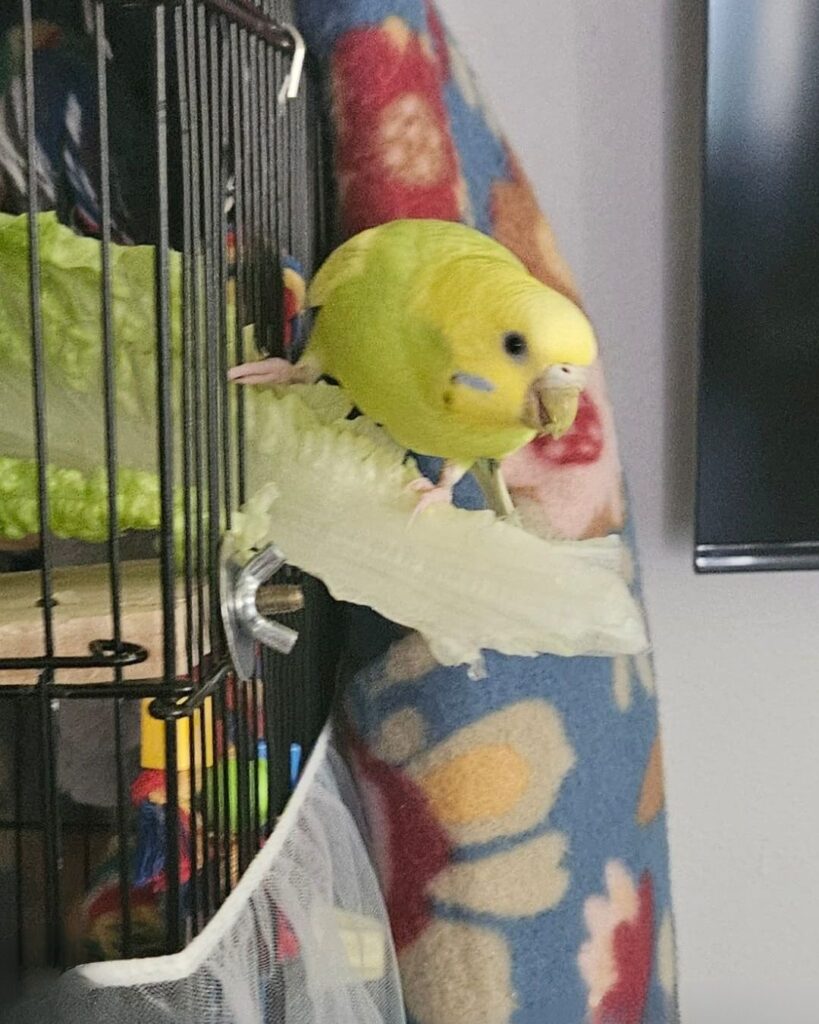
Other varieties of lettuce are meaningfully different:
Romaine lettuce — also called cos — is significantly more nutritious than iceberg. It contains vitamin A, vitamin K, folate, and a range of other micronutrients in quantities that are actually useful to a small bird. The darker the leaf, the better the nutritional content. Romaine is the most useful of the standard UK lettuce varieties for a budgie.
Little Gem — a compact variety widely available in UK supermarkets — is similar in nutritional profile to romaine and accepted well by most budgies. A leaf torn into pieces is a practical way to offer it.
Butterhead and round lettuce — the soft-leafed whole lettuces sold in most UK supermarkets — sit between iceberg and romaine nutritionally. Not as nutritionally empty as iceberg, not as good as romaine. Fine in small amounts.
Lamb’s lettuce — also called corn salad or mâche — is often sold in mixed leaf bags and is nutritionally useful. Small, soft leaves that most budgies find palatable.
Red and green leaf lettuce — the loose-leaf varieties available in some supermarkets and most farm shops — have good nutritional profiles. The red-tinged varieties in particular contain beneficial antioxidants and are among the better lettuces you can offer.
The practical rule is simple: the darker and more intensely coloured the leaf, the more nutritional value it contains. Pale, crisp iceberg at one end of the spectrum. Dark green romaine and deeply coloured leaf varieties at the other.
Iceberg Specifically — The Honest Assessment
I want to spend a moment on iceberg specifically because it is the one most owners ask about and the one I most often have to give a qualified answer on.
Iceberg is not dangerous. This needs to be said clearly because some information online suggests that iceberg lettuce is toxic to birds, which it is not. There is no compound in iceberg lettuce that is acutely harmful to a budgie.
The concern with iceberg is threefold. First, the near-absence of nutritional value means that a bird eating iceberg instead of more nutritious food is consuming calories and water without getting the vitamins and minerals its body needs. Second, the very high water content can temporarily disrupt the normal character of a bird’s droppings — making them loose and watery in a way that can alarm an owner who does not know what caused it. Third, and most practically, the habit of giving iceberg can crowd out the habit of giving the dark leafy vegetables that would actually benefit the bird.
None of this makes a leaf of iceberg a crisis. It makes it not worth offering when there are better alternatives that are just as easily available and just as cheap.
- Iceberg lettuce: Safe but almost entirely water. Minimal nutritional value. Not harmful in small amounts. Not worth using as a regular offering when better options exist.
- Romaine / cos lettuce: Significantly more nutritious. Good source of vitamin A and K. One of the better standard lettuce choices. Offer regularly.
- Little Gem: Good nutritional profile. Compact leaves easy to manage. Most budgies accept it well.
- Dark leaf lettuce varieties: Best of the standard lettuces. Higher antioxidant content. Offer freely alongside other greens.
- All lettuce: Wash thoroughly before offering. Remove any wilted or yellowing leaves. Do not leave uneaten lettuce in the cage for more than a few hours — it wilts quickly and can harbour bacteria.
Watery Droppings After Lettuce — Should You Be Worried?
This is the concern that sends some owners to a search engine after giving their budgie lettuce for the first time, so it is worth addressing directly.
Lettuce — particularly iceberg, but to a lesser extent other varieties — has a high water content. A budgie that has eaten a meaningful amount of lettuce may produce droppings that are more liquid than usual. The white urate component may be normal, but there may be more of the clear liquid portion than you are used to seeing.
This is not, in the context of a bird that has just eaten a piece of high-moisture food, a reason for concern. It is the digestive equivalent of a person drinking a large glass of water — the output briefly reflects the input. If the droppings return to normal within a few hours of eating the lettuce, there is nothing to worry about.
The droppings that do warrant attention are those that remain watery over an extended period without an obvious dietary explanation, or that are accompanied by a change in the bird’s behaviour, appetite, or posture. Persistent watery droppings that are not explained by recent food intake can be a sign of a health issue and warrant a vet assessment. But a brief change after a high-moisture food is not that.
What Is Actually Better Than Lettuce for Budgies
This is the part of the conversation I most want to have with every owner who asks the lettuce question, because the answer to “can budgies eat lettuce” is far less useful than the answer to “what greens should my budgie actually be eating.”
The vegetables that provide the most useful nutrition to budgies — and that are just as easy to source in a UK supermarket as a bag of lettuce — are the following.
Kale is among the most nutritionally dense greens you can offer a budgie. It is high in vitamins A, C, and K, contains calcium and iron, and is available in most UK supermarkets year-round. A single leaf hung from the cage bars gives most birds something to work at for a significant period. Curly kale is more easily available; cavolo nero and Tuscan kale are also excellent if available.
Spinach is high in iron and several vitamins but should not be the only green offered — it contains oxalic acid, which in very large quantities can interfere with calcium absorption. In moderate amounts as part of a varied diet it is perfectly fine and nutritionally useful.
Rocket — widely available in UK supermarkets as part of salad bags — is accepted by most budgies and has good nutritional content. The slightly peppery flavour appeals to many birds.
Watercress is highly nutritious and often overlooked as a bird food. Most budgies take to it readily. Available in most UK supermarkets in small bunches.
Broccoli — the florets in particular — is one of the best all-round vegetables you can offer a budgie. High in multiple vitamins, accepted by most birds once introduced, and easy to prepare. A single small floret is enough for a single bird.
Carrot is not a leafy green but belongs in this conversation because it is one of the most practical ways to get vitamin A into a seed-heavy diet. Grated carrot, placed in the food bowl alongside the seed mix, is a low-effort addition that makes a meaningful nutritional difference.
Pepper — red, yellow, or orange in particular — is high in vitamin C and vitamin A and most budgies enjoy investigating and nibbling at it. Slice it into strips and hang a piece from the cage bars.
How to Offer Greens So Your Budgie Actually Eats Them
There is a gap between knowing what your budgie should eat and getting a seed-habituated bird to eat it — and it is worth addressing practically.
Most UK budgies are raised on predominantly seed-based diets. A budgie that has eaten seeds its whole life will often not recognise leafy greens as food on first encounter. It may sniff the leaf, back away, and ignore it entirely. This is normal and not a reason to give up after one try.
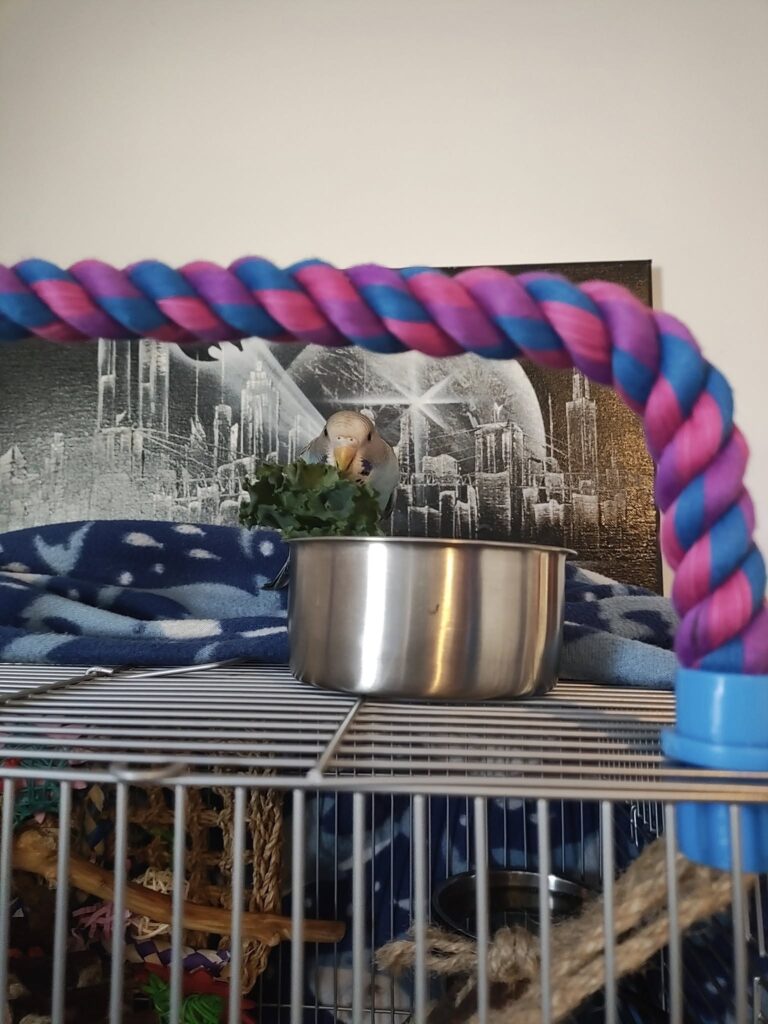
The method that produces the best results, in my experience: hang the greens from the cage bars rather than placing them in the food bowl. A leaf clipped to the bars looks more like something to investigate — something that moves slightly, that hangs in an interesting way — than a lump of unfamiliar material placed in the feeding station. Many birds will approach a hanging piece of kale or romaine with curiosity when they would completely ignore the same leaf placed in a bowl.
Placing a small amount of millet seed in the folds of a leaf so the bird has to investigate the leaf to get to the millet is another approach that works. The bird comes for the millet and encounters the leaf in the process. Over time, some birds will begin to eat the leaf as well.
Consistency matters more than variety at the start. Offering the same green every day for two weeks gives the bird time to become familiar with it and begin to investigate it. Offering a different green every day gives the bird nothing familiar to approach. Start with one green — I usually suggest romaine or carrot because they are mild and most birds accept them more readily than stronger-flavoured options — and build from there.
- Wash all greens thoroughly under cold running water before offering. Leafy vegetables carry pesticide residue, and a bird eating unwashed leaves may ingest meaningful amounts of chemicals. Organic, where available, reduces this concern.
- Remove wilted or yellowing leaves. Only offer fresh, crisp leaves. Wilted lettuce in a warm cage deteriorates quickly and can harbour bacterial growth.
- Remove uneaten greens within a few hours. Fresh food left in a cage loses quality quickly and can become a source of bacterial contamination.
- Offer at room temperature rather than straight from the fridge. Cold food can cause digestive upset in small birds.
- Hang greens from cage bars rather than placing them loose in the food bowl — birds are more likely to investigate and eat them this way.
- Do not replace seed entirely with greens as a strategy to force the bird to eat fresh food. This approach causes unnecessary stress and usually fails.
The Seed-Only Diet Problem — The Bigger Conversation Behind the Lettuce Question
I say this in most of my feeding guides and I will say it here again, because the lettuce question usually comes from an owner who is trying to do right by their bird and does not yet have the full picture.
The majority of budgies kept in UK households eat a diet composed almost entirely of commercial seed mix. Seed mix provides calories and is enjoyed by budgies, but it is not nutritionally complete. It is particularly low in vitamin A — one of the most important vitamins for a bird’s immune system, skin, and respiratory health — and in a range of other micronutrients. A seed-only diet, over years, is a significant contributor to the liver disease, immune problems, and shorter lifespans that are more common in pet budgies than they should be.
Fresh vegetables — leafy greens in particular — are not optional extras for a budgie eating an otherwise complete diet. They are part of what makes the diet complete. Kale, romaine, spinach, rocket, broccoli, carrot, and pepper, offered in rotation through the week alongside a seed mix, dramatically improve the nutritional picture and require minimal effort or expense.
Lettuce can be part of that rotation — the darker varieties genuinely contribute. But the reason I push back on the iceberg question specifically is that giving iceberg gives owners the feeling of having provided fresh food without actually delivering the nutritional benefit they intended. And the owner who switches from iceberg to romaine or kale has made a real improvement with almost zero additional effort.
Quick Reference — Lettuce and Greens for Budgies
| Green / Vegetable | Safe? | Nutritional Value | Notes |
|---|---|---|---|
| Iceberg lettuce | Yes | Very low — 95%+ water | Safe but nutritionally empty. Not worth offering as a regular food when better options exist. |
| Romaine / cos lettuce | Yes | Good — vitamin A, K, folate | Best standard lettuce choice. Offer regularly. Wash well. |
| Little Gem | Yes | Good | Compact and practical. Most budgies accept it. Good regular offering. |
| Dark leaf lettuce | Yes | Good — antioxidants, vitamins | Better than standard lettuce. Offer freely. Wash thoroughly. |
| Kale | Yes | Excellent | One of the best greens for budgies. Hang from bars. Introduce gradually. |
| Spinach | Yes — in moderation | Good | Nutritious but contains oxalic acid. Part of a varied rotation, not the only green. |
| Rocket | Yes | Good | Often in mixed salad bags. Most budgies accept it. Good rotation green. |
| Watercress | Yes | Excellent | Highly nutritious, often overlooked. Available in most UK supermarkets. |
| Broccoli florets | Yes | Excellent | One of the best overall vegetables for budgies. Offer raw. Most birds take to it well. |
| Carrot | Yes | Excellent — high vitamin A | Grated or in sticks. One of the easiest ways to address vitamin A deficiency in seed-fed birds. |
| Pepper (red/yellow/orange) | Yes | Excellent — vitamin C, A | Slice and hang from bars. Seeds included — fine for budgies. |
| Rhubarb | Never | Toxic | Contains oxalic acid at dangerous levels. Do not offer under any circumstances. |
| Onion / garlic | Never | Toxic | Toxic in any form including cooked. No exceptions. |
The Rule I Give Every Owner About Greens
If your budgie’s diet currently includes no fresh vegetables at all — not a leaf of anything green, not a shred of carrot — that is the most important thing to change. More important than choosing the perfect lettuce variety. More important than getting the frequency exactly right. Just start.
Pick one green. Romaine lettuce if that is what you have. Or a small piece of broccoli. Or some grated carrot. Put it in the cage today. The bird will almost certainly ignore it at first. Put it in again tomorrow. And the day after. Within a week or two, most birds begin to investigate. Within a month, most are eating at least something.
The goal is variety over time — rotating through kale, romaine, rocket, carrot, pepper, broccoli across the week — but you cannot get there if you do not start. One green, consistently, is the beginning of a diet that is significantly better than seed alone.
And if you find yourself standing in a supermarket choosing between iceberg and romaine for your bird — buy the romaine. It takes the same space in the fridge, costs roughly the same, and gives your budgie something that actually matters.
Frequently Asked Questions
Can budgies eat iceberg lettuce?
Yes — iceberg is safe and not toxic. A budgie eating a piece of iceberg lettuce will not be harmed by it. The honest context is that iceberg is 95 to 96 percent water with very little nutritional value. It is not a useful food for your bird in any meaningful dietary sense, and given in large amounts can cause temporarily loose or watery droppings from the high water content. If you have iceberg and want to give your bird a leaf, it is fine. Just do not mistake it for a nutritious contribution to the bird’s diet — reach for romaine, kale, or broccoli when you have the choice.
My budgie’s droppings went watery after eating lettuce — is this serious?
Almost certainly not, if the only change was the lettuce. Lettuce — particularly iceberg — has very high water content, and a bird that has eaten a meaningful amount may produce wetter droppings than usual for a few hours afterwards. This should resolve on its own and is not a cause for concern. If the watery droppings persist beyond a few hours without an obvious dietary explanation, or if any other change in behaviour, posture, or appetite accompanies them, that is worth a vet call.
Is kale better than lettuce for budgies?
Yes — significantly. Kale is among the most nutritionally dense greens you can offer a budgie, containing meaningful amounts of vitamins A, C, and K alongside calcium and other minerals. Even the best lettuce varieties do not match kale’s nutritional density. If you are going to add one green to your budgie’s diet, kale or broccoli will benefit the bird more than any variety of lettuce. Hung from the cage bars, most budgies will eventually take to kale, even birds that have never eaten fresh food before.
How often should I give my budgie fresh greens?
Daily, ideally — or as close to daily as your routine allows. Fresh vegetables should be a regular presence in the cage, not an occasional treat. The goal is to move away from the seed-only diet that most UK budgies eat toward something more genuinely complete. Daily offering of a rotating selection of greens, in small quantities, is the practical approach. The key rule is to remove uneaten greens within a few hours so they do not deteriorate in the cage.
My budgie completely ignores any vegetable I put in the cage — what do I do?
This is extremely common in seed-raised birds and not a reason to give up. Try hanging the greens from the cage bars rather than placing them in the food bowl — birds are more likely to approach something they have to investigate than something placed where food normally goes. Try putting a small amount of millet on top of or nestled into a leaf so the bird approaches the leaf to get the millet. Try the same green every day for two weeks before switching — familiarity reduces the resistance. Most birds, given enough time and the right presentation, will begin to eat at least some fresh food.
Where can I find out more about budgie feeding and care in Swindon?
Come and see us at Paradise Pets — Manor Garden Centre, Cheney Manor, Swindon SN2 2QJ. We carry budgies, appropriate feeds, and supplements, and we are happy to have a proper conversation about diet and care without a sales agenda. Call us on 01793 512400 before visiting to check what we have in stock.
Questions About Feeding Your Budgie? Come and Talk to Me
If you want to know what your budgie should actually be eating — beyond what it says on a seed bag — come in. I have kept and fed these birds for 35 years and I am happy to give you the practical version. No upselling. Just the honest information that makes a real difference to the bird’s health over time.