


Neil has kept, bred, and sold budgies at Paradise Pets Swindon since 1988 — over 35 years of first-hand experience with these birds. In that time, he has watched countless owners worry whether their budgie is genuinely happy. This is his honest guide to the 7 signs that tell you, without doubt, that your bird is thriving.
A woman came into the shop a while ago looking a bit unsure of herself. “Neil,” she said, “I have had my budgie six months now. He seems fine, but how do I actually know if he’s happy? I look at him and I just don’t know what to look for.”
It is one of the loveliest questions I get at the counter, and one of the most important ones any UK budgie owner can ask. Because a content, happy budgie is not just a nice thing to have — it is a sign that you are doing everything right, that the bird is healthy, and that you have built a real relationship together. Spotting the signs of a happy budgie is one of the most rewarding skills any owner can learn.
The honest truth is this — budgies tell you when they are happy, in dozens of small ways every single day. You just need to know what to look for. Once you learn to read the signs, you will see your bird differently. Every chirp, every movement, every behaviour starts to make sense, and you stop wondering whether your bird is content — you simply know.
In 35 years of watching budgies, I have learned that the signs of happiness are remarkably consistent. The same things show up again and again in well-kept birds, and the absence of them is one of the first things I notice in birds that are not quite thriving.
This article is the conversation I have with worried owners, written down. It will walk you through the seven clearest signs that your budgie is genuinely happy — the signs that tell you, after all your effort, that everything is going right.
Why Recognising A Happy Budgie Matters
Before we get to the seven signs, let me explain why this matters more than you might think. Because being able to read your budgie’s happiness is genuinely useful for several reasons.
First, it tells you whether your husbandry is working. A happy budgie is a sign that your cage setup, diet, interaction, and environment are all good. The opposite is also true — a budgie showing few signs of contentment is telling you something needs to change.
Second, it helps you catch problems early. Budgies are prey animals and hide illness very effectively. But the disappearance of their normal happy behaviours is often the first subtle sign that something is wrong, well before they show obvious symptoms.
Third, it deepens your relationship with the bird. The more you understand what your budgie is communicating, the more rewarding the relationship becomes. You go from “I have a bird in a cage” to “I have a little personality I genuinely understand.”
So learning these signs is genuinely worth your time — for the bird’s welfare, for your own peace of mind, and for the relationship between you.
Sign 1: Active Vocalisation — Chirping, Whistling, And Chatter
This is the first and most obvious sign of a happy budgie, and the one most owners can spot immediately. A content budgie is a vocal budgie. They chirp, whistle, chatter, and sometimes mimic sounds throughout the day — and this is one of the clearest signs that all is well.
In the wild, budgies are flock birds that communicate constantly. A budgie that vocalises freely in your home is essentially saying “I feel safe, I feel happy, and I am communicating with my flock — which is now you.”
- Gentle warbling — a soft, continuous chattering to itself, often when the bird is relaxed
- Excited chirping — louder, faster vocalisation when something interesting happens
- Whistling — particularly in males, a sign of contentment and engagement
- Mimicking sounds — copying household noises, your voice, or other birds
- Singing to itself — quiet self-contained vocalisation when the bird is relaxed
- “Talking” to you — responding when you speak to it
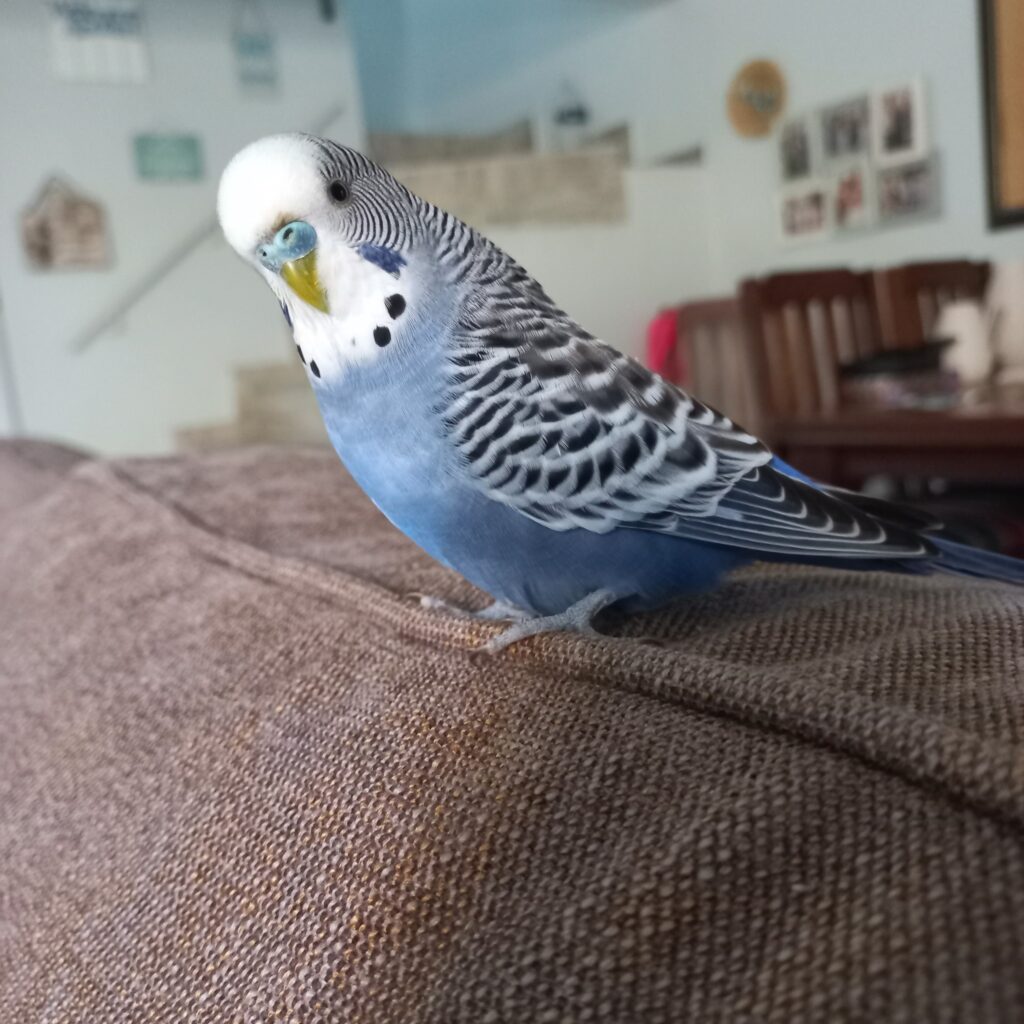
What you do not want to hear is a silent budgie. A budgie that has gone unusually quiet, that no longer chirps or sings, is often telling you something is wrong — either illness, stress, or unhappiness. The volume and frequency of vocalisation is one of the clearest indicators of mood.
What this looks like day-to-day
A happy budgie typically has two peak vocalisation times — first thing in the morning and late afternoon — with gentle background chatter throughout the day. If your bird greets the morning with cheerful chirping and sings to itself while you are around, that is a thriving bird.
Sign 2: Active Play And Engagement With Toys
This is one of my favourite signs to watch, because it is genuinely entertaining as well as informative. A happy budgie plays. They interact with their toys, swing on perches, ring bells, attack shreddable items, and generally engage with their environment.
A bird that ignores all its toys and sits motionless on a single perch all day is not a content bird. A bird that bounces around the cage, picks up objects, drops them, chews things, and finds entertainment in its surroundings is one that feels safe and stimulated.
- Ringing bells — deliberately tapping or banging bells to make noise
- Swinging on swings and perches — using moving objects as gymnasium equipment
- Mirror interaction — chatting to or displaying at a mirror (single budgies only)
- Destroying shreddable toys — paper, cardboard, soft wood being torn up enthusiastically
- Climbing ladders and exploring — actively using all parts of the cage
- Foraging behaviour — searching for hidden food, picking through bedding
- Carrying objects around — picking up and moving small items in the cage

The more variety in a budgie’s play, the better the welfare picture. A bird that uses all its toys, varies its activities, and seems to find joy in its environment is a thriving one. For more on what active play looks like, our guide on why your budgie plays during the day covers this in depth.
Sign 3: Healthy Body Language — Relaxed Posture And Bright Eyes
This is the most subtle sign, but once you learn to read it, it is one of the most reliable. A happy budgie carries itself differently from a stressed or unwell one — and the differences are visible if you know what to look for.
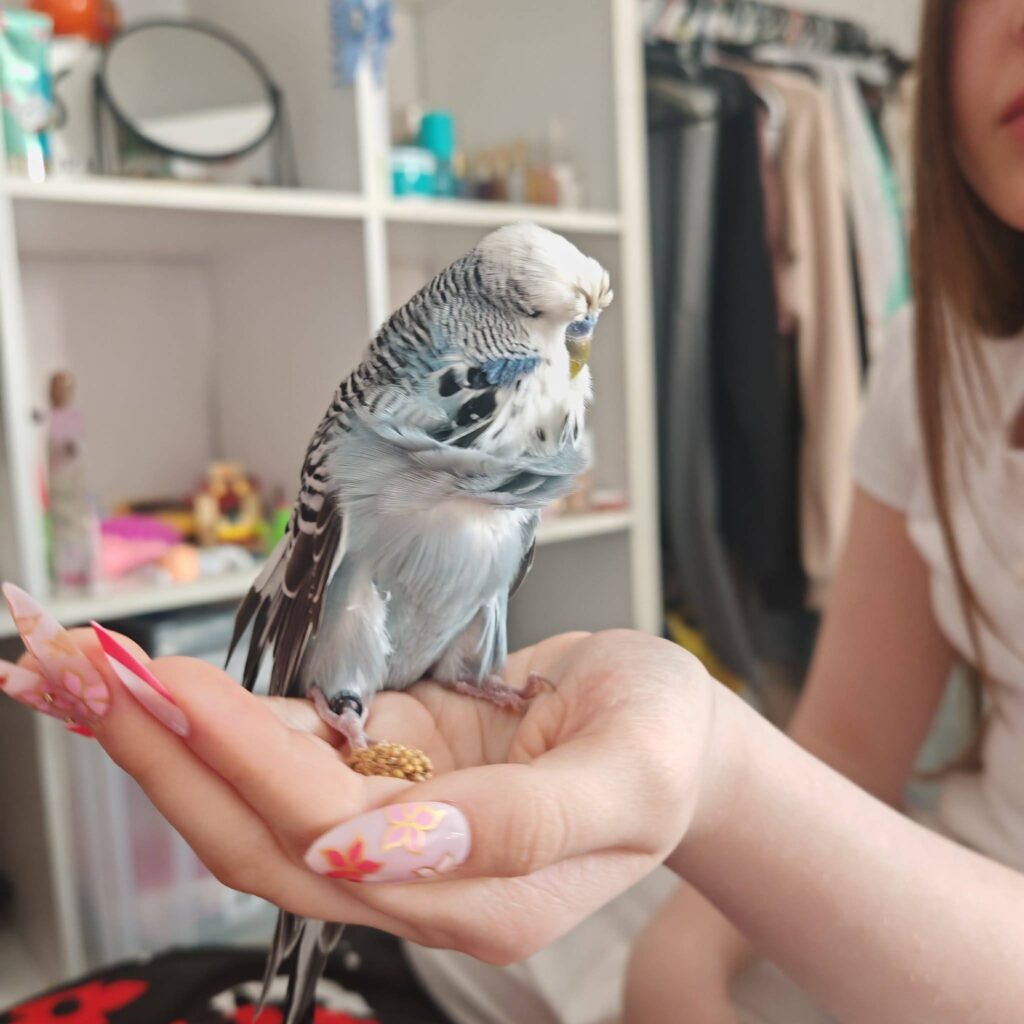
| Body Part | Happy Budgie | Concerning Sign |
|---|---|---|
| Posture | Upright, balanced, alert | Hunched, slumped, leaning |
| Feathers | Sleek, well-aligned, bright | Permanently puffed up, dull |
| Eyes | Bright, alert, fully open | Half-closed, dull, or watery |
| Cere (above beak) | Healthy colour for sex and age | Pale, scaly, or unusual colour |
| Standing | Often on one foot when relaxed | Both feet always, unable to relax |
| Movements | Smooth, purposeful, active | Lethargic or jerky and frantic |
The classic “happy budgie” pose is alert and engaged with the world — bright eyes watching what is going on, feathers sleek against the body, often perched on one foot in a relaxed way, and occasionally giving itself a contented stretch.
Pay particular attention to the eyes and the feathers. Bright, alert eyes and sleek, well-groomed feathers are two of the strongest signs of physical and emotional wellbeing in a budgie.
Sign 4: Good Appetite And Curiosity About Food
A happy budgie is interested in food. They approach the food bowl readily, eat enthusiastically, and show curiosity when something new is offered. They forage actively, they pick out their favourites, and they engage with mealtimes as one of the highlights of their day.
Signs of a healthy, happy appetite:
- Eats regularly throughout the day, particularly first thing in the morning and late afternoon
- Approaches the food bowl willingly when it is refreshed
- Shows interest in new foods, even if it does not eat them immediately
- Spends time foraging and selecting what to eat
- Eats vegetables and fresh foods, not just seed
- Drinks water regularly
- Maintains a steady, healthy weight

What you do not want to see is a budgie that has gone off its food, picks listlessly at the bowl, or ignores favourite treats. Loss of appetite is one of the first signs that something is wrong — and the appearance of a sudden willingness to eat after a problem has been resolved is often the first sign of recovery.
For more on what budgies should be eating to thrive, our honest UK feeding guide covers the proper diet that keeps budgies genuinely happy.
Sign 5: Self-Grooming And Bathing
This is one of the loveliest signs of a happy budgie, and it tells you a great deal about both physical and emotional wellbeing. A content bird spends significant time grooming itself — preening its feathers, cleaning its beak on the perch, and showing care for its own appearance.
A budgie that is grooming itself regularly is communicating several positive things at once. It feels safe enough to spend time on self-care (a stressed prey animal stays alert rather than grooming). Its feathers are healthy enough to be worth maintaining. And its body is comfortable enough to allow the natural grooming routine to happen.
- Preening feathers — running them through the beak to clean and align
- Wing stretching — extending one wing fully at a time, often combined with a leg stretch
- Beak cleaning — wiping the beak on the perch after eating
- Bathing — splashing in water, rolling in wet greens, or enjoying a gentle mist
- Foot grooming — using the beak to clean between the toes
- Body shake — a brisk all-over shake that fluffs and resettles feathers

Pay attention to bathing in particular. A budgie that enthusiastically bathes — splashing in a shallow water dish, rolling in wet leafy greens, or enjoying a fine mist of water — is showing strong signs of contentment. Offer bathing opportunities regularly, and a happy bird will usually take advantage.
What you do not want to see is a bird that has stopped grooming, has neglected feathers, or is over-grooming to the point of feather damage. Both extremes indicate that something is wrong.
Sign 6: Comfort With You And Trust In Your Presence
This sign takes time to develop, but it is one of the most rewarding to recognise. A happy budgie that trusts its owner shows specific behaviours around you that a frightened or stressed bird does not.
These behaviours develop gradually, particularly with patient handling and consistent positive interaction. The bird learns that you are not a threat, that you are a source of food, comfort, and good things. Over weeks and months, that recognition becomes a real relationship.
- Approaches when you come to the cage — comes to the front rather than fleeing to the back
- Eats while you are watching — does not stop eating when you appear
- Vocalises more when you are around — chirps, whistles, or chatters in response to your presence
- Settles when you talk to it gently — your voice has a calming effect
- Steps onto your finger — voluntarily, without grabbing or panic
- Sits comfortably on your hand or shoulder — relaxed body language while perched on you
- Allows handling — without struggling, biting, or showing panic
- Shows excitement when you come home — vocalisation, increased activity
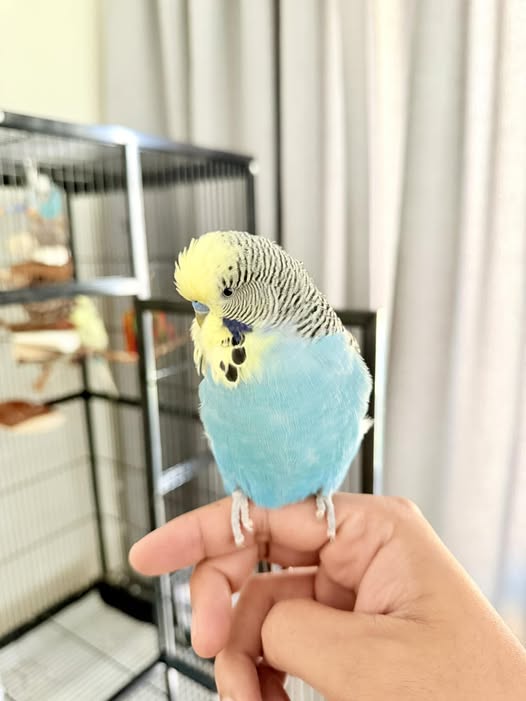
Building this trust takes time — usually weeks to months, depending on the individual bird. But once it is established, the bird’s comfort around you becomes one of the clearest and most personal signs of happiness.
Sign 7: Good Sleep And Restful Behaviour
This is the most overlooked sign of a happy budgie, but it is genuinely one of the most important. A content bird sleeps well — and a properly rested budgie is the foundation of everything else on this list.
Budgies need around 10 to 12 hours of solid darkness each night to sleep properly. They should settle calmly at dusk, sleep peacefully through the night, and wake refreshed at dawn. Good sleep is what fuels the daytime activity, vocalisation, and play that show contentment.
What healthy sleep looks like
- Settles calmly in the evening — does not become agitated or distressed as bedtime approaches
- Sleeps in a normal position — usually on one foot, head tucked into the feathers of the back, fluffed slightly
- Sleeps in the same regular spot — a chosen “safe” perch the bird returns to each night
- Wakes naturally at dawn — does not wake repeatedly during the night
- Brief daytime naps are normal — particularly in the middle of the day
- Wakes alert and ready for the day — not lethargic or slow to engage
Covering the cage at night significantly improves sleep quality and helps your budgie get the full restful darkness it needs. A well-rested bird is a happier bird — and a chronically sleep-deprived bird becomes stressed, vocal, and prone to behavioural problems.
For more on the importance of sleep, our guide on budgie sleep patterns covers what is normal and what is not.
The Combined Picture — What A Happy Budgie Looks Like
After all those signs individually, let me paint the bigger picture. A genuinely happy budgie shows most of these signs most of the time — not every single one every single day, but a clear pattern of contentment across the seven areas.
A typical day with a happy budgie looks something like this:
- Wakes at dawn with chirping and vocalisation. Greets the day cheerfully.
- Heads to food and water for an enthusiastic morning feed. Eats well, drinks well, often vocalises while eating.
- Active morning — preens, plays with toys, explores the cage, interacts if you come close.
- Midday rest — settles for a short nap, often on one foot, feathers slightly fluffed, eyes closing peacefully.
- Afternoon activity — second burst of energy. More vocalisation, play, and engagement.
- Evening winding down — gradually settles, with some final vocalisation before bedtime.
- Night-time sleep — covered cage, dark room, peaceful rest until dawn.

If your budgie’s day looks something like this, you have a genuinely happy, thriving bird. Take quiet satisfaction in that — it means you are doing your job as an owner properly.
Subtle Signs That Something Might Be Off
The flip side of recognising happiness is recognising when something is not quite right. These are the early warning signs that the budgie’s wellbeing has shifted, even before any obvious symptoms appear.
- Has gone unusually quiet — less vocalisation than normal
- Ignoring toys and playing less than usual
- Permanently fluffed-up feathers
- Spending more time on the cage floor than usual
- Reduced appetite or interest in food
- Stopped grooming or over-grooming
- No longer approaches you when you come to the cage
- Sleeping more during the day or disturbed at night
- Aggressive or fearful behaviour where there was none before
If you notice several of these changes together, it is worth investigating. Sometimes the cause is environmental (new pet in the house, recent changes, draughts), sometimes it is dietary, and sometimes it is early illness. Either way, the disappearance of normal happy behaviours is your bird telling you something needs attention.
What I Tell Owners At The Counter
When someone asks me whether their budgie is happy, I work through a quick mental checklist with them. Here is the conversation.
- Does it vocalise freely throughout the day?
Yes = strong sign of contentment. No = needs investigation. - Does it play with its toys?
Active engagement = happy. Ignoring everything = boredom or stress. - Does it look bright-eyed and sleek?
Healthy posture and feathers = thriving. Hunched or puffed = concerning. - Is it eating well and showing interest in food?
Good appetite = good welfare. Loss of interest = early warning sign. - Does it groom itself regularly?
Self-care = feels safe and healthy. Neglect = problem. - Is it comfortable when you are near?
Approaches and vocalises = trust. Fleeing or freezing = unhappy. - Does it sleep peacefully and wake refreshed?
Good sleep = good welfare foundation. Disturbed sleep = issue.
Most owners can answer most of these positively, which usually means their bird is genuinely doing well. The few who cannot tell me exactly which area to look at first.
How To Make Your Budgie Even Happier
If you are reading this list and want to ensure your budgie shows all seven signs consistently, here is the short version of what I tell every UK budgie owner.
- Provide a proper varied diet — pellets, fresh vegetables, quality seed, plus calcium and minerals
- Offer plenty of enrichment — multiple toys, rotated regularly, foraging opportunities
- Give significant daily out-of-cage time — minimum 1 hour, ideally more
- Genuine daily interaction — talking, training, hand-time
- Proper sleep environment — covered cage at night, 10-12 hours of darkness
- Offer bathing opportunities — most budgies love a gentle mist or shallow water dish
- Keep the environment calm and stable — avoid sudden changes and chaos
- Provide companionship — either yourself daily, or another budgie if you are out a lot
- Keep the cage clean and well-positioned — away from kitchen fumes, draughts, and stressors
- Watch and learn your individual bird — every budgie has its own personality and preferences
Get these things right, and you will see all seven signs of happiness in your bird consistently. It is genuinely that straightforward.
Frequently Asked Questions
How do I know if my budgie is happy?
A happy budgie shows seven main signs — active vocalisation, engagement with toys, healthy body language, good appetite, regular self-grooming, comfort around you, and good sleep patterns. A bird that shows most of these consistently is genuinely thriving. The absence of these signs, or sudden changes, is what you should watch for.
What does a happy budgie sound like?
A happy budgie produces a range of sounds — gentle warbling and chatter throughout the day, excited chirping when something interesting happens, whistling (particularly males), and sometimes mimicking sounds from its environment. Two peak vocalisation times in the morning and late afternoon are typical, with quieter chatter in between.
Is a quiet budgie unhappy?
Often yes. A budgie that has gone unusually quiet, particularly if it was vocal before, is often telling you something is wrong — illness, stress, depression, or unhappiness with the environment. A naturally less-vocal bird that has always been quieter is different — what matters is a change in your individual bird’s normal pattern.
Do happy budgies sleep on one foot?
Yes — sleeping or resting on one foot, with the other tucked up into the body feathers, is a sign of a comfortable, relaxed budgie. It is the position they take when they feel safe enough to truly rest. A budgie that always stands on both feet, never relaxes onto one, may be anxious or unwell.
How can I make my budgie happier?
Focus on the basics — proper varied diet (not seed-only), plenty of enrichment with rotating toys, significant daily interaction with you, good sleep environment (covered cage at night), bathing opportunities, and a calm stable home. Get these right, and your budgie will show all the signs of happiness consistently.
Why does my budgie chirp at me when I come home?
Because it recognises you and is greeting you — one of the loveliest signs of a happy, bonded budgie. In the wild, budgies greet returning flock members with vocalisation. Your bird is welcoming you home as part of its flock. It is a genuine sign of trust and contentment.
Where can I get honest budgie advice in Swindon?
Come and see us at Paradise Pets, Manor Garden Centre, Cheney Manor, Swindon SN2 2QJ. Or give us a ring on 01793 512400. The advice is free and we have been doing this for 35 years.
One Last Thing From Me
“How do I know if my budgie is happy?” is the question. The honest answer, after 35 years of watching these birds, is — your budgie tells you, every single day, in dozens of small ways. You just need to know what to look for.
The woman I mentioned at the start of this article? Once we worked through the seven signs together, her face lit up. “Neil,” she said, “he does most of those. He chirps when I come in, he plays with his bell every morning, he stretches and grooms after he eats. I just never knew that was him being happy.”
That is the realisation I want every UK budgie owner to have. The little personality in the cage is communicating with you constantly — vocalising, playing, grooming, resting, engaging. Once you can read those signs, you will see your bird in a completely new way. You will know, with quiet certainty, that you are doing right by your bird and that the relationship between you is working.
If you are reading this and you can see most of the seven signs in your bird, take a moment to appreciate it. You have done the work — given your bird good food, a proper home, daily attention, and the things it needs to thrive. That happy little budgie is your reward, and an entirely fair one.
If you cannot see all the signs yet, that is fine too. Birds take time to settle, and relationships take weeks and months to build. Keep doing the right things, watch for the small changes, and you will see your bird’s happiness grow. And if you are unsure about anything along the way, come and see us. We will always have a proper look and tell you honestly what we see.
Want To Know If Your Budgie Is Truly Happy? Come And See Me
Bring your bird, bring a video, or just bring your questions. I will take a proper look and tell you honestly what I see. Free advice, no obligation. That is how we have done things for 35 years.