
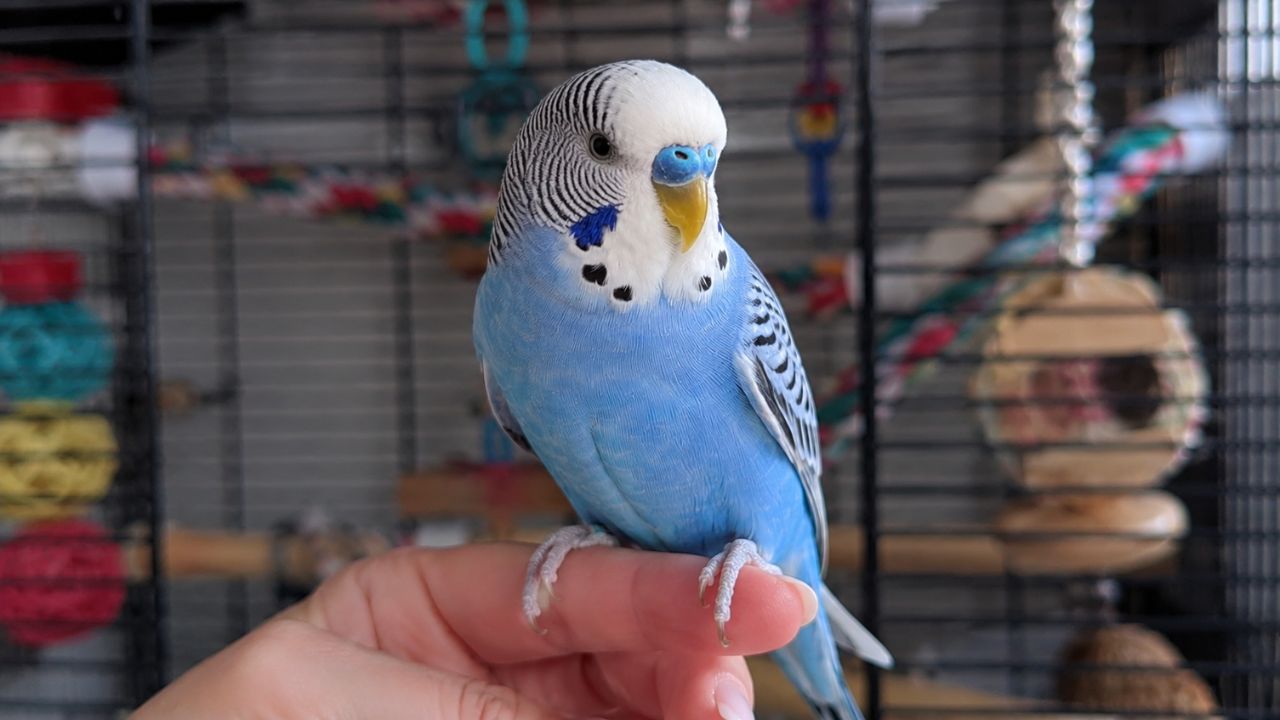

Neil has kept, bred, and sold budgies at Paradise Pets Swindon since 1988 — over 35 years of watching owners succeed with these birds and, more often than he would like, watching them get it wrong in ways that set the relationship back weeks. This is his complete, honest guide to what actually works when taming a budgie — and why so much of the advice people follow does not.
She came in on a Saturday morning with a look I have seen many times. Not quite frustrated. Not quite defeated. Somewhere in between.
She had bought a young budgie six weeks earlier. A green male, she said. She had been trying to tame it since the day she brought it home. She had done everything she thought she was supposed to do — offered her hand, put millet through the cage bars, spent time near the cage. And six weeks later, the bird still flew to the far side of the cage every time she opened the door. She had started to wonder if this particular budgie was simply untameable.
I asked her a few questions. How long had she left the bird to settle before she started trying to handle it? Three days, she said. How long were her taming sessions? Sometimes half an hour, she said. Sometimes longer, if she had the time.
Those two answers told me most of what I needed to know.
Three days is not long enough. Half an hour at a time is far too long. And the combination of the two — a bird that had not been given enough time to feel safe, then subjected to long sessions of close human presence it was not ready for — had almost certainly made the problem worse rather than better.
I explained what she needed to do differently. She looked at me a bit sceptically. The approach I was describing was slower and quieter than what she had been doing. Less active. More patient. She came back three weeks later to buy a bag of millet, and she told me the bird had stepped up onto her finger the previous evening.
That story is what this article is about.
Before You Start — The Settling Period That Most Owners Skip
If your budgie has just come home, stop. Do not start taming yet.
I know that is not what you want to hear. I know you are excited and the bird is right there and the temptation to begin immediately is completely understandable. But skipping the settling period is the single most common mistake new budgie owners make, and it costs them weeks of progress.
A budgie that has just arrived in a new home has been through a genuinely stressful experience. It has left its flock, been transported in an unfamiliar container, and been placed in a completely new environment full of unknown sights, sounds, and smells. Its nervous system is in a heightened state. It does not know yet whether this place is safe, whether the large creatures near its cage are predators, or whether it has any control over what happens to it.
Until a budgie feels safe in its environment, taming cannot happen. You cannot train an animal that is in a constant low-level state of alarm. All you can do is add to that alarm by approaching too early.
- Minimum settling time before starting any taming work: 7 to 14 days. Not three days. Not five. A week at the absolute minimum, and two weeks is better for a more nervous bird.
- During this period: go about your normal life in the same room as the bird. Talk quietly and calmly near the cage. Let the bird get used to your voice, your presence, and the rhythms of your household.
- Do not put your hands inside the cage. Do not attempt to handle the bird. Do not let strangers or other pets near the cage.
- Do place the cage somewhere the bird can see normal household activity — not a separate room, and not a busy corridor. The living room, where the family spends time, is usually ideal.
- Watch for signs the bird is becoming comfortable: eating and drinking normally, moving actively around the cage, preening, vocalising. These are good signs. A bird that is sitting quietly at the back of the cage, puffed up, and not eating is still stressed.
Step One — Building Presence Without Pressure
Once the bird has settled — genuinely settled, not just survived the first week — the first active step of taming can begin. And it is quieter than most people expect.
Sit near the cage. That is it. Sit near the cage, at a comfortable distance, and just be there. Talk quietly. Read a book out loud if it helps. The content does not matter — it is the sound of your voice at low volume that you are building an association with. Safe. Calm. Predictable.
Do this every day for ten to fifteen minutes. Not half an hour. Not an hour. Ten to fifteen minutes, consistently, every day. Consistency beats intensity at every stage of budgie taming. A bird that sees you calmly present for ten minutes daily for two weeks has had far more useful exposure than a bird that experienced four one-hour sessions in the first week and was then left alone.
During these sessions, watch the bird. What you are looking for is a gradual reduction in alarm behaviour — less flying to the far side of the cage when you sit down, less frantic movement when you shift position, and eventually a bird that goes about its normal business while you are sitting nearby. That is the signal that you are ready to move to the next step.
If the bird is still clearly stressed by your presence after a week f this — staying at the far end of the cage, not eating while you are there, showing alarm behaviour — keep going with just presence for another week. Do not move forward until the bird is genuinely relaxed with you nearby. Moving forward too early is how people end up back at the beginning.

Step Two — Getting Your Hand Accepted Inside the Cage
This is the step that most people rush, and where most taming attempts stall or go backwards.
The goal of this step is not to touch the bird. It is to get the bird comfortable with your hand being inside the cage at all. Those are two very different things, and treating them as the same step is a mistake.
Open the cage door and put your hand inside — slowly, calmly, and low. Not reaching for the bird. Not moving toward the bird. Just in. Hold it still. Leave it there for a minute or two. Then withdraw it calmly.
The bird will almost certainly react the first time — flying to the other side, alarm calls, movement. Ignore this. Do not move the hand quickly in response. Slow, calm withdrawal when the time is up. Quick, sudden movements of your hand will be read as a predator strike and will undo everything.
Repeat this every day. The hand goes in, stays still at a low position away from the bird, comes out again. After several sessions, you can begin very slowly moving the hand a short distance toward the centre of the cage — not toward the bird, just toward the middle of the space.
What you are waiting for is the day the bird does not immediately fly to the far wall when your hand enters the cage. That day may take a week. It may take two weeks. When it comes, you are ready to move forward.
The single most useful thing you can bring to this step is millet spray. Hold a small piece of millet near the tip of your fingers while your hand is resting inside the cage. Do not push it toward the bird. Let the bird decide whether it is interested. A hungry bird, over time, will begin to edge toward the millet in spite of its fear. That is the first moment of voluntary approach — and it is worth more than any amount of patient sitting.
- Never chase the bird. If the bird flies away from your hand, do not follow it across the cage. Let it go. End the session. Come back tomorrow.
- Never grab. Catching a budgie by hand to force it onto your finger teaches it that your hand is a threat. It will remember this for a long time.
- Never tap the cage or make sudden movements. Consistency and calm are everything. Sudden actions reset the bird’s comfort level to zero.
- Never do long sessions when you are impatient or in a hurry. Birds read body language and energy. A tense, hurrying human is a threatening human.
- Never let children handle the bird before it is fully tame. Children move quickly, unpredictably, and loudly. An untamed bird subjected to this early will be harder to tame, not easier.
- Never use food as a reward for something the bird did not choose to do. Giving a treat after catching the bird teaches nothing useful. The treat works when the bird voluntarily approaches — not after you forced the interaction.
Step Three — The Step-Up, and Why It Is the Foundation of Everything
The step-up is the fundamental trained behaviour in budgie taming. It is simple: the bird steps from its perch, or from one surface, onto your offered finger. Once a bird will reliably step up on command, taming becomes substantially easier. It is the moment the relationship shifts.
To teach it, wait until the bird is comfortable with your hand in the cage and has shown some interest in the millet. Position your finger horizontally, just below the bird’s feet — slightly against the lower belly, at the level of the feet or just above. Most birds, when something is pressed gently against their lower belly, will instinctively step up onto it. This is not a trick — it is just how birds are built. They step up when something presents itself at the right height.
Say a consistent word as you do it. “Up” is what most people use. It does not matter much what word you choose, but using the same one every time matters. You are beginning to associate the word with the action, which becomes useful later.
The first step-up will feel dramatic — both to you and probably to the bird. Keep your hand very still the moment the bird steps up. Do not move. Let it sit for a moment, then lower your hand gently back to the perch level to let it step off, and end the session. One step-up is enough for the first time. Do not be tempted to carry the bird halfway around the room the first time it steps up. The trust is still fragile. Build it slowly.

Practice the step-up every day, inside the cage first. Build to multiple step-ups per session. Build to carrying the bird on your finger calmly from one end of the cage to the other. And then — only when this is reliable and relaxed — start practising outside the cage.
Step Four — Out of Cage Time, Earned Properly
Out of cage time is the reward for consistent, patient work through the earlier steps — not a shortcut around them.
A budgie brought out of the cage before it is genuinely comfortable with your hand will panic, fly around the room, and potentially injure itself. It will associate your hand and the experience of being handled with a stressful, frightening event. That association is difficult to undo.
When you do begin out of cage time, do it in a small room with windows and mirrors covered. Budgies fly toward light, and windows and mirrors cause collisions that injure and sometimes kill birds. Close doors. Remove other pets. Turn off ceiling fans if you have them. A budgie flying free in a room for the first time is not fully aware of its surroundings, and it moves fast.
Start with short sessions — five to ten minutes, no more. Let the bird find its way back to the cage by leaving the door open, or guide it back with your finger step-up and a piece of millet. Do not try to catch it to put it back.
Over time, increase the duration of out-of-cage sessions as the bird becomes more confident and more reliably step-up trained. Some birds, within a few months of consistent work, will choose to spend time on you — perching on your shoulder, sitting near your head while you watch television. This is the relationship many owners are hoping for when they buy a budgie. It is genuinely achievable. But it is the end of a process, not the beginning.
Single Budgie vs a Pair — Does It Change the Taming Process?
Yes — significantly.
A single budgie, without the company of another bird, is more dependent on human interaction for its social needs. This makes the taming process somewhat more straightforward — the bird has a stronger motivation to accept you as a companion because it does not have another option. Given consistent, patient work, a single budgie often tames more quickly and bonds more closely with its owner than one kept in a pair.
A pair of budgies that are bonded to each other is a different situation. Paired birds have their social needs met by each other, and they are less motivated to seek out human interaction. They can still be tamed — with patience — but progress is slower, and the end result is typically a bird that will tolerate handling rather than one that actively seeks it out. If your main goal is a bird that sits on your finger and interacts with you, a single bird is the more realistic path to that outcome.

I always make this clear before people buy, because it affects the decision. If welfare is the priority and the owner is going to be away from home for significant portions of the day, a pair is still the better welfare choice. But if the goal is a close, interactive relationship with a bird that steps up reliably and enjoys human company, a single budgie with consistent daily attention is the right call.
How Long Does Taming Actually Take — The Honest Timeline
I want to give you a real answer here rather than a reassuring one, because the gap between what people expect and what actually happens is where most of the frustration in budgie taming lives.
A young budgie — under twelve weeks old, recently weaned — that is handled with consistent, patient technique from the start can often be reliably step-up trained within four to eight weeks. Some go faster. A naturally confident bird in the right household with the right approach can be stepping up within a fortnight. These are the success stories people share online, and they are real — but they are not the average.
An average young budgie, in an average household, with good technique applied consistently, will take six to ten weeks to reach reliable step-up. Another four to six weeks beyond that to be genuinely comfortable with out-of-cage handling.
An older bird — one that has spent time in a pet shop with limited human contact, or one that is over six months old — can be tamed, but the process takes longer. The window of easiest tameness in budgies is roughly four to twelve weeks of age. Outside that window, it is still possible, but the timeline doubles.
A bird that has been mishandled — chased, grabbed, or frightened — has an association between humans and fear that needs to be actively unbuilt. This is the longest process of all. It can take months, and it requires extraordinary patience. I have seen it done. It is not fast.
- Young bird (under 12 weeks), good technique from the start: 4–8 weeks to reliable step-up
- Young bird, average household, consistent approach: 6–10 weeks to step-up, 3–4 months to confident handling
- Older bird (over 6 months), no prior taming: 3–6 months minimum with patient daily work
- Bird that has been mishandled or frightened: 4–6 months or more — progress measured in small gains, not milestones
- Bonded pair: Add 30–50% to any of the above timelines
When Taming Stalls — What to Do
Every taming process has stalls. Periods where progress seems to stop, or where the bird that was making good progress suddenly seems to have gone backwards. This is normal and it does not mean you are failing.
The most common reasons taming stalls are these. The sessions have become too long and the bird is showing low-level stress that the owner is not reading. There has been an incident — a scare, a sudden noise, a child grabbing — that has reset the bird’s comfort. The owner has started to skip days, breaking the consistency that taming depends on. Or the bird has simply reached a plateau and needs a period of consolidation before it will progress further.
When taming stalls, go back one step. Not two steps, not all the way to the beginning — just one step. If the bird is refusing the step-up, go back to hand in the cage. If it is uncomfortable with the hand in the cage, go back to presence only. Rebuild from that step until the bird is relaxed again, then move forward.
This can feel like failure. It is not. It is exactly how the process works with a prey animal that is making a genuine decision about whether to trust you. Respect the decision, rebuild the foundation, and progress will resume.
The Honest Truth — Some Budgies Tame More Fully Than Others
I want to say this plainly, because I think owners sometimes blame themselves when the reality is simply about the individual bird.
Budgies have individual personalities. Some birds are naturally bold and curious — they approach hands, they investigate new objects, they seem to treat the world as interesting rather than threatening. These birds tame quickly and fully, and they are the ones whose owners post videos online and make taming look easy.
Some birds are naturally more cautious. They may reach a point where they will step up reliably and sit on your hand without obvious distress — and then stop there. They will not seek out your company the way a naturally bold bird does. They will not volunteer to sit on your shoulder or follow you around the room. They are tolerating handling, not enjoying it, and that is where they are comfortable.
Neither personality type is wrong. You cannot tame a cautious bird into a bold one by trying harder. What you can do is give every bird the best possible chance with good technique, and then accept it for what it is.
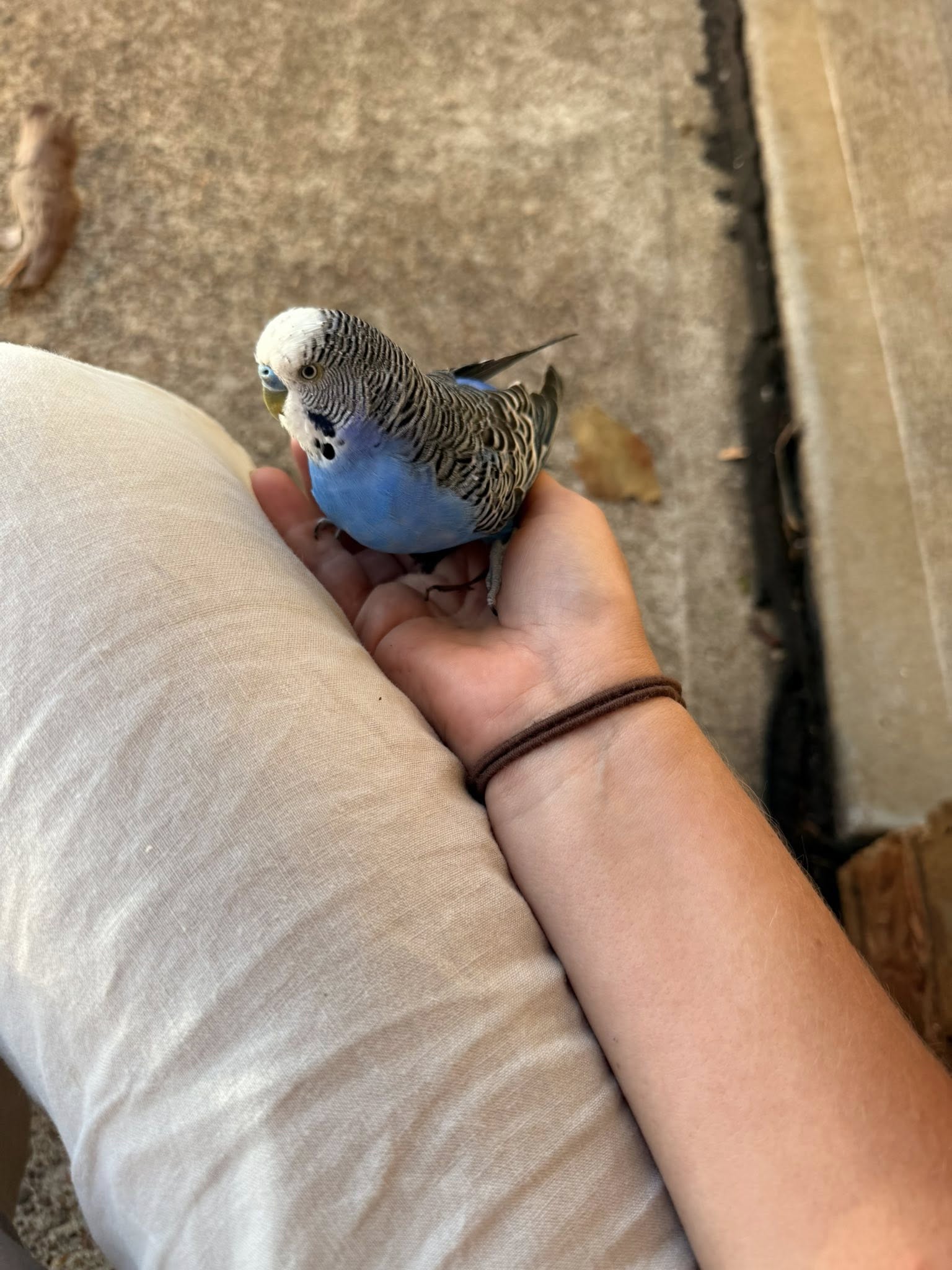
The best tame budgies I have seen in 35 years of this — birds that will fly to their owner’s shoulder from across the room, sit through meals, fall asleep on a hand — were not the result of special technique or unusual effort. They were birds with the right personality who were given patience, consistency, and time. The technique got them there. The personality determined how far they went.
The Complete Taming Process — At a Glance
| Stage | What You Are Doing | How Long to Spend Here | Move On When… |
|---|---|---|---|
| Settling in | Normal presence near cage, no taming attempts | 7–14 days minimum | Bird is eating, active, and not alarm-fleeing when you walk past |
| Building presence | Sitting quietly near cage, talking softly, 10–15 mins daily | 1–2 weeks | Bird goes about its business while you are nearby |
| Hand in cage | Still hand inside cage, low and away from bird, millet offered | 1–3 weeks | Bird does not immediately flee when hand enters — may approach millet |
| Step-up training | Finger presented below belly, gentle upward pressure, “Up” command | 1–3 weeks | Bird steps up reliably and sits calmly on finger inside cage |
| Out of cage time | Short sessions in safe, covered room — bird leads the pace | Ongoing | Never fully complete — continue building confidence over months |

Frequently Asked Questions
How long does it take to tame a budgie?
For a young bird handled with consistent, patient technique from the start, four to eight weeks to a reliable step-up is realistic. The full process — from first arriving home to a bird that is genuinely comfortable with out-of-cage handling — typically takes three to four months. Older birds and birds that have had limited human contact take longer. If you are measuring in days and feeling frustrated, adjust your expectations. This is a process measured in weeks, not sessions.
My budgie bites me every time I try to handle it — what am I doing wrong?
Biting when handled almost always means the bird is not ready for the stage you are attempting. Go back a step — if you are attempting step-up, go back to hand in cage. If hand in cage is producing biting, go back to presence only. The bite is the bird telling you it is not comfortable yet. Respect that signal rather than pushing through it. Pushing through biting makes biting worse, because the bird learns that biting is the only way to make the scary thing stop.
Can an older budgie be tamed?
Yes — but with realistic expectations about the timeline. The easiest window for taming is four to twelve weeks of age, when birds are naturally at their least fearful of new experiences. A bird over six months old can still be tamed with patient, consistent work, but expect the process to take two to three times as long as with a young bird. A bird that has spent time in a shop with minimal handling is not untameable — it is just starting from a more cautious baseline.
Will my budgie ever talk?
Some budgies talk clearly and prolifically. Some make sounds that might generously be described as words. Some never talk at all. Males are significantly more likely to talk than females, and younger birds that have consistent one-to-one time with a patient owner are most likely to develop speech. There are no guarantees, and buying a budgie primarily for the talking is a risk. Buy for the relationship, and treat talking, if it happens, as a bonus.
Is it harder to tame two budgies than one?
Yes — significantly. A pair of budgies bonded to each other has their social needs met by the other bird and is less motivated to seek human interaction. Individual taming of birds in a pair is possible but takes longer, requires separating the birds for taming sessions, and typically produces less complete results than taming a single bird. If you want a bird that bonds closely with you, a single budgie given consistent daily attention is the better path.
Where can I buy a young budgie in Swindon?
We always have budgies in stock at Paradise Pets — young birds from good stock, ready for new homes. Come and see us at Manor Garden Centre, Cheney Manor, Swindon SN2 2QJ, or call us on 01793 512400. We are happy to talk through the taming process before you buy, and to help you choose a bird with the right temperament for what you are hoping for.
Questions About Taming Your Budgie? Come and Talk to Me
If your taming process has stalled, if you are not sure what step to try next, or if you want an honest assessment of whether your approach is working — come in. Bring a short video on your phone if it helps. I have been through this process with more budgies than I can count, and I will tell you straight what I think.