
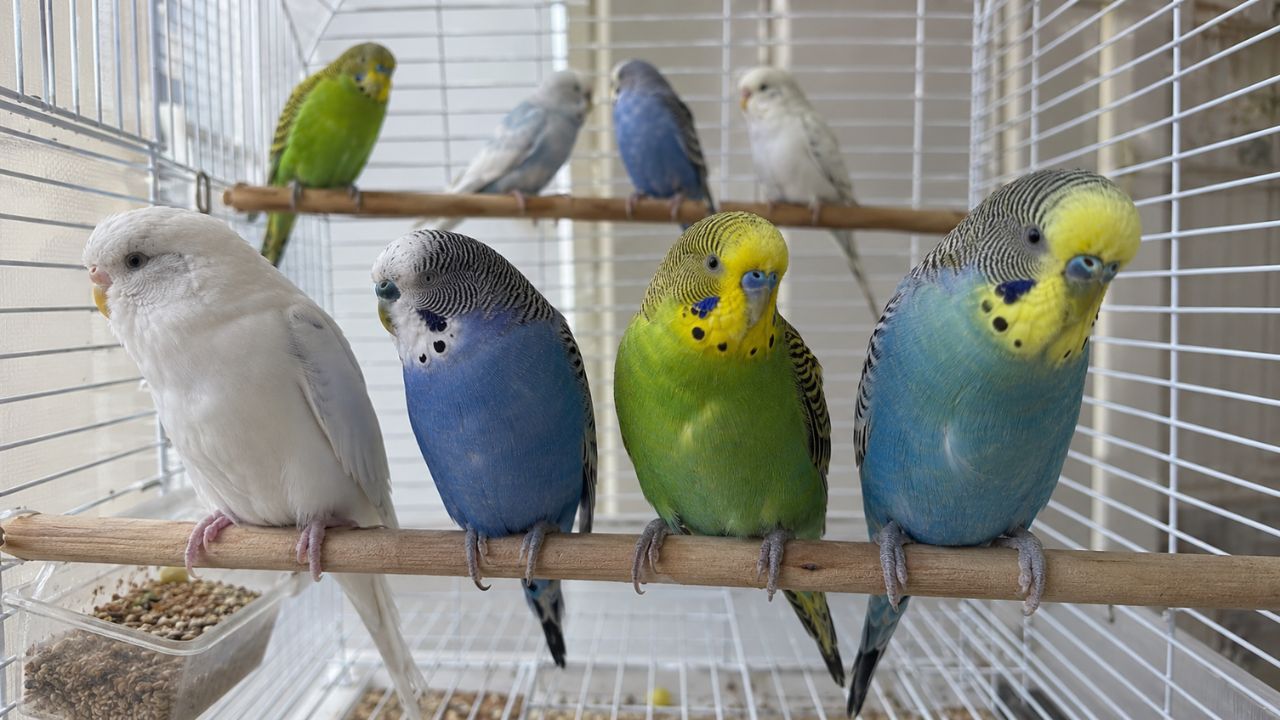

Neil has run Paradise Pets Swindon since 1988 — over 35 years of selling, keeping, and advising on budgies for first-time owners. Every week someone comes in asking which budgie is best for a beginner in a small flat. This is his honest answer.
Someone comes in every single week and asks me some version of the same question.
They live in a flat. They work from home, or they are retired, or their children have finally left and the place feels quiet. They want a pet but they cannot have a dog or a cat — landlord will not allow it, or the space is too small, or the lifestyle does not fit. A friend mentioned budgies. They have never kept a bird before. And they want to know: is a budgie right for me, and if so, which one?
I like this question. It means the person is thinking before they buy, which is more than a lot of people do.
The honest answer is that budgies are genuinely one of the best pets you can keep in a small flat — but only if you go about it the right way. Get it wrong and you will have a stressed, noisy, unhappy bird and a miserable experience. Get it right and you will have a companion that is endlessly entertaining, surprisingly affectionate, and perfectly suited to flat living.
After 35 years of helping people get it right, here is what I actually tell them.

Why Budgies Actually Suit Flat Living — When Done Properly
Let me start with the good news, because there is a lot of it.
Budgies do not need a garden. They do not need to be walked. They do not need a large house. A well set-up cage in a living room or a dedicated corner of a flat is genuinely sufficient — provided everything else is right.
They are quiet enough for most flats, most of the time. I say most, because I will be honest with you later about the exceptions. But compared to a dog, a parrot, or even some cats, a budgie’s daily noise level is manageable in close-quarters living.
They cost relatively little to keep day-to-day. A good seed mix, some fresh vegetables, cuttlebone, occasional toys — the ongoing costs are modest.
And they are genuinely interesting companions. Budgies are intelligent, curious, and social. They learn routines, they recognise their owners, and many of them talk. Living with a budgie is never dull.
The reasons people get it wrong are almost always about setup and expectations — not about the birds themselves. So let us go through both.
The Most Important Decision — One Budgie or Two?
I want to address this before anything else because it shapes every other decision you make.
Most people coming into the shop for their first budgie are thinking about getting one. I understand why — one feels simpler, one feels more manageable, and one seems like the sensible starting point.
I am going to be straight with you: for most people living in a flat, two budgies is actually the better choice — not one.
Here is why.
Budgies are flock animals. In the wild, they live in groups of hundreds. They are not built for solitude. A single budgie left alone while its owner goes to work, or even just moves to another room for a few hours, is an animal experiencing genuine distress. That distress expresses itself in one main way: noise. Persistent, repetitive calling. Because the bird is calling for its flock, and its flock is not answering.
- Are you at home most of the day? If you work from home full-time and the bird will always have company, one budgie can work — provided you spend real time with it every day. If you are out for long stretches regularly, get two.
- Do you want a budgie that bonds closely with you? A single budgie, handled and socialised from a young age, will often become significantly more human-focused than a bonded pair. If you want a bird that sits on your shoulder and learns to talk, one may be better.
- Is noise a concern in your flat? Two budgies are not twice as noisy as one — but a lonely single budgie can be more persistently loud than a contented pair. Counterintuitive, but true in practice.
- Are you prepared for the commitment of two animals? Two budgies means more food, more vet costs if needed, and a slightly larger cage. Not significantly more, but worth knowing.
My standard recommendation for a beginner in a flat who is out during the day: get two budgies. Same age, ideally from the same clutch or at least introduced at the same time. They will keep each other company, they will be more settled, and you will have fewer noise problems as a result.

Male or Female — Does It Matter For A Beginner?
Yes, and more than most people realise.
Males are generally the better choice for a first-time owner in a flat. Here is why.
Male budgies are almost always calmer and more sociable. They chirp and sing — a pleasant, gentle sound most of the time. They are more likely to talk. They are more tolerant of handling, more interested in interacting with their owner, and generally easier company day to day.
Female budgies are more independent. They can be more territorial — particularly around their cage — and more prone to nipping. They are also subject to hormonal health issues that males are not, including egg binding, which can be a genuine veterinary emergency. For someone new to budgies, a female’s health requirements are more demanding.
- Female budgies can lay eggs even without a male present — unfertilised eggs, but still a physical drain
- Egg binding — where the bird cannot pass an egg — is a life-threatening emergency that requires immediate veterinary attention
- Avoid anything that triggers nesting behaviour — no dark enclosed spaces, no nesting boxes, limit stroking to the head and neck only
- Females are more prone to fatty liver disease and some tumours — diet quality matters more with females
- None of this means females are bad pets — but know what you are taking on
For a beginner in a flat: one or two males is the setup I recommend most often. Calmer, chattier, less complicated health-wise, and more likely to become the friendly, interactive companion most people are hoping for.
What Age Budgie Should A Beginner Get?
Young. Always young.
A budgie that comes to you at six to twelve weeks old — recently weaned, just starting to explore the world — is a completely different proposition from an adult bird. Young budgies are open, curious, and adaptable. They bond with their owners during the critical socialisation period. They learn that humans are safe, that hands are for sitting on, that the room outside the cage is interesting rather than frightening.
An adult budgie that has had limited human contact since leaving the nest is a much harder project. Not impossible — but much slower, and often with a ceiling on how tame it will become.
- Get a bird that is six to twelve weeks old — recently weaned but young enough to socialise easily
- Look for a bird that is alert, bright-eyed, and active in the cage — not sitting hunched in a corner
- Young budgies have barring on their forehead that extends down to the cere — this fades with the first adult moult at around three to four months
- Eyes are fully dark in very young birds — the iris lightens as they mature
- A bird that does not immediately panic at your approach is a better sign than one that crashes around the cage
At Paradise Pets, all our budgies come from UK breeders we know personally. We know how the birds have been kept, what they have been eating, and roughly what age they are. That matters. A bird from an unknown source — a market, a classified ad, a pet superstore with high turnover — is a much bigger unknown in terms of health and temperament.

Which Colour or Variety — Does It Affect Temperament?
I get asked this often, and the honest answer is: colour does not affect temperament. A green budgie, a blue budgie, a yellow budgie — they are the same bird in a different coat.
There is one exception worth mentioning, and that is the English budgie — the larger, show-type budgie with the distinctive feathered face. English budgies are calmer and more docile than the standard budgie, partly because of selective breeding and partly because of their larger size. They are slightly less active, slightly less likely to be startled, and some people find them easier to handle as a first bird.
The trade-off is that English budgies are shorter-lived on average, more prone to certain respiratory issues, and harder to find from good-quality breeders. For most beginners, a healthy standard budgie from a good source is the better starting point.
- Colour — no effect on personality or health. Choose what you find beautiful.
- Standard vs English budgie — English budgies are calmer and larger; standard budgies are more active and longer-lived on average.
- Lutino (all-yellow) and albino (all-white) — these are colour mutations, not separate varieties. No personality difference, but some lutinos have slightly weaker eyesight, which can make them more startled in certain conditions.
- What actually matters — age, sex, source, and how the bird has been kept. These things affect your experience far more than colour ever will.
The Cage — The Most Common Mistake Beginners Make
I want to talk about this at some length because the wrong cage is the most common error I see from new budgie owners, and it affects everything downstream — the bird’s health, its temperament, and how easy or hard it is to live with.
The standard beginner cage sold in most pet supermarkets is too small. Not slightly too small — significantly too small. A budgie that cannot stretch its wings properly, cannot fly even a short distance from perch to perch, cannot move freely around its environment is a budgie that is stressed, bored, and increasingly difficult to handle.
- Minimum cage size for one budgie: 60cm wide x 40cm deep x 45cm tall — and wider is more important than taller, because budgies fly horizontally not vertically
- For a pair: at least 90cm wide x 50cm deep x 60cm tall
- Bar spacing: no more than 12mm — wider bars allow heads to get stuck
- Bar orientation: horizontal bars on at least two sides so the bird can climb
- Position: at eye level or above, against a wall on one side so the bird feels secure — not in the middle of the room, not in a draught, not in direct sun all day
- Not in the kitchen: cooking fumes, non-stick pans, and aerosol sprays are all potentially fatal to budgies. The kitchen is the most dangerous room in the house for a bird.

- The kitchen — non-stick pan fumes kill birds. This is non-negotiable.
- In a draught — near an external door, a window that is regularly open, or directly under an air conditioning unit
- In direct sunlight for more than a couple of hours — overheating is a real risk in a small flat in summer
- In an isolated room where the bird cannot see or hear household activity — a budgie that cannot see its flock becomes stressed and noisy
- Near the television if it is on at high volume — sudden loud sounds are distressing for birds
What To Feed A Beginner Budgie — And What Most People Get Wrong
Seed alone is not a complete diet. I say this to every new budgie owner and I say it here because it is the most common dietary mistake I see, and it causes real, long-term health problems.
A seed-only diet is the nutritional equivalent of feeding a child nothing but white bread. The bird will eat it. The bird will survive on it for a while. But over months and years, the deficiencies accumulate — fatty liver disease, vitamin A deficiency, feather problems, shortened lifespan.
- Good quality seed mix — the base of the diet, but not the whole of it
- Fresh vegetables daily — leafy greens, broccoli, carrot, bell pepper. Start with small amounts and introduce gradually. Many budgies are suspicious of new foods at first — persistence pays off.
- Cuttlebone or a mineral block — always available in the cage. Provides calcium and keeps the beak in good condition.
- Fresh water changed daily — not weekly, not when you remember. Every day.
- Millet spray — an excellent treat and a useful training tool, but not a daily food. High in fat and low in nutrition.
- No avocado, no onion, no garlic, no chocolate, no caffeine — all toxic to budgies.
- No non-stick cookware in the same airspace — PTFE fumes from overheated pans kill birds. This is not an exaggeration.
Noise — The Honest Answer For Flat Dwellers
This is the question everyone wants answered and nobody wants to give a straight answer to. So here is mine.
Two settled, well-kept budgies in a flat are manageable. One lonely budgie in a flat is not.
A contented pair of budgies will chirp and chat throughout the day — a pleasant, sociable background sound that most people find enjoyable rather than intrusive. There will be bursts of more active calling, particularly at dawn and when something excites them. But the sustained, repetitive screaming that gives budgies a bad reputation almost always comes from a bird that is lonely, bored, or stressed.
The controllable variables are these: companionship, cage enrichment, your presence, and routine. Get all of those right and the noise level in a flat is very manageable. Get them wrong and the neighbours will notice.
One thing I do tell people who are concerned about this: budgies are generally quietest in the evenings once the cage is covered. If you keep a consistent cover schedule — cage covered at the same time each evening, uncovered at the same time each morning — the bird settles into a predictable routine and the noise is much easier to manage.

How To Tame A Budgie From Day One
This is where most beginners go wrong — not through cruelty or neglect, but through impatience.
A new budgie needs time to settle before you try to handle it. Not a day. Not a weekend. Typically one to two weeks of simply being present, talking quietly near the cage, letting the bird learn that you are part of the landscape and not a threat.
- Week one and two — settle, do not touch. Put the cage somewhere the bird can see household activity. Talk to it. Sit near it. Let it learn your voice and your presence. Do not try to handle it yet.
- Week two or three — hand inside the cage. Put your hand inside the cage without trying to catch the bird. Leave it still. Let the bird investigate in its own time. Do this daily for short sessions.
- When the bird steps up — reward with millet. The moment a bird steps onto your finger willingly, even briefly, offer a spray of millet immediately. This is the association you are building: hand equals good things.
- Build in short sessions, not long ones. Five minutes twice a day is better than thirty minutes once. End every session before the bird gets stressed — you want it to associate handling with positive experiences.
- Never chase, grab, or restrain. Any session that ends with the bird frightened sets the taming back significantly. Patience is the only tool that works.
What To Expect In The First Month
I find it helps to give people a realistic picture of what the first few weeks actually look like — because the gap between expectation and reality is where most beginner frustrations come from.
| Week | What is normal | What to do |
|---|---|---|
| Week 1 | Bird is quiet, possibly hiding, not eating much, sitting still. This is stress from the move — completely normal. | Minimal disturbance. Quiet presence. Do not try to handle. Ensure food and water are accessible. |
| Week 2 | Bird begins to explore, starts eating more confidently, may begin to chirp. Still wary of hands. | Begin sitting near the cage, talking quietly. Start offering millet through the bars. |
| Week 3–4 | Bird is active, vocal, and curious. May begin approaching your hand at the cage bars. | Begin gentle hand-taming sessions inside the cage. Keep them short and positive. |
| Month 2 onwards | Stepping up, beginning to accept handling, possibly starting to mimic sounds. | Increase out-of-cage time. Continue daily interaction. Begin teaching simple words if desired. |
Some birds move faster than this. Some slower. A bird that was well-socialised before you got it will settle more quickly. A bird that had limited human contact will take longer. The process is the same — patience, consistency, and always ending on a positive note.

The Costs — What A Beginner Should Budget For
I believe in telling people what things actually cost before they buy. It avoids unpleasant surprises later.
| Item | One-off or ongoing | Approximate cost |
|---|---|---|
| Budgie (one or two from a good breeder) | One-off | £15 to £30 each |
| Cage (proper size, not starter cage) | One-off | £60 to £120 |
| Perches, toys, enrichment | One-off plus periodic replacement | £20 to £40 to set up |
| Seed mix and fresh food | Monthly | £10 to £20 per month |
| Cuttlebone, mineral supplements | Monthly | £3 to £5 per month |
| Avian vet — routine check | Annual | £30 to £60 |
| Avian vet — illness or emergency | If needed | £50 to £200+ |
The vet costs are the ones people underestimate most. Avian vets are specialist vets and they charge accordingly. It is worth having an emergency fund set aside — or looking at pet insurance for birds, which does exist. Do not let the cost of a vet visit be the reason a treatable bird does not get treated.
Common Mistakes Beginners Make — And How To Avoid Them
- Buying a cage that is too small — the most common mistake, and the one with the most downstream consequences. Buy bigger than you think you need.
- Getting one bird when two would be better — particularly if you are out during the day. A lonely budgie is a stressed budgie.
- Trying to tame too quickly — the first week should be about settling, not handling. Patience in week one pays off for years.
- Feeding seed only — fresh vegetables should be offered from day one, even if the bird ignores them initially. Keep offering.
- Putting the cage in the kitchen — non-stick pan fumes are fatal to birds. Do not do this.
- Not identifying an avian vet before buying — find one in your area before the bird arrives, not when you need one urgently.
- Covering the cage inconsistently — a predictable routine makes budgies calmer and quieter. Cover and uncover at the same times every day.
Frequently Asked Questions
Are budgies suitable for a flat with thin walls?
In most cases, yes — a settled, well-kept pair of budgies produces background chirping rather than sustained loud noise. The situations where budgies become very loud are almost always ones where the bird is lonely, bored, or stressed. Address those things and the noise level is generally manageable in flat living. A single bird left alone for long periods is more likely to cause noise problems than a pair that is kept properly.
Is a budgie okay to leave alone while I work full time?
If you have two budgies and they have each other for company, yes — this works well. A single budgie left alone for eight hours every working day will become lonely and stressed. Get two, give them a proper enriched environment, and leave a radio on when you go out. They will be fine.
Do budgies smell?
Very little, if the cage is kept clean. A budgie cage cleaned properly twice a week has no noticeable odour. The birds themselves do not smell. People who find budgies smelly are usually not cleaning the cage frequently enough.
Can budgies live in a bedroom?
I would advise against it for two reasons. First, budgies are active and vocal at dawn — not ideal in a room where you are sleeping. Second, budgies need 10 to 12 hours of cover-darkness to sleep properly, and a bedroom with a person moving around in the evening disrupts this. The living room, where they can be part of daily activity during the day and covered in the evening, is much better.
How long do budgies live?
A well-kept budgie typically lives six to ten years, sometimes longer. That is a meaningful commitment. Think about that before you buy — these are not disposable pets.
Where can I get a budgie for my flat in Swindon?
Come and see us at Paradise Pets, Manor Garden Centre, Cheney Manor, Swindon SN2 2QJ. Or ring us on 01793 512400. All our budgies come from UK breeders we know personally. We will help you choose the right bird, give you honest advice on setup, and answer any questions before and after you take the bird home.
One Last Thing From Me
The people who come back to the shop a year after buying their first budgie — and plenty of them do come back, often to get a second bird or to upgrade a cage — almost always say the same thing. That they did not expect to get so attached. That they did not realise how much personality a small bird could have. That it was one of the best decisions they made.
The people who come back with a problem — a stressed bird, a screaming bird, a bird that has become impossible to handle — almost always made the same mistakes. A cage that was too small. A bird that was left alone too much. An attempt to rush the taming process. A seed-only diet.
None of those mistakes are hard to avoid. They just require knowing about them in advance, which is why this article exists.
If you are thinking about getting a budgie for your flat, I would encourage you to do it. But do it properly. Come in and talk to us first — we will spend the time with you to make sure you are set up right before the bird ever comes home. That conversation costs nothing and it makes a real difference to how the whole experience goes.
Thinking About Getting A Budgie For Your Flat? Come And Talk To Us First
We will help you choose the right bird, advise on cage size and setup, and answer every question you have — before you spend a penny. Free advice, no obligation. Over 35 years of helping first-time budgie owners get it right from the start.