
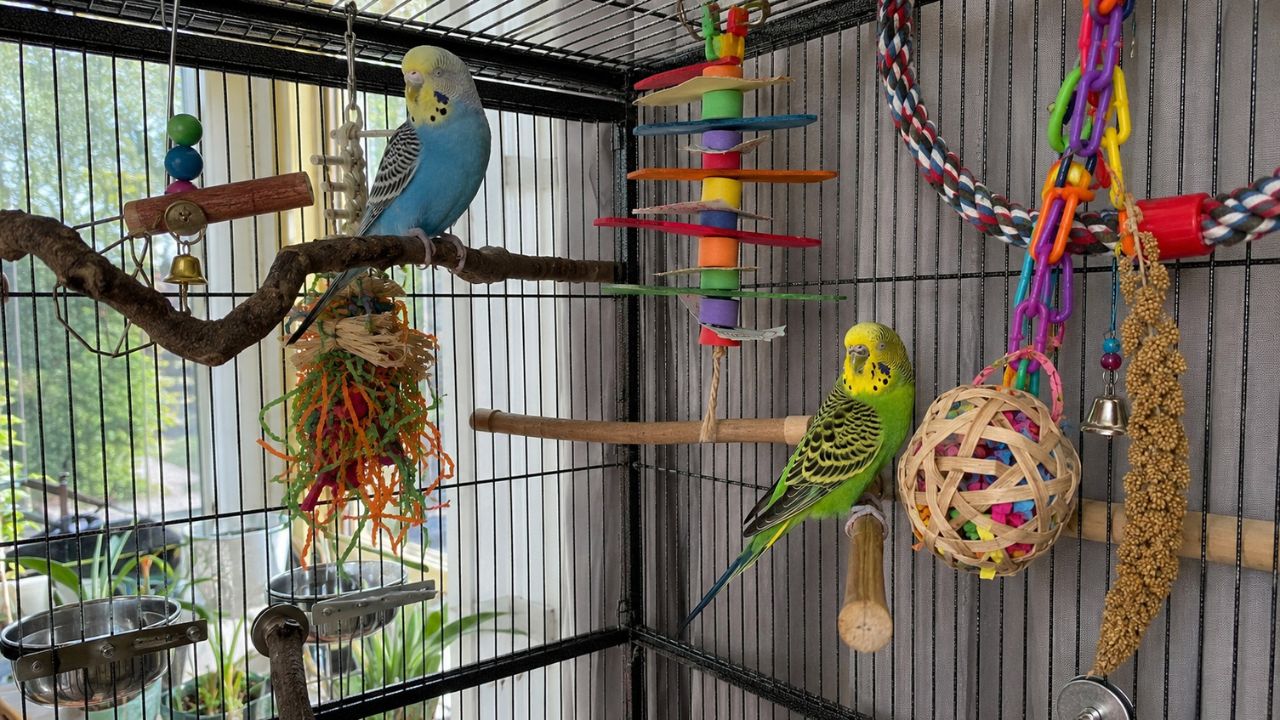

Neil has kept, bred, and sold budgies at Paradise Pets Swindon since 1988 — over 35 years of first-hand experience with these birds. In that time, he has watched countless UK owners buy the wrong toys, miss the right ones, and wonder why their budgie seems bored. This is his honest, practical guide to the best toys for UK budgies — based on what actually works, not what sells.
A woman came into the shop one afternoon looking a little frustrated. “Neil,” she said, “I have spent a fortune on budgie toys over the past year. Bells, mirrors, ladders, swings — everything. He ignores almost all of them. He just sits on his perch most of the day. Am I buying the wrong things?”
It is one of the most common conversations I have at the counter, and the answer is almost always yes — but not because the owner has done anything wrong. The honest truth is this — most of the brightly coloured “budgie toys” sold in UK supermarkets and general pet shops are designed to appeal to humans, not budgies, and budgies often ignore them completely.
In 35 years of selling budgies and watching them play, I have learned which toys genuinely engage them, which they tolerate but do not love, and which they essentially ignore. The good news is that the right toys are not expensive and not complicated — and once you find the ones that work for your particular bird, you will see a completely different animal. A bored budgie comes alive when given proper enrichment.
This article is the conversation I have with every UK owner who asks me about toys, written down. It will tell you what budgies actually love to play with, what to avoid, how to rotate toys to keep them interesting, and how much you genuinely need. By the end, you will know exactly what to buy and what to skip.
Why Toys Genuinely Matter For A Budgie
Before we get into specific toys, let me explain why this matters more than people often realise. Because some UK owners treat toys as optional extras, when they are genuinely essential for the bird’s wellbeing.
Budgies are intelligent, active birds. In the wild they spend their days flying, foraging, exploring, climbing, chewing, and interacting with their flock. In a cage, all of that natural activity has to be channeled somewhere. Without proper enrichment, budgies become bored — and bored budgies develop problems.
- Mental stimulation — toys keep a budgie’s intelligent mind engaged
- Physical exercise — climbing, swinging, and chewing maintain physical health
- Natural behaviour expression — foraging and chewing satisfy hard-wired instincts
- Beak maintenance — chewing keeps the beak at the right length
- Stress reduction — busy budgies are calmer budgies
- Prevention of feather plucking — bored birds often turn to self-destructive behaviours
- Better sleep — physically and mentally tired budgies sleep properly
A bird kept in a cage with no toys and no enrichment is essentially in solitary confinement. Even with the best food and care, the lack of stimulation causes real welfare problems. Proper toys are not luxuries — they are part of basic, decent budgie keeping.
The 3 Essential Categories Of Toys Every Budgie Needs
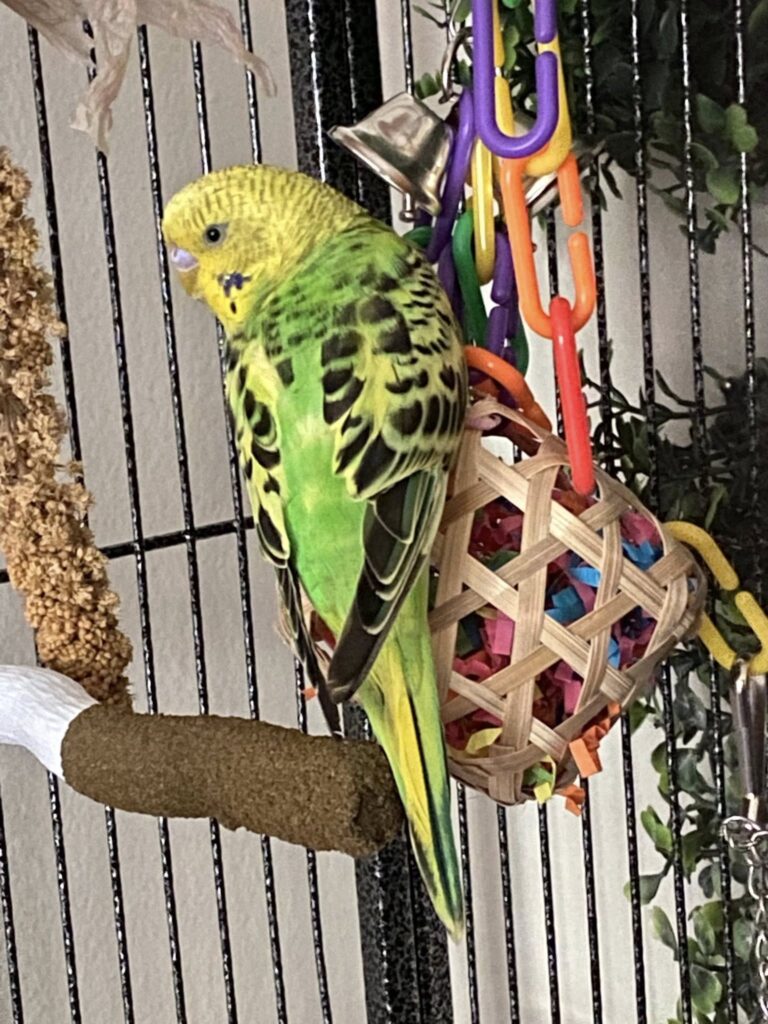
After 35 years of watching budgies, I have learned to think about toys in three essential categories. A good budgie cage has all three represented — and most cages I see only have one. Get all three right and your bird’s quality of life genuinely changes.
Category 1: Chewing And Shredding Toys — The Most Important
If I had to pick just one type of toy for every budgie cage, this would be it. Budgies are natural chewers — it is hard-wired in them. They chew to maintain their continuously-growing beaks, to express natural foraging behaviour, and because they genuinely enjoy the process of destruction.
A budgie with nothing to chew is a budgie that will chew the wrong things — cage bars, perches that should not be chewed, even feathers. A budgie with proper chewing options is a content, occupied bird.
- Bird-safe wooden blocks and chunks
Untreated soft wood pieces — small enough for a budgie to grip and chew. Pine, balsa, and birch are popular. - Shreddable paper toys
Plain paper, cardboard, raffia, palm leaves woven into shapes. Budgies absolutely love destroying these. - Natural fibre toys
Coconut fibre, sisal, sea grass mats and balls. Natural materials they recognise. - Vine balls and wooden rings
Small enough to manipulate, made of safe natural materials. - Soft wood chew sticks
Small sticks of safe wood mounted in the cage for gnawing. - Cardboard tubes
A simple toilet roll tube, plain (no glue), provides hours of shredding fun. Free and brilliant.
The mistake many UK owners make is assuming budgies want plastic toys. Most budgies far prefer natural materials they can actually destroy. The destruction is the point — that is what they are designed to do. A toy that survives a year is a toy your budgie has been ignoring.
What to avoid in chewing toys
- Treated or painted wood — chemicals are toxic to birds
- Hardwoods like oak — too tough for a budgie beak to enjoy
- Cherry, plum, or peach wood — contains cyanide compounds in the bark
- Glued cardboard or paper — the glue can be toxic
- Anything with plastic parts the bird could chew off and swallow
Category 2: Foraging Toys — The Most Underrated
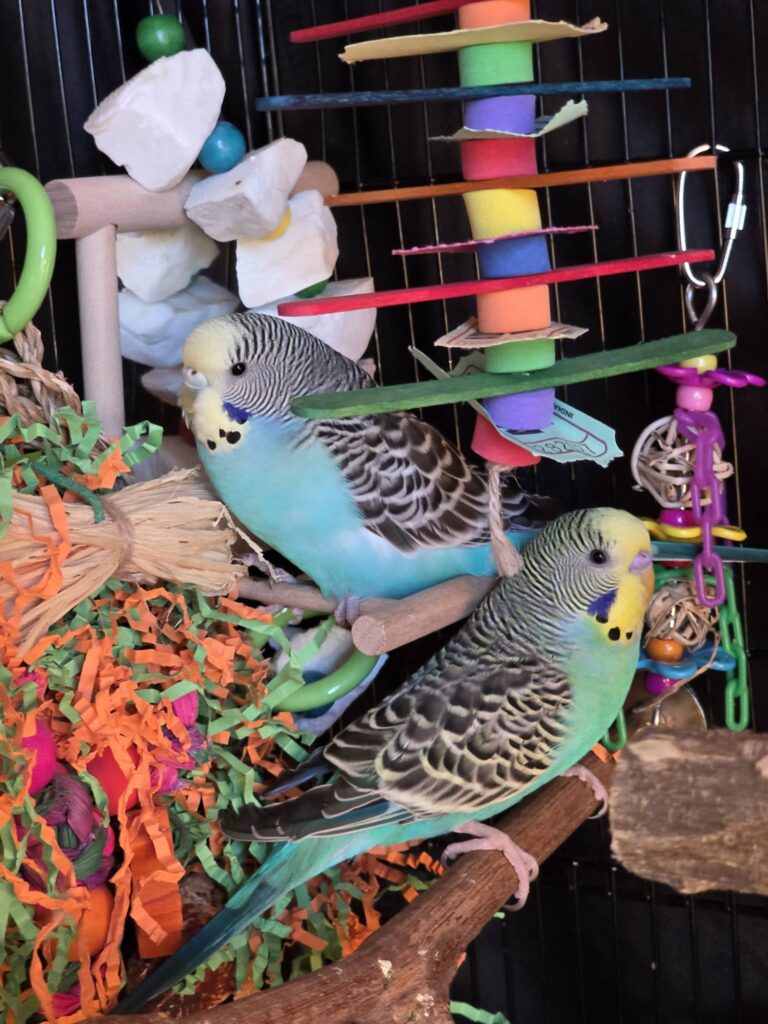
This is the category most UK owners miss entirely, and it is genuinely transformative when introduced. Foraging toys are designed so the budgie has to work to get food out of them — mimicking the natural behaviour of wild budgies searching for seeds.
A budgie with foraging toys is mentally engaged for far longer than one with passive toys. The combination of food reward and problem-solving is exactly what their intelligent little minds are built for. Watching a budgie figure out a foraging toy is one of the most rewarding things you can see.
- Foraging boxes and puzzles
Small cardboard or wooden boxes with food hidden inside that the bird has to find and access. - Treat-stuffed shreddables
Paper or palm leaf toys with small pieces of millet or seed tucked inside. - Foraging balls
Hollow balls of various materials with food inside that release when manipulated. - Skewer toys
Wooden skewers where vegetables, fruit, or millet sprays can be threaded for the bird to work through. - Hide-the-treat boxes
Simple cardboard boxes filled with shredded paper and hidden treats. - Foraging trees
Branches mounted in the cage with small treats attached at intervals.
DIY Foraging Toys That Cost Almost Nothing
Many of the best foraging toys can be made at home with materials you already have. A toilet roll tube stuffed with a small amount of millet, then crimped at both ends, makes an excellent foraging toy. A small cardboard box filled with shredded paper and a couple of seeds hidden inside provides extended entertainment. The budgie does not care that you made it yourself — it cares about the activity, not the price tag.
Category 3: Climbing And Movement Toys
The third essential category covers toys that get a budgie moving — climbing, swinging, hanging, balancing. Budgies in the wild fly constantly; in a cage, they need ways to exercise different muscles and stay physically active.
- Bird-safe ladders
Wooden or rope ladders providing climbing exercise. Multiple textures are good for foot health. - Swings of varying types
Plain wooden swings, rope swings, and bouncy spring swings. Different swings appeal to different birds. - Boings and spirals
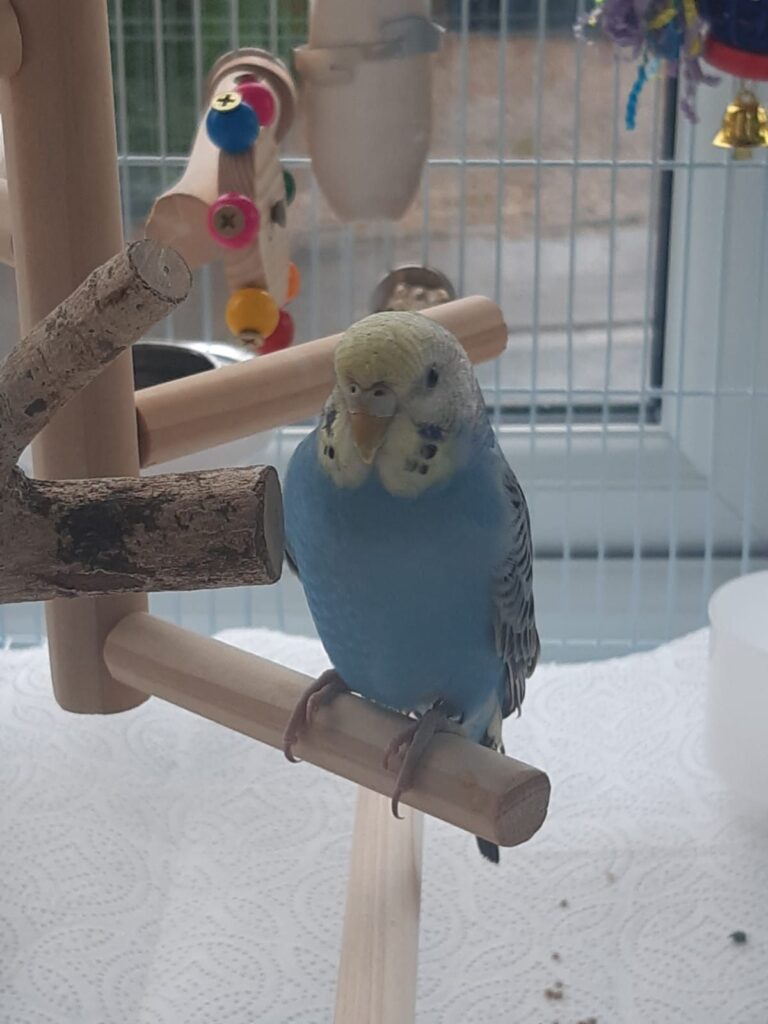
Spring-loaded perches that bounce and move — many budgies love these. - Natural branch perches at varied heights
Different sized natural branches encourage natural foot positioning and exercise. - Climbing nets and grids
Rope or natural fibre nets the bird can climb across. - Heavy bell toys to push
Bells they can ring and push around — many birds find this satisfying.
Toys That Are Worth Considering Carefully
Some popular budgie toys come with caveats worth knowing about. They are not necessarily bad — but they need careful thought.
1. Mirrors — The Controversial One
This is the toy that splits opinion in budgie keeping. Mirrors are sold heavily as budgie toys, and many budgies do love them. But there are honest concerns to consider.
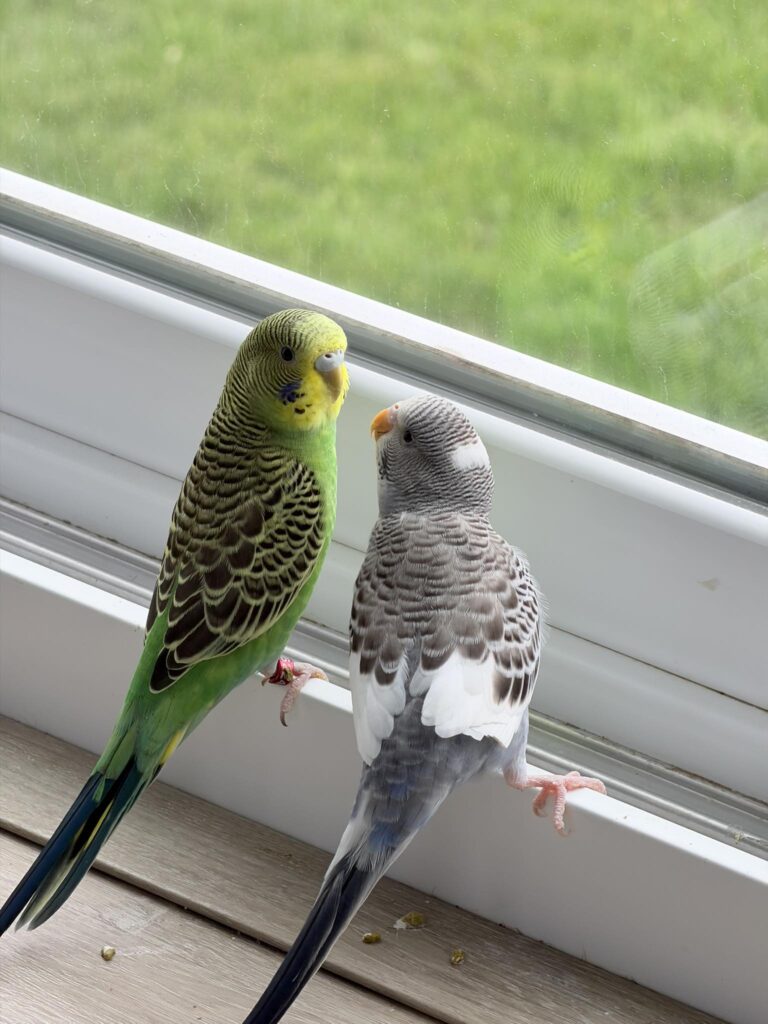
A budgie does not understand that the bird in the mirror is its own reflection. It may form a strong bond with the “other bird,” which can cause behavioural problems — particularly in single birds. The bird may regurgitate food at the mirror (a mating behaviour), become territorial, or even prefer the mirror to genuine human or bird company. In male budgies, mirrors can trigger ongoing hormonal behaviour that becomes a problem.
For a single budgie that gets plenty of human interaction and other enrichment, a mirror is usually fine in moderation. For budgies showing signs of mirror obsession — constant displaying, regurgitating, ignoring real interaction — remove the mirror.
- Bird spends most of its time at the mirror, ignoring other toys and you
- Persistent regurgitating at the mirror
- Aggressive defending of the mirror territory
- Hormonal behaviour during breeding season worsens
- Reduced bonding with you because the mirror is “the other bird”
2. Plastic Toys — Usually Less Engaging
Most plastic budgie toys are bought because they look bright and appealing to humans. Most budgies find them less engaging than natural materials. There are exceptions — some plastic toys with foraging elements work well — but as a general rule, your money is better spent on natural materials your bird can actually destroy.
If you do buy plastic toys, ensure they are bird-safe quality (not just children’s plastic), that they cannot be chewed apart into swallowable pieces, and that they have no small parts that could trap a beak or claw.
3. Cuttlebones And Mineral Blocks — Essentials, Not Toys
Worth a quick mention — cuttlebones and mineral blocks are not toys, they are dietary essentials. Every budgie cage should have a cuttlebone for calcium and a mineral block for trace elements. They do also provide some beak exercise, but their primary purpose is nutritional. Do not count them as “toys.”
How Many Toys Should A Budgie Have?
This is a practical question that comes up often. The honest answer is — fewer than you think at any one time, but with regular rotation.
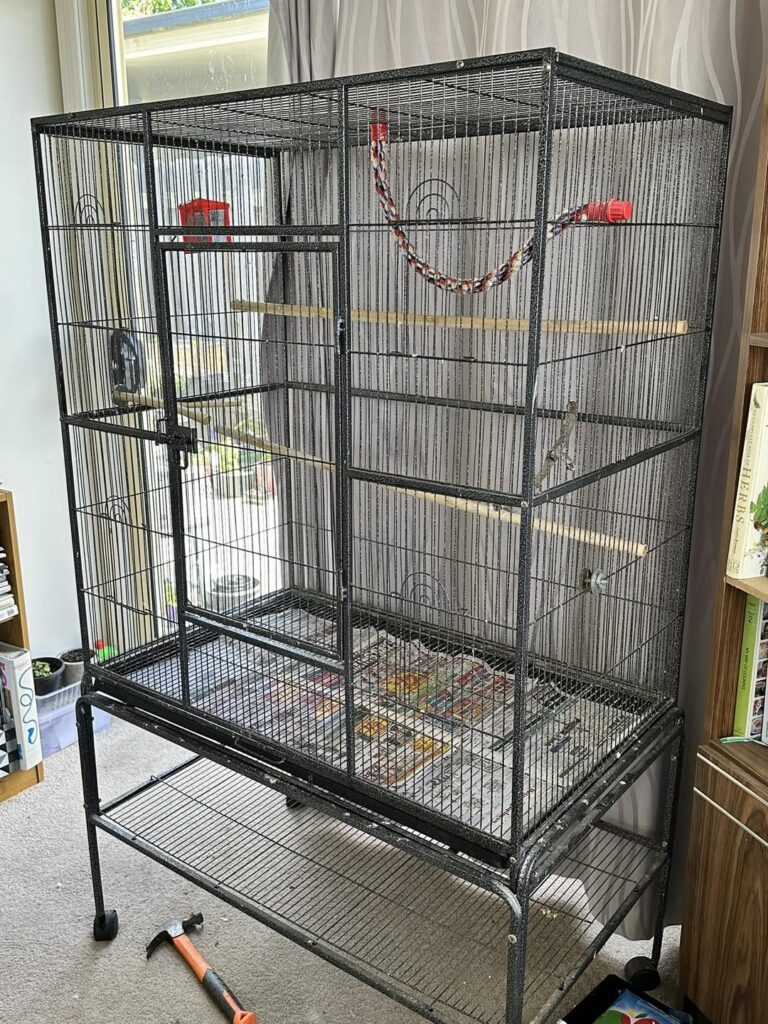
For a single budgie in a properly sized cage, 5 to 7 toys at any one time is the right number. More than that and the cage becomes cluttered, hard to clean, and overwhelming for the bird. Less than that and there is not enough variety. The cage should have movement space alongside the toys — a budgie still needs to fly between perches.
Within those 5 to 7, aim for at least one from each essential category — one chewing/shredding toy, one foraging toy, one movement toy — plus a couple of others. Variety within the cage matters more than total quantity.
Toy Rotation — The Secret Most UK Owners Miss
This is one of the most useful pieces of advice I give at the counter, and it is genuinely transformative. Rotate your budgie’s toys regularly — weekly is ideal.
Budgies are intelligent and quickly become bored with the same toys in the same positions. A toy that has been in the cage for two months is essentially invisible to the bird. The same toy, removed for a few weeks and then brought back, becomes “new” again and gets fresh interest.
The practical approach:
- Keep 5-7 toys in the cage at any time
- Keep another 5-10 toys in a “rotation box” at home
- Every week or so, swap a couple of toys — remove some, add others
- Wash returning toys before putting them back into rotation
- Watch which toys your bird favours — the favourites can stay longer, the ignored ones can be retired
- Change toy positions occasionally too — moving a toy to a new spot makes it feel new

Rotation costs nothing but makes an enormous difference. A budgie with rotating enrichment never gets bored. A budgie with the same toys for months becomes withdrawn and inactive.
Safety — What To Check Before Putting Any Toy In The Cage
Whatever toy you buy, check it carefully before putting it in the cage. Budgies have small beaks, small feet, and small bodies — and toys that look safe may have hidden hazards.
- No small swallowable parts — anything chewed off should not be small enough to choke on
- No long loose strings or threads — can wrap around legs or necks. Cut all loose threads short.
- No sharp edges or rough metal — feet and beaks can be injured
- No painted or treated materials — chemical paint is toxic when chewed
- No glued joins where the bird could chew through to the glue
- Solid attachment to the cage — toys should not fall down on the bird
- Appropriate size for a budgie — not designed for larger parrots
- Replace anything damaged or worn — broken toys become hazards
The rule of thumb — if you would not give it to a small child to chew on, do not give it to your budgie. Check toys regularly and replace anything showing wear or damage.
What I Tell Owners At The Counter About Toys
When a UK owner asks me about budgie toys, I work through a few questions to match the right toys to their bird and situation.
- How old is your budgie, and is it tame?
Young birds and tame birds are usually more curious about new toys. Older or untamed birds may take longer to accept them. - What does the bird already have?
Tells me what categories you might be missing. - What does the bird seem to do most of the day?
A budgie that mostly chews suggests it needs more chewing toys. One that climbs constantly needs more movement options. - Is the bird showing any boredom signs?
Feather plucking, cage bar biting, screaming — all suggest under-stimulation needing more enrichment. - Is the cage already cluttered, or is there room?
Affects how many new toys to add at once. - Have you tried foraging toys?
This is the question most owners answer “no” to, and it usually transforms things when introduced.
Five minutes of these questions usually leads me to recommend a couple of specific toys that genuinely suit the particular bird, rather than just selling what is on the shelf.
Common Toy-Buying Mistakes UK Owners Make
A few mistakes come up regularly at the counter. Knowing what they are helps you avoid them.
- Buying only what looks pretty to humans — bright plastic toys often ignored by budgies
- Filling the cage with too many toys at once — overwhelms the bird and crowds movement space
- Never rotating toys — the bird gets bored and stops engaging with anything
- Skipping foraging toys — missing the most enriching category entirely
- Buying expensive toys when cheap natural materials work better — budgies do not value price
- Not replacing worn or damaged toys — safety issue
- Giving up after the bird ignores something — sometimes it takes days for a budgie to accept a new toy
- Buying toys designed for larger parrots — wrong size, potentially dangerous
The biggest single mistake is assuming budgies want what humans want. They do not. They want things they can destroy, things they can forage from, and things they can move on. Plastic gadgets with bells often end up ignored.
How To Tell If A Toy Is Working
After adding a new toy, watch the bird over a few days. A working toy shows specific signs of engagement.
| Sign | Working Toy | Ignored Toy |
|---|---|---|
| Attention | Bird approaches and investigates | Bird ignores or avoids |
| Interaction | Chews, picks at, manipulates | Passes by without touching |
| Wear and tear | Visibly used after a week or two | Looks unused after weeks |
| Time spent | Multiple sessions per day | No engagement at all |
| Vocalisation | Chirps and vocalises near the toy | Silent around it |
| Body language | Active, alert, engaged | Avoids that area of the cage |
A toy that shows no engagement after two weeks is probably not for this particular bird. Move it to the rotation box, try something different, and bring the ignored toy back in a few months — sometimes a bird that ignored a toy initially takes to it on the second introduction.
Toys And Bored Budgies — The Connection
If you have a budgie showing signs of boredom — feather plucking, cage bar biting, excessive screaming, withdrawn behaviour — toys are part of the solution. A genuinely well-enriched budgie rarely develops these problems, and an under-enriched one almost inevitably does.
For more on the specific problems boredom causes, our guide on budgie feather plucking covers how boredom can lead to serious behavioural issues, and our guide on cage bar biting explains the boredom connection in detail.
The fix is rarely just adding more toys — it is providing the right types in the right combinations and rotating them properly. A bored budgie with five plastic bells is still a bored budgie. The same bird with two shredding toys, a foraging puzzle, a swing, and weekly rotation often becomes a different animal within weeks.
Frequently Asked Questions
What are the best toys for a budgie in the UK?
The best toys fall into three essential categories — chewing and shredding toys (wooden blocks, paper toys, natural fibre), foraging toys (puzzle boxes, treat-stuffed shreddables, skewer toys), and climbing/movement toys (ladders, swings, boings). A good budgie cage has all three types. Natural materials your bird can destroy are usually more engaging than plastic.
How many toys should a budgie have in its cage?
For a single budgie in a properly sized cage, 5 to 7 toys at any one time is ideal. Plus a rotation box of 5-10 more toys at home for swapping in weekly. Too many toys clutters the cage and overwhelms the bird. Too few causes boredom. Variety within those 5-7 matters more than total quantity.
Do budgies need toys?
Yes, absolutely. Budgies are intelligent, active birds that need mental stimulation, physical exercise, and outlets for natural behaviours like chewing and foraging. A budgie without toys becomes bored, stressed, and often develops behavioural problems like feather plucking, cage bar biting, and excessive vocalisation. Toys are essential, not optional.
Are mirrors good for budgies?
It depends. Some single budgies enjoy mirrors and they are fine in moderation with plenty of other enrichment. But mirrors can cause behavioural problems — birds may bond obsessively with their reflection, regurgitate at it, become territorial, or prefer it to real human interaction. Remove the mirror if you see any of these signs. For paired budgies, mirrors are generally not needed.
How often should I rotate my budgie’s toys?
Weekly is ideal. Budgies quickly become bored with the same toys in the same positions, but a toy removed and brought back a few weeks later becomes “new” again. Keep a rotation box of toys at home and swap a couple in and out each week. This is one of the most effective ways to keep a budgie genuinely engaged long-term.
What toys should I avoid for my budgie?
Avoid toys with painted or treated materials, small parts the bird could swallow, long loose threads that could trap legs, sharp metal edges, hardwoods like cherry or peach (toxic bark), toys with glue the bird can access, and toys designed for larger parrots. Always check for safety before adding any new toy to the cage.
Where can I get honest budgie advice in Swindon?
Come and see us at Paradise Pets, Manor Garden Centre, Cheney Manor, Swindon SN2 2QJ. Or give us a ring on 01793 512400. We stock quality bird-safe toys and the advice is free. We have been doing this for 35 years.
One Last Thing From Me
“What toys should I get for my budgie?” is the question. The honest answer, after 35 years of selling these birds, is — chewing and shredding toys, foraging puzzles, and climbing/movement toys, all rotated weekly, with the emphasis on natural materials your bird can actually destroy.
The woman I mentioned at the start of this article? Once we worked through what she had been buying versus what budgies actually need, the change was straightforward. She switched from a cage full of bright plastic bells to a setup with two shreddable paper toys, a wooden chew block, a small foraging box, a wooden ladder, and a simple swing. Within a fortnight she was back at the counter, delighted. “Neil, he is a completely different bird. He plays all day now. He destroys the shreddable toys, he digs in the foraging box, he climbs the ladder constantly. I had no idea what he was missing.”
That is the outcome you want — a genuinely engaged, active, content bird who finds joy in his cage every day. It is achievable for every UK budgie owner, and it does not cost a fortune. The right toys are usually the simplest and most natural ones.
If you are unsure what to buy for your particular bird, come and see us. We stock quality bird-safe toys, we know which ones budgies actually engage with, and we are happy to talk through what your bird needs. That is what we have been doing for 35 years, and helping owners build a properly enriched cage is one of the more satisfying parts of the job.
Looking For The Right Toys For Your Budgie? Come And See Me
Come and have a proper look at what we stock. I will help you choose the right toys for your specific bird and situation — and tell you honestly which ones budgies genuinely engage with. Free advice, no obligation. That is how we have done things for 35 years.