


Neil has kept, bred, and sold budgies at Paradise Pets Swindon since 1988 — over 35 years of answering the age question from owners who have taken in a rescue bird, bought from an unknown source, or simply lost track of how old their bird actually is. Telling a budgie’s age is possible up to a point, and impossible past a certain point. This guide explains both honestly.
A woman came in last winter holding a budgie she had just taken in from a neighbour.
The neighbour was moving into a care home and had asked her to take the bird. She had agreed without asking too many questions, and was now standing at my counter with a bright yellow budgie in a travel cage and no information whatsoever — not when it was bought, not where it came from, not how old it was.
“How old is it?” she asked me.
I asked to have a look. I checked the eyes, the forehead, the cere. I looked at the feet and the plumage. I asked her to hold the bird for a moment while I got a better look at the eyes in the light.
“Adult,” I told her. “Past its first moult — so at least four to five months. Could be one year old, could be five. I genuinely cannot tell you more precisely than that without a ring, and there does not appear to be one. The eyes and plumage tell me it is not elderly, but that is the best I can do.”
She looked slightly disappointed. She had hoped for a specific number.
I told her that this is the honest reality of ageing an adult budgie without documentation, and that the information was not entirely without value — at least she knew the bird was not ancient, and she knew approximately what to watch for at each life stage. That is something.
This article is the full version of what I explained to her at the counter.
Why Knowing Your Budgie’s Age Actually Matters
Before going into the physical indicators, it is worth explaining why this information is useful — because it is not purely academic.
Age affects what you should expect from a bird in terms of behaviour and tamability. A bird under four months old, before its first moult, is at its most receptive to taming. A bird between six months and two years is in prime condition and the easiest window for building a relationship. A bird over three years is entering the period where tumours and other age-related conditions begin to become more common, and where health monitoring becomes more important.
Age affects your interpretation of health signs. A bird that is quiet and less active at six months is a different concern from a bird that is quiet and less active at six years. Weight loss in a young bird and weight loss in an old bird point toward different possible causes.
And for practical purposes — if you have taken in a bird without knowing its history — knowing whether you are dealing with a young bird or an older one shapes how you approach everything from taming to diet to health expectations.
The Cap Barring — The Most Reliable Indicator in Young Birds
This is the first thing I look for when someone brings me a budgie they want aged, and for birds under about five months it is the most reliable single indicator available.
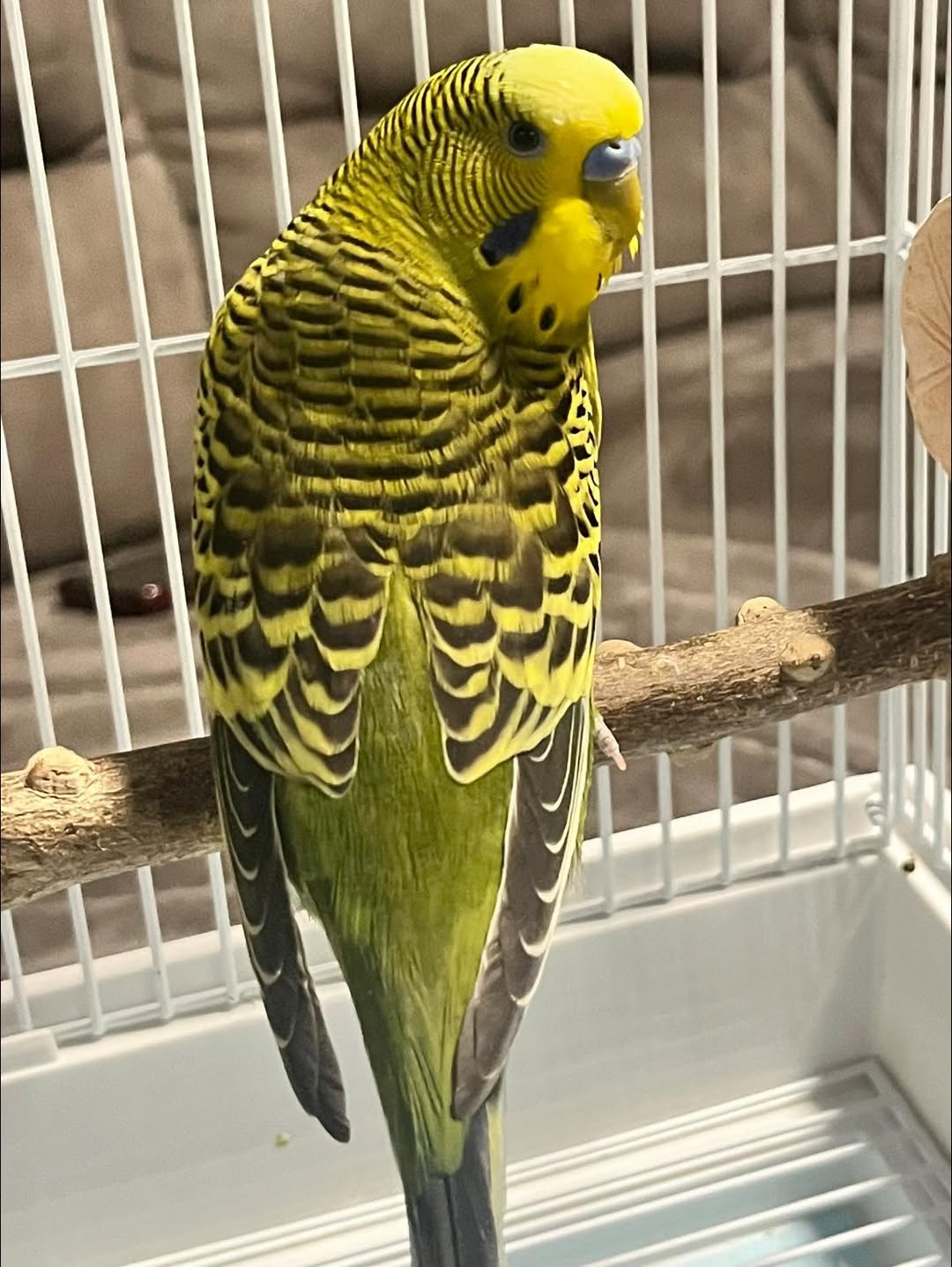
In juvenile budgies — birds that have not yet completed their first moult — the horizontal barring on the forehead extends all the way down to the cere, the fleshy area at the base of the beak. Look at a young budgie’s forehead from the front: the black and coloured barring that covers most of the crown continues uninterrupted to the point where the beak begins. There is no clear patch between the bars and the cere.
After the first moult — which occurs somewhere between ten and sixteen weeks of age depending on the individual bird — the forehead clears. The barring retreats, and a clear, unbarred area of white, yellow, or the base colour of the bird appears between the top of the beak and where the barring begins. This clear forehead patch is one of the most visible changes in the transition from juvenile to adult plumage.
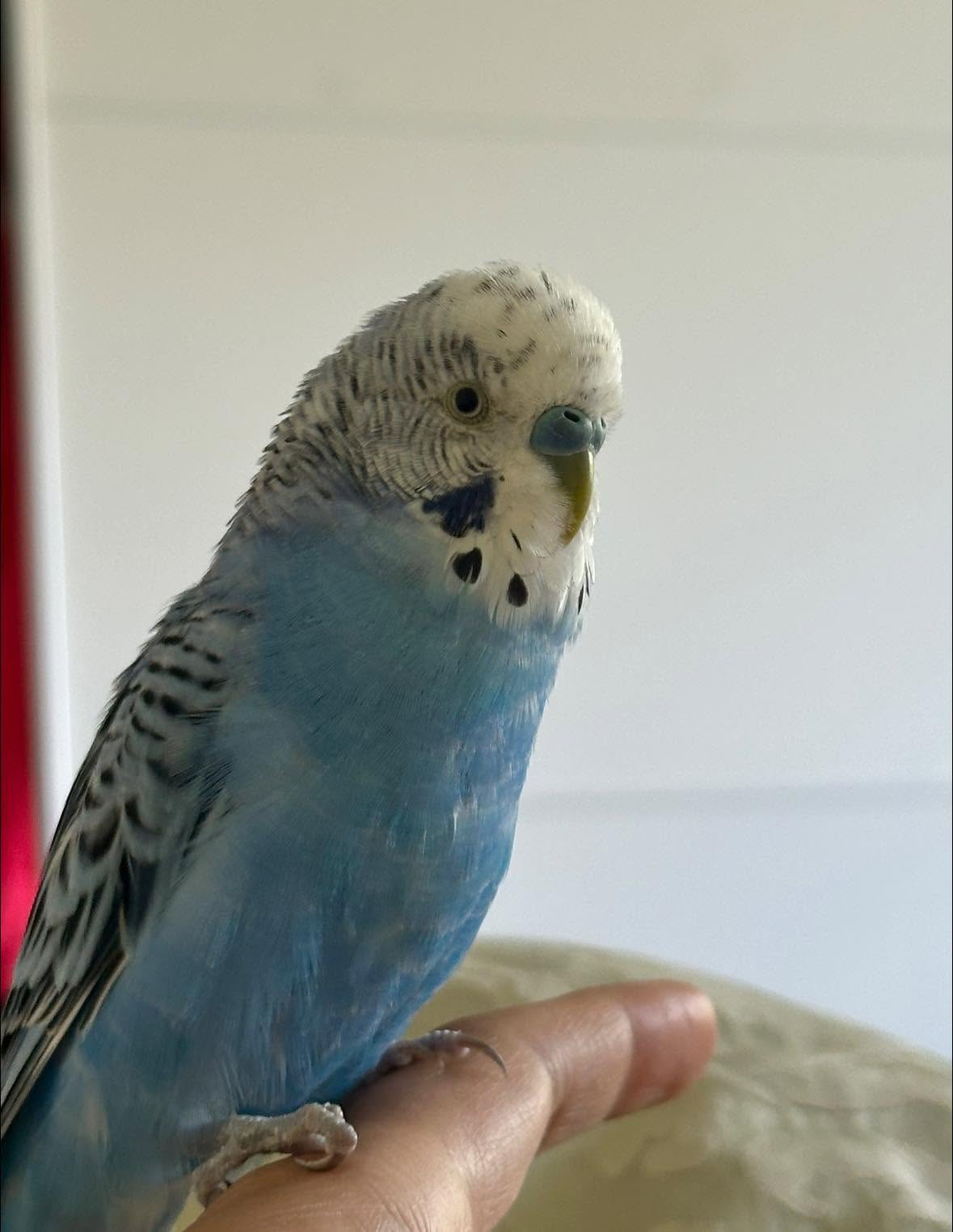
If a bird’s barring extends to the cere: it is under approximately four to five months of age and has not completed its first moult.
If the bird has a clear forehead patch: it has completed its first moult and is at minimum four to five months old. From this point forward, the forehead barring is no longer useful as an age indicator — all adult budgies have the clear patch.
The significant caveat: recessive pied budgies and some other colour mutations may have clear patches on the forehead at all ages, including as juveniles. If the bird you are looking at has unusual or patchy colouring, the forehead test may not apply.
Eye Colour and Iris Development — The Ongoing Age Indicator
Once a bird has completed its first moult, the forehead test no longer tells you much. The next most reliable physical indicator is the iris — the coloured ring visible around the pupil of the eye.
In very young budgies — birds under approximately three to four months — the iris is dark and difficult to distinguish from the pupil. The eyes of a young budgie appear almost entirely black or very dark, with no visible light ring around the pupil. This is because the iris pigmentation has not yet fully developed.
As the bird matures, the iris develops colour. In the months following the first moult — roughly four to eight months of age — the iris begins to lighten. In green and blue series budgies, it progresses from dark to grey to a light grey or white ring that becomes clearly visible around the pupil. By the time a budgie is around eight to twelve months old, a clear, visible iris ring — typically white or light grey in green and blue series birds — is well established.
Once that iris ring is fully developed, the distinction between juvenile dark eyes and adult light iris is complete. This means you can reliably distinguish a very young bird (dark, non-iris eyes) from an older bird (clear iris visible), but you cannot use eye colour to distinguish between a one-year-old and a five-year-old. Both have the same developed iris.
- Dark, all-black-appearing eyes — no visible iris ring: Bird is under approximately 3–4 months. Still juvenile or in early post-moult phase.
- Dark eyes with a very faint, slightly lighter ring beginning to appear: Bird is approximately 3–6 months. Iris developing post-first moult.
- Clear, visible light grey or white iris ring around pupil: Bird is approximately 8–12 months or older. Fully adult. Cannot determine age more precisely from eye colour alone.
- Important caveat — lutino and albino budgies: These colour mutations have red or pink eyes at all ages due to lack of melanin. Eye colour as an age indicator does not apply to these birds.
- Important caveat — recessive pied and some other mutations: May have dark eyes into adulthood. The eye colour test is most reliable in green and blue series standard budgies.
The Leg Ring — The Only Truly Reliable Age Indicator
If a budgie has a closed leg ring — a smooth, unbroken metal or plastic band on one leg that cannot be removed without cutting — it may contain information that allows the bird to be precisely dated. This is the most accurate method of age determination available, when the ring is present.
Closed rings are fitted to chicks while they are still in the nest, typically between four and fourteen days of age when the foot is small enough for the ring to slide on but large enough that it cannot be removed once the foot has grown. A ring present on an adult bird therefore confirms the bird was bred in captivity and ringed in the nest — it cannot have been fitted afterward.
In the UK, rings used by budgerigar societies and reputable breeders typically follow a standardised coding system that includes the year of hatch, the breeder’s identification, and sometimes additional information. The year of hatch is typically represented by a letter code corresponding to a specific year — the Budgerigar Society in the UK uses a rotating letter system that allows the year to be identified by looking up the relevant ring code guide.
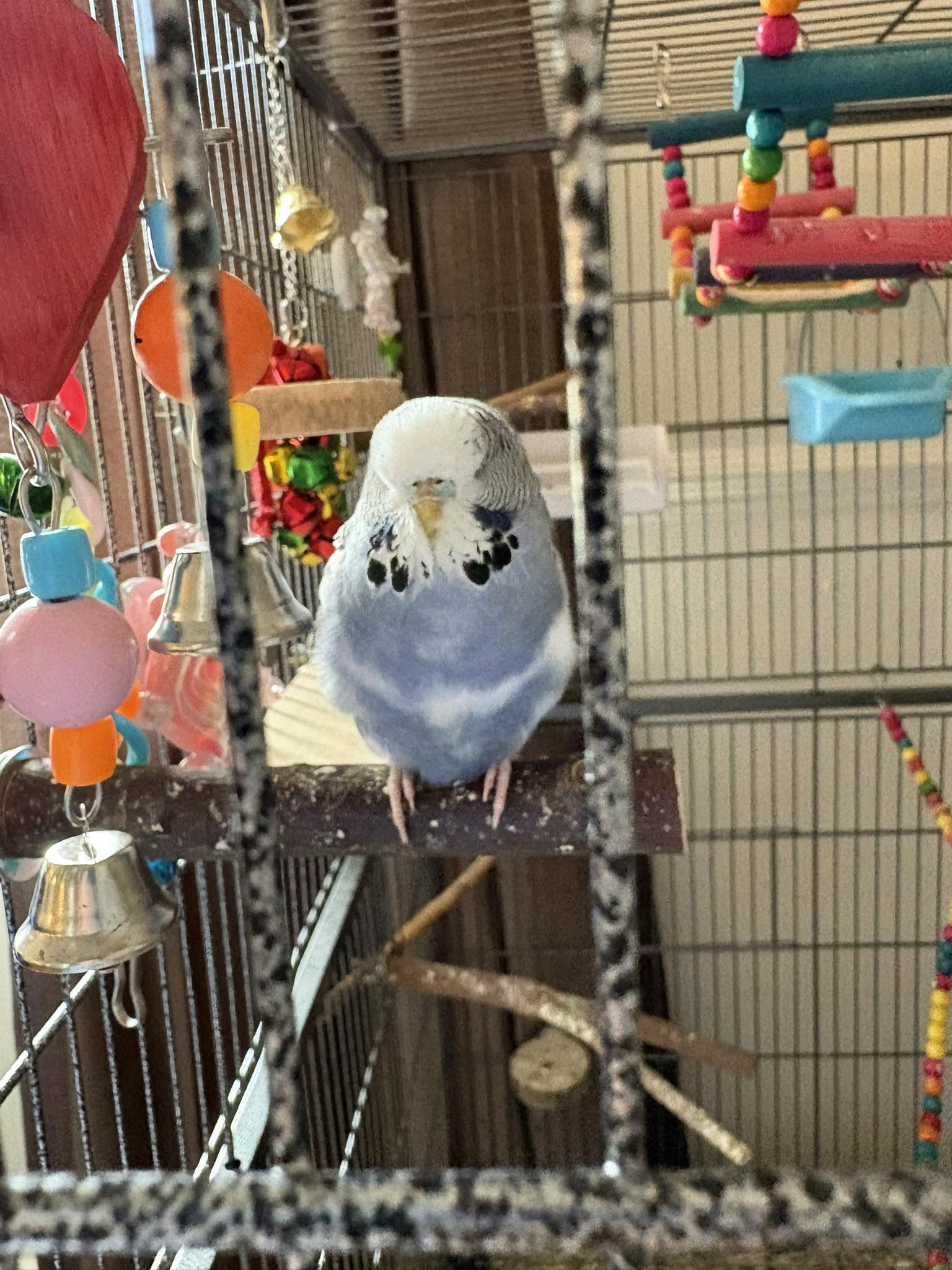
If you can read the letters and numbers on your budgie’s ring, the Budgerigar Society website — or a call to a reputable budgie breeder — can translate the year code into an actual birth year. This is precise, reliable, and eliminates all guesswork about the bird’s age.
If there is no ring on the bird — which is common in pet shop birds, aviary birds, or birds that have been through several owners — you are working with the physical indicators only.
How to Check for and Read a Leg Ring
To check for a ring, hold the bird securely but gently and examine both legs at the lower joint. A closed ring will be a smooth, seamless band sitting just above the foot, typically metal but occasionally plastic or celluloid.
The ring may be difficult to read clearly on a living, moving bird. In good light, look for stamped or embossed characters. The year letter is usually the largest or most prominent character. If you can photograph the ring — holding the leg still and using your phone camera with the flash on — the image can often be read more easily than by eye.
A split ring — a ring that appears to be made of flexible material or that has a visible gap — is an open ring that has been fitted after hatching and does not carry the same dating information as a closed ring. Open rings are often fitted for identification purposes by owners and tell you nothing reliable about age.
If the ring is there but unreadable — worn, damaged, or too small to photograph clearly — a vet with avian experience may be able to read it under magnification, or the ring can be referenced by its colour against known annual coding tables.
The Cere — Useful for Identification, Less Reliable for Age
The cere — the fleshy area above the beak where the nostrils are — is most useful for identifying male and female budgies rather than ageing them, but it does contribute some information to the age question in young birds specifically.
In very young budgies before maturity — broadly under four to six months — the cere tends to be pinkish or pale in both males and females, making identification unreliable at this stage. This is because the hormonal development that produces the differentiated cere colouration has not yet occurred.
As the bird matures, the cere differentiates: in males it turns blue or purple-blue (with variations in different colour mutations), in females it becomes brown, white, or tan. A bird with a clearly developed, fully coloured cere has reached maturity — meaning it is at minimum five to six months old and more likely eight months or over.
A cere that is still pinkish, pale, and undifferentiated suggests the bird is probably under six months old, though precise interpretation depends on the colour mutation and individual development rate.
Beyond the juvenile-to-adult transition, the cere does not progress in a way that reliably indicates older age. An eighteen-month-old male and a four-year-old male both have blue ceres. The cere is not useful for distinguishing age beyond the early developmental stage.
Plumage Condition and Feet — What They Tell You About Older Birds
For adult birds where the ring is absent and the eye test has reached its limits, general physical condition can give an approximate sense of whether you are dealing with a young adult, a middle-aged bird, or an older one — though this is the most approximate method of all.
Young adults in good health have bright, clean plumage with well-structured feathers, smooth and relatively clean feet, and a general appearance of good condition. Middle-aged birds maintained well look similar. Birds that are genuinely old — typically five years and beyond — may show subtle differences: the feathers around the cere may appear slightly more stained or worn, the scaling on the feet and legs may be more prominent, and the overall vitality may be slightly reduced.
However — and this is important — plumage condition reflects care and health as much as it reflects age. A well-kept three-year-old bird in a good environment may look significantly better than a poorly kept one-year-old. Feet condition is affected by perch type, diet, and health history as well as age. These physical markers are useful as rough guides in combination with other indicators, but they are not precise.
Colour Mutations — When the Standard Rules Do Not Apply
I have mentioned specific caveats throughout this guide and I want to bring them together here, because the colour mutation issue is significant enough to change the reliability of several standard age indicators.
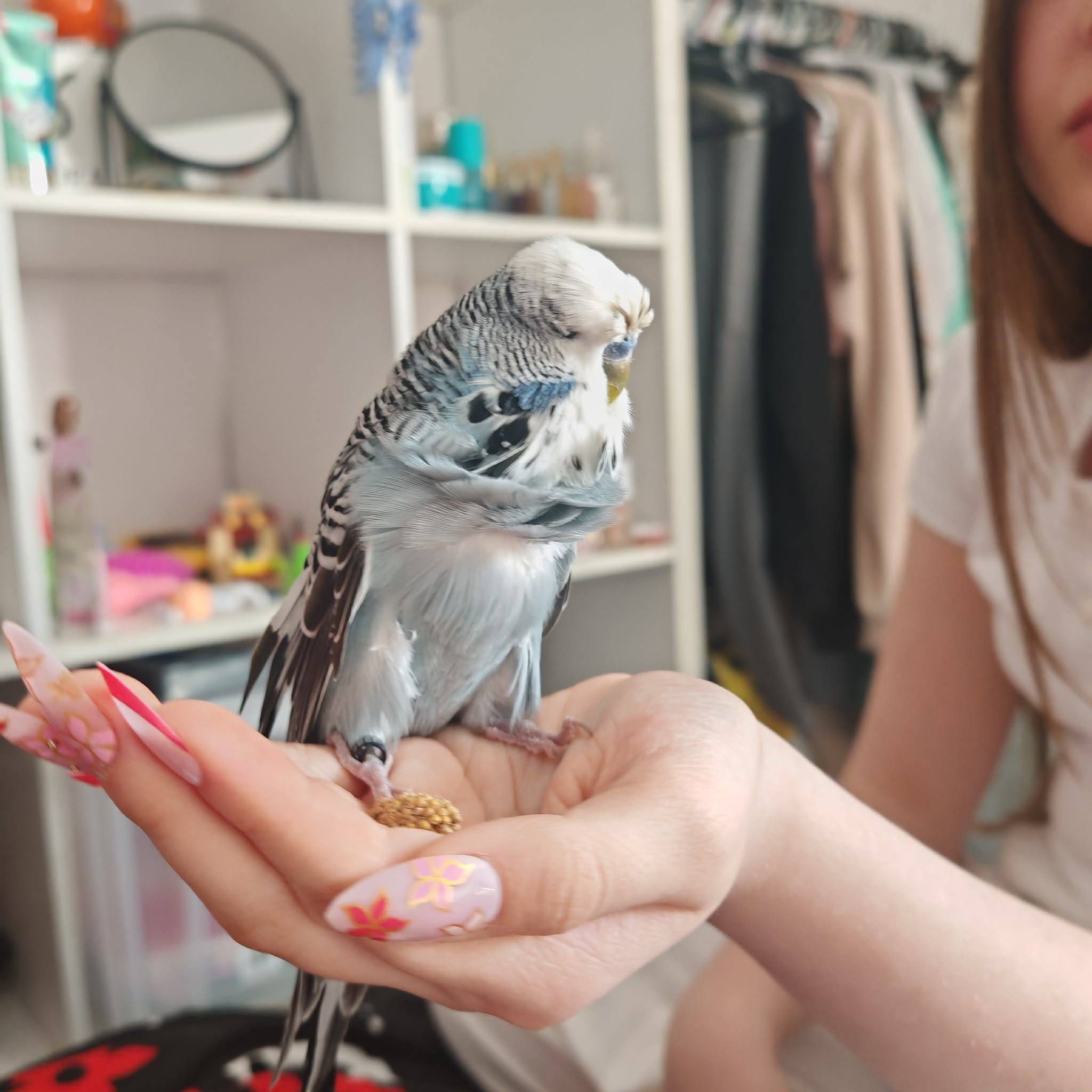
Lutino budgies — the yellow birds with red eyes — lack melanin in both the iris and the feathers. Their eyes are red or pink at all ages, making eye colour completely useless as an age indicator. The iris development test does not apply.
Albino budgies — white with red eyes — have the same melanin absence and the same limitation.
Recessive pied budgies often have dark eyes into adulthood without the iris development that characterises standard birds. The eye test may not apply.
Some colour mutations produce reduced or absent forehead barring even in juveniles, making the cap barring test unreliable for those individuals.
If you are trying to age a bird with unusual colouring, use the ring if present, and rely more heavily on whatever behavioural and contextual information is available. The physical indicators I have described are most reliable in standard green series and blue series budgies.
Quick Reference — Budgie Age Indicators
| What You See | What It Suggests | Reliability |
|---|---|---|
| Barring extends to the cere on forehead | Under 4–5 months — juvenile, pre-first-moult | High for standard birds. Does not apply to recessive pied or some other mutations. |
| Clear forehead patch — no barring to cere | Over 4–5 months — completed first moult | High. All adult standard budgies have this. |
| Dark, all-black-appearing eyes — no iris ring | Under 3–4 months | High for standard birds. Does not apply to lutino, albino, or recessive pied. |
| Visible light grey or white iris ring around pupil | Over 8–12 months — fully adult iris developed | High for standard birds that the iris test applies to. |
| Pinkish, undifferentiated cere | Under 5–6 months — immature | Moderate — varies by mutation and individual development rate |
| Fully coloured cere (blue or brown) | Over 6–8 months — mature. Cannot distinguish older ages from cere alone. | Moderate — confirms adult but does not narrow age further |
| Closed leg ring with year code | Precise birth year determinable from ring code | Highest — most reliable method if ring is present and readable |
| Good plumage, smooth feet — young adult appearance | Probably under 3 years — but highly dependent on care and health | Low — condition reflects care as much as age |
| More prominent foot scaling, slightly worn plumage | Possibly 4 years or older — but not conclusive | Low — suggestive only, not diagnostic |
The Honest Limits — What You Cannot Tell Without a Ring
I want to end the main guide with this, because I think it is worth saying plainly rather than leaving owners with the impression that physical ageing of budgies is more precise than it is.
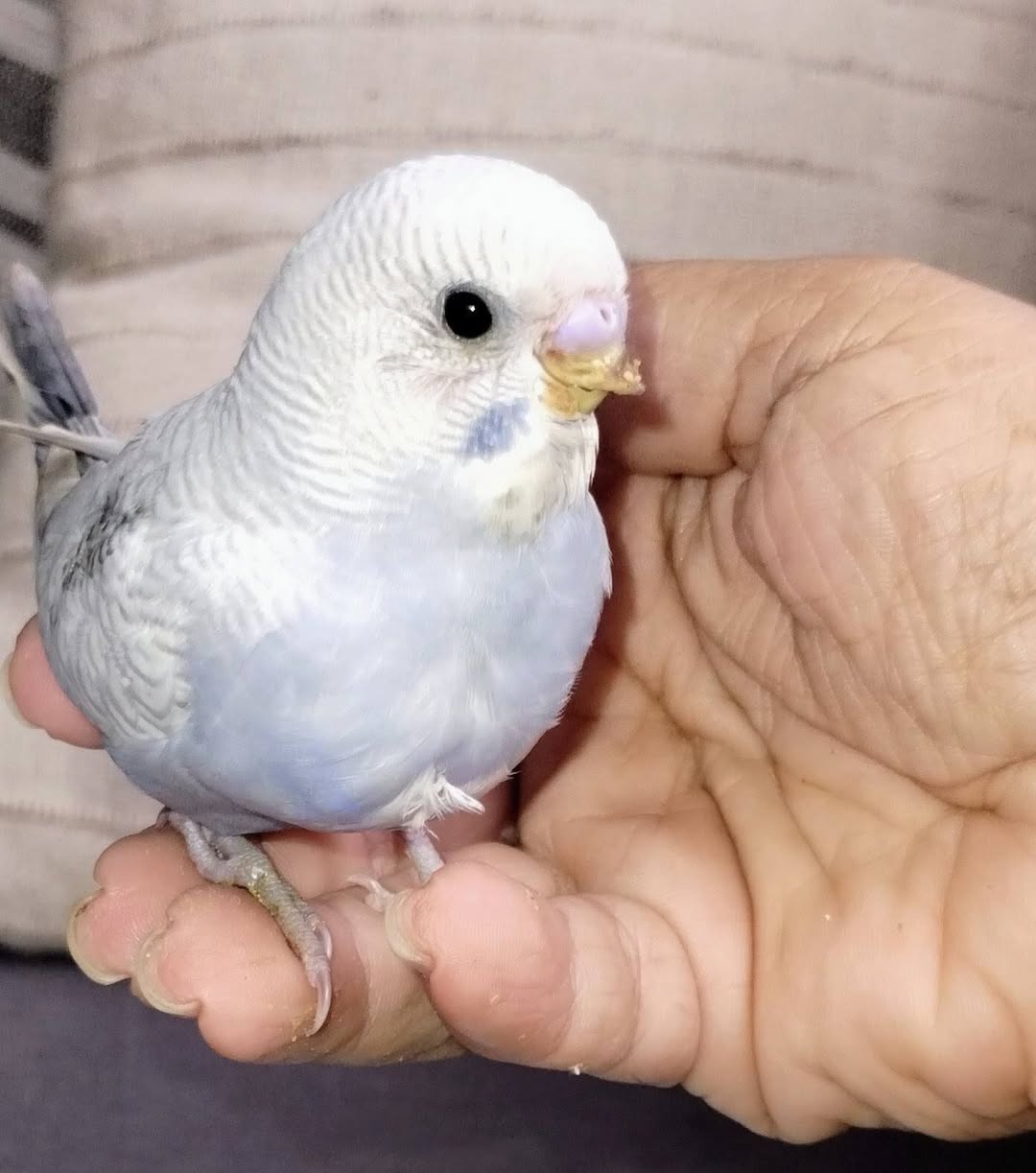 You can reliably tell: whether a budgie is a juvenile or an adult. Whether it has completed its first moult. Whether it is under four months, approximately six to twelve months, or over twelve months.
You cannot reliably tell: whether an adult budgie is one year old or four years old. Whether a middle-aged bird is two or three. Whether a bird with no ring and good plumage is in its second year or its fourth.
Once a budgie is fully adult — clear forehead, developed iris, full cere — the physical indicators plateau. Age markers stop developing in ways that are readable. Two birds of very different ages may be physically indistinguishable if both have been well kept. The ring is the only method that provides more than this rough bracket, and without it, precise dating of an adult bird is not something I can do and not something you should expect any honest person to be able to do.
What you can do is give the bird the best care appropriate to its apparent life stage, watch for the health changes associated with middle and older age, and appreciate it for what it is — an individual animal with a history you may not fully know.
Frequently Asked Questions
How can you tell a budgie’s age?
In young birds, the most reliable indicators are the forehead barring — which extends to the cere in juveniles and clears after the first moult — and the iris colour, which develops from dark to a visible light ring between approximately four and twelve months. A closed leg ring with a year code is the most precise method if present. For adult birds with no ring, precise ageing becomes significantly harder and involves general plumage and physical condition as rough guides only.
What age is a budgie fully grown?
Budgies reach their adult size and plumage relatively quickly compared to larger birds. The first moult occurs between ten and sixteen weeks of age. By approximately eight to twelve months, the bird has a fully developed iris, fully differentiated cere, and adult plumage. It is considered fully mature — physically and behaviourally — somewhere in the six to twelve month window depending on the individual.
How old is a budgie with clear eyes (visible iris)?
A budgie with a clearly visible, well-developed light iris ring around the pupil is at minimum eight to twelve months old. The iris develops progressively after the first moult and reaches its full adult form somewhere in this window. A bird with a clear, pale iris is certainly adult, but beyond “over approximately ten months” the iris alone does not allow further precision.
How can I tell if my budgie is old?
In the absence of a ring, signs that a budgie may be entering older age — broadly four to five years and above — include slightly more pronounced scaling on the feet and legs, possibly some wear on the plumage, and occasionally a subtle change in overall vitality. However, these signs are heavily influenced by the quality of care and the individual bird’s health history. A well-kept bird may show few obvious age signs for many years. The most reliable indicator remains the ring — without it, precise age determination past early adulthood is not possible.
My budgie has a ring — how do I find out when it was born?
Read the characters stamped on the ring and identify the year letter. The Budgerigar Society in the UK uses a standardised year letter system, and their website carries the guide to interpreting ring codes. A reputable budgie breeder or avian vet can also help interpret the ring. If the ring is too small or worn to read by eye, try photographing it under good light with your phone camera, or ask a vet to read it under magnification.
Where can I get advice about my budgie in Swindon?
Come to Paradise Pets — Manor Garden Centre, Cheney Manor, Swindon SN2 2QJ. Bring the bird and I will look at it honestly and tell you what the physical indicators suggest. If there is a ring I will help you read it. Call us on 01793 512400 before visiting.
Not Sure How Old Your Budgie Is? Come and I Will Take a Look
If you have a bird whose age you genuinely do not know — a rescue, a rehome, a bird bought without documentation — come in with it. I have been reading budgies for 35 years and I will tell you honestly what the physical signs suggest and where the limits of that assessment are. No guesswork presented as certainty.
⭐ Customer Reviews
Amazing Bird Selection
Had a lovley visit today,staff were very friendly and very helpful,such a great petshop,their selection of birds is incredible,really impressed,thank so much to the staff at Paradise Pets

Friendly Helpful Staff
I have been coming to this place for years and they have a great stock of food for all types of pets. Have a great selection of small mammals and a lot of birds. Staff are friendly and helpful.

Great Quality Hutch
Bought a guinea pigs hutch and run combo, very happy with the service, the hutch was put in my car for me without even asking for help. The wood quality is very good, the instructions easy to follow and we are extremely happy with the fully built hutch. A good size for 2 guinea pigs

Response from Paradise Pets | Wiltshire
Thank you Melanie Latus Nice to provide services to you.
Best Bird Shop Around
It’s the best pet shop in and around Swindon. They always have an amazing selection of birds and all you need to keep them happy. I keep birds myself and the guys there are happy to answer questions and really know their stuff. I have seen budgies etc. in chain pet shops in the area looking really unhealthy and ill – I wouldn’t go anywhere else than Paradise Pets for animals.

Highly Recommended Bird Shop
I could not praise this shop enough. Really helped my Grandson buy his first bird and he’s loving it. Travelled from Somerset and was welcomed with open arms.

Great Shop with Competitive Prices
Great shop with amazing selection for small animals, hamsters, mice ect, highly recommend!
Also has a great selection for dogs & cats too & very competitive prices! 💖

