


Neil has kept, bred, and sold budgies at Paradise Pets Swindon since 1988 — over 35 years of first-hand experience with these birds. In that time, he has had countless urgent phone calls from UK owners noticing one wing hanging lower than the other on their budgie. This is his honest, practical guide on what wing drooping really means — when it is genuinely an emergency, when it has a simpler explanation, and what every UK owner needs to do today if they see it.
A man rang the shop one Sunday evening, his voice tight with worry. “Neil,” he said, “I’ve just noticed my budgie’s right wing is hanging down. Properly hanging — like she can’t lift it. She’s still perching, still moving around, but the wing just dangles. I’m panicking. What do I do?”
I asked him three quick questions while he was still on the phone. Was the bird otherwise alert and eating? Had anything happened in the last few hours — a flight crash, the cage being knocked, a fright? And how long had he been noticing the drooping wing? By the time he had answered, I already had a strong idea that this was probably a wing injury from a panic flight earlier that day rather than an internal illness. I told him to keep the bird quiet, warm, and uncrowded overnight, and to ring the avian vet first thing Monday morning. By the following weekend the bird was holding her wing properly again, and the vet had confirmed it was a soft tissue strain rather than a fracture.
But this call could easily have gone the other way. Wing drooping is one of those symptoms where the same visible sign can mean very different things underneath. The honest truth is this — a budgie with a drooping wing needs to be taken seriously, today. Most cases have identifiable causes that can be resolved with the right action. But some cases are genuine emergencies where waiting even 24 hours can mean the difference between recovery and permanent damage.
After 35 years of selling these birds, I can tell you that wing drooping rarely sorts itself out without intervention. Most owners can identify the likely cause quickly with the right information — and acting on that information is what saves the bird’s wing, and sometimes its life. This is not a “wait and see” symptom. It is a “look carefully and act today” symptom.
This article is the conversation I have at the counter with worried owners who have just noticed a drooping wing. By the end of it, you will know exactly what the drooping wing means, the critical signs to look for alongside it, what to do in the immediate term, and when you need to skip everything else in this article and contact a vet right now.
First — What A Normal Budgie Wing Position Looks Like
Before we get into causes, you need to know what normal looks like so you can confirm what you are actually seeing. Many UK owners I see at the counter are not entirely sure their bird’s wing is genuinely drooping, or whether it just looks slightly off because they are paying close attention for the first time.
A healthy adult budgie at rest holds both wings:
- Tucked symmetrically against the body — the tip of each wing reaches roughly the same point on the tail
- Folded smoothly — no parts sticking out at odd angles
- Held at the same height — the shoulder of each wing should be level
- Closed cleanly — the primary flight feathers cross over the tail at the same point
- Slightly relaxed when the bird is calm — not held rigidly tight

A drooping wing breaks this symmetry. The affected wing visibly hangs lower than the other, may stick out from the body at an awkward angle, may have flight feathers trailing on the perch or cage floor, and the shoulder of the affected wing sits noticeably lower than the unaffected side. The bird may also use the wing for balance in unusual ways, or seem reluctant to use it at all.
If you genuinely see this asymmetry — and the difference is clear and consistent, not just a brief stretch or movement — your bird has a drooping wing, and you need to work through the rest of this article carefully.
The First Few Minutes — What To Check Before You Move The Bird
Before you do anything else, take five minutes to observe the bird carefully without disturbing it. The information you collect now will help you identify what is wrong and help any vet you contact later.
- Which wing is drooping?
Right, left, or both. Make a note. It matters for vet diagnosis. - How low is the wing hanging?
Slight droop, halfway down, fully dangling? Severity affects urgency. - Is the wing held away from the body, or hanging close?
A wing held out at an angle often suggests injury or pain. - Can you see any visible damage?
Blood, broken feathers, swelling, wounds, missing feathers? - What is the bird’s overall posture?
Upright and alert, or fluffed up and hunched? - Is the bird trying to use the wing?
Attempts to flap, or holding it completely still? - How is the bird’s breathing?
Normal, or visible effort and tail bobbing? - Has the bird eaten or drunk recently?
Activity around food and water tells you a lot about overall condition.
If the bird is alert, upright, breathing normally, eating, and the wing droop is the only visible problem — you have time to work through the causes carefully and contact a vet during normal hours. If the bird is also showing emergency signs — fluffed up, sitting on the floor, visible breathing effort, bleeding — skip the rest of this article and contact an emergency avian vet today.
- Visible bleeding from the wing or anywhere on the body
- The bird is sitting on the cage floor unable to perch
- Fluffed up posture and quiet, withdrawn behaviour
- Breathing difficulty — visible tail bobbing, open beak
- Eyes partially closed, dull, or unfocused
- The wing tip touching the floor while perched normally
- Bird unable to walk or balance
- Recent severe trauma — flight crash, attack by another animal, dropped
- Discharge from the nostrils or eyes
- Bird has stopped eating or drinking
For everyone else — the wing is drooping but the bird seems otherwise reasonably normal — let me walk you through the seven main causes I see at the counter.
The 7 Real Reasons A Budgie’s Wing Droops
After 35 years of seeing this in pet budgies, the causes fall into seven distinct patterns. Identifying which one matches your bird is the key to deciding what to do next.
1. Wing Injury From A Flight Accident
This is by far the most common cause I see at the counter. UK budgies kept indoors, particularly those with out-of-cage flying time, can panic-fly into windows, mirrors, walls, ceiling fans, or hard furniture. The resulting impact can cause soft tissue strain, bruising, or in worse cases, fractures.
Signs of flight-injury drooping:
- Drooping started suddenly, within hours of a known or possible crash
- The bird may have been seen flying into something
- The wing may be held away from the body
- Bird is otherwise alert and aware
- May be reluctant to fly or flap
- Often only one wing is affected
- Sometimes accompanied by mild bruising visible under feathers

What to do: keep the bird quiet, warm, and confined in a small cage or carrier overnight to prevent further damage. Limit out-of-cage time. Contact an avian vet first thing the next morning. Soft tissue injuries usually heal with rest, but fractures need professional assessment and sometimes splinting. Do not try to set the wing yourself.
2. Heat Exhaustion (Summer UK Behaviour)
This is something many UK owners do not realise. Budgies that are too hot sometimes hold their wings slightly away from the body — wings spread or slightly drooped — as a way to cool down. The body posture mimics drooping but is actually a deliberate cooling behaviour.
Signs of heat-related wing positioning:
- Hot weather, particularly UK summer days
- Both wings are slightly held away from body — not just one
- Bird may be panting or breathing more visibly
- Often combined with seeking cooler spots in the cage
- The “drooping” resolves when the temperature drops
- The bird is otherwise alert and well
- No actual injury or asymmetry — the wings move normally
What to do: move the bird to a cooler spot, ensure fresh water is available, and consider offering small amounts of cucumber or other hydrating vegetables. The wing position will normalise once the bird cools down. If you are not sure whether it is heat or actual drooping, look for asymmetry — a heat-related position is symmetrical, an injury is one-sided.
3. Muscle Strain From Overexertion
Budgies with limited regular exercise who then have a long flying session can strain their wing muscles, similar to a human getting sore muscles after unexpected exercise. The result is a wing that the bird does not want to use for a day or two, and which may hang slightly lower than normal.
Signs of muscle strain:
- Recent extended out-of-cage flying after limited daily exercise
- Drooping is mild rather than dramatic
- The bird is otherwise active and alert
- No visible damage or wounds
- Drooping improves within 24-48 hours with rest
- The bird may favour the wing slightly when moving
What to do: rest. Reduce flying opportunities for a few days. Keep the cage smaller temporarily so the bird does not try to fly. Watch for improvement within 48 hours. If the wing does not improve, or worsens, see a vet — what looked like a strain may actually be something more serious.
4. Nutritional Or Vitamin Deficiency
A budgie on a poor diet — primarily seed without proper vegetables, calcium, or vitamins — can develop muscle weakness and wing positioning problems over time. This is usually a gradual condition that develops over weeks or months rather than suddenly.
Signs of nutritional wing drooping:
- Gradual onset over weeks or months, not sudden
- History of seed-only diet, little to no fresh foods
- Both wings may be affected to some degree
- The bird may show other signs — dull feathers, weight loss, reduced activity
- Bird may seem to lack normal flying strength
- Often combined with other signs of poor general health
What to do: improve diet immediately and see an avian vet. Proper nutrition usually resolves mild nutritional muscle problems within weeks, but severe cases may have permanent effects. Add daily fresh vegetables, ensure cuttlefish bone is always available, and consider a quality bird supplement under vet guidance.
5. Egg Binding In Females
This is a critical condition every UK owner of an adult female budgie needs to know about. A female that is unable to pass an egg can show wing drooping as part of a wider picture of severe illness. The bird is in genuine pain and the condition is life-threatening if untreated.
Signs of egg binding causing wing droop:
- Female bird of breeding age
- Recent hormonal behaviour — nesting, paper shredding, cere changes
- Wing drooping is part of overall illness — fluffed, hunched, quiet
- Bird straining without producing droppings or egg
- Visible swelling around the vent area
- Heavy breathing, weakness, sitting on the cage floor
- Possibly visible egg-shaped swelling in the abdomen
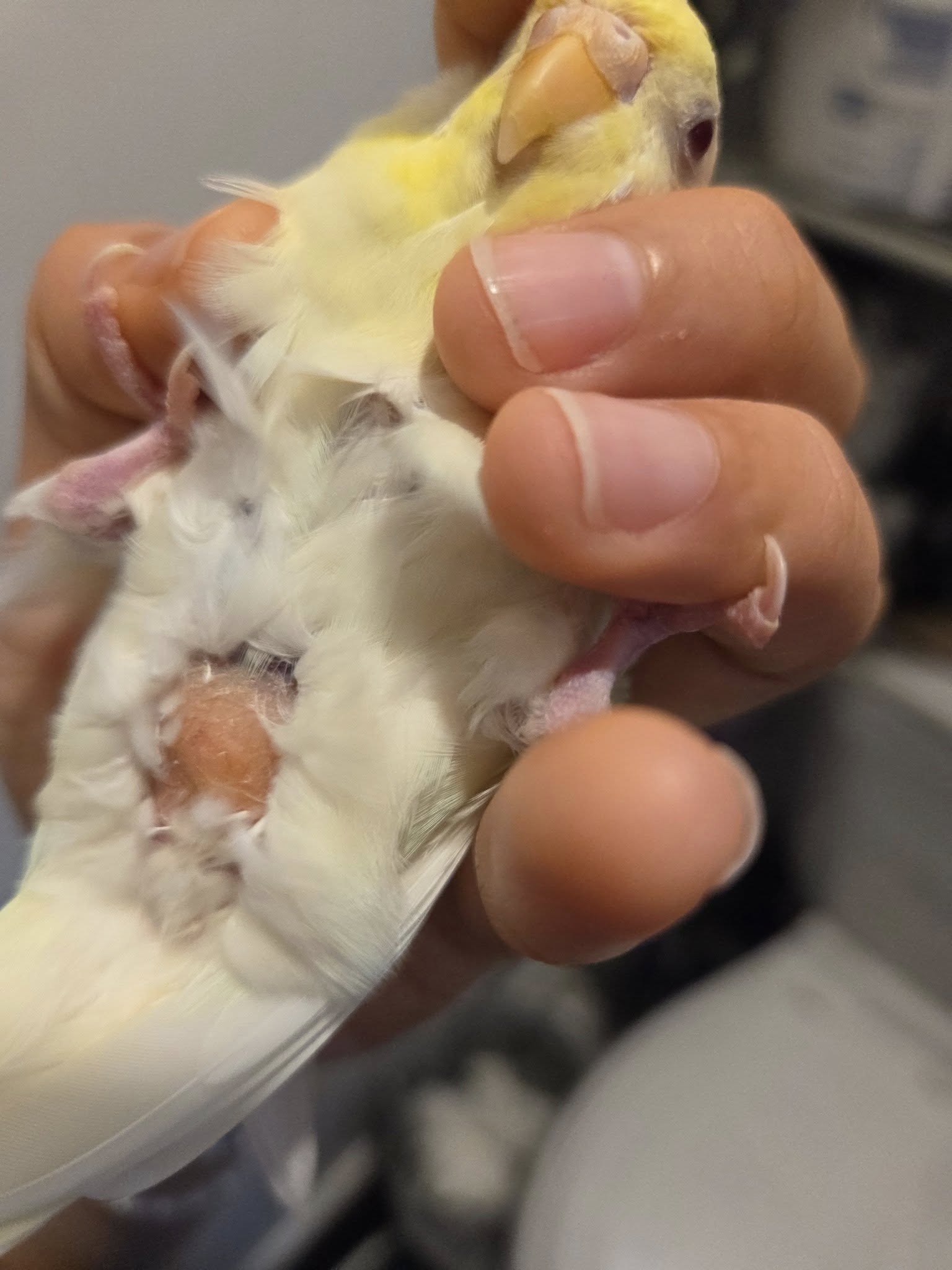
What to do: this is a veterinary emergency. Contact an avian vet today, even if it means an out-of-hours visit. Egg binding can kill a budgie within 24-48 hours if not treated. Keep the bird warm and quiet on the way to the vet.
6. Internal Illness Or Infection
Some internal illnesses — respiratory infections, organ problems, infections — can present with wing drooping as one of several signs. The drooping itself is not the primary problem; it is part of the bird showing it is genuinely unwell.
Signs of illness-related drooping:
- Drooping combined with other illness signs — fluffed up, quiet, off food
- The bird seems generally unwell, not just affected in one wing
- Breathing changes — tail bobbing, open beak, faster than normal
- Changes in droppings — colour, consistency, frequency
- Reduced activity, perching low or on the floor
- Eyes partially closed, dull, or watery
- Sometimes weight loss visible over days
What to do: see an avian vet today. The wing droop is a secondary sign of underlying illness, and that illness needs diagnosis and treatment. Early intervention dramatically improves outcomes.
7. Old Age Or Chronic Conditions
Older budgies — particularly those over 7 years — can develop chronic conditions including arthritis, age-related muscle weakness, or organ issues that affect wing positioning. The drooping is usually gradual, bilateral, and accompanied by other signs of ageing.
Signs of age-related drooping:
- Older bird, often over 7 years
- Gradual onset over months
- Both wings often affected to some degree
- Reduced flying ability overall
- The bird may be slower, less active in general
- Other age-related changes — slight feather quality decline, sleep changes
- Otherwise the bird is functioning and eating normally
What to do: an avian vet check is still worthwhile to rule out treatable conditions. For confirmed age-related changes, the focus is on comfort — easier-to-reach food and water, lower perches, less demanding cage layout, and excellent nutrition.
How To Tell The Causes Apart — Neil’s Counter Approach
When an owner brings in or rings about a drooping wing, here is the order I work through to identify the cause. Most cases become clearer in the first five questions.

| Question | What The Answer Tells Me |
|---|---|
| Did the drooping start suddenly within hours? | Yes = likely injury or trauma. No = consider gradual causes. |
| Did the bird crash or have a flying accident? | Yes = wing injury most likely. Vet first thing. |
| Is it hot weather and are both wings affected? | Yes = possibly heat-related cooling, not actual droop. |
| Is the bird otherwise alert and eating? | Yes = isolated wing issue. No = systemic illness. |
| Is the bird a female showing hormonal signs? | Yes = consider egg binding immediately. |
| What is the bird’s age and overall condition? | Older birds = age-related possibility. Younger = injury or illness more likely. |
| Has the bird had a poor diet? | Yes = nutritional cause possible. Address diet plus vet. |
| How long has the drooping been present? | Hours to days = acute. Weeks to months = chronic. |
Working through these questions in order usually identifies the most likely cause within five minutes. The vast majority of cases fall into one of the seven categories above, and the answer determines what to do next.
What To Do Right Now — Your First 24 Hours
For UK owners reading this with a drooping-wing budgie at home, here is the practical immediate action plan. Work through these steps in order.
- Confirm the wing is genuinely drooping
Check symmetry. Compare both wings at rest. Is one clearly held lower than the other? - Check for emergency signs
Bleeding, sitting on the floor, fluffed up, breathing problems? If any present, vet today. - Note the bird’s overall condition
Posture, eyes, breathing, droppings, eating. The wider picture matters enormously. - Confine the bird in a smaller cage or carrier
Reduce flying opportunities. A small space prevents further injury while you assess. - Keep the room warm and quiet
Around 22-24°C is ideal. Reduce stress and noise. - Offer food and water at easy-to-reach height
Bird should not have to fly or stretch to access basics. - Watch the bird closely for the next several hours
Is it improving, stable, or worsening? Improvement may mean rest will heal it. Worsening means vet today. - Contact an avian vet within 24 hours if not improving
Persistent drooping wings rarely fix themselves. Vet input is almost always needed.
For most drooping wing cases, the right approach is immediate confinement and rest, followed by veterinary assessment within 24-48 hours. Cases involving obvious injury, illness, or female hormonal signs need a vet on the day. Cases involving mild strain or heat-related positioning may resolve with rest alone, but always with vet input if the situation does not improve quickly.
What NOT To Do With A Drooping Wing
There are a few things UK owners do with the best of intentions that can make wing problems worse. Avoid these.
- Do not try to splint or bind the wing yourself — incorrect splinting can worsen injury
- Do not give pain medication intended for humans or other animals — many are toxic to birds
- Do not handle the bird more than necessary — stress slows healing
- Do not encourage flying or movement — rest is essential
- Do not assume rest alone will fix everything — vet input matters
- Do not wait several days “to see what happens” — early action improves outcomes
- Do not move the bird to a large cage — confinement helps recovery
- Do not try home remedies you have read online — most are useless or harmful
- Do not feed unusual foods to “build strength” — stick to the normal diet plus fresh water
The single most common mistake I see is owners waiting to see if the wing improves on its own. Some mild cases do improve, but most drooping wings have underlying causes that need professional assessment — and waiting reduces the chance of full recovery.
When To See A Vet — Honest Guidance
After 35 years, this is when I tell UK owners to stop assessing and start phoning the vet.
- The drooping is severe, with the wing fully hanging or dragging
- The bird is showing any other illness signs alongside the drooping
- There is visible bleeding, wounds, or obvious injury
- The bird is a female showing hormonal or egg-binding signs
- The drooping has not improved within 24 hours of rest
- The bird is reluctant to use the wing at all
- You suspect a fracture or serious injury
- The bird is breathing with effort or has reduced activity
A specialist avian vet is genuinely worth the journey for wing injuries. General small-animal vets often do not have the specific avian experience for proper assessment and treatment. If you do not know an avian vet in your area, ring us at Paradise Pets and we will try to point you in the right direction.
How To Help A Budgie Recover From Wing Problems
For UK owners whose bird has been diagnosed with a wing injury or condition and is recovering at home, here is the supportive care that genuinely helps.
- Smaller hospital cage — prevents flying attempts during healing
- Low perches only — reduces drops if the bird falls
- Food and water at perch height — easy access without stretching
- Stable, warm temperature — 22-24°C is ideal
- Reduced light hours — helps the bird rest more
- Quiet environment — minimal household noise and disruption
- Excellent nutrition — quality seed plus daily fresh vegetables
- Follow vet instructions precisely — including any medication schedules
- Watch for improvement signs — wing held higher, more movement, better appetite
- Avoid handling unless necessary — stress slows recovery
Most properly-treated wing problems show clear improvement within 1-2 weeks. Full recovery may take several weeks for soft tissue injuries, longer for fractures. Patience and careful adherence to vet guidance gives the best outcome.
How To Prevent Wing Injuries In The First Place
For UK owners who want to reduce the risk of wing injuries happening, here are the practical prevention steps that genuinely work.
- Bird-proof the room before out-of-cage time — cover mirrors and large windows with curtains or blinds
- Switch off ceiling fans — these are the single biggest indoor risk
- Remove other pets from the room — even friendly cats or dogs can cause panic flights
- Close doors to other rooms — prevents escape attempts and crashes
- Provide regular flying opportunities — fit, strong birds are less likely to crash
- Maintain proper diet — strong muscles and bones resist injury
- Keep cages free of dangerous toys — sharp edges, small openings, anything that could catch a wing
- Use cages with appropriate bar spacing — under 12mm prevents trapping
- Avoid sudden environment changes — gradual transitions reduce panic
- Annual avian vet checks for older birds — catch chronic issues before they cause drooping

Prevention is genuinely easier than treatment. Most wing injuries I see at the counter happened during indoor flying time in rooms that had not been properly bird-proofed. A few minutes of preparation before letting your bird out can prevent serious problems.
Frequently Asked Questions
Why is my budgie’s wing hanging down on one side?
A wing hanging clearly lower than the other almost always indicates injury, strain, or illness affecting that specific wing. The most common cause is a flight injury from crashing into something, but illness, infection, fracture, or even egg binding in females can also cause one-sided drooping. See an avian vet within 24 hours.
Can a budgie’s drooping wing heal on its own?
Mild muscle strain may improve with rest within 48 hours. But most drooping wings have underlying causes — fractures, infections, internal illness — that need veterinary assessment and treatment. Waiting and hoping rarely produces good outcomes. Even mild cases benefit from vet input to confirm there is no fracture or hidden problem.
How long does it take for a budgie’s wing to heal?
Soft tissue injuries usually improve significantly within 1-2 weeks of rest. Fractures take 4-6 weeks to heal with proper treatment, sometimes longer. Internal illnesses depend on the underlying cause. Old age or chronic conditions may never fully resolve, but proper management improves quality of life.
What does it mean if my budgie’s wing droops and the bird is fluffed up?
This combination is genuinely worrying. A fluffed-up posture combined with wing drooping suggests systemic illness rather than just a wing problem. The bird is showing it feels unwell overall. This is a same-day vet situation, not a “wait and see” situation.
Can hot weather cause a budgie’s wing to droop?
Hot weather can cause budgies to hold their wings slightly away from the body to cool down, which can look like drooping. The difference — heat-related wing positioning affects both wings symmetrically and resolves when the bird cools down. True drooping is usually asymmetric and persistent. If you are not sure, cool the room and check again.
Should I try to splint my budgie’s wing at home?
No. Incorrect splinting can cause permanent damage. Even experienced bird keepers leave wing splinting to avian vets. If you suspect a fracture or serious injury, confine the bird in a small cage to prevent further damage and get veterinary help today. Do not attempt to manipulate or set the wing yourself.
Where can I get honest budgie advice in Swindon?
Come and see us at Paradise Pets, Manor Garden Centre, Cheney Manor, Swindon SN2 2QJ. Or give us a ring on 01793 512400. The advice is free and we have been doing this for 35 years.
One Last Thing From Me
“My budgie’s wing is drooping — what do I do?” is one of the most worried calls I get from UK owners, and one of the most important to answer quickly. The honest answer, after 35 years of selling these birds, is — take it seriously today, identify the likely cause, and get veterinary input within 24 hours unless it is a clear case of mild muscle strain that resolves overnight.
Drooping wings almost never fix themselves completely. Some cases get a little better with rest, but the underlying cause usually persists or gets worse. The owners who get the best outcomes are the ones who act within the first day, contact an avian vet promptly, and give the bird proper supportive care while it heals. The owners who wait and hope are the ones who end up with permanent wing problems, chronic conditions, or worse.
The man who rang me about his budgie that Sunday evening? He acted exactly right. Saw the drooping, confined the bird overnight, rang the vet first thing Monday, and followed the treatment plan carefully. By the following weekend the wing was held properly again, and three months later the bird was flying around the lounge with no obvious issues. That is the outcome you want — caught early, treated properly, recovered fully.
If you are reading this with a budgie whose wing is drooping right now, please do not panic but please do not delay. Go through the observation checklist. Identify the likely cause. Confine the bird safely. And get veterinary input within 24 hours. If you are local to Swindon and unsure, come and see us. We have helped countless UK owners through wing problems, and we are always happy to take a proper look and talk through the next steps.
Worried About Your Budgie’s Drooping Wing? Come And See Me
Bring the bird in or give us a ring today. Five minutes of careful observation and a few honest questions usually identifies the likely cause. Free advice, no obligation. That is how we have done things for 35 years.