


Neil has kept, bred, and sold budgies at Paradise Pets Swindon since 1988 — over 35 years of first-hand experience with these birds. A budgie that chews everything it can reach is a budgie doing exactly what budgies are built to do. The question is not how to stop it — it is how to give the bird appropriate things to chew, and how to identify the one version of chewing that genuinely needs addressing.
Someone comes in and says their budgie is destroying everything in its cage. The toys are in pieces, the perches are chewed down, the newspaper on the cage floor has been shredded, and now the bird has started on the cage bars.
Is something wrong with it?
I ask which of those things concerns them most. Usually it is the cage bars — because that one looks deliberate and aggressive in a way the others do not.
Here is the honest answer to both questions.
Nothing is wrong with it. A budgie that chews is a budgie doing precisely what millions of years of evolution designed it to do. Budgies are parrots. Parrots chew. Their beaks grow continuously throughout their lives and require constant use to stay at the correct length and shape. Their natural diet and behaviour involve manipulating objects with their beaks for hours every day. The urge to chew is not a behaviour problem. It is a biological constant.
The cage bars, though — that version is worth a separate conversation.
The Short Answer — Your Budgie Is a Parrot and Parrots Chew
Budgerigars are the smallest member of the parrot family commonly kept as pets in the UK. That distinction matters for understanding chewing, because the urge to gnaw, shred, and manipulate objects with the beak is one of the defining characteristics of the entire parrot order — present in every species, regardless of size.
In the wild, budgies spend a significant portion of every day using their beaks. Cracking seed casings, stripping bark from branches, investigating new objects in their environment, occasionally gnawing at wood. The beak is their primary tool for interacting with the physical world. It is also a continuously growing structure that requires constant wear to maintain its correct shape and length. Without sufficient chewing, beak overgrowth occurs.
A budgie in captivity that has appropriate things to chew will chew them constantly, enthusiastically, and completely without apology. This is healthy. This is what should be happening. An owner who provides natural wood perches and watches the bird steadily reduce them to sawdust over several months is watching a bird maintaining its beak correctly and fulfilling one of its most fundamental biological drives.
The problem is not the chewing. The problem — when there is one — is what the bird is chewing when appropriate alternatives are not provided.
Why Chewing Is Not a Problem — The Biology Worth Understanding
A budgie’s beak consists of two keratin-covered structures — the rhinotheca (upper beak) and the gnathotheca (lower beak) — that grow continuously from their bases throughout the bird’s life. In a bird with appropriate chewing opportunities, this growth is constantly worn down by use, maintaining the beak at the correct length and angle. In a bird without adequate chewing material, the beak overgrows — the upper beak extends beyond the lower, curving forward in a way that eventually interferes with the bird’s ability to eat.
Beyond beak maintenance, the urge to chew in parrots is linked to foraging behaviour. Wild budgies do not simply find seed and consume it — they investigate, manipulate, and work at their food and their environment for much of the day. The beak is the tool they use for this exploration. Captive birds have the same neural drives. When those drives cannot be expressed through meaningful activity — foraging, investigation, environmental manipulation — they find expression through whatever is available. Cage bars, if nothing better is on offer.
This is why providing appropriate chew materials is not optional enrichment for budgies. It is meeting a biological need that, unmet, leads to beak problems, boredom behaviours, and the substitution chewing of inappropriate materials.

Bar Chewing — The One Version Worth Addressing
Bar chewing is different from chewing wood, toys, or paper. It looks different, it sounds different, and it means something specific.
A budgie gripping the cage bars and working at them methodically — often in the same spot, over and over, sometimes for extended periods — is almost always expressing boredom, frustration, or stress. The bars are not appropriate chew material. The bird is not chewing them because it wants to. It is chewing them because there is nothing else to do, or because the urge to do something with its beak is stronger than the available alternatives.
This distinction matters practically because bar chewing has a physical risk that goes beyond beak wear. If the cage bars are galvanised — coated with zinc, which many cheaper cages are — the bird is ingesting zinc with every session. Zinc toxicity is cumulative and progressive. A bird that bar-chews on galvanised bars for months is a bird being slowly poisoned. I have written about this in our complete cage guide — the material question is important and it is not always obvious from looking at the cage.
But before the material question, the behaviour question: why is the bird bar-chewing?
The most common answers: the cage is undersized and the bird is frustrated by limited movement. There is insufficient enrichment in the cage. The bird is spending too long alone. The available toys and chew materials are not engaging enough.
Addressing bar chewing means providing more and better. More space. More enrichment. More out-of-cage time. More appropriate things to chew that are more interesting than the bars. When the alternative is better than the bar, the bird almost always chooses the alternative.

What Budgies Should Be Chewing — The Safe List
These are the materials I recommend providing, in rough order of value and availability.
Natural untreated wood from safe species. Apple, pear, cherry, willow, hazel, birch. These are all safe for budgies and all excellent chew materials. A branch cut from a fruit tree, washed, dried, and placed in the cage is the ideal — free, natural, the correct hardness for beak maintenance, and replaceable as often as needed. The bird will reduce it to splinters over time. That is the point.
Avoid cedar and pine, which contain aromatic oils that irritate the respiratory system. Avoid any wood that has been treated, painted, or varnished. Avoid wood from unknown sources that may have been exposed to pesticides.
Cuttlefish bone. Cuttlefish bone is not wood but it belongs on this list because every budgie should have one always available. It provides both the calcium that budgies need and an appropriate gnawing surface. A budgie that has access to cuttlefish bone will use it regularly. It also serves as a beak conditioning surface that supplements wood chewing.
Mineral blocks. Similar purpose to cuttlefish bone. Provide both mineral supplementation and a hard surface for beak work. Not a substitute for wood chewing but a useful supplement.
Palm leaf and coconut products. Dried palm leaf toys, coconut shell pieces, and similar natural materials provide a different texture from wood and are enjoyed by many budgies. Safe to chew, different sensory experience, good for enrichment rotation.
Paper and plain cardboard. Plain, unprinted paper and cardboard — not glossy, not dyed, not printed with ink — is entirely safe for budgies to shred. It is also free, requires no preparation, and provides the shredding enrichment that many budgies find highly satisfying. A piece of plain cardboard clipped to the cage bars is better enrichment than many commercial toys.
Dried herbs and grasses. Dried chamomile, dried grass bunches, dried herb stems. Safe to chew, provide foraging engagement alongside the chewing, and can be tucked into other cage furniture to create compound enrichment items.

What Budgies Should Not Be Chewing — The Danger List
Galvanised cage bars. As discussed above — zinc toxicity. Check your cage material. Powder-coated steel is safe. Galvanised wire is not. If you are not sure, contact the manufacturer or come and talk to us.
Painted or varnished wood with unknown finishes. A budgie chewing a piece of wood will consume whatever is on the surface. Bird-safe, water-based natural finishes are acceptable. Synthetic paints, varnishes, and stains are not.
Plastic toys and fittings. Hard plastic can be chewed to sharp fragments that cause injury if ingested. Rope toys made from nylon can cause crop obstruction if the fibres are ingested. Keep plastic accessories to a minimum in a cage with an enthusiastic chewer, and inspect regularly for damage that creates ingestion risks.
Treated or unknown wood. Any wood that has been treated with pesticides, pressure treatment, or chemical preservatives should never be in a budgie cage. This includes most wood from timber merchants and hardware stores. Use only wood from known safe species that has not been treated.
Houseplants during free-fly time. Many common UK houseplants are toxic to birds. During out-of-cage time, a chewing budgie will investigate every accessible plant. Remove plants from the flight area or replace them with bird-safe species. Avocado, daffodil, philodendron, dieffenbachia, lily, and many others are toxic. The safe list is shorter than the unsafe one for most houseplant collections.
Furniture, wallpaper, and skirting boards. Not toxic in themselves in most cases, but skirting boards may be treated with paint containing compounds that are not safe for birds to ingest, and wallpaper adhesive is not appropriate either. Manage free-fly time so these are not accessible.
Chewing When Out of the Cage — Managing Free-Flight Time
A budgie given free-fly time in a room is a budgie that will systematically investigate and attempt to chew everything it can land on. Books, wooden furniture, picture frames, electrical cables, plants. The enthusiasm is entirely normal. The management responsibility falls on the owner.
Bird-proofing a room for budgie free-fly time means: electrical cables covered or removed from the flight area, plants moved out of reach, windows and mirrors covered so the bird does not fly into them, doors and exterior openings closed. And appropriate chew materials positioned in the flight space — a branch mounted on a stand, a piece of cuttlefish, a foraging toy — so the bird has interesting things to chew that it can choose freely.
A budgie that has good chew options available during free-fly time will spend most of its time on those rather than on your furniture. Not all of it — curiosity is part of the bird’s nature, and it will investigate new surfaces regardless. But directing the chewing toward appropriate targets reduces the damage to inappropriate ones significantly.
Female Budgies and Nesting Chewing — The Seasonal Version
Female budgies in breeding condition will chew wood with a specific intensity and purpose that differs from general foraging chewing. They are not maintaining their beaks. They are building a nest.
In the wild, female budgies excavate nest holes in dead wood and chew the interior to shape it to their needs. In captivity, a female in hormonal breeding condition will do the same thing to whatever wood is accessible — the perches, the wooden toys, any piece of timber she has identified as a potential nest site. The chewing is deliberate, localised, and often surprisingly effective. I have seen female budgies do significant structural damage to wooden cage furniture in a short period.
This behaviour is seasonal — it increases in spring when light levels rise and decreases as the hormonal phase passes. Management is the same as for other hormonal behaviours: reduce light exposure to twelve hours per day, remove any enclosed spaces or dark corners that could be adopted as nest sites, and provide appropriate chew materials that are acceptable for this purpose — natural wood branches that can be replaced.
Do not attempt to stop a female budgie in breeding condition from chewing appropriate wood materials. It is a hormonal drive that cannot simply be redirected away. Channel it toward safe materials and allow the behaviour its natural course.
Chewing Your Fingers, Jewellery, and Clothes — What It Means
A budgie that is on your hand and begins nibbling your fingers is not biting — it is investigating. The beak is the budgie’s primary sensory organ for exploring new surfaces. Your skin, your jewellery, the weave of your sleeve — these are all objects of curiosity that the bird explores through tactile beak contact.
The nibbling that most owners describe from a tame, comfortable budgie is gentle, exploratory, and not painful. It is the bird telling you, in its own language, that it is comfortable enough with you to use you as an enrichment item. That is, in most cases, a compliment.
The version that is worth discouraging: hard biting that is not exploratory but defensive — a bird that bites when it is uncomfortable. This is different from the gentle nibbling of a settled, curious bird and distinguishable by context and force. I cover biting specifically in our guide on budgie aggression.
For jewellery: metal jewellery is worth being cautious about with a budgie on your hand. Some metals — zinc, lead — are toxic if chewed and ingested even in small amounts. A budgie investigating a ring or bracelet intensely is a bird potentially ingesting metal traces. Stainless steel and gold are safer than cheap alloys with unknown compositions.
How to Redirect Chewing to the Right Things
The practical version. A bird that is chewing the wrong thing — the bars, the furniture, something unsafe — needs something better to chew, positioned where the bird is.
Put the best chew material in the place the bird is chewing. If it is chewing the bars at the front of the cage, clip a piece of fresh apple wood to the front bars at the height where the bird is chewing. The bird will switch to the wood. If it is chewing a specific corner of a perch, cut a fresh perch and replace that section.
Rotate chew materials regularly. A piece of wood that has been in the same position for three weeks is no longer interesting. New, fresh wood in a new position is novel. Novelty drives engagement. Rotate the materials, change the positions, introduce new species of safe wood periodically.
Use foraging chew combinations. A piece of wood with seeds pushed into cracks, or a bundle of dried herbs wrapped around a piece of wood, creates a compound enrichment item that combines chewing with foraging. These hold the bird’s attention longer than plain wood and provide more complete stimulation.
Increase out-of-cage time if bar chewing persists. A bird that bar-chews despite having good cage enrichment may need more free-fly time. The bars are often a frustration response to confinement. More time out of the cage, in a bird-proofed space with appropriate chew materials available, reduces the frustration that drives bar chewing.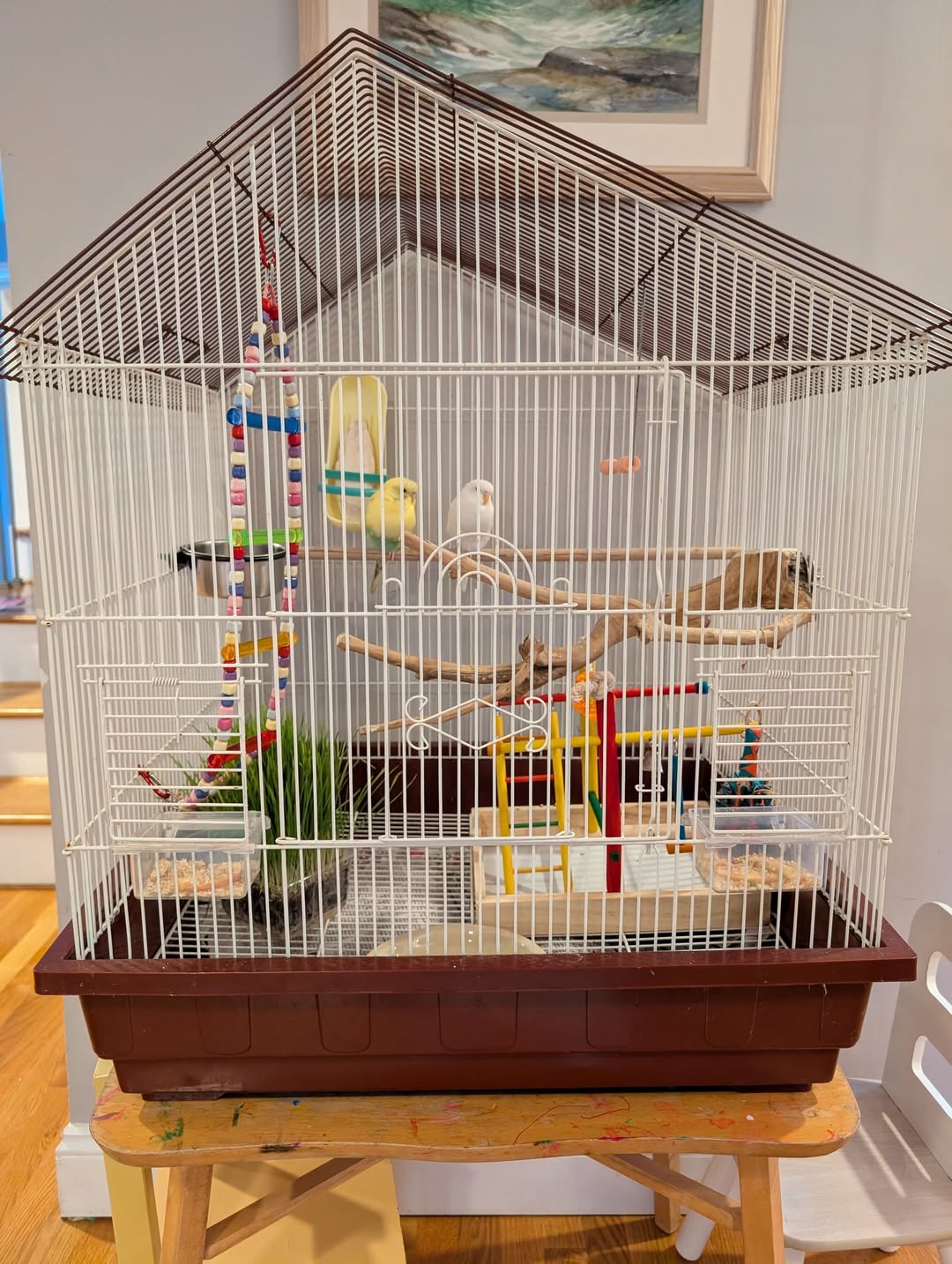
- “I need to stop it chewing — it’s destroying everything” — You cannot stop a budgie from chewing, and you should not. The chewing will redirect to whatever is most accessible, not stop. The goal is not elimination. It is management — providing so many appropriate and interesting things to chew that the bird has no reason to target the wrong ones.
- “It’s chewing the bars because it wants to get out” — Sometimes. More often, a bar-chewing budgie is chewing the bars because the bars are the most interesting thing available, or because it is bored and nothing else is occupying its beak. Provide better alternatives and watch where the chewing goes. If it moves to the alternatives — boredom was the cause. If it continues on the bars despite enrichment — out-of-cage time is likely the missing piece.
- “The perches only last a few months — that’s a waste of money” — Perches lasting a few months means they are being used correctly. Natural wood perches are consumable items in a budgie cage, not permanent fixtures. Budget for them accordingly, keep a stock of appropriate branches, and replace them when they are chewed down. This is not waste. It is the cost of appropriate beak maintenance.
- “It chewed through the rope perch so I threw it away” — If the rope perch was natural cotton and the bird chewed through it, it did exactly what it was supposed to do. Replace it. If it was nylon and the bird chewed it — do not replace it with the same thing. Nylon fibres can cause crop obstruction. Switch to cotton or natural fibre ropes only, and inspect them monthly.
- “My last budgie never chewed this much” — Chewing intensity varies between individuals. A bird with a stronger foraging drive, more energy, or better beak health will chew more than a less active bird. More chewing in a healthy bird is not a sign of a problem. It is a sign of a bird with a good beak and appropriate instincts. Make sure the materials it is chewing are safe.
What I Tell Every New Budgie Owner About Chewing
- Provide natural wood in the cage at all times.
Apple, pear, cherry, or willow — a fresh branch, washed and dried, clipped into the cage. Replace it when it has been chewed down. This is the most important single chewing provision you can make. Everything else supplements this. - Check what your cage bars are made of.
If the cage is powder-coated steel — fine. If it is galvanised wire, or if you are not sure — find out. Bar chewing on galvanised bars is a zinc toxicity risk that accumulates over time. This is worth checking once and knowing definitively. - Address bar chewing with enrichment, not deterrents.
If your bird is bar-chewing, the response is more and better cage enrichment — not bitter sprays or coverings that simply frustrate the behaviour without addressing the cause. Provide better alternatives and the behaviour almost always reduces. - Remove unsafe chew targets before free-fly time.
Plants, electrical cables, treated wood, unknown-composition metals. Clear the flight space before opening the cage door. The bird will investigate everything. Make sure everything accessible is safe. - Expect to replace chew materials regularly.
Natural wood perches, palm leaf toys, cardboard foraging items — these are consumable. Build their replacement into your routine. A chewed-down perch means the bird has been doing exactly what it should. Replace it and carry on.
If you have questions about what is safe to chew, what to provide, or how to set up a cage that channels the chewing correctly — come in. We are at Manor Garden Centre, Cheney Manor Industrial Estate, Swindon, SN2 2QJ — open every day. Or call us on 01793 512400. We stock natural wood perches, appropriate chew toys, and cuttlefish bone, and we are always happy to talk through the setup with you.
Visit Us at Paradise Pets Swindon
We stock budgies year-round alongside the full range of chew materials, natural wood perches, foraging toys, and cuttlefish bone that keep them properly occupied. Come in and see what we recommend — and ask us about cage setup if you are starting from scratch or dealing with a bar-chewing bird.
We also stock a full range of cockatiels, canaries, and finches, alongside guinea pigs, rabbits, and gerbils and hamsters.