

Neil has run Paradise Pets Swindon since 1988 — over 35 years of keeping, breeding, and advising on budgies. Shaking and trembling is one of the most common concerns owners bring to the shop. This is his honest guide on what it actually means — and when to act immediately.
A young woman came in one afternoon with her phone held out, showing me a video. Her budgie was on its perch, feathers slightly puffed, trembling in a way that was subtle but unmistakable once you knew to look for it.
“He’s been doing this since this morning,” she said. “Is it normal? Is he cold? Is he dying?”
Three questions. All reasonable. And the honest answer to all three, at that point, was: I do not know yet — tell me more.
Shaking in a budgie is one of those symptoms that sits right at the intersection of completely normal and genuinely serious. The same visible trembling that means a young bird is excited about its breakfast can, in a different context, mean a bird that is in the early stages of a serious illness. The difference is almost never the shaking itself. It is everything around it — the context, the age of the bird, what else is happening, what has changed recently.
After 35 years of working with budgies at Paradise Pets, I have learned to read the difference fairly quickly. This article is my attempt to share that reading with you — so that when you see your budgie shaking, you have a framework for working out what it means rather than just a rising sense of panic.
First — Is The Shaking Actually a Problem?
This is the question I always start with, because a significant proportion of owners who come in worried about a shaking budgie have a budgie that is doing something entirely normal.
Budgies shake, tremble, and quiver in several completely healthy contexts. Knowing what those look like saves a lot of unnecessary anxiety — and helps you recognise more clearly when something genuinely is wrong.
Normal shaking in a healthy budgie includes:
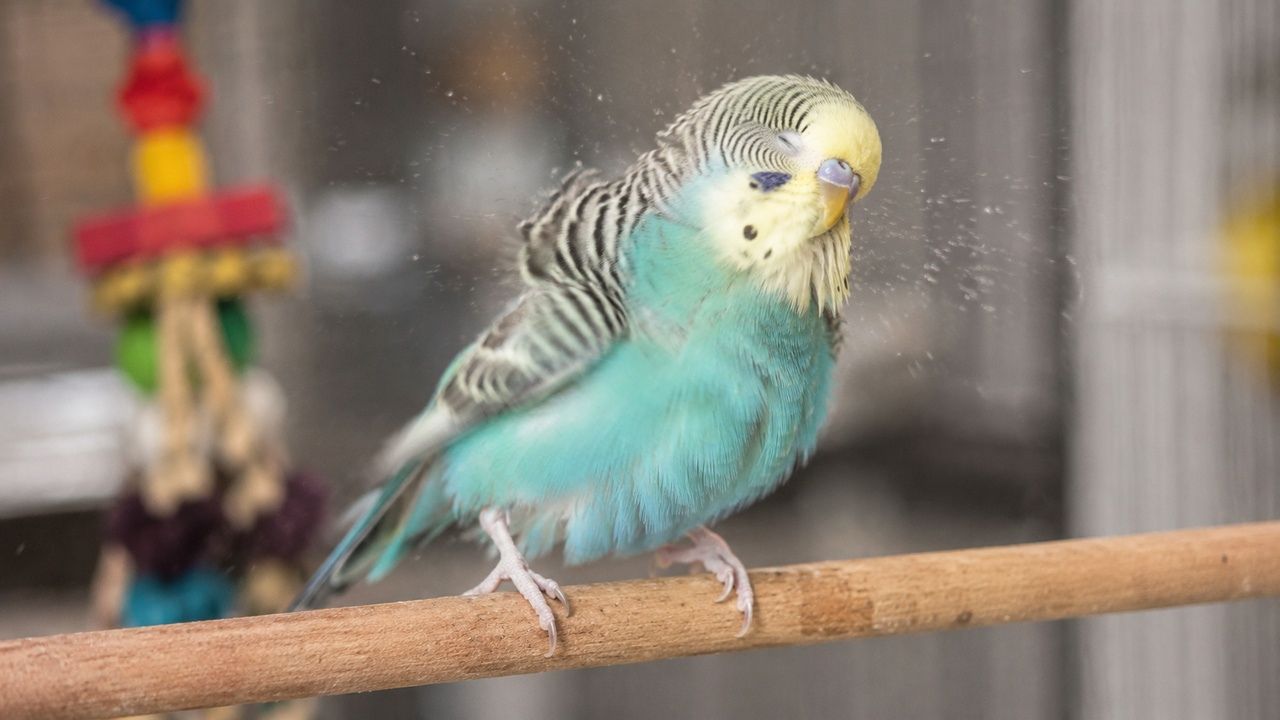
- Feather ruffling and body shaking after preening — a brisk, full-body shake is how a budgie settles its feathers back into place. Completely normal, done many times a day.
- Tail wagging or tail bobbing during singing — an active, vocal bird often moves its whole body when it is in full song. This is enthusiasm, not illness.
- Trembling with excitement at feeding time — young budgies in particular will visibly tremble when food is being prepared or offered. The bird is anticipating, not suffering.
- A brief shiver after bathing or misting — a wet bird shivers to generate warmth while drying. Completely normal, passes quickly.
- Wing shaking during stretching — budgies stretch regularly, often with one wing and one leg extended simultaneously, sometimes with a visible shiver through the wing. Normal behaviour.
- Young birds recently weaned — very young birds sometimes tremble slightly during the adjustment period after weaning. Usually passes within a week or two as they settle.
The key question to ask with all of these is: is the bird otherwise normal? Alert, active, eating well, producing normal droppings, bright-eyed? If yes, and the shaking fits one of the patterns above, you are most likely watching a healthy bird doing healthy things.
If the answer is no — if anything else has changed alongside the shaking — keep reading.
The 7 Real Causes of Concerning Budgie Shaking
Cause 1: Cold and Hypothermia — The First Thing To Check
This is where I always start, because it is the most immediately actionable cause and one of the most common ones I see — particularly in UK winters.
Budgies need a stable ambient temperature between 18 and 22°C. They struggle when temperatures drop below 15°C, and sustained cold below 10°C is genuinely dangerous. In a UK home, this means draughts are a serious enemy — a cage near a door, a window, or an air conditioning unit can expose the bird to cold air it cannot see coming.
A cold budgie will shiver to generate warmth, exactly as we do. The feathers will be puffed up — this is the bird trapping warm air close to its body. The bird may sit hunched, low on the perch, and be less active than usual.
- Feathers puffed up and shaking at the same time — the bird is cold and trying to warm up
- Cage is near a window, external door, or air vent
- Temperature in the room is below 18°C — particularly common in UK winters in older homes
- Shaking is worse in the morning when the house has been cold overnight
- Bird warms up and behaviour returns to normal once the room temperature rises
What to do
Move the cage away from any source of draught immediately. Bring the room temperature up gradually — do not point a fan heater directly at the cage, but warm the room. If the bird is very cold, covering three sides of the cage with a blanket to trap warmth can help while the room heats up. Once warm, the bird should recover quickly. If it does not improve within an hour of being warm, something else is going on and you need a vet.
Cause 2: Fear or Shock — Often Overlooked
A budgie that has been badly frightened will often shake for several minutes afterwards. This is an adrenaline response — the same mechanism that causes shaking in humans after a sudden fright or shock. It passes, but it can be alarming to watch.
Common triggers I hear about in the shop: a cat pressing against the cage, a dog barking very close to the bird, a loud unexpected noise — a dropped pan, a car backfiring, a smoke alarm. Night frights are particularly common — a budgie that has been disturbed in darkness will panic and crash around the cage, and will often be visibly shaking when the light comes on.
- Did anything happen in the last hour that could have scared the bird? Loud noise, another animal near the cage, something falling, an unexpected visitor.
- Did the shaking start suddenly rather than gradually? Fear responses are almost always sudden — the bird was fine, then something happened, then it was shaking.
- Is the bird alert despite the shaking? A frightened bird is often wide-eyed and reactive — watching everything carefully. An ill bird tends to be dull and unresponsive.
- Has it settled within fifteen to twenty minutes? A fear response should pass relatively quickly once the trigger is removed and the environment is calm again.
What to do
Remove the trigger if it is still present. Keep the environment quiet and calm. Do not try to handle the bird immediately — being grabbed while already frightened makes things worse. Speak quietly near the cage, move slowly, and give the bird time to settle. If shaking persists for more than half an hour after a fright, or the bird seems unable to grip its perch properly, that warrants a closer look and possibly a vet call.
Cause 3: Illness — The Cause You Cannot Afford To Miss
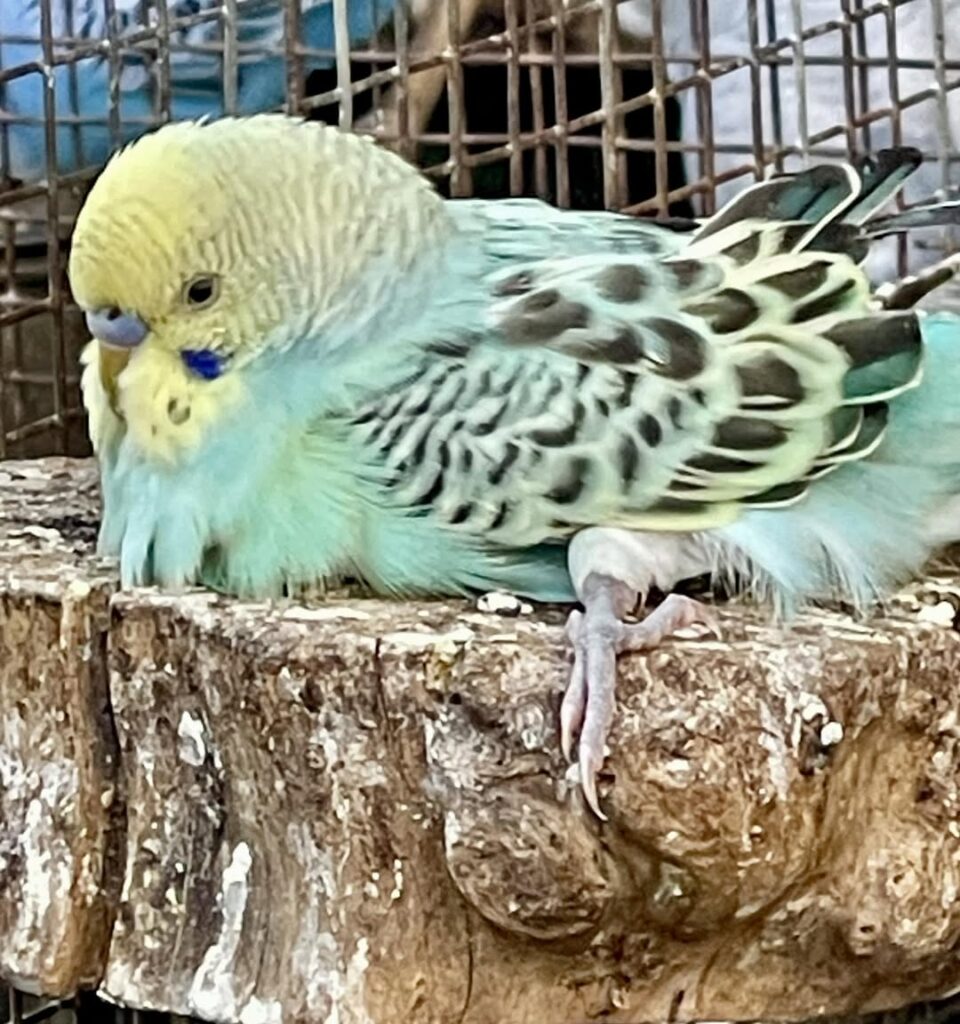
A budgie that is shaking because it is unwell usually looks different from one that is cold or frightened — but the differences are subtle enough that they are easy to miss if you do not know what to look for.
The key distinction is this: a cold or frightened budgie usually recovers once the cause is removed. An ill budgie does not. The shaking persists. Other signs develop or are already present. The bird looks wrong in a way that is hard to articulate but impossible to miss once you have seen it.
- Shaking combined with feathers permanently puffed up — not just briefly, but continuously
- Eyes half-closed or closing during the day — a well budgie does not sleep during daylight hours
- Tail bobbing with each breath — the bird is working harder than normal to breathe
- Bird has moved to the bottom of the cage or is struggling to stay on the perch
- Not eating or drinking, or significantly reduced intake
- Droppings have changed — watery, discoloured, or absent
- The shaking has been present for more than a few hours with no improvement
- The bird feels lighter than usual when held
What to do
Same-day avian vet — no exceptions if several of those signs are present together. Budgies mask illness until they physically cannot, which means by the time the shaking is visible, the underlying problem is often already advanced. Keep the bird warm while you arrange the vet — warmth reduces the energy the bird is spending on temperature maintenance and buys it time. Do not wait overnight to see if it improves.

Cause 4: Respiratory Infection — Specific Signs To Look For
Respiratory infections deserve their own section because they are common in UK budgies and because the shaking they produce has a specific character — often combined with visible breathing effort — that owners can learn to recognise.
A budgie with a respiratory infection will often shiver or tremble because it is using significant energy just to breathe. Infections spread quickly through the respiratory tract and can progress to pneumonia within days.
- Tail bobbing rhythmically with every breath — the clearest single sign of respiratory effort
- Clicking, wheezing, or rattling sounds when breathing
- Open-mouth breathing — the bird cannot get enough air through its nostrils
- Wet or crusty discharge around the nostrils
- Shaking combined with a fluffed-up, lethargic, generally miserable-looking bird
- Any recent exposure to draughts, cold, damp conditions, or other sick birds
What to do
Avian vet the same day. Respiratory infections in budgies need antibiotics and often supportive care. They do not resolve on their own and they deteriorate fast. Keep the environment warm and draught-free while you arrange the appointment.
Cause 5: Toxic Exposure — Fast Onset, Critical Urgency
This is the cause that arrives without warning and gets serious within minutes. Budgies have one of the most efficient respiratory systems of any animal — which makes them extraordinarily sensitive to airborne toxins. The same biological efficiency that lets them fly at altitude makes them vulnerable to fumes that would barely affect a human.
A budgie that has been exposed to a toxic substance will often shake violently, lose coordination, and deteriorate rapidly. This is a genuine emergency.
- Non-stick cookware fumes — PTFE from overheated non-stick pans is fatal to birds. Do not use non-stick pans in any home with a budgie, or ensure complete air separation from the kitchen
- Aerosol sprays — air fresheners, deodorants, cleaning sprays, polish. Brief exposure in an enclosed space can be enough to cause serious harm
- Scented candles and incense — the particles and combustion products are toxic to avian respiratory systems
- Cigarette and vape smoke — acute exposure causes rapid deterioration; chronic exposure causes cumulative damage
- Paint fumes, varnish, adhesives — any strong chemical odour should be treated as a potential risk to a bird in the same airspace
- Carbon monoxide — a gas leak or faulty appliance. If other people or animals are also feeling unwell, get everyone out and call 999
What to do
Move the bird to fresh air immediately. Open windows, get the bird into a room with no connection to the source of the fumes. Then get to an avian vet as fast as you can — there is no home treatment for toxic exposure, and time is the only resource you have. If carbon monoxide is suspected, leave the property with everyone including the bird and call the emergency services before anything else.
Cause 6: Nutritional Deficiency — The Slow, Gradual Cause
This one takes longer to develop and longer to identify, but it is more common than most owners expect — particularly in birds that have been fed a seed-only diet for extended periods.
Budgies fed exclusively on seed often develop deficiencies in vitamin A, calcium, iodine, and other nutrients over time. These deficiencies affect the nervous system among other things, and one of the symptoms that can develop is muscle tremor or weakness — a subtle, ongoing shaking that is different from the acute shaking of fear or cold.
- What does the bird eat? Seed only, or a varied diet that includes fresh vegetables, leafy greens, and mineral supplementation?
- Is there a cuttlebone in the cage? Calcium deficiency is particularly common and cuttlebone is the simplest way to address it.
- How long has this bird been on its current diet? Deficiencies take months or years to develop — a bird that has eaten seed only for two or three years is at real risk.
- Are there other signs of poor nutrition? Dull or brittle feathers, overgrown beak, weight loss, lethargy.
What to do
Begin introducing fresh vegetables immediately — leafy greens, broccoli, carrot, bell pepper. Ensure cuttlebone is always available. Consider a good quality avian vitamin supplement in the water or on soft food. The improvement from better nutrition is real but gradual — do not expect overnight changes. If the shaking is significant, a vet visit is worthwhile to identify specific deficiencies and advise on supplementation.
Cause 7: Neurological Problem — Less Common, But Worth Knowing
This is the least common cause on this list, but it is one I see occasionally and it is important that owners know it exists.
Neurological issues in budgies — caused by certain infections, head injuries, genetic conditions, or tumours — can produce tremors, shaking, loss of coordination, head tilt, or difficulty gripping a perch. These are distinct from the other causes on this list because they are often persistent, often progressive, and do not respond to the usual interventions of warmth, calm, and improved diet.
- Persistent, ongoing tremor that does not resolve over days
- Head tilt or circling — the bird moves in one direction repeatedly
- Loss of coordination — falling off the perch, difficulty landing
- One-sided weakness — one wing or leg appearing less functional than the other
- Progressive worsening over days or weeks
What to do
This is a vet conversation — specifically an avian vet who has experience with neurological conditions in small birds. Some causes are treatable. Some are not. The honest answer depends entirely on the specific diagnosis, which requires a proper examination and sometimes imaging. Do not assume the worst, but do not delay in getting it looked at.

How To Tell The Difference — A Practical Guide
- Is the bird otherwise alert and active?
Yes — probably cold, frightened, or post-bath shiver. Monitor closely.
No — possible illness. Check the next questions urgently. - Did the shaking start suddenly after a specific event?
Yes — fear response or toxic exposure. Identify and remove the cause.
No — gradual onset points to illness, nutritional issue, or neurological cause. - Is the bird eating and drinking normally?
No change — reassuring. Keep observing.
Reduced — concerning. If combined with other signs, vet same day. - What are the droppings like?
Normal — reassuring.
Watery, discoloured, or absent — vet same day. - Is the bird warm enough?
Room below 18°C or draught present — warm the environment first and observe.
Already warm — cold is not the explanation. Look elsewhere. - How long has the shaking been going on?
Under an hour, following a specific trigger — probably fear or cold. Monitor.
Several hours with no improvement — vet call regardless of other signs.
What Not To Do With A Shaking Budgie
| What people do | Why it is wrong | What to do instead |
|---|---|---|
| Handle the bird repeatedly to check on it | Stress and handling worsens the condition of a sick or frightened bird | Minimal handling — observe from nearby, keep the environment quiet |
| Put the bird directly on a heat source | Direct heat burns or overheats — the shock can make things worse | Warm the room gradually to around 28–30°C for a sick bird |
| Wait overnight to see if it improves | Sick budgies deteriorate fast — hours matter | If other symptoms are present alongside shaking, phone a vet the same day |
| Give human medication or over-the-counter treatments | Most are ineffective; some are harmful to birds | Only give what an avian vet has prescribed |
| Assume it will pass on its own | Sometimes it does. Sometimes it does not — and the difference can be the bird’s life | Use the checklist above to assess, and act if in doubt |
Frequently Asked Questions
My budgie is shaking but eating normally — should I be worried?
A budgie that is shaking but still eating, alert, and producing normal droppings is less likely to be seriously ill than one showing multiple symptoms. However, shaking is not normal resting behaviour in a healthy bird. Monitor very closely over the next few hours. If the shaking does not resolve, or if any other sign develops, speak to an avian vet.
My budgie shakes when I take it out of the cage — is this normal?
Some budgies, particularly those that are not fully tame or are young and still settling, will tremble slightly when handled outside the cage. This is usually a fear or excitement response and passes as the bird becomes more comfortable with handling. If it is severe or combined with other signs of distress, slow down the taming process and give the bird more time to settle.
My budgie shakes its tail a lot — is this the same thing?
Tail wagging and bobbing during singing or activity is completely normal in a healthy budgie. Rhythmic tail bobbing that matches the breathing — each breath accompanied by a visible tail movement — is different. That is a sign of respiratory effort and warrants a vet call.
Why does my budgie shake in the morning?
A brief shake when waking up is normal — the bird is warming up and fluffing its feathers after sleep. If the shaking is sustained through the morning and the bird does not warm up and become active within the first half hour of being uncovered, that is worth investigating. Check the room temperature first.
Can stress cause a budgie to shake?
Yes. A stressed budgie — one that is chronically lonely, in an environment that is too loud or too unpredictable, or that has been recently moved or paired with an incompatible bird — can develop persistent trembling as a symptom of ongoing stress. If the shaking is chronic and low-level rather than acute, look carefully at the bird’s environment and social situation.
Where can I get urgent budgie advice in Swindon?
Come and see us at Paradise Pets, Manor Garden Centre, Cheney Manor, Swindon SN2 2QJ. Or ring us on 01793 512400. For genuine health emergencies, go straight to an avian vet — we will help you work out which it is.
One Last Thing From Me
The young woman who came in with the video of her shaking budgie — her bird turned out to have the start of a respiratory infection. She had caught it early enough that the vet prescribed a course of antibiotics and the bird made a full recovery within ten days.
She told me afterwards that she had almost not come in. She had nearly convinced herself it was nothing, that she was overreacting, that it would probably sort itself out. I am glad she did not listen to that voice.
With budgies, the difference between catching something early and catching it late is often the difference between a bird that recovers and one that does not. They are too small, and they mask illness too well, for there to be much margin for error once symptoms appear.
If your budgie is shaking and you are not sure why — do not sit on it. Use the checklist in this article, warm the environment, observe closely, and call us or an avian vet if anything else is wrong. It costs nothing to phone and ask. It can cost everything to wait.
Worried About Your Budgie? Come And See Us — Or Ring An Avian Vet
For breathing emergencies, toxic exposure, or a bird that is unresponsive — go straight to an avian vet. For everything else, come in or ring us and we will help you work out the urgency. Free advice, no obligation. Over 35 years of hands-on budgie experience.