

Neil has sold and kept rabbits at Paradise Pets Swindon since 1988 — over 35 years of first-hand experience with one of the UK’s most popular small animals. In that time, he has spoken with hundreds of worried UK owners whose rabbits have started grinding their teeth. This article is his honest, complete guide on what teeth grinding in rabbits actually means, why it matters, and what you should do about it.
A couple came in a few months ago, properly concerned. They had a three-year-old lop — a big, well-loved rabbit that had been with them since he was eight weeks old. They had noticed, over the past week or so, that he was making a grinding noise with his teeth. Not constantly. But regularly enough that they had looked it up online and frightened themselves with what they found.
I asked them a few questions. Was the grinding loud or soft? Was the rabbit eating normally? Was he still moving around, using the litter tray, behaving roughly as he usually did? Were there any other symptoms — head tilting, drooling, weight loss, a hunched posture?
Their answers told me a lot. Because teeth grinding in rabbits is not one thing. It is two completely different things, depending on how it sounds and what else is going on. And understanding which one you are dealing with is the difference between reassurance and an urgent vet visit.
This article covers everything you need to know.
The Two Types of Teeth Grinding — And Why the Difference Matters
The first and most important thing to understand is that there are two completely distinct types of teeth grinding in rabbits. They sound different, they mean different things, and they require completely different responses.
Confusing the two is the most common mistake I see owners make — and it leads either to unnecessary panic or, more dangerously, to a serious problem being dismissed as nothing.
Purring — soft tooth grinding that means contentment.
Rabbits purr. Not like cats — they do not make a vocal sound. Instead, they grind their teeth very softly and rapidly, producing a gentle vibration or chattering noise that you can sometimes feel as much as hear if you are holding the rabbit. This is called tooth purring or bruxism, and it is a sign of contentment.
You will see it most often when the rabbit is being stroked in a spot it enjoys — behind the ears, along the forehead, on the cheeks. The rabbit relaxes, perhaps closes its eyes slightly, and produces this gentle grinding sound. It is the rabbit equivalent of a cat purring. It means the animal is comfortable and happy.

Tooth grinding — loud, forceful grinding that means pain.
The second type is entirely different. It is louder, slower, more forceful — a deliberate, audible grinding or gnashing of the teeth that you cannot mistake for contentment once you have heard both. This is called bruxism in its negative form, and it is a pain response.
A rabbit that is grinding its teeth loudly and forcefully is in pain. Full stop. It is not a quirk, it is not a habit, it is not something that will pass on its own. It needs attention, and it usually needs it today rather than next week.
- Soft, rapid, gentle chattering while being stroked — contentment purring, nothing to worry about
- Loud, slow, forceful grinding with no obvious trigger — pain response, needs investigation
- Purring usually occurs during positive interaction; pain grinding often happens when the rabbit is resting or sitting hunched
- Purring rabbits look relaxed — soft body, eyes half-closed, settled posture
- Pain-grinding rabbits often look tense — hunched, still, eyes wide or half-closed in discomfort rather than relaxation
- If you are not sure which you are hearing, err on the side of caution and get a vet to check
- Loud, forceful teeth grinding in a rabbit is a pain signal — treat it as urgent
- Do not wait to see if it improves — rabbit pain can escalate quickly
- Book a vet appointment today, ideally with a vet experienced with rabbits or exotic animals
- Check for other symptoms alongside the grinding — not eating, hunched posture, bloated abdomen, drooling, head tilt
- Note when the grinding happens, how long it lasts, and what the rabbit is doing at the time
- If you are local to Swindon and unsure how urgent it is, ring us on 01793 512400 — we will help you assess it honestly
The Main Causes of Painful Teeth Grinding in Rabbits
Once you have established that what you are hearing is pain grinding rather than contentment purring, the next step is understanding what is causing the pain. There are several common causes, and they vary significantly in how serious they are and how quickly they need addressing.
Cause 1: Dental Disease — The Most Common Cause I See
Dental problems are, without question, the cause I see most often behind painful teeth grinding in rabbits. And they are also the cause that most owners do not see coming, because rabbit teeth are not like human teeth — or even dog and cat teeth. They work differently, they go wrong differently, and the problems they cause are often invisible until they are already serious.
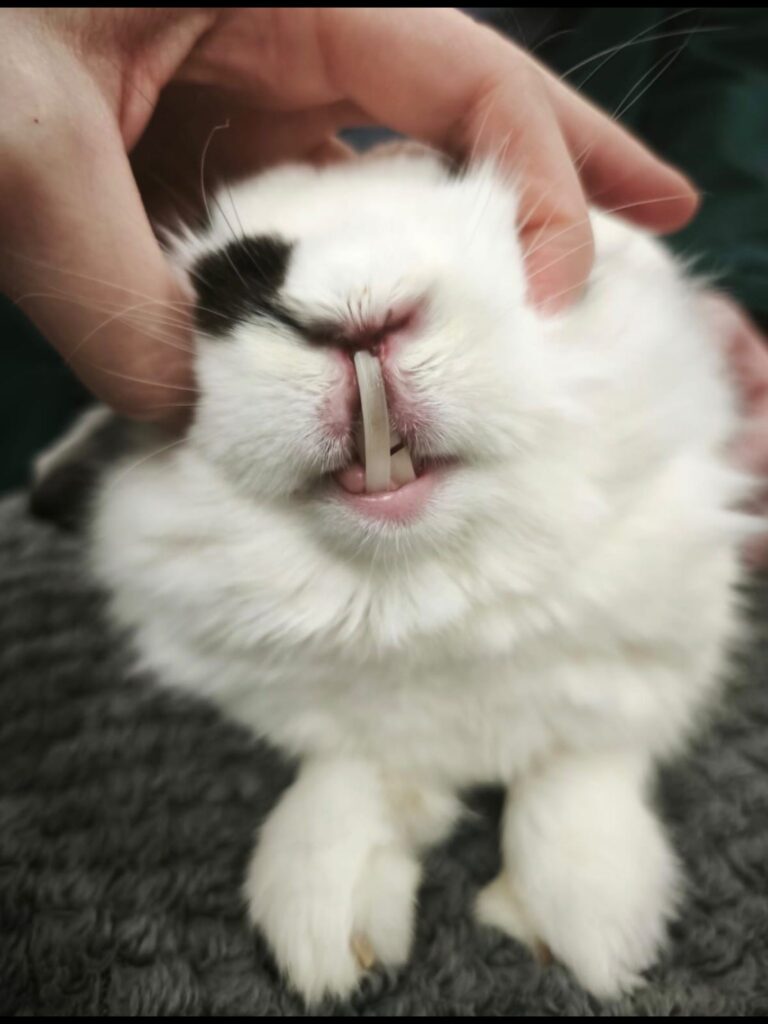
Rabbits have teeth that grow continuously throughout their lives — both the front incisors that you can see and the back cheek teeth, the molars and premolars, that you cannot. Those back teeth are designed to be worn down by constant grinding of fibrous food, particularly hay. When the diet is wrong — too little hay, too many pellets, too much soft food — the back teeth do not wear down properly. They develop sharp spurs and points that dig into the tongue and the cheeks. The rabbit is in constant low-level pain with every mouthful it takes.
This is why dental disease in rabbits is so strongly linked to diet, and why the diet advice I give to every rabbit owner starts with hay. Unlimited, good quality hay, available at all times, is not optional for a rabbit. It is the single most important thing in the diet, and its absence is the most common route to the dental problems that cause teeth grinding.
- Teeth grinding alongside reduced appetite or difficulty eating
- Dropping food — picking up hay or pellets and then letting them fall
- Drooling or wet fur under the chin and on the chest
- Weight loss over weeks — feels like the backbone and hips are becoming more prominent
- Selective eating — only eating the softest foods and leaving hay untouched
- Swellings along the jawline — these can indicate tooth root abscesses
- One or both eyes watering — dental roots sit close to the tear ducts and tooth problems can cause persistent eye discharge
What to do
This is a vet visit — specifically a vet who is experienced with rabbits and has the equipment to examine the back teeth properly. The front incisors can be checked easily, but the cheek teeth require a specialist scope and often sedation to examine fully. Do not assume that because the front teeth look normal, the back teeth are fine. Most rabbit dental disease is in the back teeth where you cannot see it.
Treatment ranges from filing sharp spurs under sedation to tooth extraction in more advanced cases. Some rabbits need dental work every few months. The condition is manageable but it is not curable — prevention through correct diet is far easier than treatment after the fact.
Cause 2: Gastrointestinal Problems — GI Stasis
This is the cause that worries me most when an owner describes a rabbit that is grinding its teeth and not eating. Gastrointestinal stasis — GI stasis — is a condition in which the rabbit’s digestive system slows down or stops moving entirely. It is a genuine emergency that can be fatal within twenty-four to forty-eight hours if not treated.
The rabbit’s digestive system is designed to move continuously. Food should pass through the gut in a constant, steady flow driven by fibre. When that flow stops — from stress, pain, dehydration, a blockage, or insufficient fibre in the diet — gas builds up in the stomach and intestines. That gas causes significant pain. The rabbit grinds its teeth, sits hunched, stops eating, and stops producing droppings.
- Teeth grinding alongside complete or near-complete loss of appetite
- No droppings, or dramatically reduced droppings, for several hours
- Hunched posture — the rabbit is sitting in a tight, rounded position rather than relaxed
- Bloated or hard abdomen — the belly feels drum-tight rather than soft
- The rabbit is not moving and does not want to be touched on the belly
- Lethargy — the rabbit is not responding normally to its environment
- This is a same-day emergency vet visit — do not wait overnight
What to do
Go to a vet immediately. GI stasis needs prompt treatment — gut motility drugs, pain relief, fluids, and sometimes syringe feeding. The sooner treatment starts, the better the outcome. A rabbit that has been in stasis for twenty-four hours is in a much more dangerous position than one caught in the first few hours.
While you are waiting to be seen, keep the rabbit warm, encourage gentle movement if it will allow it, and do not force food or water. Do not give any medication unless a vet has specifically prescribed it.
Cause 3: Pain From Injury or Illness
Teeth grinding is a general pain response in rabbits — it is not exclusive to dental or digestive causes. Any source of significant pain can trigger it. The ones I see most often alongside teeth grinding:
Urinary problems. Bladder sludge, bladder stones, and urinary tract infections are all common in rabbits and all cause significant pain. A rabbit with urinary problems may grind its teeth, strain in the litter tray, produce reduced or bloody urine, and sit in a hunched posture.
Uterine disease in unneutered females. Uterine cancer is disturbingly common in unspayed female rabbits — studies suggest the majority of unspayed does will develop uterine disease by middle age. It causes chronic pain, and teeth grinding can be one of the signs. This is one of the strongest arguments for neutering female rabbits early.
Arthritis and musculoskeletal pain. Older rabbits frequently develop arthritis, particularly in the spine and hind limbs. Chronic joint pain causes persistent low-level teeth grinding that owners sometimes notice only when they start looking for it.
Abscesses. Rabbits are particularly prone to developing abscesses — pockets of infection that can occur internally or at tooth roots. They cause persistent pain and can be difficult to detect without examination.
- Grinding that is persistent and not linked to eating or handling
- Grinding in an older rabbit alongside reduced mobility or reluctance to jump
- Grinding in an unspayed female of any age — take this seriously
- Grinding alongside straining in the litter tray or changes in urination
- Any grinding that has been going on for more than twenty-four hours without an obvious benign explanation

What to do
A thorough vet examination. Tell the vet specifically that the rabbit is grinding its teeth — it is one of the clearest pain signals rabbits give and any experienced rabbit vet will take it seriously. Blood work, urinalysis, X-rays, or ultrasound may be needed depending on what the examination reveals.
Cause 4: Stress and Anxiety
Rabbits are prey animals. They feel fear and stress acutely, and they respond to it physically. A rabbit in a chronically stressful environment may grind its teeth not from physical pain but from sustained psychological distress.
The stressors I see most often in the shop:
- Predator presence — a cat or dog the rabbit can see, hear, or smell. Even behind glass or through a fence, the scent and presence of a predator species causes genuine sustained fear in rabbits
- Excessive handling — particularly in young rabbits or rabbits that have not been properly socialised. Being picked up is frightening for a rabbit; being picked up frequently by children who do not handle it correctly is chronically stressful
- Isolation — rabbits are social animals and keeping a single rabbit with no companion and limited human interaction causes real psychological stress over time
- Loud or unpredictable noise — fireworks, building work, loud music, raised voices near the hutch
- Inadequate space — a rabbit confined to a small hutch with insufficient room to run, hop, and behave naturally is under constant physical and psychological stress
- Recent significant change — moving house, losing a bonded companion, change in routine or owner presence
What to do
Identify and address the stressor where possible. Move the hutch or run away from where the cat patrols. Review handling — reduce it and improve the technique. Consider a companion rabbit if the animal is alone. Ensure the rabbit has adequate space — the minimum recommended in the UK is now far larger than the hutches most pet shops sell, and I will say that plainly.
Stress grinding is less common than pain grinding and less acute in its urgency — but chronic stress causes real long-term health damage in rabbits, including immune suppression and digestive problems. It is not something to leave indefinitely.
Cause 5: Post-Operative or Post-Procedure Discomfort
If your rabbit has recently had surgery — a dental procedure, a spay or neuter, any other operation — some teeth grinding in the days following is expected. It reflects the discomfort of recovery and is normal within that context.
What to watch for is grinding that is worsening rather than improving day by day, or grinding accompanied by other concerning signs like not eating twenty-four hours post-surgery, a wound that looks infected, or a rabbit that is not recovering as the vet said to expect.
What to do
Follow the post-operative care instructions your vet has given you precisely. If the grinding is mild and the rabbit is otherwise recovering normally — eating, producing droppings, becoming gradually more alert — continue monitoring. If you have any concern that the recovery is not going as it should, phone the vet rather than waiting.
What I Check When a Rabbit With Teeth Grinding Comes Into the Shop
When an owner describes teeth grinding to me, I work through a consistent set of questions to understand what we are dealing with. Here is that process.
- Is the grinding soft and rapid, or loud and forceful?
Soft and rapid during handling or stroking — almost certainly contentment. Loud and forceful at rest — pain. This single question shapes everything that follows. - Is the rabbit eating normally?
A rabbit that is grinding and eating normally is in a different position to one that is grinding and not eating. Not eating combined with grinding is always serious and usually urgent. - When did it start, and did anything change around that time?
New pet in the house, change in diet, recent handling by children, a stressful event — context matters. - Is the rabbit producing normal droppings?
No droppings plus grinding equals possible GI stasis. This is a same-day vet visit, no question. - What does the abdomen feel like?
Soft and normal — reassuring. Bloated, hard, or drum-tight — urgent. - How old is the rabbit, and is it neutered?
An older rabbit with grinding may have arthritis or dental disease. An unspayed female with grinding needs uterine disease ruled out promptly. - What is the diet?
A rabbit on primarily pellets with limited hay is at high risk of dental disease. This is often the starting point for a long conversation about diet.
The Diet Connection — Why Hay Is Not Optional
I cannot write an article about rabbit teeth grinding without addressing diet directly, because the most common cause of the problem — dental disease — is almost entirely diet-driven.
A rabbit’s teeth are designed to process large quantities of fibrous material. Hay is that material. The lateral grinding action required to chew long-stem hay is exactly what wears down the cheek teeth properly, prevents sharp spurs from developing, and keeps the jaw mechanics working as they should.
Pellets — even good quality ones — do not provide this. Pellets are consumed with a different chewing motion and do not provide adequate dental wear. Fresh vegetables are excellent nutritional supplements but again do not substitute for hay in terms of dental mechanics. Hay is the one food that cannot be replaced or reduced without consequences.
- Hay should make up approximately eighty percent of the total diet by volume — not by weight, by volume
- It should be available at all times, unlimited, from a hay rack or a generous pile on the floor of the enclosure
- Good quality hay is green-tinted, sweet-smelling, and not dusty or mouldy — replace it daily if it gets damp or soiled
- Timothy hay and meadow hay are both excellent; orchard grass hay is a good alternative for variety
- Pellets should be a small, measured daily amount — not a bowl kept constantly full
- Fresh leafy greens daily provide vitamins and hydration and most rabbits enjoy them enormously
- Fruit and sugary treats should be rare and small — they contribute to obesity and digestive problems
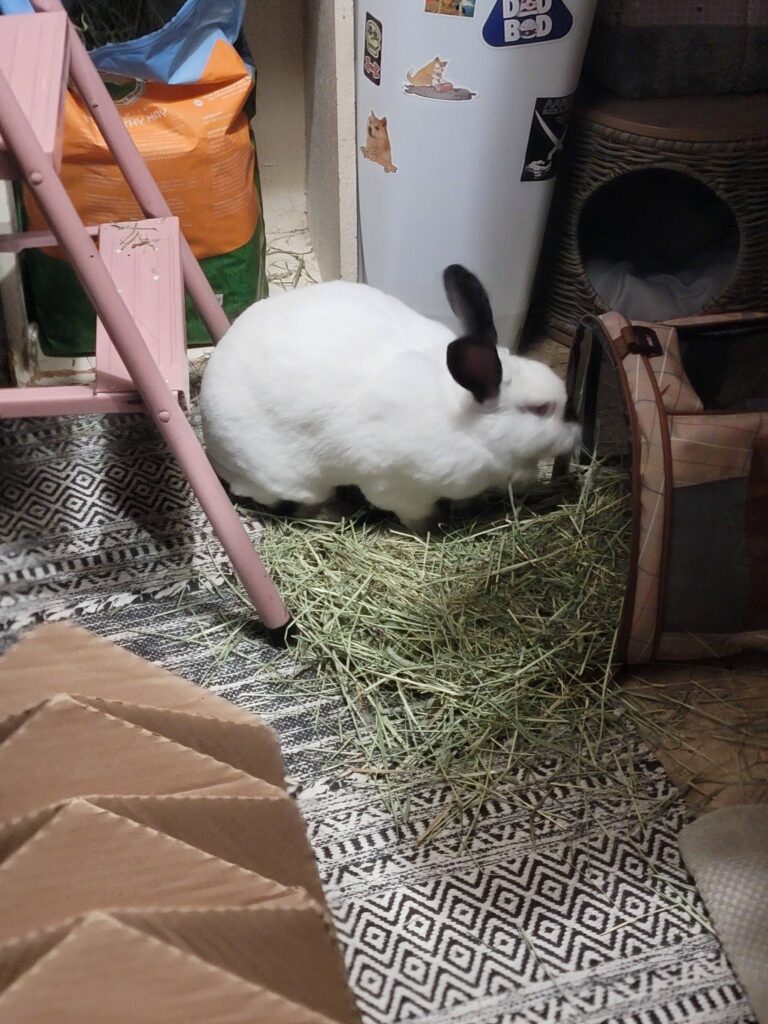
If your rabbit has been on a pellet-heavy diet and you need to transition to a hay-based one, do it gradually. Sudden dietary changes in rabbits can cause digestive upset. Increase hay slowly over two to three weeks while reducing pellets, and make sure the rabbit is eating throughout the transition.
What Not To Do
Over 35 years, I have seen enough well-intentioned mistakes to know the common ones. Here is what to avoid when your rabbit is grinding its teeth.
| What people do | Why it is wrong | What to do instead |
|---|---|---|
| Assume it is just a habit | Loud teeth grinding is always a pain signal — there is no such thing as harmless forceful grinding | Assess carefully — is it soft purring or loud grinding? If loud, see a vet |
| Wait a week to see if it passes | Pain that causes grinding rarely resolves on its own — the underlying cause needs addressing | Book a vet appointment within twenty-four to forty-eight hours at most |
| Give human pain relief | Most human pain medications — including ibuprofen and paracetamol — are toxic to rabbits | Only use pain medication prescribed specifically by a vet for that rabbit |
| Stop offering hay because the rabbit is not eating it | A rabbit not eating hay is a symptom that needs investigating — removing hay removes the solution as well | Keep hay available and book a vet visit to find out why it is not being eaten |
| Assume dental problems are visible | Most rabbit dental disease is in the back cheek teeth, which are completely invisible without specialist examination | Have the back teeth checked by a rabbit-experienced vet with proper equipment |
| Handle the rabbit more to check on it | A rabbit in pain finds handling stressful and additional handling can worsen its condition | Minimise handling, keep the environment calm and quiet, get to a vet |
When To Go Straight To The Vet Without Stopping Here First
I am always happy to talk things through. But there are situations where I will tell you plainly — do not stop at the shop, go to a rabbit-experienced vet today. These are:
- Loud, forceful teeth grinding with complete loss of appetite
- No droppings for several hours alongside grinding
- Bloated, hard, or painful-looking abdomen
- Grinding alongside a head tilt, loss of balance, or sudden change in mobility
- Drooling or wet fur around the chin and chest combined with grinding
- The rabbit is hunched, unresponsive, and clearly in significant distress
- An unspayed female of any age grinding persistently without obvious cause
For everything else — the soft grinding you are not sure about, the grinding that started recently in an otherwise well rabbit, the owner who just wants someone experienced to look at the animal — come in and we will help you work out what is going on.
Frequently Asked Questions
Is it normal for rabbits to grind their teeth?
Soft tooth purring during pleasant handling is completely normal and means the rabbit is content. Loud, forceful grinding is not normal — it is a pain signal that needs investigation. The key is knowing which you are hearing. If you are not sure, treat it as the pain version and get a vet to check.
Can teeth grinding in rabbits be caused by just stress, without physical pain?
Yes, in some cases — chronic stress can cause teeth grinding. But I always say: rule out physical pain first. Pain is more common, more urgent, and more dangerous. Get a vet to confirm there is no physical cause before putting it down to stress alone.
How do I know if my rabbit’s teeth are overgrown?
You can check the front incisors yourself — they should be relatively short, straight, and meeting properly. But the cheek teeth, where most dental disease occurs, are completely invisible without specialist examination. Do not assume normal-looking front teeth mean healthy back teeth. Annual dental checks by a rabbit-experienced vet are worthwhile for all rabbits.
My rabbit is grinding its teeth but eating normally — should I still see a vet?
If it is soft purring during stroking, no — that is contentment. If it is louder grinding that happens independently of handling, yes — even if the rabbit is eating, persistent grinding without an obvious benign explanation needs checking. Rabbits mask discomfort well and the fact that they are eating does not mean nothing is wrong.
How can I prevent dental disease in my rabbit?
Unlimited good quality hay is the single most effective prevention. It is not complicated but it is non-negotiable. Hay drives the grinding jaw action that wears teeth down properly. Pellets and soft food do not do this. Get the hay right, reduce pellets to a small measured daily amount, and you dramatically reduce the lifetime risk of dental disease.
Where can I get rabbit advice in Swindon?
Come and see us at Paradise Pets, Manor Garden Centre, Cheney Manor Industrial Estate, Swindon SN2 2QJ. Or ring us on 01793 512400. We have been keeping and selling rabbits for over 35 years and we will give you an honest assessment — not a sales pitch.
One Last Thing From Me
The couple with the lop — the ones I mentioned at the start — came back about six weeks after that first visit. The vet had found dental spurs on both sides. The rabbit had been in low-level discomfort for probably longer than a week, they were told. The back teeth had not been wearing down properly because the diet was heavier on pellets than it should have been, and the hay rack had often been allowed to run empty.
After dental treatment and a proper switch to a hay-led diet, the grinding stopped within two weeks. The rabbit was eating more enthusiastically. Moving more freely. Being himself again.
They said they wished they had known about the hay years earlier. I hear that a lot.
Rabbit teeth grinding has a solution in almost every case. But that solution depends on finding the cause, and finding the cause depends on taking the signal seriously when you hear it.
You have the information now. If you are sitting at home reading this with a rabbit that is grinding its teeth, do not put it off. Phone a vet, or come and see us. We would rather help you sort it out today than hear about it in a month when things are harder to fix.
Worried About Your Rabbit? Come In Or Give Us A Ring
For anything that sounds like a genuine emergency — no droppings, not eating, bloated abdomen — go straight to a rabbit-experienced vet. For everything else, come in and let me take a look. Thirty-five years of rabbits means I have seen this before. Free advice, no obligation.