
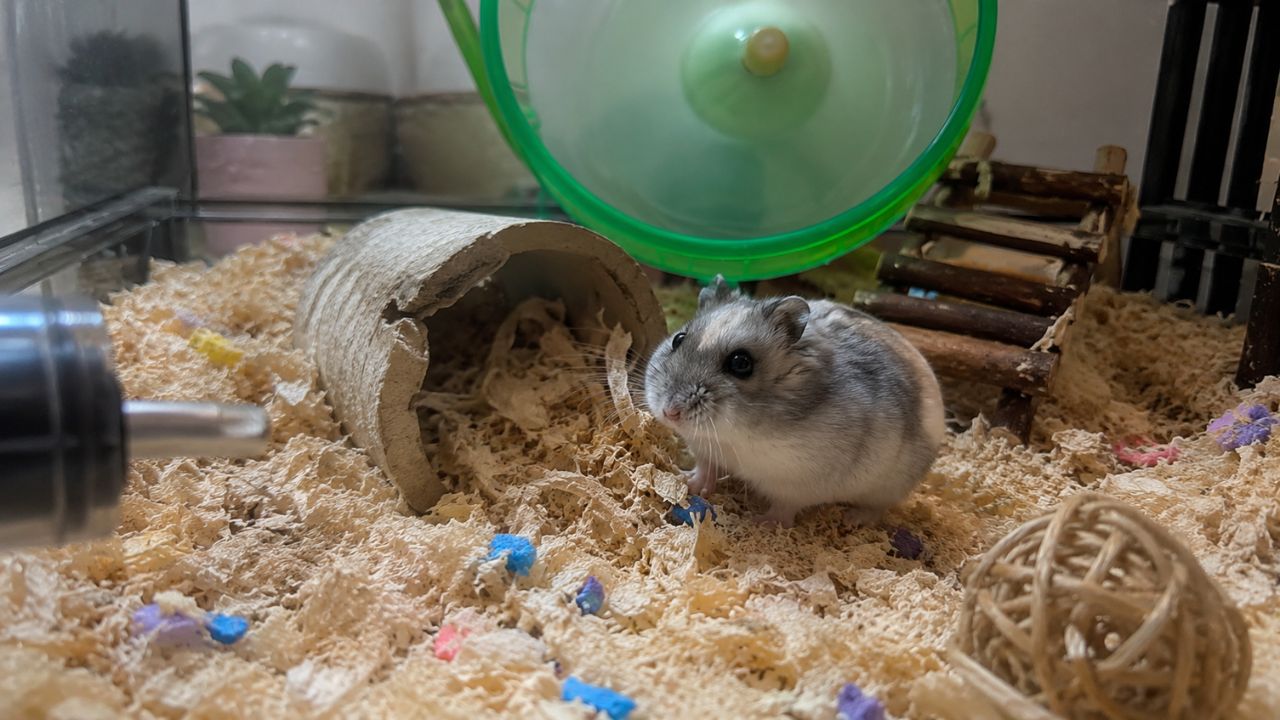

Neil has kept, bred, and sold hamsters at Paradise Pets Swindon since 1988 — over 35 years of first-hand experience with these animals. In that time, he has watched owners interpret their hamster’s behaviour in ways that are sometimes the opposite of what the animal is actually communicating. This article is his honest guide to what a happy hamster actually looks like — and what the signs of an unhappy one are.
A young couple came into the shop with a question I get asked more often than people might expect. They had a Syrian hamster called Peanut — about four months old, bought from us six weeks earlier. They thought Peanut seemed fine. But they were not sure. They could not quite tell whether he was happy or not, and they wanted to know what they were looking for.
It is a good question. It is, actually, the right question — because a hamster that looks fine is not always a hamster that is thriving. And a hamster that seems quiet and calm may be stressed in ways that do not show themselves dramatically.
I asked them to describe Peanut’s evenings. What did he do when the lights went down and he became active? Did he groom himself regularly? Did he forage through his bedding? Did he run on his wheel? Did he move around the cage with purpose, investigating things, or did he pace the same route repeatedly?
The answers told me quite a lot. Peanut was, by what they described, a well-settled, happy hamster. But there were a couple of things in the setup I wanted to adjust — the bedding depth was too shallow and the wheel was slightly too small for a Syrian. Small things, but they mattered.
This article is that conversation, written down. What a happy hamster actually looks like, what the signs of stress and unhappiness are, and what you can do about it.
First — Understanding How Hamsters Communicate Wellbeing
Before I go through the specific signs, I want to explain something about hamster behaviour that is worth understanding properly — because it changes how you read everything else.
Hamsters are prey animals. They are hardwired to mask vulnerability. In the wild, an animal that shows distress or weakness is an animal that gets eaten. So hamsters do not communicate unhappiness the way a dog or cat might — with obvious distress signals that are hard to miss. They carry on. They appear functional. And the signals they give are subtle enough that most owners miss them entirely.
This means that a hamster you think is fine may not be fine. And it also means that learning the positive signs — the things a genuinely happy hamster does — is just as important as learning the warning signs. Because if you know what thriving looks like, you will notice much more quickly when something shifts.

Signs Your Hamster Is Happy — What Thriving Actually Looks Like
These are the positive signs — the things I look for when someone brings a hamster into the shop and asks me whether it seems well and content.
1. Active and Purposeful in the Evening
A happy hamster is active when it should be active — in the evening and during the night. Hamsters are nocturnal, and a hamster that is genuinely well will be moving purposefully when the lights go down. Not just moving — purposefully moving. Exploring different parts of the cage, investigating objects, foraging through bedding, interacting with toys.

The distinction I always make is between purposeful movement and repetitive pacing. A happy hamster explores with curiosity — it goes to different areas, investigates different things, changes what it is doing. A stressed hamster often repeats the same movement over and over — running the same route along the bars, climbing the same corner, doing the same thing in the same pattern. The movement looks the same from a distance. The meaning is completely different.
2. Regular, Thorough Grooming
Self-grooming is one of the clearest signs of a content, relaxed hamster. A hamster that grooms itself regularly — particularly in your presence, or shortly after being handled — is a hamster that feels safe enough to be vulnerable. Grooming requires a degree of inattention to the environment that a stressed or frightened animal will not allow itself.
Watch for the full grooming sequence — face-washing with both paws, cleaning the ears, running paws through the fur on the body. A hamster that grooms thoroughly and regularly, particularly in the open rather than hidden in a hide, is a genuinely relaxed animal.
3. Burrowing and Nesting Activity
Burrowing is one of the most fundamental hamster behaviours. In the wild, hamsters spend significant time constructing and maintaining their burrow systems. A hamster that actively burrows through its bedding — digging, rearranging, creating tunnels and chambers — is expressing a natural behaviour that indicates it feels settled and safe in its environment.

This is one of the reasons deep bedding matters so much — a hamster in shallow bedding cannot burrow properly, and a hamster that cannot burrow is a hamster that cannot fully express one of its most important behaviours. If Peanut is burrowing enthusiastically, creating a visible tunnel network and rearranging his nest regularly, that is a very good sign.
4. Using the Wheel Consistently
A hamster that uses its wheel regularly — running in a smooth, relaxed way for extended periods — is a hamster with good physical health and enough energy to express it. Wheel running is natural exercise behaviour, and a happy hamster will often run for significant distances overnight.
The wheel needs to be the right size and type. For a Syrian hamster, the wheel should be at least twenty-five to thirty centimetres in diameter — smaller wheels force the back to arch unnaturally during running, which is uncomfortable and eventually damaging. The surface should be solid, not barred, to prevent legs and feet from slipping through.
5. Comfortable With Your Presence
A well-settled hamster that has been properly handled will come to the edge of the cage when you approach, take food from your hand without immediate retreat, and step onto your hand without excessive hesitation. It may sit on your hand and groom itself — which, as I mentioned, is a sign of relaxation.

This does not happen immediately with a new hamster. It takes weeks of patient, consistent, gentle interaction to build the trust that allows a hamster to be relaxed in your hands. But once that trust is established, a hamster that seeks out your hand, accepts food calmly, and grooms while being held is a hamster that is genuinely comfortable with you.
6. Good Appetite and Normal Food-Storing Behaviour
Hamsters are compulsive hoarders — they stuff food into their cheek pouches and carry it to a preferred storage spot in the cage. A happy hamster will have an active food store somewhere in the bedding, will transport food regularly, and will eat with obvious appetite when food is offered.
A hamster that shows no interest in hoarding, that leaves food untouched, or that has stopped using its cheek pouches is a hamster worth watching carefully. Changed eating behaviour is one of the earlier signs that something is not right.
Signs Your Hamster Is Unhappy — What Stress Looks Like
These are the signs I ask about when owners come in and describe something that does not feel right. Most of them are subtle enough to miss if you do not know to look for them.

- Bar chewing or bar running — a hamster that repeatedly chews the cage bars or runs along them obsessively is not playing. It is trying to escape. This is a classic sign of inadequate space or insufficient stimulation, and it is one of the clearest welfare signals a hamster can give.
- Repetitive pacing — moving the same route over and over in a stereotyped pattern. Different from normal exploration. The same path, the same sequence, over and over. This is a stereotypy — a repetitive behaviour caused by chronic stress.
- Excessive sleeping during active hours — a hamster that should be active in the evening but is sleeping is telling you something. Occasional daytime sleeping is normal. A hamster that is consistently inactive during its natural active period is not well.
- Aggression when handled — a hamster that was previously calm and is now biting when approached or picked up may be in pain, may be chronically stressed, or may have experienced a fright that has damaged its trust. Any sudden change in behaviour toward handling is worth investigating.
- Excessive hiding — some hiding is normal. A hamster that never comes out of its hide during active hours, that refuses food unless it is placed directly in the hide, and that runs for cover at any sound, is a hamster that does not feel safe in its environment.
- Over-grooming or fur chewing — a hamster that grooms excessively — to the point of creating thin patches or bare areas — or that chews its own fur is under significant stress. This is different from normal grooming and is a welfare concern that needs addressing.
- Freezing when approached — a hamster that freezes completely still when you approach the cage, rather than becoming alert and curious, is not calm. It is afraid. Calmness and fear look similar from a distance but are very different states.
The Most Common Reasons Hamsters Are Unhappy in UK Homes
When I see the stress signs I have just described, these are the causes I check for — in the order I encounter them most often.
1. The Cage Is Too Small
This is the leading cause of unhappiness and stereotypic behaviour in UK hamsters, and it is the one the pet industry has been slowest to address.
The standard starter cages sold in UK pet shops are too small for a Syrian hamster to live a behaviourally complete life. A hamster that cannot run freely, cannot burrow adequately, cannot have separate areas for sleeping, eating, and toileting — will show stress behaviours. Bar chewing, repetitive pacing, and excessive hiding are almost always connected to inadequate space.
PDSA’s hamster guide cites at least 100cm by 50cm of floor space and at least 25cm of suitable bedding. More floor space is preferable. Check housing and enrichment if your hamster is bar-chewing, and seek veterinary advice if the behaviour is persistent, causes injury, or accompanies other changes.
2. Not Enough Bedding
I cover this in our hamster lifespan guide, but it is worth repeating here specifically in the context of happiness. A hamster that cannot burrow is a hamster that is being denied one of its most important natural behaviours. The stress this causes shows up in exactly the ways I have described — bar chewing, repetitive pacing, excessive hiding.
Fifteen to twenty centimetres of paper-based bedding, minimum. This one change transforms the quality of life for many hamsters almost immediately.
3. Too Much Handling, Too Soon
New hamsters need time to settle before handling begins. A hamster brought home and immediately picked up by children, handled multiple times a day, passed between people — is a hamster that is chronically stressed before it has even had a chance to learn that its new home is safe.
The first week should be almost entirely hands-off. Let the hamster explore the cage, establish its territory, find its food and water, and begin to feel secure. Only after this settling period should gentle, brief handling begin — and it should always be at the hamster’s pace, never forced.
4. Incorrect Wheel
A wheel that is too small, too loud, or has a barred surface is a wheel that a hamster will not use comfortably — and a hamster that cannot exercise properly is a stressed hamster. Check that the wheel is solid-surfaced, silent or near-silent, and appropriately sized for the animal. For a Syrian hamster, twenty-five to thirty centimetres in diameter is the minimum.
5. Inconsistent or Unpredictable Environment
Hamsters thrive on predictability. A cage that is moved regularly, a room that has unpredictable loud noise, children who approach the cage suddenly and at random times, a routine that changes constantly — all of these create chronic low-level stress that shows up in the behaviours I have described.
Consistency is one of the simplest welfare tools available for hamster owners. Same feeding time, same light hours, same handling approach, same cage position. Simple and enormously effective.
What I Tell Owners When They Ask If Their Hamster Is Happy
When someone asks me this question at the counter — and they do, regularly — I always give them the same starting point.
Tell me what your hamster does in the evening. Walk me through it. Does it come out of the hide purposefully? Does it groom? Does it forage through the bedding? Does it run on the wheel? Does it investigate things?
If the answer to those questions is mostly yes — you probably have a happy hamster. If the answer is that it mostly bars-chews, paces, or hides — you have a hamster telling you something needs to change.
The good news is that most of the causes of hamster unhappiness are entirely fixable. A bigger cage, deeper bedding, a better wheel, a more consistent routine — these are not complicated interventions. They are straightforward changes that make a measurable difference to how a hamster lives.
A Quick Happiness Check — Use This Every Week
Here is the practical version — a quick weekly check that takes about five minutes and tells you a great deal about how your hamster is doing.
| What To Check | Happy Sign | Concern Sign |
|---|---|---|
| Evening activity | Purposeful exploring, foraging, varied movement | Repetitive pacing, bar running, minimal movement |
| Grooming | Regular, thorough, sometimes in the open | Absent, excessive, or fur chewing |
| Burrowing | Active digging, visible tunnel network | No burrowing, surface sleeping only |
| Wheel use | Regular running, smooth movement | Not using the wheel, or arching back while running |
| Response to you | Alert, comes to the front, takes food calmly | Freezes, hides immediately, bites |
| Eating and hoarding | Active food store, uses cheek pouches regularly | Food untouched, no hoarding, no cheek pouch use |
| Bar chewing | Absent or very occasional | Regular or obsessive — needs urgent attention |
Frequently Asked Questions
How do I know if my hamster is happy or just calm?
Calmness and happiness look different on close inspection. A happy hamster is calm AND active during its natural evening hours — it moves purposefully, grooms, burrows, forages, and uses its wheel. A stressed hamster may also appear calm during the day — but that is because it is sleeping, or frozen, or hiding. The key observation time is in the evening when the hamster should be active. A hamster that is genuinely content will show it through purposeful behaviour, not just stillness.
Is bar chewing a sign my hamster is unhappy?
Yes — bar chewing is one of the clearest welfare signals a hamster can give. It means the hamster is trying to escape its environment and is almost always caused by inadequate space, insufficient bedding, or boredom. The first response should be to assess whether the cage is large enough and whether the bedding is deep enough to allow proper burrowing. In most cases, addressing these two things resolves bar chewing within a few weeks.
My hamster runs on its wheel for hours — is that normal?
Extensive wheel running is normal hamster behaviour — in the wild, hamsters travel several miles per night. A hamster that runs enthusiastically on a properly sized, solid-surface wheel is expressing natural behaviour. The concern would be if the hamster runs obsessively and seems unable to stop or engage with other activities — this can occasionally indicate anxiety. But for most hamsters, long nightly wheel sessions are a healthy sign.
My hamster bit me — does that mean it is unhappy?
Not necessarily, but it is worth understanding why. Hamsters bite when frightened, when in pain, when startled from sleep, or when they smell food on your hands. A single bite from a new hamster is almost always fear-based and not a sign of a fundamentally unhappy animal. A hamster that has been calm and is now regularly biting may be in pain or may be experiencing chronic stress — in that case, it is worth checking the environment and, if nothing obvious explains it, getting a vet check.
How long does it take for a new hamster to be happy in its home?
Most hamsters need at least two to three weeks to settle into a new home properly. During this period, they are establishing their territory, learning the sounds and smells of the environment, and building the sense of security that allows relaxed behaviour. Give a new hamster time, keep the environment calm and consistent, and do not rush handling. Most hamsters that are given a proper settling period become well-adjusted, contented animals within a month.
Where can I get honest hamster advice in Swindon?
Come and see us at Paradise Pets, Manor Garden Centre, Cheney Manor, Swindon SN2 2QJ. Or give us a ring on 01793 512400. The advice is free and I have been doing this for over 35 years.
Not Sure If Your Hamster Is Happy? Come And See Me
Bring your hamster, bring a video, or just bring your questions. I will have a proper look and tell you honestly what I think. Free advice, no obligation. That is how we have done things for over 35 years.