
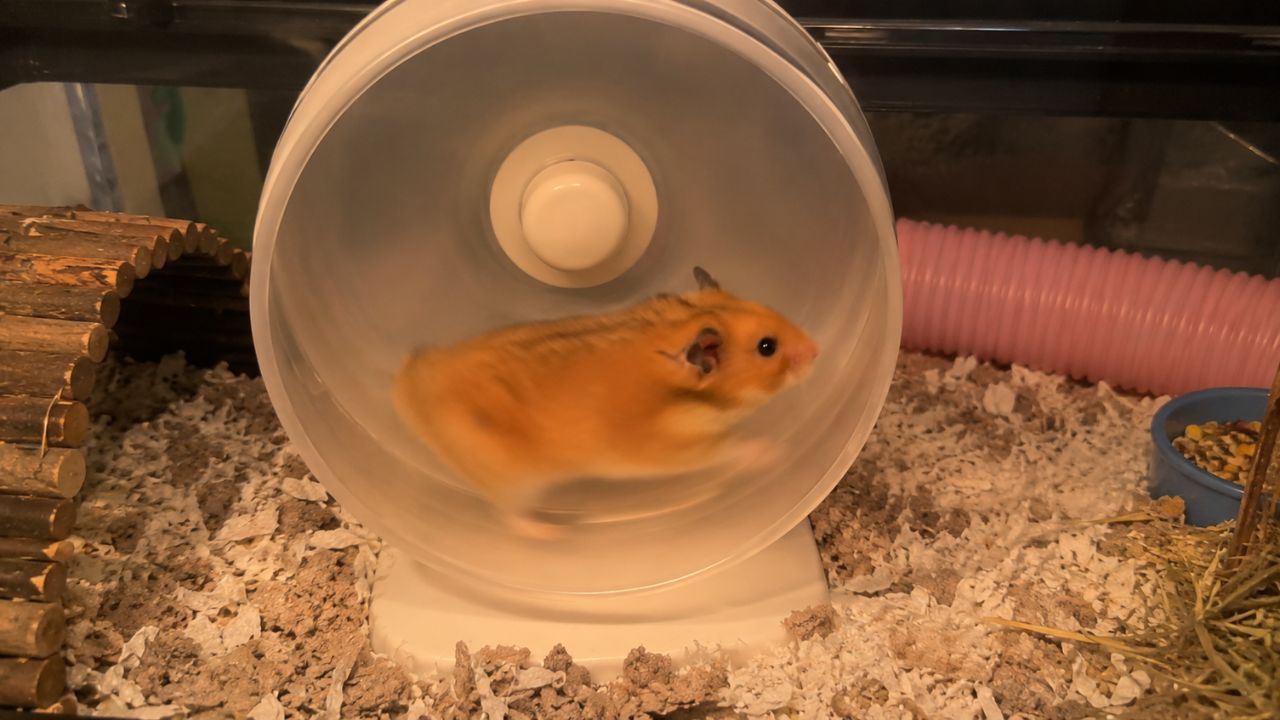

Neil has been keeping, breeding, and selling hamsters at Paradise Pets Swindon since 1988 — over 35 years of daily first-hand experience with these animals and the people who keep them. Night wheel running is the complaint that comes to the counter most often from parents of children who keep hamsters — and it is almost always accompanied by the same question. Is something wrong with it? This is his honest guide to why hamsters run on their wheel all night, what is normal, what is excessive, and the small number of situations where the running actually tells you something worth acting on.
A mother came in one morning looking considerably less rested than she should have been. Her son had a Syrian hamster in his bedroom. The hamster ran on its wheel from approximately ten in the evening until two or three in the morning, every single night. The wheel was a standard plastic wheel that came with the cage. The noise, she said, was somewhere between a squeaky gate and a small engine.
She wanted to know whether the hamster was doing something wrong, whether it was stressed, and whether there was any way to make it stop without getting rid of it.
I answered her questions in order. No, the hamster was doing nothing wrong — it was doing exactly what hamsters do. It was not stressed; if anything, a hamster that runs extensively on its wheel at night is a hamster that is using the wheel appropriately. And yes, there was a way to reduce the noise, though it involved a different wheel rather than anything about the hamster itself.
Then I told her the fuller picture — because the question of why hamsters run at night, how much running is appropriate, and when the wheel running might actually reflect something in the environment worth looking at is more interesting and more useful than a simple yes or no.
Why Hamsters Run At Night — The Biology First
Before I explain anything about the wheel specifically, I want to explain the biological reality of hamster locomotion — because without this context, the nightly running seems excessive or pathological rather than what it actually is.
Syrian hamsters, in the wild, are native to the arid regions of Syria and neighbouring countries. They live in burrow systems and forage exclusively at night — emerging after dark, covering vast distances in search of food, and returning to the burrow before dawn. Research tracking wild hamsters with GPS has recorded individuals covering between five and ten kilometres in a single night. Not occasionally. Routinely.
Your hamster has the same biology. It does not know it lives in a cage in Swindon. It does not know that food appears in a bowl every morning without any effort on its part. Its nervous system, its hormonal systems, its circadian rhythm — all of these are calibrated to the expectation of extensive nocturnal locomotion. When that locomotion does not happen, the drive does not simply disappear. It accumulates. And the wheel is where it goes.
- Wild Syrian hamsters cover five to ten kilometres per night foraging — this is not an aberration; it is the baseline expectation of the species; a hamster running several kilometres on its wheel is not running excessively, it is running normally
- The wheel is not a luxury or enrichment in the way a toy is — for a hamster in captivity, the wheel is the primary mechanism for meeting a locomotion need that is as fundamental as eating and sleeping; removing it or restricting access to it causes genuine welfare problems
- Hamsters are obligate nocturnal animals — their activity cycle is fixed and not adjustable; the running will happen at night because that is when hamsters run; this is not a habit that can be trained away
- The drive to run is hormonal and neurological, not just behavioural — it is not a choice the hamster is making in the way a human might choose to go for a run; it is a physiological need that produces significant stress when unmet

Once you understand this, everything else in this guide makes sense — including why the question of how much running is too much is less straightforward than it appears, and why the wheel noise is usually a wheel problem rather than a hamster problem.
How Much Wheel Running Is Normal
This is the question most owners actually want answered when they come in, and the honest answer is that the range of normal is wider than most people expect.
A healthy, well-housed Syrian hamster typically runs between three and ten kilometres per night on the wheel. Some individuals run more. The running is usually concentrated in the first few hours after darkness falls — typically between nine and midnight in a UK household — with a secondary burst before dawn. The pattern corresponds to the foraging schedule the species evolved for.
- Running for two to four hours per night is entirely normal — do not attempt to limit this; it is the hamster meeting a physiological need
- Running for longer periods in a young hamster — adolescent hamsters in their first few months often run more than adults; the drive is at its peak in young animals and reduces somewhat as the hamster matures
- Variation night to night is normal — a hamster that ran for three hours last night and six hours tonight has not developed a problem; individual variation and the influence of temperature, time of year, and recent feeding all affect running duration
- Dwarf hamsters typically run less than Syrian hamsters — but the proportion of their body size to distance covered is similar; dwarf hamsters are smaller animals with proportionally smaller territories in the wild
The Wheel Noise Problem — Usually the Wheel, Not the Hamster
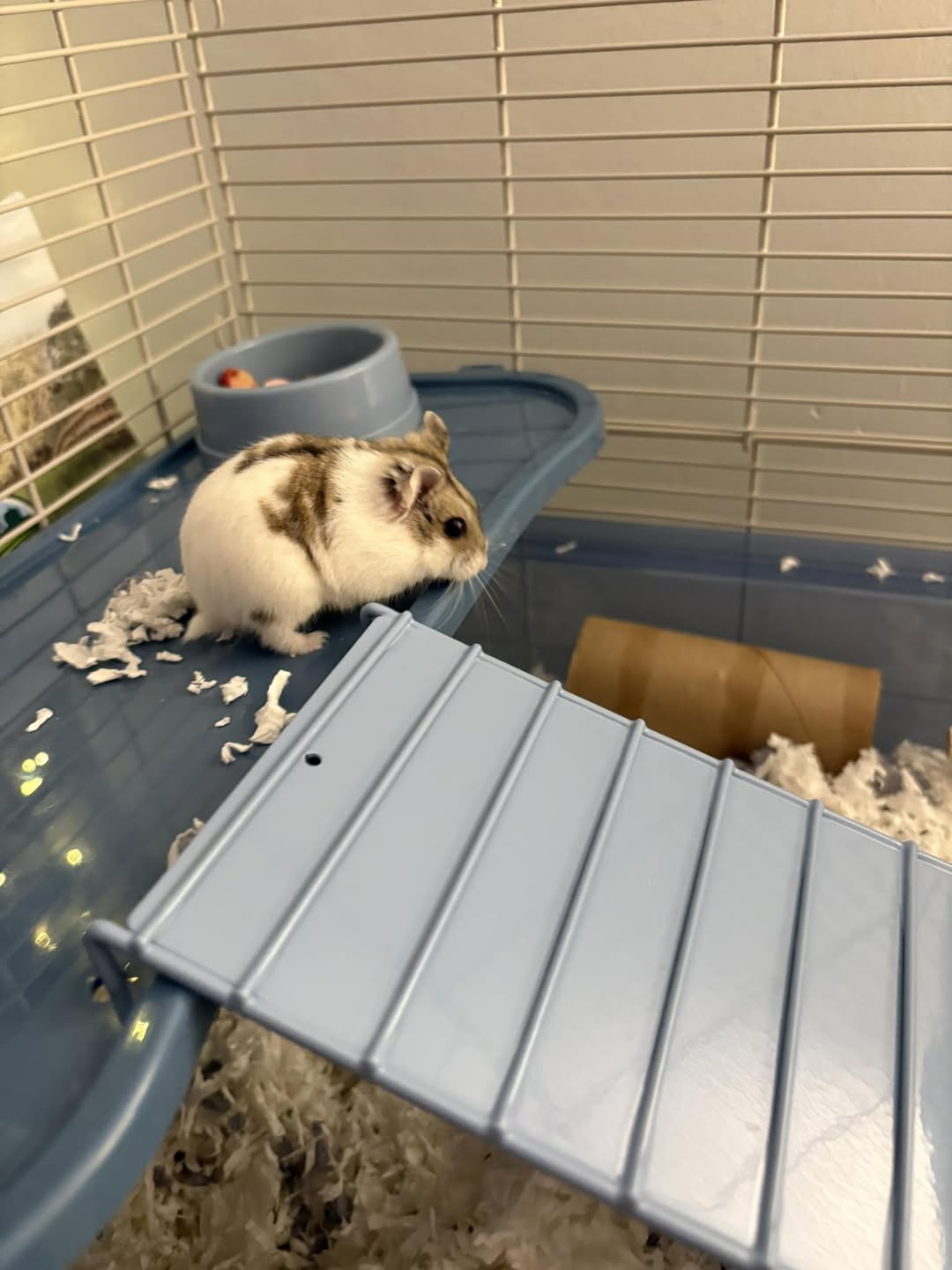
The complaint I hear most often is not really about the running — it is about the noise. And in the majority of cases, the noise problem is entirely solvable because it is a wheel problem, not a hamster problem.
Standard plastic wheels sold with starter cages are almost universally inadequate — too small, too noisy, and in many cases physically harmful to the hamster. The noise they produce is a combination of the bearing mechanism squeaking and the plastic vibrating against the cage or stand.
- The wheel is too small — this is the most common problem; a Syrian hamster needs a wheel with a minimum running diameter of 28cm; most wheels sold with starter cages are 18 to 21cm; a hamster running on a wheel that is too small has to arch its back while running, which causes spinal stress and produces the characteristic drumming noise as the animal compensates for the awkward running position
- The wheel has a noisy bearing — cheap plastic wheels use a simple axle that squeaks; this is the sound that wakes people up; it is not the hamster’s running itself but the mechanical noise of a poorly made wheel
- The wheel is not freestanding or is vibrating against the cage — a wheel attached to the cage bars transfers vibration directly into the cage structure and amplifies it; a freestanding wheel placed on the cage floor reduces this significantly
- The solution is a quality silent wheel — specifically a ball-bearing wheel with a solid running surface; the Niteangel, Silent Spinner, and Wodent Wheel are the most commonly recommended options; they are significantly more expensive than the standard wheel but they are genuinely quiet, the correct size, and last the lifetime of the animal
- The wheel surface matters for safety — solid running surface rather than bars or mesh; a hamster running on a barred wheel can catch its feet between the bars; solid surface wheels are safer and generally quieter
When Wheel Running Might Reflect Something Worth Looking At
Most night wheel running is completely normal and the only question is whether the wheel is appropriate. There are, however, some contexts in which the pattern of wheel running tells you something about the environment or the animal’s welfare that is worth paying attention to.
Excessive Running in an Inadequately Housed Hamster
A hamster in a cage that is too small, with inadequate bedding depth and insufficient enrichment, will often run on the wheel more than it would in a properly set up environment — not because it enjoys running more, but because the wheel is the only available outlet for its activity drive and the inadequacy of the rest of the environment leaves it with nothing else to do.
- A hamster that runs almost continuously throughout its active period, rarely stopping to eat, burrow, or explore — this is the version of wheel running worth examining; a healthy hamster in a good environment uses the wheel as one of several activities; a hamster that uses the wheel almost exclusively may be compensating for an environment that does not offer enough else
- Check floor space and enrichment — PDSA’s hamster guide cites at least 100cm by 50cm of floor space. A wheel should be part of a spacious enclosure with opportunities for burrowing, exploring and foraging.
- Bedding depth matters enormously — hamsters need a minimum of 20 to 30cm of bedding to burrow properly; burrowing is as important to hamster welfare as running; a hamster without adequate bedding cannot burrow and the running intensity on the wheel often increases as a result
- The addition of more burrowing substrate often reduces wheel running intensity — not because the hamster runs less, but because it now has more outlets for its activity; the running becomes one behaviour among several rather than the only available option
Stress-Related Running
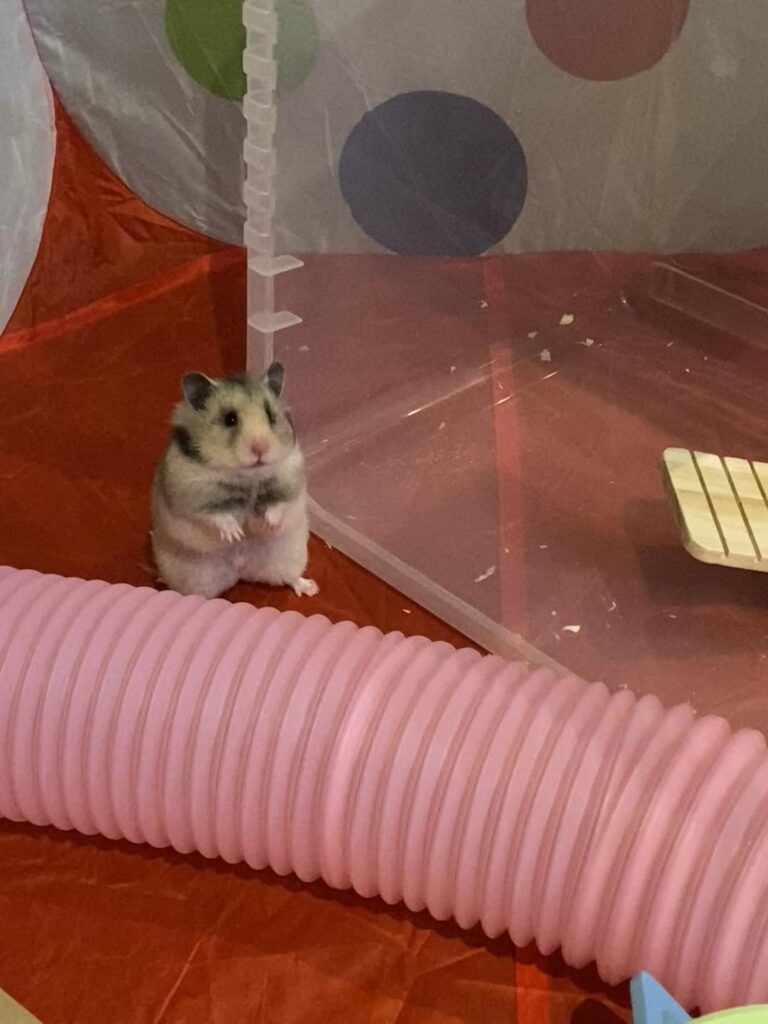
A hamster that is chronically stressed — from inadequate housing, from a nearby predator animal, from inconsistent handling, from a cage positioned in a noisy or brightly lit location — may run on the wheel in a more driven, less purposeful way than a relaxed hamster.
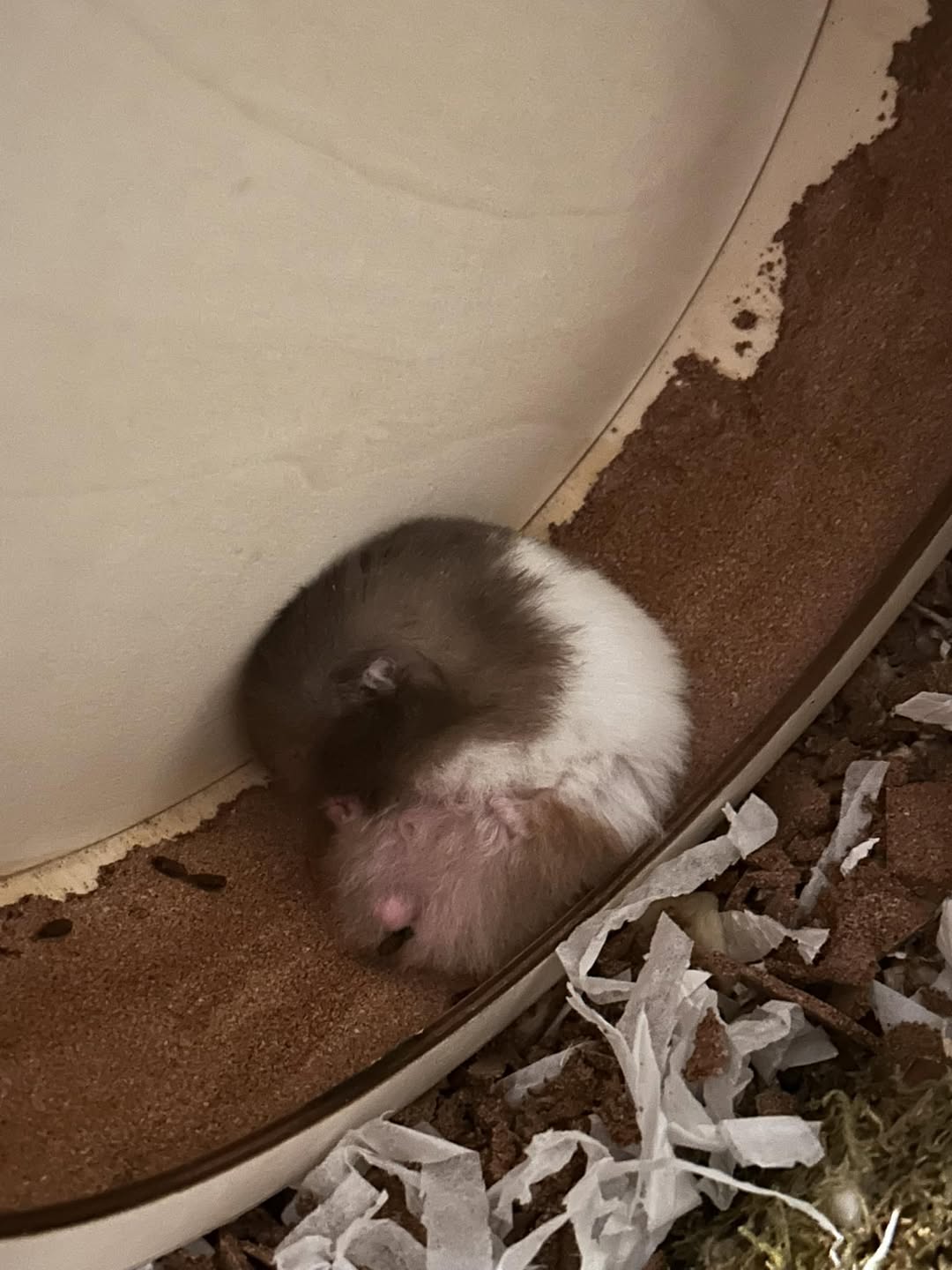
- Stress-related running tends to look different from normal running — the hamster runs in a driven, repetitive way, often returning immediately to the wheel after brief pauses, rather than the more varied pattern of a relaxed animal that runs, stops, explores, eats, and runs again
- A dog or cat in the household — even one that never approaches the cage; the scent of a predator species in the room maintains elevated arousal in a hamster; an aroused, stressed hamster runs more intensively and with less variation in its activity pattern
- A cage in a noisy location — television, music, household traffic; hamsters are sensitive to sound and vibration; chronic noise disrupts sleep quality and increases generalised arousal, which can manifest as more intensive wheel running during active hours
- The cage is too brightly lit during the day — hamsters should have a genuine period of darkness during their sleep phase; a cage in a room that is brightly lit throughout the day disrupts the circadian rhythm; disrupted sleep affects activity patterns including wheel running intensity
- Compulsive wheel running that the hamster cannot interrupt — the hamster continues running even when food is placed in the cage, does not pause to eat, groom, or investigate; true compulsive running of this intensity is rare but when present it indicates significant stress or a neurological issue
- Running that is uncoordinated or involves the hamster falling off the wheel repeatedly — a hamster that cannot maintain coordination while running may have an inner ear problem, a neurological issue, or may be weak from illness
- Wheel running that has suddenly stopped entirely in a hamster that previously ran normally — a hamster that has stopped using the wheel and is also less active generally may be unwell; see a vet with small animal experience
- Running alongside significant weight loss, reduced food intake, or changes in droppings — these combinations suggest illness rather than a pure behavioural issue
The Bedroom Problem — Practical Solutions
The most common practical problem owners bring to the counter is not the running itself but the impact of the running on the sleep of the people sharing the space. Here is what actually helps.
- Replace the wheel with a quality silent wheel of the correct size — this is the most impactful single change; a 28cm ball-bearing wheel with a solid running surface reduces noise to a level that most people find completely tolerable; the Niteangel and similar quality wheels are the standard recommendation; they cost more than the standard wheel but the difference in noise is dramatic
- Move the cage out of the bedroom — a hamster’s activity schedule is not compatible with human sleep schedules; this is not a failing of the hamster, it is a mismatch of biology; a landing, hallway, living room, or spare room is a better location than a child’s bedroom; the hamster does not need to be in the bedroom to be a good pet
- Place the cage on a solid surface with a non-slip mat underneath — vibration transfer from the cage to the surface it sits on is a significant noise amplifier; a solid table or chest of drawers with a rubber mat underneath is considerably quieter than a cage directly on a wooden floor
- Ensure the wheel is freestanding rather than attached to the cage bars — bar-mounted wheels transfer vibration into the cage structure and amplify it; a freestanding wheel on the cage floor produces far less transmitted noise
- Do not attempt to restrict the hamster’s access to the wheel at night — removing the wheel or blocking it to reduce noise causes genuine welfare harm; the locomotion need does not disappear when the wheel is unavailable; it produces stress, increased cage bar climbing, and a generally more distressed animal
Frequently Asked Questions
Is it normal for my hamster to run on its wheel all night?
Yes — entirely. A Syrian hamster running for several hours each night is doing exactly what its biology requires. Wild Syrian hamsters cover five to ten kilometres per night foraging. The wheel is the captive equivalent of that foraging run. A hamster that uses its wheel extensively at night is a healthy, active animal meeting a genuine physiological need. The question worth asking is not whether the running is normal but whether the wheel is appropriate — the right size, the right surface, and quiet enough not to disrupt the household.
My hamster only runs on the wheel and does nothing else. Should I be concerned?
If the wheel is the only activity the hamster engages in during its active hours — not eating, not burrowing, not exploring — the cage environment is probably not meeting its needs. A hamster with adequate space, deep bedding, and environmental enrichment uses the wheel as one of several activities. A hamster that uses only the wheel is often a hamster that has only the wheel available as a meaningful outlet. Improve the environment and the wheel use will typically become one behaviour among several rather than the only one.
Can I train my hamster to run at a different time so it does not keep me up?
No. Hamsters are obligate nocturnal animals. Their activity cycle is governed by light and hormonal cues that are not adjustable through training or routine. Attempts to shift the activity cycle by keeping the hamster awake during the day, changing feeding times, or altering light exposure tend to produce a stressed, sleep-deprived animal rather than one that has shifted its schedule. The practical solutions are a quieter wheel and a different cage location, not a changed schedule.
My hamster’s wheel is noisy. What should I replace it with?
A solid-surface, ball-bearing wheel of at least 28cm diameter for a Syrian hamster. The Niteangel range and the Silent Spinner are the most consistently recommended options among UK hamster owners. The key features to look for are a ball-bearing axle rather than a plain spindle, a solid running surface rather than bars or mesh, and a diameter of at least 28cm for a Syrian. Dwarf hamsters can use a smaller wheel — 20 to 21cm — but the same quality criteria apply.
Is it bad for my hamster to run too much?
In normal circumstances, no. There is no evidence that the amount of running a healthy hamster does voluntarily on an appropriate wheel is harmful. The body condition of a hamster that runs extensively should be checked periodically — a hamster that is losing weight despite adequate food availability may be running more than its caloric intake supports, though this is uncommon with normal diet provision. If the hamster looks lean or the keel bone feels prominent, increase the food slightly.
My hamster has stopped using the wheel. Should I be worried?
Possibly, depending on the context. An older hamster that gradually reduces wheel use over months is showing normal age-related reduction in activity. A hamster that stops using the wheel suddenly, particularly alongside reduced appetite or reduced overall activity, may be unwell. A vet check with a small animal experienced vet is appropriate in the second scenario. Also check the wheel itself — if it has become stiff, unbalanced, or the bearing has worn out, the hamster may have stopped using it because it is uncomfortable to run on.
Where can I get a good hamster wheel in Swindon?
Come in to Paradise Pets at Manor Garden Centre, Cheney Manor Industrial Estate, Swindon SN2 2QJ — or call us on 01793 512400. I am happy to talk through what wheel suits the hamster you have, what size is appropriate, and what else might help if the cage setup needs improving. Free advice, no obligation. That is how we have done things here for 35 years.
One Last Thing From Me
The mother I described at the start — the one who had not been sleeping because of the wheel noise — came back about a month after our conversation. She had moved the cage to the hallway and replaced the wheel with a silent ball-bearing wheel of the correct size. She had also, in the process of reading up on wheel requirements, discovered that the cage they had was too small for the animal and upgraded it.
She looked considerably better rested. Her son was happier because the hamster was now more active and more visible during its waking hours — the enriched environment with adequate space meant it was spending time exploring and burrowing as well as running, and was therefore more interesting to observe.
The hamster, she said, was running just as much as before. They just could not hear it anymore.
That is the complete answer to most hamster wheel problems. The running is correct. The wheel is the issue. And the wheel is fixable.
A hamster that runs on its wheel all night is not a hamster with a problem. It is a hamster that is doing what five million years of evolution built it to do, in the only format a domestic cage makes available. The fact that it happens to do this at two in the morning is an inconvenience of the biology, not a failing of the animal.
Give it the right wheel. Put the cage in the right room. And let it run.
Questions About Your Hamster’s Wheel, Cage, Or Setup? Come In And Ask.
Tell me what you have and I will tell you honestly whether it is adequate and what is worth changing. If the noise is the problem, I can tell you exactly what wheel will fix it. Free advice, no obligation. That is how we have done things here for 35 years.