

Neil has run Paradise Pets Swindon since 1988 — over 35 years of keeping, breeding, and advising on budgies. Bathing is one of the most commonly misunderstood parts of budgie care. This is his honest guide on how to do it properly — and what most owners get wrong.
A customer came in last summer looking slightly defeated. She had read online that budgies need regular baths. She had filled a bowl, put it in the cage, and her budgie had looked at it with pure contempt for three days before using it as a second food dish.
“He just stands in it and eats the seeds that fell in,” she said. “Is he broken?”
He was not broken. He was a budgie. And the thing about budgies and bathing is that they do it entirely on their own terms — which is both the charm and the frustration of the whole subject.
Bathing is important for budgies. It keeps the feathers in good condition, helps with preening, supports skin health, and for many birds is a source of genuine enjoyment. But forcing it, doing it the wrong way, or doing it at the wrong time causes more problems than it solves. And there are several things that well-meaning owners do with budgie bathing that are genuinely harmful.
After 35 years of keeping and advising on budgies at Paradise Pets, here is what I actually tell people.

Do Budgies Actually Need Baths?
Yes — but not in the way most people think.
Budgies in the wild get wet regularly. Rain, dew on vegetation, morning mist — their feathers and skin are designed to cope with and benefit from regular moisture. The fine powder-down that budgies produce — the white dust you sometimes see on surfaces near the cage — is part of the feather maintenance system, and moisture helps distribute it properly through the plumage.
Without regular bathing or misting, a budgie’s feathers can become dry, brittle, and prone to breaking. The skin can become irritated. Preening becomes less effective. In dry UK homes, particularly in winter with central heating running, the air is often far drier than a budgie’s feathers need.
So yes — bathing matters. But it is not something that requires a specific technique or a structured routine the way, say, grooming a dog does. It is something you facilitate by offering options and letting the bird choose.
The 4 Ways To Bathe A Budgie — And Which Suits Your Bird
There is no single correct way to bathe a budgie. Different birds have strong preferences, and what works brilliantly for one will be ignored completely by another. The key is to try different options and pay attention to what your bird actually responds to.
Method 1: Shallow Bath Dish In The Cage
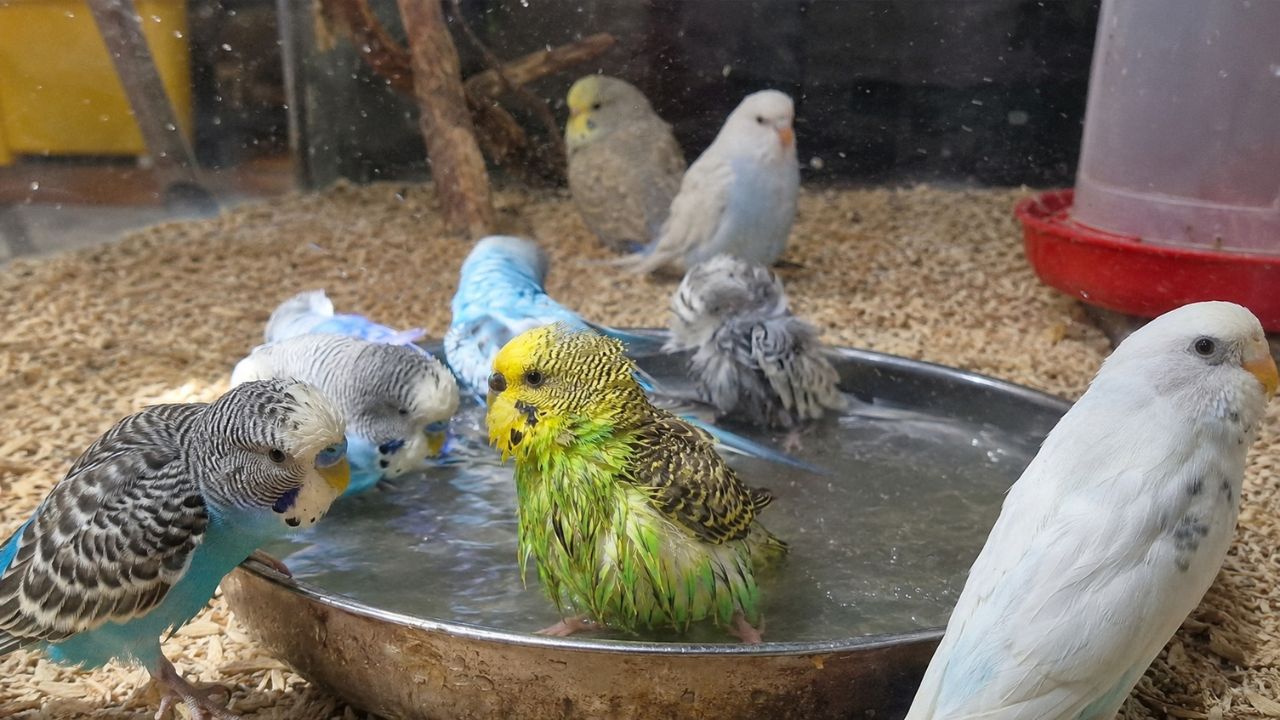
This is the most common approach and the one most people try first. A shallow dish — no deeper than 2 to 3cm — placed inside the cage with room-temperature water. The bird chooses whether to use it and when.
The critical word here is shallow. Budgies do not swim. They do not submerge. A dish that is too deep is a dish the bird will not use — and in the worst case, a dish the bird could become distressed in if it stumbles. The water should cover the bird’s feet when it stands in it, no more.
- Use a proper budgie bath dish or a small, stable ceramic dish — not a tall glass or a deep bowl
- Water temperature must be room temperature — not cold from the tap, not warmed. Run it until it loses the chill.
- No additives — no soap, no shampoo, no bath salts, no essential oils. Plain water only.
- Place it in a stable part of the cage where the bird can approach it from a perch
- Leave it in for twenty to thirty minutes then remove it — stale bath water sitting in the cage is a hygiene problem
- Offer it in the morning, not the evening — a wet bird needs time to dry before the temperature drops
Some birds take to a bath dish immediately. Others take weeks of it being offered before they try it. Others never use it at all and prefer one of the other methods. None of these responses is wrong — it is just individual preference.
Method 2: Misting With A Spray Bottle
This is the method I recommend most often for budgies that ignore a bath dish — and for UK owners in winter when the central heating dries the air significantly.
A clean spray bottle, filled with plain room-temperature water, used to mist the bird with a fine, gentle spray. Hold the bottle at least thirty to forty centimetres away and spray in an arc above the bird so the mist falls on it like light rain — not a direct blast of water straight at its face.
Most budgies respond to misting far more readily than to a standing bath. The falling-mist sensation is closer to the natural experience of rain than a dish of standing water is. Many birds that completely ignore a bath will puff up, flap, and preen enthusiastically when misted.
- Use a dedicated clean bottle — never use a bottle that has contained cleaning products or fragrances, even if rinsed. Residue at parts per million is enough to harm a budgie’s respiratory system.
- Room temperature water only — cold water is a shock to a small bird. Take the chill off it before you spray.
- Spray from above at an angle — not directly into the face. The mist should fall on the bird like rain, not hit it like a hose.
- Read the bird’s reaction — a bird that fluffs up and starts preening is enjoying it. A bird that moves away, crouches in alarm, or shows obvious distress should not be forced. Try again another day.
- Morning only — the bird needs the whole day to dry. Never mist in the evening.
Method 3: Wet Greens In The Cage
This is my personal favourite for budgies that are reluctant bathers, and it is the most natural of all the methods.
Take a few leaves of fresh leafy greens — spinach, lettuce, kale — and rinse them under the tap. Leave them slightly wet and place them in the cage. Many budgies will roll in wet leaves enthusiastically, rubbing their feathers against the damp surface in a way that functions as a very effective bath. They are doing what they would do with dew-covered vegetation in the wild.
It also has the advantage of combining bathing with diet — if the bird actually eats the greens afterwards, so much the better. For a bird that ignores a bath dish and tolerates misting only reluctantly, wet greens are often the solution that actually works.
- Rinse the leaves thoroughly to remove any pesticide residue
- Leave them damp but not dripping — you want moist leaves, not standing water in the cage
- Use safe greens — spinach, romaine lettuce, kale, dandelion leaves are all fine
- Remove after an hour or so — wilted wet greens left in a warm cage can develop bacteria
- Offer first thing in the morning so the bird has time to dry before the evening

Method 4: Running Water — For Budgies That Like The Tap
Some budgies are fascinated by running water. If your bird shows interest in the sound of running water, or tries to get closer when you are at the sink, it may prefer to bathe under a gentle trickle from a tap.
Hold the bird gently and allow it to approach the running water on its own terms — a very gentle flow, not a strong current. Let the bird choose where and how much contact it has with the water. Some birds will stand under it directly. Others will just wet their face and head. Others will decide it is not for them after all and that is fine too.
This method only works for birds that are already tame and comfortable with handling. Do not attempt it with a bird that is not yet relaxed about being held — the combination of unfamiliar handling and running water will be genuinely distressing.
How Often Should You Bathe A Budgie?
Two to three times a week is a good general guideline for a healthy adult budgie in a typical UK home. In summer, when the weather is warm and the air is more humid, you may find the bird wants to bathe more often. In winter, when central heating dries the indoor air significantly, maintaining that two to three times a week frequency is particularly important for feather and skin health.
Follow the bird’s lead. A budgie that actively seeks out its bath dish, or that reacts enthusiastically to misting, is telling you it wants more. A bird that consistently avoids bathing may have a reason — illness, cold, stress — or it may simply be a bird that prefers minimal bathing. Not all budgies are equally enthusiastic.
- In the evening — a wet bird overnight in a UK home risks dangerous chilling
- When the bird is unwell — a sick bird cannot thermoregulate properly and should not be made wet
- During a vet-prescribed treatment period — unless the vet specifically advises otherwise
- In a cold room — the room should be comfortably warm before you offer a bath
- Immediately after coming out of the cold — if the bird has been transported or the cage has been cold, let it warm up first
How To Dry A Budgie After Bathing
This is where a lot of owners go wrong — and where well-meaning attempts at care can cause real harm.
The correct answer is: you do not dry a budgie. You allow it to dry itself.
A budgie that has bathed will shake off excess water, preen its feathers thoroughly, and dry naturally in a warm room. This process takes twenty to forty minutes depending on how wet the bird got and how warm the room is. The bird manages it entirely on its own, and the preening process is actually an important part of the benefit of bathing — the bird distributes its natural oils through the feathers as it dries.
- Never use a hair dryer — the heat is impossible to control safely at close range, the noise is terrifying, and the directed hot air can cause burns and respiratory damage from the heating element fumes
- Never towel dry — towelling disrupts the feather structure, stresses the bird, and can cause injury if the bird struggles
- Never put the bird in direct sunlight immediately after bathing — a wet bird that overheats cannot regulate its temperature effectively
- Never put the cage cover on a wet bird — it traps moisture and prevents drying
- Never bathe in a cold room — if the room is not warm enough for comfortable air drying, it is not warm enough for a bath
Simply ensure the room is warm — around 20°C or above is fine — move the cage away from any draught, and let the bird get on with it.

My Budgie Refuses To Bathe — What Do I Do?
This comes up constantly. A budgie that will not bathe — despite every option being offered — is a source of genuine worry for owners who have read about how important bathing is.
My honest answer: some budgies are simply reluctant bathers, and that is fine. Not every bird wants to bathe frequently. Some birds bathe vigorously every day. Some bathe once a week. Some seem to bathe almost never.
If the bird’s feathers look healthy — smooth, well-structured, not brittle or broken — and the bird is preening normally, it is probably managing its feather condition adequately without the bathing sessions you are offering. Some birds get sufficient moisture from their food, particularly if they eat fresh greens regularly.
- Have you tried all four methods? A bird that ignores a bath dish may love wet greens. A bird that avoids misting may use a tap. Try everything before concluding the bird is a non-bather.
- Is the water temperature right? Too cold is the most common reason birds avoid a bath dish. Take the chill off completely — the water should feel neither cold nor warm when you test it on your wrist.
- Is the timing right? Offer the bath mid-morning on a warm day. Birds are more likely to bathe when they are active and the environment is warm.
- Is the bird watching another bird bathe? If you have two budgies, one bathing enthusiast often encourages the other. Social learning is real in budgies — a reluctant bather will sometimes follow a willing one into the bath within days.
- Is the bird unwell? A bird that has recently stopped bathing when it previously did is worth watching. Loss of interest in bathing can be an early sign of illness.
What To Put In The Bath Water — And What Never To Add
Plain room-temperature water. That is the complete answer.
I want to be direct about this because there is a great deal of misinformation online about adding things to budgie bath water — aloe vera, chamomile tea, essential oils, bird-specific shampoos. The honest answer is that none of these are necessary and several of them are potentially harmful.
- No soap or shampoo of any kind — strips the natural oils from the feathers and skin, causing exactly the dryness and irritation you are trying to prevent
- No essential oils — highly concentrated plant compounds that are toxic to birds in amounts that seem trivial to us
- No vinegar — acidic and irritating to the eyes and mucous membranes
- No commercial bird shampoos unless specifically prescribed — the vast majority are unnecessary and some contain fragrances that are harmful to avian respiratory systems
- No additives of any kind — plain water is what a budgie needs. Anything added is either useless or potentially harmful.
If a bird has a specific skin or feather condition that you think needs treatment, that is a conversation for an avian vet — not a reason to add something to the bath water.
Bathing and Moulting — What Changes
During a moult — when the bird is actively losing old feathers and growing new ones — bathing takes on slightly added importance and requires a bit more attention.
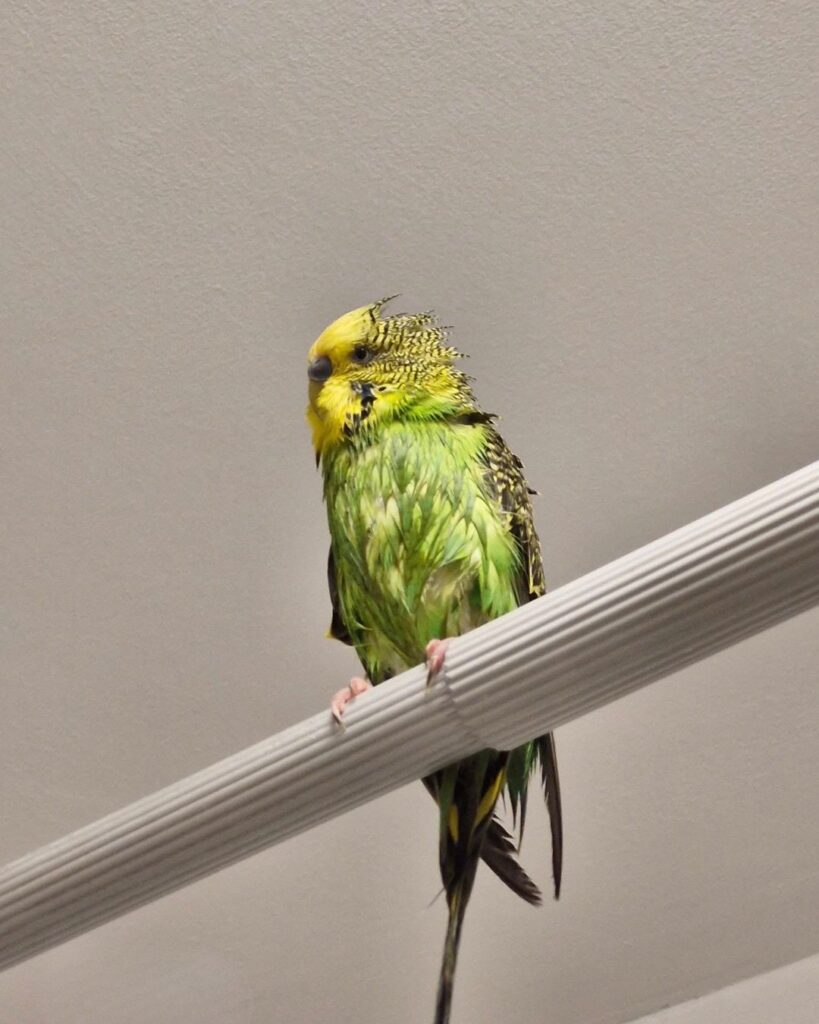
New pin feathers, the waxy-sheathed emerging feathers, are sensitive and can be uncomfortable for the bird. Regular light misting during a moult helps soften the sheaths and makes the preening process easier. Many birds actually bathe more frequently during a moult for this reason.
What to avoid during a moult: do not attempt to help remove pin feather sheaths on the body. On the head, where the bird cannot reach itself, a bonded companion will do this naturally. If the bird is alone and appears to have very itchy, irritated pin feathers on the head, a gentle misting is more appropriate than trying to handle the feathers yourself — disturbing an unripe pin feather can cause bleeding and real pain.
Common Mistakes UK Budgie Owners Make With Bathing
| What people do | Why it is wrong | What to do instead |
|---|---|---|
| Bathe in the evening | A wet bird in a UK home at night risks chilling — potentially fatal in cold weather | Morning only — gives the bird a full day to dry in a warm room |
| Use cold tap water | Cold water is a shock to a small bird and most will avoid it consistently | Run the tap until the water loses its chill — room temperature throughout |
| Use a hair dryer to speed drying | Heat damage, respiratory damage from heating element fumes, and genuine terror for the bird | Warm room, no draughts — let the bird air dry naturally |
| Add shampoo or oils to the water | Strips natural oils, potentially toxic — plain water is all that is needed | Plain room-temperature water only, every time |
| Force the bird into a bath | Creates fear and aversion — the bird becomes more reluctant, not less | Offer options and let the bird choose — try different methods over time |
| Leave bath water in the cage all day | Bacteria multiply in warm standing water — hygiene problem within hours | Remove the bath dish after twenty to thirty minutes |
Frequently Asked Questions
How do I get my budgie to bathe for the first time?
Start with the least invasive method — wet greens in the cage. Most birds will investigate damp leaves even if they ignore a bath dish entirely. Once a bird has had a first positive experience with moisture, it often becomes more open to other bathing options. Patience is the main ingredient here. Some birds take weeks to start bathing regularly, particularly if they had no bathing opportunities before you got them.
My budgie splashes water everywhere when it baths — is this normal?
Completely normal. A budgie that is bathing enthusiastically will shake, splash, and flap — this is the bird doing it right. Put a towel under the cage on bath days. The mess is a small price for a bird that is genuinely enjoying its bath.
Can I bathe my budgie in the sink?
Some budgies enjoy it — see Method 4 in this article. The key is that the bird must be tame enough to be comfortable being held near running water, the flow must be very gentle, and the water must be room temperature. Never put a budgie directly under a running tap with any significant flow.
My budgie got very wet and is shivering — what should I do?
Move the bird to a warm room immediately and ensure there are no draughts. A bird shivering after a bath is cold and needs to warm up before it can dry properly. Do not use a hair dryer. Hold the bird gently near your body for warmth, or ensure the room temperature is genuinely warm. Once it stops shivering and starts preening, it is recovering. If it remains shivering and lethargic for more than an hour, that warrants a call to an avian vet.
Should I bathe my budgie in winter?
Yes — in fact, winter bathing is particularly important in UK homes where central heating dries the air significantly. The key is timing and temperature: bath in the morning, in a warm room, and ensure the bird is fully dry before the evening temperature drops. Misting is often more practical than a bath dish in cold weather, as the bird dries faster.
Where can I get budgie care advice in Swindon?
Come and see us at Paradise Pets, Manor Garden Centre, Cheney Manor, Swindon SN2 2QJ. Or ring us on 01793 512400. We have kept and sold budgies for over 35 years and are happy to help with any question about care, behaviour, or health — no obligation.
One Last Thing From Me
The customer whose budgie was using the bath as a seed dish — she came back about six weeks later. She had switched to misting, then tried wet lettuce leaves, and her bird had gone from complete indifference to bathing enthusiastically in wet greens every morning.
“He just needed the right type of bath,” she said. “I was offering him a swimming pool and he wanted a puddle.”
That is a better summary of budgie bathing than most of what I have read. These birds will tell you what they prefer if you pay attention. Your job is to offer the options, get the basics right — right temperature, right time of day, no additives, no forcing — and then follow the bird’s lead.
Questions About Your Budgie? Come And See Us
Bathing questions, care questions, health questions — we have heard them all across 35 years. Come in and talk to us at the shop, or ring us for a quick conversation. We are always happy to help. No obligation, no pressure.