
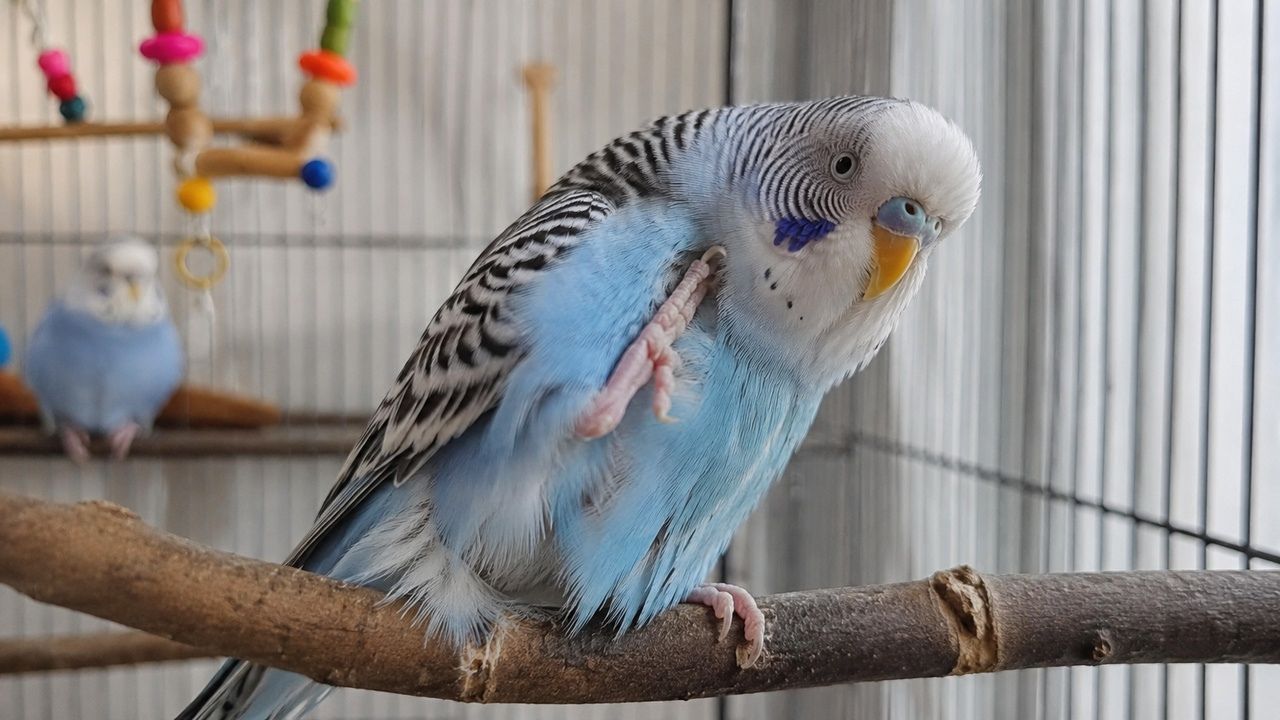

Neil has kept, bred, and sold budgies at Paradise Pets Swindon since 1988 — over 35 years of first-hand experience with these birds. In that time, he has had countless worried owners describe a budgie that will not stop scratching. This article is his honest, practical guide on what scratching actually means and what to do about it.
A man came into the shop one Saturday morning, properly concerned. “Neil,” he said, “my budgie has started scratching constantly. All day. Scratching at his face, his body, pulling at his feathers. He never used to do this. I’m worried something’s seriously wrong with him.”
I asked him a few questions, then suggested he bring the bird in so I could have a proper look. When he did, the answer became clear within minutes — the budgie had a mite problem, easily treatable, and within a couple of weeks the scratching had stopped completely.
It is one of the most common worried-owner questions I get at the counter, and I am glad when people take it seriously — because while some scratching is completely normal, persistent scratching is your budgie telling you something is wrong, and the sooner you work out what, the easier it is to fix.
The honest truth is this — a small amount of scratching and preening is completely normal in budgies, but constant, frantic, or worsening scratching is not. Telling the difference is the skill, and that is what 35 years of working with these birds has taught me to recognise quickly.
This article is the conversation I have at the counter, written down for every UK budgie owner watching their bird scratch and wondering whether to worry. By the end of it, you will know what is normal, what is not, what causes it, and exactly what to do about it.
First — What Is Normal Scratching?
Before we go into the causes that worry me, I want to make sure we are talking about the same thing. Because some of the “scratching” complaints I get at the counter turn out to be completely normal budgie behaviour.
A healthy budgie scratches and grooms itself regularly throughout the day. This is normal and important — it is how the bird keeps its feathers clean, aligned, and in good condition. Normal grooming behaviour includes:
- Occasional head scratching with a foot — exactly like a dog or cat scratches
- Preening — running feathers through the beak to clean and align them
- Scratching after the cover comes off in the morning — a normal waking routine
- A good shake and scratch after a bath or a nap
- Light scratching during a moult — when new pin feathers are coming through and feel itchy
That kind of scratching — occasional, brief, part of a normal grooming routine — is nothing to worry about. A budgie that scratches its head a few times a day, preens its feathers, and otherwise looks healthy is doing exactly what budgies do.
What we are talking about in this article is different. It is the budgie that scratches constantly, frantically, or far more than usual — often combined with feather damage, restlessness, or visible skin problems. That kind of scratching has a cause, and it needs addressing.
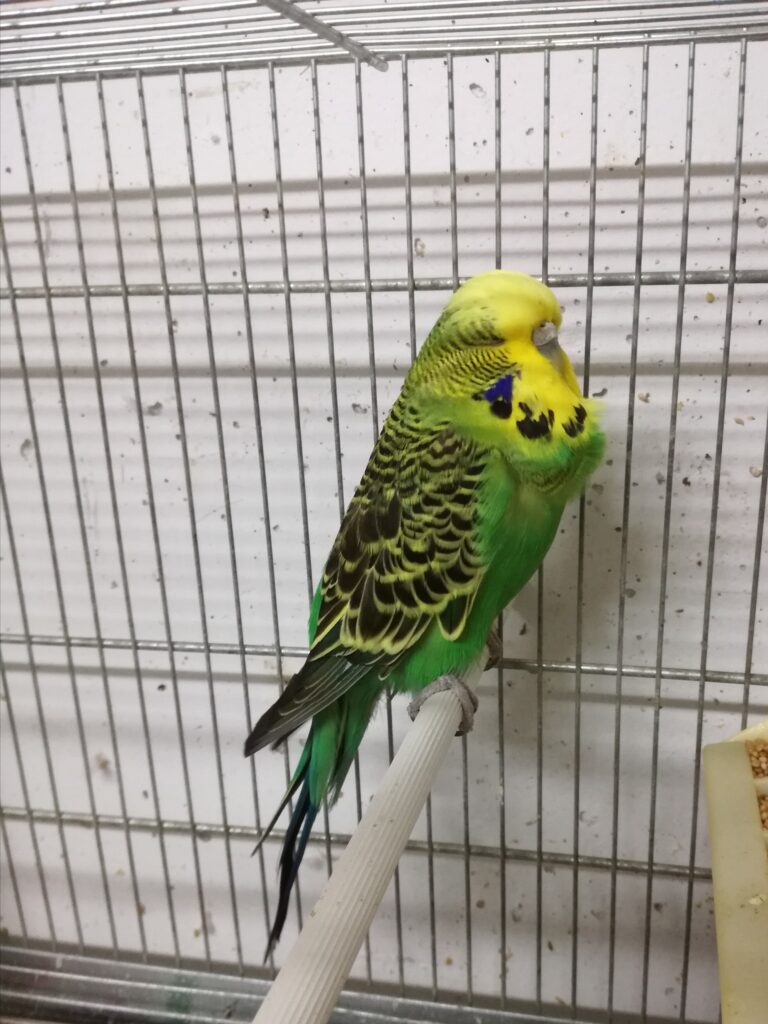
The 6 Main Causes Of Excessive Scratching
After 35 years, I can usually narrow down what is causing constant scratching within a few minutes of looking at the bird and asking the owner some questions. Here are the six most common causes I see, roughly in the order I encounter them.
Cause 1: Mites — The Most Common Cause By Far
This is the cause I see most often, and it is the one most worth checking first. Mites are tiny external parasites that live on or under a budgie’s skin, and they cause genuine, persistent itching that drives the bird to scratch constantly.
The most common type in UK budgies is the scaly face mite (Knemidocoptes), which burrows into the skin around the beak, cere, eyes, legs, and vent. It produces a characteristic crusty, honeycomb-like appearance on the affected areas. There are also red mites and other external parasites that cause itching without the obvious crusting.
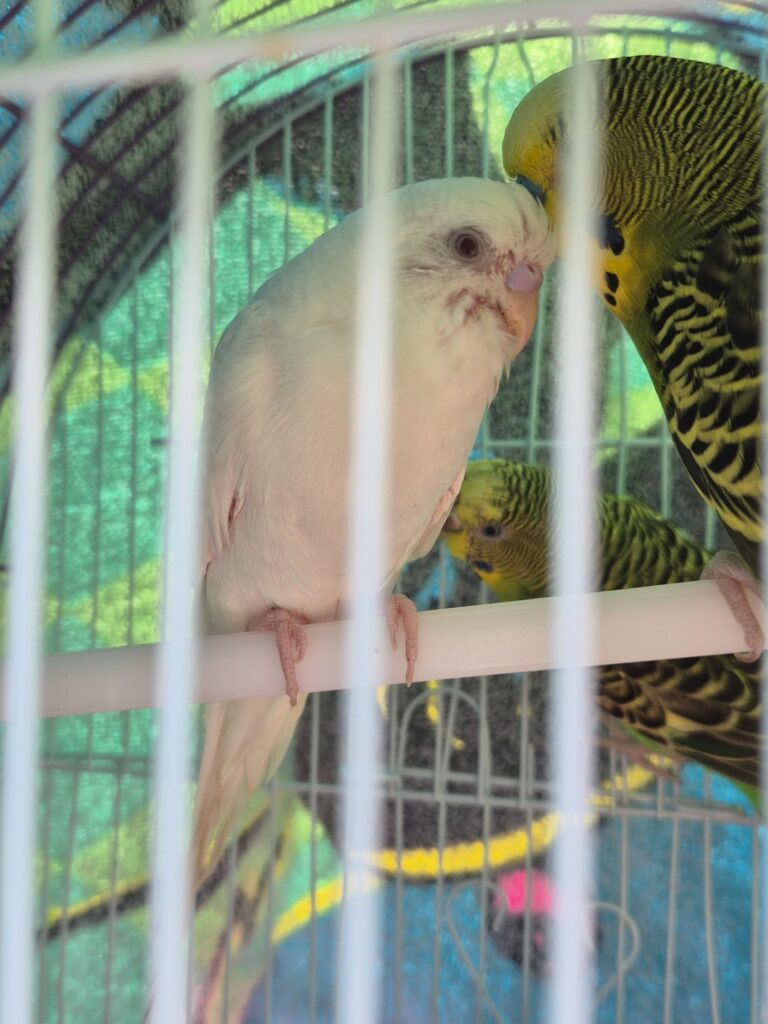 Mites are more common than many owners expect. They can be present at a low level for a long time and then flare up when the bird is stressed or its immune system is lowered. They can also be introduced by new birds, contaminated seed, or second-hand cages.
- Crusty, honeycomb-like deposits around the beak, cere, eyes, or legs (scaly face mite)
- Constant scratching, particularly at the face and head
- Restlessness, especially at night (some mites are more active in the dark)
- Feather damage from over-preening and scratching
- Flaky or irritated skin where feathers are thin
- Tiny moving specks visible on the bird or in the cage at night
What to do
Mites are very treatable, but they need proper treatment. An avian vet can confirm the diagnosis and prescribe the correct treatment — usually a topical or systemic anti-parasitic medication. Do not rely solely on the cheap “mite sprays” sold in some shops, which are often ineffective. While treating, clean the cage thoroughly and replace perches and any porous items where mites may be hiding. If you have multiple birds, all of them usually need treating.
Cause 2: Dry Skin And Low Humidity
This is the second most common cause I see, particularly in UK homes during winter. Central heating dries out the air significantly, and a budgie kept in a dry, heated room can develop dry, itchy skin that drives it to scratch and over-preen.
Budgies originate from a climate very different to a centrally-heated UK home. In the wild, they get regular access to water, rain, and humidity. In a dry living room with the heating on all winter, their skin and feathers can suffer.
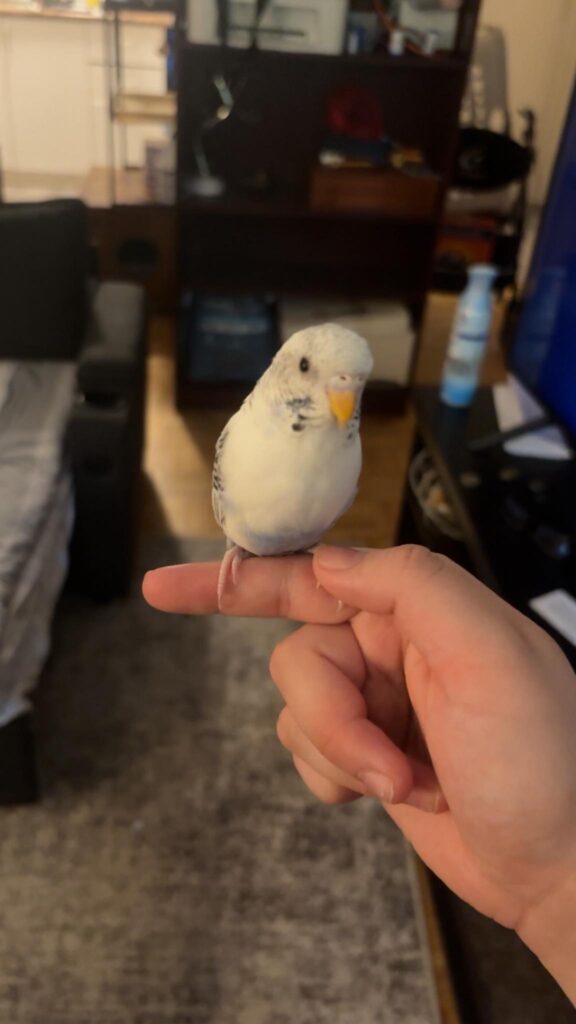 Signs of dry-skin scratching: the scratching tends to be generalised rather than focused on one spot, there is no crusting or visible parasites, the skin may look slightly flaky, and the problem is often worse in winter when the heating is on.
What to do
Increase humidity and bathing opportunities. Offer regular bathing — a shallow dish of water, a gentle misting with a plant sprayer filled with clean water, or letting the bird bathe in wet leafy greens. Many budgies love a light misting. You can also raise the room humidity slightly with a humidifier or by keeping the cage away from direct heat sources. Improvement is usually noticeable within a week or two.
Cause 3: Moulting
This one catches owners off guard because it looks alarming but is completely normal. When a budgie moults — usually once or twice a year in UK conditions — old feathers are shed and replaced by new ones. The new feathers come through as “pin feathers,” encased in a waxy sheath, and these genuinely itch as they grow.
A moulting budgie will scratch more than usual, preen heavily, and you will see feathers in the bottom of the cage. The bird may look slightly scruffy for a few weeks. You may see the spiky pin feathers, particularly around the head and neck.
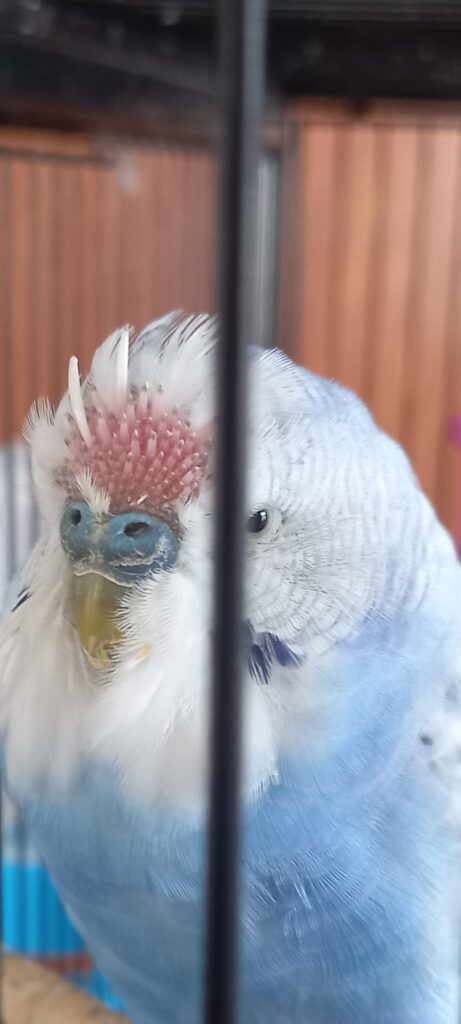 This is normal and temporary. The key signs that it is moulting rather than a problem: feathers are being replaced (not just lost), the bird is otherwise healthy and active, and the increased scratching settles once the moult is complete.
What to do
Support the bird through the moult. Moulting takes energy, so good nutrition matters — make sure the diet includes proper vitamins and minerals. Offer bathing opportunities, which help loosen the pin feather sheaths and soothe itchy skin. Avoid handling the head area too much, as new pin feathers are sensitive. The increased scratching will settle naturally once the new feathers are through.
Cause 4: Skin Irritation From The Environment
A budgie whose skin is being irritated by something in its environment will scratch in response. UK homes contain a surprising number of potential irritants for a sensitive little bird.
- Dusty bedding or seed? Cheap, dusty substrates and seed mixes irritate skin and respiratory systems.
- Aerosols, air fresheners, scented candles? Budgies are extraordinarily sensitive to airborne chemicals.
- Cigarette or vape smoke? Highly irritating to a budgie’s skin and respiratory system.
- New cleaning products near the cage? Strong chemicals can leave irritating residues.
- Cooking fumes, especially non-stick pans? Dangerous and irritating to budgies.
- Perfume or hairspray used near the bird? Even small amounts can cause irritation.
What to do
Detective work. Think about what is in the bird’s environment, particularly anything that has changed recently. Remove suspected irritants, switch to dust-extracted bedding, stop using aerosols and candles near the bird, and ensure good ventilation without draughts. Environmental scratching usually improves quickly once the irritant is removed.
Cause 5: Allergies Or Food Sensitivities
This is a less common cause but worth knowing about. Some budgies develop sensitivities to something in their diet or environment that manifests as itchy skin and scratching. This is harder to diagnose because the cause is not always obvious.
Common culprits include certain foods, additives in cheap seed mixes, specific types of bedding, or environmental allergens. Allergy-related scratching tends to be persistent, generalised, and does not respond to mite treatment or humidity changes.
What to do
This usually needs a vet’s help to investigate properly. The approach is often to simplify the bird’s environment and diet, then reintroduce things gradually to identify the trigger. Switch to a good quality, simple diet, use plain dust-extracted bedding, and remove potential allergens. If scratching persists despite ruling out mites, dry skin, and irritants, an avian vet can help investigate further.
Cause 6: Stress And Boredom
This one surprises owners, but stress and boredom can manifest as excessive scratching and over-preening in budgies. A bird that is bored, stressed, or under-stimulated may scratch and pick at itself as a displacement behaviour — much like a person might bite their nails.
If left unaddressed, this can progress to feather plucking, which is a more serious behavioural problem. So catching stress-related scratching early matters.
Signs it might be stress or boredom: the scratching and over-preening have no obvious physical cause (no mites, no dry skin, no irritants), the bird is under-stimulated (small cage, few toys, little interaction), or there has been a recent change in the bird’s environment or routine.

What to do
Enrich the bird’s life. More toys, rotated regularly. More out-of-cage time. More interaction with you. Foraging opportunities. A bigger or better-equipped cage if the current one is inadequate. Address any source of stress in the environment. A content, well-stimulated budgie is far less likely to scratch and pick at itself out of boredom.
For more on how boredom and stress can progress to feather damage, our guide on budgie feather plucking covers the deeper behavioural issues in detail.
What I Check When A Scratching Budgie Comes Into The Shop
When an owner brings in a budgie that will not stop scratching, I do not just guess. There is a process I work through. Here is what it looks like.
- Where exactly is the bird scratching?
Face and beak = often mites. Generalised = dry skin or allergies. One spot = possible injury or local irritation. - Is there any crusting or honeycomb appearance?
Around the beak, cere, or legs = scaly face mite until proven otherwise. - Is the skin visibly flaky, red, or irritated?
Helps distinguish dry skin, irritation, and infection. - Is the bird moulting?
Feathers in the cage, pin feathers visible = normal moult-related scratching. - What has changed in the environment recently?
New bedding, cleaning products, candles, smoke, season change (heating on)? - How is the cage set up?
Boredom and stress from poor setup can cause over-preening and scratching. - Is the bird otherwise healthy?
Eating, active, bright-eyed? Or showing other signs of illness alongside the scratching?
Five minutes of these questions usually narrows things down enough to know whether it is normal grooming, something to address at home, or something that needs a vet visit.
When Scratching Means “See A Vet”
Most scratching can be addressed at home once you identify the cause, but there are situations where I would tell you straight — get to an avian vet. These include:
- Crusty, honeycomb-like deposits around the beak, cere, or legs (likely scaly face mite)
- Visible skin damage, bleeding, or open sores from scratching
- Scratching combined with feather plucking or bald patches
- Scratching that is getting worse despite home measures
- Scratching combined with other illness signs — reduced eating, fluffed up, less active
- Any visible parasites on the bird or in the cage
- Scratching concentrated obsessively on one specific spot
For everything else — the occasional grooming, light moult-related scratching, mild seasonal dry skin — these are usually manageable at home with the measures described above.
How To Prevent Scratching Problems
Most scratching problems are preventable with good husbandry. Here is what I tell every UK budgie owner to keep their bird’s skin and feathers in good condition.
- Quarantine new birds — keep new budgies separate for two weeks before introducing them, to prevent mite spread
- Use dust-extracted bedding — paper-based or aspen, not dusty sawdust or low-quality shavings
- Offer regular bathing — a dish of water, gentle misting, or wet greens. Helps skin and feather health.
- Maintain good humidity — particularly in winter when UK heating dries the air
- Feed a proper varied diet — vitamins and minerals support healthy skin and feathers
- No smoking, aerosols, or scented candles near the bird
- Keep the cage clean — regular cleaning prevents parasite build-up
- Provide plenty of enrichment — prevents stress and boredom-related over-preening
- Observe the bird daily — catching scratching early makes it much easier to address
Frequently Asked Questions
Is it normal for budgies to scratch themselves?
Yes, occasional scratching and daily preening is completely normal — it is how budgies keep their feathers clean and in good condition. What is not normal is constant, frantic, or worsening scratching, particularly when combined with feather damage, crusty skin, or visible parasites. That kind of scratching has a cause that needs addressing.
Why is my budgie scratching its face so much?
Face scratching, particularly with crusty, honeycomb-like deposits around the beak and cere, is the classic sign of scaly face mite — a very common and treatable parasite in UK budgies. If you see this, an avian vet can confirm it and prescribe the correct treatment. Do not rely on cheap mite sprays alone.
Can dry air make my budgie scratch?
Yes. UK central heating dries out the air significantly in winter, and this can cause dry, itchy skin in budgies that drives them to scratch and over-preen. Regular bathing, gentle misting, and maintaining humidity help considerably. This is one of the most common causes of winter scratching I see.
My budgie is scratching and losing feathers — what’s wrong?
Scratching combined with feather loss could indicate mites, a skin infection, or the early stages of feather plucking from stress or boredom. This combination is worth investigating with a vet, particularly if you can see crusty skin or any parasites. Catching it early makes a significant difference to the outcome.
Does scratching mean my budgie has mites?
Mites are the most common cause of excessive scratching, but not the only one. Dry skin, moulting, environmental irritants, allergies, and stress can all cause scratching too. The location and appearance help narrow it down — crusty deposits around the face strongly suggest mites, while generalised scratching with flaky skin suggests dry skin.
How do I treat mites in my budgie?
Mites need proper veterinary treatment — usually a prescribed topical or systemic anti-parasitic. The cheap mite sprays sold in some shops are often ineffective. Alongside treatment, clean the cage thoroughly, replace porous items like wooden perches, and treat all birds in the household. See an avian vet for the correct diagnosis and medication.
Where can I get honest budgie advice in Swindon?
Come and see us at Paradise Pets, Manor Garden Centre, Cheney Manor, Swindon SN2 2QJ. Or give us a ring on 01793 512400. The advice is free and we have been doing this for 35 years.
One Last Thing From Me
A scratching budgie is not usually a seriously ill budgie — but it is a budgie that is trying to tell you something. In 35 years of selling these birds, the most common causes of constant scratching I see at the counter turn out to be mites or dry skin, both of which are very treatable once identified.
The man I mentioned at the start of this article? His budgie had scaly face mite — that crusty deposit around the beak was the giveaway. We got him to an avian vet, the bird had the correct treatment, and within a couple of weeks the scratching had stopped completely. He came back to tell me the bird was back to its old self, bright and active and comfortable in its own skin again.
That is the outcome you want. A comfortable bird that grooms normally rather than scratching constantly. And the way to get there is to take constant scratching seriously, work through the causes methodically, and act on what you find.
If you are reading this with a scratching budgie at home, work through the checks in this article first. Most of the time, you will find the cause — mites, dry skin, an environmental irritant, or boredom. If the scratching is severe, getting worse, or combined with skin damage, please get to an avian vet promptly. And if you are local and unsure, come and see us. We will take a proper look and tell you honestly what we think. That is what we are here for.
Worried About Your Budgie Scratching? Come And See Me
Bring the bird, bring a clear photo, or just bring your questions. I will take a proper look and tell you honestly what I think. Free advice, no obligation. That is how we have done things for 35 years.