

Neil has kept, bred, and sold budgies at Paradise Pets Swindon since 1988 — over 35 years of first-hand experience with these birds. In that time, he has helped countless UK families set up their first budgie cage in the right place. This is his honest, practical guide on where to put a budgie cage in a UK home — and the locations to avoid completely.
A couple came into the shop one Saturday morning, ready to buy their first budgie. They had everything sorted — the cage, the food, the toys. But they had one question that surprised me with how often it comes up. “Neil,” the husband said, “where should we actually put the cage when we get him home? Living room? Bedroom? Kitchen? We had no idea this would be such a difficult decision.”
It is one of the most common questions I get from first-time UK budgie owners, and it is one of the most important ones to ask before bringing a bird home. Because the honest truth is — where you put your budgie’s cage genuinely affects how healthy, how happy, and how long your bird lives. Get it right and your budgie thrives. Get it wrong and you can shorten its life without realising it.
In 35 years of selling budgies, I have watched countless UK families set up cages brilliantly and a fair few make placement mistakes that caused problems later. The good news is that getting it right is not complicated. There are some simple rules, a few non-negotiable safety considerations, and a bit of common sense.
This article is the conversation I have with every new owner at the counter, written down. By the end of it, you will know exactly where to put your budgie’s cage in your UK home, which rooms to avoid completely, and how to set things up for a happy, healthy bird.
Why Cage Placement Matters More Than People Think
Before we get into the specifics, let me explain why this matters. Because most first-time owners do not realise how much the location of the cage affects the bird.
A budgie lives its entire life in the spot where you place its cage. Everything about that location — the temperature, the light, the air quality, the noise levels, the human activity, the smells, the draughts — affects the bird every minute of every day. A bird in a good spot thrives. A bird in a bad spot suffers, often silently, until problems become serious.
- Temperature stability — sudden temperature changes are dangerous for birds
- Air quality — fumes, smoke, and aerosols can kill a budgie
- Light exposure — affects sleep, breeding hormones, and behaviour
- Noise levels — affect stress and welfare
- Human interaction — too isolated or too chaotic both cause problems
- Predator safety — visible cats, dogs, or other animals stress the bird
- Draughts — silent killer of UK pet birds in winter
Get these things right and you have set your bird up for success. Get them wrong and you are working against the bird’s biology from day one.
The Best Room For A Budgie Cage In A UK Home
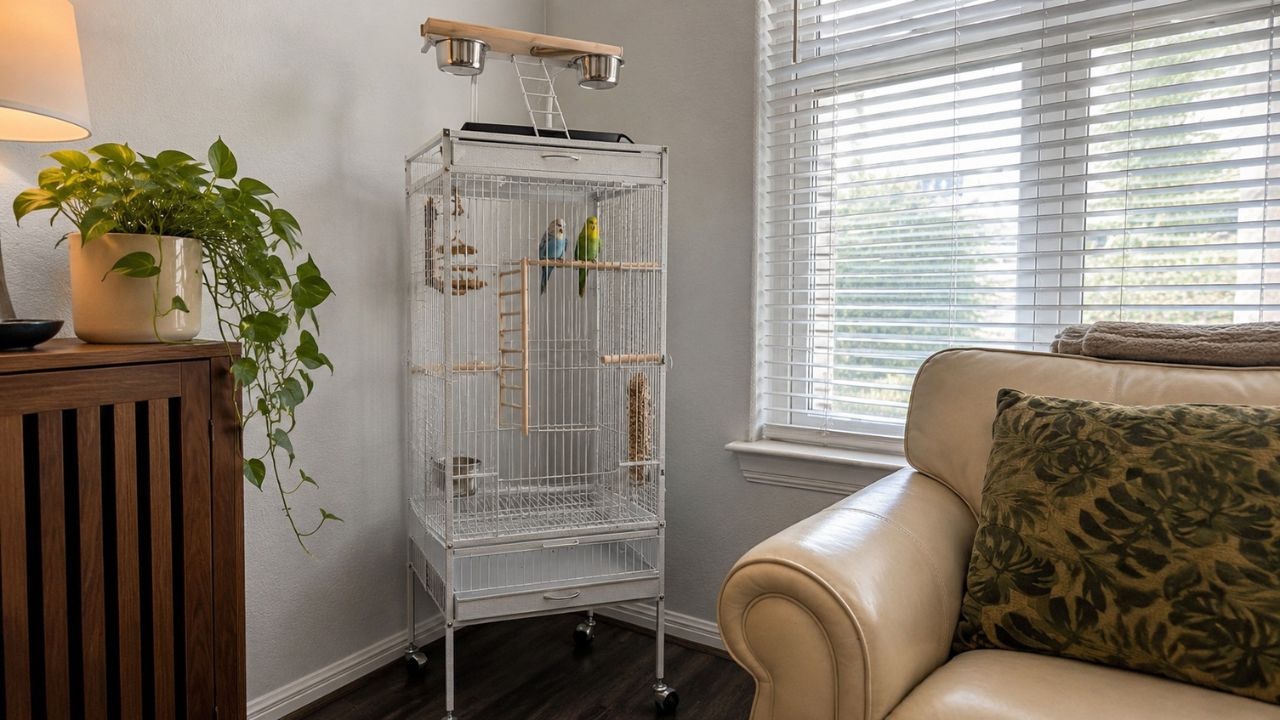
Let me give you the honest answer first, then explain why. For most UK homes, the best room for a budgie cage is the living room. This is the room I recommend to almost every first-time owner who walks through my door.
The living room works for several reasons. Budgies are social, flock-oriented birds — they want to be around their humans. A cage in the living room means the bird sees you regularly, hears your conversations, and feels like part of the household. This is genuinely important for their welfare and bonding.
The living room is also usually the most temperature-stable room in a UK home. It is heated when people are home, has reasonable insulation, and tends to have manageable humidity levels. Compared to bedrooms (which may be cooler at night), kitchens (cooking fumes), bathrooms (humidity swings), or conservatories (temperature extremes), the living room hits the sweet spot.
Within the living room, the ideal spot is:
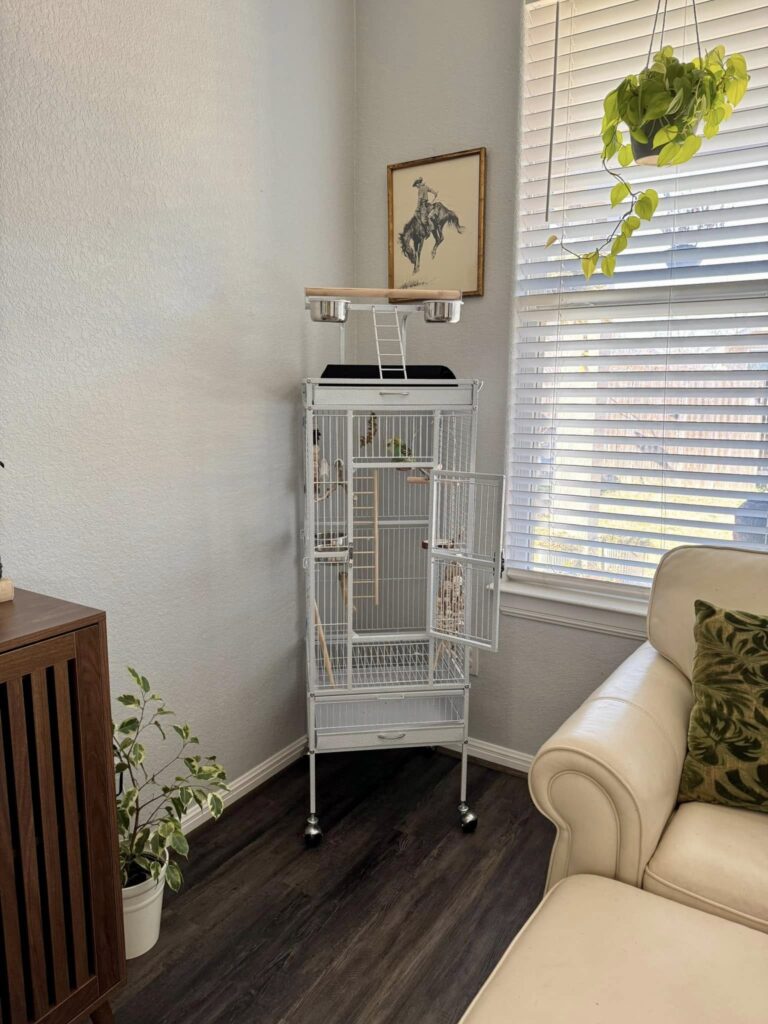
- Against an interior wall — not an external wall (cold and condensation issues)
- Slightly back from the main activity area — part of the room but not in the chaos
- At chest or eye height — on a sturdy stand, not on the floor
- Where you spend evening time — the bird sees you most active times
- Away from windows and radiators — at least 2 feet from each
- Where natural light reaches but not direct sun — important for circadian rhythm
The Rooms To Avoid Completely
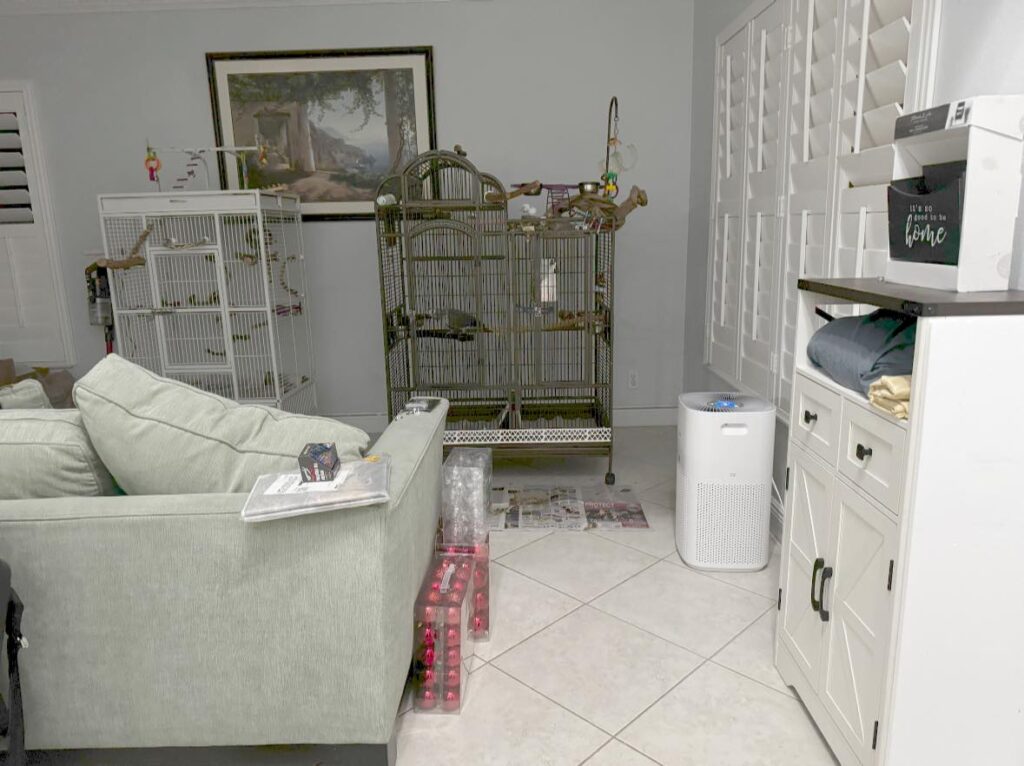
This part matters as much as choosing the right room. Some rooms in UK homes are genuinely unsuitable for budgie cages — not just less ideal, but actually dangerous. Be honest with yourself about your home layout before you commit.
1. The Kitchen — Genuinely Dangerous
This is the most important rule on this entire list. Never put a budgie cage in the kitchen. Kitchens are responsible for more accidental budgie deaths in UK homes than almost anything else, and the reasons are not always obvious until it is too late.
The biggest danger is non-stick cookware. When non-stick pans (containing PTFE) are overheated — which happens easily on UK hobs — they release fumes that are invisible and odourless to us but rapidly fatal to budgies. A budgie in the kitchen, even across the room from a hot pan, can die within minutes. I have heard heartbreaking stories of this happening to UK owners who simply did not know.
- Non-stick cookware fumes — fatal to birds when overheated
- Cooking smoke and steam — irritates sensitive respiratory systems
- Hot oil and burning food fumes — toxic to budgies
- Self-cleaning ovens — release PTFE fumes during cleaning cycle
- Cleaning sprays and aerosols — often used heavily in kitchens
- Open windows when cooking — sudden draughts and temperature changes
- Constant temperature swings — between cooking and cool periods
There is no “safe corner” of a kitchen for a budgie cage. The fumes from non-stick cookware spread throughout the room within seconds and can reach a cage across the room. If you only remember one thing from this article, remember this — keep your budgie completely out of the kitchen, every single day.
2. The Bedroom — Several Problems
This catches people out because it seems intuitive. Many first-time owners think their bedroom would be a quiet, calm spot for their bird. But there are several reasons I steer people away from this.
First, dust and feather dander. Budgies produce fine feather dust that can affect human breathing during sleep, particularly for anyone with asthma, allergies, or respiratory sensitivities. Many UK owners do not realise this until they wake up wheezing.
Second, sleep disruption — for both of you. Budgies wake at dawn. If your cage is in the bedroom, you wake at dawn too. And bedroom activity at night — getting up, light from devices, snoring — can disturb the bird’s sleep, which they need 10-12 solid hours of for proper health.
Third, temperature variation. Bedrooms are often cooler than living rooms, particularly at night when heating switches off. This can create temperature swings that affect bird health.
The bedroom is not as dangerous as the kitchen, but it is generally not the right choice. The living room or another shared family space works better in most UK homes.
3. The Bathroom — Humidity And Chemicals
This one might seem obvious, but I do get asked about it. Bathrooms are wrong for budgies because of:
- Massive humidity swings — from showering, baths, and steam
- Temperature extremes — particularly in unheated bathrooms
- Aerosol products — deodorant, hairspray, air fresheners
- Cleaning chemicals — bleach, toilet cleaners, antibacterial sprays
- Lack of social contact — bathroom traffic is brief, not interaction
- Often poor ventilation — chemical fumes linger
Never put a budgie cage in a bathroom. There is no scenario where this is the right choice.
4. The Garage Or Conservatory — Temperature Extremes
Some UK owners ask about garages or conservatories, particularly if living space is tight. The honest answer is no — neither is suitable for a pet budgie.
Garages are typically unheated, cold in winter and overheating in summer. They often contain car fumes, paint, chemicals, and tools — all sources of harmful airborne particles. The temperature swings alone can kill a budgie during a UK winter.
Conservatories are even worse for temperature extremes. They overheat dramatically in summer sun and become freezing cold on winter nights. The temperature can swing by 20°C or more within hours. This is genuinely lethal for a small bird that needs stable warmth.
If you do not have room in the main living area for a budgie cage, please reconsider whether you have the right setup for a bird. These outbuildings are not safe options.
5. Hallways And High-Traffic Areas — Stress And Disturbance
This one is less dangerous but still not ideal. Hallways and entrances are areas of constant brief disturbance — people walking past, doors opening and closing, draughts coming in from outside. A budgie in this kind of spot lives in a state of low-level constant stress.
The bird never gets the sustained calm it needs to settle, and the sudden movements and noises can trigger startle responses repeatedly. Over time, this affects the bird’s welfare even if there is no single dramatic problem.
Choose a calmer location with steady activity rather than constant disturbance.
Within The Right Room — Where Exactly To Place The Cage
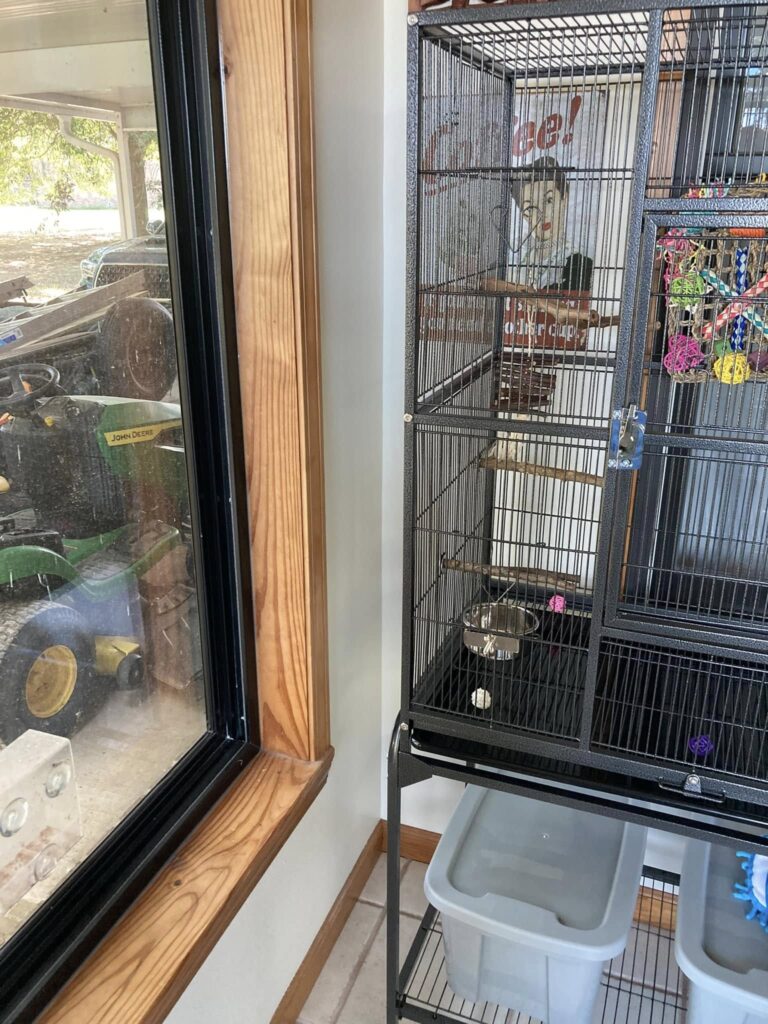
Choosing the right room is half the battle. Within that room, where exactly the cage sits matters too. Here is what I tell every UK owner.
- Against an interior wall
Interior walls are warmer than external walls and provide a sense of security. The bird can see the room without feeling exposed from behind. - At chest or eye height
On a sturdy stand or table. Floor-level cages put the bird in a vulnerable prey position and make handling awkward. - Away from windows by at least 2 feet
Avoids direct sunlight overheating, cold draughts in winter, and the stress of seeing predators outside. - Away from radiators and heat sources by at least 2 feet
Direct radiator heat dries the bird out and can be uncomfortable. Same for fireplaces and heaters. - Away from electronics emitting heat or fumes
TVs, computers, printers, candles. Modern flat-screen TVs are generally fine if a couple of feet away, but some older equipment is not. - Where natural light reaches but is not direct
Indirect daylight is important for the bird’s circadian rhythm. Direct sun overheats. - Where you spend significant time
Budgies are social birds. Being in a space with regular human presence supports bonding and welfare.
The Best Height For A Budgie Cage
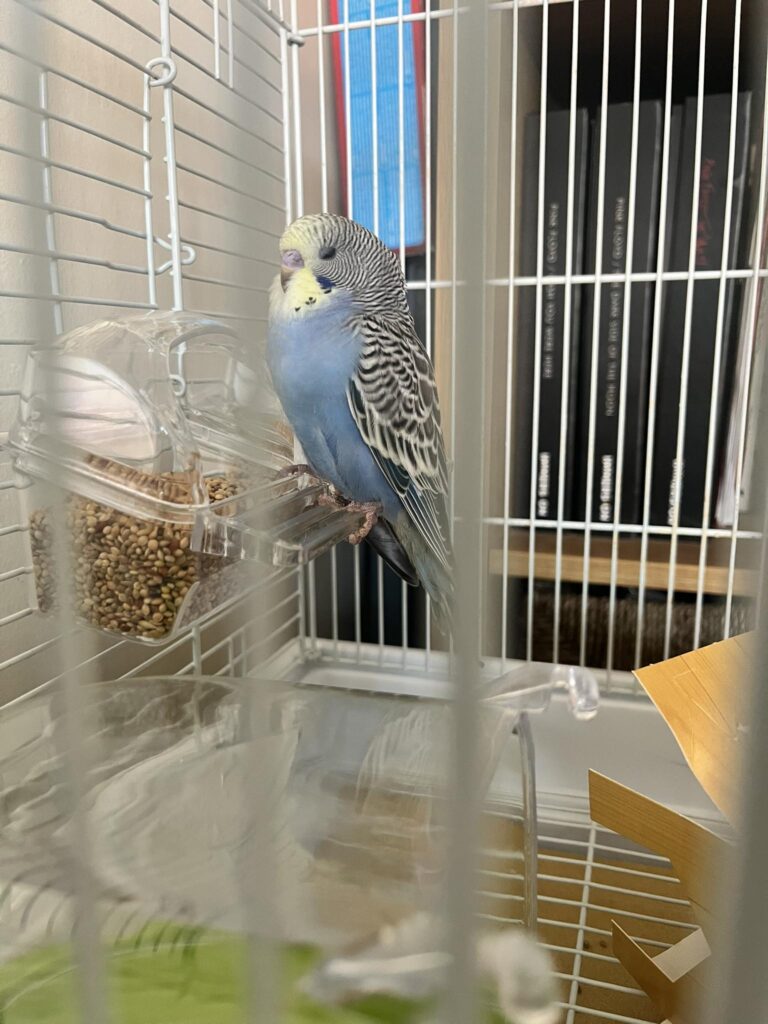
The ideal height places the bird at roughly your chest or shoulder level when you are standing. This means:
- The bird is at a height where it feels safe (not below predator eye-level)
- You can comfortably interact without bending down
- Cleaning and feeding are easier on your back
- The bird gets a good view of the room without feeling overlooked
A solid cage stand is the best investment. Avoid placing the cage on furniture that might wobble, get bumped, or be needed for other purposes.
Light, Temperature, And Air — The Three Conditions To Get Right
Beyond the room and exact spot, three environmental conditions matter enormously for a budgie’s welfare in a UK home.
1. Light — Mimicking Natural Daylight
Budgies need exposure to natural light cycles to regulate their hormones, sleep, and behaviour. In their natural environment, they experience clear day and night cycles, and pet budgies need something similar.
What works:
- Indirect natural daylight — through a window without direct sun on the cage
- Consistent uncovering and covering times — aim for 10-12 hours of light and 10-12 hours of darkness
- Avoid direct sun — can overheat the cage rapidly, particularly in UK summers
- Avoid full darkness during day — a windowless interior corner can suppress natural rhythms
For UK winters when daylight is limited, ensuring the bird is uncovered during daylight hours helps maintain its natural rhythms. Some owners use full-spectrum bird lights in dark interior rooms, but for most homes, indirect natural light is sufficient.
2. Temperature — Stability Is The Key
Budgies are remarkably tolerant of temperature, but only if it is stable. Sudden changes are far more dangerous than a slightly cool or slightly warm steady temperature.
The ideal range is 18-22°C (65-72°F) — the same comfortable range most UK homes maintain. Budgies can handle slightly cooler temperatures (down to 15°C) and slightly warmer (up to 25°C) if it is gradual, but they cannot handle sudden drops or spikes.
- Cage near a window where temperature drops significantly at night
- Cage near a radiator that turns on and off, creating swings
- Cage in a conservatory or unheated room
- Cage in direct summer sun, even briefly
- Cage near a draughty door or window
- Cage near an air conditioning vent or fan blowing directly
- Moving the cage between rooms with different temperatures
Aim for consistency. A cage in a stable room temperature is far better than one in a room that swings between extremes.
3. Air Quality — Genuinely Critical
Budgies have extraordinarily sensitive respiratory systems. The phrase “canary in a coal mine” exists because cage birds are affected by airborne toxins before humans are. In a modern UK home, several common things can harm them.

- Non-stick cookware fumes — keep cage out of kitchen entirely
- Aerosol sprays — air fresheners, deodorants, hairspray, polish, fly spray
- Scented candles and wax melts — even “natural” scents harm birds
- Cigarette and vape smoke — never smoke indoors with a bird present
- Plug-in air fresheners and oil burners — constant low-level toxic exposure
- Strong cleaning products near the cage — bleach, ammonia, antibacterial sprays
- Self-cleaning oven cycles — release PTFE fumes throughout the home
- Construction or renovation dust and fumes — relocate the bird temporarily
This is the part that catches owners out most. People often do not realise that everyday household products are dangerous to birds. Once you have a budgie, your household habits need to change — not dramatically, but meaningfully.
The Specific Setup Challenges In Different UK Homes
UK homes come in many shapes and sizes, and each presents its own challenges. Here is how to think about the most common situations.
Small Flats And Apartments
For UK apartment-dwellers, the challenge is finding cage space when every room serves multiple purposes. The honest advice is:
- Use the living room corner — the calmest part of the most-used room
- Choose a corner against interior walls — better thermal and acoustic stability
- Avoid placing near the kitchen if it is open-plan — kitchen fumes spread further than expected
- Cover at night to limit early-morning vocalisation — important for sleep and neighbours
- Consider noise impact on neighbours — interior walls are better for shared apartment buildings
For more on this specifically, our guide on budgies in UK apartments covers small-space living in detail.
Terraced Houses
The classic UK terraced house often has a smaller living room, which can make placement tight. Key considerations:
- Choose a wall facing inward, not toward the neighbour — reduces noise transmission
- Avoid window walls if they are external — older terraced houses have less insulated external walls
- Be mindful of cooking smells — open-plan kitchens or small terraced layouts may mean fumes travel
- Stay alongside the family activity — not isolated in a back room
Houses With Children Or Other Pets
Family homes have their own challenges. The cage placement needs to balance bird welfare with practical realities.
- Out of reach of young children — but visible to them, so they can watch and learn
- Where cats and dogs cannot stalk the cage — even friendly pets stress the bird
- In a room where supervision is easy — out-of-cage time needs adult presence
- Not in a busy thoroughfare with constant disturbance
- Where children can have positive supervised interactions — important for bonding and bird welfare
How To Tell If The Placement Is Working
After you have set up the cage, watch the bird. The bird will tell you whether the placement is working. A budgie in a good spot shows specific signs of contentment.

| Sign | Good Placement | Wrong Placement |
|---|---|---|
| Vocalisation | Regular cheerful chirping | Silence or constant alarm calls |
| Activity | Active, exploring, playing | Withdrawn, hunched, still |
| Eating | Eating normally | Reduced appetite |
| Sleep | Settles peacefully at night | Restless or disturbed |
| Posture | Relaxed, sometimes on one foot | Permanently fluffed up |
| Interaction | Approaches you, vocalises with you | Flees when you approach |
| Plumage | Sleek and well-groomed | Dull, neglected, missing feathers |
If your budgie shows signs from the right column despite a good general setup, the placement may need adjusting. Sometimes moving the cage even a couple of feet — away from a draught, into a slightly quieter corner, away from a TV — makes an enormous difference.
What I Ask Owners At The Counter About Placement
When a UK owner asks me where to put their cage, I work through a quick mental checklist with them. Here is the conversation.
- What type of UK home do you have?
Flat, terraced, detached, modern, period? Affects insulation and layout options. - Which room do you spend the most time in?
That is usually the right room — bird needs social contact. - Where is the kitchen, and is it open-plan?
Critical safety question. Open-plan layouts need careful planning. - Are there any smokers in the house?
Smoking is incompatible with bird keeping. Be honest. - Are there other pets — cats, dogs, other birds?
Affects placement to keep the budgie safe and unstressed. - What is the heating like — radiators, underfloor, central?
Helps me advise on temperature stability concerns. - Do you have a quiet corner in your main room?
The answer to this is usually the right spot.
Five minutes of these questions usually identifies the right placement clearly. Most UK homes have a good option once you know what you are looking for.
Frequently Asked Questions
Where is the best place to put a budgie cage in a UK home?
The living room is the best room for most UK homes. Within the living room, place the cage against an interior wall, at chest or eye height on a sturdy stand, away from windows and radiators by at least 2 feet, where natural light reaches indirectly, and where you spend significant time. Avoid kitchens, bedrooms, bathrooms, garages, conservatories, and busy hallways.
Can I put my budgie cage in my bedroom?
It is not the best choice. Budgies wake at dawn and may disturb your sleep. Their feather dust can also affect human breathing during sleep, particularly for anyone with allergies or asthma. The temperature variation between bedrooms and living rooms can also affect bird health. The living room or another shared family space works better.
Why can’t I put my budgie cage in the kitchen?
Kitchens are genuinely dangerous for budgies. The biggest threat is non-stick cookware (PTFE), which releases invisible, odourless fumes when overheated that can kill a budgie within minutes. Cooking smoke, hot oil fumes, aerosols, cleaning products, and temperature swings all pose additional risks. Never put a budgie cage in the kitchen, even briefly.
Should the cage be near a window?
Near, but not against. Indirect natural light is important for a budgie’s circadian rhythm, so being in sight of a window helps. But the cage should be at least 2 feet from the window itself to avoid direct sun (overheating), cold draughts in winter, and the stress of seeing predators outside. Avoid windows that face direct south or west sun.
How high should my budgie cage be?
The cage should be at roughly your chest or shoulder height when standing. A sturdy cage stand is best. This puts the bird at a height where it feels safe (not below predator eye-level), allows comfortable interaction without bending, and makes cleaning easier. Avoid placing the cage on the floor or on wobbly furniture.
Can I move my budgie’s cage around the house?
Settled budgies prefer stability. Once you have found a good spot, leave the cage there. Moving the cage around the house creates stress and breaks the bird’s sense of security. Take the bird out of the cage for interaction, but keep the cage itself in one consistent location.
Where can I get honest budgie advice in Swindon?
Come and see us at Paradise Pets, Manor Garden Centre, Cheney Manor, Swindon SN2 2QJ. Or give us a ring on 01793 512400. The advice is free and we have been doing this for 35 years.
One Last Thing From Me
“Where should I put my budgie’s cage?” is the question. The honest answer, after 35 years of selling these birds, is — somewhere stable, in your main living area, away from kitchen fumes, away from temperature extremes, and where the bird feels part of family life.
The couple I mentioned at the start of this article? We talked through their UK semi-detached house layout. They went home with their budgie set up in the corner of the living room, against an interior wall, on a proper cage stand at chest height, near a window but not against it, well away from the kitchen. They came back a few months later, delighted. “Neil,” the wife said, “he is brilliant. Loves where we put him. Chirps along with our morning chat, settles down when we watch TV in the evening, sleeps through the night. We could not have set him up better.”
That is the outcome you want — a bird in a good spot that thrives in your UK home, fits into your daily life, and lives a long healthy life. It is not complicated, but it does take a bit of thinking before you bring the bird home.
If you are setting up your first budgie cage and you are unsure, come and see us. We will talk through your home layout, your routine, and help you decide on the right placement. That is what we have been doing for 35 years, and getting it right from the start saves a lot of problems later.
Setting Up Your First Budgie? Come And See Me
Bring your questions about your home, your layout, and where to put the cage. I will help you work out the right placement for your specific UK home. Free advice, no obligation. That is how we have done things for 35 years.
⭐ Customer Reviews
Amazing Bird Selection
Had a lovley visit today,staff were very friendly and very helpful,such a great petshop,their selection of birds is incredible,really impressed,thank so much to the staff at Paradise Pets

Friendly Helpful Staff
I have been coming to this place for years and they have a great stock of food for all types of pets. Have a great selection of small mammals and a lot of birds. Staff are friendly and helpful.

Great Quality Hutch
Bought a guinea pigs hutch and run combo, very happy with the service, the hutch was put in my car for me without even asking for help. The wood quality is very good, the instructions easy to follow and we are extremely happy with the fully built hutch. A good size for 2 guinea pigs

Response from Paradise Pets | Wiltshire
Thank you Melanie Latus Nice to provide services to you.
Best Bird Shop Around
It’s the best pet shop in and around Swindon. They always have an amazing selection of birds and all you need to keep them happy. I keep birds myself and the guys there are happy to answer questions and really know their stuff. I have seen budgies etc. in chain pet shops in the area looking really unhealthy and ill – I wouldn’t go anywhere else than Paradise Pets for animals.

Highly Recommended Bird Shop
I could not praise this shop enough. Really helped my Grandson buy his first bird and he’s loving it. Travelled from Somerset and was welcomed with open arms.

Great Shop with Competitive Prices
Great shop with amazing selection for small animals, hamsters, mice ect, highly recommend!
Also has a great selection for dogs & cats too & very competitive prices! 💖

