
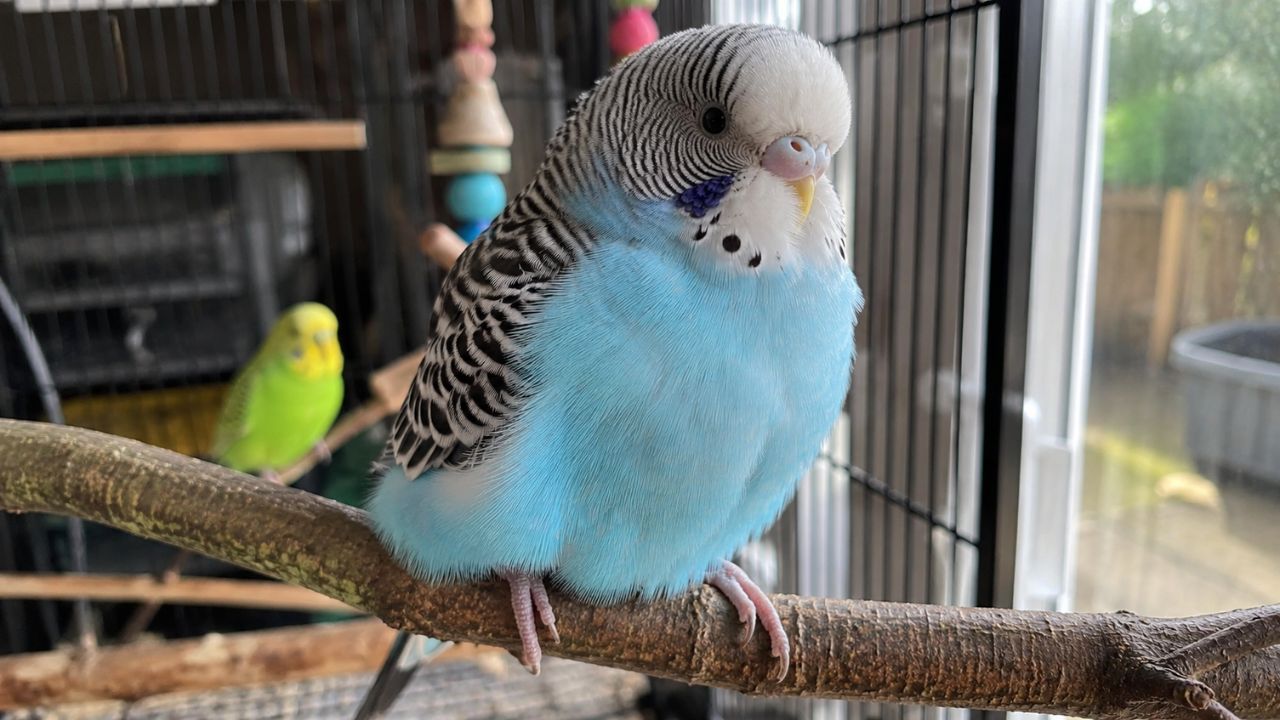

Neil has been keeping, breeding, and selling budgies at Paradise Pets Swindon since 1988 — over 35 years of daily first-hand experience with these birds and the owners who keep them. A budgie sitting with its feathers fluffed up is one of the most commonly misread signs in the species — sometimes dismissed when it should not be, sometimes panicked over when the explanation is entirely innocent. Summer adds a specific layer of complication because the same appearance can mean opposite things depending on context. This article is the honest guide to reading it correctly.
An older gentleman came into the shop one July afternoon looking genuinely worried. His budgie had been sitting fluffed up since mid-morning. It was a warm day — probably the warmest of the summer so far. The bird was on its usual perch, not on the cage floor, not showing any obvious distress. But the feathers were noticeably puffed out and it had been quieter than usual.
He had spent an hour reading about fluffed feathers in budgies online before coming in. Everything he had read told him it was a sign of serious illness. He was ready to make an emergency vet appointment.
I asked him where the cage was positioned. Near the window, he said — gets the morning sun, which the bird had always seemed to enjoy. Had the curtains been open all morning on a warm day? Yes. Was the room warm? Yes, quite warm actually. Was the bird drinking? He thought so, yes.
I told him to move the cage away from the window immediately, into a cooler part of the room, and to make sure fresh water was available. I told him to come back and tell me what the bird was doing in an hour.
He rang about ninety minutes later. The bird was alert, vocal, and sitting normally with its feathers flat. The fluffing had resolved entirely once it was out of the direct heat.
The bird had not been ill. It had been too hot.
Why Budgies Fluff Their Feathers — The Biology Behind It
Before the causes, I want to explain why budgies fluff their feathers at all — because once you understand the mechanism, each of the causes makes immediate sense.
Feather position in birds is an active temperature regulation system. When a bird fluffs its feathers, it is trapping air in the spaces between and beneath the plumage. That trapped air acts as insulation — keeping warmth in when the bird is cold, and in the case of extreme heat, creating a layer of still air between the body surface and the environment that reduces direct heat transfer.
Birds cannot sweat. They have no sweat glands. Their only evaporative cooling mechanisms are panting and holding their wings slightly away from their body. Feather manipulation — fluffing to trap air, or flattening to allow heat to escape — is one of the primary ways they manage body temperature in conditions that are either cooler or warmer than ideal.
This means fluffed feathers are, at their most fundamental level, a temperature management behaviour. The question in any specific situation is: what is the bird managing against — cold, heat, illness, or nothing more than comfortable rest?
The Three Categories — And How To Tell Them Apart
Every case of fluffed feathers in a budgie falls into one of three categories. Knowing which category you are in is what determines the right response.
Category 1 — The Bird Is Too Hot (Environmental — Act Immediately)
In summer, this is the most common reason a budgie sits fluffed up during the day, and it is the one most owners do not immediately think of because fluffing is so strongly associated with being cold or ill.
A budgie that is overheating will fluff its feathers as part of its thermal management response. At the same time — and this is the key observation that distinguishes overheating from illness — it will show other specific heat-related signs that illness does not produce.
Signs your budgie is too hot, not ill:
- Wings held slightly away from the body — this is the clearest indicator of overheating specifically; a bird that is ill fluffs but holds wings normally; a bird that is hot holds wings slightly out to allow air circulation around the body core; look for this alongside the fluffing
- Open beak at rest or panting — evaporative cooling through the respiratory system; a bird panting with its beak open in a warm room is almost certainly responding to heat
- The cage is in direct sun or a warm, poorly-ventilated room — the environmental explanation is present; the bird has been exposed to heat that would cause this response
- The fluffing started during the hottest part of the day — typically between late morning and mid-afternoon in summer; the timing correlates directly with heat exposure
- The bird resolves quickly when moved to a cooler position — as the gentleman’s bird did; an illness-related fluffing does not resolve simply because the environment improves
- The bird is still alert and responsive when you approach — a hot bird is uncomfortable but not collapsed; it will still track your movement and respond to your voice
What to do immediately:
- Move the cage away from direct sun and heat sources immediately — do not wait; overheating in a small bird can progress quickly to heat stress
- Improve ventilation in the room — open a window on the shaded side if possible; use a fan directed at the wall rather than directly at the cage to improve air circulation without creating a direct draught
- Ensure fresh cool water is available and accessible — a bird that is hot needs to drink; check the water dispenser is working and topped up
- Do not put the bird in a cold draught or spray it with cold water — the temperature change should be gradual; a sudden cold shock to an overheated bird is harmful
- Monitor over the next 30 to 60 minutes — a bird that is simply hot should be noticeably improved within this period in a cooler environment; one that is not improving despite the environmental change needs vet attention
Category 2 — The Bird Is Resting Contentedly (Normal — Nothing Required)
This is the category that produces the most unnecessary anxiety, particularly in newer owners who have read that fluffed feathers always mean illness.
A healthy, contented budgie resting will often adopt a slightly fluffed posture — feathers loosened slightly, giving the bird a rounder, fuller appearance than when it is fully alert. This is the avian equivalent of a person settling into a comfortable chair. It is not illness. It is relaxation.
The distinction from illness-related fluffing is almost always clear from the accompanying signs:
- One foot tucked up under the body — a budgie resting on one foot with feathers slightly loose is the picture of a completely contented bird; this specific posture is a reliable contentment indicator
- Eyes partly closed or blinking slowly — a drowsy, resting bird looks drowsy; its eyes will half-close in a way that is entirely unlike the sunken or dull-eyed look of a genuinely ill bird
- The bird rouses quickly and normally when you approach — a resting bird that was just napping becomes alert and responsive when it hears you; an ill bird does not rouse with the same alertness
- Normal behaviour before and after the resting period — if the bird has been active this morning, takes a rest with slightly loose feathers in the early afternoon, and then goes back to normal activity — this is a normal daily rhythm
- Happening at predictable rest periods — budgies have patterns; a bird that rests at roughly the same time each day with the same appearance is not ill; it is on schedule
- Beak grinding — if you can hear the bird gently grinding its beak while slightly fluffed, you are looking at a bird in a state of deep contentment; beak grinding is a specific relaxation signal that does not occur in ill birds
Category 3 — The Bird Is Ill (Medical — Act Today)
This is the category where fluffed feathers are genuinely a warning sign, and the one that every budgie owner needs to be able to recognise.
An ill budgie fluffs its feathers because its body is attempting to retain heat — a sick bird runs a lower effective body temperature and fluffing is the attempt to compensate. This is the opposite of the resting bird’s casual looseness; it is sustained, pronounced fluffing with a specific accompanying picture that is quite different from either contentment or heat response.
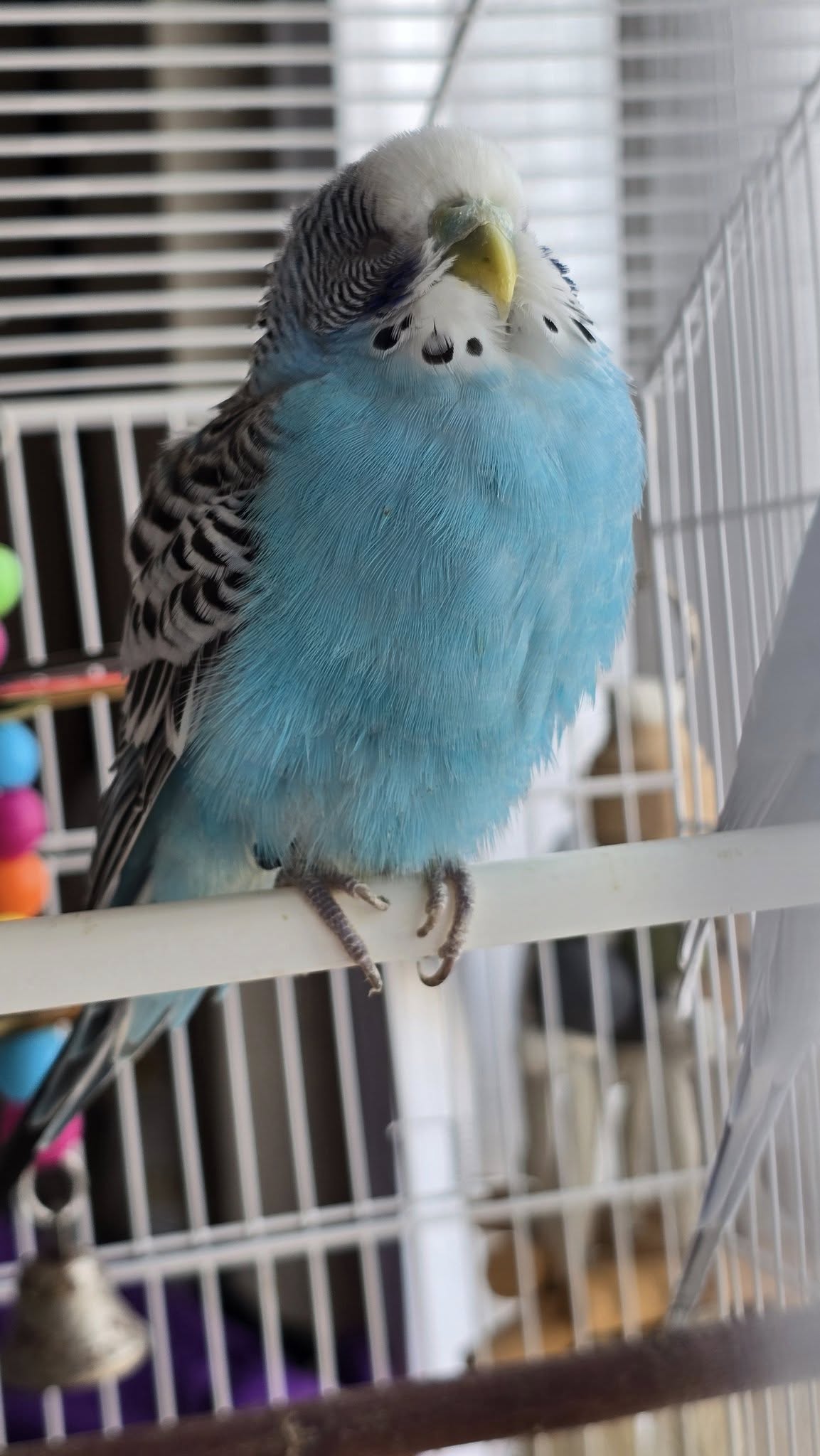
- Sustained, pronounced fluffing that does not resolve — not occasional and not just during rest periods; the bird is fluffed for most of the day and does not look normal between times
- Fluffing combined with lethargy — the bird is not resting; it is sitting motionless for long periods without the alert responsiveness of a resting bird; it does not rouse normally when you approach
- Fluffing combined with reduced or absent vocalisation — a bird that has gone quiet alongside sitting fluffed is showing two early illness signs together; this combination warrants same-day vet attention
- Fluffing combined with tail bobbing — the tail moving rhythmically with each breath alongside fluffed feathers is respiratory distress; this is a same-day veterinary emergency
- Fluffing combined with sitting very low on the perch or on the cage floor — a bird that is fluffed and has also moved to a lower position than usual is significantly unwell; a bird on the cage floor is in serious distress
- Fluffing that does not improve when the bird is moved to a cooler or more comfortable environment — illness-related fluffing is driven by the bird’s internal state, not by the external temperature; moving it to a cooler room will not resolve it
- Fluffing alongside any other change in normal behaviour — eating less, drinking less, different posture, different droppings; the combination matters more than any single sign
Summer-Specific Factors That Make This More Complicated
Summer adds a layer of complexity to reading fluffed feathers in budgies that is worth addressing directly, because the season changes the probabilities around what any given presentation means.
- Direct sunlight through windows moves during the day — a cage that is in a safe position in the morning may be in direct sunlight by midday as the sun’s angle changes; many owners do not realise their bird’s cage has moved into sun during the day without anything being physically moved; check the cage position at different times of day in summer
- UK homes trap heat in warm weather — a room that feels comfortable to you in the morning can become significantly warmer than a budgie should be in by afternoon; UK houses, particularly older ones, do not dissipate heat quickly; the bird may be experiencing a room temperature you are not fully registering
- Illness can look like heat stress initially — a bird in the very early stages of illness, slightly lethargic and fluffed, can look similar to an overheated bird; the key test is whether the bird improves meaningfully when moved to a cooler environment; if it does not, illness has not been ruled out
- Moult often occurs in late summer — a bird in heavy moult may sit slightly puffed more than usual as feather regrowth is physiologically demanding; moult-related fluffing is accompanied by visible pinfeathers and increased feather loss, not by lethargy or reduced vocalisation
- Breeding condition in females — a female in reproductive condition may sit slightly fluffed, particularly if she is sitting on eggs or in a nest box; this is hormonal behaviour and not a health concern in the specific context of an actively breeding bird
How To Check Which Category Your Bird Is In — Right Now
If you are reading this because your budgie is sitting fluffed up and you are not sure which of the three categories applies, work through this in order.
| Observation | What It Points Toward |
|---|---|
| Cage in direct sun or warm room. Warm day. Wings slightly held out from body. Panting. | Too hot — Category 1. Move cage immediately. |
| Mid-afternoon. One foot tucked up. Eyes half-closed. Beak grinding. Rouses normally when you approach. | Resting contentedly — Category 2. Nothing needed. |
| Fluffing sustained all morning. Bird quieter than normal. Does not rouse alertly when approached. | Possible illness — Category 3. Move to cooler room and monitor 30 minutes. If no improvement, vet today. |
| Moved cage to cooler room. Bird improved and is now alert and vocal. | Was heat-related — Category 1. Confirmed. |
| Moved cage to cooler room. Bird has not improved after 30–60 minutes. | Not heat-related. Monitor for other illness signs. Vet today if any additional signs present. |
| Fluffing with tail bobbing. Laboured breathing. Sitting very low or on cage floor. | Illness — Category 3. Vet today, no exceptions. |
| Fluffing only during moult. Visible pinfeathers. Increased feather loss. Otherwise normal. | Moult-related — normal. Monitor that bird remains active and eating. |
What To Do When You Are Not Sure
I want to give you a clear decision rule for the situation where the bird is fluffed, you are not certain whether it is hot or ill, and you are trying to decide whether to call a vet.
The test is straightforward. Move the cage to the coolest, most comfortable part of the house — away from sun, away from heat sources. Offer fresh water. Leave the bird for 30 to 60 minutes without further disturbance. Then reassess.
If the bird is significantly more alert, less fluffed, and has returned to something closer to normal behaviour — the cause was almost certainly heat-related. Monitor for the rest of the day and ensure the cage position is adjusted to prevent recurrence.
If the bird has not improved meaningfully — or if it has deteriorated — it is not heat. Contact an avian-experienced vet today. Do not wait overnight. The pattern of a bird that is fluffed, lethargic, and unimproved by environmental comfort is the pattern of a bird that has been unwell for longer than you realised and is past the point where its illness is easily hidden.
- Keep the bird warm while you arrange the vet visit — an ill bird should be kept at around 30°C; this is warmer than a comfortable room; a heat lamp on a low setting or a warm towel around three sides of the cage helps
- Move food and water to an accessible position — if the bird is weak or sitting low, food at normal cage height may not be accessible; a small dish of seed near where the bird is sitting ensures it does not have to travel to eat
- Reduce environmental stress — cover three sides of the cage; keep the room quiet; minimise disturbance; a sick bird uses energy it cannot afford
- Note everything you have observed — when the fluffing started, how long it has been going on, whether the bird has eaten and drunk today, any other changes; this helps the vet considerably
Preventing Heat-Related Fluffing In Summer
For owners who want to make sure this does not become a recurring summer problem, these are the practical steps that eliminate heat stress risk for cage birds through the warmer months.
- Check the cage position at multiple times of day in summer — the sun’s angle changes across the day; a cage that is out of sun at 9am may be in direct sun by 11am; do this check once on a clear summer morning and you will know what adjustments to make
- Net curtains on windows near the cage — diffuse the light without blocking it; reduce heat gain without darkening the room significantly
- A fan directed at the wall rather than directly at the cage — improves air circulation in the room without creating a direct draught across the cage; effective at reducing room temperature without chilling the bird
- Offer a shallow bath dish during hot weather — many budgies will use it; the evaporative effect of damp feathers helps them cool down; use a shallow dish of room-temperature water, not cold
- Fresh water twice daily in hot weather — water warms up quickly in summer; a bird presented with warm water in a hot room may drink less; refreshing the water in the afternoon maintains cool, accessible water during the hottest part of the day
- Know the temperature range — budgies are comfortable between approximately 18 and 30°C; above 30°C heat stress becomes a real risk; if the room temperature is approaching this in very hot weather, active cooling measures are not optional
Frequently Asked Questions
My budgie is fluffed up but eating normally. Should I be worried?
A bird that is fluffed but eating with normal appetite and normal behaviour — active when not resting, responsive when approached, vocalising at normal levels — is more likely resting or mildly warm than ill. An ill bird almost always shows reduced appetite alongside the fluffing; a reduction in eating is one of the more consistent early illness indicators. Monitor closely over the rest of the day. If the fluffing is sustained, if the bird becomes quieter, or if appetite reduces, contact a vet.
My budgie is fluffed up and has been since this morning. When is it time to call a vet?
If the fluffing has been sustained since morning and the bird is also quieter than usual, less active, or not rousing alertly when you approach — contact a vet today. First move the cage to a cool, comfortable position away from any heat source and monitor for 30 to 60 minutes. If the bird improves significantly, the cause was likely heat. If it does not improve, do not wait overnight.
Is a fluffed budgie always a sick budgie?
No. A budgie resting contentedly will often adopt a slightly loose-feathered posture with one foot tucked up — this is normal and healthy. An overheated budgie will fluff as part of its heat management response — not illness, but an environmental problem that needs addressing. An ill budgie fluffs in a sustained, pronounced way alongside other signs. The feather position alone does not tell you which situation you are in; the accompanying signs do.
Why is my budgie fluffed up in summer when it is warm?
Counter-intuitively, budgies can fluff their feathers in response to being too warm, not just too cold. Feather fluffing traps a layer of still air next to the body that provides some insulation against direct heat transfer. If the bird is also holding its wings slightly away from its body and panting, overheating is almost certain. Move the cage to a cooler position immediately and ensure fresh water is available.
My budgie is fluffed up and not moving much. Is this an emergency?
If the bird is fluffed, not moving much, not responding alertly when you approach, and this has been going on for several hours — treat it as urgent. First move to a cool, comfortable position. If the bird is not significantly improved within 30 to 60 minutes, contact an avian vet today. If the bird is also on the cage floor, has tail bobbing with breathing, or appears extremely weak — this is a same-day emergency, do not wait.
Could moult cause my budgie to sit fluffed up?
Moult places significant physical demands on a budgie and some birds are slightly less active and slightly more fluffed during a heavy moult — particularly late summer when the annual moult often occurs. Moult-related fluffing is accompanied by visible evidence of the moult — pinfeathers appearing, increased feather loss on the cage floor, slightly ragged appearance to the coat. The bird should otherwise be eating, drinking, and behaving normally. If a bird that appears to be moulting is also lethargic and not eating — that is not just moult, and it needs vet attention.
My budgie is fluffed up and has diarrhoea. What should I do?
This combination — fluffed feathers alongside abnormal droppings — is a significant illness indicator that needs a vet today. Do not wait overnight. Keep the bird warm while you arrange the visit; move food and water to a low, accessible position; reduce environmental stress. Contact an avian-experienced vet and describe both signs when you call.
Where can I get advice about my budgie sitting fluffed up in Swindon?
Ring us on 01793 512400 and describe what you are seeing — the fluffing, how long it has been going on, what the room temperature is, and whether the bird is showing any other signs. We can help you work out which of the three categories you are in and whether a vet needs to be involved. Paradise Pets is at Manor Garden Centre, Cheney Manor Industrial Estate, Swindon SN2 2QJ. For any bird showing significant illness signs alongside the fluffing, ring the vet first.
One Last Thing From Me
The gentleman who rang me ninety minutes after that July conversation — the one whose bird had resolved entirely once moved to a cooler position — came back in person a few days later. He was not embarrassed about having been worried. He was thoughtful about the whole thing.
“I think what bothered me,” he said, “was that I had read so much about fluffed feathers meaning illness that I stopped thinking about what else might cause it. I assumed the worst because the internet told me to.”
That is precisely the problem I see repeated at the counter, and it is why I wrote this article the way I did — not as a list of illness symptoms, but as a framework for reading context. The feather position tells you something is happening. The temperature, the time of day, the bird’s other behaviour, whether it improves with environmental change — those tell you what.
An owner who knows how to ask the right questions when they see a fluffed bird is in a significantly better position than one who either dismisses it entirely or immediately assumes the worst. Both mistakes have real consequences. The dismissal means genuine early illness signs get missed. The panic means an overheated bird gets taken to a vet when what it actually needed was the curtains drawn.
After 35 years, the skill is not knowing that fluffed feathers matter. It is knowing what they mean. You now have that knowledge. Use it.
Not Sure What Your Budgie’s Fluffed Feathers Mean? Ring Us
Describe what you are seeing — the fluffing, the room temperature, how long it has been going on, anything else that seems different. We will tell you honestly which category we think you are in and whether a vet needs to be involved. Free advice, no obligation. That is how we have done things here for 35 years.
⭐ Customer Reviews
Amazing Bird Selection
Had a lovley visit today,staff were very friendly and very helpful,such a great petshop,their selection of birds is incredible,really impressed,thank so much to the staff at Paradise Pets

Friendly Helpful Staff
I have been coming to this place for years and they have a great stock of food for all types of pets. Have a great selection of small mammals and a lot of birds. Staff are friendly and helpful.

Great Quality Hutch
Bought a guinea pigs hutch and run combo, very happy with the service, the hutch was put in my car for me without even asking for help. The wood quality is very good, the instructions easy to follow and we are extremely happy with the fully built hutch. A good size for 2 guinea pigs

Response from Paradise Pets | Wiltshire
Thank you Melanie Latus Nice to provide services to you.
Best Bird Shop Around
It’s the best pet shop in and around Swindon. They always have an amazing selection of birds and all you need to keep them happy. I keep birds myself and the guys there are happy to answer questions and really know their stuff. I have seen budgies etc. in chain pet shops in the area looking really unhealthy and ill – I wouldn’t go anywhere else than Paradise Pets for animals.

Highly Recommended Bird Shop
I could not praise this shop enough. Really helped my Grandson buy his first bird and he’s loving it. Travelled from Somerset and was welcomed with open arms.

Great Shop with Competitive Prices
Great shop with amazing selection for small animals, hamsters, mice ect, highly recommend!
Also has a great selection for dogs & cats too & very competitive prices! 💖

