


Neil has been keeping, breeding, and selling budgies at Paradise Pets Swindon since 1988 — over 35 years of daily experience with these birds and the owners who love them. In that time, he has had more conversations than he can count with owners who came in after losing a bird too soon — not because they did not care, but because they did not know the signs until it was too late. This article is his honest guide to recognising when a budgie is seriously ill, what to do immediately, and — just as importantly — what the signs mean when you see them.
A woman rang the shop on a Thursday afternoon. She had a budgie that had been in the family for three years. It had always been active, vocal, flying around the cage every day. That morning she had noticed it sitting quietly at the bottom of the cage, feathers puffed up, not moving much. She had assumed it was just tired. By the time she rang us — several hours later — she was worried enough to ask.
I told her to get to an avian vet immediately. Not tomorrow morning. That afternoon.
She rang back the next day. The vet had found a serious respiratory infection. It had almost certainly been developing for weeks. The bird survived — but only because treatment started when it did. Another day, the vet told her, and the outcome would probably have been different.
The thing she said to me stayed with me. “I just didn’t know those signs meant something that serious. I thought he was just having an off day.”
In 35 years of selling budgies and talking with their owners, I have seen this pattern repeat itself more times than I would like. This article is my attempt to break that pattern — for every UK budgie owner who wants to know what to watch for before it is too late.
Why Budgies Hide Illness — And Why This Matters
Before I go through the signs themselves, I want to explain something that changes how you should interpret everything you observe in a sick bird.
In the wild, a bird that shows weakness is a bird that attracts predators. A budgie that sits apart from the flock, fluffs its feathers, and stops flying is announcing to every hawk and cat in range that it is vulnerable. So budgies have evolved, over millions of years, to conceal illness for as long as their bodies allow. They eat even when eating is painful. They perch even when perching takes effort. They stay active until activity is no longer possible.
This instinct does not switch off in captivity. Your pet budgie does exactly the same thing. It hides from you — not deliberately, not because it distrusts you, but because hiding illness is what its biology has been doing for longer than humans have kept birds.
What this means practically is important:
- A budgie that looks visibly unwell is already seriously unwell — the illness has progressed to the point where the bird can no longer compensate
- The early signs are subtle — small behavioural changes, slight shifts in posture or routine, that most owners attribute to tiredness or mood
- Waiting to see if it improves is almost always the wrong decision — with small birds, conditions escalate quickly; the 24-hour wait often costs the bird its life
- Your instinct that something is not right is worth acting on — if the bird feels different to you, it probably is different; you know your bird better than anyone

I want every UK budgie owner to read those four points and hold them in mind as they read the rest of this article.
The Early Signs — What Most Owners Miss
These are the signs that come before the obvious ones. They are the signs that, if acted on, give a bird the best possible chance. They are also the signs that are most commonly dismissed as nothing to worry about — sometimes with fatal consequences.
Early Sign 1: A Change In Behaviour Or Routine
This is the one I ask about first when an owner tells me something seems wrong but they cannot quite put their finger on what.
You know your bird’s normal. You know when it is usually most active, when it chatters, when it moves around the cage, when it eats. A healthy budgie has a pattern — a daily rhythm that is reasonably consistent. When that pattern changes noticeably without an obvious external reason, it is almost always worth paying close attention.
- A bird that is normally vocal going quiet — not completely silent, but less chatty than usual, less responsive to your voice
- A bird that normally moves around the cage spending more time on one perch — particularly if it is sitting lower than usual
- A bird that normally comes to the front of the cage when you approach staying back — reduced interest in interaction it normally welcomes
- Eating or drinking noticeably more or less than usual — either change can indicate a problem
- Less preening than normal — a healthy bird preens regularly; reduced preening is sometimes an early sign of illness
- Sleeping more than usual outside of the normal night period — occasional dozing is normal; frequent or prolonged sleeping during daylight hours is not
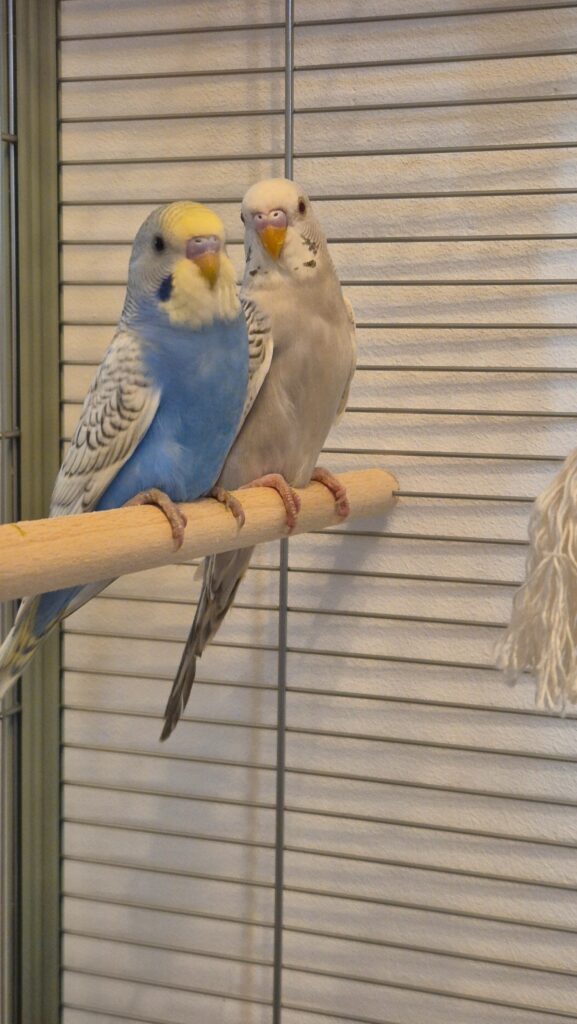
None of these signs is definitively serious on its own. All of them together — or any single one that persists for more than a day or two — are worth taking seriously.
Early Sign 2: Subtle Posture Changes
Posture tells you a great deal about how a bird is feeling, and it changes before the more dramatic signs appear.
A healthy budgie sits upright, balanced, and alert. Its feathers lie relatively flat unless it is sleeping or very relaxed. It grips the perch firmly. Its eyes are bright and fully open during waking hours.
Watch for:
- Feathers slightly more puffed than usual — not dramatically, just a little fuller than normal; the bird is trying to retain warmth, which is a sign its body is under stress
- A slightly hunched posture — shoulders drawn in, head sitting lower than usual
- Eyes closing or half-closing during the day when the bird is not in a sleeping position — a resting, ill bird will often struggle to keep its eyes fully open
- Sitting lower on the perch than usual — sometimes gripping lower branches or the cage floor rather than its normal high perch
- Tail slightly dropped rather than held normally upright

These are subtle. They require you to know what your bird’s normal looks like — which is why I always tell new budgie owners to spend time simply observing their bird in the early weeks. That baseline knowledge is what allows you to recognise when something has shifted.
The Serious Signs — Act Immediately
These are the signs that mean the situation is already urgent. If you see any of these, do not wait. Contact an avian vet today — not tomorrow, not at the weekend when it is more convenient. Today.
Serious Sign 1: Sitting At The Bottom Of The Cage
This is the single most serious sign a budgie can show, and it is the one the woman I mentioned at the start saw that Thursday morning.
A budgie that has come down from its perch and is sitting on the cage floor is a bird that no longer has the strength or balance to maintain its perch. This is not tiredness. This is not mood. This is a bird in serious physical distress that is past the point of compensation. It has been ill for longer than you knew, and it is now at a stage where it can no longer hide it.

- This is almost never a minor problem — a bird that has come off its perch is in serious distress
- Do not wait overnight to see if it improves
- Do not assume it is resting — healthy budgies rest on perches, not on the cage floor
- Keep the bird warm while you arrange transport — a sick bird loses heat quickly; a heat lamp or warm (not hot) towel-covered cage helps
- Contact an avian vet immediately — not a general small animal vet if you can help it; a vet with bird experience will make a significant difference
Serious Sign 2: Laboured Or Visible Breathing
A healthy budgie breathes in a way you barely notice. The movement is subtle and the rate is steady. When breathing becomes visible — when you can see the tail bobbing with each breath, when the bird’s whole body seems to be working to breathe, when the beak is open at rest — this is a respiratory emergency.
Tail bobbing in particular is one of the clearest indicators of respiratory distress in small birds. The tail moves up and down with each breath because the bird’s respiratory muscles are working at full capacity just to move air. This is serious. It needs to be seen by a vet the same day.
- Tail bobbing rhythmically with breathing — vet same day, no exceptions
- Open beak breathing at rest — the bird is struggling to get enough air through its nasal passages; urgent
- Clicking or wheezing sounds with breathing — audible respiratory effort; vet immediately
- Discharge from the nostrils — wet or crusted material around the cere (the fleshy area above the beak); respiratory infection
- Voice change — a bird whose voice sounds different, raspier or quieter than normal, may have a respiratory problem affecting its syrinx
Serious Sign 3: Dramatic Feather Puffing And Lethargy
A bird that is dramatically puffed — feathers fully fluffed, body rounded, sitting motionless — is a bird that is cold and depleted. It is using every available resource to maintain body temperature because its body is under serious stress.
This is different from the subtle early-sign puffing I described earlier. This is obvious. The bird looks significantly different from its normal self. It is not moving, not responding to noise or movement near the cage, not eating.
Combined with lethargy — an absence of the normal responses and movements you would expect — this picture describes a bird that is in serious decline. Warmth and immediate vet contact are the priorities.
Serious Sign 4: Changes In Droppings
Budgie droppings have a normal appearance that most experienced owners know well — a solid dark green or brown portion with a white urate portion and a small amount of liquid. Significant changes from this normal appearance are worth paying attention to.
- Droppings that are entirely liquid — diarrhoea in birds is always worth investigating promptly
- Black or very dark droppings — can indicate internal bleeding; urgent
- Bright green or lime-coloured droppings — can indicate liver problems or the bird is not eating (anorexia produces very green droppings as bile is not diluted by food)
- Droppings stuck to the feathers around the vent — soiling around the vent is a sign the bird is too weak or ill to maintain normal hygiene; always significant
- A dramatic increase or decrease in dropping volume — the amount of droppings tells you about how much the bird is eating and drinking
A single unusual dropping is not necessarily an emergency. A pattern of unusual droppings over 24 hours, or any of the more serious presentations above, is.
Serious Sign 5: Neurological Signs
These are the least common but most alarming signs, and they require immediate veterinary attention without question.
- Loss of balance or falling from the perch — a bird that cannot maintain its balance on a perch is experiencing something serious affecting its nervous system or inner ear
- Head twisting or tilting to one side — torticollis in birds can indicate infection, injury, or neurological disease
- Seizure or convulsion — the bird shaking or convulsing involuntarily; this is an emergency
- Walking in circles — disorientation or loss of directional control; neurological sign
- Wing drooping on one side — can indicate injury, stroke, or neurological problem
If you see any of these, do not wait for a morning appointment. These signs require same-day emergency veterinary care.
What To Do While You Wait For The Vet
If your budgie is showing serious signs and you are waiting to get to a vet, there are things you can do in the meantime that genuinely make a difference.
- Keep the bird warm — a sick budgie loses body heat quickly; place the cage near a gentle heat source or use a heat lamp; the temperature near the bird should be around 30–32°C; do not overheat
- Move food and water to a low, easily accessible position — a bird that is weak may not be able to reach food at normal heights; place a small dish of seed on the cage floor near the bird
- Reduce stress in the environment — cover three sides of the cage with a light cloth to reduce visual stimulation; keep the room quiet; minimise handling
- Do not try to force feed or give home remedies — unless directed by a vet; well-intentioned interventions can cause additional stress and harm
- Do not leave the bird with other birds if it is seriously unwell — a very ill bird may be bullied; separation reduces additional stress
- Note everything you have observed — when the signs started, what the bird has eaten and drunk, any changes in droppings, any changes in behaviour over recent days; this information helps the vet significantly

The Signs That Are Normal — And Are Not Cause For Immediate Alarm
I want to give equal space to this, because I also see owners come in genuinely alarmed about things that are entirely normal budgie behaviour. Knowing what is normal is as important as knowing what is not.
| What You See | What It Usually Means | When To Be Concerned |
|---|---|---|
| Sleeping during the day occasionally | Normal — budgies nap; a resting bird on its perch is usually fine | Frequent daytime sleeping, or sleeping on the cage floor |
| Feathers puffed briefly after bathing | Normal drying behaviour | Prolonged puffing without recent bathing, especially with lethargy |
| Quiet periods during the day | Normal — budgies are not vocal every minute | Prolonged unusual silence lasting more than a day or two in a normally vocal bird |
| One foot tucked up while resting | Normal resting posture — healthy budgies often stand on one foot when relaxed | Both feet on the perch looking unsteady, or inability to grip |
| Moulting — losing feathers | Normal seasonal process; bird may be slightly quieter during heavy moult | Bald patches, feathers not regrowing, excessive feather loss outside normal moult |
| Regurgitating seed to a mirror or toy | Normal bonding behaviour — the bird is “feeding” what it has bonded to | Genuine vomiting — seed sprayed around the cage rather than deliberately offered |
| Grinding the beak gently before sleep | Normal contentment behaviour — a relaxed bird grinds its beak slightly | Overgrown beak, misaligned beak, difficulty eating |
When A Budgie Is Dying — The End Of Life Signs
I want to address this part of the article with the seriousness it deserves, because it is the question that brings some owners to this page, and they deserve an honest answer.
Sometimes, despite the best care and prompt veterinary treatment, a budgie is dying. It may be very old. It may have a condition that has progressed too far to treat. The kindest thing an owner can do at this point is understand what they are seeing and act with the bird’s comfort in mind.
The signs that a budgie is in its final hours:
- Complete cessation of movement — the bird is no longer able to move around the cage; it sits motionless on the floor or on a low perch
- Eyes closed for long periods — the bird can no longer maintain alertness
- Dramatic weight loss visible at the breastbone — the keel bone is prominently visible and the breast muscles on either side have wasted; this indicates significant systemic decline
- Breathing that is slow and irregular — not the rapid effort of respiratory distress, but slow, laboured, irregular breaths
- No response to familiar voices or movement — a bird that normally responds to you and no longer does is deeply depleted
- Complete absence of interest in food or water

If your bird is showing these signs, the priority is comfort. Keep it warm. Keep the environment quiet and calm. If you have not yet spoken to a vet, do so — not necessarily to pursue aggressive treatment, but to understand what is happening and whether there is anything that can be done to reduce discomfort. Euthanasia, in cases of significant suffering, is a kindness that a vet can discuss with you honestly.
Losing a bird you have cared for is genuinely hard, and I do not want to minimise that. The owners who have sat at my counter after losing a budgie and felt they did everything they could — those are the ones who read things like this article, who acted on early signs, who knew what they were looking at. That knowledge does not always save the bird. But it always means the owner did everything that could reasonably be done.
Frequently Asked Questions
How quickly can a budgie go from seeming fine to seriously ill?
Much faster than most owners expect — sometimes within hours once visible signs appear. This is because the signs only become visible once the bird can no longer compensate, which means the illness has often been developing silently for days or weeks. When the mask slips, the bird is frequently already in an advanced stage. This is why acting on early or subtle signs — rather than waiting for obvious ones — is so important.
My budgie is sitting on the bottom of the cage. What should I do?
Contact an avian vet immediately — today, not tomorrow. A budgie on the cage floor has come off its perch, which means it no longer has the strength or balance to maintain it. This is a serious sign. While you arrange the vet visit, keep the bird warm — around 30°C near the bird — and move food and water to the cage floor where the bird can reach them. Do not wait to see if it improves on its own.
Can a sick budgie recover without a vet?
Occasionally, for minor issues — a mild stress response, a slight dietary problem — yes. For anything beyond the mildest symptoms, the honest answer is: unlikely, and the attempt to manage it without professional help costs the bird valuable time. The conditions that kill budgies — respiratory infections, liver disease, bacterial infections — require diagnosis and specific treatment. Supportive care at home helps, but it does not replace treatment.
My budgie’s tail is bobbing when it breathes. Is this serious?
Yes. Tail bobbing with breathing indicates that the bird’s respiratory muscles are working at near-full capacity just to move air. This is respiratory distress — not a minor symptom. It needs same-day veterinary attention. Keep the bird warm and quiet while you arrange this.
How do I find an avian vet near me in the UK?
Search for vets who list birds, exotic animals, or avian species as a specialism — not all small animal vets have strong bird experience, and the difference in outcome can be significant. The Association of Avian Vets has a directory. Your nearest exotic animal practice is usually a good starting point. If you are in Swindon or nearby, call us at 01793 512400 and we can point you toward vets in the area with genuine bird experience.
Is it normal for a budgie to be quiet and puffed up?
Briefly and occasionally — yes. A budgie that has just bathed will puff up while drying. A bird that is dozing may puff slightly. But a bird that is puffed up and quiet for an extended period, particularly during hours when it would normally be active, is showing signs that something is not right. Monitor closely. If it persists for more than a few hours, or is combined with any other signs from this article, seek vet advice.
My budgie died very suddenly with no warning signs. What happened?
What appears sudden is almost never truly sudden. Budgies hide illness so effectively that owners frequently see no warning signs — but in most cases, the signs were there and were either too subtle to notice or were attributed to something else. Internal conditions — organ failure, tumours, severe infections — can develop over weeks or months with minimal external evidence. This is not a failure on the owner’s part. It is the reality of keeping a prey species whose biology is designed to conceal vulnerability.
Where can I get advice about a sick budgie in Swindon?
Come in to Paradise Pets at Manor Garden Centre, Cheney Manor Industrial Estate, Swindon SN2 2QJ — or call us on 01793 512400. We cannot replace a vet, and if your bird needs medical treatment we will always tell you to see one. But we can help you assess what you are seeing, talk through what it might mean, and point you toward the right help. We have been doing this for 35 years and the advice is always free.
One Last Thing From Me
The woman who rang me that Thursday afternoon — the one whose budgie survived a serious respiratory infection — came back into the shop a few weeks later. The bird had recovered fully and was back to its normal self. She seemed both relieved and slightly shaken by how close it had been.
“The vet told me another day and it probably would not have made it,” she said. “I had no idea those signs were that serious. I genuinely thought he was just tired.”
She is not unusual. She is the majority of budgie owners. Not careless — careful, in fact; she had noticed something was different and had the instinct to ring and ask. What she lacked was the knowledge to understand what she was seeing.
That knowledge is what this article is. If your budgie is showing any of the serious signs I have described — bottom of the cage, laboured breathing, dramatic puffing, neurological signs — please act today. Not tonight. Not in the morning. Today.
And if you are not sure — if something feels wrong but you cannot quite identify what — trust that instinct and make the call. The worst outcome of acting on a false alarm is a vet bill for a healthy bird. The worst outcome of dismissing a genuine one is a different conversation entirely.
If you want to talk through what you are seeing before you decide what to do, ring us on 01793 512400. We will be honest with you about what it sounds like, and we will always tell you when we think a vet needs to be involved. That is what we have been doing here for 35 years.
Worried About Your Budgie? Ring Us Or Come In
If something does not seem right with your bird — even if you are not sure — come in or give us a call. We will tell you honestly what we think and whether a vet needs to be involved. Free advice, no obligation. That is how we have done things here for 35 years.