
Neil has kept, bred, and sold budgies at Paradise Pets Swindon since 1988 — over 35 years of watching these birds in every kind of domestic environment, from the well-designed and enriching to the bare and inadequate. A budgie climbing its cage bars is something almost every owner sees, and the answer to why it is doing it ranges from “completely normal” to “the cage needs to change.” This guide tells you which end of that spectrum you are looking at.
A mother came in with her two children, both crowding close to look at the budgies in the shop. The younger one pointed at one of the display birds climbing across the top of the cage bars and looked up at her mother.
“Ours does that all the time,” the child said. “Why does it do that?”
Her mother looked at me. “It does do it a lot,” she said. “Is it normal? I’ve always wondered.”
I asked her a few things. How large was the cage? What perches were in it? How often did the bird come out? Was the climbing varied — all over the cage, in different directions — or was it more repetitive, back and forth on the same section of bars?
The cage was medium-sized, she said. Smooth round dowel perches, the ones that came with it. The bird came out maybe twice a week. And yes, come to think of it, the climbing was fairly repetitive — up and across the top, back, up and across the top, back.
I told her the honest answer: some climbing is normal and healthy. But what she was describing — a repetitive pattern in a medium cage with limited perches and minimal out-of-cage time — was worth taking more seriously. Not because the bird was ill. Because it was telling her something about its environment.
She left with a larger cage, two natural wood perches, and a foraging toy.
First — Some Cage Bar Climbing Is Completely Normal
Before going any further, I want to establish this clearly because some owners read about budgies climbing cage bars and immediately assume something is wrong. It is not always wrong. In fact, occasional cage bar climbing is entirely natural and expected behaviour from a healthy, active bird.
Budgies in the wild are climbers as well as flyers. They navigate branches, vegetation, and feeding sources using both their beaks and their feet to grip and move. The fine motor skill of gripping and climbing is a natural part of their physical repertoire. Cage bars, whatever else they might be, are something to grip and climb — and a bird that occasionally moves across the bars as part of its general activity is using a natural behaviour in a domestic setting.
The bird that climbs to the top of the cage when you walk into the room and looks at you from above is probably doing it because height feels advantageous for observation — birds instinctively prefer elevated vantage points — and because you are interesting to it. That is a healthy, engaged bird moving around its environment. The bird that climbs toward the door of the cage at the time it usually gets let out is anticipating out-of-cage time. That is a smart, temporally aware bird that has learned your routine. Neither of these is a concern.
What distinguishes normal climbing from the kind worth thinking about is the pattern, the frequency, and what else is happening alongside it.
Exploring and Exercising — The Most Common Innocent Reason
The most common reason a budgie climbs cage bars, in an active bird in a reasonably adequate environment, is simply that it is moving around and the bars are there to move on.
A budgie’s cage, however well-equipped, does not provide the three-dimensional movement opportunities of an outdoor environment. Climbing the bars adds a vertical and horizontal movement dimension to what the bird can do within its space. An energetic bird, particularly one that has had a recent out-of-cage flight session and is still in an active phase, will often climb around the cage as part of its general post-flight activity.
This kind of climbing has a varied, exploratory quality — the bird moves in different directions, stops to investigate different parts of the cage, changes direction freely. It is the opposite of the mechanical, repetitive pattern that indicates something is wrong.
If your budgie climbs bars occasionally in this varied, exploratory way, particularly in the morning when it is most active, and otherwise sits on perches, plays with toys, eats, and generally behaves normally — you are watching a healthy bird making use of its environment. There is nothing to address.
Climbing Toward You — A Sign the Taming Is Working
This is one of the more pleasant forms of cage bar climbing and worth distinguishing from everything else, because it is easy to misread as restlessness or anxiety when it is actually the opposite.
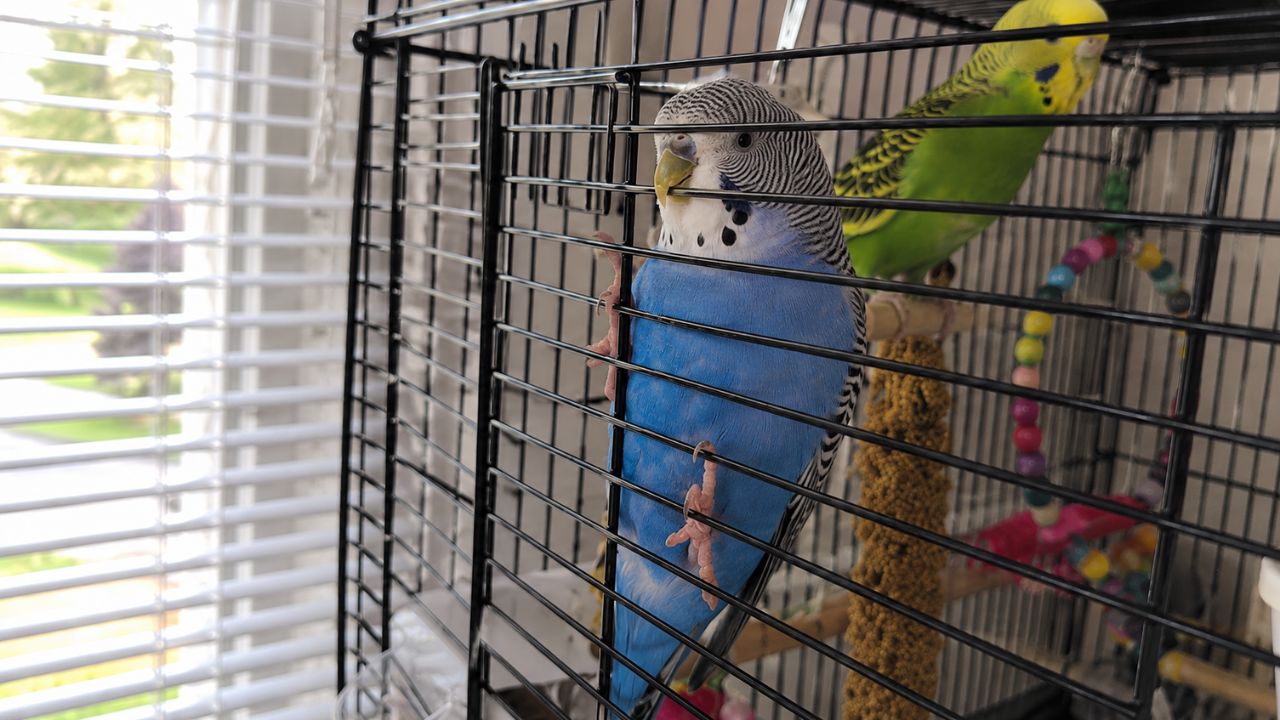
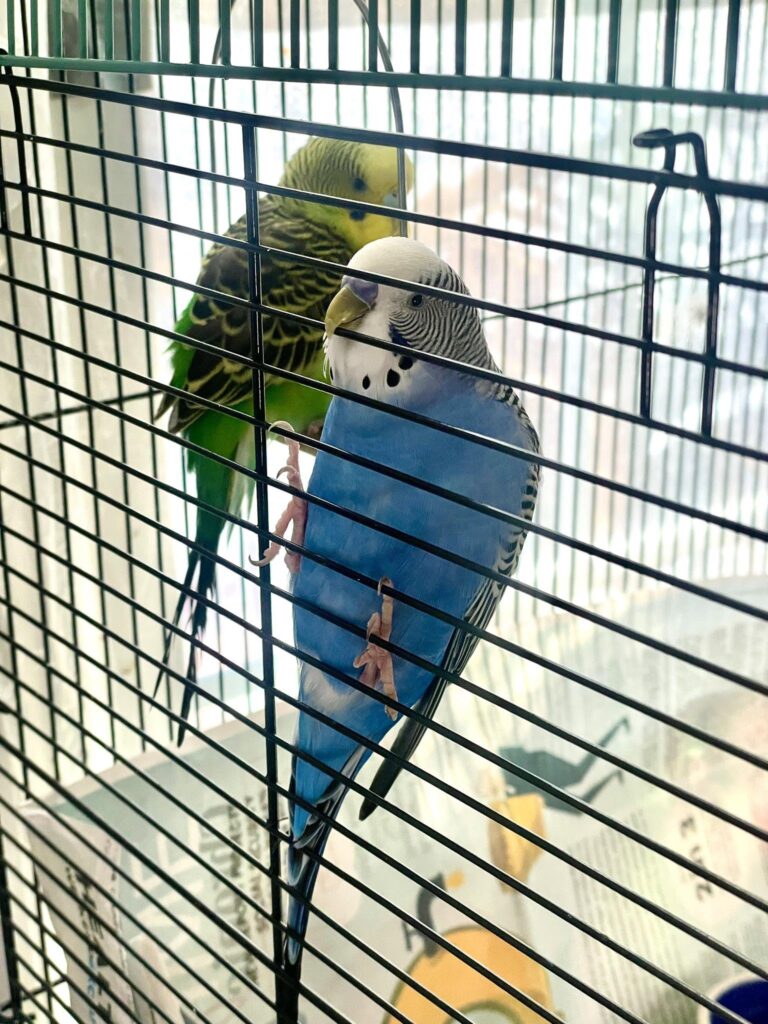
A tamed or semi-tamed budgie that climbs to the side or front of the cage when you sit nearby, when you call to it, or when you bring your hand close, is demonstrating something specific: it is moving toward you because it wants to be near you. Height and proximity are the two ways a caged bird can control its relationship to a person outside the cage. Climbing toward you is the bird choosing to close the distance.
This behaviour is most obvious in birds that have been through a taming process and have developed a genuine relationship with their owner. It is a positive sign — the bird is engaged, it recognises you, and it wants to interact. If your bird consistently climbs toward you and then stops, watches, and makes eye contact or vocalisations, that is an interactive, bonded bird doing exactly what you hoped for when you started taming.
The appropriate response is to match the communication — talk to the bird, offer your hand for a step-up if it is ready for that, or simply spend time near the cage so the bird’s effort to be close to you is rewarded by your presence. A bird that climbs toward you and then gets ignored will eventually stop trying.
The Cage Too Small Problem — When Climbing Replaces Flying
Here is the more significant reason, and the one I want to be honest about because it affects more budgies in UK households than most owners would like to acknowledge.
Budgies are flying animals. Their primary means of natural locomotion is flight — rapid, sustained flight, in the kind of open spaces that UK living rooms do not generally provide. In captivity, the cage is not a substitute for that movement — it is where the bird sleeps, eats, and rests. The flight happens outside the cage during out-of-cage time.
When a cage is too small, or when out-of-cage time is minimal or non-existent, the bird is physically restricted in a way that conflicts fundamentally with its nature. Climbing cage bars becomes, in this situation, a substitute for the movement the bird needs and cannot have. Not exploration, not curiosity — compensation. The bird climbs because it cannot fly, and climbing is what its limbs can do within the available space.
The standard cages sold alongside budgies in most UK pet shops — the ones that come in a box with a bag of seed and a bag of millet — are typically inadequate for the long-term welfare of an active budgie. The minimum cage dimension that allows a budgie to extend its wings, hop between perches, and move freely is significantly larger than what most entry-level cages provide. And even a large cage is not a substitute for regular out-of-cage flight time.
If your budgie climbs the bars frequently and its cage is smaller than approximately 60 centimetres wide — or if it does not get out of the cage at least once a day — cage size and access are the first things to review before looking for any other explanation.
Boredom Climbing — What It Looks Like and Why It Matters
A bird in a barren cage — minimal perches, no toys, limited stimulation, long hours alone — will climb the bars because there is nothing else to do. This is not the curious, exploratory climbing of a well-stimulated bird. It is the purposeless physical activity of an intelligent animal with an understimulated mind.
Boredom climbing in budgies tends to look different from normal climbing in a few specific ways. The bird returns to the same section of bars repeatedly. The movements are less varied and more rhythmic. The bird does not seem to be going anywhere or investigating anything — it moves through the same route, in the same way, with a mechanical quality that is different from genuine exploration.
If you sit near the cage and watch a bored-climbing budgie for five minutes, you will see the repetitiveness clearly. It is running a behavioural loop rather than exploring. This matters because it indicates the bird’s environment is not meeting its needs for mental stimulation and physical engagement.
The solution is environmental enrichment, which I will address specifically in the section below. But the point I want to make here is this: boredom is not a trivial welfare state for a budgie. These are intelligent, social, physically active animals. Chronic boredom is a genuine welfare concern, and the climbing that results from it is the bird communicating that something needs to change.
Stereotypic Behaviour — The Climbing That Is a Serious Welfare Signal
This is the end of the spectrum that I want to address clearly, because it is the most significant thing cage bar climbing can indicate and the most commonly missed.
Stereotypies — repetitive, invariant behaviours that serve no apparent function — are well documented in captive animals kept in inadequate environments. They appear in zoo animals, farm animals, and domestic pets. They are the physical manifestation of chronic frustration, and once established they tend to persist even if conditions improve.
In budgies, bar climbing can become stereotypic — a precisely repeated route, the same bars, the same direction, the same timing, performed dozens or hundreds of times a day with no variation. The bird is not exploring. It is not responding to stimuli. It is running a fixed motor pattern that has become the default behaviour because the environment has provided nothing better.
A bird that is doing this is not well. It is not in pain, and it is not dying — but it is living in a state of chronic environmental deprivation. The route back from established stereotypic behaviour, once it has set in, is long and requires significant environmental change. Getting there before the behaviour is fully established — by improving the environment when you first notice repetitive climbing — is much easier than trying to address it afterward.
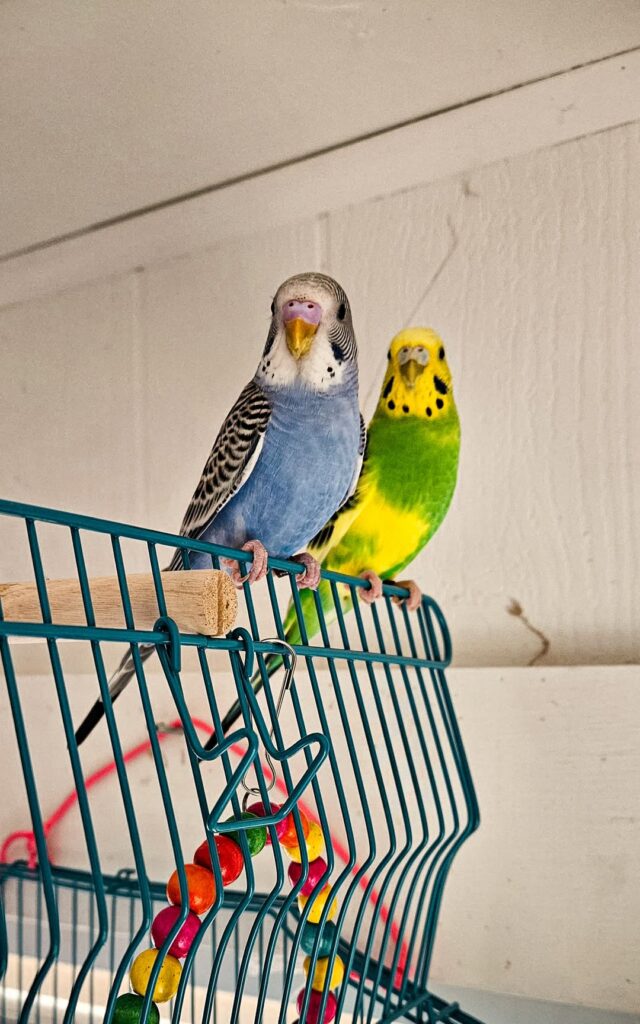
- The climbing is repetitive — same bars, same route, same direction, repeatedly: This is the key signal that distinguishes boredom/stress climbing from normal activity
- The bird climbs for extended periods with little variation in other behaviour: A bird that spends most of its active hours climbing bars and little time doing anything else is under-stimulated
- The cage is small — less than 60cm wide — with smooth dowel perches and few or no toys: Environmental inadequacy is the most likely driver
- The bird rarely or never comes out of the cage: Limited out-of-cage time is a significant welfare gap for flying animals
- The climbing has increased over time rather than remaining stable: Progressive increase in bar climbing usually indicates worsening boredom or frustration
- The bird is single, in a quiet location, with minimal human interaction: Compound isolation factors make boredom-driven behaviour more likely
What to Add to the Cage to Reduce Unnecessary Climbing
The practical response to boredom or frustration-driven bar climbing is environmental improvement, and I want to be specific about what actually makes a difference rather than giving you a generic list.
Natural Wood Perches in Varying Diameters
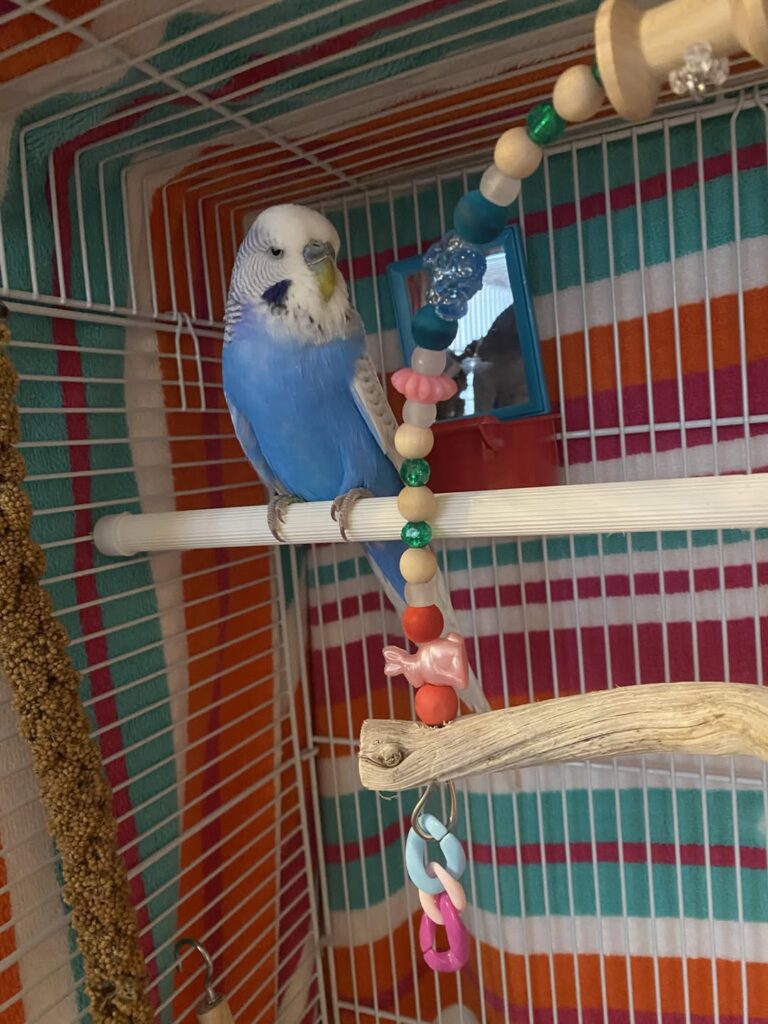
The standard smooth round dowel perches that come with most UK budgie cages are among the worst things in the cage. They are uniform in diameter, smooth in texture, and provide no variation for the feet. Natural wood perches — apple, willow, hazel — in varying diameters change the physical experience of perching significantly. Thicker sections exercise the foot differently from thinner ones. Irregular surfaces provide grip variation. The wood itself provides something to chew and investigate. This alone makes a meaningful difference to cage engagement and reduces the drive to climb bars for movement variation.
Foraging Opportunities
Wrapping a small amount of seed in a piece of paper, tucking food into a specially designed foraging toy, or scattering seeds among foraging material means the bird has to work to find its food rather than finding it all in one place immediately. Foraging is one of the most natural and time-consuming budgie activities, and providing foraging opportunities occupies birds for significantly longer than a standard food bowl does.
Toys That Require Interaction
Not all toys are equal. A plastic bell attached to the cage bars is not the same as a toy that requires the bird to manipulate it — to push, pull, or investigate to produce a result. Foot toys, puzzle toys, and objects the bird can hold and work with provide mental engagement that decorative hanging toys do not. Rotate toys so there is always something relatively unfamiliar in the cage.
Positioning
A cage positioned where the bird can observe normal household activity — a living room or kitchen rather than a spare room — gives the bird visual stimulation throughout the day that a bird in an isolated room does not have. This is inexpensive, requires no equipment, and makes a genuine difference to a social animal.
- Natural wood perches in at least two diameters: Provides foot variation, chewing opportunity, and physical engagement
- Daily out-of-cage flight time: The single most important factor for a flying animal’s welfare — even 20 minutes a day makes a meaningful difference
- Foraging toys or hidden food: Occupies the bird in natural behaviour for extended periods
- Rotating enrichment objects: Novel objects provide investigation opportunity — familiarity reduces the stimulation value
- Cage positioned where the bird can see household activity: Social stimulation for a flock animal
- A companion bird, where practical: For a single bird that is chronically under-stimulated, a companion is the most effective welfare improvement available
Climbing at the Cage Door — Wanting Out
This deserves a brief section because it is one of the most consistent forms of cage bar climbing owners describe, and it has a clear cause and a clear management approach.
A bird that has learned that out-of-cage time is a regular part of its day will begin to display at the cage door in anticipation — climbing toward it, hanging on the bars near it, vocalising at it. This is a smart, time-aware bird demonstrating that it knows what comes next and that it wants it to happen.
This is fundamentally positive — it is a bird that enjoys and anticipates its out-of-cage time, and that is the correct state of affairs. The management question is simply whether you want the bird to be able to trigger its own release by climbing at the door, or whether you want to establish a routine it anticipates without that specific behaviour.
If the door-climbing is happening at an appropriate time and the bird would normally be let out, let it out. If it is happening at a time when you are not ready for out-of-cage time, do not respond to the climbing by opening the door — give it five or ten minutes and then let the bird out when the climbing has stopped, so the release is not associated directly with the climbing behaviour.
Quick Reference — Why Your Budgie Is Climbing the Bars
| What You Are Seeing | Most Likely Cause | What To Do |
|---|---|---|
| Occasional varied climbing, bird otherwise active and normal | Normal exploration and exercise | Nothing. This is a healthy bird using its environment. |
| Climbs toward you when you sit near the cage | Wanting proximity — sign of bonding | Positive. Respond with attention, voice, or a hand for step-up. |
| Climbs toward cage door at the same time each day | Anticipating out-of-cage time | Let the bird out at consistent times. Do not respond to climbing directly with release. |
| Repetitive climbing — same bars, same route, many times a day | Boredom, cage too small, or emerging stereotypy | Review cage size. Add natural perches, foraging toys, enrichment. Increase out-of-cage time. |
| Constant bar climbing in a small cage with minimal perches or toys | Environmental inadequacy — climbing replacing flight | Upgrade cage size. Add enrichment. Daily out-of-cage time essential. |
| Climbing increases steadily over time, bird seems restless | Worsening boredom or stress | Review all environmental factors. Consider companion bird. Increase interaction. |
| Frantic bar climbing alongside alarm calling or puffed feathers | Fear or stress — environmental trigger | Identify what is frightening the bird. Review cage position, nearby pets, sudden noise sources. |
The Honest Answer — What Cage Bar Climbing Usually Means in UK Households
After 35 years of seeing budgies in the full range of domestic situations — from the genuinely well-kept to the obviously inadequate — I will tell you what cage bar climbing in a UK household most often comes down to.
In the majority of cases I encounter, excessive cage bar climbing is a combination of a cage that is slightly too small, smooth plastic perches that do not provide foot variation or chewing opportunity, inadequate enrichment in the cage, and limited out-of-cage time. None of these things is catastrophic on its own. Together they produce a bird with not enough to do, not enough space for natural movement, and not enough engagement — and the climbing is what that looks like from the outside.
The fix is not complicated and not particularly expensive. A larger cage — 60 centimetres wide at minimum, wider if possible. Natural wood perches in two or three different diameters. A foraging toy or two, rotated. Daily out-of-cage time, even for twenty minutes. And a cage positioned somewhere the bird can see household activity rather than a quiet room where nothing happens.
These changes, made consistently, produce a different bird. One that still climbs occasionally because climbing is a natural behaviour — but one that has enough to engage it that the bars are one option among many rather than the only thing available.
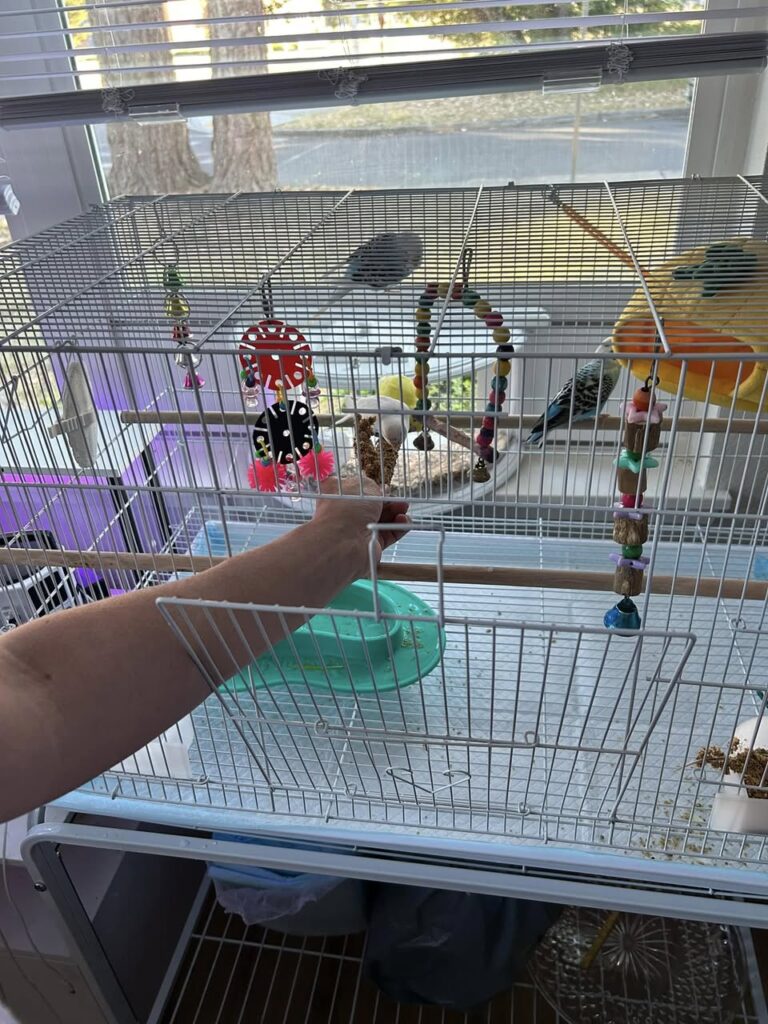
Frequently Asked Questions
Is it normal for budgies to climb cage bars?
Yes — some climbing is completely normal. Budgies climb in the wild, and cage bars are a natural surface for them to grip and move on. Occasional, varied climbing that forms part of the bird’s general activity is not a concern. What is worth examining is climbing that is repetitive, constant, or replacing other normal behaviours — that pattern suggests the bird’s environment needs improvement rather than that the bird has a problem.
My budgie climbs the bars non-stop — what does that mean?
Non-stop climbing, particularly if it is repetitive — the same bars, the same route, multiple times — is almost always a welfare signal. The most common causes are a cage that is too small, insufficient enrichment, and limited out-of-cage time. Review the cage size, add natural wood perches and foraging toys, and increase how often the bird is let out. If the climbing has become a fixed, mechanical pattern that happens regardless of other activity in the room, this has become a stereotypic behaviour and the environment needs significant improvement.
Why does my budgie climb the bars when I walk past?
It is moving toward you. This is one of the positive forms of cage bar climbing — a bonded or taming bird closing the distance between itself and the person it has formed an attachment to. Height and proximity are the two things the bird can control from inside the cage, and climbing to the side nearest to you is how it manages both. Respond positively — talk to the bird, offer your hand, spend time near the cage. A bird that climbs toward you repeatedly and gets no response will eventually stop trying.
Could climbing cage bars hurt my budgie’s feet?
Rarely — but this is worth noting in the context of smooth metal bars. The smooth, uniform surface of standard cage bars can contribute to pressure point issues on the feet when it is the primary surface available, particularly if smooth plastic dowel perches are the only alternative. Natural wood perches in varying diameters distribute foot pressure more naturally and prevent the foot fatigue that can develop in birds whose feet are always gripping the same diameter at the same angle. This is another reason why natural perches are an important addition to any cage — not primarily for the climbing, but for overall foot health.
Does climbing cage bars mean my budgie wants a bigger cage?
Possibly — if the climbing is repetitive and the cage is small, this is the most practical interpretation. A cage that does not allow a budgie to extend its wings fully, or in which all surfaces are within a short hop of each other, is inadequate for an active flying bird. Cage bar climbing is one of the ways this inadequacy expresses itself physically. A minimum width of 60 centimetres is a reasonable threshold for a single budgie, with wider cages being better. The length — allowing horizontal flight movement — matters more than the height.
Where can I buy a budgie or a better cage in Swindon?
Come and see us at Paradise Pets at Manor Garden Centre, Cheney Manor, Swindon SN2 2QJ. We stock budgies and carry a range of appropriate cages, natural perches, and enrichment items. I am happy to give you an honest assessment of whether what you have is adequate for your bird, and what the practical improvements are. Call us on 01793 512400 before visiting.
Worried About Your Budgie’s Cage Behaviour? Come and Talk
If your budgie’s climbing seems excessive or repetitive and you want an honest opinion on what the environment needs — come in. I have been watching these birds in every kind of housing situation for 35 years. I will tell you straight what I think and what I would change, without overselling anything you do not need.