
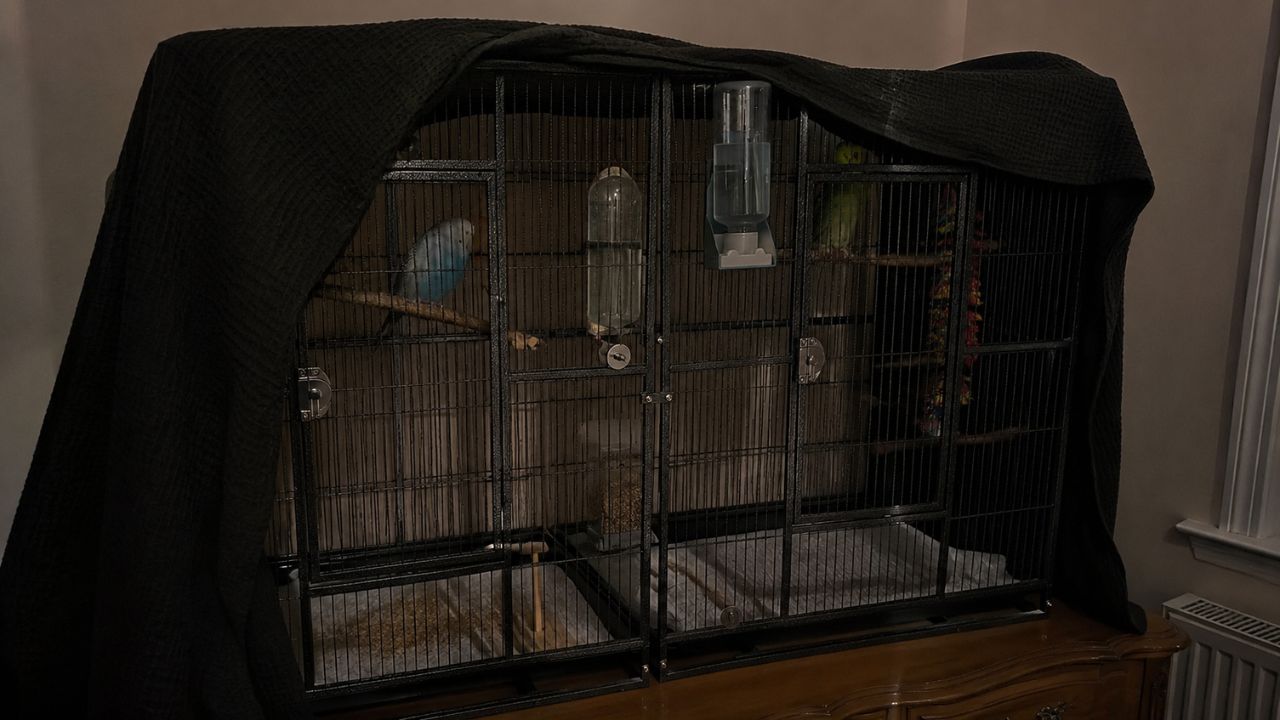

Neil has kept, bred, and sold budgies at Paradise Pets Swindon since 1988 — over 35 years of answering questions about how to keep these birds properly. The cage covering question comes up regularly, and the answer most people get is either too vague to be useful or contradicted by the next person they ask. This is the honest, practical version — with the reasons behind it.
A man came in last spring looking slightly sheepish, which is not an unusual expression at this counter.
He had been arguing with his wife, he explained. About the cage cover. He covered the budgie every night at half past nine, he said, on a fairly firm schedule. His wife thought this was unnecessary — their living room light went off around ten anyway, and the bird seemed fine in the morning whether it was covered or not. He had told her the bird needed covering. She had asked him why. He had said because that was what you were supposed to do. She had asked him who had told him that, and he had not been able to produce a satisfactory answer.
He was, therefore, in the shop.
I told him that his instinct was not wrong but that his timing was probably slightly off, and that his wife was also not wrong that covering may be less critical in some households than others. They were both partially right, which is the kind of answer that does not win arguments but is usually the accurate one.
Then I explained what actually matters and why — which is what this article is about.
The Direct Answer — How Long Should the Cover Be On?
Ten to twelve hours per night is the amount of darkness and undisturbed sleep a budgie needs for good health, normal hormonal function, and proper immune maintenance.
If your household is dark and quiet for ten to twelve hours naturally — the lights go off, the television goes off, the room is genuinely dark and undisturbed — and the bird is in a room where early morning light is not an issue, you may not need a cover at all. The cover is a means to an end. The end is ten to twelve hours of darkness. If that is already happening without a cover, the cover is not adding anything essential.
In most UK households, particularly in summer, this is not the case. Late evenings with lights on, televisions running, people moving around. And early mornings — particularly in UK summer when light begins before five o’clock — where without a cover the bird will wake with the sun and be active while the rest of the household is still asleep. In these situations, a cover is genuinely useful.
The practical guidance I give: cover the cage around thirty to sixty minutes before the household settles for the night — so the bird’s lights-out happens slightly ahead of human activity reducing, giving it transition time. Uncover it in the morning at a consistent time that gives the bird ten to twelve hours covered. In a UK summer household where lights and activity continue until ten or ten-thirty pm, this might mean covering at nine-thirty and uncovering at seven-thirty or eight in the morning.
Why Sleep Quality Actually Matters for Budgies
Before getting into the practical details, I want to explain why this matters — because “cover the cage so the bird can sleep” is advice that most owners follow without understanding what it is actually doing.
Budgies in the wild sleep when it is dark and are active when it is light. This is not a preference — it is a physiological pattern governed by the circadian rhythm, which in turn is regulated by light exposure. Light tells the budgie’s brain when to be alert, when to sleep, when to produce certain hormones, and — crucially — when to begin reproductive activity.
Disrupted sleep in budgies, over time, has real consequences. Insufficient darkness reduces the quality of the immune rest that sleep provides. Chronic sleep disruption is associated with increased susceptibility to illness, reduced resistance to infection, and in some cases chronic low-grade stress that manifests as increased vocalisation, feather problems, or reduced vitality. These consequences do not appear overnight — they accumulate gradually, which is why owners who routinely provide insufficient sleep do not immediately see a problem but may see their bird deteriorate in subtle ways over months.
Adequate, consistent, dark sleep — ten to twelve hours — is not a luxury or a comfort. It is a basic physiological need, in the same category as appropriate food and water.
Do You Actually Need to Cover the Cage at All?
Honest answer: it depends on your household, and I think telling every owner categorically that they must cover the cage is slightly misleading.
The cover is not the point. The darkness is the point. If your budgie’s cage is in a room that is genuinely dark — no streetlight through the curtains, no television in the corner, no light coming under the door — and genuinely quiet by a reasonable hour, and if the room does not flood with early morning sunlight while the household is still asleep, a cover may provide no meaningful additional benefit.
Breeders keeping birds in purpose-built bird rooms with consistent light control often cover their birds rarely or not at all, because the environment is already doing what the cover does. The bird gets its dark hours from the environment rather than from a cloth.
In a typical UK living room or bedroom — light from screens, ambient streetlight, variable household activity patterns — the cover is genuinely useful because it provides consistent, controlled darkness that the room itself does not reliably offer.
Ask yourself honestly: does my budgie get ten to twelve hours of genuine darkness and undisturbed quiet every night? If yes, with or without a cover — carry on. If no — either add a cover or change the environment.
- Cover is genuinely useful when: The room has ambient light from screens, streetlights, or household activity extending past nine or ten pm. The room gets bright early morning sunlight before you are ready to uncover the bird. The bird is in a frequently used room where people are up later than the bird should be sleeping.
- Cover may not be necessary when: The room is genuinely dark and quiet for ten to twelve hours naturally. The bird is in a separate room away from household evening activity. The windows are properly blacked out and morning light is not an issue.
- The non-negotiable requirement in either case: Ten to twelve hours of genuine darkness and undisturbed sleep, delivered consistently, every night.
What to Use as a Cover — Fabric, Safety, and What Never to Use
If you are going to use a cover — and in most UK households this is the practical choice — what you use matters more than most owners realise.
The single most important requirement is breathability. The cover must allow adequate airflow through the cage. A budgie sleeping under a cover is producing carbon dioxide, moisture, and heat. A cover that traps these — particularly one that sits tightly against the cage bars and restricts airflow — creates conditions inside the cage that are unsuitable for the bird. At extreme end, a fully airtight cover on a small cage in a warm room is a welfare hazard.
Cotton is the standard and correct choice. A thin cotton sheet, a piece of muslin, or a purpose-made cotton cage cover provides the opacity to block light while allowing sufficient airflow through the weave. The cover does not need to be heavy to be dark enough — a single layer of plain cotton fabric is usually adequate.
What not to use: plastic sheeting or bin bags, even briefly. Polyester or synthetic fabric that does not breathe well. Heavily scented fabric softener on the cover — budgies are sensitive to chemical fumes and a cover loaded with artificial fragrance is in direct contact with the air the bird breathes all night. Wash the cover in unscented detergent and do not use fabric softener on it.
The cover does not need to enclose the cage entirely. Leaving the bottom few centimetres uncovered on one or two sides provides additional airflow and is perfectly adequate — the light exclusion at the top and sides is what matters most.

Night Frights — What They Are and How the Cover Affects Them
This is worth its own section because night frights are a real phenomenon in budgies and the cover’s relationship to them is slightly more nuanced than most guides suggest.
Night frights — sometimes called night thrashing — are episodes in which a sleeping budgie is suddenly disturbed and panics in the dark, often flying blindly around the cage and sometimes injuring itself on the bars or fittings in the process. They are most often triggered by a sudden noise, a flash of light, or the movement of a shadow — any sudden stimulus that activates the bird’s prey-animal threat response while it is in a vulnerable, disoriented sleep state.
In total darkness, a budgie that is startled cannot orientate visually — it cannot tell where the perches are, where the bars are, or where the threat is. The thrashing that results is the bird trying to escape a perceived predator in conditions where it cannot see. This is where night frights produce injuries.
A cover can both help and hinder with night frights, depending on how it is used. A cover that excludes all ambient light creates the total darkness that makes night frights more dangerous when they occur — the bird cannot see at all. A cover that excludes artificial light but allows some low-level ambient light from outside, or that is used alongside a small nightlight in the room, gives the bird enough visual information to orientate if startled, without being bright enough to disrupt sleep.
If your bird has a history of night frights — if you have heard the sudden thrashing sound, found feathers in the cage in the morning, or seen the bird looking distressed first thing — consider leaving a very dim nightlight in the room alongside the cover, or choose a cover that is not completely opaque. The goal is darkness sufficient for good sleep, not darkness so complete that a startled bird cannot see at all.
- Night frights are triggered by: Sudden noise, a flash of light (car headlights through a gap in curtains, a phone lighting up), sudden movement near the cage, or another animal in the room
- Signs your bird has had a night fright: Found feathers loose in the cage in the morning, bird looks dishevelled or distressed at waking, unusual noise from the cage during the night
- If your bird has frequent night frights: Dim nightlight in the room. More opaque curtains. Move the cage away from windows or doors where sudden stimuli may penetrate. Consider whether another pet is disturbing the bird at night.
- What NOT to do: Do not rush to uncover the cage the moment you hear a night fright. Wait until the bird has settled, then uncover quietly and speak calmly. Uncovering immediately in a state of alarm can extend the panic.
The UK Summer Problem — Why Covering Matters Most in the Morning
This is the most practically relevant section for many UK owners, and it is the one I find myself explaining most during summer months.
In the United Kingdom, sunrise in midsummer begins before five in the morning. Without adequate window coverings or a cage cover, a budgie in a room with easterly-facing windows — or in any room where morning light enters significantly — will wake at sunrise. This means the bird is active, noisy, and demanding attention at four-thirty or five in the morning throughout the summer months.
This is not the bird misbehaving. It is the bird responding to light, exactly as its biology dictates. The solution is the cover — which keeps the bird in its perceived night for long enough that it wakes at a reasonable hour for the household rather than at sunrise.
In UK summer, I recommend covering the cage every night regardless of whether you need it during autumn and winter. The morning cover — keeping the bird in darkness until seven or seven-thirty — is genuinely worth the habit even in households where the evening light and activity are not a concern.
The alternative is very early mornings in June and July, which most owners find considerably less pleasant than remembering to put the cover on before bed.
Light Exposure and Hormonal Health — The Less-Known Reason Consistency Matters
This is a point that goes beyond comfort and sleep quality into something more fundamental about the bird’s long-term health.
Budgies are photoperiodic — meaning their hormonal state is regulated in part by the length of the light period they experience each day. In the wild, changing day length through the year signals the appropriate season for breeding. Longer days trigger hormonal changes that prepare the bird for reproductive activity. Shorter days wind that down.
In a UK household with artificial lighting extending the day, a budgie may experience a persistently extended “light period” that maintains it in a state of low-level hormonal activation that should not be permanent. Chronic hormonal activation of this kind is associated with reproductive problems — chronic egg-laying in females, which depletes calcium and creates health risks, and persistent aggressive or territorial behaviour in males.
Consistent light control — ten to twelve hours of darkness each night, year-round — helps moderate this by ensuring the bird’s light period remains within a normal range rather than extending indefinitely because the household lights are always on. This is a secondary benefit of the cover beyond sleep quality, and it is most relevant in birds that are showing signs of excessive breeding behaviour, persistent aggression, or in female birds with laying problems.
What Not to Do With the Cage Cover
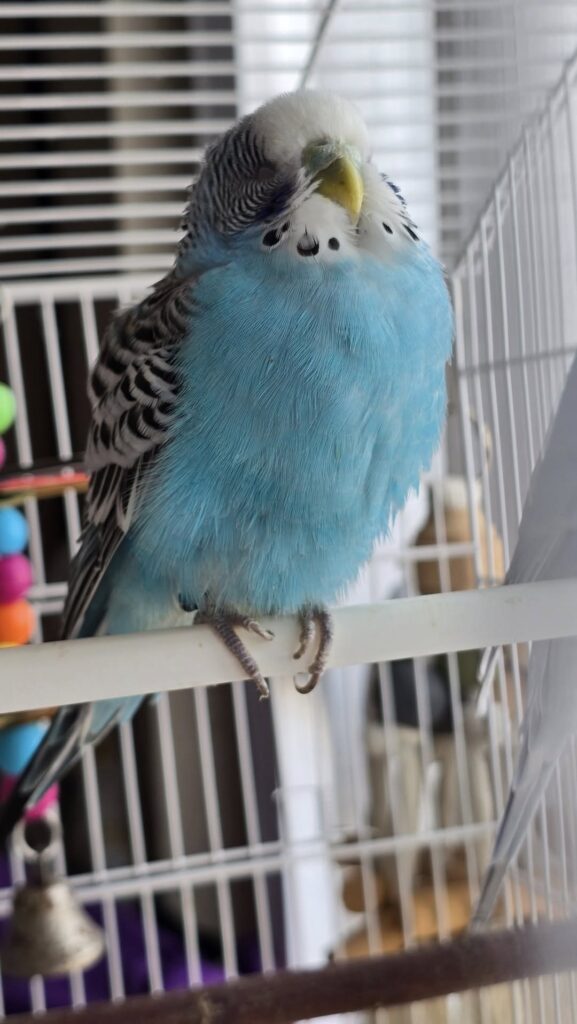
Most owners use cage covers correctly once they understand the principle. There are a handful of mistakes worth naming specifically because they come up at the counter and are worth avoiding.
Do not use the cover as a management tool during the day. Covering the cage to quiet a screaming budgie, or to stop it from demanding attention, teaches the bird nothing useful and is stressful for an animal that is suddenly placed in darkness without the usual light-based signal that darkness is coming. Daytime covering should only happen if you are moving the bird for transport, or if an unusual circumstance requires brief darkening for a specific practical reason.
Do not cover before the usual time to try to extend the bird’s sleep at the weekend. Consistency in the cover schedule matters more than occasional extra sleep. A bird that is covered at nine-thirty every night and suddenly covered at seven on a Friday will not simply sleep more contentedly — it will be confused by the early darkness and is more likely to be unsettled.
Do not assume the cover guarantees silence. A covered bird that is alarmed by a noise will still vocalise. A covered bird in the wrong room — where household noise continues past its sleep time — will not sleep well regardless of the light being blocked. The cover handles the light. The noise has to be managed separately.
- Using plastic or non-breathable material: Creates a dangerous accumulation of heat, moisture, and carbon dioxide inside the cage. Cotton only.
- Covering during the day to manage behaviour: Not effective and stressful for the bird. The cover is for sleep, not discipline.
- Heavily scented or freshly washed-with-softener cover: Chemical fumes from fabric softener or strong detergent are directly inhaled all night. Wash in unscented detergent only.
- Covering for more than 12 hours routinely: Extended darkness limits the bird’s active day unnecessarily and can affect vitamin D synthesis and general activity levels.
- Inconsistent schedule — varying by hours night to night: Consistency is what regulates the bird’s biological clock. Random covering times work against the purpose of having a schedule at all.
- Rushing to uncover during a night fright episode: Wait for the bird to settle first. Uncovering during active panic can extend the distress.
Quick Reference — Cage Covering at Night
| Question | Honest Answer |
|---|---|
| How long should the cover be on? | 10–12 hours per night. Consistent every night. |
| What time should I cover the cage? | Approximately 30–60 minutes before the household settles. Consistent time matters more than the specific hour. |
| What time should I uncover it? | A consistent morning time that gives 10–12 hours covered. In UK summer this may mean 7–8am to keep the bird sleeping past sunrise. |
| Do I have to cover the cage at all? | Only if the bird does not already get 10–12 hours of genuine darkness and quiet. If the room is already dark and quiet for long enough, a cover adds nothing essential. |
| What fabric should I use? | Plain cotton — breathable, not airtight. Unscented wash only. Never plastic or synthetic non-breathable material. |
| Should the whole cage be covered? | Not necessarily. Top and sides covered, leaving a few centimetres at the base uncovered on one or two sides for airflow is fine. |
| My bird has night frights — should I change how I cover? | Use a less opaque cover or add a dim nightlight so the bird can orientate if startled. Complete darkness makes night frights more dangerous. |
| Can I cover the cage during the day? | Not as a management tool. Only for transport or a specific practical short-term reason. |
The Rule I Give Every Budgie Owner
The rule is simple and it holds whether you use a cover or not: ten to twelve hours of genuine darkness and undisturbed quiet, every night, at consistent times.
The mechanism matters less than the outcome. If a cover is how you achieve that in your household, use one — plain cotton, breathable, consistent timing. If your bird already gets adequate darkness without a cover because your household and the room conspire to provide it naturally, a cover is not compulsory.
What I would add is this: if you are in any doubt, cover. The practical cost of covering a cage is negligible. The cost of a bird that is chronically sleep-disrupted — in health, in behaviour, in long-term wellbeing — is considerably higher. The cover is cheap insurance for something that genuinely matters.
Consistent timing is the most important element of whatever you decide. A bird that is covered at the same time every night and uncovered at the same time every morning has a regulated biological clock. A bird that is sometimes covered at nine, sometimes at eleven, sometimes not at all, has a chronically confused one. Get the timing consistent before worrying about anything else.
Frequently Asked Questions
Should I cover my budgie’s cage every night?
If your household has lights, screens, or activity continuing past nine or ten in the evening — yes. If your bird’s room is dark and quiet for ten to twelve hours naturally — it is less critical, but covering is still a straightforward habit that costs nothing and ensures the bird gets what it needs consistently. In UK summer particularly, covering is worthwhile for most households because early sunrise will otherwise wake the bird at four or five in the morning.
How many hours should a budgie sleep?
Ten to twelve hours of darkness per night is the appropriate range. This matches approximately with natural day/night cycles, and provides the immune rest, hormonal regulation, and physical recovery that birds need. Fewer than ten hours regularly is insufficient. More than twelve routinely is also not ideal — it limits the bird’s active day and can affect vitamin D synthesis and general vitality.
My budgie wakes up very early in summer — what should I do?
This is the most common summer problem in UK budgie keeping and the most practical argument for using a cover year-round. A cover kept on until a consistent morning time — seven or seven-thirty — prevents early sunrise from activating the bird. Use a cover that blocks direct light effectively, and if necessary improve the window coverings in the room so that first light does not penetrate enough to partially activate the bird before the cover comes off.
Is it cruel to cover a budgie’s cage?
No — provided it is done correctly. Covering with a breathable cotton cover for ten to twelve hours of sleep is not a restriction of the bird’s wellbeing. It is provision of the darkness the bird needs for adequate sleep. What would be unkind is covering with a non-breathable material that restricts airflow, covering for excessive periods, or covering during the day as a way of managing behaviour. Done correctly, the night cover is a welfare benefit, not a welfare concern.
What fabric should I use to cover my budgie’s cage?
Plain cotton is the standard recommendation and the correct choice. It is breathable enough to allow adequate airflow while being sufficiently opaque to block most ambient light. A thin cotton sheet, muslin, or a purpose-made cotton cage cover all work well. Wash it in unscented detergent only — no fabric softener. Never use plastic, polythene, or synthetic non-breathable materials, even briefly, as these restrict airflow and create dangerous conditions inside the cage.
My budgie has night frights — does covering make this worse?
A fully opaque cover in a completely dark room can make night frights more dangerous if they occur, because the bird cannot see to orientate when startled. If your bird has a history of night frights, use a slightly less opaque cover or a cover that leaves a small gap at the base, and place a very dim nightlight in the room. The bird needs enough ambient light to see where it is if suddenly alarmed, without the light being bright enough to disrupt normal sleep.
Where can I find cage covers and budgie supplies in Swindon?
We carry a range of cage accessories including appropriate covers at Paradise Pets — Manor Garden Centre, Cheney Manor, Swindon SN2 2QJ. Come and see us or call 01793 512400 before visiting to check what we currently have in stock.
Questions About Budgie Care and Housing? Come and Talk
If you want practical advice about covering, cage setup, lighting, or any other aspect of keeping your budgie well — come in. I have been looking after these birds for 35 years and I am happy to give you the honest version of what actually makes a difference. No unnecessary products. No vague reassurance. Just the practical information.