

Neil has kept, bred, and sold budgies at Paradise Pets Swindon since 1988 — over 35 years of helping UK owners protect their birds through British weather extremes. The Met Office has issued an Amber Extreme Heat Warning with peak temperatures forecast to reach 38°C this week, the UK Health Security Agency has issued heat-health alerts across multiple regions, and budgies kept in many British homes are genuinely at serious risk over the coming days. This is his urgent, practical guide on exactly what UK budgie owners should be doing right now — emergency signs to watch for, immediate cooling actions, cage setup adjustments, and the critical mistakes that could cost your bird its life this week.
A man came rushing into the shop one Tuesday afternoon last summer, holding a small cage covered with a damp towel. His budgie Bertie was breathing with his beak open, holding his wings away from his body, sitting motionless on the cage floor. The temperature outside was 33°C. The man’s south-facing flat had reached over 38°C inside by mid-afternoon. He had only realised something was wrong when he came home from work and found Bertie genuinely struggling. He drove straight to the shop, hoping I could help.
We saved Bertie that day — barely. The combination of immediate emergency cooling, a quick drive to the avian vet I recommended, and several hours of intensive recovery care brought him back from what would otherwise have been a fatal heat episode within another couple of hours. The man learned, the hard way, that British heatwaves are genuinely dangerous for pet budgies in ways most UK owners do not anticipate until it happens to their bird.
I am writing this article because the Met Office has just issued an Amber Extreme Heat Warning for this week, with temperatures forecast to reach 38°C across southern England by Wednesday and Thursday — challenging the all-time UK June temperature record of 35.6°C. The UK Health Security Agency has issued amber heat-health alerts across five English regions. Tropical Nights — where overnight temperatures stay above 20°C — are forecast for many areas, particularly urban locations. Humidity will make this heatwave especially oppressive, with dew points around 22°C compared to single figures during the July 2022 record-breaking heat. For UK budgie owners, this combination of high temperatures, high humidity, and elevated overnight temperatures is genuinely the most dangerous weather pattern British birds face in their domestic environments.
This article is the conversation I would have with you at the counter if you came in this week worried about your budgie in the heat. By the end of it, you will know exactly what heat stress looks like in a budgie, what to do immediately if your bird is showing signs, how to set up your cage location to prevent dangerous overheating, what critical mistakes to avoid, which budgies are at highest risk, and how to get your bird safely through the most dangerous days of this heatwave.
The Current UK Heatwave — What You Need To Know
For UK budgie owners trying to understand exactly what is happening this week, here is the honest picture based on Met Office and UK Health Security Agency information.
Current UK heatwave conditions:
- Met Office Amber Extreme Heat Warning in force across parts of England and Wales
- Peak temperatures forecast to reach 38°C across southern England Wednesday and Thursday
- 37°C forecast for parts of southern England by Tuesday
- 35°C forecast for southeast Wales
- Tropical Nights forecast for many areas — overnight temperatures not dropping below 20°C
- Very high humidity — dew points around 22°C, making conditions feel oppressive
- UKHSA amber heat-health alerts issued for five English regions
- UKHSA yellow alerts for southwestern and northern England
- Potential to challenge all-time UK June temperature record of 35.6°C (Southampton, 1976)
- Heat conditions forecast to persist through much of the week
This is genuinely an exceptional UK weather event. The combination of very high daytime temperatures, very high overnight temperatures, and high humidity creates exactly the conditions that pose the greatest risk to pet budgies in British homes. Wild budgies in Australia are adapted to dry heat with cool nights — UK conditions this week will be hot day, hot night, and humid throughout. The pattern is genuinely different from anything Australian budgies evolved to handle.
For UK budgie owners, the practical implication is significant. Your bird’s normal heat regulation strategies — wing extension, panting, behavioural cooling — work best in dry heat. In humid heat, these strategies become less effective. Combined with cage confinement and the inability of birds to leave a hot room, the risk to UK budgies during this specific weather pattern is genuinely substantial.
Heat Stress Warning Signs — Recognise These Today
For UK budgie owners, the single most important skill this week is recognising heat stress quickly. Budgies can deteriorate from manageable heat discomfort to life-threatening heat emergency within hours. Knowing the warning signs lets you act before the situation becomes critical.
Early warning signs (act now if you see these):
- Wings held away from body — the budgie is trying to lose heat through their armpit-equivalent area
- Increased water drinking — visiting the water dish more than usual
- Reduced vocalisation — normally chatty budgie becoming noticeably quieter
- Reduced activity — less moving around, more sitting still
- Seeking cooler areas of cage — often the floor or lower perches
- Loss of appetite — disinterested in normally favourite foods
- Eyes half-closed for extended periods — beyond normal rest
Urgent warning signs (immediate action required):
- Open-mouth breathing (panting) — clear sign of significant heat stress
- Tail bobbing during breathing — respiratory effort, urgent intervention needed
- Wings held fully outstretched — maximum heat-loss posture
- Sitting on the cage floor — particularly with wings outstretched
- Watery or wet droppings — heat stress affecting water balance
- Lethargy or unresponsiveness — bird appears disengaged or weak
- Loss of balance or instability — coordination affected
- Eyes closed with head drooping — collapse imminent
Critical warning signs (emergency vet attention required):
- Bird unresponsive or unconscious
- Severe respiratory distress
- Visible weakness or collapse
- Convulsions or seizure-like activity
The progression from early warning signs to emergency can happen genuinely quickly in extreme UK conditions. A budgie showing wing extension and reduced activity in the morning can be in critical condition by afternoon if the room continues to heat up and no intervention occurs. Acting on early signs prevents progression.
Immediate Emergency Actions — If Your Budgie Is Showing Signs RIGHT NOW
For UK budgie owners whose bird is currently showing heat stress signs, here is the immediate action protocol. These steps work — they have saved many budgies through 35 years of UK summers.
- Move the cage immediately to the coolest room in your house
Ground floor, north-facing room, away from windows. Tile or stone floors are coolest. - Mist the bird with cool (not cold) water
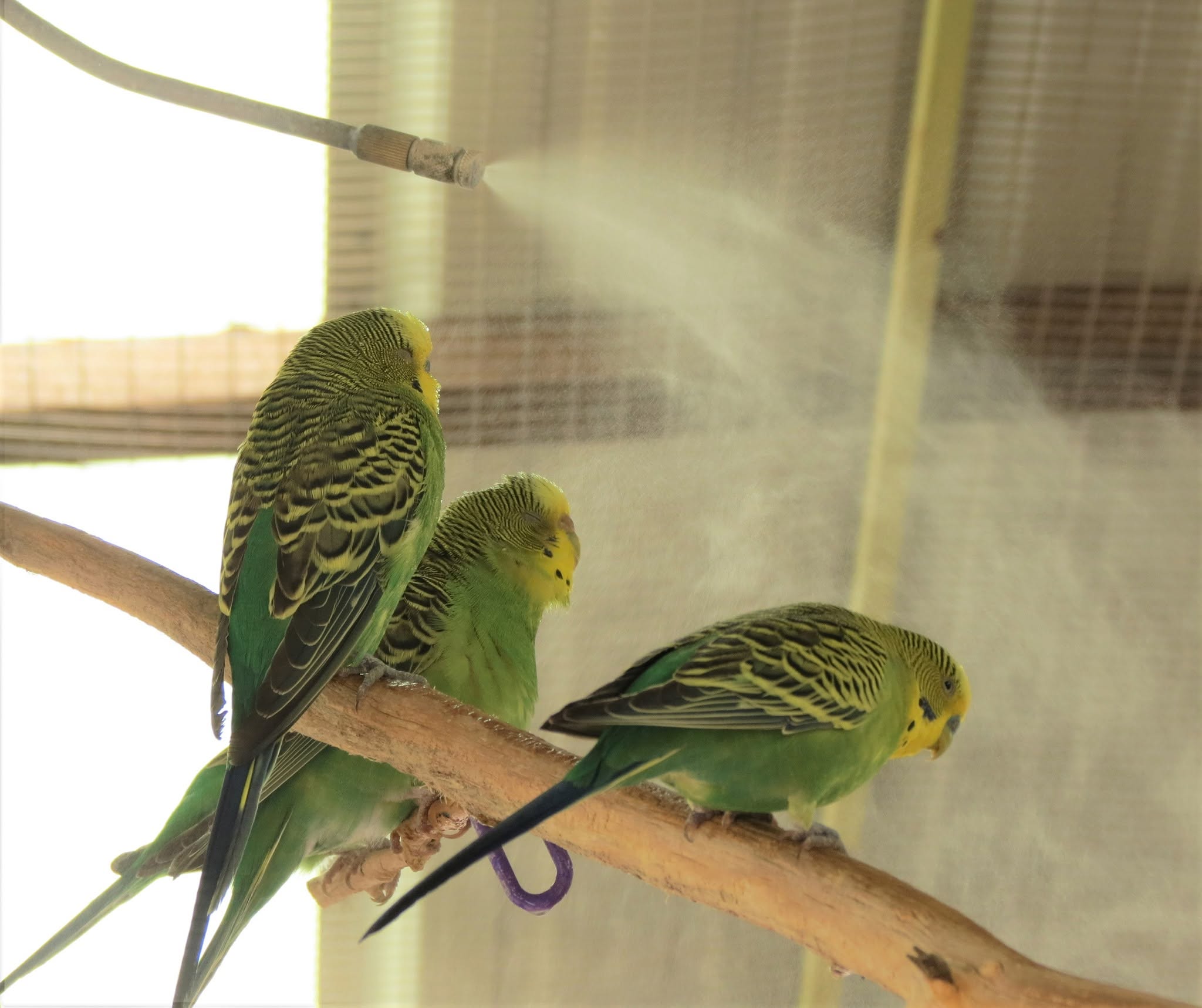
A spray bottle of cool tap water, lightly misting from above. NOT cold water — thermal shock is dangerous. - Provide a shallow water dish for bathing
Many budgies will bathe to cool down when given the option. Use a shallow heavy dish that won’t tip. - Place ice packs wrapped in towels near the cage
NOT inside the cage. Around the outside, helping cool the air. Frozen water bottles wrapped in cloths work. - Set up a fan on lowest setting
Positioned NOT pointing directly at the bird. Aimed at the ice packs or wall, creating gentle air circulation. - Drape damp (not soaking) towels over part of the cage
Creates a cooling zone the bird can move into. Leave open access too. - Offer frozen vegetables as treats
Frozen peas, sweetcorn, broccoli florets. The bird gets cooling moisture from inside. - Ensure constant access to fresh water
Change water frequently. Add a second water dish in case main becomes warm. - Monitor the bird every 15 minutes
Look for improvement or deterioration. Be ready to call an avian vet. - Call an avian vet immediately if symptoms worsen or do not improve within 30 minutes
This is a genuine emergency. Heat stroke can be fatal. Don’t wait.
The single most important emergency action is moving the cage to the coolest room. This addresses the underlying problem (the bird is in a too-hot environment) directly. All other actions help, but if you cannot reduce the ambient temperature significantly, the bird will continue to struggle.
Cage Setup For The Heatwave — TODAY Actions
For UK budgie owners whose bird is not yet showing distress but who want to prevent it through the peak heatwave days, here are the cage setup adjustments you should make today.
Heatwave cage setup priorities:
- Move cage away from windows — particularly south-facing or west-facing windows
- Move cage to coolest room in the house — ground floor, north-facing if possible
- Avoid conservatories, sunrooms, or upper-floor rooms — these become genuinely lethal hot zones
- Avoid kitchens during cooking — combination of heat and fumes
- Position cage on or near tile/stone floors — these stay cooler than carpeted areas
- Provide multiple water sources — main drinking dish plus secondary backup
- Add a shallow bathing dish — many budgies use this to cool down
- Remove perches that are in direct sun — even if sun moves through the day
- Place a wet towel over part of the cage — creates evaporative cooling
- Set up a fan in the room (not pointed at the bird) — air circulation helps
- Consider an air conditioning unit if available — set to gentle cooling, not blast cold
- Close curtains during the hottest part of the day — block radiant heat
The cage location decision is the single most impactful thing you can do today. A budgie in the wrong room with the wrong window exposure can experience 35-40°C ambient temperatures even on a “moderate” UK summer day. A budgie in the right room with sensible setup can stay 5-8°C cooler — which is genuinely the difference between life and death during this week’s forecast peak.
What NOT To Do — Critical Mistakes To Avoid
For UK budgie owners trying to help their birds, here are the well-intentioned actions that can actually make things worse. After 35 years of UK summers, these are the mistakes I see UK owners make most often.
- DO NOT put ice cubes in the drinking water — thermal shock can be dangerous; cool tap water is sufficient
- DO NOT put ice or frozen items inside the cage — direct contact can cause cold injury
- DO NOT spray cold water directly at the bird — cool water mist only, no direct cold spraying
- DO NOT point a fan directly at the bird — gentle air circulation, not direct cold airflow
- DO NOT move the bird suddenly to air-conditioned cold rooms — gradual temperature transitions only
- DO NOT soak the bird in water — light misting only, no submersion
- DO NOT cover the entire cage with wet towels — air circulation must be maintained
- DO NOT leave windows wide open near the cage — predator risk and uncontrolled drafts
- DO NOT put cage in fridge or freezer — extreme thermal shock
- DO NOT use products containing essential oils or aerosols — respiratory damage risk
- DO NOT assume conservatories are safe with windows open — they become greenhouse traps
- DO NOT delay vet contact if bird shows critical signs — heat stroke is a real emergency
The single most common dangerous mistake I see is owners panicking and putting ice directly into the cage or water. The instinct is understandable — they want to cool the bird quickly. But sudden cold contact or thermal shock can cause genuine harm. The goal is steady, controlled cooling of the environment, not rapid extreme cold contact with the bird itself.
The second most common mistake is conservatory placement. UK conservatories become greenhouse traps during heatwaves, often reaching 45°C or higher even with windows open. A budgie in a UK conservatory during this week’s heatwave is in genuine immediate danger. If your bird is currently in a conservatory or sunroom, please move them today — before the peak temperatures arrive Wednesday and Thursday.
High-Risk UK Budgies — Which Birds Are Most Vulnerable
For UK budgie owners wondering whether their specific bird is at higher risk this week, here is the honest picture based on 35 years of seeing which budgies struggle most during UK heatwaves.
UK budgies at highest heatwave risk:
- Older budgies (over 5 years) — reduced ability to regulate body temperature
- Very young chicks and recently fledged budgies — heat regulation systems still developing
- Birds currently unwell or recovering — reduced resilience to additional stress
- Overweight budgies — additional insulation makes heat dissipation harder
- Budgies in upper-floor flats and homes — heat rises, top floors become hottest
- Budgies in small cages — less air volume, fewer movement options
- Budgies in conservatories or sunrooms — greenhouse effect creates lethal temperatures
- Budgies in south-facing or west-facing rooms — afternoon sun creates peak risk
- Solitary budgies without owner attention — nobody to notice early warning signs
- Birds in plastic-heavy cages — plastic traps and radiates heat
- Birds without bathing options — cannot self-regulate through bathing
- Birds in poorly ventilated rooms — humidity builds up rapidly
If your budgie falls into multiple risk categories — an older bird in an upper-floor flat with south-facing windows, for example — your bird is at substantial elevated risk this week. The risk factors compound, and the practical implication is that your monitoring and intervention needs to be more attentive than for a younger bird in cooler accommodation.
For more on supporting older budgies through challenging conditions, our article on how to tell if your budgie is happy covers baseline behaviour recognition, and our article on why your pet bird is watching you more than you realise covers the close attention that genuinely helps spot early warning signs.
The 48-Hour UK Heatwave Survival Plan For Your Budgie
For UK budgie owners wanting a clear day-by-day action plan through this week’s peak heat, here is the practical framework based on 35 years of getting UK budgies safely through British summer extremes.
- Today (before peak arrives)
Move cage to coolest room. Remove cage from any south/west-facing window areas. Add bathing dish. Stock up on cool tap water. Confirm ice pack availability. - Tonight
Set up fan (not pointing at bird), ice packs wrapped in towels, damp towel over part of cage. Monitor evening cage temperature. Tropical Night conditions expected. - Tomorrow morning (early)
Check bird’s behaviour and breathing first thing. Adjust setup if room already warm. Refresh water and ice packs. - Tomorrow midday (peak heat building)
Close curtains in cage room. Ensure ventilation. Watch for early warning signs every hour. - Tomorrow afternoon (peak temperatures)
Be physically present if possible. Watch bird actively. Mist with cool water if showing early signs. Refresh ice packs. - Tomorrow evening
Continue monitoring as overnight temperatures may stay above 20°C. Tropical Night conditions affect overnight recovery. - Wednesday/Thursday (peak forecast days)
Highest risk period. Active monitoring throughout day. Cage in coolest room with all cooling measures active. Vet contact information ready. - Have avian vet emergency number written down
Visible on fridge or near phone. If your bird shows critical signs, every minute matters. - Check on bird before leaving home
If going out, ensure cage room will not heat up. Consider asking neighbour to check if extended absence. - Reduce evening enrichment activities
Bird needs rest and cool conditions. Save active play for cooler days.
The single most important survival strategy is active monitoring during peak hours. UK budgies that come through heatwaves without incident are typically the ones whose owners are watching them actively — not just glancing in occasionally. The early warning signs are clear if you are looking. The intervention is effective if you act promptly. Your active attention this week could genuinely save your bird’s life.
Common UK Owner Misunderstandings About Budgie Heat
For balance, here are the genuine misunderstandings I see UK owners make about budgies and heat. Avoiding these helps you respond appropriately this week.
- Believing budgies are heat-tolerant because they originated in Australia — they are adapted to DRY heat, not humid UK heat
- Assuming wild budgie temperature ranges apply to pet budgies in cages — caged birds cannot move to cooler areas
- Thinking the bird will tell you when too hot — by the time it’s obvious, the situation may be critical
- Believing UK summers cannot get hot enough to harm budgies — modern UK heatwaves regularly reach 35°C+
- Assuming the cage room temperature is the same as outside — indoor temperatures often exceed outdoor in heatwaves
- Thinking a fan blowing directly is helpful — direct airflow at birds can be harmful
- Believing ice in water makes things better — thermal shock risk; cool water is sufficient
- Assuming conservatories with open windows are safe — greenhouse effect is severe
- Thinking budgies don’t need bathing options — bathing is a key self-regulation behaviour
- Believing one heatwave-survival experience means future safety — each heatwave is different and risks accumulate
The single most common dangerous misunderstanding is the belief that budgies are inherently heat-tolerant because of their Australian origins. This belief leads UK owners to underestimate the risk during British heatwaves. The reality is that wild Australian budgies experience dry heat with cool nights and the ability to seek shade and move around. UK pet budgies in cages experience humid heat with hot nights and no ability to relocate. The conditions are genuinely different, and the risk is genuinely real.
Frequently Asked Questions
How hot is too hot for a UK budgie?
Budgies are generally comfortable between 18-26°C. They can tolerate up to about 29-30°C without significant stress in low humidity. Above 30°C, particularly with UK humidity levels, heat stress becomes a genuine risk. Above 35°C, the situation becomes dangerous. The peak temperatures forecast for this week (38°C) are genuinely critical for UK budgies in inappropriate locations. Indoor temperatures often exceed outdoor temperatures during heatwaves, so the room temperature matters more than what the weather app says.
What are the first signs my budgie is too hot?
The earliest signs are wings held away from the body, reduced vocalisation, and increased water drinking. These are followed by panting (open-mouth breathing), wings fully outstretched, sitting on the cage floor, and listlessness. Tail bobbing during breathing is a serious warning sign requiring immediate intervention. Once a budgie shows clear distress signs, the situation can progress to critical within hours if not addressed.
What should I do immediately if my budgie shows heat stress signs?
Move the cage immediately to the coolest room in your house. Mist the bird lightly with cool (not cold) tap water. Provide a shallow bathing dish. Place ice packs wrapped in towels NEAR (not inside) the cage. Set up a fan on lowest setting NOT pointed directly at the bird. Drape a damp towel over part of the cage. Offer frozen vegetables as treats. Monitor every 15 minutes. If symptoms worsen or do not improve within 30 minutes, contact an avian vet immediately — heat stroke is a genuine emergency.
Should I put ice in my budgie’s water during the heatwave?
No — cool tap water is sufficient and safer. Ice in drinking water can cause thermal shock if the bird drinks a large amount quickly. Provide cool fresh water in multiple locations and refresh frequently. If you want to use ice for cooling, wrap ice packs in towels and place them near (not inside) the cage to cool the surrounding air. This is much safer than ice in the water dish.
Is my conservatory or sunroom safe for my budgie during the heatwave?
No — UK conservatories and sunrooms become genuine death traps during heatwaves, often reaching 45°C or higher even with windows open. The greenhouse effect concentrates radiant heat in these spaces. If your budgie is currently in a conservatory or sunroom, please move them today to the coolest room in your house. This is one of the most important single actions you can take before peak temperatures arrive Wednesday and Thursday this week.
What if I have to go to work and leave my budgie alone during the heatwave?
Set up the coolest possible environment before you leave — coolest room, away from windows, fan on low (not at bird), ice packs wrapped in towels, multiple water sources, bathing dish, damp towel over part of cage, curtains closed. If possible, ask a neighbour or family member to check on the bird midday. Leave your contact details and the avian vet emergency number visible. For very high-risk birds during peak heat days, consider whether work can be done from home or whether the bird can be moved to a cooler relative’s home.
Where can I get UK budgie heat care advice in Swindon?
Come and see us at Paradise Pets, Manor Garden Centre, Cheney Manor, Swindon SN2 2QJ. We stock cooling supplies, proper-sized cages, bathing dishes, and everything UK budgie owners need to get their birds safely through this week’s heatwave. Free urgent advice based on 35 years of helping UK budgies through British summers. Ring us on 01793 512400.
One Last Thing From Me
“Will my budgie be okay through this heatwave?” is the question I have been getting most often from UK customers over the past few days, and one I want to give the most direct possible answer to. The honest answer, after 35 years of seeing UK budgies through British summers, is — yes, your budgie will be okay through this heatwave if you act on what you have read in this article. The risks this week are genuinely real — the Met Office forecasting 38°C peaks, Tropical Nights, and high humidity creates exactly the conditions that have caused budgie deaths in UK homes in previous years. But the deaths are almost always preventable. UK budgie owners who recognise early warning signs, set up cooling environments today, avoid the critical mistakes, and monitor their birds actively through peak temperatures get their budgies through these conditions safely. The knowledge is straightforward. The actions are practical. The outcome — your bird coming through this week healthy and well — is genuinely achievable for every UK budgie owner reading this.
The man with Bertie that hot afternoon? Bertie made a full recovery and went on to live another four healthy years. The man — now a regular at the shop — became one of the most attentive UK budgie owners I have ever known, watching his bird carefully through every subsequent British summer. He told me once that the experience had changed how he thought about his bird’s welfare entirely. Heat stress had nearly cost him a beloved pet. The lesson stayed with him.
That is exactly what I want for every UK budgie owner reading this article. Not the experience of nearly losing your bird, but the knowledge to prevent it. UK heatwaves are becoming more frequent and more intense, and pet budgies in British homes will continue to face these conditions in coming summers. The first time you go through a UK heatwave with full awareness of what to do is the first time your relationship with your bird shifts from passive ownership to active welfare-led care. That shift is genuinely valuable — and this week is the perfect moment to make it.
If you have a budgie at home, please act on this article today — before peak temperatures arrive Wednesday and Thursday. Move the cage if needed. Set up cooling supplies. Check the early warning signs. Have the avian vet number ready. Monitor actively through the worst days. These small actions, taken before they become urgent, are what get UK budgies safely through British heatwaves.
If you are local to Swindon and need urgent advice about your specific budgie or setup this week, we are open and happy to help. After 35 years at the counter, helping UK budgie owners through British weather extremes is one of the most genuinely useful things any pet shop can do.
Need Urgent UK Budgie Heatwave Supplies? Come And See Me
We stock proper-sized cages, bathing dishes, cool-air supplies, and everything UK budgie owners need to get their birds safely through this week’s heatwave. Free urgent advice based on 35 years of helping UK budgies through British summers. That is how we have done things since 1988.