
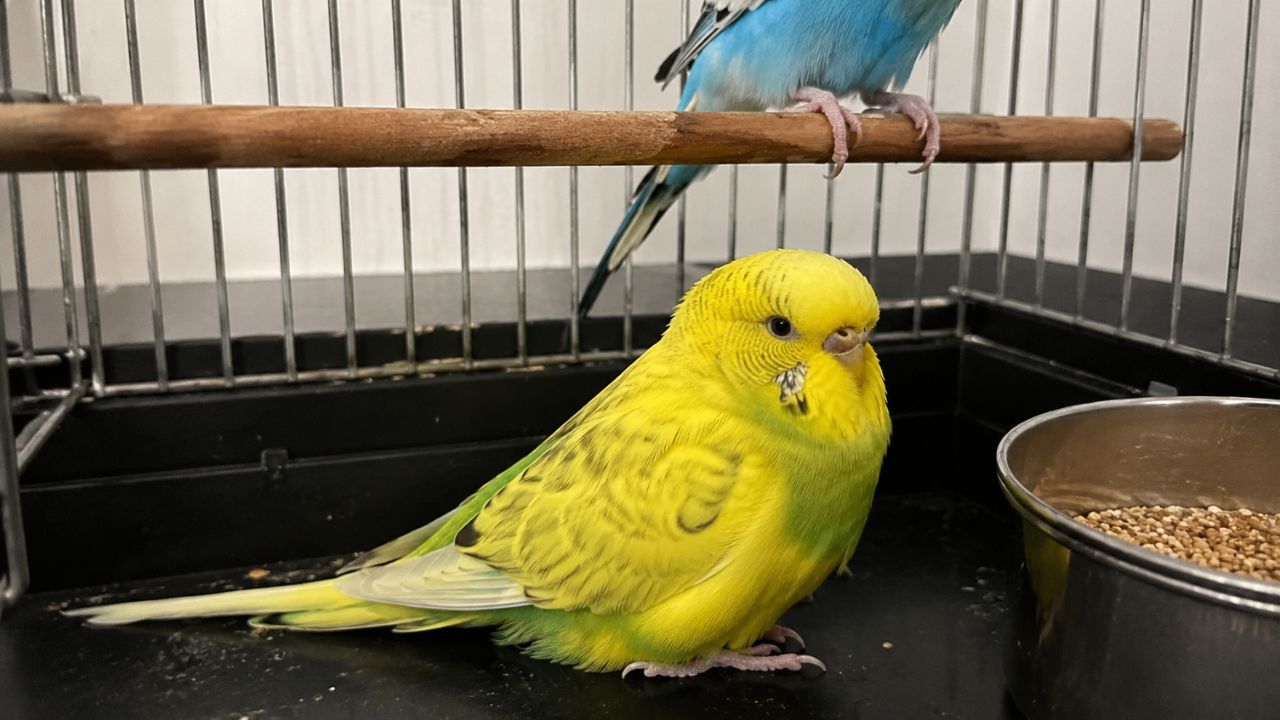

Neil has kept, bred, and sold budgies at Paradise Pets Swindon since 1988 — over 35 years of first-hand experience with these birds. In that time, he has seen hundreds of worried owners walk into the shop carrying a bird that is sitting at the bottom of its cage. This article is his honest, urgent guide on what it means and what to do.
Last week, a man came into the shop just before closing. He had a small travel cage in his hands and he was properly worried. “Neil,” he said, “she’s been at the bottom of the cage since this morning. She won’t move. I don’t know what’s wrong.”
I looked at the bird. She was a little blue hen, sitting on the cage floor, fluffed up, eyes half-closed. Not dead, but not far from it either if something did not change fast.
That scene plays out in my shop more often than I would like. A budgie sitting at the bottom of its cage is one of the most serious symptoms you can witness as an owner — and yet a lot of people, in my honest experience, do not realise quite how serious it is until it is too late.
So let me say this plainly, right at the start. A budgie sitting at the bottom of its cage is not normal behaviour. It is not the bird being tired. It is not the bird being cosy. It is a warning sign that something is genuinely wrong, and in most cases, you need to act today.
This article is my attempt to help you understand what is happening, why it is happening, and what to do about it. After 35 years of watching budgies, I know that the owners who act quickly are the ones whose birds recover. So please read this properly.
Why This Symptom Is So Serious
Before we go into the causes, let me explain why I am being so blunt about this one.
Budgies are prey animals. In the wild, they live in flocks, and the flock survives by being constantly alert — watching for predators, ready to fly at a moment’s notice. A bird that cannot fly, that has to rest on the ground, is a bird that gets eaten. So budgies have evolved to hide weakness. They will perch upright and act normal even when they are seriously unwell, right up until they physically cannot do it anymore.
When you see a budgie sitting on the cage floor, that means the bird has reached a point where it can no longer pretend. The hiding stops. The illness becomes visible. And that point usually arrives days after the bird first became unwell — not minutes.
This is why I tell every customer the same thing. By the time your bird is on the cage floor, it has probably been unwell for several days. You are not seeing the start of the problem. You are seeing the late stages of it.
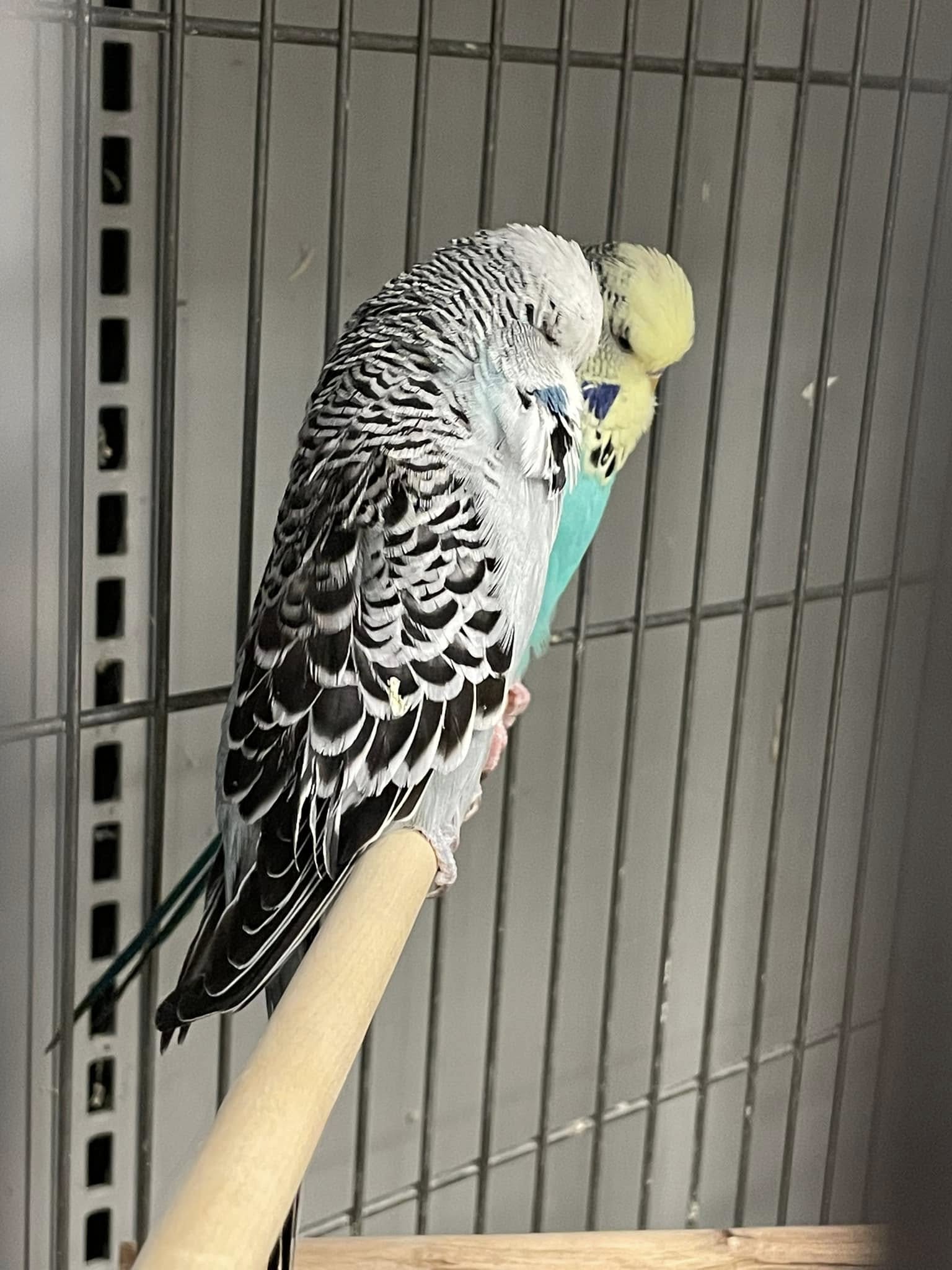
- Do not wait to see if it improves on its own. It very rarely does.
- Move the bird to a warm, quiet, low-stress environment immediately
- Keep food and water within easy reach — at floor level if needed
- Phone an avian vet today. Not tomorrow. Today.
- If you are local to Swindon and unsure, ring us on 01793 512400 — we will help you work out the urgency
The 6 Main Causes I See In The Shop
After 35 years, I can usually narrow down what is going on with a fair bit of accuracy by asking a few questions and looking at the bird carefully. Let me walk you through the six causes I encounter most often, in roughly the order of how common they are.
Cause 1: Serious Illness Or Infection
This is the most common reason I see, and it is the one that owners need to take most seriously. A budgie that is sitting on the cage floor with fluffed feathers, half-closed eyes, and reduced activity is almost certainly fighting something — a respiratory infection, a bacterial infection, a fungal issue, or sometimes a parasite load that has finally overwhelmed the bird.
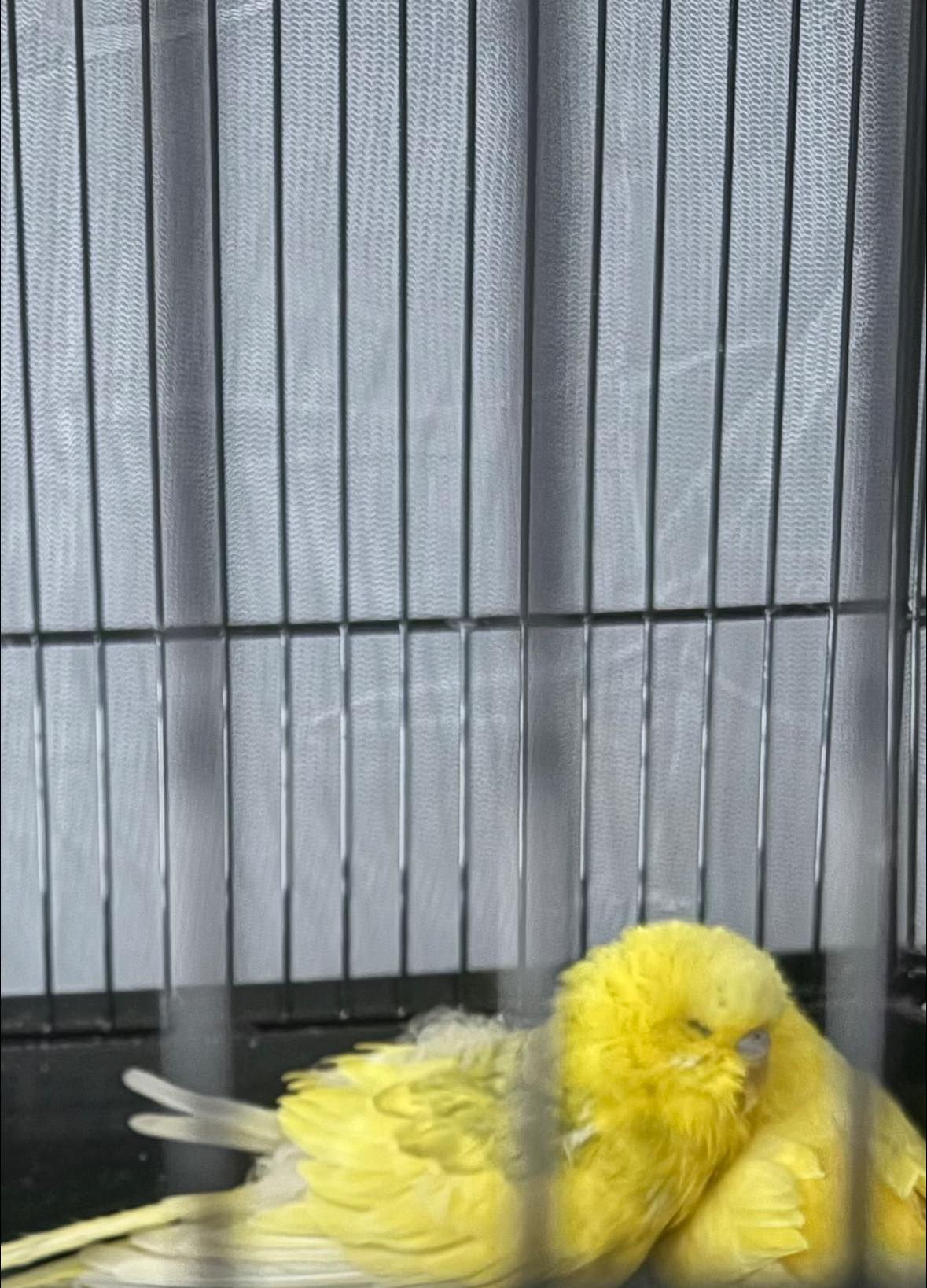
The signs that point to illness are usually a combination of things rather than one symptom alone. The bird looks fluffed up. The eyes are dull or half-closed. The breathing may be laboured — you might see the tail bobbing in time with each breath. The droppings may have changed colour or consistency. The bird may not be eating, or may have stopped chirping.
I have covered the early warning signs of an unwell budgie in detail in our guide on why your budgie is sleeping too much. The thing is, by the time a budgie is on the cage floor, it has usually moved past those early signs. The illness has had time to develop.
What to do
This is a vet visit. Not a “let me see how it goes overnight” situation. Phone an avian vet today. If you cannot get to a vet quickly, at minimum move the bird to a warm, quiet location, place food and water at floor level so it does not have to climb, and reduce stress as much as possible. But the vet conversation needs to happen today.
Cause 2: Egg Binding In Females
This is a specific emergency that affects female budgies and it is one of the most urgent situations on this list. Egg binding is when a hen is trying to lay an egg but cannot pass it. The egg becomes stuck in the reproductive tract, and without intervention, the bird can die within hours.
A female budgie with egg binding will typically be on the cage floor, often in a fluffed, hunched posture. She may be straining visibly — pushing as if trying to pass something. The area around her vent (the opening at the back) may look swollen or distended. She may be panting or breathing heavily.
This happens more often than people realise, even in females that have never been around a male budgie. Hens can become hormonal and start laying eggs without any breeding partner, particularly in spring and autumn.
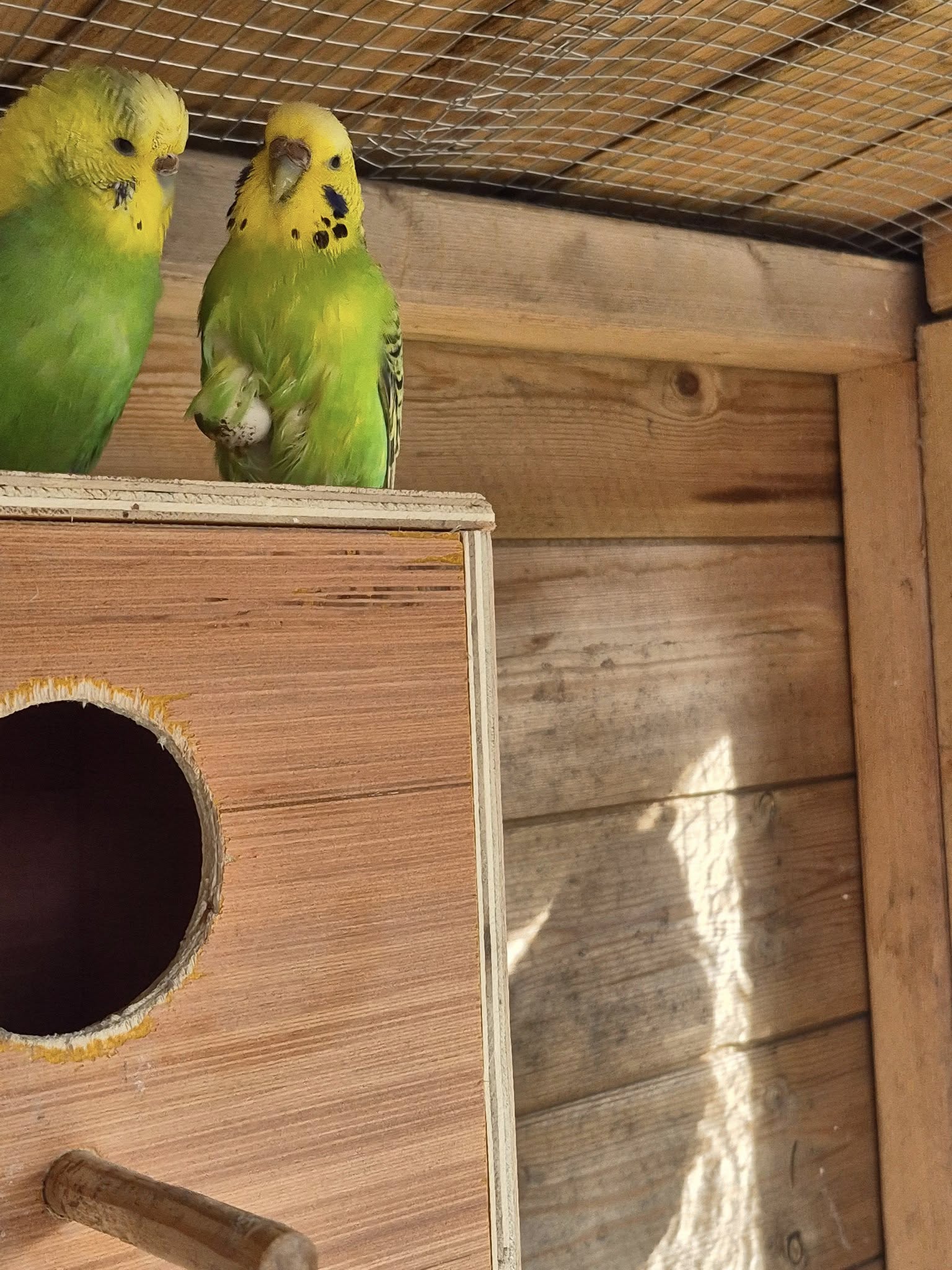
- Hen sitting on the cage floor in a hunched, straining posture
- Visibly trying to push something out — repeated abdominal contractions
- Swollen or distended area around the vent
- Tail bobbing or panting
- Sometimes a partial egg visible at the vent
- Bird appears weak, fluffed, and lethargic
What to do
This is a same-day vet emergency. Egg binding is treatable if caught early — vets can administer calcium, fluids, and sometimes manually assist the egg out. Left untreated, it is fatal within 24 to 48 hours in most cases. If you have a female budgie on the cage floor, particularly one that has been showing breeding-type behaviour recently, treat it as egg binding until a vet tells you otherwise.
If you are not sure whether your bird is male or female, our guide on how to tell male from female budgies walks you through it. It is worth knowing.
Cause 3: The Bird Has Fallen Or Is Injured
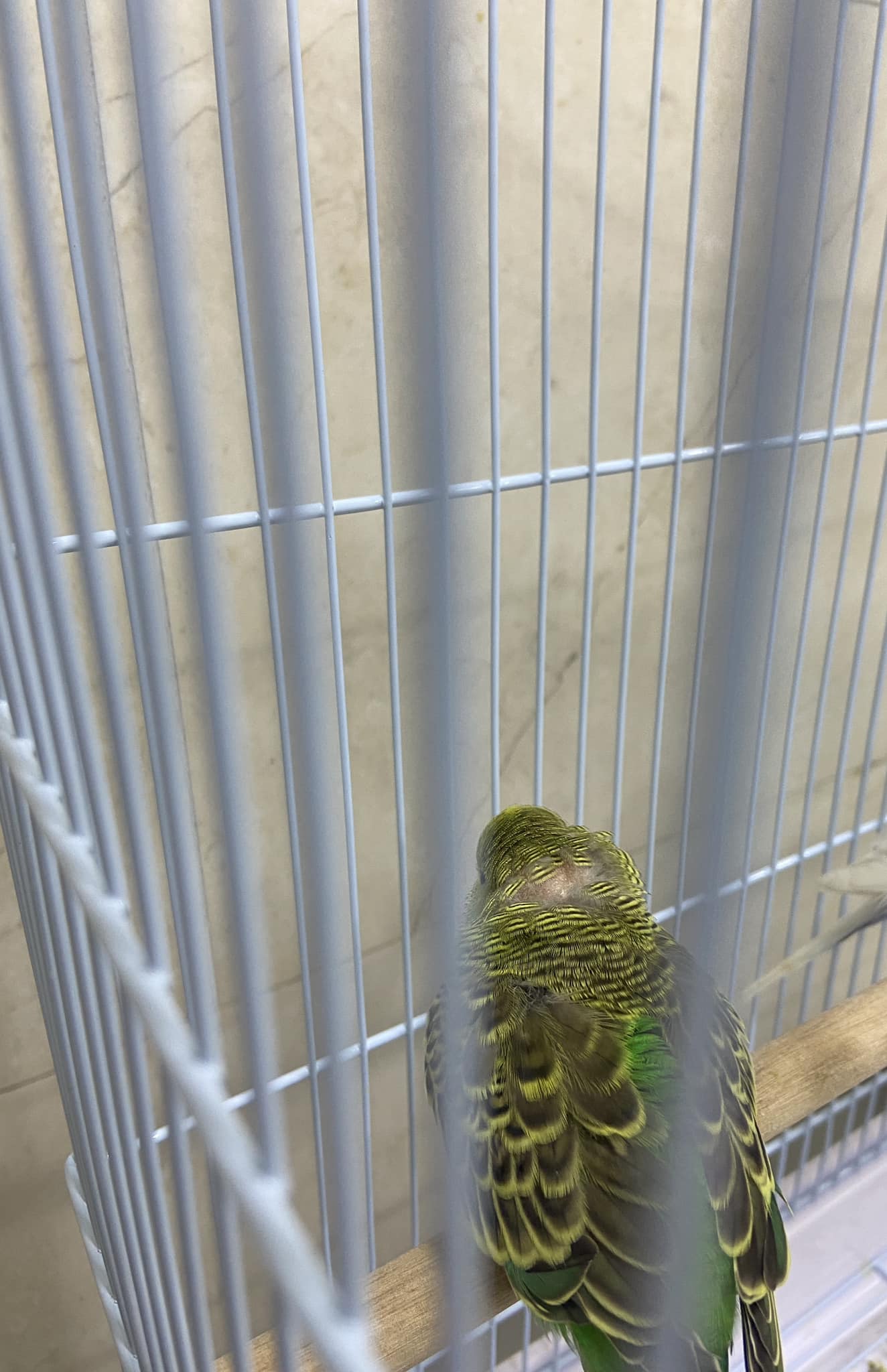
This one is more common than people realise, particularly with older birds or birds in cages with slippery perches. A budgie that has fallen from a perch — sometimes from a height, sometimes from a minor stumble — can land on the cage floor and be unable to get back up.
The fall itself might not be obvious. You might not have seen it happen. But the bird ends up sitting on the cage floor, sometimes with a wing held at an odd angle, sometimes favouring one foot, sometimes just unable to muster the energy to climb back up.
Older budgies, in particular, can have arthritis or weak grip strength that makes perching difficult. If your bird is 6+ years old and is suddenly sitting on the cage floor, age-related issues are worth considering.
What to do
Look carefully at the bird without handling it too much. Is one wing drooping? Is one leg held differently? Is there any visible injury? If yes, see an avian vet — broken wings and legs are treatable in budgies but need professional care.
If there is no visible injury but the bird seems unsteady or weak, set the cage up so the bird does not need to climb to access food and water. Lower the perches, put food and water bowls at floor level, and reduce stress. If the bird does not improve within a day, see a vet.
Cause 4: Severe Cold Or Hypothermia
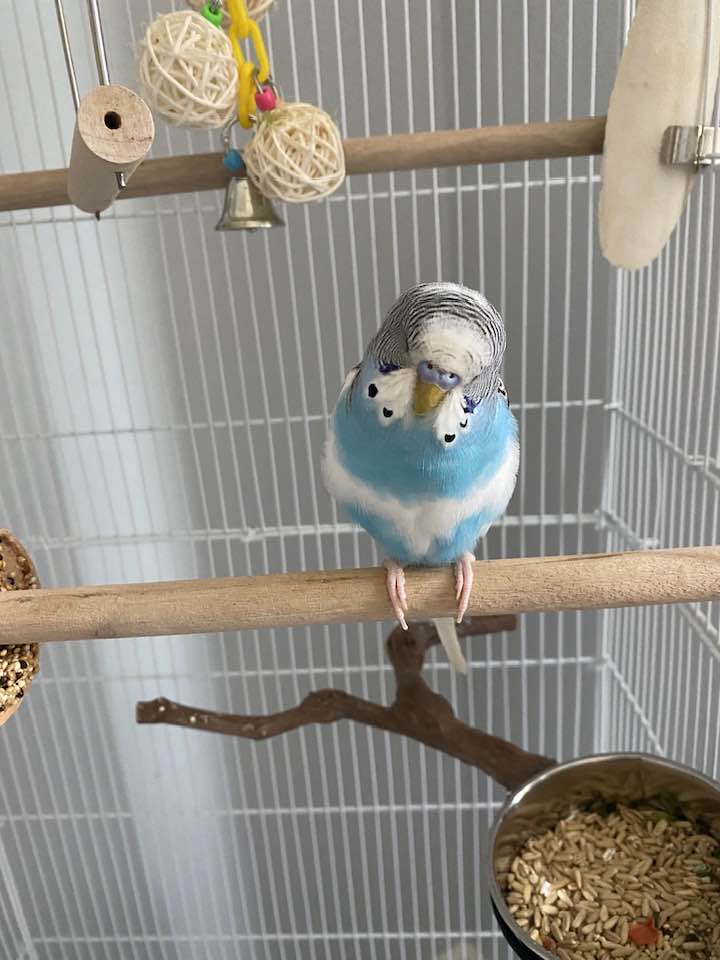
This one is more common in UK homes than people might think, especially in winter. Budgies are tropical birds and they do not handle cold well. A cage in a draughty corner, near a window with single glazing, in a conservatory that loses heat overnight, or in a room where the heating goes off entirely at night — any of these can cause a budgie to become dangerously cold.
A hypothermic budgie will sit on the cage floor, fluffed up to try to trap warmth, often in a corner of the cage. The bird may be unresponsive or slow to react. The feet may feel cold to the touch if you carefully check.
- What is the room temperature overnight? Budgies need a stable 18 to 24°C. UK homes often drop well below this in winter.
- Is the cage near a window or external door? Cold drafts kill more budgies than people realise.
- Does the heating go off at night? Many UK homes drop to 10°C or lower overnight — far too cold for a budgie.
- Is the cage in a conservatory or porch? These rooms lose heat fast. Not appropriate for a budgie in UK winters.
What to do
Warm the bird up slowly and carefully. Move the cage to a warm room — around 22 to 25°C is ideal for recovery. You can use a heat lamp aimed at one corner of the cage so the bird can move closer or further away as it wants. Do not put the bird directly on a hot water bottle or radiator — that is too intense and can cause more harm.
If the bird perks up within an hour or two of warming, you have likely caught it in time. If it does not improve, see a vet today. Hypothermia can trigger other complications.
Cause 5: Poisoning Or Toxin Exposure
This is a difficult one to think about, but it does happen — and it is more common than owners realise. Budgies are extraordinarily sensitive to airborne toxins and certain household substances.
Common toxins that I have seen cause sudden collapse and floor-sitting in budgies:
- Non-stick (PTFE) cookware fumes — overheated Teflon pans can kill a budgie within minutes
- Scented candles, plug-in air fresheners, diffusers — chronic exposure causes respiratory damage
- Aerosol sprays — deodorants, hairspray, polish, cleaning products used near the cage
- Cigarette and vape smoke — direct exposure is highly toxic
- Self-cleaning oven cycles — release fumes that are fatal to birds
- Lead and zinc — found in some older cages, paints, and cheap toys
A budgie that has been exposed to toxins may suddenly collapse, sit on the cage floor, appear disoriented, or struggle to breathe. The symptoms can come on within minutes of exposure with airborne toxins, or develop over days with chronic low-level exposure.
What to do
Get the bird into fresh air immediately. Open windows in the room, move the cage to a different room if possible, and identify the source of the toxin so you can remove it. Then phone an avian vet — even if the bird seems to recover, internal damage may have occurred.
Cause 6: Old Age And End Of Life
I include this one last because it is the saddest of the six, but it does need to be talked about honestly.
A budgie that is 8 to 10 years old or more, sitting on the cage floor without obvious injury or illness, may simply be reaching the end of its natural life. Older budgies become less able to grip perches, less able to maintain body temperature, and gradually less mobile. There comes a point where a bird genuinely cannot perch anymore — not because it is sick, but because it is old.
This is heartbreaking for owners, but it is also the most natural thing in the world. Budgies that have been well-kept can live 7 to 12 years in UK homes — some longer. When they reach the end of that life, the signs are often gradual — increasingly sitting low on the perch, then on the bottom of the perch, then eventually on the cage floor.
What to do
Even in old age cases, a vet visit is worthwhile to rule out treatable conditions. Sometimes what looks like “old age decline” is actually treatable arthritis or a chronic infection that can be managed. But if the vet confirms the bird is simply reaching the end of its life, your job becomes about comfort — warmth, easy access to food and water, low stress, and gentle company.
What I Check When Someone Brings A Floor-Sitting Bird Into The Shop
When an owner walks in with a budgie on the cage floor, I do not just guess. There is a process I go through to try to narrow down what is going on. Here is what it looks like.
- How old is the bird?
Young birds are unlikely to be facing end-of-life issues. Older birds are more likely to be dealing with multiple problems at once. - Male or female?
Females raise the possibility of egg binding, which is its own emergency. - When did this start?
Sudden onset (minutes to hours) usually points to toxin exposure, injury, or acute illness. Gradual onset (days) usually points to chronic infection or environmental issues. - What has the bird been like in the last few days?
Eating? Drinking? Chirping? Active? A bird that has been “a bit quiet” for several days has probably been unwell longer than you realised. - What is the environment like?
Temperature, draughts, position in the house, recent changes, anything sprayed or used near the cage? - Does the bird look injured or just unwell?
Drooping wing, odd posture, favouring a leg — that points to injury. Fluffed feathers, half-closed eyes, dull appearance — that points to illness.
Five minutes of these questions usually narrows things down enough to point the owner in the right direction. Sometimes that direction is the vet. Sometimes it is environmental changes. Always, it is urgent.
What Not To Do
After 35 years, I have also seen plenty of well-meaning owners do the wrong thing in a panic. Let me save you from a few of the most common mistakes.
| What people do | Why it is wrong | What to do instead |
|---|---|---|
| Wait overnight to see | By morning, the bird may have deteriorated significantly | Phone an avian vet the same day |
| Force-feed water | A weak bird can aspirate fluid into its lungs | Place water at floor level — let the bird drink if it can |
| Pick up and handle repeatedly | Stress alone can kill an already weak bird | Minimal handling, quiet environment, low light |
| Put on a hot water bottle | Direct heat can scald or cause shock | Warm the room, use a heat lamp at distance |
| Ignore it because budgie looks OK now | Improvement may be temporary — underlying cause still there | Vet visit anyway to rule out chronic issues |
| Give human medication | Most human medications are toxic to birds | Only give what an avian vet has prescribed |
When To Skip The Shop And Go Straight To The Vet
I am always happy to have customers come in and talk things through. But there are situations where I will tell you straight — do not stop here, go to the vet. These include:
- A female budgie straining on the cage floor with a swollen vent — egg binding emergency
- Visible injury — broken wing, drooping wing, leg held at odd angle, bleeding
- Open-mouth breathing or tail bobbing at rest — respiratory emergency
- Bird has been exposed to toxin fumes (Teflon, smoke, sprays) — needs immediate veterinary attention
- Bird is unresponsive, collapsed, or seizing
- Symptoms developed in less than an hour and are getting worse fast
For everything else — the gradual decline, the unclear cause, the bird that is fluffed and quiet but not in obvious distress — I am happy to take a look and help you work out what is going on. Bring a photo or short video if you can.
How To Prevent This Happening
Most of the cases I see could have been caught earlier. Here is what I tell new budgie owners every week.
- Watch the bird every day — not just feed and refill water. Actually observe how it looks and behaves.
- Notice early warning signs — fluffed feathers, reduced chirping, less eating, sleeping more. These come days before the bird ends up on the cage floor.
- Keep the environment stable — temperature 18 to 24°C, no draughts, no toxins, no overheated Teflon pans nearby
- Feed properly — not seed only. Pellets, fresh greens, occasional fruit. A bird on a poor diet is more likely to get sick.
- Keep two budgies, not one — flock animals do better paired. Less stress, fewer behavioural problems.
- Have an avian vet’s number to hand — before you need it. Not when you are panicking.
For more on the common mistakes UK budgie owners make, our article on the 5 mistakes I still see in 2026 covers the patterns I encounter every week.
Frequently Asked Questions
Is it ever normal for a budgie to sit at the bottom of the cage?
No. A healthy budgie does not sit on the cage floor. It may briefly come down to forage if food has been dropped, but it will not rest there. A bird sitting on the floor for any length of time needs investigating urgently.
How long can a budgie survive on the cage floor before it dies?
This varies enormously depending on the cause. Egg binding can kill within 24 to 48 hours. Severe infections can be fatal within a day or two. Hypothermia can cause death within hours if not corrected. The honest answer is — assume hours, not days, and act fast.
My budgie is on the floor but still eating and chirping — is that better?
It is a positive sign that suggests the bird is not at the most critical stage, but it does not mean everything is fine. A bird that has chosen to be on the floor when it has the option to perch is telling you something is wrong. Get a vet to look.
Can a budgie recover after sitting at the bottom of the cage?
Yes, in many cases — if the cause is identified and treated quickly. The birds that recover are the ones whose owners act the same day rather than waiting to see what happens. The birds that do not recover are usually the ones where treatment came too late.
Where can I get urgent budgie advice in Swindon?
Come and see us at Paradise Pets, Manor Garden Centre, Cheney Manor, Swindon SN2 2QJ. Or ring us on 01793 512400. For genuine emergencies, go straight to an avian vet — we will help you decide which it is.
One Last Thing From Me
A budgie sitting at the bottom of the cage is not a problem you can sleep on. I know how easy it is, when you are tired and worried, to think “let me see how she is in the morning.” Please do not do that. In my 35 years, the difference between a budgie that recovered and one that did not has more often than not been a matter of hours.
The man I mentioned at the start? His hen had egg binding. We told him to go straight to the avian vet, which he did. The vet got the egg out, gave her fluids and calcium, and she made a full recovery. She is back home, paired up with her companion bird, and back to chattering at the kitchen window.
That is the outcome you want. And the only way to get there is to act when you see the signs — not the day after, not the week after, but today.
If you are reading this with a worried bird at home, do not hesitate. Phone an avian vet. Or come and see us if you are local and unsure. We have been doing this for 35 years, and we would much rather help you sort it out today than see you come back later with a story that did not end well.
Budgie In Trouble? Come And See Us Today — Or Phone A Vet
For genuine emergencies, go straight to an avian vet. For everything else, bring the bird, bring a video, or just bring your questions. We will take a proper look and tell you honestly what to do. Free advice, no obligation. 35 years of helping budgie owners in Swindon.