


Neil has kept, bred, and sold rabbits at Paradise Pets Swindon since 1988 — over 35 years of watching rabbit pairings work and watching them fail. Two female rabbits kept together is one of the most consistently misunderstood combinations in small animal keeping. It is not automatically a problem. But it requires specific conditions to work — conditions that most people are not told about before they buy the second rabbit. This guide is what they should have been told.
Someone comes in with what they think is a straightforward question. They have a female rabbit. They want to get her a companion. They have been told — by a friend, by something they read online, by another pet shop — that two females is the safe option. No risk of pregnancy. No aggression. Just two does living peacefully together.
I hear some version of this regularly. And the honest answer is more complicated than what they have been told.
Two female rabbits can live together. Some pairs work beautifully for years — bonded, grooming each other, resting together, clearly providing the companionship that rabbits genuinely need. But two female rabbits is also one of the pairings most likely to break down — sometimes catastrophically, sometimes after months of apparent peace — in a way that leaves owners shocked, one or both animals injured, and the question of what to do now much harder to answer than the question of which rabbits to get in the first place.
The difference between a female pair that works and one that does not comes down to a short list of specific factors. Understanding those factors before you bring the second rabbit home is what this guide is for.
Why Female Rabbits Fight — The Biology People Are Not Told
The assumption behind the two-females-is-safe advice is that aggression in rabbits is primarily a male-hormone problem — that intact males fight over territory and mates, and that females, without that hormonal driver, are naturally more peaceable.
This assumption is wrong. Or rather, it is incomplete in a way that makes it dangerous.
Female rabbits are territorial. In the wild, does in a warren have established social hierarchies and defend their territories with real conviction — including from other females. The reproductive drive that shapes female rabbit behaviour is not absence of aggression but a different kind of aggression, directed partly at competing females who represent a threat to resources, nesting space, and social position.
Intact does are subject to hormonal cycles that directly affect their aggression levels. A female rabbit in a hormonal phase — and intact does go through these regularly, sometimes becoming pseudopregnant — can become significantly more territorial, more reactive, and more aggressive than her baseline behaviour would suggest. Two intact does whose hormonal cycles bring them into an aggressive phase simultaneously can escalate from tolerable tension to serious fighting very quickly.
This is the mechanism behind most female pair breakdowns. The rabbits were fine for weeks or months. Then something changed — usually a hormonal cycle, sometimes a change in environment or routine — and the equilibrium that had held dissolved into conflict.

The Breakdown Pattern — What Owners Experience
The way female pair breakdowns happen is specific enough to be worth describing in detail, because it is almost never what owners expect.
The pair comes home. There may be some initial tension — chasing, mounting, occasional teeth chattering — but it seems to settle. After a week or two, the rabbits appear to be getting along. They eat near each other. They rest in the same enclosure. The owner concludes that the pairing is working.
Then, weeks or months later — sometimes after six months of apparent peace — a fight happens. Often at night, when the owner is not present to intervene. One or both rabbits has injuries in the morning. Sometimes minor. Sometimes serious — bite wounds to the face, the ears, the flanks, the genitals. Sometimes one rabbit is significantly injured and needs immediate veterinary attention.

The owner is bewildered. They were fine. What happened?
What happened, in most cases, is that a hormonal phase arrived in one or both does, the territorial tension that had been present but managed escalated past the threshold that the pair’s social equilibrium could contain, and the fight that resulted was the expression of weeks or months of low-level conflict that the owner had interpreted as peace.
A fight in a rabbit pair is not a single event that comes from nowhere. It is the visible point of an escalation that has been building beneath the surface. The difficulty is that the earlier stages of that escalation — the tension, the subtle body language of dominance and submission, the low-level harassment — are easy to miss without experience of reading rabbit behaviour.
Neutering — The Factor That Changes Everything
I want to be direct about this because it is the single most important thing I can say on this topic.
A pair of intact female rabbits is a pair under continuous hormonal influence that drives territorial behaviour. A pair of spayed female rabbits is a pair without that influence — more stable in their social dynamics, more consistent in behaviour, significantly less likely to fight, and with a much better long-term pairing prognosis.
Spaying also has major health benefits for female rabbits that are entirely separate from the social question. Uterine cancer is extremely common in intact does — research suggests that by the age of five, over fifty percent of unspayed female rabbits have some form of uterine disease. Spaying eliminates that risk entirely. It also eliminates the behavioural effects of hormonal cycling — the pseudopregnancies, the aggression spikes, the nesting behaviour that can lead to conflict — that make intact does harder to pair.
If you are considering a female pair, both rabbits should be spayed before or very shortly after introduction. This is not an optional extra for cost reasons. It is the difference between a pairing that has a realistic chance of long-term success and one that is substantially more likely to break down.
The cost of neutering both rabbits is real. It is also significantly less than the veterinary cost of treating serious fight injuries — which, in a rabbit pair that has a major fight, can easily exceed the cost of the surgeries that would have prevented it.
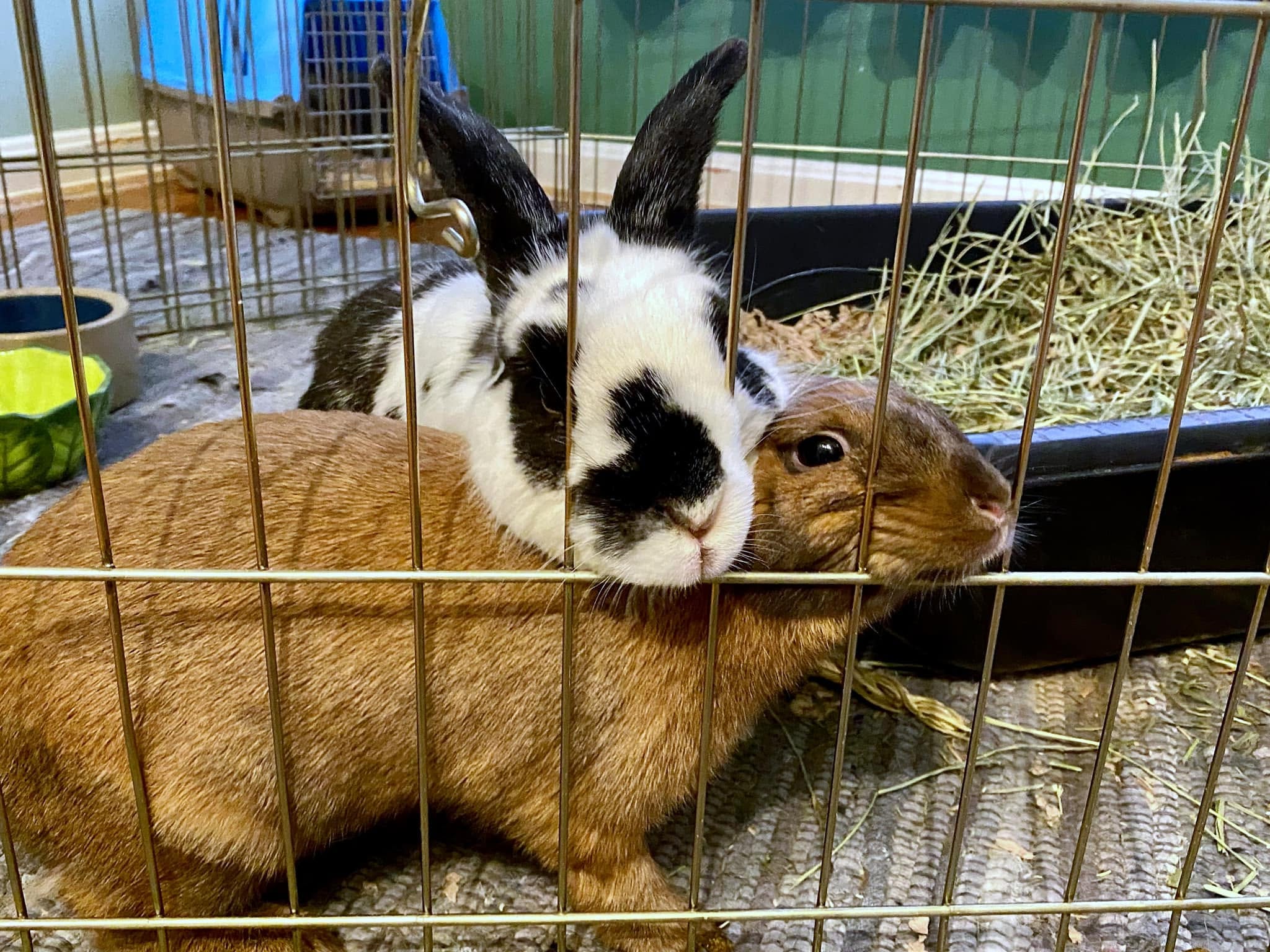
The Bonding Process — What Most People Skip
This is the second most consistently neglected factor in rabbit pairing problems, and it is one that applies to all rabbit pairings — not just female pairs.
Bringing a second rabbit home and placing it directly in the existing rabbit’s enclosure is not a bonding process. It is an invasion of territory, and the existing rabbit will respond to it as such. The newcomer has entered a space that is thoroughly scent-marked and socially claimed by the resident. The resident responds with territorial behaviour — chasing, mounting, aggression — and the second rabbit either submits or retaliates.
This approach occasionally works, particularly with young rabbits before their territorial behaviour is fully established. It fails far more often than it succeeds with adult does.
The correct bonding process takes place in neutral territory — a space that neither rabbit has previously occupied and that carries neither rabbit’s scent marks. It begins with short, supervised sessions in that neutral space and extends over days and weeks until the pair is demonstrably comfortable with each other. Only then are they introduced to a living space — which should ideally be a fully cleaned enclosure where both rabbits’ scents are introduced simultaneously, rather than the existing rabbit’s established territory.
The bonding process is not quick. A straightforward pair may bond in one to two weeks of daily neutral sessions. A more challenging pair may take four to six weeks or longer. Some pairs do not bond at all — and knowing when to accept that two specific animals are not compatible is as important as knowing how to facilitate the process.
Signs of successful bonding include mutual grooming, resting in physical contact, eating side by side without tension, and a relaxed body posture around each other. Signs that the process needs more time or is not working include persistent mounting without resolution, constant chasing, aggressive lunging, teeth chattering, or any actual biting.
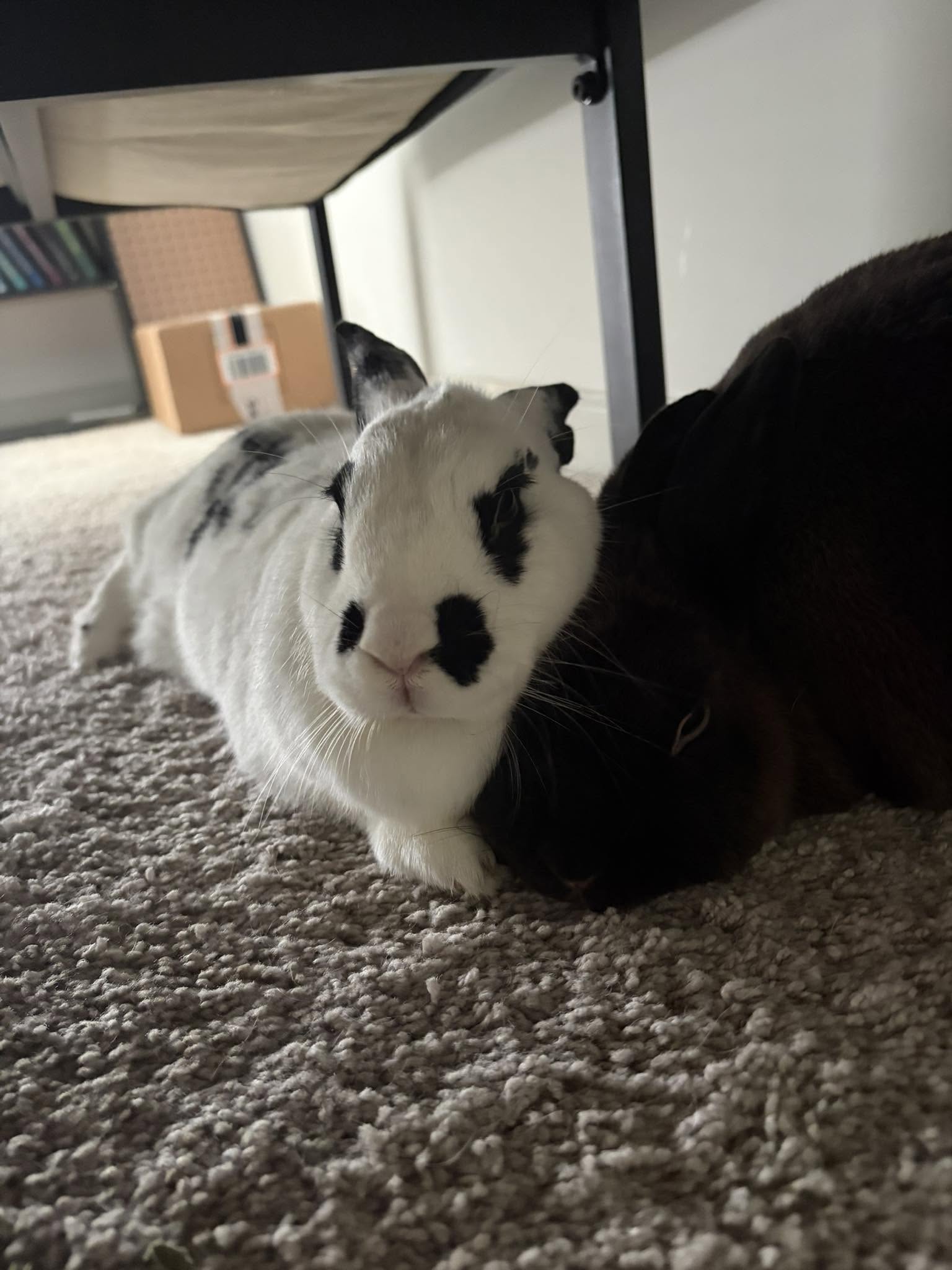
Space — The Requirement Most People Underestimate
Even a well-bonded, spayed female pair will experience tension if the space they share is inadequate. And adequate, for two rabbits, is larger than most people expect.
The Rabbit Welfare Association and Fund recommends a minimum of three metres by two metres of combined living and exercise space — accessible at all times. This is for one rabbit. Two rabbits in the same space need, at minimum, that much space each — meaning a combined space that is, at minimum, twice what a single rabbit needs.
In a small hutch, two female rabbits that are mildly territorial with each other will be in constant proximity to the source of their tension. They cannot get away from each other. Every feeding visit, every move to a resting spot, brings them into the space of an animal they are not entirely at peace with. Over time, that constant low-level friction produces the conditions for escalation.
In a large enough space — multiple hides so that each rabbit has its own retreat, separate feeding stations so that food competition is eliminated, enough room to move away from each other when needed — the same two rabbits may live contentedly for years.
This is not a small consideration. If the planned setup is a standard garden hutch with a small attached run, a female pair — however well-bonded and however thoroughly neutered — is likely to struggle. The space question needs to be resolved before the second rabbit comes home, not after the first fight.
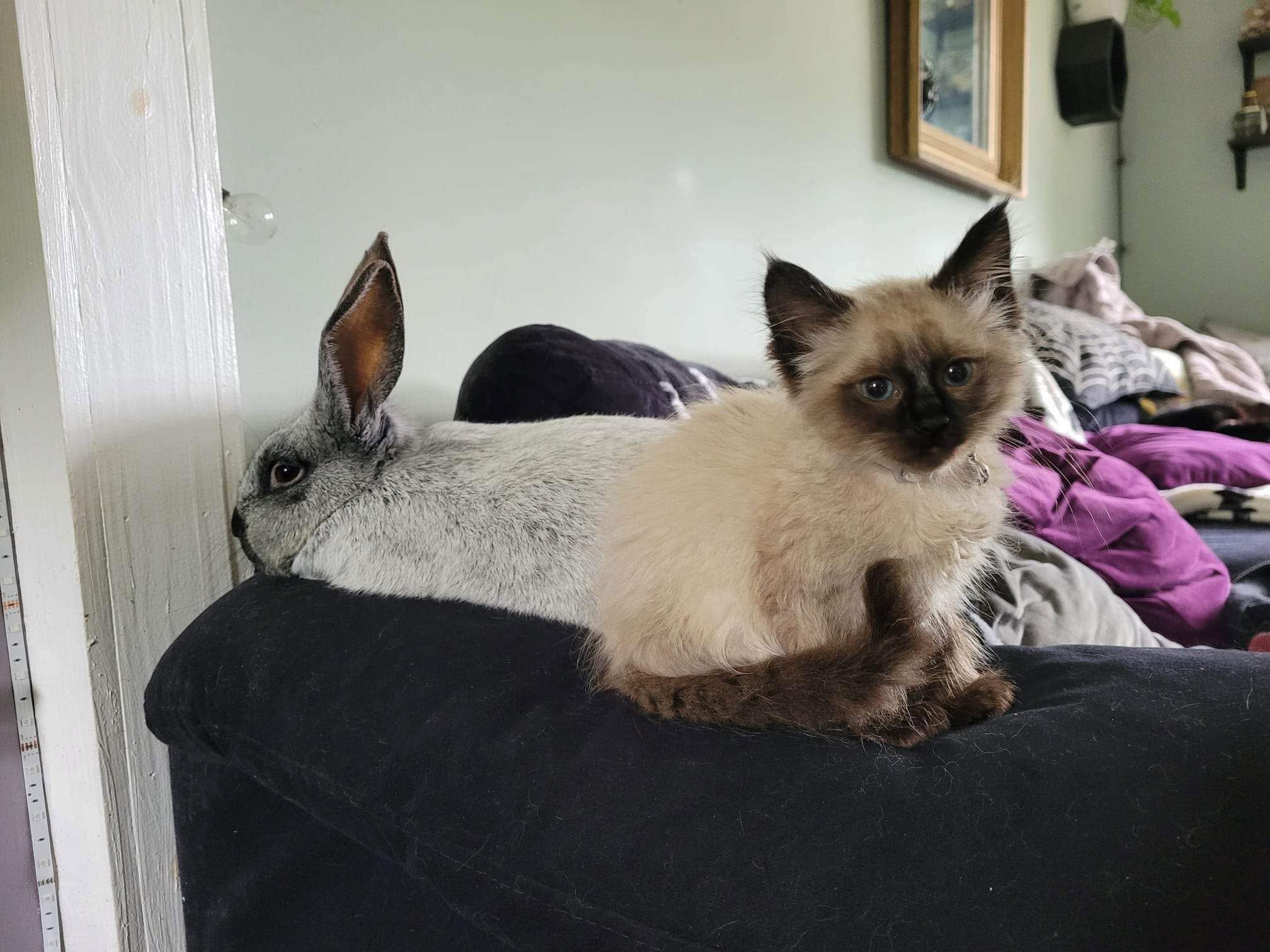
Which Pairing Actually Works Best — The Honest Answer
Since the purpose of getting a second rabbit is companionship for the first, and since the female-female pairing is more complicated than most people expect, the question of which pairing actually works best deserves a direct answer.
A neutered male and neutered female — a mixed-sex pair, both neutered — is the most consistently successful rabbit pairing in my experience and in the experience of rabbit welfare organisations. The complementary social dynamics between a buck and a doe tend to produce stable, peaceful pairings more reliably than any same-sex combination. The hormonal drivers of same-sex aggression are absent on both sides. The social hierarchy tends to establish itself more cleanly. These pairs bond more readily and maintain their bonds more consistently than same-sex pairs in most cases.
Male-male pairs — neutered — can work well, particularly when the males have been together from a young age and are bonded before sexual maturity. Adult male pairs that are introduced after sexual maturity are more challenging, but neutered adult males bonded correctly can succeed.
Female-female pairs — spayed — are not impossible. Many work very well. But they are the most variable pairing in terms of long-term success, and they require all the factors above — both spayed, properly bonded in neutral territory, with adequate space — to give the pairing the best possible chance.
If someone comes to me wanting a companion for their rabbit and has no strong reason to prefer a specific sex combination, I will almost always suggest a neutered male as the companion for a neutered female, or vice versa. Not because female pairs cannot work, but because the conditions required to make them work reliably are more exacting — and the consequences of getting it wrong are more serious — than for a mixed-sex pair.
What to Do If the Pairing Has Already Broken Down
Sometimes people come in after the fact. The pair was working and now it is not. There has been a fight. One or both rabbits has injuries. They want to know whether the pair can be re-bonded and what to do now.
The first priority is medical — any bite wound on a rabbit needs veterinary assessment, because rabbit bites can introduce infection into tissue in a way that is not always obvious from the surface, and rabbit skin heals quickly over what may be a deep wound that requires treatment.
Once the medical situation is addressed, the two rabbits must be separated. Not temporarily, in adjacent spaces — fully separated, out of sight and ideally out of scent range of each other if possible, until both animals are fully recovered and the decision about re-bonding has been made.
Re-bonding after a serious fight is possible but requires starting the entire bonding process from scratch — neutral territory, short sessions, very gradual progression. It also requires addressing whatever factor caused the breakdown in the first place. If neither rabbit is neutered, neutering is the first step before any re-bonding attempt. If the space was inadequate, the space needs to be resolved. Re-bonding without addressing the underlying cause is likely to produce the same outcome.
Some pairs that have had a serious fight cannot be successfully re-bonded. They will need to be housed separately for the remainder of their lives, each with appropriate companionship from other sources. This is a significant practical consequence, and it is one more reason why the decision about pairing — the neutering, the bonding process, the space — is better made correctly the first time than corrected after a breakdown.
What I Tell People at the Counter
When someone comes in wanting a second rabbit and mentions that two females is the safe option, I take a moment before we go any further.
Not to tell them they are wrong. To tell them the full picture that the shorthand version leaves out. That female pairs can work beautifully. That they also carry specific risks that the safe option framing does not capture. That the factors which determine which outcome they get — neutering, bonding process, adequate space — are all within their control, but only if they know about them before the second rabbit comes home.
The conversation that follows is a practical one. Are both rabbits neutered or is neutering planned? What does the enclosure space look like? Is the owner prepared for a proper neutral-territory bonding process? Does the existing rabbit have any history of aggression toward other rabbits?
Those answers tell me whether the female pair they are considering has the conditions it needs to succeed. If they do not, I say so — and we talk about what needs to change before the second rabbit comes home, or whether a different pairing might be a better starting point.
A female pair that works is a genuinely good outcome. Getting there requires doing the groundwork. I would rather have that conversation in the shop than take a call three months later about a fight.
Come in if you want to talk through your specific situation before getting a second rabbit. We are at Manor Garden Centre, Cheney Manor Industrial Estate, Swindon, SN2 2QJ — open every day. Or call us on 01793 512400.
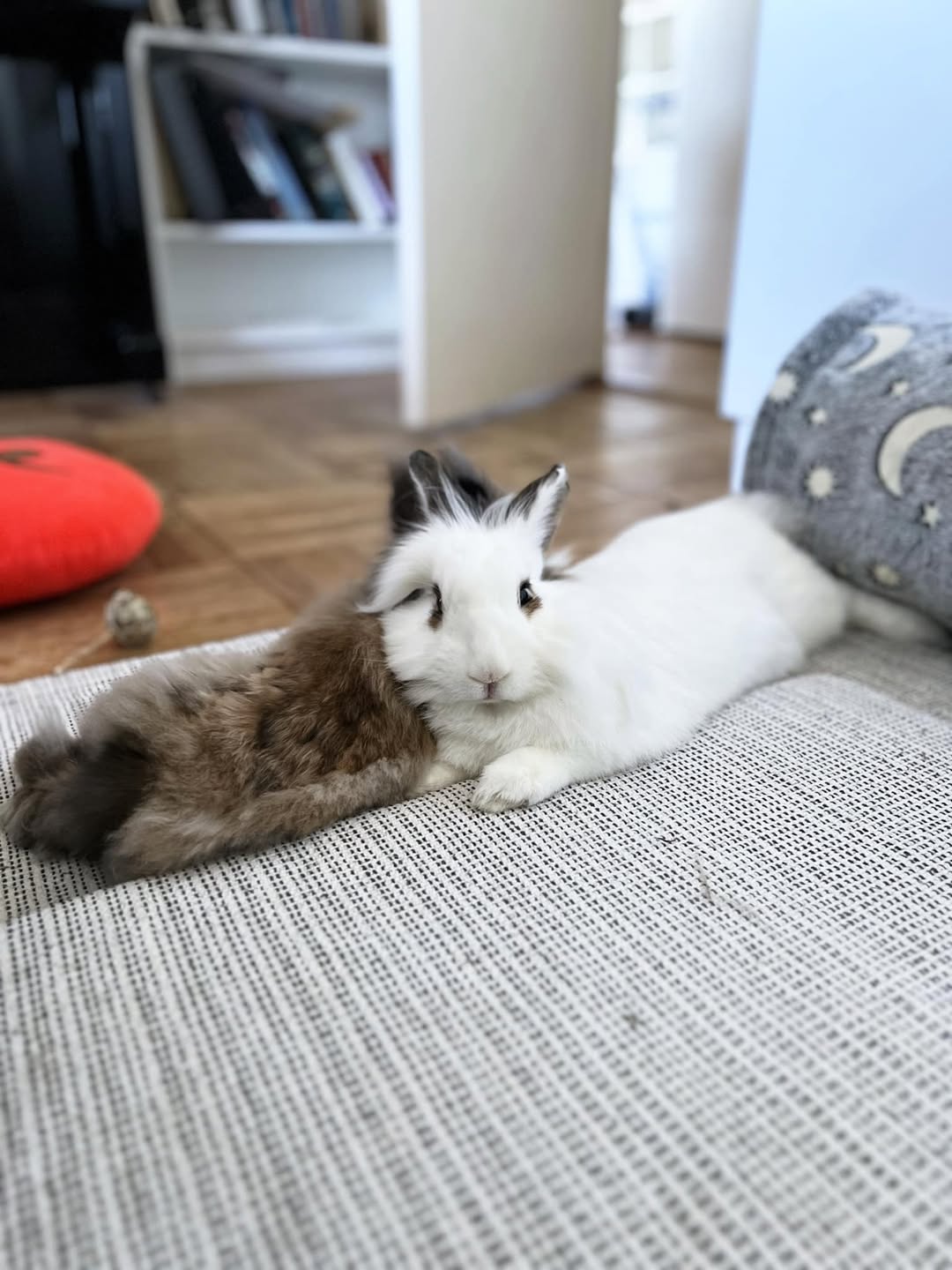
- “Two females is always safer than a male and female” — Two females is lower risk for unwanted pregnancy — that part is true. It is not lower risk for aggression, territorial conflict, or serious fighting. In my experience, same-sex female pairs produce some of the most serious fight injuries I see, precisely because the assumption that they are safe leads to under-preparation. A neutered male and neutered female, properly bonded, is typically the lower-risk pairing overall.
- “They were fine for months so the pairing is established now” — Months of apparent peace is not the same as a stable, established bond. Hormonal cycles in intact does can disrupt an equilibrium that held for weeks or months. A pair that has been living without incident can escalate to serious fighting when a hormonal phase arrives. Apparent peace in an intact female pair is always conditional.
- “I put them together and they didn’t fight so the bonding is done” — Not fighting immediately after introduction is the minimum threshold, not evidence of successful bonding. True bonding involves mutual grooming, resting in contact, and relaxed body posture around each other. Absence of visible fighting is the beginning of the assessment, not the end of it.
- “Sisters from the same litter don’t need a bonding process” — Littermates that have been together from birth have the best starting point of any rabbit pair. But as they reach sexual maturity — typically at three to four months — their territorial and hormonal behaviour develops in ways that can disrupt even a previously peaceful sibling relationship. Littermates still need to be neutered, and the transition through puberty still needs to be managed carefully.
- “One of them is dominant so it’ll be fine — she’s in charge” — A stable dominant-submissive relationship in a rabbit pair is a positive sign — it means the hierarchy has established itself without ongoing conflict. But dominance in a rabbit pair is not permanent and is not guaranteed to hold. Hormonal changes, illness, a change in environment, or simply a shift in one rabbit’s condition can disrupt an established hierarchy and require it to be renegotiated — sometimes through fighting.
- Both does neutered, properly bonded in neutral territory, adequate space with multiple resources.
Best possible conditions for a female pair — proceed with the bonding process, monitor the early weeks carefully, and be alert to signs of tension. This pairing has a good chance of long-term success. - Both does intact, considering pairing them.
Neuter both before or immediately after introduction. Do not attempt long-term pairing of intact does. The hormonal cycling will eventually produce the conditions for serious conflict regardless of how peacefully they start. - One doe neutered, one intact — considering pairing.
Neuter the intact doe before introduction. One spayed and one intact is an unstable combination — the intact doe’s hormonal cycling will affect the dynamic of the pair even if the spayed doe is not contributing to it. - Female pair that has been living together without issues but neither is neutered.
Neuter both now, before a breakdown occurs rather than after. The absence of problems to date does not mean the problems will not come. Neutering now is significantly easier than re-bonding after a serious fight. - Female pair that has had a fight — injuries present.
Veterinary assessment of injuries first. Separate the rabbits fully. Do not attempt re-bonding until both are recovered, both are neutered, and the environmental factors that contributed are addressed. Re-bonding from scratch in neutral territory. - Considering getting a companion for a single female rabbit.
Come in and discuss the options before deciding. A neutered male companion, if the doe is spayed, is often the lower-risk route to successful long-term companionship. We can talk through your specific situation.
Visit Us at Paradise Pets Swindon
We stock rabbits year-round alongside a full range of small animals — all UK-bred, properly housed, and sold with honest advice about pairing and welfare. If you are considering getting a companion rabbit and want to talk through what will actually work for your situation, come in before you buy rather than after.
We also stock guinea pigs, gerbils and hamsters, and a full range of cage and aviary birds.