
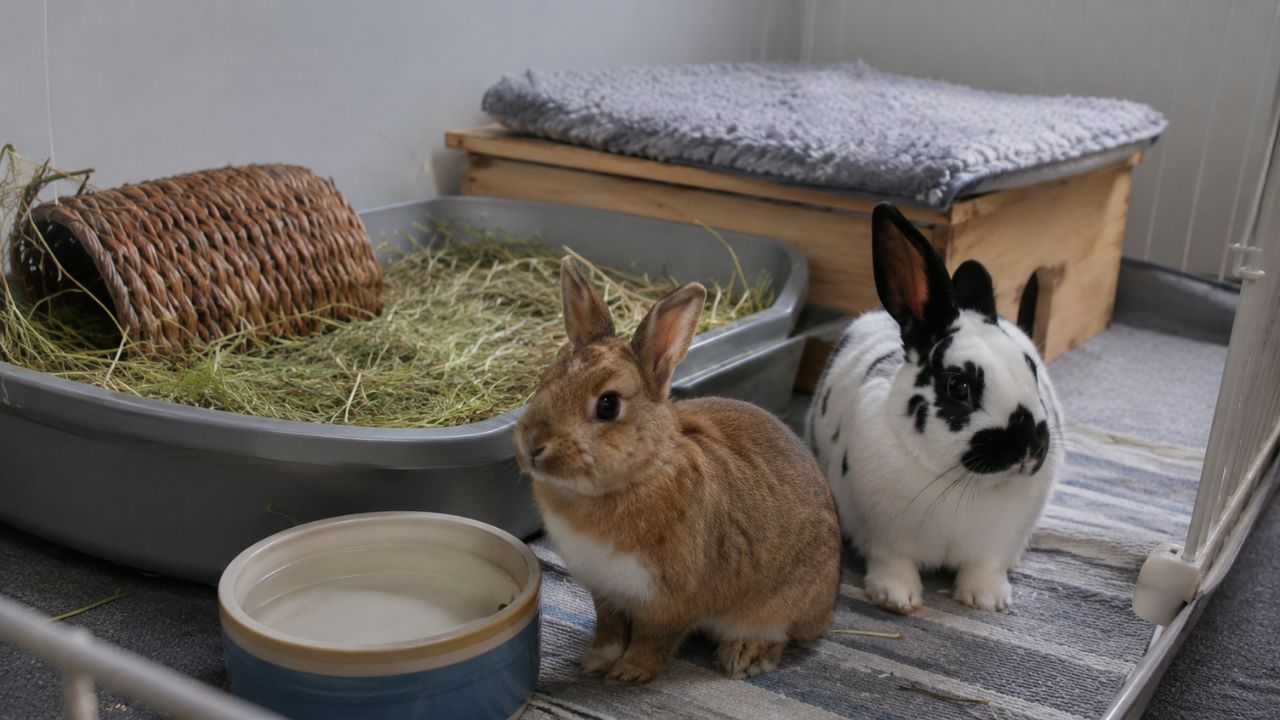

Neil has kept, bred, and sold rabbits at Paradise Pets Swindon since 1988 — over 35 years of watching what happens when people buy rabbits for the right reasons and the wrong ones. There is one question he asks every customer before a rabbit goes to a new home. The answer to it determines almost everything about whether the rabbit will thrive. This is that question — and why it matters as much as it does.
The question is not about the hutch. It is not about the food, or the breed, or whether they have kept rabbits before. Those things matter and we talk about them, but they are not the question.
The question is this: do you understand that rabbits are not low-maintenance pets?
I ask it directly and I wait for the answer. Not because I am trying to catch anyone out. Not because I enjoy making people feel tested before they buy something. I ask it because the answer — and more than the answer, the way the answer comes — tells me whether this person has an accurate picture of what they are taking on, or whether they are working from the version of rabbits that most people carry around, which is almost entirely wrong.
The version most people carry: rabbits are easy. They live in a hutch. They eat pellets. Children can look after them. They are a starter pet, a step-down from a dog or cat, something manageable and undemanding. A good first animal.
That version is not accurate. And the gap between that version and the reality of what a rabbit actually requires is where most of the problems I see originate — the rabbits that come back, the rabbits whose welfare declines quietly over the first year, the owners who are surprised and overwhelmed by something they were told would be simple.
I would rather have the conversation at the counter before the rabbit goes home than after.
Why That Question — What It Is Actually Testing
When I ask whether someone understands that rabbits are not low-maintenance, I am not testing their knowledge of rabbit husbandry in a technical sense. I am testing whether their expectation matches reality in the single most important way.
Because the low-maintenance assumption is the root of almost every rabbit welfare problem I see in thirty-five years of this work. It is not neglect in the deliberate sense. It is expectation failure — the pet did not behave the way the owner was told it would behave, the care requirements turned out to be more significant than anticipated, and the gap between expectation and reality produced a situation where the animal’s needs were not being met.
Rabbits are high-maintenance animals. They require more space than most people provide. They have complex social needs. They need a diet that is predominantly hay — not pellets, not seed mixes, hay — and a rabbit that is not getting adequate hay is a rabbit that will develop dental problems and gastrointestinal problems that are both painful and expensive to treat. They are vulnerable to specific diseases and conditions that require owner awareness. They live for eight to twelve years. They are not children’s pets in the sense that children can be the primary carer — they need adult-level attention and oversight.
The question tests whether the person sitting across the counter from me knows any of this. Whether they have done the research that would give them that knowledge. Whether the rabbit they are about to buy will go to a home that is ready for what it actually is.

What Most People Get Wrong About Rabbits
The misconceptions I encounter most consistently at the counter are worth naming specifically, because they are the ones that most directly produce welfare problems when they go uncorrected.
The hutch assumption. Most people imagine a rabbit living in a hutch — a small wooden box in the garden, with a run attached that the rabbit uses for an hour or two a day under supervision. That model does not meet a rabbit’s welfare needs. Rabbits need continuous access to adequate space. They are crepuscular animals — most active at dawn and dusk — and if their activity period coincides with times the owner is not available to open the hutch, the rabbit spends its most active hours confined. The current guidance from the Rabbit Welfare Association and Fund recommends a minimum of three metres by two metres of floor space, accessible at all times. Most standard hutches provide a fraction of that.
The solitary animal assumption. Many people buy one rabbit. Rabbits are social animals that live in groups in the wild and suffer from genuine social isolation when kept alone. A single rabbit with inadequate human interaction will experience a level of social deprivation that affects its mental and physical health. The RWAF recommends keeping rabbits in neutered pairs or compatible groups. The commitment of a second rabbit is significant — but it is the right environment for the animal.
The children’s pet assumption. Rabbits are often sold as appropriate pets for young children. They are not, in the sense that most people mean. Rabbits do not enjoy being picked up. They are prey animals that find being lifted off the ground genuinely frightening — it replicates the experience of being caught by a predator. Many rabbits that bite or scratch are doing so in response to being handled in the way a child naturally handles a small animal. A rabbit is a wonderful pet for a household with children. It is not a pet that a young child can be the primary carer for.
The short-lifespan assumption. People are often surprised to hear that a healthy rabbit can live for eight to twelve years. This is a longer commitment than a dog in many cases, and significantly longer than the implicit expectation of many buyers. A rabbit bought for a child’s eighth birthday may still be in the household when that child is in their late teens or early twenties.
The Hay Question — The Single Most Important Dietary Fact
I spend more time on this at the counter than on any other single aspect of rabbit care, because it is the one where the gap between common practice and correct practice is widest — and where the consequences of getting it wrong are most significant.
The majority of pet rabbit owners feed their rabbit primarily on pellets. Some add vegetables. Many add seed mixes or muesli-style feeds. Very few provide the quantity and quality of hay that is actually required — not because they do not care, but because the information they have been given has not adequately communicated how central hay is to rabbit health.
The figure is stark. Eighty to ninety percent of a rabbit’s diet should be hay or fresh grass. Not pellets with some hay as a supplement. Hay as the foundation, with a limited quantity of pellets and fresh greens alongside it. A rabbit that is eating primarily pellets and minimal hay is a rabbit whose teeth are not being worn correctly — because the grinding side-to-side motion of chewing hay and grass is the mechanism that prevents the teeth from overgrowing. Rabbits’ teeth grow continuously throughout their lives. Without the mechanical wear provided by adequate hay consumption, the teeth overgrow, the roots elongate into the jaw, and the result is dental disease that is painful, progressive, and expensive to treat.
The first sign is often subtle — the rabbit eating less, losing weight slightly, being less enthusiastic about food. By the time an owner notices, the dental problem is often already well established. Correcting it requires veterinary intervention, often repeated, and sometimes the damage to the dental structure is permanent.
A rabbit that has unlimited access to good-quality hay from the day it arrives in a new home, and eats it in the quantities a healthy rabbit should, is a rabbit whose dental health is being supported in the most direct way possible. That single change — hay as the primary diet component rather than a supplement — is the most significant welfare improvement available to the majority of rabbit owners.

The Space Question — Why Most Hutches Are Not Enough
The standard garden hutch is the image most people have when they imagine keeping a rabbit. Two feet wide, three feet long, a small attached run. The rabbit lives in the hutch and comes out to the run during the day or when someone has time.
That setup does not meet a rabbit’s needs. Not in terms of space, not in terms of consistent access to exercise, and not in terms of the kind of environmental stimulation that a physically and mentally active animal requires.
Rabbits in the wild range across large territories. They run, jump, dig, explore, forage, and engage in complex social behaviour over significant distances. The physical architecture of a healthy rabbit — the powerful hind legs, the fast-twitch muscle, the cardiovascular system — is built for that level of activity. A rabbit in a small hutch cannot express any of it.
The practical minimum that allows a rabbit to live well: a space large enough that the rabbit can take at least three full consecutive hops in a straight line, stand fully upright on its hind legs without its ears touching the ceiling, and access an exercise area at all times — not just when the owner is available to open a separate run. The Rabbit Welfare Association and Fund’s recommended minimum is three metres by two metres of combined housing and exercise space. Many standard hutches are shorter than three metres in their total dimension.
Indoor rabbits — rabbits kept in the house rather than in an outdoor hutch — often fare better in terms of space and social interaction, and have a higher baseline quality of life in many respects, because they are part of the household environment rather than isolated in the garden. An indoor rabbit with appropriate space and interaction is a different situation from an outdoor rabbit in a small hutch.

The Social Needs — Why One Rabbit Is Often the Wrong Answer
This is the part of the conversation that owners sometimes find the most unexpected, because buying two rabbits when they came in for one was not the plan.
Rabbits are social animals. In the wild, they live in warrens — complex social groups with established relationships, hierarchies, and the constant companionship that prey animals in group living depend on for security and wellbeing. A single rabbit, kept without companionship from its own species and without adequate human interaction as a partial substitute, is an animal in a situation that does not match its social biology.
The signs of social isolation in rabbits are not always obvious to owners who have not been told what to look for. Reduced activity. Repetitive behaviours — running the same circuit of the hutch repeatedly, bar-chewing, excessive self-grooming. Depression, in the clinical sense — a reduced engagement with the environment, less responsiveness, less interest in food. These are the behavioural signs of an animal that is not getting what it needs socially.
The recommended approach is to keep rabbits in compatible pairs or groups — ideally neutered, because intact rabbits are significantly harder to keep together peacefully and because neutering has major health benefits for both sexes. A neutered male and a neutered female is the pairing that tends to work most consistently, though neutered same-sex pairs can work well when properly introduced.
A rabbit that has significant daily human interaction — time in the household, regular handling and engagement from adult family members — has a partial substitute for conspecific companionship. It is a partial substitute. It does not fully replace what another rabbit provides.
What Happens When the Question Gets the Wrong Answer
When I ask whether someone understands that rabbits are not low-maintenance, and the answer reveals that they are working from the standard set of misconceptions — they expected a hutch pet, they planned on pellets, they thought the children would look after it — I do not refuse the sale at that point.
I use the answer as the starting point for the conversation that needs to happen before the rabbit goes home.
Not a lecture. Not a test that has to be passed. A conversation. What does the space look like that the rabbit is going to? What is the plan for the social needs? What does the owner know about hay? What is the plan for veterinary care, including neutering? Has the family had a realistic discussion about who will actually be responsible for this animal’s daily care across a lifespan of potentially a decade?
In most cases, that conversation produces a person who is better prepared than they were twenty minutes earlier. They may need to make some adjustments — a larger enclosure, a different food plan, a reconsideration of whether a second rabbit is appropriate at some point. Those are adjustable. The fundamental commitment — to an animal that will live for eight to twelve years and require real, consistent care — needs to be in place before the rabbit goes home.
Occasionally the conversation reveals that the timing is not right. A family that is planning a two-week holiday in three weeks. A household where no adult has considered who will actually be responsible. A situation where the rabbit is intended as a surprise present for a child whose parent has not agreed to it. In those cases, the honest thing is to say so — and to say that the rabbit will be here when the situation is more ready.
I would rather have that conversation than the one three months later when the welfare situation has developed.

What I Tell People at the Counter
The question — do you understand that rabbits are not low-maintenance — is not the only thing I say before a rabbit goes home. But it is the frame for everything else. It sets the tone of the conversation as one that is honest rather than transactional.
What I want every person who buys a rabbit from us to leave with is an accurate picture of what they are taking on — the space requirements, the dietary needs, the social nature of the animal, the lifespan, the veterinary costs, the level of daily care. Not a frightening picture. Not a picture designed to put them off. An accurate one.
Because the people who go in with an accurate picture — who know what hay-led feeding looks like, who have a proper enclosure ready, who understand that this is a ten-year commitment to a social animal with real needs — those people are the ones whose rabbits thrive. And a rabbit that thrives, in a home where it is properly understood and properly cared for, is one of the most rewarding animals you can share a space with.
That is the outcome I am working toward with every sale. The question is the first step in getting there.
Come in if you want to talk through whether a rabbit is right for your household. We are at Manor Garden Centre, Cheney Manor Industrial Estate, Swindon, SN2 2QJ — open every day. Or call us on 01793 512400.
- “Rabbits are great first pets for children” — Rabbits are wonderful animals for households with children. They are not pets that children can be the primary carer for. They do not enjoy being picked up. They require adult-level oversight for feeding, health monitoring, and welfare management. The idea that a rabbit is a manageable entry-level pet for a young child is one of the most persistent and most harmful misconceptions in pet keeping.
- “A hutch and a run is all they need” — A hutch and a separate run that is only accessible during supervised exercise periods does not meet a rabbit’s welfare needs. The run needs to be accessible at all times — not opened and closed by a schedule that suits the owner. And both the hutch and the run, combined, need to be significantly larger than most standard setups provide.
- “Rabbits eat pellets” — Pellets are a supplement, not a staple. A rabbit’s staple diet is hay — unlimited, high-quality hay, available at all times. Pellets provide concentrated nutrients that have a place in a balanced rabbit diet, but a rabbit fed primarily on pellets without adequate hay will develop dental problems that are painful, progressive, and expensive. Hay first, always.
- “One rabbit is fine — they don’t need company” — Rabbits are social animals that suffer from genuine isolation when kept alone without adequate companionship. A single rabbit with insufficient human interaction is an animal whose social needs are not being met. The evidence for this in the form of stereotypical behaviours, reduced engagement, and poorer health outcomes is consistent enough that the RWAF recommends pair or group housing as the standard.
- “They only live three or four years so it’s not a long commitment” — A well-cared-for domestic rabbit lives eight to twelve years. A rabbit bought when a child is eight years old may still be in the household when that child leaves for university. The lifespan is significantly longer than the assumption most buyers bring to the purchase, and the commitment needs to be made with that full timeframe in mind.
- Diet: hay is the staple, not the supplement.
Eighty to ninety percent of a rabbit’s diet should be hay or fresh grass, available at all times. Pellets: a limited daily quantity. Fresh greens: a handful daily. Seed mixes and muesli feeds: not recommended. The hay is non-negotiable for dental health. - Space: significantly more than a standard hutch.
Minimum three metres by two metres of combined living and exercise space, accessible at all times. Not opened for exercise and closed again. Continuously available. - Company: one rabbit is usually not enough.
Rabbits need the companionship of their own kind. A neutered male and neutered female is the most compatible pairing. If keeping a single rabbit, daily human interaction needs to be substantial — not a few minutes of feeding. - Lifespan: eight to twelve years.
A rabbit is a decade-long commitment. Make sure that commitment has been made honestly before the rabbit comes home. - Veterinary costs: real and ongoing.
Annual vaccinations against RVHD and myxomatosis. Neutering — which has significant health benefits for both sexes. Dental checks. The rabbit that is cheapest to buy is often the most expensive to keep if its welfare needs have not been considered from the start. - Children’s involvement: supervised, not primary.
Children can have a wonderful relationship with a family rabbit. An adult needs to be the primary carer — the person responsible for daily feeding, health monitoring, and welfare management. That responsibility should not sit with a child.
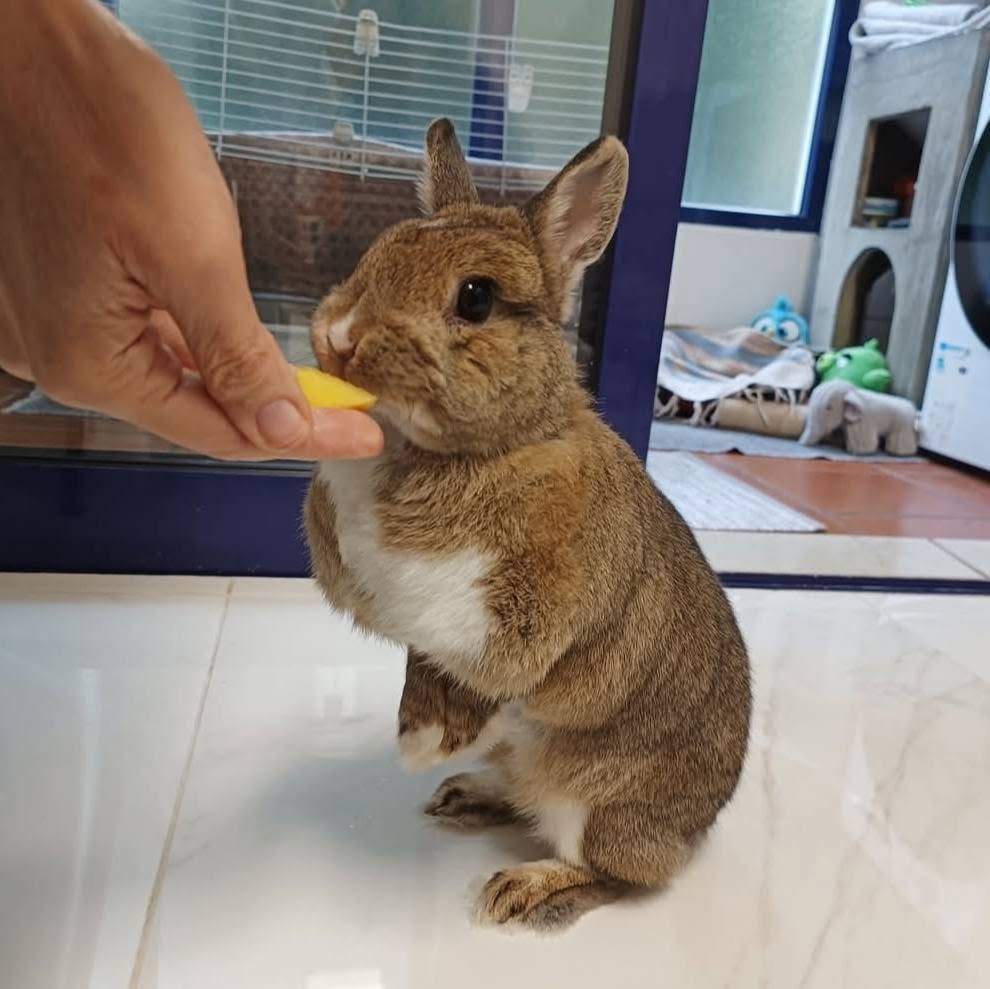
Visit Us at Paradise Pets Swindon
We stock rabbits year-round alongside a full range of small animals — all UK-bred, properly housed, and sold only to homes we are confident are ready for them. If you are thinking about getting a rabbit and want an honest conversation about what is involved, come in. We would rather talk it through properly than have the situation develop the wrong way.
We also stock guinea pigs, gerbils and hamsters, and a full range of cage and aviary birds.