
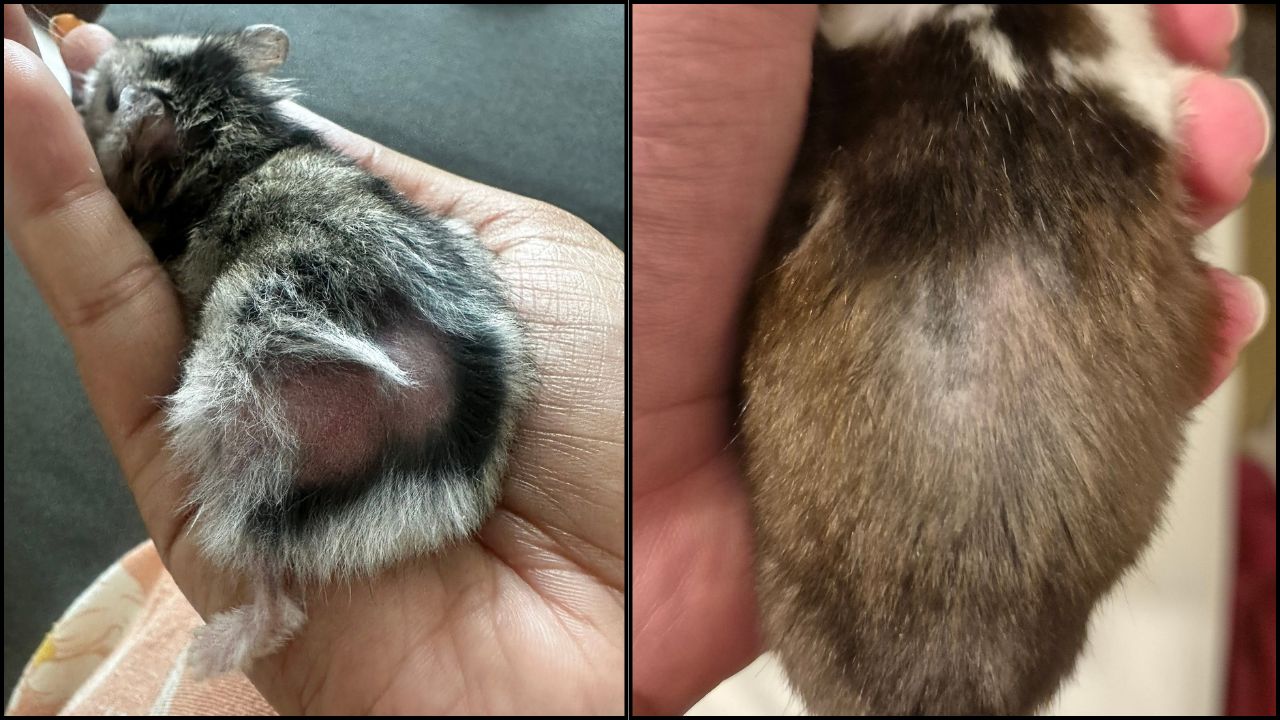
Neil has kept, bred, and sold hamsters and small animals at Paradise Pets Swindon since 1988 — over 35 years of first-hand experience with Syrian hamsters, dwarf hamsters, and every breed in between. “My hamster is losing fur in patches” is a phrase he hears at the counter regularly, and it covers a wider range of situations than most owners realise. This is his honest guide to what patchy fur loss usually means, how to tell the causes apart, and what genuinely needs a vet.
A teenage girl came in with her mum last week, holding a small carrier with real care. “Neil, she’s got bald bits all over — not just one spot, loads of little patches. We don’t know if it’s normal or if something’s really wrong.”
I asked to have a proper look, and what I saw told a different story from a single bald spot, which is usually a simpler thing to work through. Multiple patches scattered across a hamster’s body point toward a different set of likely causes than one isolated bald area — and the pattern itself, where the patches are and how they are spread, is some of the most useful diagnostic information available without a vet visit.
In 35 years of keeping and selling hamsters, I have learned that “losing fur in patches” is a phrase that covers everything from a completely benign seasonal coat change to a genuine parasitic infestation that needs prompt treatment. The honest answer to what it means depends entirely on the specifics — and most owners who come to me worried have not yet looked closely enough to know which specifics apply to their hamster.
This article is my attempt to give you that closer look. I want to walk through what patchy fur loss usually means, how the pattern and distribution of the patches narrows down the likely cause, and exactly when this moves from something to monitor into something that needs a vet today.
Why Patchy Fur Loss Is A Different Conversation From A Single Bald Spot
I want to start here because the distinction matters for how you think about the problem.
A single, isolated bald patch in a hamster is most commonly explained by something localised — friction against a specific point in the cage, the normal appearance of scent glands on the flanks, or a single site of injury or irritation. The explanation tends to be tied to something specific happening in one place.
Multiple patches scattered across the body point more often toward causes that affect the whole animal rather than one location — a parasitic infestation that has spread, a hormonal or systemic condition affecting the coat broadly, or a seasonal moult that is uneven in its progress. The fact that the fur loss is happening in several places rather than one is itself diagnostic information, because it suggests the underlying cause is something acting on the hamster generally rather than something localised to a particular spot in the cage.
This does not mean patchy fur loss is automatically more serious than a single bald spot — some of the causes of patchy loss are entirely benign. But it does mean the list of likely explanations shifts, and the questions worth asking shift with it.
What To Look At Before You Decide Anything
- How many patches are there, and where? Two or three patches in a specific area is a different picture from fur loss scattered across the whole body, including the back, sides, belly, and legs.
- Is the pattern symmetrical? Patches appearing in mirrored positions on both sides of the body suggest a different cause from patches that are randomly distributed with no symmetry.
- What does the skin look like under each patch? Smooth and normal-coloured skin suggests a different cause from skin that is red, scaly, crusty, flaky, or thickened. Check each patch individually — they do not have to look the same.
- How quickly did this develop? A change you noticed gradually over a couple of weeks is a different situation from patches that appeared seemingly overnight.
- Is your hamster scratching, biting, or rubbing the affected areas? Visible irritation and self-directed attention to the patches points toward causes involving itching, such as mites, rather than causes that are not itchy.
- How old is your hamster, and has anything in its environment changed recently? New bedding, a new cage-mate, a change in diet, or simply advancing age can all be relevant context.
- Is your hamster otherwise behaving normally? Eating, drinking, active during its waking hours, and generally itself — or is something else different too?
With those observations gathered, here are the most common explanations I work through at the counter, broadly in order of how frequently I see them.

The Most Common Causes Of Patchy Fur Loss
1. Seasonal Or Age-Related Moulting
Hamsters, like many small mammals, can go through periods of more pronounced shedding, particularly with seasonal light and temperature changes. This often presents as a generally thinning coat with some patchier areas rather than perfectly even loss, and it tends to be most noticeable along the back and sides. Importantly, the skin underneath in a moulting hamster should look normal — no redness, no scaling, no crusting — and the hamster’s behaviour should be entirely unaffected.
Older hamsters, broadly those over a year and a half, often show a general thinning of the coat as part of the ageing process, which can appear patchy rather than perfectly uniform. This is usually gradual, accompanied by no skin changes, and not a cause for alarm on its own, though it is worth mentioning to a vet at a routine check given the other age-related conditions worth ruling out in an older hamster.
2. Mites — A Leading Cause Of Genuinely Patchy Loss
Mite infestations are one of the most common causes of fur loss that appears as multiple patches rather than a single area, and they deserve careful attention because they need treatment and will not resolve on their own.
Demodex mites are present in small numbers on most hamsters without causing any problem. When the population increases — often triggered by stress, an underlying illness, or a weakened immune system, particularly in older hamsters — the result is patchy fur loss that often starts on the back and spreads, with the skin underneath frequently looking slightly thickened, scaly, or greasy. Itching may or may not be prominent, which is part of why this can be missed initially.
Other mite species cause a more clearly itchy presentation, with the hamster scratching visibly, and patches that may be more inflamed or have small crusts at the edges.
If the pattern you are seeing is multiple patches, particularly starting on the back, with any change to the skin texture underneath, mites belong high on the list of likely explanations, and a vet visit with a skin scraping is the way to get a definitive answer.

3. Barbering From A Cage-Mate
If your hamster is housed with another — which I would generally caution against for Syrian hamsters, as they are solitary by nature — one hamster chewing or plucking the fur of another can produce multiple patches, typically in places the affected hamster cannot reach to groom itself, such as the top of the head, the back, and the shoulders.
The tell-tale sign here is that the skin underneath is usually completely normal — this is fur removal, not a skin condition — and the pattern of patches will often cluster in those hard-to-reach areas rather than being randomly distributed across the whole body. If you have more than one hamster and are seeing this pattern, separate them and examine both animals, because the dynamic between them needs addressing regardless of what else may be going on.
4. Fungal Infection — Ringworm
Ringworm, a fungal skin infection rather than an actual worm, commonly produces patches that are more clearly defined and circular or oval in shape, often with a scaly or crusty edge and a slightly reddened appearance to the skin underneath. Multiple patches can develop as the infection spreads across the body.
This one matters for a reason beyond the hamster’s own welfare — ringworm is zoonotic, meaning it can pass from your hamster to you or other household members. If you are seeing distinctly circular, crusty-edged patches, and especially if anyone in the household has developed an unexplained circular, itchy rash on their own skin around the same time, mention both to a vet and to your GP. This needs proper diagnosis and antifungal treatment; it will not clear up by itself.

5. Hormonal Conditions — Particularly In Older Hamsters
Hyperadrenocorticism, commonly known as Cushing’s disease, is more common in hamsters than many owners realise and is a leading cause of more widespread, often symmetrical fur loss in older animals — typically those over 18 months. The pattern tends to start on the flanks and trunk and spread, with the skin underneath becoming thin and sometimes darkened, occasionally with small blackhead-like spots.
What distinguishes this from the more localised causes above is the combination of signs that often accompany it — a pot-bellied appearance, increased thirst and urination, and a general reduction in activity and brightness. If your hamster is older and the fur loss is symmetrical and spreading rather than isolated to a couple of patches, and especially if any of those other signs are present, this deserves a vet visit specifically to discuss this possibility.

6. Diet And Nutritional Factors
A diet lacking sufficient variety or key nutrients can affect coat condition generally, sometimes presenting as patchy thinning rather than perfectly even dullness. This is less commonly the sole cause of dramatic fur loss but is worth considering as a contributing factor, particularly in hamsters fed a very limited or low-quality diet. Reviewing and improving the diet is a reasonable step alongside investigating other causes, not a substitute for it if the fur loss is significant.
The Pattern Guide — What The Spread Of Patches Suggests
| Pattern Of Patches | Most Likely Causes | Action |
|---|---|---|
| General thinning, mild patchiness, normal skin | Seasonal moult, age-related thinning | ✅ Monitor — mention at routine vet check if older |
| Multiple patches starting on back, scaly skin | Mite infestation | 🔴 Avian/exotic vet for skin scraping and treatment |
| Patches on head, shoulders, back only — normal skin | Barbering from cage-mate | ⚠️ Separate hamsters, examine both |
| Circular, crusty-edged patches | Ringworm (fungal infection) | 🔴 Vet — also check household members for rash |
| Symmetrical, spreading on flanks/trunk, older hamster | Cushing’s disease (hormonal) | 🔴 Vet — discuss alongside other signs (pot belly, thirst) |
| General dullness and patchy thinning, poor diet | Nutritional deficiency | ⚠️ Review diet, vet if no improvement |
When To See A Vet — Without Delay
- Broken, scabbed, or bleeding skin at any of the affected patches
- Visible scratching or biting at the affected areas, suggesting significant itching or discomfort
- Rapid spread — new patches appearing over days rather than weeks
- Skin that looks scaly, greasy, thickened, or crusty under any of the patches
- The hamster is also unwell — reduced appetite, weight loss, lethargy, or any other behavioural change alongside the fur loss
- The hamster is over 18 months old with symmetrical, spreading patches — Cushing’s disease becomes a significant possibility with age
- A circular, itchy rash has appeared on your own skin or another household member’s around the same time — possible ringworm transmission
- You simply cannot identify a clear, benign explanation after looking closely — when in doubt, a vet visit is the right call
The situations where a watch-and-wait approach is genuinely reasonable are narrower than many owners assume. A young, healthy hamster with mild, generally even thinning, normal skin throughout, normal behaviour, and an identifiable seasonal trigger is a reasonable candidate for simple monitoring. Most other patterns of patchy fur loss are better served by a vet visit than by waiting to see what happens next.

What To Tell Your Vet
- When you first noticed the patches and how they have changed since — more patches, bigger patches, the same
- Where on the body each patch is located — a simple sketch or photograph is genuinely useful
- Your hamster’s age as precisely as you know it
- Whether your hamster is kept alone or with others
- Any recent changes — new bedding, new diet, new cage-mate, change in cage cleaning products
- Any other behavioural or physical changes — appetite, activity, water intake, weight if known
- Whether anyone in the household has developed an unexplained skin rash
- Clear photographs of the patches in good light, taken in advance in case the hamster is too active or stressed for a clear examination at the vet
Frequently Asked Questions
Is patchy fur loss worse than a single bald spot in a hamster?
Not automatically — but it points toward a different set of likely causes. A single bald spot is more often explained by something localised, such as friction against a specific point in the cage or normal scent gland anatomy. Multiple patches more often suggest a cause that is affecting the hamster more generally, such as a mite infestation, a hormonal condition, or a seasonal moult. Neither pattern is inherently more or less serious on its own — the specific cause behind the pattern is what determines that.
Can stress cause my hamster to lose fur in patches?
Stress does not directly cause fur loss in the way it might in some other species, but it can be a contributing factor — particularly by suppressing the immune system in a way that allows a mite population to increase, or by leading to barbering behaviour if hamsters are housed together inappropriately. If stress seems to be part of the picture, it is still worth investigating the specific mechanism — whether that is mites, a cage-mate issue, or something else — rather than treating stress itself as the final answer.
My hamster has patches but is eating, active, and seems completely fine — should I still be concerned?
A hamster that otherwise seems well is reassuring but should not lead to complacency about the patches themselves. Hamsters hide illness well, and several of the causes of patchy fur loss — mites, early Cushing’s disease, ringworm — can be present and progressing before the hamster shows obvious signs of feeling unwell. Investigate the patches properly even if the rest of the hamster’s behaviour seems normal.
Will my hamster’s fur grow back after treatment?
This depends entirely on the cause. Fur lost to friction, barbering, or a treated mite or fungal infection generally regrows once the underlying cause is resolved and the skin has had time to recover. Fur loss associated with Cushing’s disease or other hormonal conditions is more complex, as it depends on how well the underlying condition is managed. Age-related thinning in a very old hamster may not be fully reversible. The clearest message is that addressing the cause promptly gives the best chance of full regrowth.
Can I catch anything from my hamster’s patchy fur loss?
If the cause is ringworm, yes — this is the one cause on this list that is zoonotic and can pass between your hamster and people in the household. If you notice a circular, itchy, slightly scaly rash on your own skin around the same time your hamster develops patches, mention it to both a vet for the hamster and your GP for yourself. Other causes of patchy fur loss in hamsters, including mites, barbering, and hormonal conditions, are not transmissible to humans.
Where can I get honest small animal health advice in Swindon?
Come and see us at Paradise Pets, Manor Garden Centre, Cheney Manor, Swindon SN2 2QJ. Or give us a ring on 01793 512400. We can have a look, tell you honestly what we think, and tell you when you need a vet. The advice is free and we have been giving it for 35 years.
One Last Thing From Me
The girl and her mum left with a clear next step. The pattern they described — multiple small patches starting on the back, with a slightly rough texture to the skin underneath — pointed most strongly toward early mite activity, and I told them to get a vet appointment for a skin scraping rather than waiting to see if it resolved on its own. They called a few days later to say the vet had confirmed mites and started treatment, and the hamster was already looking brighter.
What struck me about that conversation, as it often does, was how much useful information was available simply from looking closely and describing accurately what was actually there — not just “bald patches” but where they were, what the skin looked like, how quickly things had changed. That detail is what turns a worried, vague description into a clear diagnostic picture, both at my counter and at the vet’s.
If your hamster is losing fur in patches, take the time to look properly before you decide what it means. Note where the patches are. Check the skin underneath each one. Watch for scratching. And if anything you find does not point clearly toward a benign explanation, do not wait to find out — a vet with proper examination tools will get you a definitive answer far faster than continued observation at home.
Concerned About Your Hamster’s Fur Loss? Come And Let Me Look
Bring your hamster in and I will examine the pattern carefully and tell you honestly what I think is happening — including whether I think it needs a vet. Free assessment, no obligation. That is what we have been doing for 35 years.


