
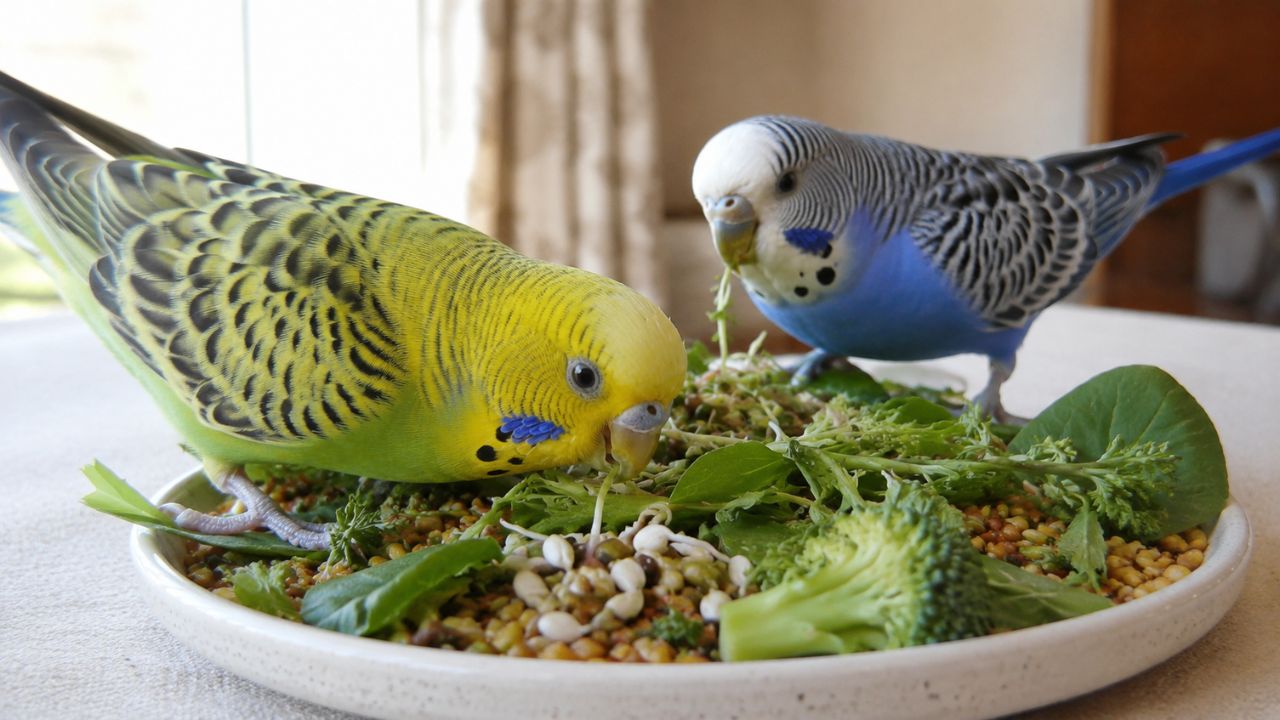

Neil has kept, bred, and sold budgies at Paradise Pets Swindon since 1988 — over 35 years of first-hand experience with these birds. Diet is the most common area where UK budgie owners get things wrong — and the most common reason healthy young birds become unwell before their time. This guide covers everything he tells new owners before their bird goes home.
Someone buys a budgie, takes it home, buys a bag of seeds from the supermarket, and assumes that is the diet sorted.
It is not the diet sorted. It is the start of a diet that, if nothing is added to it over the next seven to ten years, will quietly undermine the bird’s health year by year until something gives.
I am not saying seeds are bad. Seeds are part of a budgie’s natural diet and a perfectly reasonable base for a captive one. The problem is when seeds become the whole diet — the only thing in the bowl, day after day, from the day the bird arrives to the day it becomes ill. That situation is far more common in UK homes than it should be, and it is entirely preventable.
This guide is everything I know about budgie diet after thirty-five years of keeping, breeding, and selling these birds. What to feed, what to avoid, what most owners miss entirely, and how to make the change if you have a bird that already refuses everything except seeds.
Why the Seed Bowl Alone Is Not Enough
Seeds are high in fat and carbohydrate. They are low in protein, low in most vitamins, and low in minerals — particularly iodine, calcium, and vitamin A. A budgie living exclusively on seeds is meeting its caloric needs while missing significant portions of its nutritional needs.
The consequences are not dramatic and immediate. They are gradual. A seed-only budgie in its first year may look healthy. In its second and third year, coat condition starts to suffer — feathers that are slightly duller, slightly more brittle. By its fourth or fifth year, the cumulative effect of nutritional deficiency begins to manifest more clearly: fatty liver disease, which is the most common diet-related condition I see in budgies, and which is directly linked to a high-fat, low-variety seed diet maintained over years.
Fatty liver disease is progressive and largely silent until it is advanced. A bird with fatty liver disease looks normal, eats normally, behaves normally — until one day it does not. By the time the owner notices something is wrong, the condition has usually been developing for a long time.
The good news is that it is entirely preventable. A diet that includes seeds as a base but also includes pellets, fresh vegetables, and occasional other foods covers the nutritional gaps that seeds leave. It is not complicated. It does not require expensive ingredients. It requires a change in habit, and a willingness to persist with new foods even when the bird initially ignores them.
The Right Seed Mix — What to Look For in the UK
Not all seed mixes are equal, and the cheapest option is rarely the best one.
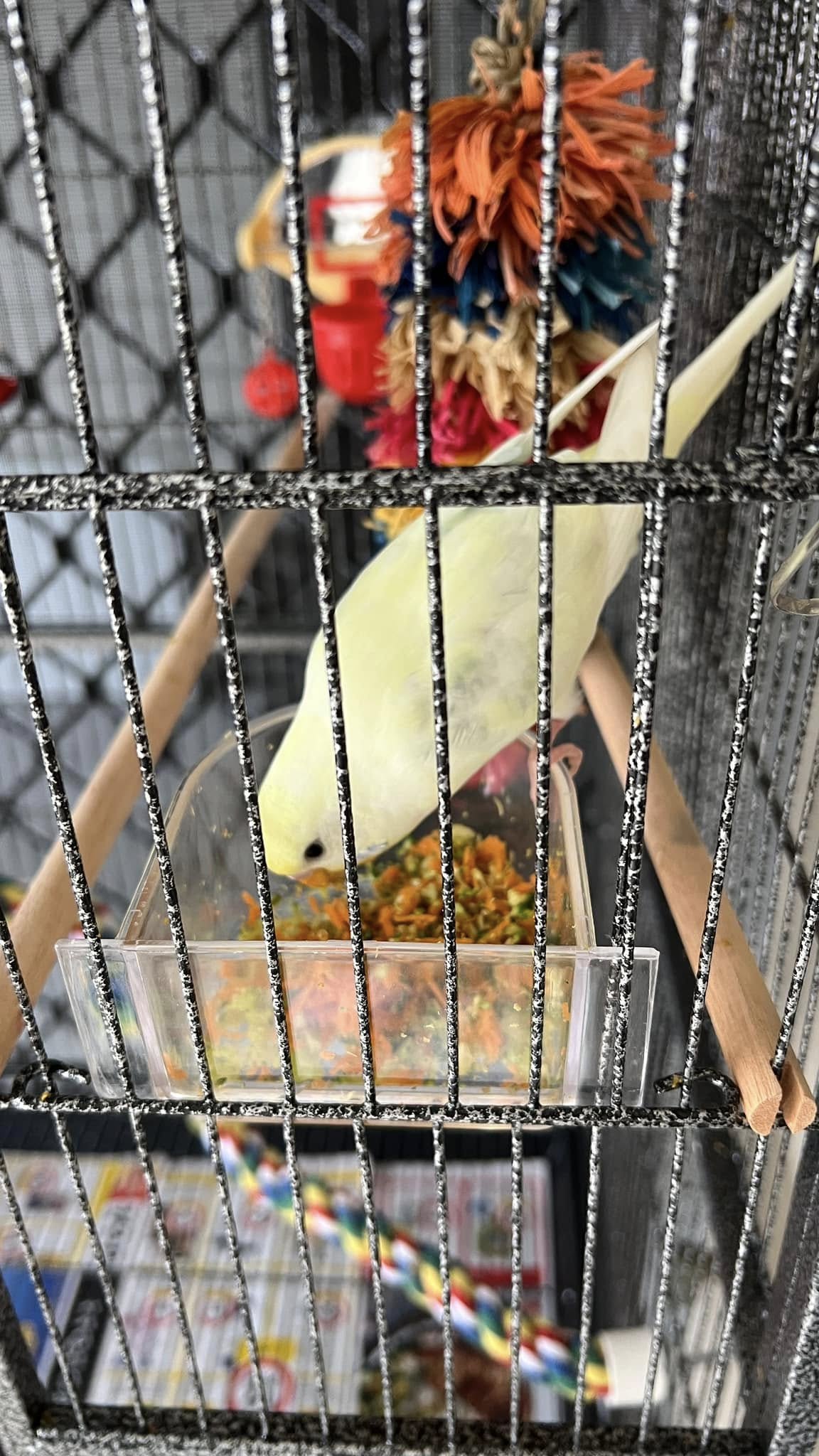
A good budgie seed mix contains a variety of seeds — millet (white, panicum, and Japanese varieties), canary seed, and small amounts of oats. It should not be predominantly sunflower seeds or safflower seeds, which are very high in fat and which budgies will eat in preference to everything else if given the chance. A mix that is mostly millet and canary seed, with other varieties present in smaller proportions, is what to look for.
Check the bag for dust. A seed mix that is dusty or powdery has often been stored for too long, or is of lower quality. Fresh seed should look clean and smell faintly nutty — not stale, not musty. Musty seed can carry mould, and mould in a bird’s respiratory environment or gut is not a minor issue.
Reject the bowl the bird has already eaten from before refilling it each day. Budgies hull their seeds — they crack the outer case and eat only the inner seed, leaving the empty hull in the bowl. A bowl that looks full of seed may actually be full of empty husks with very little edible seed remaining. This is one of the most common reasons budgies lose weight while appearing to have a full food bowl. Blow gently across the bowl to remove hulls, or empty and refill completely each day.
Pellets — The Complete Nutrition Most UK Budgies Are Missing
Budgie pellets are a formulated food — a complete nutritional profile compressed into a small pellet that a budgie can crack and eat. They are not a replacement for seed entirely, but they are the best way to fill the nutritional gaps that seeds leave, because they are designed specifically to do exactly that.
The difficulty with pellets is getting a seed-accustomed budgie to eat them. A bird that has eaten seeds all its life will often ignore pellets completely at first. They look wrong, feel wrong, and smell wrong compared to the seeds the bird is used to. This is not a reason to give up — it is a reason to introduce them gradually. I cover the introduction process in detail later in this guide.
In the UK, the most widely available budgie pellet brands worth looking at are Harrison’s Bird Foods and Roudybush — both formulated specifically for small parrots and budgies, with good nutritional profiles. If you are not sure what to choose, come and talk to us and we will point you in the right direction based on what your bird is currently eating.
A diet that is roughly half quality seed mix and half pellets, supplemented with daily fresh vegetables, is a very solid foundation for a healthy budgie long-term. Getting to that balance takes time if the bird is a confirmed seed-addict, but it is achievable for most birds with patient, consistent effort.
Fresh Vegetables — The Daily Addition Most Owners Skip
Fresh vegetables are not an optional extra in a budgie’s diet. They are the primary source of the vitamins and minerals that seeds and even pellets do not fully provide — particularly vitamin A, which is critical for respiratory health, feather condition, and immune function.
The key is consistency. Vegetables offered once a week make almost no difference to the bird’s nutritional profile. Vegetables offered every single day, in small amounts the bird can finish, make a measurable difference over the course of months and years.
- Leafy greens — kale, romaine lettuce, spinach (in moderation — high in oxalates), rocket, watercress, and fresh herbs like parsley and coriander. These are the most nutritionally valuable fresh foods you can offer a budgie. Offer a small leaf or two daily.
- Broccoli — both the florets and the stem. High in vitamin C and calcium. Most budgies accept it readily once they are familiar with it. A small floret is enough.
- Carrot — high in beta-carotene, which converts to vitamin A. Grated carrot is easier for budgies to manage than a large piece. The green tops of carrots are also safe and enjoyed by many birds.
- Red bell pepper — one of the best vitamin C sources you can offer any bird. Most budgies enjoy it. A small piece, offered several times a week.
- Courgette — mild, soft, and readily accepted. Slice it thinly. Good for introducing vegetables to reluctant eaters because the flavour is not strong.
- Corn on the cob — a small piece of fresh corn, or a few defrosted frozen corn kernels. Budgies enjoy the texture and it provides useful variety.
- Peas — fresh or defrosted frozen. Podded peas are a good size for budgies and most birds enjoy them.
- Cucumber — high in water content, low in nutrients, but harmless and enjoyed. Good as a hydrating treat, not a nutritional staple.
Wash everything before offering it. Remove any uneaten fresh food within a few hours — wilted vegetables sitting in a warm cage attract bacteria quickly.
Fresh Fruit — Occasional, Not Daily
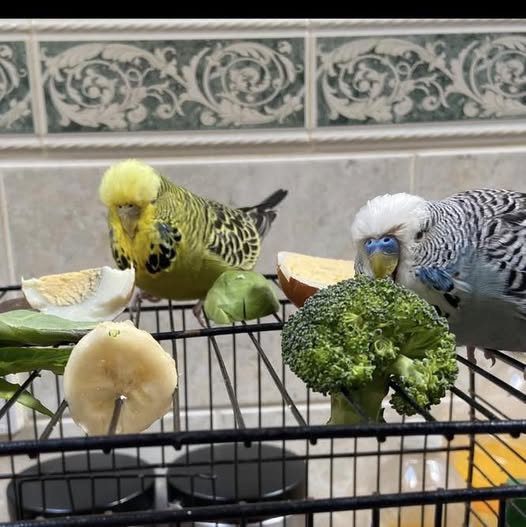
Fruit is enjoyed by most budgies and is safe in small amounts. The caveat is sugar content — fruit is significantly higher in sugar than vegetables, and a budgie eating large amounts of fruit daily is consuming more sugar than its system is designed to handle consistently.
Safe fruits for budgies in the UK, offered in small amounts a few times a week:
Apple, pear, melon, strawberry, raspberry, blueberry, mango, papaya, and kiwi are all fine. Remove any seeds or pips from apple and pear before offering — fruit seeds from these plants contain compounds that are toxic to birds and must not be included.
Citrus fruits — oranges, lemons, grapefruit — are generally avoided. The high acidity can cause digestive irritation. Not immediately dangerous in a small amount, but not something to make a regular part of the diet.
Grapes are a subject of debate in bird keeping circles. I avoid them as a precaution — the toxicity data for budgies is not as clear as for dogs, but there is enough uncertainty that I do not recommend them.
Avocado is not a fruit to offer. Ever. It is toxic to budgies and several other bird species. I cover this in the danger section below.
Sprouted Seeds — The Most Underused Food in UK Budgie Care
Sprouted seeds are one of the best things you can add to a budgie’s diet, and one of the most underused. In my experience, the majority of UK budgie owners have never tried them.
When a seed sprouts — when it begins to germinate — the nutritional profile changes dramatically. The fat content drops. The protein content rises. Vitamins and enzymes increase significantly. A sprouted seed is, nutritionally, a fundamentally different food from the dry version of the same seed.
For a budgie that is reluctant to eat fresh vegetables, sprouted seeds are often the easiest bridge — they look and smell similar to dry seeds but are far more nutritious, and most seed-addict budgies will eat them readily once they are familiar with the texture.
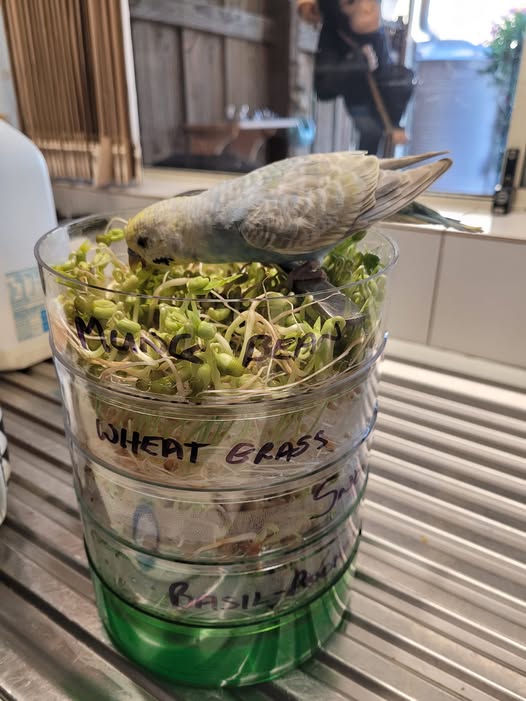
Sprouting is straightforward. Soak a small amount of seed in clean water for eight to twelve hours, then drain and rinse. Spread in a shallow dish and rinse twice daily for one to two days until small white tails appear. Offer immediately and do not store for more than a day after sprouting — bacteria multiply quickly in damp seeds at room temperature. Any batch that smells sour or shows visible mould should be discarded.
Millet, canary seed, and lentils all sprout well. Commercially available sprouting mixes for birds take the guesswork out of it.
Millet — Treat, Not Staple
Millet spray — the long stems of millet seeds that budgies peck at enthusiastically — is one of the most effective training and bonding tools available, and budgies love it without exception. It is also one of the most overfed foods in UK budgie care.
Millet is high in carbohydrate and fat. A budgie with constant access to millet spray will eat it in preference to almost everything else — which means it will eat less of the more nutritious parts of its diet. Millet crowding out the rest of the diet is a common cause of the nutritional imbalances I see in budgies presented as healthy but declining slowly.
One or two small pieces of millet spray per week, used as a treat or a training reward, is appropriate. Not a constant fixture in the cage. Not something permanently clipped to the bars. A treat — given occasionally, appreciated properly, not relied upon as a daily staple.
What Budgies Must Never Eat — The UK Danger List
This is the short version. The items below are toxic to budgies and should never be offered, even in small amounts.
Avocado. Contains persin, a fungicidal toxin that is harmless to humans but causes heart failure in birds. Even a small amount can be fatal. Avocado is used in many UK households — guacamole, salads, on toast — and the risk of accidental exposure is real. Keep it away from the bird entirely.
Chocolate and cocoa. Theobromine, which chocolate contains, is toxic to birds as it is to dogs and cats. No chocolate in any form — not even a small amount.
Onion and garlic. Both contain compounds — thiosulfates and disulfides — that destroy red blood cells in birds and cause a form of anaemia. Cooked or raw, both are dangerous.
Fruit pits and apple seeds. The pits of stone fruits — peach, cherry, plum, apricot — and the seeds inside apple and pear contain cyanogenic compounds. Remove all seeds and pits before offering any fruit.
Caffeine. Tea, coffee, fizzy drinks — none of these should ever be offered to a budgie. Caffeine causes heart arrhythmia in birds and is potentially fatal.
Alcohol. Obvious in principle, but birds can be accidentally exposed when glasses are left within reach. Even a small amount is toxic.
Salt and highly processed human food. Crisps, crackers, anything heavily salted or processed. Budgies have no mechanism for processing the sodium levels in human snack food. Kidney damage is the consequence of regular exposure.
Rhubarb. Both the stalks and leaves contain oxalic acid at levels that are toxic to birds. It is not a food most people would think to offer a budgie, but it is worth knowing.
Dairy products. Budgies are lactose intolerant. Cheese, milk, yoghurt — not appropriate. Small accidental exposures are unlikely to be dangerous, but dairy should not be a deliberate part of the diet.

Water — Simple But Almost Always Done Wrong
Fresh water, changed daily. That is the whole instruction.
What happens in most households is that the water gets changed when it looks dirty or when the owner remembers — which in practice means every two or three days. In those two or three days, a budgie that has been dunking food and preening over its water bowl has turned clean water into a bacterial soup. Birds drinking from contaminated water develop digestive problems, respiratory problems, and are generally more susceptible to illness than those with genuinely clean water available at all times.
Change the water every morning. Empty the bowl or bottle completely, rinse it, refill it. It takes thirty seconds. The difference to the bird’s health over a year of consistent daily changes versus every-three-day changes is not negligible.
Water bowls versus water bottles is a regular debate. Bottles are easier to keep clean and less likely to become contaminated from droppings or food. Bowls allow budgies to splash and bathe, which many enjoy. I recommend a bottle for primary drinking water and a shallow dish offered for bathing a few times a week — which doubles as a water source and provides enrichment the bird clearly enjoys.
- “My budgie has only ever eaten seeds and he’s seven — seeds must be fine” — A seven-year-old seed-only budgie has reached middle age despite its diet, not because of it. The question is not whether it survived — it is whether it will reach ten, twelve, fourteen, with the same quality of health it had at three. Seed-only diets cause cumulative damage. The damage shows up later, not immediately.
- “He won’t eat vegetables — I’ve tried once and he ignored them” — Once is not enough. Budgies are neophobic — they are instinctively cautious about new foods. Introducing a vegetable for the first time and concluding the bird will never eat it based on one offering is like deciding a child dislikes a food because they refused it on a Tuesday. Consistency and patience, over weeks, not hours.
- “Vitamin drops in the water cover the nutritional gaps” — They do not. Vitamin C degrades in water within hours. Other vitamins fare little better, particularly in sunlight. The dose that reaches the bird through vitamin-treated water is uncontrolled and usually inadequate. Vitamins through fresh food — where they are in stable, bioavailable form — is the correct approach.
- “Grit helps digestion — budgies need it” — Budgies hull their seeds before eating. They do not need insoluble grit to grind food in their gizzard the way chickens do. Fine insoluble grit is not necessary for a budgie and some birds eat it obsessively, which can cause crop impaction. A cuttlefish bone for calcium is appropriate. Sharp insoluble grit as a digestive aid is not.
- “Millet is healthy — it’s just seeds” — Millet is fine as an occasional treat. As a daily staple or permanent cage fixture it crowds out better foods and contributes to the same high-fat, low-variety diet problem that standard seed mix creates. Treat it as a treat.
- “He shares food from our plates and he’s fine” — Most human food is not dangerous to budgies in a brief, accidental exposure. The concern is with regular sharing of heavily processed, salted, or seasoned food — and with the specific items on the danger list above. If a budgie occasionally tastes plain cooked rice or a piece of plain boiled vegetable, that is not a problem. If it is regularly eating seasoned human food from a dinner plate, that is worth changing.
How to Introduce New Foods to a Budgie That Only Wants Seeds
This is the practical question most owners have after reading everything above. The bird has eaten nothing but seeds for three years. How do you change that?
Slowly. And with the expectation that it will take longer than you expect.
The first approach is placement. Put a small piece of vegetable in the seed bowl — not beside it, not in a separate dish, inside the seed bowl where the bird is already eating. A budgie rooting around for seeds will encounter the vegetable repeatedly. Contact, smell, incidental tasting — over days and weeks, the unfamiliar becomes familiar.
The second approach is eating together. Budgies are flock animals and they are more likely to try new foods when they see another bird — or their owner — eating them. Hold a piece of broccoli and eat it in front of the bird. This sounds odd. It works surprisingly well.
The third approach is the wet method. Mist a small leafy green with water and clip it to the cage bars where the bird perches. The wetness makes the leaf more interesting texturally, and the bird will often mouth and peck at it before progressing to actually eating it.
Sprouted seeds are usually the easiest bridge food — they look and smell like seeds but are far more nutritious. Start there if the bird is refusing everything else.
The one approach that does not work is starvation — removing seeds entirely and offering only vegetables in the hope that hunger will force the bird to eat. A hungry budgie is not a bird that tries new foods. It is a bird in distress. Remove seeds gradually — reduce the amount rather than eliminating them — while increasing the variety of other foods available. Patient, gradual, consistent.

What I Tell Every New Budgie Owner About Diet
- Start the right diet from day one.
It is significantly easier to establish a varied diet with a young bird than to change the habits of an established seed-addict. If you are buying a new budgie, begin offering vegetables and pellets from the first week, alongside seeds. The bird is in a new environment, encountering new everything — new foods are less threatening at this stage than they will be later. - Buy a quality seed mix, not the cheapest option.
Check the contents. Millet and canary seed should dominate, not sunflower. No visible dust. Fresh smell. Empty and refill the bowl daily rather than topping up — remove hulls each day so you know what the bird is actually eating. - Offer fresh vegetables every single day.
Not three times a week. Not when you remember. Every day. A small amount — a leaf of kale, a piece of broccoli, a sliver of carrot. Consistency matters more than quantity. Remove uneaten fresh food after a few hours. - Know the danger list before you offer anything new.
Avocado, onion, garlic, chocolate, fruit pits, caffeine, alcohol, rhubarb. These are the ones that matter most. If you are not sure whether something is safe, do not offer it until you have checked. A good rule of thumb: if it is heavily processed, salted, or seasoned, it is not appropriate. - Change the water every morning without exception.
Thirty seconds. Empty, rinse, refill. Daily. If you have a water bottle rather than a bowl, clean the nozzle regularly — they accumulate biofilm that is invisible but real.
If you have questions about any aspect of budgie diet — what to feed a bird that refuses everything, whether a specific food is safe, how to transition a seed-addict to a better diet — come in and ask us. We are at Manor Garden Centre, Cheney Manor Industrial Estate, Swindon, SN2 2QJ, open every day. Or call us on 01793 512400.
You can also read our full budgie care guide for everything else that goes into keeping these birds well — housing, handling, companionship, and what a well-kept budgie actually looks and behaves like.
Visit Us at Paradise Pets Swindon
We stock budgies year-round alongside a full range of seed mixes, pellets, and fresh food advice. If you are not sure what to feed your bird, come in and ask — we stock only what we would use ourselves, and we are always happy to walk new owners through a practical feeding routine before their bird goes home.
We also stock cockatiels, canaries, and finches, alongside a full range of guinea pigs, rabbits, and gerbils and hamsters.
⭐ Customer Reviews
Amazing Bird Selection
Had a lovley visit today,staff were very friendly and very helpful,such a great petshop,their selection of birds is incredible,really impressed,thank so much to the staff at Paradise Pets

Friendly Helpful Staff
I have been coming to this place for years and they have a great stock of food for all types of pets. Have a great selection of small mammals and a lot of birds. Staff are friendly and helpful.

Great Quality Hutch
Bought a guinea pigs hutch and run combo, very happy with the service, the hutch was put in my car for me without even asking for help. The wood quality is very good, the instructions easy to follow and we are extremely happy with the fully built hutch. A good size for 2 guinea pigs

Response from Paradise Pets | Wiltshire
Thank you Melanie Latus Nice to provide services to you.
Best Bird Shop Around
It’s the best pet shop in and around Swindon. They always have an amazing selection of birds and all you need to keep them happy. I keep birds myself and the guys there are happy to answer questions and really know their stuff. I have seen budgies etc. in chain pet shops in the area looking really unhealthy and ill – I wouldn’t go anywhere else than Paradise Pets for animals.

Highly Recommended Bird Shop
I could not praise this shop enough. Really helped my Grandson buy his first bird and he’s loving it. Travelled from Somerset and was welcomed with open arms.

Great Shop with Competitive Prices
Great shop with amazing selection for small animals, hamsters, mice ect, highly recommend!
Also has a great selection for dogs & cats too & very competitive prices! 💖

