

Neil has been keeping, breeding, and selling budgies at Paradise Pets Swindon since 1988 — over 35 years of daily first-hand experience with these birds and the owners who keep them. The tongue is one of the least-discussed parts of a budgie’s anatomy in most care guides, and one that owners notice more often than you might expect — usually during close handling or feeding, and usually followed by a moment of “is that normal?” This article is the honest answer, covering every reason a budgie’s tongue becomes visible, what each one means, and when it is worth a closer look.
A woman came into the shop holding her phone with a short video already queued up, ready to show me before I had even said hello properly. Her budgie, while eating a piece of millet spray, had repeatedly stuck its tongue out in a way she had never noticed before. In the video, the tongue appeared dark, almost black-tipped, moving in and out as the bird manipulated the seed.
She had watched the video several times and convinced herself something was wrong with the bird’s mouth.
I watched it once. The behaviour was completely normal — a budgie’s tongue, used exactly as it should be, to manipulate and dehusk seed before eating it. The dark tip she had noticed was simply the natural pigmentation of a healthy budgie tongue, not a sign of illness or injury.
I told her this honestly, and I also told her something else — that her noticing this at all, and coming in rather than dismissing it, was exactly the right instinct, even though in this case there was nothing to worry about. Most owners have never actually looked closely at their budgie’s tongue, which means most owners would not know if something genuinely was different about it.
What The Budgie Tongue Actually Does
Before going through the specific situations where you might notice the tongue, it is worth understanding what this organ actually does for the bird — because once you understand its function, the visibility of it in normal daily life makes complete sense.
A budgie’s tongue is a remarkably dextrous, muscular organ — proportionally large and strong relative to the size of the bird, and essential to several critical daily functions. It is not, as some people assume, a relatively unimportant or rarely-used part of the bird’s anatomy. It is in almost constant use.
- Seed manipulation and dehusking — the primary daily function; the tongue works in coordination with the beak to rotate seeds, position them against the ridges inside the upper beak, and manipulate the husk away from the kernel before the seed is swallowed; this happens dozens of times during a normal feeding session
- Tactile sensing — the tongue has sensory function that helps the bird assess food texture, temperature, and suitability; budgies use their tongue to investigate new objects in much the same way they use their beak, gathering tactile information
- Drinking — the tongue plays a role in moving water from the beak into the throat during drinking, a motion that can sometimes be visible if you watch closely while the bird drinks
- Vocalisation — while birds do not use the tongue for sound production the way mammals do, tongue position does play a minor role in shaping certain calls and in the mechanics of mimicked speech in talking budgies
- General oral exploration — budgies that are chewing on toys, wood, or cuttlefish bone use the tongue extensively as part of that interaction, not just the beak
The Normal Reasons Your Budgie’s Tongue Becomes Visible
I am going to go through the situations where seeing your budgie’s tongue is entirely expected and not a cause for concern, before moving on to the smaller number of situations that do warrant closer attention.
Reason 1 — Eating And Seed Manipulation (Completely Normal)
This is by far the most common context in which owners notice their budgie’s tongue, and it is the situation the woman in my opening story had filmed.
- What it looks like — the tongue appears and moves rhythmically as the bird works a seed against the ridges of the upper beak, rotating and manipulating it; the tongue may protrude slightly beyond the beak tip during this process, particularly with larger seeds
- When it happens — during any feeding session, particularly with seed mix that requires more manipulation than soft foods; close observation during feeding will reveal this happening regularly in any healthy budgie
- What to do — nothing; this is the tongue doing exactly the job it is meant to do
Reason 2 — Investigating Objects (Completely Normal)
Budgies are exploratory animals, and the tongue is one of their primary tools for investigating new objects, alongside the beak.
- What it looks like — the tongue extends briefly to make contact with a new toy, a finger, a perch, or any unfamiliar surface; often combined with beak contact in the same investigative motion
- When it happens — when a new item is introduced to the cage, during interaction with a trusted hand, or when the bird is generally exploring its environment
- What to do — nothing; this is healthy curiosity and normal sensory investigation
Reason 3 — Drinking (Completely Normal)
Watching a budgie drink closely will often reveal tongue movement that owners do not associate with the action because they are focused on the beak dipping into water rather than what happens inside the mouth during swallowing.
- What it looks like — subtle tongue movement visible at the edges of the beak as the bird tips its head back slightly to swallow after dipping into water
- What to do — nothing; this is part of normal drinking mechanics
Reason 4 — Pigmentation, Not Pathology (Completely Normal)
This is the specific source of concern in the case I described at the start, and it deserves its own clear explanation because it produces unnecessary worry quite consistently.
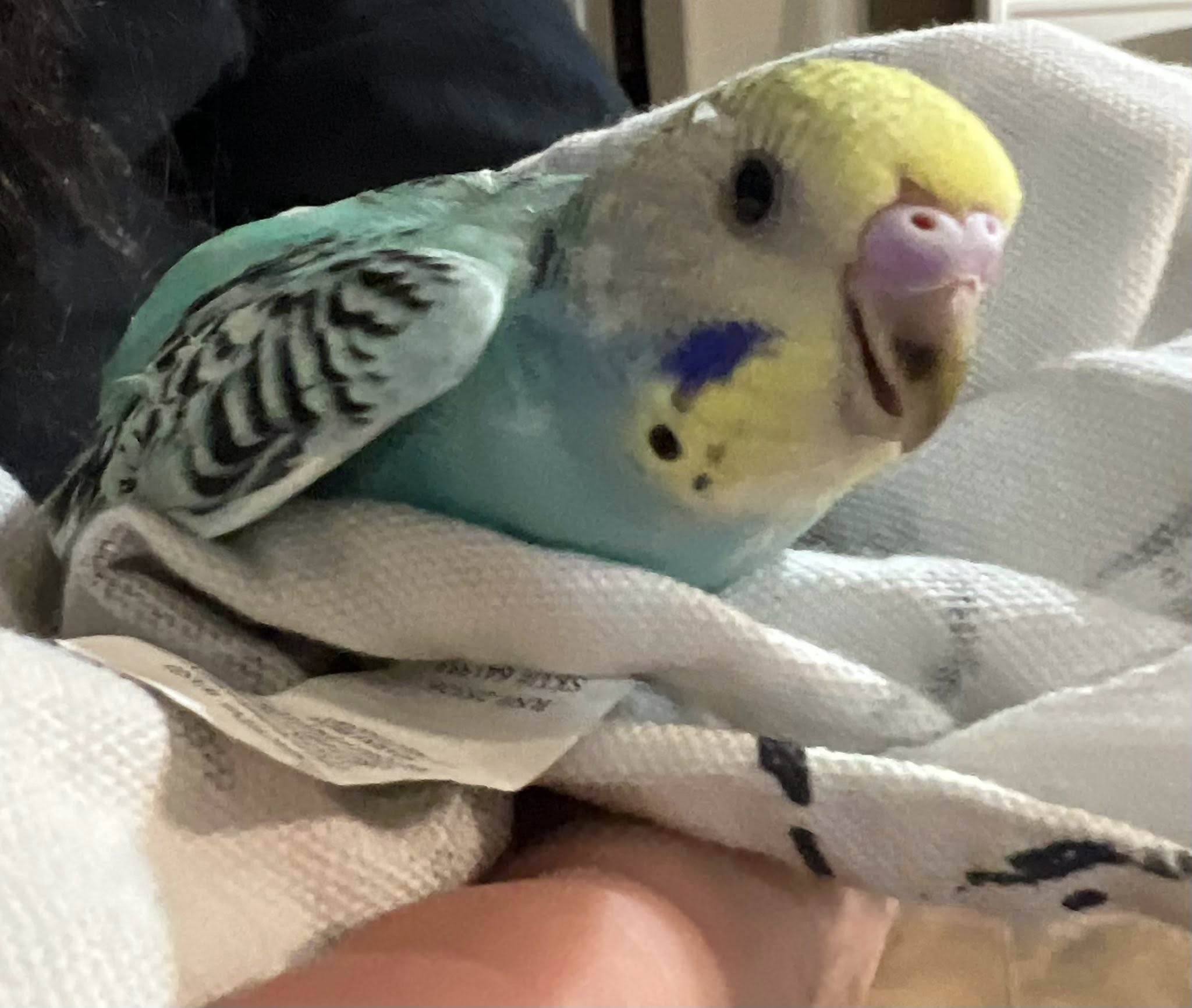
- What it looks like — the tongue tip, or in some birds a larger portion of the tongue, appears dark grey to nearly black, in contrast to the pinker tissue of the rest of the mouth
- Why it happens — this is simply natural pigmentation, comparable to the way some dogs have naturally black-spotted tongues or gums; it has no relationship to health and is present from a young age in many budgies, particularly certain colour varieties
- How to distinguish this from a genuine concern — natural pigmentation is consistent over time, does not change in appearance, is not accompanied by any other signs of illness, and the surrounding tissue (the rest of the mouth and the cere) is otherwise healthy-looking; a genuinely concerning discolouration would typically be a new development, often patchy or irregular rather than consistent, and frequently accompanied by other signs
- What to do — nothing, if it is a stable, longstanding feature of your particular bird; if you notice a new dark patch that was not there before, particularly if it looks irregular or is accompanied by any other signs, that is worth a closer look
Reason 5 — A Quick Flick Or “Tasting” Motion While Vocalising Or Preening (Normal)
Some budgies show a brief tongue movement, almost a flick, in the pauses between vocalisations, or occasionally during preening. This is a minor and not fully understood behaviour, but it is common and not associated with any health concern in an otherwise normal, healthy bird.
- What it looks like — a brief, quick protrusion and retraction of the tongue, not associated with eating, drinking, or investigating an object
- When it happens — often during quiet moments, between vocalisations, or during general settling behaviour
- What to do — nothing, provided the bird is otherwise behaving normally; this falls into the category of minor individual behaviours that vary between birds without indicating anything concerning
The Situations That Do Warrant A Closer Look
Having covered the reasons that are entirely normal, I want to be equally clear about the situations where tongue-related signs are part of a picture that needs veterinary attention. In every one of these cases, the tongue sign is accompanied by other signs — it is the combination, not the tongue alone, that indicates a problem.
Concern 1 — Difficulty Eating Alongside Tongue Movement
- What it looks like — the bird appears to be struggling to manipulate or swallow food, with more pronounced or repeated tongue movement than usual, possibly alongside head shaking or apparent discomfort; food may be dropped repeatedly or the bird may approach food and then turn away
- Possible causes — beak misalignment or overgrowth making normal feeding mechanics difficult; an oral lesion or sore affecting comfortable tongue movement; canker (trichomoniasis), a parasitic infection that produces lesions in the mouth and can make eating uncomfortable
- What to do — vet check within a few days; if the bird is showing reduced food intake alongside this, sooner rather than later, as reduced eating in a small bird needs prompt attention regardless of the specific cause
Concern 2 — Visible Swelling, Lesions, Or Unusual Coloured Deposits In The Mouth
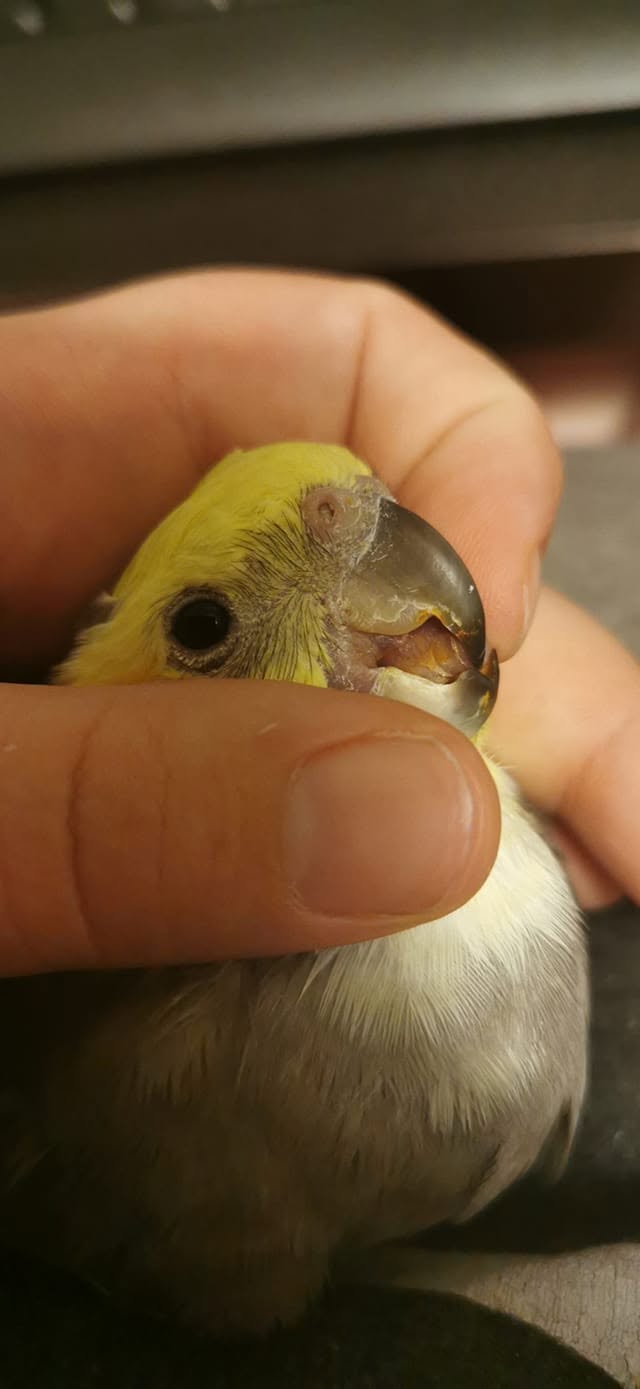
- What it looks like — anything beyond normal pigmentation that appears new, irregular in shape, raised, or accompanied by a change in the tissue texture around the tongue or inside the beak; yellowish-white, cheese-like deposits in particular are characteristic of canker
- What to do — vet check; this requires professional assessment and, in the case of canker, specific antiparasitic treatment that is not available without a prescription

Concern 3 — Tongue Movement Combined With Respiratory Signs
- What it looks like — visible tongue or beak movement alongside laboured breathing, tail bobbing, clicking or wheezing sounds, or open-beak breathing at rest
- What this indicates — this combination points toward a respiratory issue rather than anything specific to the tongue itself; the tongue movement in this context is incidental to the breathing difficulty, not the primary concern
- What to do — vet today; respiratory distress in a budgie is always urgent regardless of what else is observed alongside it
Concern 4 — Persistent Drooling Or Excess Moisture Around The Beak
- What it looks like — wetness around the beak that is not explained by recent drinking or bathing, sometimes alongside more visible or unusual tongue movement than normal
- Possible causes — oral infection, crop issues affecting normal swallowing, or less commonly, exposure to an irritant or toxin
- What to do — vet check within 24 hours; this combination is not a normal presentation and warrants professional assessment
The Quick Reference — Normal Versus Concerning
| What You See | Most Likely Explanation | What To Do |
|---|---|---|
| Tongue visible repeatedly while eating seed. Bird otherwise behaving normally. | Normal feeding mechanics | Nothing. |
| Tongue briefly touches a new toy, finger, or object during exploration. | Normal investigative behaviour | Nothing. |
| Dark grey or black tongue tip, present consistently, no other signs. | Normal pigmentation | Nothing. |
| Brief tongue flick during quiet moments or between vocalisations. | Minor normal individual behaviour | Nothing, if bird is otherwise well. |
| Repeated difficulty manipulating or swallowing food, food being dropped. | Possible beak or oral problem, or canker | Vet check within a few days. |
| New, irregular, or raised deposits or lesions in the mouth. | Possible canker or oral lesion | Vet check needed. |
| Tongue or beak movement alongside laboured breathing or tail bobbing. | Respiratory issue — tongue sign is incidental | Vet today. |
| Unexplained wetness around the beak, possibly with unusual tongue movement. | Possible oral or crop issue | Vet within 24 hours. |
How To Get A Good Look At Your Budgie’s Tongue Without Causing Stress
If you want to check your bird’s tongue and mouth area as part of general health monitoring, there are gentle ways to do this without creating unnecessary stress for the bird.
- Observe during natural behaviour rather than forcing a look — watching during feeding, drinking, or play will show you the tongue in normal use far more reliably and with far less stress than attempting to open the beak to inspect it directly
- Use a calm, well-handled bird’s natural trust for closer observation — a bird that is comfortable being handled may allow a brief, gentle look if you are not forcing the beak open; this should never be attempted with a bird that is not already comfortable with handling, as forcing the issue causes more stress than the observation is worth
- Photograph or video natural behaviour for later review — exactly as the woman in my opening story did; this is a genuinely useful way to capture and later review something you have noticed without needing to handle the bird specifically to inspect it
- If you are genuinely concerned about something specific, let a vet do the close inspection — an avian vet can examine the mouth and tongue properly and safely if there is a specific concern that needs a thorough look, rather than attempting this yourself with a bird that may not tolerate it well
Frequently Asked Questions
Is it normal for a budgie’s tongue to look dark or black?
Yes, in most cases. A dark grey to nearly black tongue tip, or sometimes a larger portion of the tongue, is natural pigmentation in many healthy budgies and has no relationship to illness. This is similar to natural dark pigmentation seen in other animals’ mouths and gums. What matters is whether this colouring is consistent and longstanding rather than a new, irregular, or changing development — the former is normal, the latter warrants a closer look.
Why does my budgie stick its tongue out when eating?
The tongue is essential to how budgies process seed — it works with the beak to rotate and position seeds against ridges inside the upper mandible, helping to remove the husk before the kernel is swallowed. This happens during essentially every feeding session and the tongue is often visible during this process, particularly with larger seeds that require more manipulation. This is completely normal feeding behaviour.
My budgie keeps sticking its tongue out at toys. Is this normal?
Yes. Budgies use their tongue, alongside the beak, to investigate new objects in their environment. A brief tongue contact with a new toy, perch, or unfamiliar surface is part of normal exploratory behaviour and is not a cause for concern in an otherwise healthy, normally behaving bird.
How can I tell if something is actually wrong with my budgie’s tongue or mouth?
Look for changes rather than the simple presence of tongue movement. A new, irregular discolouration that was not there before; visible swelling or raised lesions; difficulty manipulating or swallowing food; food being repeatedly dropped; or any of these alongside other signs of illness such as reduced appetite or breathing difficulty. Normal tongue use during eating, drinking, and exploring does not on its own indicate any problem.
Could my budgie’s tongue movement be a sign of canker?
It can be part of the picture, but canker (trichomoniasis) typically presents with more specific signs than tongue movement alone — particularly yellowish-white, cheese-like deposits inside the mouth or at the corners of the beak, along with difficulty eating, reduced appetite, or a clicking sound when the bird attempts to swallow. If you notice these additional signs alongside unusual tongue behaviour, a vet check is warranted for diagnosis and appropriate treatment.
My budgie’s tongue looks different from before. What should I do?
If the change is recent, irregular in appearance, or accompanied by any other change in the bird’s eating, breathing, or general behaviour, a vet check is the right next step. If you have a recent photograph or video showing the change, this is useful to share with the vet or to bring in and show us, as it gives a clear basis for comparison rather than relying on memory of how the tongue looked before.
Is excessive tongue movement a sign of stress in budgies?
Tongue movement alone is not a recognised primary stress indicator in budgies in the way that posture, vocalisation changes, or feather position are. If you are concerned about stress, look at the broader picture — is the bird eating normally, vocalising as usual, approaching or avoiding you, showing any of the more established stress or illness signs described in our other articles on budgie health and behaviour. Tongue visibility on its own, without these accompanying signs, is most likely just normal use of a frequently active part of the bird’s anatomy.
Where can I get advice about my budgie’s tongue or mouth in Swindon?
Come in to Paradise Pets at Manor Garden Centre, Cheney Manor Industrial Estate, Swindon SN2 2QJ or call us on 01793 512400. If you have a photo or video of what you have noticed, bring it along or describe it to us. We can tell you honestly whether what you are describing sounds like normal behaviour or something worth a vet visit. The advice is always free.
One Last Thing From Me
The woman with the video came back into the shop about two weeks later, this time without her phone in hand. She had clearly relaxed about the whole thing, in the way owners often do once they understand what they were actually looking at.
“I’ve noticed it loads of times since,” she said. “Now that I know what it is, I actually find it quite interesting watching him do it. I had no idea the tongue did so much.”
That reaction is, honestly, one of my favourite outcomes from these conversations. Not just relief that something was not a problem, but a genuine shift toward finding the bird’s normal behaviour more interesting rather than less, once it is properly understood. The tongue is a small, often-overlooked part of what makes a budgie a budgie — but it is working constantly, doing genuinely impressive fine manipulation work every time the bird eats, and most owners go years without ever really looking at it closely.
If you have noticed your budgie’s tongue and wondered about it, you are not unusual, and in the overwhelming majority of cases, what you have noticed is simply your bird doing something it does many times a day. If something about it still does not sit right with you after reading this — a recent change, an unusual appearance, difficulty eating alongside it — that instinct is worth acting on, and a vet check or a conversation with us costs nothing but a few minutes.
Noticed Something Unusual About Your Budgie’s Tongue Or Mouth? Come And Talk To Us
Bring a photo or video, or just describe what you have seen. We will tell you honestly whether it sounds normal or whether it is worth a vet visit. Free advice, no obligation. That is how we have done things here for 35 years.