
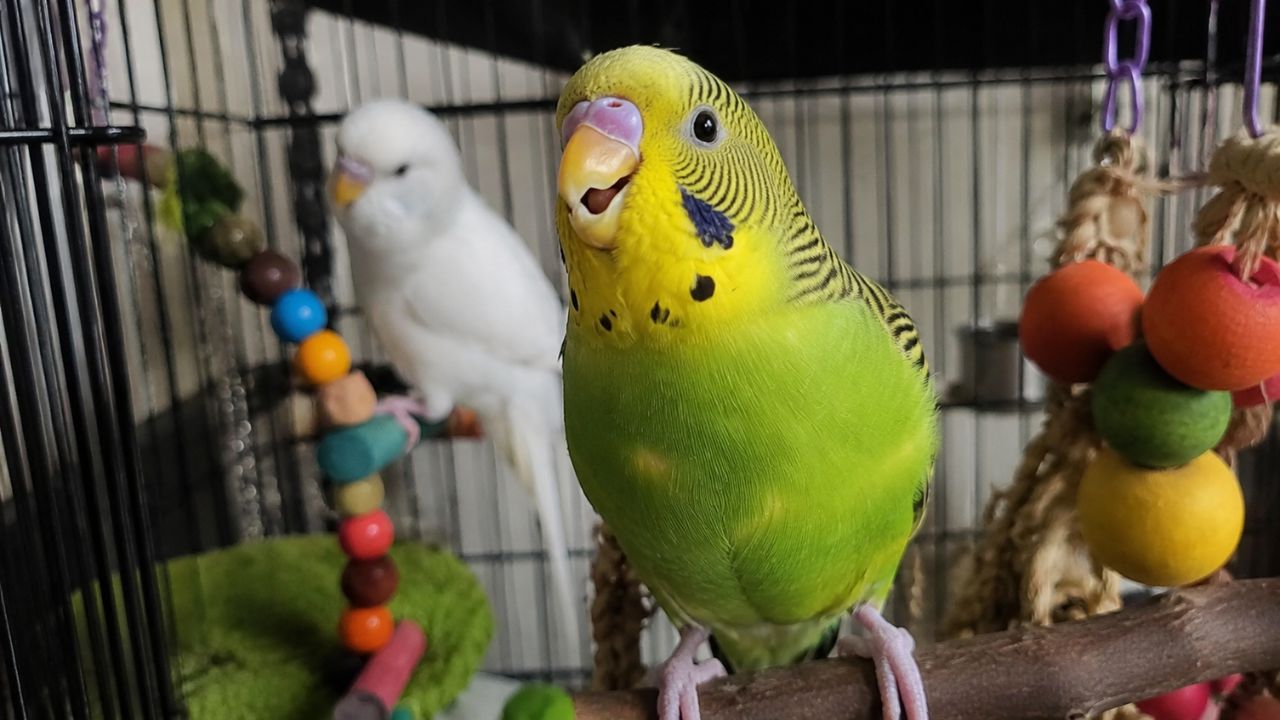

Neil has kept, bred, and sold budgies at Paradise Pets Swindon since 1988 — over 35 years of first-hand experience with these birds. Beak clicking is one of the most frequently misunderstood budgie sounds. Most of the time it means the bird is completely happy. Occasionally it means something needs attention. This guide is how to tell the difference.
People hear a clicking sound from their budgie and immediately assume something is wrong.
Most of the time, the opposite is true.
Beak grinding — the rhythmic, quiet clicking or grinding a budgie makes as it settles down to sleep — is one of the most reliable signs that a bird is content. It is the budgie equivalent of a cat purring. It means the bird feels safe, comfortable, and relaxed. Owners who panic at this sound, or rush the bird to a vet because of it, have misread one of the nicest things a budgie can tell them.
But — and this matters — not all clicking from a budgie is beak grinding. The sounds that come from the beak, from the throat, and from the chest can be difficult to distinguish from a distance. Some of them mean nothing. Some of them mean a vet visit.
The difference between those situations is worth understanding clearly before something that needs attention gets dismissed as contentment, or before a worried owner rushes to a vet over a bird that was simply telling them it was happy.
This guide covers the full range — from the grinding that means everything is fine, to the sounds that mean act today.
The Most Important Distinction — Where Is the Sound Coming From?
Before anything else, this is the question that matters most.
A sound that is genuinely coming from the beak — from the bird physically moving its mandibles together — is almost always harmless. Grinding, clicking, and the sounds of beak-on-beak contact at rest or during feeding are the normal mechanical sounds of a bird using its beak.
A sound that appears to be coming from the throat, the chest, or the bird’s breathing — a click or rattle that you hear with each breath, or between breaths, that does not match any beak movement you can see — is not a beak sound. It is a respiratory sound. And respiratory sounds in budgies are not something to dismiss or wait on.
The practical test: watch the bird when you hear the sound. Is the beak visibly moving, opening and closing, or grinding back and forth? If yes — this is almost certainly a beak sound. Is the beak still, the bird breathing quietly, and the sound coming from the bird’s body rather than its face? If yes — this is a respiratory sound and needs investigation.
Most of this guide covers beak sounds, because those are what the question usually refers to. But the respiratory section towards the end is the part I want every owner to read regardless, because misidentifying a respiratory click as a beak click is a mistake with real consequences.
Beak Grinding — The Contentment Sound Most Owners Mistake for a Problem
Beak grinding is the most common cause of clicking sounds in healthy budgies, and the one most consistently misidentified as a health concern by owners who have not heard it before.
It happens at a specific time: as the bird settles down to sleep. In the last few minutes before a budgie fully closes its eyes for the night — or for a daytime nap — it will often grind its beak back and forth. The sound is a soft, rhythmic clicking or grinding. It is quiet enough that you need to be near the cage to hear it. The bird’s eyes are partially or fully closed, its feathers are slightly fluffed for warmth, and it is in the process of relaxing completely.
This is exactly what it looks like: a happy bird going to sleep.
The evolutionary origin of beak grinding is not fully understood, but the behavioural context is consistent across all parrots and many other bird species — it happens during relaxation and appears to indicate a state of comfort and safety. A bird that does not feel secure will not grind its beak. A bird that grinds its beak is telling you it is content with its environment and feels safe enough to fully let down its guard.
If you hear this sound in the evenings as your budgie settles on its perch, or after a period of activity when the bird rests — do not worry about it. Enjoy it. It is a good sign.
Normal Beak Clicking During the Day — Manipulation and Communication
Outside of the sleep-settling grind, budgies produce a variety of beak-related sounds during their normal daily activity. These are worth knowing about so they are not confused with something abnormal.
Eating sounds. A budgie husking seeds is a busy mechanical process — the bird rolls the seed in its beak, cracks the outer shell, discards it, and extracts the inner seed. This produces audible clicks and cracks. Multiple seeds in rapid succession creates a consistent clicking sound from the cage. This is entirely normal and means the bird is eating well. A cage full of clicking sounds at mealtimes is a healthy cage.
Beak on perch or toys. Budgies tap, explore, and investigate surfaces with their beaks constantly. Tapping on a wooden perch, clicking against a toy, or working at something interesting produces sounds that carry. This is exploratory behaviour — the bird using its beak to investigate its environment, which is exactly what it should be doing.
Communication clicks. Some budgies include clicking sounds in their general vocalisation — as part of the mix of chirps, chatter, and mimicry that makes up their daily sound repertoire. This varies by individual bird. Some birds are clicky talkers. Some are not. If the clicking is part of a broader pattern of normal vocalisation and the bird is otherwise well — this is simply your bird’s particular vocal style.
Alarm clicks. A sharp, short click — sometimes a double click — can be an alarm or alert sound. If a bird is startled or notices something unfamiliar, a single sharp click is sometimes produced alongside a sudden alerting posture. The bird will typically relax within seconds as it assesses the situation. This is a normal response to sudden stimulus, not a health sign.
Clicking From the Beak Due to Overgrowth or Misalignment
When a budgie’s beak is the correct shape and length, the upper and lower mandibles meet cleanly and work smoothly together. When the beak is overgrown, misaligned, or deformed, the mechanics change — and that change can produce an abnormal clicking or snapping sound as the beak is used.
Beak overgrowth. The upper beak — the rhinotheca — grows continuously throughout a budgie’s life and is normally kept in check by the bird’s own activity: eating, chewing, working on cuttlefish bone and mineral blocks, and general beak-on-surface use. If a bird is not eating the right foods, not having enough to chew, or has an underlying health condition affecting beak growth, the upper beak can become overgrown — extending beyond the lower beak in a curve that prevents normal closure.
An overgrown beak changes how the bird eats, drinks, and grooms. It also changes the sounds the beak makes — because the mandibles are no longer meeting correctly, the closing action produces an audible click or snap rather than the smooth action of a correctly proportioned beak.
A vet can trim an overgrown beak safely. Do not attempt this at home — the beak contains blood vessels and incorrect trimming causes bleeding and pain. It takes a few minutes in the right hands and makes an immediate difference to the bird’s comfort and function.
Prevention is better than correction: provide cuttlefish bone, mineral blocks, and hard food surfaces for the bird to use. A bird with appropriate things to work its beak on is much less likely to develop overgrowth.
Beak misalignment. A beak where the upper and lower mandibles do not meet centrally — where one side crosses to the other — produces a characteristic abnormal click because the closing action is catching rather than smooth. Mild misalignment sometimes develops from injury or after a beak trim that was not quite even. Significant misalignment — where the crossing is visibly obvious — needs veterinary assessment.
The Clicking That Is Not From the Beak — Respiratory Warning Signs
This is the section I want every budgie owner to read carefully, because this is where a clicking sound stops being a beak question and becomes a health emergency.
Respiratory infections, obstructions, and other conditions affecting a budgie’s airways can produce clicking, rattling, or wheezing sounds that come from the bird’s chest or throat. To a worried owner listening from across the room, these can sound superficially similar to beak grinding or beak manipulation sounds. They are not the same thing. They are not safe to dismiss.
The distinguishing features of a respiratory click versus a beak click:
It occurs with breathing, not with beak movement. A respiratory click is timed with the bird’s inhalation or exhalation. If you watch the bird and the clicking or rattling sound is happening with each breath — or between breaths, without any visible beak movement — it is coming from the airway, not the beak.
The beak is still when you hear it. Watch the bird’s face while listening. If the beak is closed and still and you can still hear the sound — it is not a beak sound.
The bird also seems unwell. A bird making respiratory sounds is rarely otherwise completely normal. Watch for: tail bobbing with each breath, any change in breathing rate or visible effort to breathe, discharge from the nostrils, changes in posture — the bird sitting more upright or leaning forward, which can indicate breathing difficulty.
The sound is there at rest. Normal beak grinding and manipulation sounds happen during specific activities — settling to sleep, eating, exploring. A sound that is present continuously, at rest, when the bird is not actively doing anything with its beak, is not a beak sound.
If any of these describe what you are hearing — this is a vet call today, not a wait-and-see situation. Respiratory illness in budgies progresses fast. I have written about this in detail in our guide on why budgies sneeze — the respiratory section covers the same territory from a different angle and is worth reading alongside this guide.
Scissor Beak — A Congenital Cause Worth Knowing
Scissor beak — where the upper and lower mandibles cross to one side rather than meeting centrally — is a congenital condition present from hatching. It can range from mild, where the crossing is barely noticeable and causes minimal functional impact, to severe, where feeding becomes significantly difficult.
In mild cases, a budgie with scissor beak may produce an audible click when the beak closes because the crossing mandibles catch slightly on each other. The bird may manage adequately with soft foods and a slightly adjusted diet — softer seeds, soaked or sprouted seeds, finely grated vegetables.
In moderate to severe cases, regular beak trimming by a vet is needed to keep the beak functional. The condition does not correct itself and does not improve with time, but it can be managed with appropriate veterinary support.
If you have bought a young budgie and notice that the beak seems offset — one side crossing to the other — raise it with a vet early. Earlier management gives better outcomes than waiting until the crossing becomes severe.
At Paradise Pets, every bird we sell is checked before it goes to a new home. We do not sell birds with obvious beak deformities. But congenital conditions can sometimes only become apparent as a bird grows, so it is worth knowing what to look for.
- “It’s grinding its beak — something must be wrong with its teeth” — Budgies do not have teeth. The grinding sound is the two mandibles of the beak moving against each other. It is a perfectly normal behaviour that occurs during contentment, particularly at sleep time. No teeth are involved and nothing is wrong.
- “I can hear a clicking when it breathes but it seems fine otherwise” — If you can hear a sound timed with breathing, the bird is not fine otherwise — you are just not yet seeing the other signs. Respiratory clicks are among the earliest signs of airway compromise in small birds. “Seems fine” and “has no respiratory issue” are not the same assessment.
- “The beak click is louder than usual — I think it’s trying to tell me something” — Budgies do communicate through beak sounds, but volume changes are rarely meaningful signals in the way this implies. More useful questions: when does the clicking happen, what is the bird doing when it happens, and is the beak moving when you hear it.
- “I’ll file its beak with a nail file to help” — Never file or trim a budgie’s beak at home. The beak contains blood vessels. Filing incorrectly causes bleeding, pain, and can worsen any underlying alignment issue. If the beak needs attention, a vet with bird experience should handle it.
- “It only clicks at night so it can’t be serious” — Nighttime clicking in a settling bird is beak grinding — a good sign. But nighttime sounds that are happening with each breath, particularly in a bird that seems off-colour, are not safe to dismiss because of the time of day. If the sound is respiratory in character, the time it occurs does not change what it means.
When to See a Vet — The Honest Summary
- Rhythmic grinding sound as the bird settles to sleep, beak visibly moving, bird looks relaxed and comfortable.
Beak grinding — contentment. No vet needed. This is a good sign. Note that this is your bird’s normal settling behaviour so you recognise it reliably in future. - Clicking sounds during eating or while the bird investigates objects in its cage.
Normal beak mechanics. No concern. A healthy bird eating well and exploring actively will produce clicking sounds. This is exactly what should be happening. - Clicking or snapping sound when the beak closes, upper beak appears longer than usual, or the mandibles do not seem to meet centrally.
Possible beak overgrowth or misalignment. Vet this week. Do not attempt to correct this at home. A short appointment with a vet experienced with birds will resolve it quickly. - Clicking or rattling sound timed with breathing, beak is still when you hear it, or the sound is present continuously at rest.
Respiratory sound — not a beak sound. Vet today. Call ahead and describe what you are hearing. Do not wait overnight if the sound is clearly tied to breathing. - Any clicking sound alongside tail bobbing, visible breathing effort, discharge from nostrils, or a bird that seems unwell.
Respiratory emergency. Vet today, urgently. Multiple signs together mean the condition is not early-stage. Call ahead so the practice knows you are coming. - Young bird with a beak that appears offset or crossed — one mandible crossing to the side of the other.
Possible scissor beak. Vet soon for assessment and early management plan. Earlier is better for this condition.
What I Tell Budgie Owners at the Counter
When someone comes in worried about a clicking budgie, the first thing I ask is: what time of day, and what was the bird doing when you heard it?
If the answer is “in the evening, just before it went to sleep, it was sitting on its perch with its eyes half closed” — I tell them that is beak grinding, and that it is one of the nicest sounds their bird can make. The relief on people’s faces when they hear this is always satisfying.
If the answer is “throughout the day, when it’s just sitting there, I’m not sure if it’s the beak or the breathing” — that is a different conversation, and it ends with a recommendation to get the bird seen by a vet with avian experience before the week is out.
The key is being specific about what you are hearing. A vague description of “a clicking sound” does not tell me enough. The more detail an owner can give — timing, what the bird was doing, whether the beak was visibly moving, whether the bird seemed well or unwell — the more accurately I can help them work out what they are looking at.
If you are not sure what you are hearing, come in and describe it to us. Or — even better — take a short video on your phone with the sound audible. Hearing the actual sound is worth considerably more than any description. We are at Manor Garden Centre, Cheney Manor Industrial Estate, Swindon, SN2 2QJ — open every day. Or call us on 01793 512400.
Visit Us at Paradise Pets Swindon
We stock budgies year-round — all UK-bred, all checked and handled from a young age. If you have a concern about your budgie’s beak sounds, or anything else about its health or behaviour, come in and talk to us. A short video on your phone is always helpful. Free advice, no obligation — thirty-five years of experience means we have heard almost every sound a budgie makes.
We also stock a full range of cockatiels, canaries, and finches, alongside guinea pigs, rabbits, and gerbils and hamsters.