

Updated : Clarified budgie head-bobbing behaviour and the limits of judging health from one behaviour.
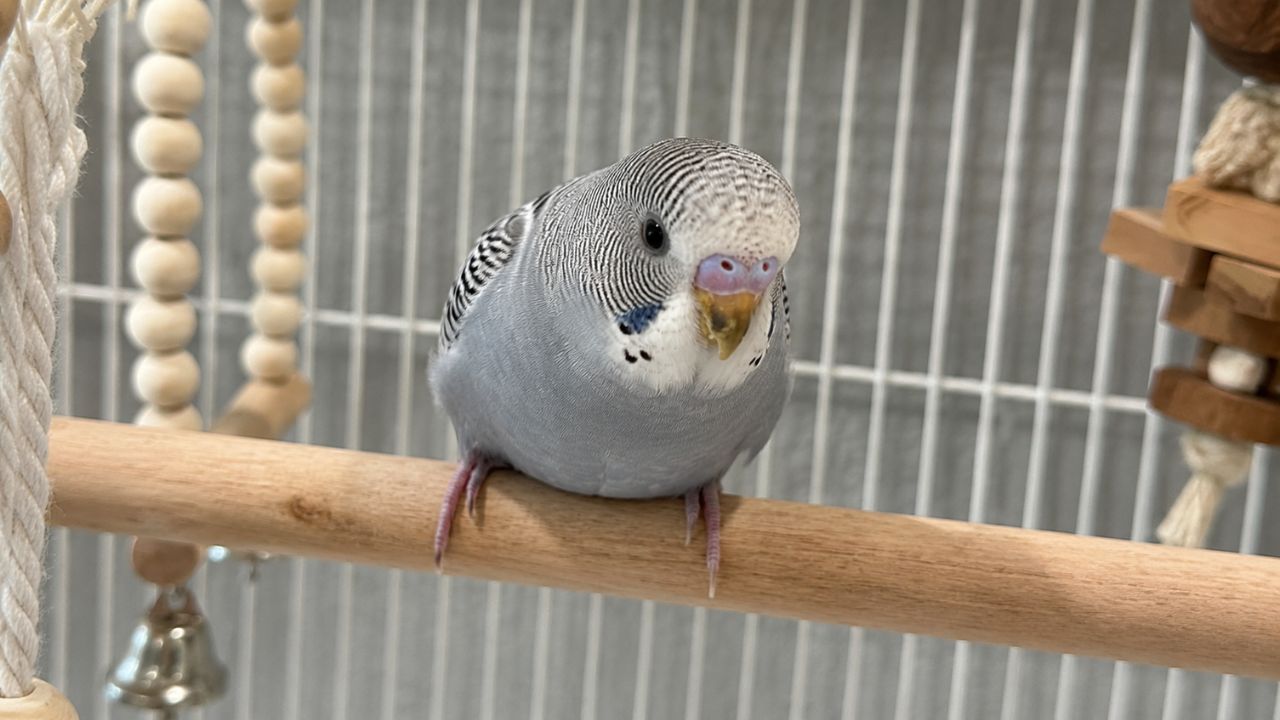
A budgie’s head movements need to be understood in context. Movement during an interaction, around food or while climbing does not have one fixed meaning. A head bob alone cannot tell you that your bird is happy, frightened, bonding or unwell.
Contact an avian vet if head movements are new or persistent, look uncontrolled, involve food or fluid coming up, or accompany a change in balance, appetite, breathing, droppings or activity. Breathing difficulty or collapse needs emergency help.
Start with what you can observe
- When did the movement start, and how often does it happen?
- Is the bird interacting with a person, another bird, a mirror or a toy?
- Is it moving or climbing, or does the movement continue while it is resting?
- Does food appear, and have eating, droppings, weight or activity changed?
A short video may help a vet or qualified behaviour professional assess the situation. Do not repeatedly provoke the behaviour to film it, and do not delay a call for help to get a better recording.
Could it be courtship or food offering?
Food offering can be part of courtship in birds and may be directed towards another bird, a person or an object. VCA’s bird sexual-behaviour guidance also warns that regurgitation and vomiting can indicate illness. A familiar target or calm-looking bird does not exclude a medical cause.
Our budgie regurgitation and vomiting guide explains what to report to a vet. Avoid treating the movement’s speed, clean head feathers or a presumed sign of affection as a diagnostic test.
Young birds and feeding
When a young bird moves its head around food, pay attention to whether it is actually eating. Do not assume that apparent begging is harmless, proof of trust or a reason to attempt hand-feeding. If a newly acquired budgie is not eating normally, contact an avian vet promptly and tell the seller about the concern.
Excitement, approach and withdrawal
Chirping or movement during an interaction can be useful context, but it does not certify a bird’s health or emotional state. Give your budgie the choice to approach or move away. If it lunges, tries to escape or resists contact, stop the interaction and give it space.
The RSPCA’s bird-company guidance stresses that friendly and unfriendly reactions can look similar. Observe the whole interaction rather than relying on a single pose. Do not use a raised-versus-flat ‘crest’ rule to interpret an ordinary budgie’s behaviour.
Movement while climbing
Note whether the head movement occurs only as the bird climbs or also when it is still. This is useful information to record, not proof that every repeated movement is normal. A change in coordination, difficulty perching or loss of balance needs veterinary attention.
What if it happens at a mirror repeatedly?
Review the bird’s daily activity and the object it is focusing on. Removing an object that triggers repetitive courtship may help, but unexplained weight loss or repeated food-bringing still needs veterinary assessment. Do not add a new bird as an immediate remedy.
For husbandry planning, see our budgie companionship guide and the RSPCA’s enrichment suggestions. These support everyday care; they do not replace an examination when a bird is unwell.
Does bobbing prove a strong bond?
A single movement is not a score for your relationship with a bird. Calm, consistent care and allowing the bird to choose its interactions are more useful goals than encouraging a particular display. If the meaning of a behaviour is unclear, describe the context without assuming a motive.
VCA’s signs-of-illness guide provides further context on changes that deserve veterinary attention.
General care advice in Swindon
Paradise Pets is at Manor Garden Centre, Cheney Manor Industrial Estate, Swindon, SN2 2QJ. For general bird-care and supplies enquiries, call 01793 512400 or email [email protected]. Contact an avian vet for illness concerns; a shop conversation cannot diagnose a bird.
Explore our cage and aviary bird information and budgie care guide.