
Can Budgies Live Alone? The Honest Answer From 35 Years

May 29, 2026 by Neil
From the counter at Paradise Pets
Neil has kept, bred, and sold budgies at Paradise Pets Swindon since 1988 — over 35 years of watching what happens when these birds are kept alone, kept in pairs, and everything in between. The question of whether a budgie can live alone is one he answers carefully, because the honest answer is more nuanced than most guides suggest. This is that answer.

Most pet guides give you one of two answers to this question. Either “yes, budgies can live alone perfectly well” — which is technically true and practically misleading. Or “no, budgies must always be kept in pairs” — which is also not quite the whole story.

The honest answer is: it depends. And what it depends on is whether you, as the owner, can realistically provide what a lone budgie needs from you every single day.

That is the question nobody asks. And it is the one that determines whether a single budgie thrives or quietly declines.

I have sold budgies for thirty-five years. I have seen single budgies that were genuinely happy, well-stimulated, and strongly bonded to their owners. I have also seen lone budgies that were lonely, under-stimulated, and slowly withdrawing from the world in a cage in the corner of a room where nobody really paid them much attention. The difference between those two situations is not the number of birds. It is the amount of meaningful human interaction the bird received every day.

This guide gives you the full picture. Not to tell you what you want to hear — to help you make the right decision for your specific household.

“A budgie can live alone. Whether it should depends entirely on what that lone budgie’s day actually looks like. If the answer is ‘mostly in a cage while we’re at work and busy in the evenings’ — that is not a life that works well for a flock bird.”

What Budgies Actually Are — Before We Answer the Question

Wild budgerigars live in flocks. Large ones — sometimes thousands of birds, moving across the Australian outback in formations that shift and settle and rise again. Within those flocks, individual birds form bonded pairs. They preen each other, sleep beside each other, fly together, call to each other constantly.

The calling matters particularly. Budgies are contact callers — they vocalise to maintain connection with their flock. The chirping and chattering of a budgie in your living room is not random noise. It is the bird checking in. It is saying, in the way birds say things, “I am here. Is everyone else here too?”

In a flock, those calls are answered. In a cage in a living room, they may not be — or they may be answered only occasionally, by a human who is busy with other things.

This is the biological context that the “can budgies live alone?” question has to be answered within. Not “can a budgie technically survive without another bird?” — the answer to that is yes. But “can a budgie live as it is biologically built to live, without another bird?” — the answer to that is only if the human fills a genuinely significant portion of what another bird would provide.

Flock
Budgies are flock animals — they evolved in groups of thousands. A lone budgie is not an animal living simply. It is an animal missing something fundamental.
Hours
Meaningful daily interaction needed for a lone budgie — not minutes of passing attention, but genuine, engaged time out of the cage with a present human
Talks more
Single budgies often learn to mimic more readily than paired ones — because they look to their owner for companionship rather than to another bird
Pair
Two budgies is the easier option for most households — the birds meet each other’s social needs, requiring less intensive daily human interaction

What a Lone Budgie Actually Needs From You

If you are going to keep one budgie, you need to be honest about what that means in practice. Not in principle — in the actual daily reality of your household.

A lone budgie needs its owner to be its flock. That is not a metaphor. It means the bird needs a human present and engaged for a significant portion of the day. Not in the same room while you watch television with your back to the cage. Not a quick five minutes in the morning and another five in the evening. Genuine, present interaction.

What that looks like in practice:

Out-of-cage time, daily, in a room where you are present and engaged with the bird. A lone budgie needs at least two to three hours out of its cage every day — ideally more. This is not the bird sitting on a perch in the corner of the room while you scroll your phone. It is the bird on your shoulder, on your hand, on a play stand near where you are sitting, in a room where it can see you and interact with you. The bird is watching you, following your movements, responding to your voice. That is what fills the flock-shaped gap.

Talking to the bird regularly throughout the day. A budgie left in silence with no interaction will stop calling as consistently over time. Talk to it when you pass the cage. Answer its contact calls. It sounds strange to people who have not done it. It matters to the bird in ways that are real and measurable.

Consistent daily presence. A lone budgie in a household where everyone is out all day and busy all evening is a lone budgie that is, in practice, alone most of its waking hours. That is not a lifestyle that works for a flock bird. If your household is regularly away for eight to ten hours and then tired and busy in the evenings, a lone budgie is probably the wrong choice. Two budgies would be the right one — they can meet each other’s social needs during the hours when you are not available.


What Happens When a Lone Budgie Does Not Get Enough

I want to describe this concretely, because it does not happen dramatically. It happens slowly, in ways that are easy to attribute to something else or miss entirely.

A lone budgie that is not getting sufficient interaction will, over weeks and months, become quieter. Not ill-quiet — just gradually less vocal, less active, less interested in investigating new things. The bird that used to call every time it heard your voice starts calling less. The bird that used to climb around the cage enthusiastically starts spending more time sitting in one spot.

By the time this becomes obviously visible, the pattern has usually been established for some time. The bird has adapted — not to a better situation, but to its situation. It has lowered its expectations of the environment, as animals do when the environment consistently fails to provide what they need.

The behaviour changes that come with social deprivation in lone budgies:

Repetitive behaviour. Bar-chewing, pacing the same route, bobbing in a fixed pattern. These are stereotypic behaviours — the bird finding a way to occupy itself that does not require anyone else. They are a sign the animal is under-stimulated and under-socialised.

Feather plucking. I have written about this in our guide on budgie feather loss. Isolation and loneliness are among the most consistent causes of self-destructive feather behaviour. A bird that has enough interaction rarely develops this. A bird that does not is significantly more prone to it.

Reduced vocalisation over time. A bird that has been alone and under-engaged for months will often be quieter than it was when it arrived. This is not the bird settling in and becoming calmer. It is the bird giving up on a behaviour — calling — that has rarely been answered.


The Case For One — When a Single Budgie Makes Sense

I am not going to tell every buyer that they must have two. Because in some households, a single budgie kept properly is a genuinely wonderful pet — and a pair of budgies in the same household might actually be less rewarding for the owner.

Here is the trade-off, and it is a real one.

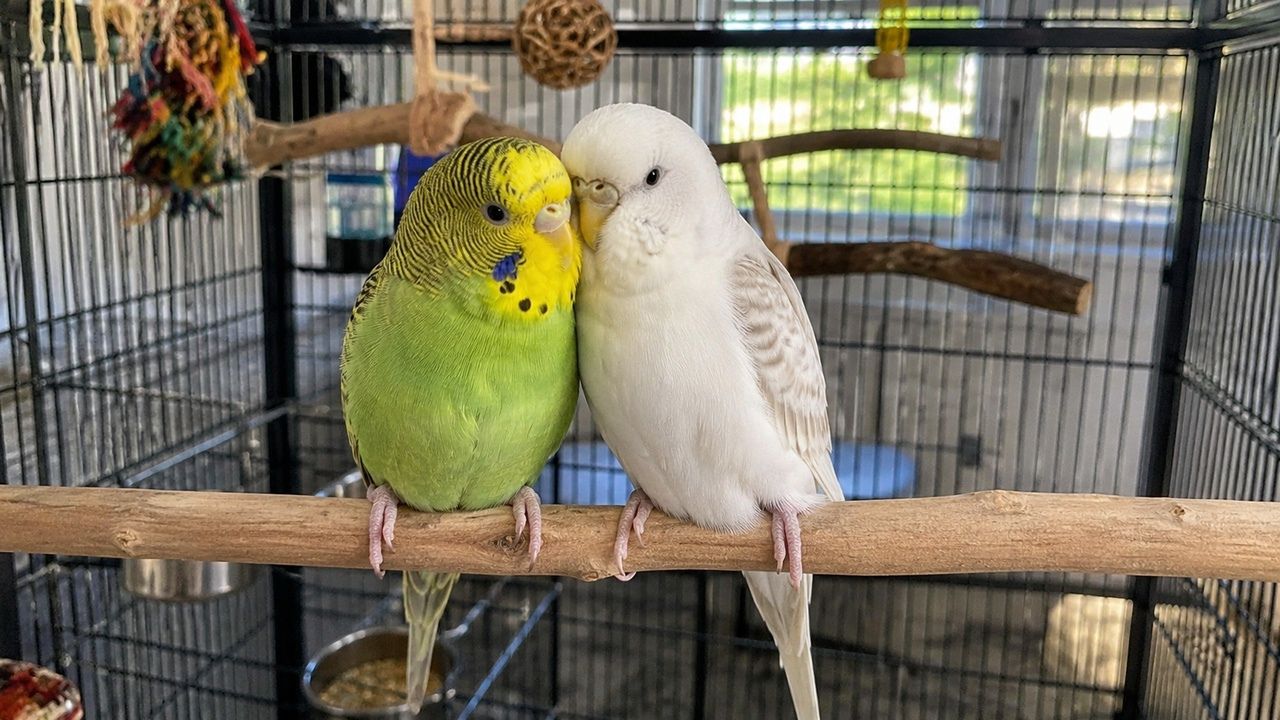
Two budgies will bond with each other. They will groom each other, sleep together, call to each other, and generally meet each other’s social needs. This is good for the birds. It also means that their primary bond is with each other, not with you. A pair of budgies in a well-set-up cage are often perfectly content to be budgies together, with the human as a pleasant but secondary part of their world. They will be less hand-tame, on average. They will be less likely to seek out human interaction independently. And they will be significantly less likely to learn to mimic or talk, because the drive to vocalise toward humans is reduced when another bird is available.

A single budgie, kept with excellent daily human interaction, often becomes something genuinely different. More hand-tame. More responsive to its owner’s voice. More likely to learn words and sounds. More bonded to the people in the household than any pair of budgies typically becomes.

This is not a reason to keep a budgie alone in all circumstances. It is a reason that the single budgie — in the right household — is a legitimate choice rather than an automatic welfare concern.

The right household for a single budgie: someone who is home for significant portions of the day, who genuinely wants to interact with the bird daily, who will provide out-of-cage time consistently, and who finds the deeper bond that a lone budgie forms with its owner rewarding rather than burdensome. A retired person who is home most of the day. Someone who works from home. A family where at least one person is consistently present and engaged.

The wrong household: anyone who is out for most of the day and busy most of the evening. Anyone who wants a bird but is not prepared for the daily time commitment. Anyone who thinks the bird will be fine in its cage as long as it has food and water.


The Case For Two — When a Pair Is the Better Choice

For most UK households, two budgies is the more practical and more honest recommendation. And here is why.

Most households cannot provide the level of daily interaction a lone budgie needs. Not because the owners are negligent — because they have jobs, children, commitments, and the kind of life that does not allow for two to three hours of engaged bird time every day, reliably, without exception.

Two budgies together do not need that from you. They have each other. They are active, entertaining, social, and stimulated during the hours when you are not available. When you are available, they enjoy interaction — but they are not dependent on it for their psychological wellbeing in the way a lone bird is.

Two budgies together are also, in my experience, more entertaining to observe. Watching two bonded birds interact — preening each other, calling to each other, squabbling mildly over a favourite perch — is genuinely enjoyable. There is always something happening. A lone bird in a cage, however good the setup, has a quieter and more limited range of observable behaviour.

If you want budgies as part of the household — birds that are there, that are active, that add life to a room — two is almost always the better answer. If you want a specific, deeply personal bond with one bird and are prepared to invest the daily time that requires — one may be the better answer for you.


The Mirror Is Not the Answer

I need to say this clearly because it comes up constantly when people are trying to solve the lone budgie problem cheaply and easily.

A mirror is not a companion. A budgie interacting with a mirror is interacting with its own reflection — a bird that always does exactly what it does, never initiates, never grooms it, never calls back. Some lone budgies become significantly attached to their mirror image, which looks like successful companionship from the outside but is actually a fixation that can lead to obsessive regurgitation onto the mirror, weight loss, and a deepening of the problem rather than a solution to it.

I have covered the mirror issue in detail in our guide on why budgies regurgitate. The short version: a mirror as a temporary distraction is harmless. A mirror as a substitute for companionship — left permanently in the cage of a bird that has nobody else — is not.

If your bird needs a companion, give it a companion. Either invest the genuine human time that a lone bird requires, or get a second bird. The mirror is neither.


If You Already Have a Lone Budgie — What to Do Now

If you are reading this because you already have a single budgie and you are wondering whether it is getting what it needs — here is how to assess that honestly.

Is the bird vocal throughout the day? A well-socialised, adequately stimulated budgie will call regularly — making contact calls, responding to voices, chirping at activity in the room. A budgie that is mostly quiet is not necessarily ill — but it may be a bird that has learned not to call because calling rarely produces a response.

Does the bird come readily to you when you open the cage? A lone budgie with good daily interaction will typically step up onto a finger without significant hesitation. A bird that retreats when approached is either insufficiently tamed or has learned that human interaction is unpredictable.

Is the bird physically well? Good weight, full feathers, bright eyes, active when out of the cage. Loneliness and under-stimulation show up in physical health over time — feather quality drops, weight fluctuates, and the bird’s general condition gradually declines.

If your honest assessment is that the bird is not getting what it needs, there are two paths. Significantly increase the daily time you invest in the bird — genuinely, consistently, not just this week. Or introduce a companion.

Introducing a second adult budgie to an established single bird needs to be done correctly — not by putting a new bird directly into the existing cage. Use a split cage method, the same approach I described in our guide on budgie care. A divider down the middle of a large cage, both birds on separate sides, swapped daily so they get used to each other’s scent. After a week or two with no aggression through the divider, remove it and watch carefully. Done correctly, most introductions succeed.

Come and talk to us before you buy a second bird. We will help you choose the right companion and walk you through the introduction.


⚠️ Things I hear about lone budgies that are not quite right
  • “It’s fine on its own — it has us” — “Having you” needs to translate to specific, daily, engaged interaction for this to be true. A bird that is in the same house as a busy family, but rarely the centre of direct attention, does not have meaningful company in the way this phrase usually implies.
  • “Two budgies are twice the work” — Two budgies that are bonded to each other are, in most respects, less work than one lone bird that requires intensive human interaction to stay psychologically healthy. The daily cleaning and feeding scales minimally. The daily time commitment scales downwards, not upwards.
  • “She’ll talk more if she’s alone” — Possibly true. But the premise that talking is the goal, and that the talking justifies keeping a social animal without adequate companionship, needs examining. A bird that talks but is lonely is not a better outcome than a pair of birds that talk less but are genuinely content.
  • “He seems happy enough” — Budgies do not perform unhappiness. They adapt to their circumstances quietly. A bird that has been alone for a year is not going to tell you it is lonely — it has adjusted its expectations of the world it lives in. “Seems fine” and “is fine” are not the same assessment in a species that hides its needs as effectively as budgies do.
  • “We give it a mirror so it has company” — A mirror is not company. It is a reflection. The bird cannot receive anything from a mirror — no grooming, no reciprocated call, no genuine social signal. It is a surface that happens to move when the bird moves. Please read the mirror section above if you have a lone budgie with a mirror.

The Questions I Ask Before Recommending One or Two

Neil’s questions before the single or pair decision
  1. How many hours a day is someone home?
    If the honest answer is “most of the day — I work from home, or I am retired, or someone is always in” — a single budgie with genuine daily interaction may work well. If the answer is “we are out from eight until six most days” — two budgies, without question. The bird cannot wait nine hours for its social needs to be met.
  2. Do you want a talking, hand-tame bird as your primary goal?
    If yes, and if the household time commitment is genuinely there, a single male budgie tamed from a young age is the most reliable route to that outcome. A pair will be less focused on humans and less likely to talk. This is a legitimate reason to choose one.
  3. Are there children in the household who will be interacting with the bird?
    Children and budgies can work very well. But children’s attention is not reliably consistent — a bird that has its primary social interaction from a nine-year-old will have good days and forgotten days. A pair of budgies is more resilient to the natural inconsistency of a household with children.
  4. Are you prepared for the daily time commitment of a lone bird?
    Not “yes, of course” — the considered, honest version of that answer. Two to three hours of genuine interaction per day, every day, for the seven to ten year lifespan of the bird. If that sounds like a commitment you can maintain — go ahead. If it sounds like a lot — get two birds, and be honest about that decision.
  5. What has happened with pets in this household before?
    Not a judgmental question — a useful one. If previous pets have been well-cared-for over their full lives, that tells me something about the household’s capacity for sustained commitment. If there is a pattern of pets that were enthusiastically welcomed and gradually neglected, that tells me something too. A lone budgie needs its owner to stay engaged for its entire life, not just the first year.

Whatever you decide, come and see us before you buy. We are at Manor Garden Centre, Cheney Manor Industrial Estate, Swindon, SN2 2QJ — open every day. Or call us on 01793 512400. The conversation takes ten minutes and it makes a real difference to how things go for the bird.

Visit Us at Paradise Pets Swindon

We stock budgies year-round — single birds and bonded pairs, all UK-bred, all handled from a young age. Whether you are buying your first budgie or thinking about adding a companion to a lone bird, come in and talk to us first. We will help you make the right choice for your specific household — not the easiest answer, the right one.

We also stock a full range of cockatiels, canaries, and finches, alongside guinea pigs, rabbits, and gerbils and hamsters.

AddressManor Garden Centre, Cheney Manor Industrial Estate, Swindon, SN2 2QJ

Written by Neil — Neil has owned and run Paradise Pets Swindon since 1988. He has kept, bred, and sold budgies alongside a full range of cage and aviary birds for over 35 years. For advice on whether a single or paired budgie is right for your household, visit us at Manor Garden Centre, Cheney Manor, Swindon — or call 01793 512400.

⭐ Customer Reviews

Amazing Bird Selection

May 25, 2026

Had a lovley visit today,staff were very friendly and very helpful,such a great petshop,their selection of birds is incredible,really impressed,thank so much to the staff at Paradise Pets

Avatar for Craig Shears
Craig Shears

Friendly Helpful Staff

May 25, 2026

I have been coming to this place for years and they have a great stock of food for all types of pets. Have a great selection of small mammals and a lot of birds. Staff are friendly and helpful.

Avatar for Simon Miles
Simon Miles

Great Quality Hutch

May 1, 2026

Bought a guinea pigs hutch and run combo, very happy with the service, the hutch was put in my car for me without even asking for help. The wood quality is very good, the instructions easy to follow and we are extremely happy with the fully built hutch. A good size for 2 guinea pigs

Avatar for Melanie Latus
Melanie Latus

Response from Paradise Pets | Wiltshire

Thank you Melanie Latus Nice to provide services to you.

Best Bird Shop Around

April 29, 2026

It’s the best pet shop in and around Swindon. They always have an amazing selection of birds and all you need to keep them happy. I keep birds myself and the guys there are happy to answer questions and really know their stuff. I have seen budgies etc. in chain pet shops in the area looking really unhealthy and ill – I wouldn’t go anywhere else than Paradise Pets for animals.

Avatar for Joe Salter
Joe Salter

Highly Recommended Bird Shop

April 28, 2026

I could not praise this shop enough. Really helped my Grandson buy his first bird and he’s loving it. Travelled from Somerset and was welcomed with open arms.

Avatar for Debra Hart
Debra Hart

Great Shop with Competitive Prices

April 28, 2026

Great shop with amazing selection for small animals, hamsters, mice ect, highly recommend!

Also has a great selection for dogs & cats too & very competitive prices! 💖

Avatar for Lauren
Lauren

Written by Neil

Neil has owned and run Paradise Pets Swindon since 1988 — over 35 years of first-hand experience keeping, breeding and selling budgies, cockatiels, canaries, hamsters, gerbils, rabbits and guinea pigs. He has helped thousands of UK pet owners over the decades, and everything he writes comes from real experience at the counter — not textbooks. For advice on any pet, visit Paradise Pets at Manor Garden Centre, Cheney Manor, Swindon SN2 2QJ or call 01793 512400.

View more updates from Neil

Leave a Comment