
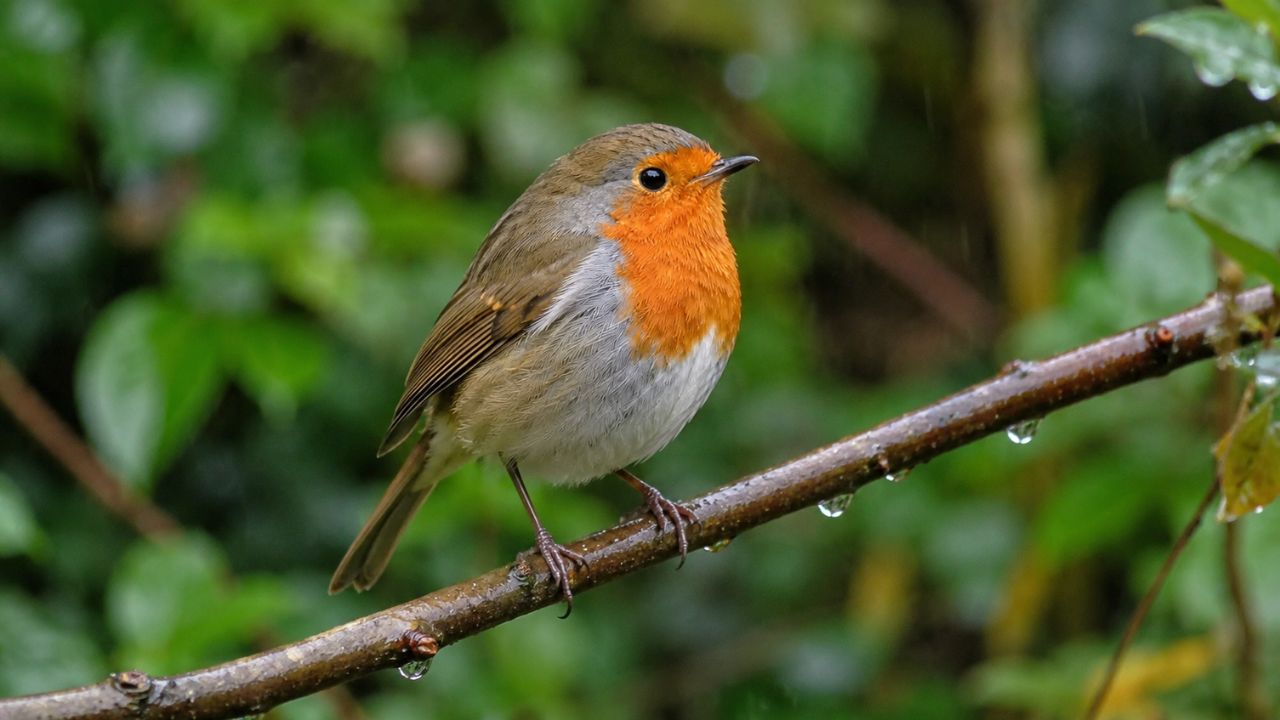
This Beautiful Garden Bird Can Tell You A Lot About The Weather

From the counter at Paradise Pets
Neil has been keeping and selling cage and aviary birds at Paradise Pets Swindon since 1988 — over 35 years of watching birds behave in ways that most people walk past without noticing. He has kept robins in the garden at the shop for most of those years, watched them respond to changes in the weather with a consistency that would put most weather apps to shame, and listened to the folklore surrounding them with the honest curiosity of someone who has had enough years outdoors to know when old observations are worth taking seriously. This article is what he has learned about the robin and the weather — the folklore, the science behind it, and what your garden robin is actually telling you when you bother to watch.

A woman stopped me in the car park at the garden centre a few years ago — not a customer, just someone who had noticed the birds around the shop and wanted to ask a question. She had a robin that visited her garden every morning. She had started to notice that on the mornings it sang from the top of the fence rather than from somewhere lower in the hedge, the day tended to be dry. When it sang from inside the hedge, or did not sing much at all, rain usually followed. She had been tracking it for three months.

“I know it sounds daft,” she said, “but it’s been right more often than not. Is there anything in it?”

I told her there was. Quite a lot, actually.

The robin has been one of the most closely observed birds in the British landscape for as long as people have been paying attention to such things. It is familiar enough to be noticed, present year-round in a way that migratory birds are not, and — crucially — sensitive enough to barometric and environmental changes that its behaviour shifts in ways that are readable to anyone who knows what to look for. The folklore around it is old, widespread across the British Isles, and in many of its specifics, backed up by what we now understand about avian biology.

“I have heard the robin called England’s national bird, a Christmas card cliché, and a sentimental favourite. All of that may be true. But what most people who say these things have never noticed is that the robin sitting on that garden fence is reading the atmosphere with instruments more sensitive than anything most of us have in our kitchens. It has been doing this for millions of years. We just stopped paying attention.”

Why Birds Can Read The Weather — The Honest Science

Before I get into the robin specifically, I want to explain the biological mechanism behind all of this — because once you understand it, the folklore makes immediate sense rather than seeming like superstition.

Birds, as a group, are extraordinarily sensitive to changes in atmospheric pressure. Their inner ears contain specialised pressure receptors — structures called Vitali organs in the cochlea — that detect minute changes in barometric pressure with a precision that far exceeds anything the human sensory system can register. A drop in pressure that is entirely imperceptible to you is already being processed by the robin on your fence, hours before the rain arrives.

This is not folklore. It has been confirmed experimentally. Studies using captive birds in pressure-controlled chambers have demonstrated that birds alter their behaviour in direct response to pressure changes — feeding more intensively when pressure drops, as if preparing for bad weather, and relaxing their feeding pace when pressure rises. The biology has been there all along. The folklore was simply observing it, centuries before the science caught up.

 robin barometric pressure sensor UK garden bird

Pressure sensors
Birds detect barometric pressure changes hours before they become perceptible to humans
Science confirmed
Experimental studies confirm birds alter behaviour in direct response to pressure shifts
Centuries old
UK weather folklore about birds predates modern meteorology — and holds up well against it
35 yrs
Of watching garden birds read the weather in ways that are consistent and reliable

What this means practically is that a bird’s behaviour in the hours before a weather change is not random. It is a physiological response to real atmospheric information. The folklore that grew up around watching these responses was, in most cases, people accurately recording what they observed — without the scientific vocabulary to explain why it was happening.

The Robin And Rain — What The Folklore Actually Says

The robin has accumulated more weather-related folklore in the British Isles than almost any other garden bird. This is partly because it is so familiar and so consistently present — a bird you can observe across every month of the year, in almost every county, in almost every garden. You cannot build a reliable observational tradition around a bird you only see occasionally. The robin’s ubiquity is partly why the observations around it became so specific and so consistent.

The main pieces of UK robin weather folklore, and what they say:

  • A robin singing from high up — a fence post, a rooftop, the top of a tree — indicates fair weather ahead — this is the most consistent piece of robin weather lore across different regions of the UK, and it is the one the woman in the car park had independently rediscovered
  • A robin singing from deep inside a hedge or bush, or singing very little, indicates rain is on the way — the bird is taking shelter from falling pressure in the same way it would shelter from actual rain; the movement to shelter precedes the rain by hours
  • A robin singing in the rain itself means the rain will stop and fine weather is coming — a bold claim, but one that has some biological basis; a bird singing in rain has registered rising pressure and is responding to the improving conditions, not the current ones
  • A robin singing particularly loudly and persistently in autumn foretells an early and harsh winter — less reliably confirmed, but the observation that robins increase territorial song as conditions harden is consistent with known behaviour
  • A robin seen frequently around the house and garden in early autumn is a sign of cold weather coming — robins do move into more sheltered positions as temperatures drop; the appearance of one close to the house in late summer or autumn may simply indicate the bird is responding to cooling temperatures before you have noticed them

robin singing high position fair weather UK folklore

What The Robin Is Actually Doing — And Why

Now let me explain the mechanism behind each of these observations, because this is where the biology and the folklore converge in a way I find genuinely interesting.

Why High Singing Means Fair Weather

When atmospheric pressure is high and stable — the conditions associated with fine, settled weather — a robin feels no pressure-related discomfort. Flying is easier in high-pressure air; the bird’s inner ear pressure receptors are not signalling anything alarming. The bird sings from exposed, elevated positions because it is comfortable to do so, and because elevated singing posts project territorial song more effectively.

When pressure is falling — indicating incoming rain or a weather system — the bird’s pressure receptors register the change. Flying becomes slightly more effortful. The bird responds by moving to more sheltered positions instinctively, in the same way it would move to shelter during actual bad weather. It sings from lower, more covered positions not because it is making a forecast, but because the atmospheric conditions have already changed for it even though the rain has not yet arrived for us.

The robin is not predicting the weather. It is reacting to it. We see the reaction before we experience the weather it is reacting to — and that gap, of several hours in many cases, is what makes the observation useful.

robin singing high exposed position UK fair weather

Why Increased Feeding Before Rain Makes Sense

This is the behaviour the scientific studies most consistently confirm. When barometric pressure drops, birds feed more intensively — taking in more food in a shorter period than they would under stable or rising pressure conditions.

The reason is straightforward: falling pressure precedes bad weather, and bad weather makes feeding difficult or impossible. A bird that can read a pressure drop hours in advance will front-load its caloric intake before the conditions make feeding difficult. It is not a conscious decision any more than your appetite responding to cold is a conscious decision. It is physiological preparation.

At a garden feeding station, this produces a very reliable visible signal. A feeder that is unusually busy in the morning — birds arriving earlier than normal, feeding more intensively, competing more actively than they usually would — is very often followed by rain within a few hours. The woman in the car park had, without knowing it, been observing the singing version of exactly this pattern.

Why Robins Sing In The Rain

This is the one that surprises people most, because singing in the rain seems counterintuitive. Why would a bird sing in bad weather?

The answer is that a robin singing in rain is not singing because it is raining. It is singing because its pressure receptors have detected rising pressure — the front is passing, the conditions are improving. The bird is responding to the pressure rise that signals the end of the weather system, not to the rain currently falling. From your perspective, it is raining. From the robin’s perspective, it is already clearing up.

This is one of the more useful pieces of folk weather observation, because it gives you an indication that poor weather is ending before there is any visible evidence of it. A robin singing clearly and persistently in the middle of steady rain is a reasonable indicator that the rain will not last much longer. Not a guarantee — but an indicator worth noting.

Robin singing in rain UK weather improving sign

Other UK Garden Birds That Read The Weather

The robin is the most celebrated weather-reading garden bird in British folklore, but it is not the only one. Several other common UK garden birds show consistent weather-related behaviour that is worth knowing about.

  • Swallows and swifts flying low — perhaps the most scientifically reliable of all bird weather signs; swallows and swifts feed on insects; falling pressure drives insects lower to the ground; the birds follow their food; swallows skimming low over a garden or field is one of the most consistently accurate rain predictors available; it typically precedes rain by a few hours
  • Blackbirds singing urgently in the evening — a blackbird producing a particularly intense, repetitive alarm-style song as light fades in the evening is often responding to falling pressure; the observation “when the blackbird sings his loudest in the evening, expect rain tomorrow” is old, regional, and more reliable than it might sound
  • Woodpigeons calling more persistently than usual — pigeons and doves are sensitive to pressure changes; unusual persistence in their cooing in calm conditions has been associated with incoming wet weather in various UK rural traditions
  • Seagulls moving inland — one of the most widely known pieces of bird weather folklore, and one with solid observational backing; coastal seagulls move inland ahead of storms because conditions at sea become increasingly uncomfortable before they become dangerous; if you are inland and see unusual numbers of gulls, deteriorating weather is often on the way
  • Garden birds going quiet — in the hour or two before a significant storm, garden bird activity often drops dramatically; the feeding frenzy that precedes bad weather gives way to a period of near-silence as the birds take cover; if your garden goes unexpectedly quiet on what appears to be a calm day, it is worth looking at the sky

swallows flying low UK rain coming weather sign

The Folklore That Has Not Stood Up As Well

I want to be honest about this, because I think credibility requires acknowledging where the old observations are less reliable alongside the ones that hold up.

Not all bird weather folklore survives contact with scrutiny. The specific claims about individual calls or movements of particular birds predicting the exact number of days of rain, or the severity of the coming winter based on the thickness of a particular bird’s plumage, are the kind of observation that sounds plausible in retrospect but does not hold up as a reliable predictive system.

The things that hold up are the behavioural responses — feeding intensity, singing height, shelter-seeking — because these are direct physiological responses to real atmospheric signals. The things that are less reliable are the interpretive elaborations that people have added over centuries — the specifics about duration, severity, and seasonal prediction that go beyond what the bird’s behaviour is actually communicating.

The honest position is this: a robin singing from high up in stable conditions is a reasonable indicator of continued fair weather. A robin singing in rain is a reasonable indicator of improving conditions. A garden feeder that is unusually frantic in the morning is a reasonable indicator of rain later in the day. These are observable, biologically grounded signals worth paying attention to.

What you should not do is treat any bird’s behaviour as a precise meteorological forecast. Birds are barometers, not weather stations. They tell you the direction of change with reasonable reliability. They do not tell you exactly how much rain, for how long, starting at precisely what time. That distinction matters.

“The honest way to think about birds and weather is this: they are reading the same atmospheric signals that produce our weather, and they are reading them earlier and more sensitively than we can. Watching them does not give you a weather app. It gives you a direction of travel. For a farmer, a sailor, or someone planning a day outdoors, that direction of travel — available hours in advance, completely free, and requiring nothing more than knowing what to look for — is genuinely useful.”

How To Use Your Garden Robin As A Weather Guide

If you want to start paying closer attention to what your garden robin is telling you, this is the practical approach I would suggest.

  • Establish its normal — spend a few days simply noting where the robin usually sings from at different times of day; knowing its baseline means you will notice when it changes
  • Note singing height — high and exposed means pressure is stable or rising; low and sheltered means pressure may be falling; track this against the next day’s weather for a few weeks and you will quickly develop a feel for how consistent it is in your specific location
  • Watch the feeders in the morning — unusually intense feeder activity in the early morning, particularly if birds seem more competitive than normal, is one of the more reliable rain indicators in my experience
  • Listen for rain-time singing — if you hear the robin singing clearly and persistently while it is actively raining, give it an hour or two; the conditions are often improving before the rain actually stops
  • Use it alongside other observations — the robin is one signal; combine it with swallow flight height, garden bird activity levels, and the simple observation of which way the wind is coming from; multiple signals pointing the same direction are considerably more reliable than any single one

watching robin garden weather guide UK morning

A Few Things Worth Knowing About The Robin Itself

While I am writing about this bird, I want to give you a few things about the robin itself that most garden owners either do not know or have slightly wrong — because it is one of the most watched birds in the UK and one of the least accurately understood.

  • Robins sing year-round, including in winter — most songbirds fall silent outside the breeding season; robins do not; their winter song is used to defend feeding territories rather than attract mates, and it is typically delivered from lower positions and in a quieter, more melancholy register than the spring song
  • Both males and females hold territories and sing in winter — this is unusual among British birds; the female robin maintains her own territory in winter separate from the male’s, and both birds sing to defend it
  • The robin that follows you when you dig the garden is not being friendly in any sentimental sense — it is following a food opportunity; your digging exposes earthworms and soil invertebrates that the robin wants; the apparent tameness is opportunism, not affection — though the two are not mutually exclusive
  • Robins are aggressive birds — the red breast is a territorial signal, not a decorative feature; robins will fight each other, sometimes fatally, over territory; what looks like a pleasant garden companion is also a bird with a relatively short fuse when it comes to rivals
  • The association with Christmas is old and has a practical origin — Victorian postmen wore red uniforms and were nicknamed robins; Christmas cards featuring postmen were eventually replaced by the actual bird; but the robin’s year-round presence and its tendency to come close to human activity made it a natural garden companion figure long before Victorian greeting cards

robin following gardener UK foraging behaviour

Frequently Asked Questions

Can birds really predict the weather?

Within limits, yes — and the limits are important to understand. Birds detect changes in barometric pressure with significantly greater sensitivity than humans, and they alter their behaviour in response hours before the weather those pressure changes produce arrives. This means observing bird behaviour gives you a directional indicator of coming weather — whether conditions are improving or deteriorating — several hours in advance. It does not give you precision forecasting. The biology is real and experimentally confirmed; the useful application is as one indicator among several, not as a standalone forecast.

Why does a robin singing in the rain mean it will stop?

Because the robin is not responding to the rain — it is responding to the pressure. When a weather system passes and pressure begins to rise again, the robin’s pressure sensors register the change and the bird’s behaviour shifts toward the active singing associated with improving conditions. The rain is still falling when this happens because there is a lag between the pressure change and the weather we experience at ground level. A robin singing clearly in rain has detected the pressure rise that signals the system is clearing, typically an hour or two before the rain actually stops.

What does it mean when birds are very active at my garden feeder?

Unusual intensity of feeding activity — particularly in the morning, and particularly if birds seem more competitive or hurried than normal — is often associated with falling barometric pressure. Birds respond to falling pressure by feeding more intensively as preparation for the bad weather conditions that typically follow it. If your feeder is unusually busy first thing in the morning and the sky looks benign, it is worth looking at a weather forecast. The birds may be ahead of you.

Do all garden birds read the weather the same way?

No. The most reliable weather readers among UK garden birds tend to be species that are highly active fliers — swallows, swifts, and house martins show some of the most consistent and scientifically documented responses to pressure changes. Ground-feeding birds and species that rarely fly high tend to show less dramatic behavioural responses to pressure shifts, though most birds show some response. The robin is notable because it is so commonly observed and its behaviour is readable in ways that the more cryptic or less familiar species are not.

Is the robin actually England’s national bird?

Informally, yes — the robin has been considered England’s unofficial national bird for a long time, and it topped a public poll run by naturalist David Lindo in 2015 to choose a formal national bird. The campaign for official recognition has not resulted in formal designation, but the robin’s status in the popular imagination is uncontested. It appears on more Christmas cards than any other British bird and has been closely associated with the British garden in popular culture for well over a century.

Why does the robin follow me when I garden?

Food. When you dig, turn compost, or disturb soil, you expose earthworms, grubs, and soil invertebrates that the robin feeds on. The robin has learned — either individually or generationally — that large animals disturbing soil means food. It is following a foraging opportunity rather than expressing companionship, though it is a behaviour that has produced a very close and comfortable relationship between robins and humans over centuries of garden-keeping. The tameness and the opportunism are genuine; the sentimentality we project onto the relationship is largely our own.

How can I attract more robins to my garden?

Robins are insectivores and omnivores with a preference for ground-level feeding. Mealworms — live or dried — are probably the most reliable attractant; robins will visit for them with a regularity and boldness that few other foods produce. Turning compost or digging beds will reliably bring a robin to watch proceedings. Dense hedging and shrubby cover provide nesting and shelter habitat. Keeping a small area of the garden slightly wild — leaf litter, undisturbed ground — maintains the invertebrate population that sustains them through winter. Fresh water is appreciated throughout the year, particularly in freezing conditions when other water sources are unavailable.

Can I keep a robin as a cage bird?

No. Robins are wild native British birds and are fully protected under the Wildlife and Countryside Act 1981. It is illegal to keep them in captivity, take them from the wild, or interfere with their nests or eggs. The relationship with a wild garden robin — the bird that follows you round the garden and sings from the fence — is the only relationship available, and honestly, having watched many cage birds over 35 years, it is a more interesting one in several respects.

One Last Thing From Me

The woman from the car park came back about two months after that conversation. She had kept her informal notes going. She was, she said, increasingly convinced there was something in it — not just the singing height, but the feeder activity in the morning and the silence that seemed to precede the bigger weather systems.

“I find myself looking at the robin before I look at my phone in the morning,” she said.

I told her that was probably about right. Not because I would advise anyone to make practical decisions based solely on a robin’s singing position. But because watching a familiar garden bird with genuine attention — noticing what it does, when it does it, how that relates to what the day produces — is one of the older and more quietly satisfying ways of being in a garden. It connects you to something that people in this country have been doing for centuries, in every garden and on every farm, without any technology beyond a pair of eyes and the patience to pay attention.

The robin has been reading the atmosphere longer than humans have been keeping records of the weather. It is still doing it, every morning, on every garden fence in Britain. The question is only whether anyone is watching.

Interested In Birds — Garden Or Otherwise? Come And See What We Have

Whether you want to know more about the birds visiting your garden or you are thinking about keeping cage birds yourself — come in and have the conversation. We stock cage and aviary birds of all kinds and we have been advising on everything to do with birds for 35 years. Free advice, no obligation.

AddressManor Garden Centre, Cheney Manor Industrial Estate, Swindon, SN2 2QJ

Written by Neil — Neil has owned and run Paradise Pets Swindon since 1988. He has kept, bred, and sold cage and aviary birds for over 35 years and watched garden birds with close attention for just as long. For advice on any bird — wild or captive — visit us at Manor Garden Centre, Cheney Manor, Swindon — or call 01793 512400.

⭐ Customer Reviews

Amazing Bird Selection

May 25, 2026

Had a lovley visit today,staff were very friendly and very helpful,such a great petshop,their selection of birds is incredible,really impressed,thank so much to the staff at Paradise Pets

Avatar for Craig Shears
Craig Shears

Friendly Helpful Staff

May 25, 2026

I have been coming to this place for years and they have a great stock of food for all types of pets. Have a great selection of small mammals and a lot of birds. Staff are friendly and helpful.

Avatar for Simon Miles
Simon Miles

Great Quality Hutch

May 1, 2026

Bought a guinea pigs hutch and run combo, very happy with the service, the hutch was put in my car for me without even asking for help. The wood quality is very good, the instructions easy to follow and we are extremely happy with the fully built hutch. A good size for 2 guinea pigs

Avatar for Melanie Latus
Melanie Latus

Response from Paradise Pets | Wiltshire

Thank you Melanie Latus Nice to provide services to you.

Best Bird Shop Around

April 29, 2026

It’s the best pet shop in and around Swindon. They always have an amazing selection of birds and all you need to keep them happy. I keep birds myself and the guys there are happy to answer questions and really know their stuff. I have seen budgies etc. in chain pet shops in the area looking really unhealthy and ill – I wouldn’t go anywhere else than Paradise Pets for animals.

Avatar for Joe Salter
Joe Salter

Highly Recommended Bird Shop

April 28, 2026

I could not praise this shop enough. Really helped my Grandson buy his first bird and he’s loving it. Travelled from Somerset and was welcomed with open arms.

Avatar for Debra Hart
Debra Hart

Great Shop with Competitive Prices

April 28, 2026

Great shop with amazing selection for small animals, hamsters, mice ect, highly recommend!

Also has a great selection for dogs & cats too & very competitive prices! 💖

Avatar for Lauren
Lauren

Written by Neil - Owner, Paradise Pets Swindon

Neil has owned and run Paradise Pets Swindon since 1988 — over 35 years of first-hand experience keeping, breeding and selling budgies, cockatiels, canaries, hamsters, gerbils, rabbits and guinea pigs. He has helped thousands of UK pet owners over the decades, and everything he writes comes from real experience at the counter — not textbooks. For advice on any pet, visit Paradise Pets at Manor Garden Centre, Cheney Manor, Swindon SN2 2QJ or call 01793 512400. Neil is not a veterinary surgeon. For urgent illness, injury or emergency symptoms, pet owners should contact a qualified vet. Meet Neil, owner of Paradise Pets Swindon since 1988. Neil writes practical, first-hand pet care advice based on more than 35 years of helping UK owners with birds, rabbits, guinea pigs, hamsters, gerbils and other small pets.

View more updates from Neil - Owner, Paradise Pets Swindon

Leave a Comment