


Neil has been keeping and selling birds at Paradise Pets Swindon since 1988 — over 35 years of daily engagement with birds of all kinds, wild and captive. In that time he has watched the house sparrow go from a bird so ubiquitous that nobody gave it a second thought, to a species whose absence from streets it once dominated has become genuinely noticeable. This article is his honest account of what has happened to the house sparrow in the UK, why it has happened, and what ordinary households can practically do to help.
An older gentleman came into the shop about two years ago. He had grown up in Swindon, had lived in the same street for most of his adult life, and had a specific and slightly melancholy thing he wanted to say. There had been house sparrows in his street his entire life. In the gutters, on the eaves, in the hedges, arguing noisily in small groups every morning. They were, in his words, just part of the street — like the postbox and the lamppost and the cracked paving stone outside number fourteen.
He had noticed, over the past several years, that they were gone. Not reduced. Gone. He could not say exactly when the last one had been. They had just faded out, the way things do when you are not specifically watching for them, and one day he had realised he had not heard a sparrow on his street in a long time.
“I know it’s silly,” he said. “They’re just sparrows. But it doesn’t feel right.”
It is not silly. And it is not just his street.
The house sparrow has declined by an estimated 60 percent in the UK since the mid-1970s. In some urban areas — particularly London and other major cities — the decline has been steeper than that. A bird that was, for most of the twentieth century, one of the most familiar living things in British streets and gardens has become genuinely scarce in places where it was once impossible to avoid.
The Scale Of What Has Happened
Before I go into the reasons, I want to give you the honest picture of the numbers — because the scale of the sparrow decline is not always conveyed clearly, and understanding it changes how you think about the individual things that can be done to help.
The house sparrow was the most commonly recorded bird in the UK’s first Breeding Bird Survey in the early 1970s. At its peak, the UK population was estimated at somewhere between 12 and 14 million pairs. The current estimate is around 5 million pairs — a decline of roughly 60 percent over fifty years.

The decline has not been uniform. Rural sparrow populations, while reduced, have held up better than urban ones. The steepest falls have been in cities and large towns — precisely the places where sparrows were once most densely concentrated. A bird whose identity was bound up with human settlement has been hit hardest in the places of greatest human settlement. That irony is not accidental, and understanding it is central to understanding what has gone wrong.
Why Sparrows Are Disappearing — The Honest Picture
There is no single cause for the house sparrow decline. Anyone who tells you there is — whether they are blaming cats, or sparrowhawks, or mobile phones, or any single factor — is oversimplifying something that is genuinely complex. The honest answer involves several things happening at the same time, their combined effects greater than any one of them alone.
Reason 1 — The Loss Of Food For Chicks
This is the factor that most ornithologists and researchers now consider the most significant driver of the urban sparrow decline, and it is the one least often mentioned in popular accounts.
Adult house sparrows are predominantly seed eaters. This is well known. What is less well known is that house sparrow chicks — in the nest, for the first week or two of life — cannot digest seed. They require invertebrates: small insects, aphids, caterpillars, soft-bodied bugs. Without a reliable supply of invertebrate food near the nest during the breeding season, sparrow chicks do not survive.
Urban environments have become significantly poorer in invertebrates over the past fifty years. The reasons are multiple — pesticide use in gardens, the loss of rough ground and weedy margins to development and tidying, the decline of older buildings and infrastructure that harboured insects, the reduction in the diversity of urban planting. The result is that urban sparrow pairs, attempting to breed in places where they have bred for generations, are unable to find enough invertebrate food to raise chicks successfully. The nests fail, or chicks die before fledging. The adult population is not being replaced.
- Chicks need invertebrates, not seed — this is the critical fact that most garden feeding misses; filling a feeder with grain and seed does not help breeding sparrows
- Urban invertebrate populations have declined significantly — pesticide use, over-tidy gardens, loss of rough vegetation, hard landscaping all reduce the insect life sparrows need to feed chicks
- The result is poor breeding success — adult birds survive, but chick mortality is high; the population ages and shrinks without adequate replacement
- The most impactful thing households can do — increase the insect-friendliness of garden spaces; more on this below
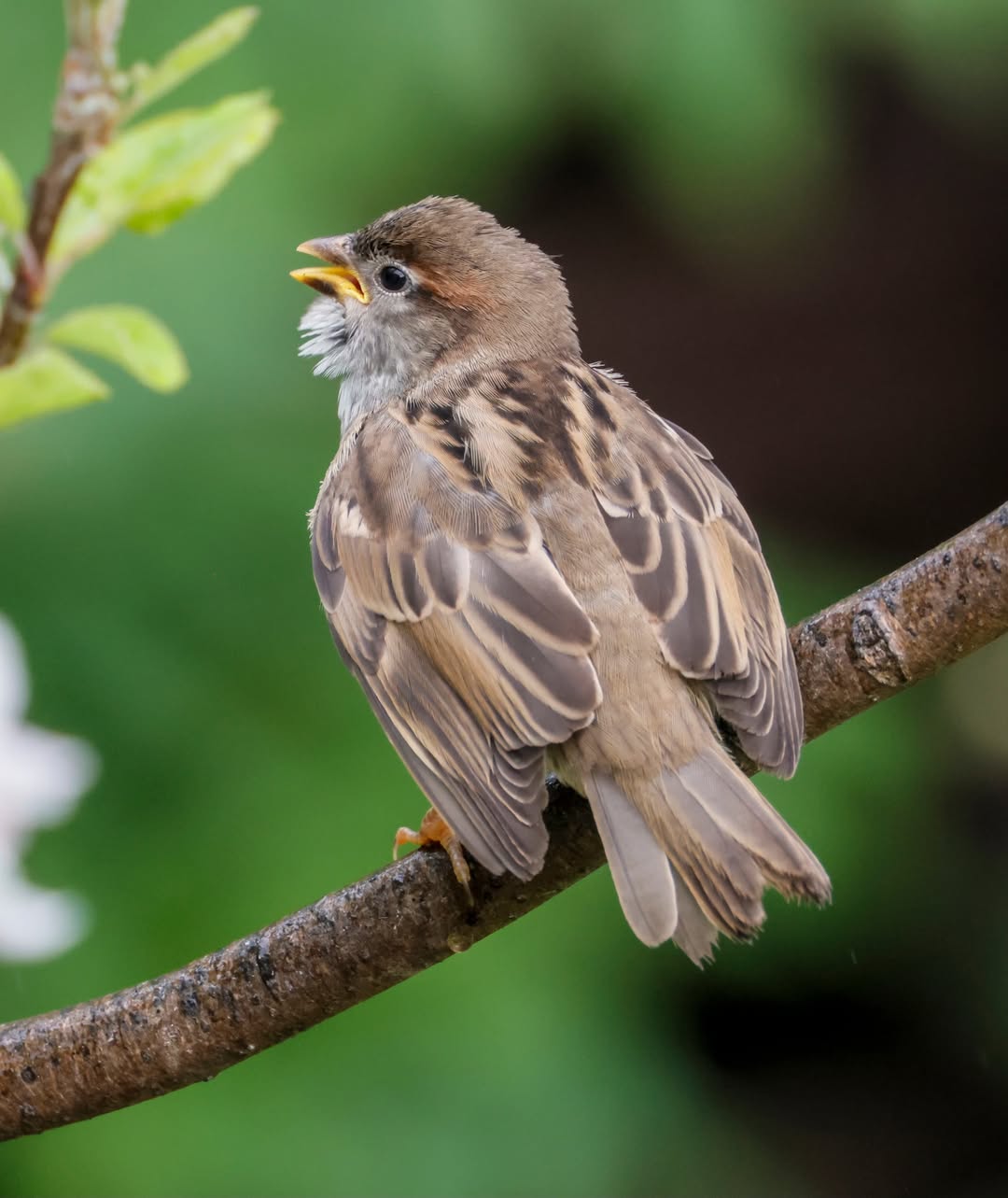
Reason 2 — The Loss Of Nesting Sites
House sparrows are cavity nesters. They nest under roof eaves, in gaps in old brickwork, behind loose fascia boards, in wall cavities, in thick ivy and climbing plants. The architecture that suited them perfectly was the traditional Victorian and Edwardian housing stock that dominates much of UK urban areas.
What has changed is the renovation and modernisation of that housing stock. Cavity wall insulation fills the gaps. UPVC fascia boards replace the old painted wood with its gaps and loose sections. Roof renovations seal the eaves. Rendering covers old brickwork. Every individual improvement makes a house warmer, cheaper to heat, better maintained — and eliminates another sparrow nest site. Multiplied across millions of houses over fifty years, the cumulative effect on available nesting cavities has been enormous.
- Traditional housing provided abundant nesting cavities — gaps in eaves, loose tiles, old brickwork, ivy on walls; all now systematically removed in renovation
- Modern buildings provide almost none — new construction is sealed and smooth by design; sparrows cannot colonise it
- The renovation of existing stock has been continuous and cumulative — each house improved removes nest sites that were used for generations
- What can be done — nest boxes designed specifically for house sparrows, installed in the right positions; more on this below

Reason 3 — Changes In How We Keep Gardens
The British garden has changed significantly over the past fifty years, and most of the changes have been bad for sparrows and the invertebrates they depend on.
- The decline of the weedy, untidy garden margin — rough patches, unmown corners, weedy borders, sprawling hedges — these are precisely the habitat that harbours the invertebrate life sparrows need; the tidier the garden, the fewer the insects
- Hard landscaping replacing grass and plants — driveways, patios, and decking replacing lawn and beds eliminate foraging habitat and reduce the bare soil sparrows use for dust-bathing and foraging
- The decline of the traditional mixed hedge — dense hedgerow planting, particularly of native species, provided both nesting cover and a rich invertebrate food source; it has been progressively replaced by fence panels and walls
- Over-tidying in autumn and winter — removing seed heads, clearing fallen leaves, cutting back dead plant material eliminates food sources and habitat for overwintering invertebrates that form an important part of the food chain in spring
- The use of pesticides and herbicides in gardens — insecticides kill the invertebrates directly; herbicides remove the weedy plants that support insect communities

Reason 4 — The Disappearance Of Horse-Drawn Transport And Grain Spillage
This is the historical factor that explains something that is sometimes missed — why the sparrow was so extraordinarily abundant in cities in the nineteenth and early twentieth centuries, and why its numbers began to fall even before the more recent factors came into play.
The house sparrow’s relationship with human settlement was built, in significant part, on the horse. Urban horses — drawing carts, buses, delivery vehicles — were everywhere in British cities until the early twentieth century. Horses spill grain. Horses produce dung rich in undigested grain and invertebrates. Urban sparrow populations fed heavily on this resource, and the resource was enormous.
The replacement of horse transport with motor vehicles between roughly 1900 and 1930 removed a food source that had supported sparrow populations for centuries. The sparrow decline that accelerated in the 1970s had, in some respects, an earlier chapter. The species adapted as best it could to a changed urban food landscape — but the long-term trajectory was set earlier than most people realise.
Reason 5 — Predation Pressure
I want to address predation honestly, because it comes up in discussions of garden bird decline and the answer is more nuanced than either side of the debate usually admits.
Sparrowhawk populations have recovered strongly since the banning of organochlorine pesticides in the 1970s, and sparrowhawks do take house sparrows. Cat predation of garden birds is significant and well-documented. Urban fox populations have increased.
The honest assessment of the research is that predation is a contributory factor — it exerts real pressure on sparrow populations that are already struggling from the other causes I have described — but it is not the primary driver of the long-term decline. A sparrow population with sufficient food, good breeding success, and adequate nesting sites can sustain predation pressure. It is the combination of reduced food, reduced nesting, and reduced breeding success that leaves populations too thin to absorb even normal predation levels.
Blaming cats or sparrowhawks for the sparrow decline is an oversimplification that distracts from the habitat and food changes that are the primary causes.
What Ordinary Households Can Actually Do
This is the section most people reading this article are looking for, and I want to be more specific than most accounts manage to be. Vague advice to “make your garden wildlife-friendly” is not particularly useful. What follows are the specific things that the evidence suggests make a genuine difference to house sparrows.
What Works 1 — Install Sparrow-Specific Nest Boxes
A single nest box is unlikely to produce a sparrow colony. Sparrows are colonial nesters — they like company, and they are more likely to use nest boxes when several are available in close proximity. A group of three or more sparrow-specific nest boxes, installed together on the same wall, is considerably more effective than isolated single boxes.
- Use sparrow-specific boxes — the entrance hole diameter matters; 32mm for house sparrows; boxes with smaller holes designed for blue tits will exclude sparrows
- Install in groups of three or more — close together on the same wall; sparrows are colonial and this matches their nesting behaviour
- North or east facing if possible — away from direct afternoon sun, which can overheat the box in summer
- At least 2 to 3 metres from the ground — reduces ground predator access and provides the height sparrows prefer
- Under an eave if possible — this mimics the natural nest position sparrows have used in buildings for centuries and provides weather protection
- Clean boxes once a year — after the breeding season, in autumn; remove old nesting material; sparrows may use the same box across several years if it remains suitable

What Works 2 — Create Invertebrate Habitat In The Garden
As I described in the reasons section, the shortage of invertebrate food for chicks is now considered the primary driver of urban sparrow breeding failure. Addressing this is the highest-impact thing a householder can do — but it requires a different kind of thinking from simply putting out a feeder.
- Leave a patch of the garden rough and unmanaged — an area of longer grass, weedy plants, and leaf litter in a corner; this single change can meaningfully increase invertebrate diversity
- Plant native species — native plants support significantly more invertebrate life than ornamentals; hawthorn, blackthorn, dog rose, and native wildflowers all support insect communities that introduced ornamentals do not
- Stop using insecticide and herbicide in the garden — insecticides kill the food chain directly; herbicides remove the plants that support it; neither is necessary in a garden managed with wildlife in mind
- Leave seed heads standing through autumn and winter — they feed seed-eating birds directly and provide habitat for overwintering invertebrates that become food in spring
- Reduce the proportion of hard landscaping — any lawn, bed, or border replacing paving or decking improves invertebrate habitat; even a narrow border makes a difference
- Consider a log pile — a pile of old logs in a shaded corner creates habitat for beetles, centipedes, woodlice, and other invertebrates; it looks untidy and it is ecologically valuable

What Works 3 — Provide Food Thoughtfully
Garden feeding for sparrows is useful, but the type of food and when it is provided matters more than most people realise.
- Millet, wheat, and mixed seed — house sparrows are seed eaters and these are their preferred foods; avoid niger seed, which is primarily for finches; a simple mixed grain and seed on a platform feeder or scattered on the ground works well
- Ground feeding or low platform — sparrows feed most naturally at ground level or close to it; hanging feeders designed for acrobatic tit species are less suitable; a flat platform feeder at low height suits sparrows well
- Feed consistently through winter — winter food shortages affect adult survival; consistent feeding through the cold months supports the adult population that will attempt to breed in spring
- Mealworms during the breeding season — live or dried mealworms provided during spring and early summer provide a protein source that partially compensates for the invertebrate shortages that cause chick mortality; this is one of the more direct feeding interventions that genuinely helps breeding success
- Fresh water always available — for drinking and bathing; sparrows bathe frequently and a shallow dish at ground level or near the ground is well used

What Works 4 — Think Beyond Your Own Garden
House sparrows are not solitary birds. They are colonial, they live in loose social groups, and they need enough connected habitat to support a functioning colony. A single improved garden in a street of otherwise inhospitable gardens may attract passing sparrows but will not sustain a breeding population.
- Talk to neighbours — the impact of several households making changes in the same street is genuinely greater than the sum of the individual changes; a street with three or four sparrow-friendly gardens is qualitatively different from one with a single isolated one
- Support the hedgerow rather than the fence — if you have a boundary to mark, a native hedge is incomparably better for sparrows and other wildlife than a close-board fence panel
- Encourage any local green spaces to be managed for wildlife — parks, school grounds, road verges managed with some rough margins rather than close-mown grass support the wider invertebrate and seed plant communities that sparrows depend on
What Does Not Help — Being Honest About The Limits
I want to be honest about the things that are commonly recommended and that have limited impact, because clarity about what works allows people to prioritise better.
- Cat collars with bells — may reduce hunting success slightly but the evidence for meaningful population-level impact is limited; useful individual measure, not a solution
- A single nest box installed in isolation — rarely taken up by sparrows without other boxes nearby; the colonial nesting behaviour makes isolated boxes significantly less attractive than groups
- Feeding seed alone without addressing invertebrate habitat — supports adult sparrow survival in winter but does not address the breeding failure that is driving the long-term decline; necessary but not sufficient
- Blaming sparrowhawks and advocating their control — sparrowhawks are a protected native species; the evidence does not support them as a primary cause of the sparrow decline; targeting them would be both illegal and ineffective
Where Sparrows Are Still Doing Well — What That Tells Us
The sparrow decline has not been uniform, and the places where sparrows remain abundant are informative about what they need.
House sparrows remain genuinely common in areas with older, less renovated housing stock — particularly streets with old eaves, loose brickwork, and abundant ivy. They are common on farms and in agricultural settings where grain spillage and rough habitat are available. They are found in higher numbers in gardens and parks with dense shrubby planting and minimal pesticide use.
These patterns point directly back to the causes I have described. The sparrow is not disappearing because something has happened to the sparrow. It is disappearing because the environment it depended on has changed. Where that environment is preserved or recreated, sparrows remain.
This matters because it means the decline is not inevitable. It is a response to specific, human-created changes, which means that specific, human-made changes in the opposite direction can genuinely help. The evidence that nest boxes, reduced pesticide use, insect-friendly gardening, and consistent feeding make a real difference at the local level is real. It does not reverse the national trend overnight. But it matters, and the cumulative effect of thousands of households making these changes is not negligible.

Frequently Asked Questions
Why have sparrows disappeared from my garden when they used to be there?
The most common explanations are: loss of nesting sites through building renovation or removal of suitable vegetation; reduction in invertebrate food near the nest during the breeding season; reduction in seed-bearing plants; and the fragmentation of local sparrow colonies below a viable size. In most cases, several of these are happening simultaneously. The specific thing that changed may be in your garden, in a neighbour’s, or in the wider street — sparrows require a territory of connected suitable habitat, not just a single garden.
What is the single most effective thing I can do to help sparrows?
Create invertebrate habitat. Not seed feeders — the research consistently points to invertebrate food shortage during the breeding season as the primary driver of sparrow population decline in urban areas. A rough patch of unmown garden with native plants and no pesticide use does more for sparrow breeding success than any feeder. Combined with a group of nest boxes and winter seed feeding, this is the most complete single-household intervention available.
Do sparrows come to garden feeders?
Yes — adult sparrows eat seed and will visit feeders regularly, particularly in winter. Mixed grain and seed on a platform feeder or ground feeder is the most suitable format. They feed most naturally at or near ground level and are less inclined than some species to use hanging feeders requiring acrobatic access. Consistent winter feeding supports adult survival and keeps birds in the area, which is a foundation for breeding when conditions allow.
Are house sparrows endangered in the UK?
Not in the technical sense — the population is still in the millions and the species is not at risk of extinction. But the house sparrow has been on the UK Birds of Conservation Concern Red List since 2002, indicating that the scale and speed of decline is a genuine conservation concern. Red List status reflects a species that has declined significantly and requires attention, even if it is not at the point of acute extinction risk.
Why are sparrows declining in cities but less so in the countryside?
Because urban environments have lost more of the specific things sparrows need than rural ones have. The combination of building renovation removing nest sites, intensified garden management reducing invertebrates, and the loss of rough food-producing habitat has hit urban sparrow populations harder than rural ones, where agricultural settings, older buildings, and less intensively managed land still provide some of what the species requires.
Can I attract sparrows back to a garden where they used to be?
Possibly, but it depends significantly on whether there are any sparrows remaining in the wider area. Sparrows are not solitary colonisers — they move into areas where other sparrows are already present more readily than they pioneer completely empty territories. If there are sparrows in neighbouring streets or nearby green spaces, improved habitat in your garden can attract them. If the local population has collapsed entirely, individual garden improvements are unlikely to bring them back alone; coordinated neighbourhood action is more effective in that situation.
Do cats significantly affect sparrow populations?
Cat predation of garden birds is real and documented. Studies estimate that domestic cats in the UK kill tens of millions of birds annually. Whether this is a significant cause of the sparrow decline specifically — rather than a pressure on an already reduced population — is debated. The consensus among researchers is that habitat loss and food shortage during breeding are the primary causes, and that predation is a contributory pressure rather than the main driver. Keeping cats in at dawn and dusk, when birds are most active and vulnerable, and fitting bells to outdoor cats are individual-level mitigation measures.
Where can I get advice about helping garden birds near Swindon?
Come in to Paradise Pets at Manor Garden Centre, Cheney Manor Industrial Estate, Swindon SN2 2QJ — or call us on 01793 512400. We stock nest boxes, seed and grain mixes, and feeding equipment, and we are happy to talk through what is most likely to make a difference for the birds in your specific garden and street. The advice is always free.
One Last Thing From Me
The gentleman who came in to tell me about his street — the one where the sparrows had faded out over the years — listened carefully to most of what I have described in this article. He was the kind of person who actually listened rather than waiting to speak, and he asked good questions.
At the end of it he was quiet for a moment and then he said something I have thought about quite a bit since.
“So it’s not one thing. It’s everything changed at once, a little at a time, and the sparrows just ran out of road.”
That is, as accurate a summary as I could give. Not one catastrophe. Not one villain. A slow accumulation of small changes — the UPVC fascias, the pesticides, the paved-over front gardens, the tidied-up borders — each individually reasonable, collectively producing an environment that a bird which had lived alongside humans for thousands of years could no longer navigate.
He put three sparrow nest boxes up the following spring. His neighbour put up two more after a conversation over the fence. By the following summer he had a small group of sparrows using two of the boxes.
Not the street of his childhood. But a start. And, honestly, more than most streets have managed.
If you have noticed that the sparrows on your street are fewer than they were — or gone — you are not being sentimental. You are noticing something real. And if you want to do something about it rather than just noticing it, the things I have described in this article are where to start.
Want To Help Garden Birds? Come In And We’ll Point You In The Right Direction
Nest boxes, seed mixes, feeding equipment, and honest advice about what actually makes a difference — we have all of it and we are happy to help. Free advice, no obligation. That is how we have done things here for 35 years.