
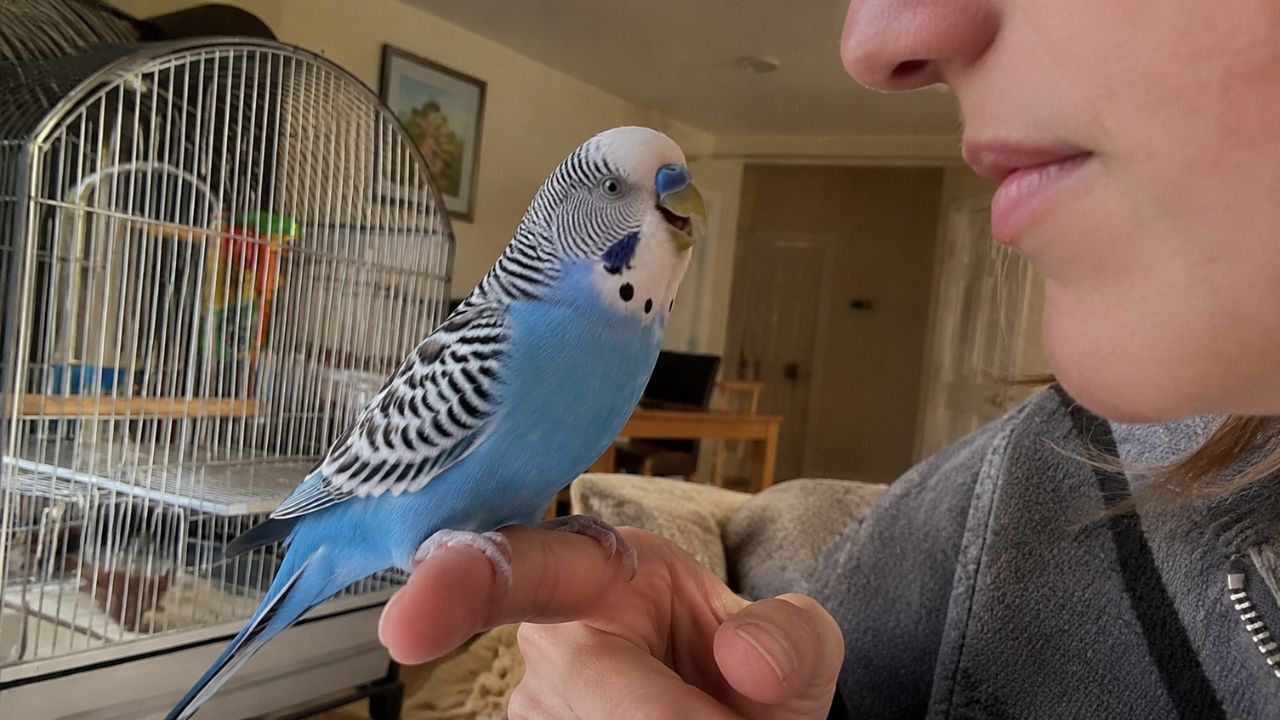

Neil has kept, bred, and sold budgies at Paradise Pets Swindon since 1988 — over 35 years of first-hand experience with these birds. In that time, he has helped hundreds of UK owners teach their budgies to talk — and watched just as many make the same mistakes that prevent it from ever happening. This article is his honest guide to what actually works.
A young woman came into the shop about two years ago, frustrated. She had a nine-month-old male budgie called Charlie. She had been trying to teach him to talk for six months. She had watched videos online. She had repeated words to him for what felt like hours. She had tried teaching him his name, the word “hello,” a phrase or two. Nothing. Not a single recognisable word.
I asked her a few questions. When did she do the training sessions? In the evening, she said, when she was watching television. How long were the sessions? She kept at it until he seemed to lose interest, she said — sometimes twenty minutes or more. Was Charlie alone, or did he have another budgie? Alone, she said. She had wanted Charlie to bond with her rather than another bird.
I told her gently that she had made three of the most common budgie talking mistakes, all at once — and that none of them were her fault, because almost nobody tells new owners the truth about what actually works.
By the time she left the shop, she had a clear picture of what to change. Three months later she rang to tell me that Charlie had said “hello Charlie” clearly enough that she had almost dropped her coffee.
That is the conversation this article is about.
First — The Honest Truth About Budgie Talking
Before I give you the method, I want to set realistic expectations — because unrealistic expectations are the source of most of the frustration I see at the counter.
Not every budgie will talk. I want to say that clearly. The ability to mimic human speech is not uniformly distributed across the species. Some budgies become accomplished talkers with clear, recognisable vocabularies. Some learn a handful of words or phrases. Some never produce anything recognisably human, despite perfectly good training.
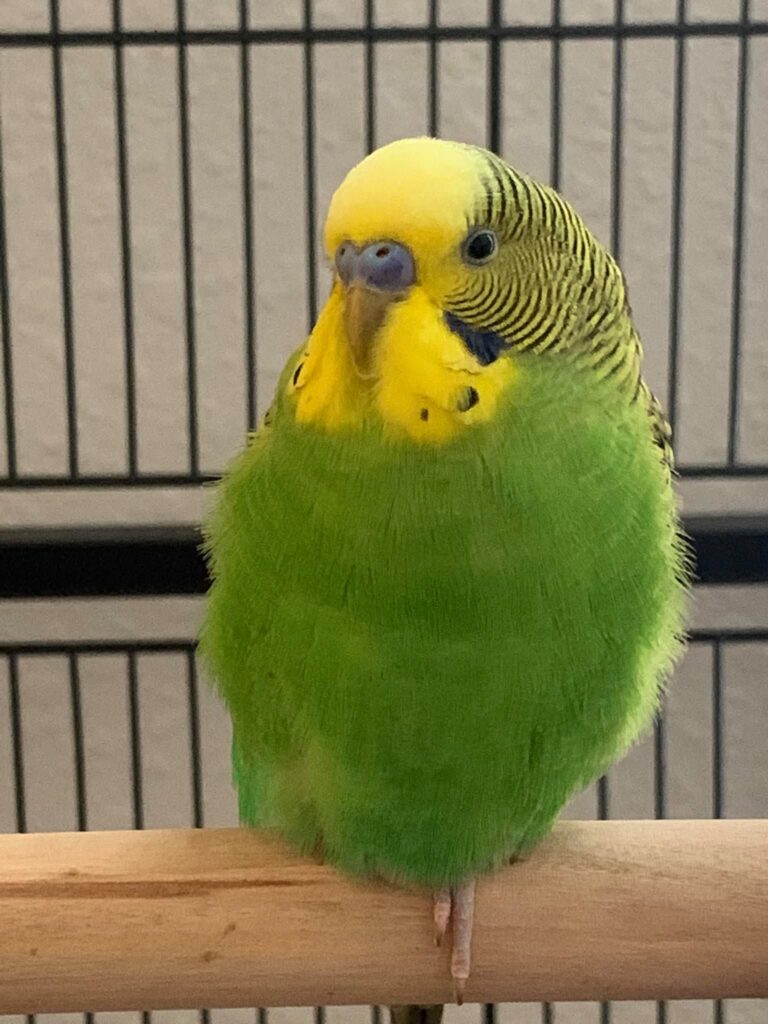
Several factors affect the likelihood of a budgie talking — sex, age, individual personality, and environment. Understanding these upfront means you can make good decisions about which bird to get, set appropriate expectations, and not feel like a failure if your specific bird turns out to be a non-talker.
Which Budgies Are Most Likely to Talk?
Let me go through the factors that genuinely affect talking ability — because choosing the right bird is the most important step, and it is the one that happens before any training begins.
Males Talk — Females Rarely Do
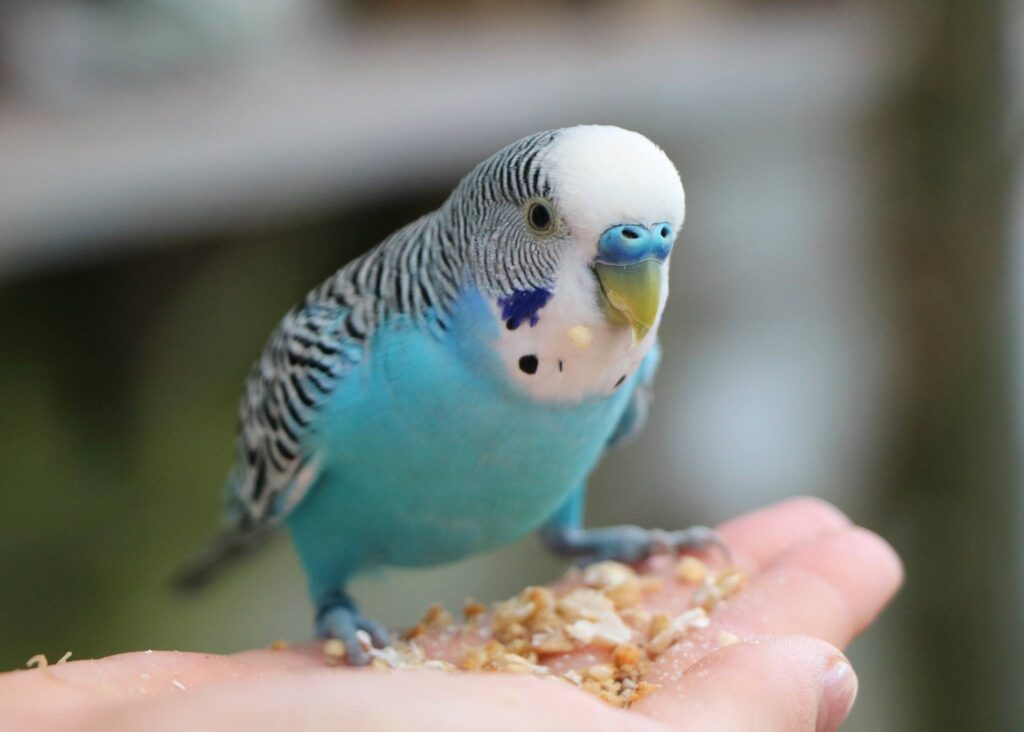
This is the single most important thing I tell anyone who comes in wanting a talking budgie. Male budgies are far more likely to learn speech than females. This is not absolute — I have known occasional females that learned a word or two — but as a generalisation it holds reliably enough that if talking is your goal, you should get a male.
Male budgies are naturally more vocal. They chatter, they whistle, they mimic sounds. The same instinct that makes them more musical makes them more likely to pick up and reproduce human speech patterns. A female budgie is quieter and more independent — lovely in many ways, but not typically a talker.
How to tell a male from a female — look at the cere, the fleshy area above the beak where the nostrils are. In adult males, the cere is blue or purplish-blue. In adult females, it is brown, beige, or white. In very young birds under four months, this difference has not yet fully developed. Our full guide on telling males from females covers everything you need to know.
Young Birds Learn Fastest
The younger the bird when training begins, the faster and more reliably it learns. A budgie under twelve months old is in the optimal window for learning speech — the brain is receptive, the vocalisation instinct is active, and the habits that will define the bird’s relationship with language are being formed.
This does not mean an older bird cannot learn. I have seen birds of two or three years learn their first words. But the younger the bird, the more receptive it tends to be, and the faster things happen.
If you are specifically buying a budgie to teach it to talk, buy a young male — ideally under six months old.
Individual Personality Matters
Within the same sex and age, individual budgies vary considerably in their inclination to mimic. Some birds are naturally more curious about sounds, more inclined to vocalise, more likely to pick up and reproduce what they hear. Others are less interested in mimicry regardless of how good the training is.
You cannot identify this in a young bird before you buy it. But if your bird is several months into training and showing no signs of interest in speech — not attempting any sounds, not increasing its vocalisation — it may simply be an individual that is less inclined toward mimicry. That is not a failure. It is the variation that exists within any species.
The Three Mistakes That Stop Budgies From Talking
These are the mistakes I see most often — including all three of them made simultaneously, as Charlie’s owner demonstrated.
Mistake 1: Training in the Evening
Budgies are most alert and receptive in the morning — particularly in the first hour or two after the cage is uncovered and the bird has eaten. This is when the brain is fresh, when the bird is naturally most vocalised, and when new sounds are most likely to be absorbed.
Evening training sessions — conducted when the bird is winding down, in lower light, with a television or other background noise competing — are fighting against the bird’s natural rhythms. The information is going in at the wrong time of day.
Train in the morning. Ten minutes after the cage is uncovered and the bird has had a chance to settle and eat. That is the optimal window.
Mistake 2: Sessions That Are Too Long
Twenty-minute training sessions sound committed and thorough. They are actually counterproductive.
A budgie’s attention span for focused learning is short — five minutes is roughly the ideal session length. After that, the bird is no longer actively processing what it is hearing. It is just background noise.
Five minutes of focused, consistent repetition — the bird alert and close to you, your voice clear and direct — is worth more than thirty minutes of distracted, variable training. Short sessions, repeated daily, is the formula that works.
Mistake 3: Trying to Teach a Single Bird
This is the one that surprises people most. A single budgie, kept without another bird, does not necessarily learn to talk faster because it bonds more intensely with its owner. This is the logic — I hear it regularly — and it is wrong.
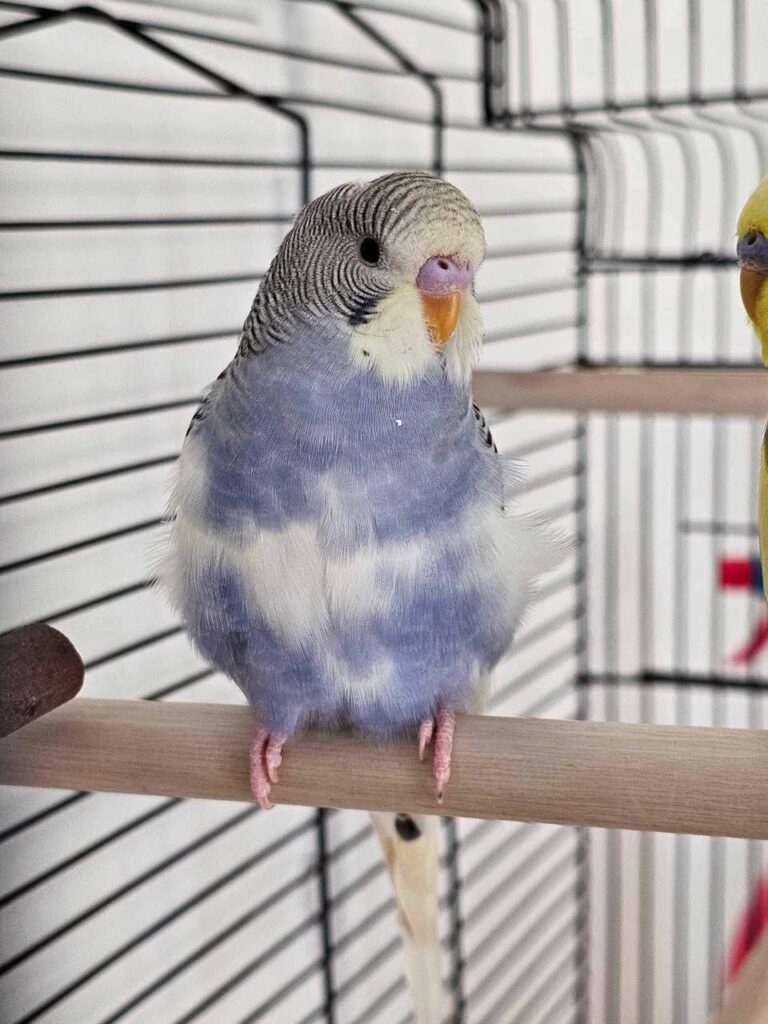
A single bird is a stressed bird. The chronic low-level anxiety of living without conspecific company — without another bird to preen with, sleep close to, and chatter at — creates a background state of stress that reduces the cognitive availability for learning. A content bird learns more readily than an anxious one.
The other factor is that the best talking budgies I have seen over 35 years have almost always been birds that live with other budgies. They practice vocalisation constantly — not at humans, but at each other — and this continuous vocal practice creates the foundation that human speech training builds on.
I know this seems counterintuitive. But in my experience, a young male budgie living with one companion, trained daily with the right approach, will almost always learn more reliably than a single bird receiving the same training.
The Method That Actually Works — Step By Step
Right. Here is the approach I recommend, based on 35 years of watching what succeeds.

- Choose one word or short phrase to start — do not try to teach multiple words simultaneously. Start with the bird’s name, or a simple two-syllable word. “Hello,” “pretty boy,” or the bird’s own name are classic starting points because they have clear sounds and natural stress patterns that budgies find easier to replicate.
- Train in the morning, when the bird is most alert — within the first hour or two after uncovering the cage. The bird should have eaten and settled, but should be clearly awake and alert.
- Position yourself at eye level with the bird — not looking down at it, not at a distance. As close to eye level as you can manage. Direct your voice at the bird, clearly and with normal conversational tone. Not a shout, not a whisper. Clear, calm, and direct.
- Repeat the word or phrase consistently, with a natural rhythm — say the word, pause, say it again. Not too fast. Let each repetition be clear and complete. Think of it as a song with a simple chorus — the repetition and the rhythm are what the bird’s brain is tracking.
- Keep the session to five minutes — stop before the bird loses interest. If it is clearly distracted before five minutes, stop earlier. The session should always end while the bird is still somewhat engaged, not after it has tuned out.
- Be consistent every day — once a day, every day, is more effective than long sessions three times a week. Regularity is what builds the neural pathways that produce speech.
- Use the word naturally in conversation too — say “hello” every time you enter the room. Use the bird’s name when you speak to it throughout the day. The training session is the focused work, but the ambient repetition throughout the day reinforces it.
When To Move to the Next Word
This is where patience matters most — and where most owners go wrong by moving too fast.
Wait until the bird is producing a clear, consistent version of the first word before introducing a second. Not an approximation. Not a sound that might be the word. A clear, recognisable reproduction that you can hear across the room.
This might take two weeks. It might take six. For some birds it takes longer. The temptation to introduce new words before the first is properly established is understandable — but it almost always results in a bird that produces a confused mixture of sounds rather than clear, distinguishable words.
One word, properly learned, then another. That is the formula.

Things That Help — Small Details That Make a Real Difference
These are the details I pass on at the counter that most guides do not mention — small things that consistently improve results.
- Cover the mirror before training sessions — a budgie interacting with its reflection is a budgie that is mentally occupied with something other than you. Remove or cover the mirror before the session begins.
- Turn off background noise — television, radio, background music. The training session should be quiet except for your voice. Background noise competes with what you are trying to teach.
- Use a clear, consistent voice — always say the word the same way. Same tone, same stress, same rhythm. The bird is learning a specific sound pattern — variation confuses the process.
- React positively when the bird attempts any vocalisation — you do not need treats. Verbal praise, a warm response, moving closer to the cage. The bird is learning that vocalisation produces a positive response from you, which reinforces the behaviour.
- Do not use recordings as a substitute for your voice — recorded speech can teach a bird sounds, but it does not build the bond that makes talking meaningful. Your voice, directed at the bird in person, is what creates the relationship that motivates the bird to communicate back.
What To Expect and When
This is the timeline question I get asked most often, and the honest answer is that it varies — but I can give you realistic markers.
With a young male budgie, trained correctly from the beginning, you should hear the first approximations of the target word within two to six weeks. Not perfect replications — approximations. A sound that is clearly attempting the word rather than coincidentally resembling it.
Clear, recognisable versions of the first word typically emerge within six to twelve weeks of consistent training. For some birds it is faster. For others, particularly if training started with an older bird or the early sessions were inconsistent, it takes longer.

If you have been training consistently for three to four months and are seeing no approximations at all — no increase in vocalisation, no attempts at the sound — it is worth reviewing the method. Are the sessions in the morning? Are they short and focused? Is background noise eliminated? Is the bird in good health? Any of these factors can stall progress.
If everything is being done correctly and the bird is still not attempting any speech after several months, it may be an individual that is less inclined toward mimicry. That is not a failure of training — it is the natural variation within the species.
What I Tell Owners Who Are Getting Frustrated
When someone comes in having tried for months without result, I always say the same thing first.
The bird has not failed. The training has not failed. What we need to do is look at what is actually happening and adjust something — the timing, the session length, the consistency, the environment. Almost always, when we go through it properly, there is something that can be changed.
And then I tell them the other thing — that some of the most rewarding budgies I have known over 35 years were birds that never said a single recognisable word. A budgie that chatters enthusiastically, whistles its own invented tunes, calls back when you speak to it, and is clearly engaged with the sounds in its environment — that is a rich, communicative, rewarding bird. The absence of human speech does not make it a lesser bird.
If your budgie talks — wonderful. If it does not — you still have an animal with personality, character, and its own language. That is not nothing. That is actually quite a lot.
Frequently Asked Questions
How long does it take to teach a budgie to talk?
With a young male budgie trained correctly — morning sessions, five minutes, one word at a time — most owners hear first approximations within two to six weeks. Clear, recognisable words typically emerge within six to twelve weeks of consistent daily training. Older birds and inconsistent training both lengthen this timeline. Some birds take several months. Some never talk, regardless of how well they are trained.
Can female budgies learn to talk?
Occasionally — but it is significantly less common than in males. Female budgies are naturally less vocal and less inclined toward mimicry. If talking is specifically what you want from a budgie, a male is the right choice. A female may learn a word or two, but you should not make this the primary expectation.
At what age should I start training my budgie to talk?
The earlier the better — ideally before twelve months old. Young birds are in the optimal window for language learning. This does not mean older birds cannot learn, but younger birds typically learn faster and more reliably. If you have an older bird, start training now regardless — the sooner you begin with the right method, the better.
My budgie chatters constantly but never says actual words — why?
Chattering and whistling is the vocal expression that precedes speech, not a sign that speech will not come. Many budgies produce a complex stream of sounds — some of which begin to incorporate fragments of the words they hear regularly — before anything recognisably human emerges. Keep training consistently. The chatter is the foundation the speech is built on.
Should I use a mirror to help my budgie talk?
No — actually the opposite. A mirror gives the bird a companion to interact with, which reduces its motivation to interact with and mimic you. Remove or cover the mirror during training sessions. The mirror is one of the things that can actively slow down talking development in single birds.
Where can I get honest budgie advice in Swindon?
Come and see us at Paradise Pets, Manor Garden Centre, Cheney Manor, Swindon SN2 2QJ. Or give us a ring on 01793 512400. The advice is free and I have been doing this for over 35 years.
Want To Teach Your Budgie To Talk? Come And See Me
Bring your bird, bring your questions, or just come in for a chat. I will tell you honestly what approach suits your specific bird. Free advice, no obligation. That is how we have done things for over 35 years.