


Neil has kept, bred, and sold cage birds at Paradise Pets Swindon since 1988 — over 35 years of first-hand experience with budgies, cockatiels, canaries, and aviary birds. In that time, some of the most persistent and puzzling behaviour problems he has been asked about have had their root cause not inside the house, but outside it. This is his honest guide to the garden sounds UK bird owners consistently underestimate.
The call came in on a Tuesday morning in July. A woman whose cockatiel had been with her for three years — settled, well-tamed, no previous issues — had suddenly started refusing to eat. Feathers slightly puffed. Quieter than usual. Not engaging with her the way it normally did.
She had been through everything she could think of. Diet had not changed. Routine had not changed. No new pets, no new people, nothing different inside the house.
I asked her one question. Had the weather been particularly warm recently, and had she been leaving the windows open more than usual?
She paused. Yes. For the past week, she had been leaving the kitchen window open during the day because the house had been getting hot. The bird’s cage was in the kitchen.
What she had not connected — because why would you — was that the kitchen window faced the back garden. And the back garden backed onto a row of trees. And in those trees, every afternoon for the past week, a sparrowhawk had been calling.
She moved the cage. The cockatiel was eating normally within two days.
That conversation has stayed with me because it illustrates something I have tried to explain to bird owners for thirty-five years. Your bird cannot see the walls of your house as boundaries of safety. Its nervous system evolved in an environment where sounds from every direction carried information about survival. A sound that means danger does not stop meaning danger simply because there is a wall between the bird and its source.
The garden is not outside your bird’s world. For a bird sitting near a window or an open door, the garden is its world.
Why Garden Sounds Affect Cage Birds So Severely
Before going through the specific sounds, it is worth understanding why this matters as much as it does — because the consequences of sustained acoustic stress in birds go further than most owners appreciate.
A bird that is chronically stressed — not acutely frightened, but under a persistent low-level stress response — will show it in several ways. Reduced eating. Feather condition decline. Increased vulnerability to illness, because chronic stress suppresses the immune system in birds as it does in mammals. Behavioural changes — increased aggression or handling resistance, repetitive behaviours, excessive calling or the opposite, unusual silence.
None of these are inevitable if the source is identified and addressed. But they will continue and typically worsen as long as the source remains. A bird hearing a predator sound repeatedly, every day, from a direction it cannot see clearly, is a bird that never gets to fully relax. That is not a minor welfare concern.
The other thing worth saying is that birds hear differently from us. Their hearing is acute and in some frequency ranges significantly more sensitive than human hearing. Sounds that register as faint background noise to you may be loud and directionally specific to your bird. A sparrowhawk calling three gardens away is not necessarily background noise to a budgie. It may be the dominant sound in its immediate experience.
One: Sparrowhawk and Raptor Calls
This is the one that comes up most in my experience, and the one with the most consistent effect on cage birds.
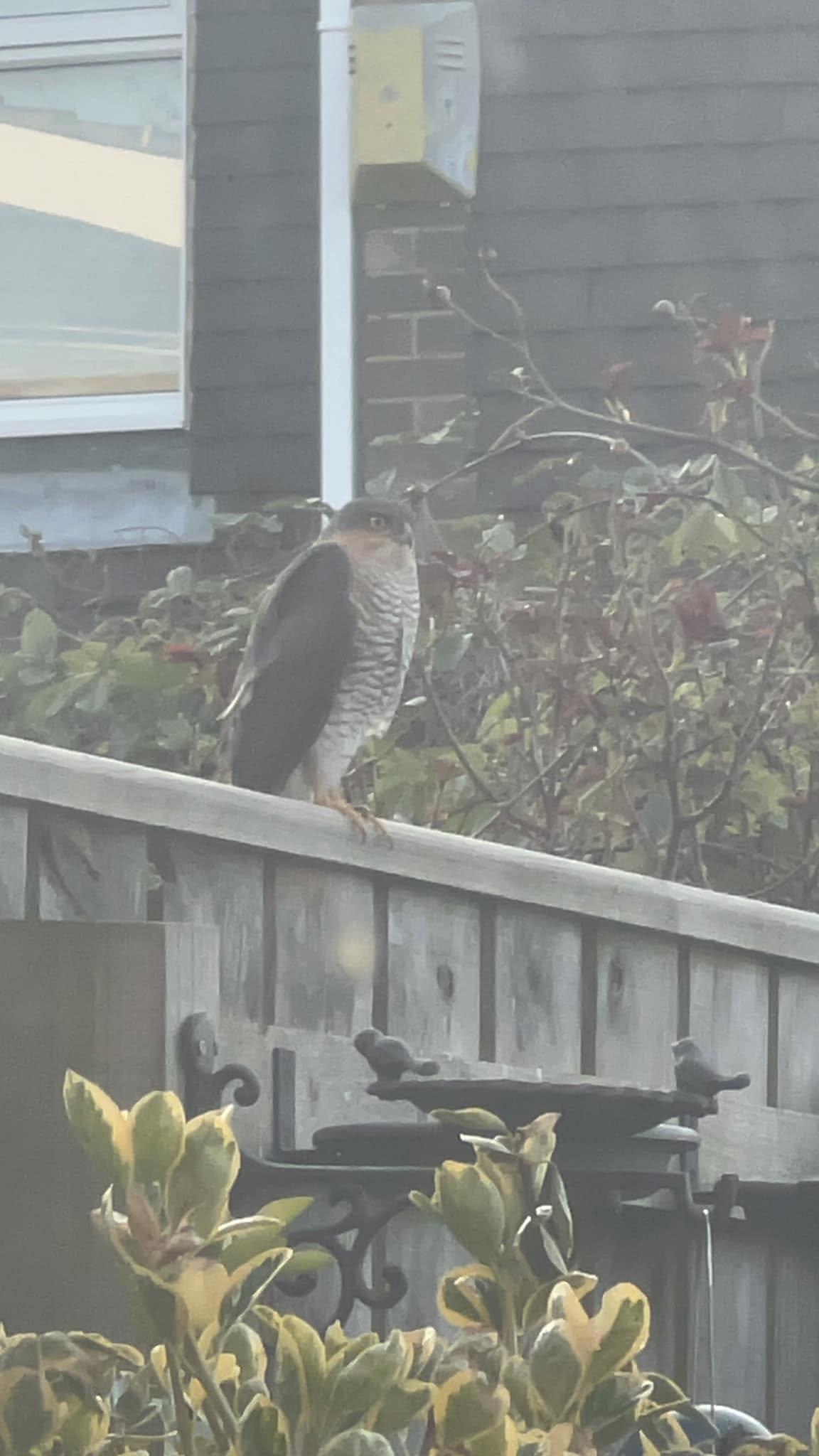
Sparrowhawks are the most common urban garden raptor in the UK and their population has increased significantly over the past few decades. They are present in suburban gardens year-round, and during warm months when windows are open, their calls carry clearly into houses that back onto gardens with trees or hedgerows.
A cage bird — budgie, cockatiel, canary — hearing a sparrowhawk call will respond with the full threat response its nervous system is capable of. This is not learned behaviour. It is hardwired. The call of a bird of prey triggers an immediate alarm response in small cage birds whether they have ever encountered one before or not. They press themselves flat. They go silent. They may thrash in the cage if the sound is sudden and close.
With repeated exposure, the response may become less acute but the underlying stress does not disappear. The bird is simply becoming habituated to being frightened — which is not the same as being comfortable.
Other UK raptors that produce similar responses include the buzzard — whose loud, mewing call carries significant distances and is increasingly common in suburban areas — and the red kite, whose population has expanded considerably and whose call, while different, is processed by cage birds as a similar threat signal.
If your bird has recently become unsettled without any obvious indoor cause, establishing whether any raptors have taken up residence in or near the garden is a sensible first step.
Two: Cats Vocalising Nearby
Cat sounds are the second most common acoustic stressor I hear about from bird owners, and in some ways the more insidious one because the cause is so easily overlooked.
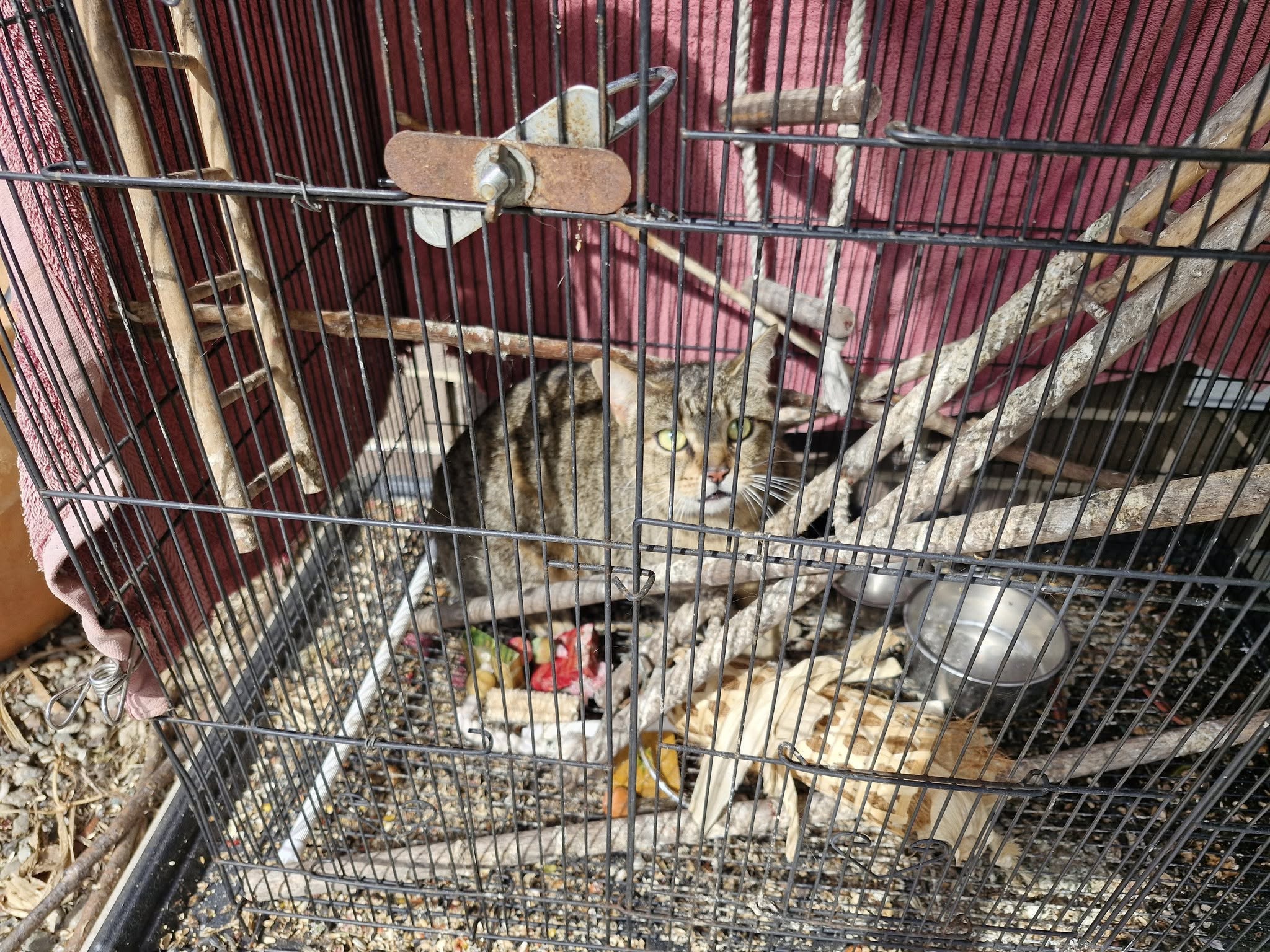
A cat that has established a habit of sitting near the house — on a windowsill, in the garden, on a fence that runs close to the window where the cage sits — will produce sounds that a cage bird processes as an immediate threat. The specific vocalisations most likely to trigger a stress response are the low, intent chittering that cats make when watching prey, the yowl of a cat in territorial dispute, and the sustained focused silence of a hunting cat that the bird can see or hear moving nearby.
The chittering sound in particular is one that people often do not identify as a problem because it seems so soft and non-threatening to a human ear. To a bird, it is one of the most specific threat sounds it can hear. It is the sound of a predator that has locked onto a target.
If a neighbour’s cat visits your garden regularly, or if your own cat has access to areas near the bird’s cage, this is worth taking seriously. The solution is not always straightforward — you cannot always control a neighbour’s cat — but cage repositioning, closing the relevant window during times when the cat is known to visit, and ensuring the bird cannot see the cat even if it can hear it will all help.
Three: Alarm Calls From Wild Garden Birds
This is the one that surprises people most when I explain it, because it seems counterintuitive. Surely hearing other birds would be comforting?
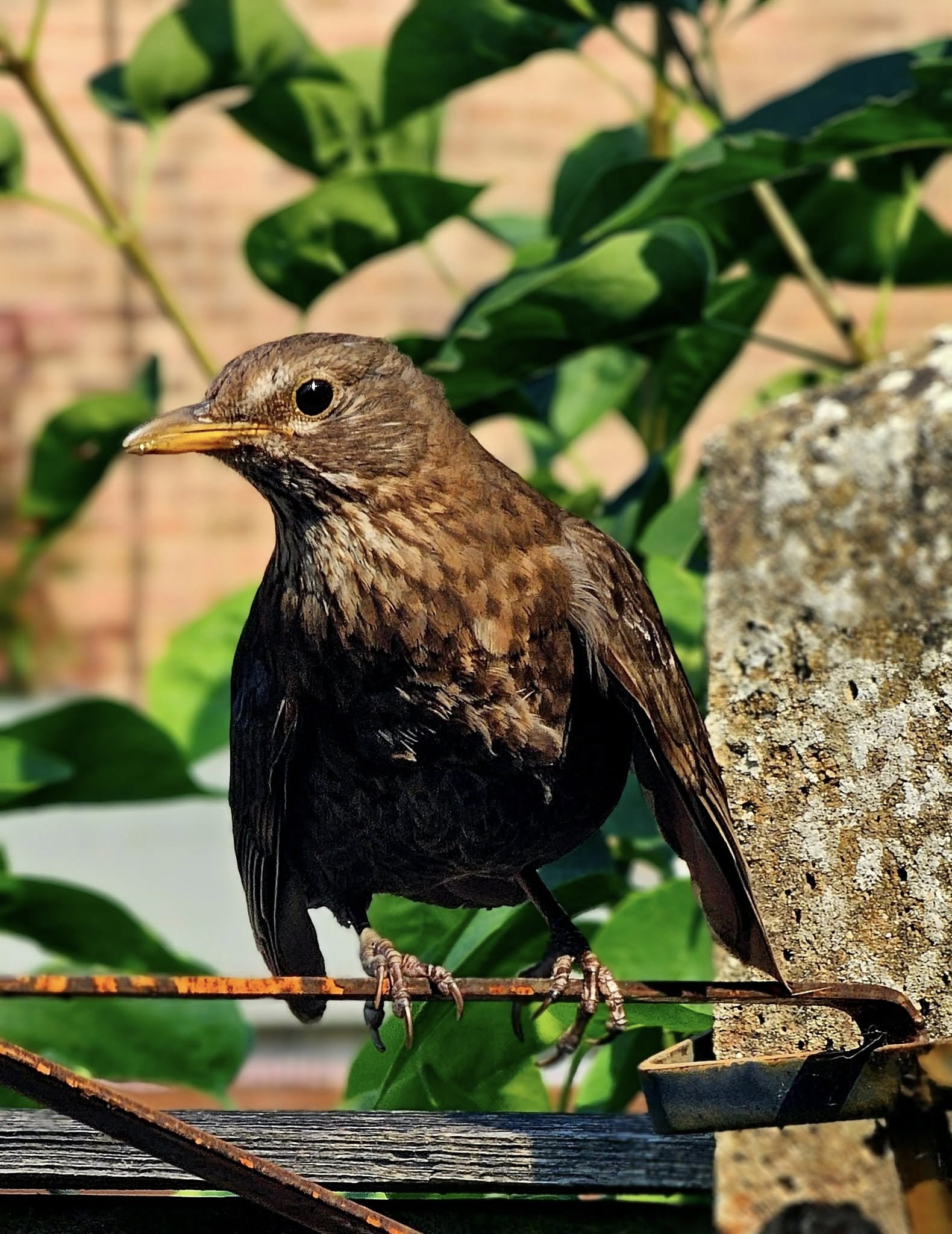
Not when those birds are giving alarm calls. And garden birds in the UK — blackbirds, robins, blue tits, great tits — have specific alarm vocalisations that are quite distinct from their normal song. The blackbird alarm call in particular — a rapid, insistent chinking — is one of the most recognisable sounds in any UK garden, and it is produced in response to exactly the kinds of threats that would concern a cage bird: a cat, a raptor, a fox.
A cage bird near a window hearing a sustained blackbird alarm sequence is hearing a broadcast that something dangerous is nearby. It does not matter that the cage bird is inside and technically safe. It is receiving real-time information from wild birds about a threat in the immediate environment, and its nervous system responds accordingly.
This means that persistent wild bird alarm calls from the garden are worth treating as genuine information about what is happening outside, not just as background garden noise. Something is causing them. If you identify what that something is, you may also identify the source of your cage bird’s stress.
Four: Fox Sounds — Particularly at Night
Urban foxes in the UK are a fixture of most suburban gardens, and their vocalisations are genuinely disturbing — not just to humans who are woken by them, but to cage birds whose sleep they disrupt.
The fox scream — the high, sharp, repetitive call of a fox, most commonly heard in late winter and early spring during the mating season but present to a lesser degree year-round — is one of the sounds most likely to trigger a night fright in a cage bird. A bird experiencing a night fright will thrash suddenly in the cage in complete darkness, often injuring itself on perches, bars, or toys in the process.
Night frights are not trivial. A bird that thrashes hard enough can injure its wings, break a blood feather, or in extreme cases sustain a fatal injury from impact with the cage. Even if the physical outcome is minor, a repeated pattern of night disturbance and night frights is a significant welfare concern that will show in the bird’s daytime behaviour — increased anxiety, reduced eating, handling resistance.
If you know foxes visit your garden at night and your bird is in a room where fox sounds carry, a very dim nightlight in the room will significantly reduce the risk. A bird that can see even faintly during a sudden disturbance is far less likely to thrash than one woken in total darkness. The room does not need to be lit brightly — a small plug-in nightlight is sufficient.
Cage position is also relevant. A cage on an exterior wall, close to a window that faces the garden, will transmit more sound from outside than one positioned on an interior wall. If night frights are a recurring problem, this is worth considering.
Five: Power Tools, Lawnmowers, and Sudden Mechanical Noise
This one is seasonal and predictable, which makes it one of the more manageable items on this list — but it still catches owners off guard regularly, particularly in spring and summer when garden activity increases.
A lawnmower starting up close to the house. A neighbour using a hedge trimmer. Power tools from a nearby building project. These are sudden, loud, irregular sounds that sit outside the acoustic patterns a bird has learned to treat as safe. Unpredictability is the key factor — it is not the volume alone that produces the stress response, but the fact that the sound appears suddenly without warning and does not resolve predictably.
The stress response to this kind of sound is usually acute rather than chronic — the bird is alarmed in the moment but recovers once the sound stops. The exception is when the mechanical noise is prolonged, as with a construction project that runs for days or weeks nearby, or a situation where the lawnmower goes on every Saturday at the same time for months and the bird never quite settles to it.
The practical management here is about anticipation. If you know garden activity is happening — your own or a neighbour’s — moving the cage temporarily to an interior room away from the noise is a simple and effective intervention. The bird does not need to hear it. It does not need to habituate to it. Removing it from the acoustic environment for the duration is the cleanest solution.
How to Tell If Garden Sound Is Affecting Your Bird
The signs are worth listing clearly, because they are not always obvious and they often develop gradually enough that the connection to an external sound source is not immediately made.
Increased alertness without obvious cause. The bird is more watchful than usual, crest up or head tracking movements, without anything in the immediate indoor environment to account for it.
Sudden thrashing or night frights. The bird panics in the cage — particularly at night — with no indoor trigger. This is one of the clearest signs that acoustic disturbance from outside is reaching the bird during its sleep period.
Changes in vocalisation pattern. A bird that has become quieter than usual, or conversely one that has started calling more persistently and anxiously, may be responding to a chronic stress source. The change from normal is the indicator.
Reduced eating or weight loss. Stress suppresses appetite in birds as in other animals. A bird under chronic acoustic stress may eat less than usual, lose condition, and decline in feather quality over weeks.
Increased handling resistance in an otherwise well-tamed bird. A bird that is under ongoing environmental stress will often be less willing to handle than it usually is. Its overall threat threshold is elevated, and it has less tolerance for additional stressors including handling.
If you are seeing any of these and cannot identify an indoor cause, the garden is worth investigating as the source.
What to Do — Practical Steps That Actually Help
I want to be specific here because generic advice to “reduce stress” is not very useful without concrete actions.
Identify the sound source first. Spend time near the cage at the times when the bird seems most affected. Listen carefully. Go into the garden and listen from outside. If you can identify a specific sound — a raptor in a nearby tree, a cat that visits at a particular time, foxes at night — you have something to act on.
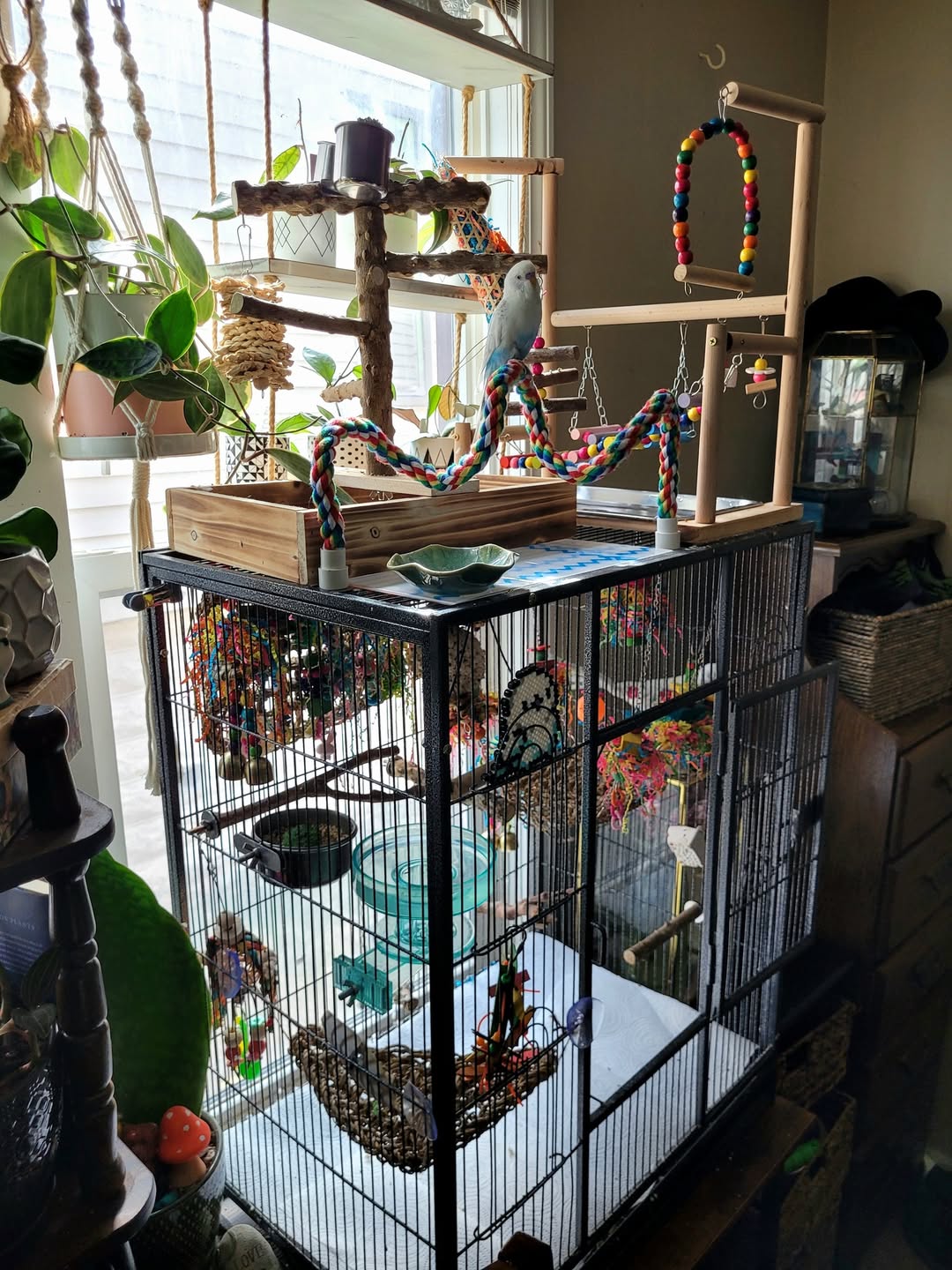
Reposition the cage. Moving the cage away from the window or wall closest to the sound source is often the single most effective intervention. An interior wall, away from the garden-facing side of the house, transmits significantly less outdoor sound. This does not require a permanent change to your household layout — a temporary repositioning during the period when the sound is most likely to occur is often sufficient.
Use sound cover during problem periods. A radio or television at a moderate volume provides a consistent acoustic background that partially masks irregular outdoor sounds. The predictability of indoor background sound is calming in itself — it is the sudden, unpredictable sounds that produce the strongest stress responses.
Use a nightlight if night frights are occurring. A dim plug-in nightlight in the room where the cage is positioned will significantly reduce the risk and severity of night frights from fox calls or other nocturnal sounds. This is one of the simplest and most effective interventions available.
Manage windows and doors during peak periods. If you know that summer afternoons bring increased raptor activity, or that weekend mornings bring lawnmowers, closing the nearest window during those periods is a straightforward and effective measure. Your bird does not need the ventilation at the cost of the acoustic disturbance.
Frequently Asked Questions
My bird seems to enjoy sitting near the window — should I stop it?
Window access is not inherently a problem. Natural light and the visual stimulation of outdoor activity are genuinely positive for cage birds in many ways. The question is whether what the bird is exposed to acoustically at that window — and the answer depends entirely on what is happening outside. A window that faces a quiet garden with no regular predator presence is a different proposition from one that backs onto trees where raptors call. Assess the specific acoustic environment before deciding.
Could my bird be hearing sounds I cannot?
Yes, genuinely. Birds hear across a wider frequency range than humans in some directions, and their spatial hearing is more precise. A sound you register as faint and directionless may be clearly localised and more prominent to your bird. If your bird is stressed and you cannot hear an obvious cause, this does not mean there is not one.
Will my bird get used to the garden sounds over time?
Some habituation to neutral sounds will occur over time. Habituation to genuine predator sounds — raptor calls, fox screams, cat chittering — is slower, less complete, and more costly in terms of ongoing stress than most owners expect. These are sounds the bird’s nervous system is designed not to ignore. Reducing the exposure is a more reliable solution than waiting for the bird to habituate.
My bird is in an aviary outside — does this change things?
Significantly, yes. An outdoor aviary bird is in direct acoustic contact with the garden environment at all times. Predator deterrence, covered sections of the aviary where birds can shelter out of sight, and careful positioning away from trees and fence lines where raptors perch are all important. An outdoor aviary near a known sparrowhawk hunting route is a serious welfare concern. Come and talk to us about aviary positioning if this applies to you.
How quickly should a stressed bird recover once the sound source is removed?
For acute stress from a single incident — a sudden loud noise, a one-off scare — most well-settled birds will return to normal within hours. For chronic stress from a persistent sound source over days or weeks, recovery takes longer. The bird needs time to establish that the threat has genuinely gone, not just paused. Give it a week of quiet and consistent routine before assessing whether the behaviour has fully returned to normal.
One Last Thing
The woman with the cockatiel rings the shop occasionally. The bird has been well since the cage moved. A straightforward intervention, a few minutes of conversation, and three years of settled bird ownership continued.
That is the version of this problem that resolves easily. It resolves easily because she called when the behaviour first changed, identified the cause quickly, and acted on it. The version that does not resolve easily is the one where the bird has been under acoustic stress for months, has lost condition, has developed chronic anxiety behaviours — and the cause is only identified after considerable investigation.
The difference is knowing what to look for and taking early changes in behaviour seriously.
If your bird has changed and you cannot account for it indoors, look outside. Listen carefully. The garden may be talking to your bird in ways you have not been hearing.
Come and discuss it with us if you need to. We are at Manor Garden Centre, Cheney Manor, Swindon SN2 2QJ, every day. Get in touch here or call 01793 512400.
Visit Us at Paradise Pets Swindon
We stock budgies, cockatiels, canaries, and aviary birds year-round. If you have a concern about your bird’s behaviour or welfare, come in and talk to us — we are always happy to help you find the cause.