
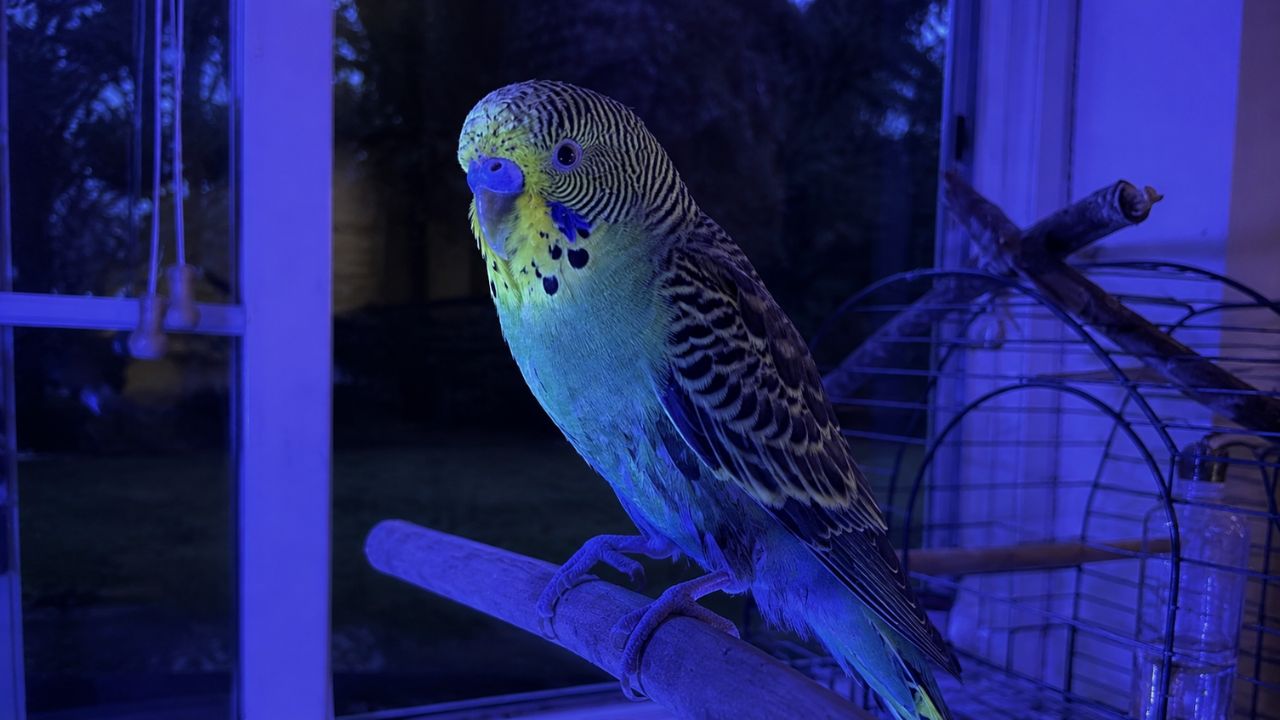

Neil has sold and kept budgerigars at Paradise Pets Swindon since 1988 — over 35 years of first-hand experience with one of the UK’s most popular pet birds. In that time, the science of how budgies actually see the world has changed significantly, and what we now know about UV light and budgies has real, practical implications for how these birds should be kept in UK homes. This article is his honest guide on what UV light means for your budgie and what to do about it.
A customer asked me this question a while back — not a new owner, someone who had kept budgies for years. He had read something online about UV light and birds and wanted to know if it was true. Could budgies really see ultraviolet light? And if so, did that mean he needed to do something differently?
It is a better question than it might first appear. Because the answer is yes — budgies can see UV light, and yes, it does matter, and yes, most UK owners are inadvertently keeping their birds in conditions that fall short of what those birds need visually. And the way you address it is simpler than most people expect.
Let me explain the whole picture.
What UV Light Actually Is — A Plain English Explanation
Before anything else, let me make sure we are on the same page about what UV light is, because the term gets thrown around a lot without much explanation.
Light exists on a spectrum. Human eyes can detect a portion of that spectrum — roughly from red at one end through orange, yellow, green, blue, and violet at the other. Beyond violet, at wavelengths shorter than our eyes can detect, sits ultraviolet light — UV. We cannot see it. We can feel its effects on our skin when we are in strong sunlight, but we cannot see it.
Many animals can. Bees use UV patterns on flowers to find pollen. Some fish can see UV. And birds — including budgerigars — have a fourth type of photoreceptor in their eyes that allows them to see ultraviolet wavelengths that are completely invisible to us.
This is not a small addition to their visual world. It changes how they see everything. Colours look different. Patterns that are invisible to us are visible to them. The world a budgie sees when looking at another budgie — or at its food, or its cage, or its environment — is genuinely different from the world we see when we look at exactly the same things.
Why Budgies Have UV Vision — And What They Use It For
UV vision in budgies is not accidental. It is deeply woven into how they live, communicate, and make decisions. Understanding why they have it helps you understand why it matters in captivity.
Mate selection. This is the most well-researched function of UV vision in budgerigars. Budgie plumage fluoresces under UV light — the feathers on the head and face in particular reflect UV wavelengths in patterns that are completely invisible to human eyes. These patterns are used by budgies to assess potential mates. Studies have shown that budgies strongly prefer partners whose UV plumage patterns are visible to them, and that birds kept without UV light show significantly disrupted mate selection behaviour.
Flock recognition and social communication. UV-reflective patterns help budgies identify flock members, assess the health and condition of other birds, and communicate in ways we simply cannot observe with human vision. A bird that cannot see these patterns is missing a significant part of the social information its species depends on.
Food identification. Some research suggests that budgies use UV cues when assessing food — ripeness, quality, and suitability. In the wild, this helps them choose the most nutritious seeds and fruits. In captivity, food is presented in bowls and quality is controlled by the owner, but the visual system is still there and still being used.
Navigation and environmental awareness. UV light provides environmental information that helps birds orient themselves, particularly in relation to sunlight patterns. A budgie in a room lit entirely by standard artificial light is receiving a fundamentally different set of visual information from what its visual system evolved to process.
The Problem With UK Homes and UV Light
Here is where this becomes practically important for anyone keeping a budgie in Britain.
Outdoors, natural sunlight contains UV wavelengths. A budgie sitting in an outdoor aviary on a summer day in Wiltshire is receiving UV light and using it exactly as its visual system is designed to. Its flock is visible to it in full. Its world looks the way its eyes expect the world to look.
Indoors in a UK home, almost none of that applies.
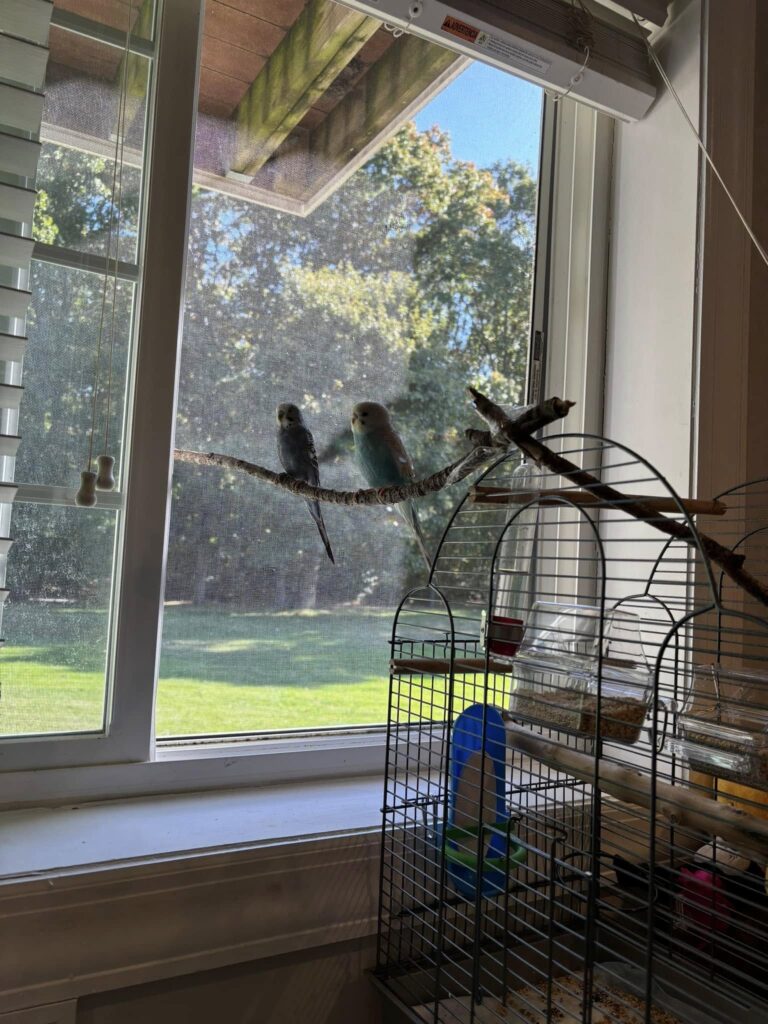
Standard window glass blocks UV light. Essentially all of it. A budgie sitting in a sunny window, appearing to enjoy the light, is receiving no meaningful UV. The glass has filtered it out completely before it reaches the bird.
Standard household light bulbs — LED, fluorescent, halogen — do not produce UV in meaningful amounts. The room may be well-lit to human eyes, and appear perfectly adequate, but in terms of UV output it is close to zero.
What this means in practice is that a budgie kept indoors in a UK home and never given access to unfiltered natural light or a UV-producing lamp is living in a world that is, from its visual perspective, significantly impoverished. Not dark — it can still see. But missing an entire dimension of visual information that its eyes and brain are built to receive and process.
- Standard window glass blocks essentially all UV light — a sunny window does not solve the problem
- Standard household bulbs — LED, fluorescent, halogen — produce negligible UV
- A budgie kept entirely indoors under standard lighting has no meaningful UV exposure
- The effects of UV deprivation accumulate over time — they are not immediately visible
- UK winters, with shorter days and lower light levels generally, make this more pronounced
- An indoor budgie that never goes outside and has no UV lamp has likely had no meaningful UV exposure for its entire captive life
What Happens When Budgies Don’t Get UV Light
The consequences of UV deprivation in budgies are real and documented. They are not dramatic and sudden in the way that, say, not eating is — they are cumulative, gradual, and easy to miss until you understand what to look for.
Disrupted vitamin D3 synthesis. This is the most direct physical consequence. Budgies, like most birds, synthesise vitamin D3 through their skin when exposed to UV-B light. Vitamin D3 is essential for calcium absorption. A budgie without UV-B exposure cannot produce adequate vitamin D3, even if the diet is excellent, and calcium deficiency follows. In budgies, calcium deficiency causes soft bones, weak egg shells in females, muscle weakness, and neurological problems in severe cases. It also suppresses immune function.
Behavioural and psychological effects. A budgie that cannot see UV light is missing a dimension of social information it evolved to depend on. Research in captive budgerigars has shown that UV-deprived birds show abnormal mate preference behaviour, reduced social responsiveness, and in some studies increased signs of stress and anxiety. The bird is not operating with a full set of sensory information.
Disrupted circadian rhythm. UV light, as part of the natural light spectrum, plays a role in regulating biological rhythms — sleep cycles, hormone production, moult timing, and breeding condition. Budgies kept without proper light spectrums can develop disrupted rhythms that affect moult quality, egg laying patterns, and general vitality.
Reduced feather quality over time. Poor calcium status and disrupted physiology affect feather production. Some of the dull, poor-quality plumage I see in long-term indoor budgies is at least partly attributable to inadequate UV exposure affecting vitamin D3 and calcium status.
- Dull, poor-quality plumage that does not improve with dietary changes alone
- Abnormal or prolonged moult — feathers taking longer to come through than expected
- Soft or flaking beak or claws — possible calcium deficiency
- Egg binding in females — calcium is essential for muscle contraction during laying
- Reduced energy and activity compared to how the bird used to be
- Seizures or tremors in severe cases — these are neurological signs of calcium deficiency and need immediate vet attention
- The bird has never had meaningful UV exposure throughout its captive life
The Solution — UV Lamps for Indoor Budgies
The practical answer to this problem is a UV lamp designed specifically for birds — and the good news is that these are widely available in the UK, not particularly expensive, and straightforward to use correctly.
Bird-specific UV lamps — sometimes called avian full-spectrum lamps — produce UV-A and UV-B wavelengths alongside visible light. UV-A is the portion that budgies use for vision. UV-B is the portion that drives vitamin D3 synthesis through the skin. A lamp producing both gives the bird what natural sunlight would provide.
- Look for lamps specifically designed for birds — not reptile UV lamps, which produce higher UV-B intensities designed for different needs
- The lamp should produce both UV-A and UV-B at appropriate intensities for birds
- Position the lamp close enough to be effective — most bird UV lamps are effective within 30cm to 50cm of the bird; check the manufacturer’s guidance for the specific product
- The bird must be able to move away from the lamp if it chooses — do not position it so the bird cannot escape the UV if it wants to
- Most manufacturers recommend replacing the bulb every six to twelve months — UV output degrades over time even when the visible light appears normal
- Do not put glass or plastic between the lamp and the bird — these filter out UV
- A timer that runs the lamp for ten to twelve hours during the day mirrors natural daylight patterns

If you are not sure which lamp to buy or how to set it up, come and talk to us. It is a question we are asked increasingly often and we are happy to walk through it properly.
What About Letting Budgies Outside in Summer?
This is the other option, and for UK owners with outdoor space it is a perfectly good one during the warmer months — but it comes with important caveats.
Direct outdoor time in an appropriate cage or aviary during summer months gives the bird genuine, unfiltered UV exposure. Even the diffuse light of a cloudy British summer day contains more UV than an indoor environment. An hour or two outdoors on a warm day is genuinely beneficial.
However.
- The bird must always have shade available — direct sun exposure without the ability to move to shade can cause heatstroke, which in a budgie is life-threatening
- Outdoor temperatures must be appropriate — budgies can tolerate British summer temperatures reasonably well but should not be left outside when temperatures drop below about 15°C
- The enclosure must be predator-proof — cats, sparrowhawks, and other predators are a genuine risk even during brief outdoor time
- Never leave a budgie outside unsupervised — even in a secure cage, an unsupervised bird is vulnerable
- Outdoor time in UK winters is not a solution — the days are too short and temperatures too low for it to be practical or safe
Outdoor time is excellent as a supplement, not a year-round solution. For consistent, reliable UV provision in the UK, a lamp is the practical answer.
Does UV Lighting Affect How Budgies See Each Other?
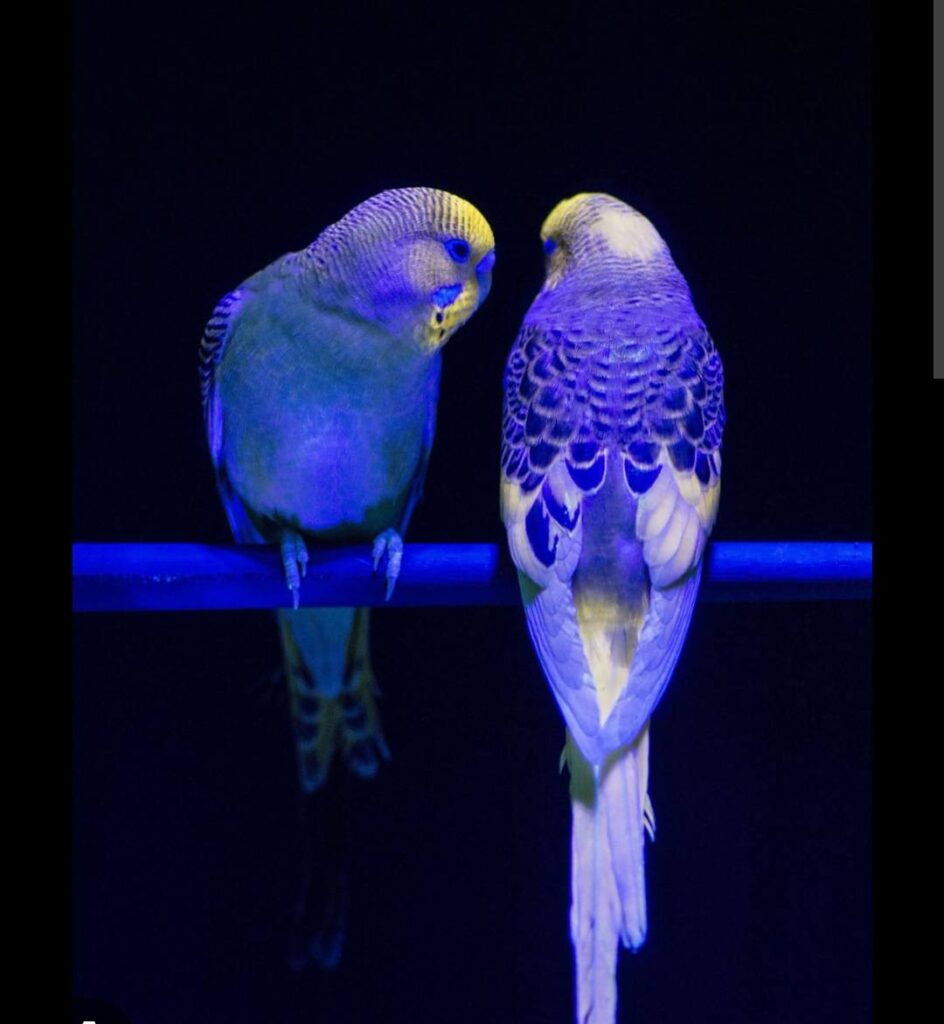
Yes — and this is one of the more fascinating aspects of this topic, and one that has real implications for how you keep budgies.
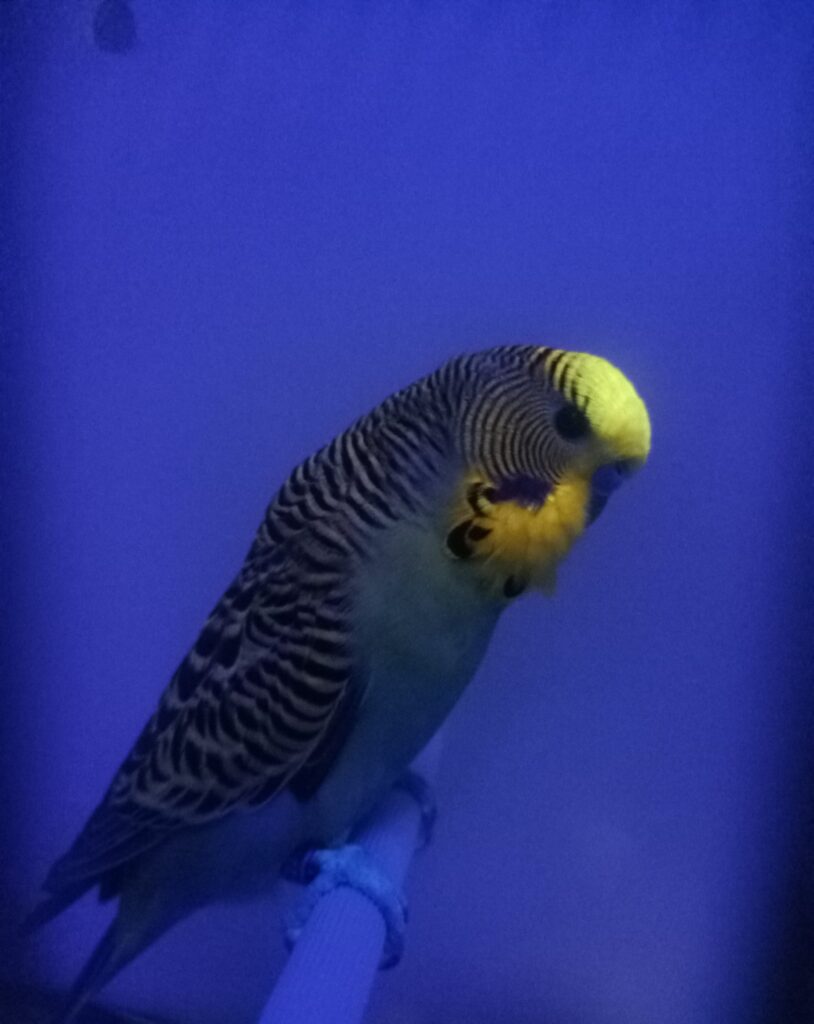
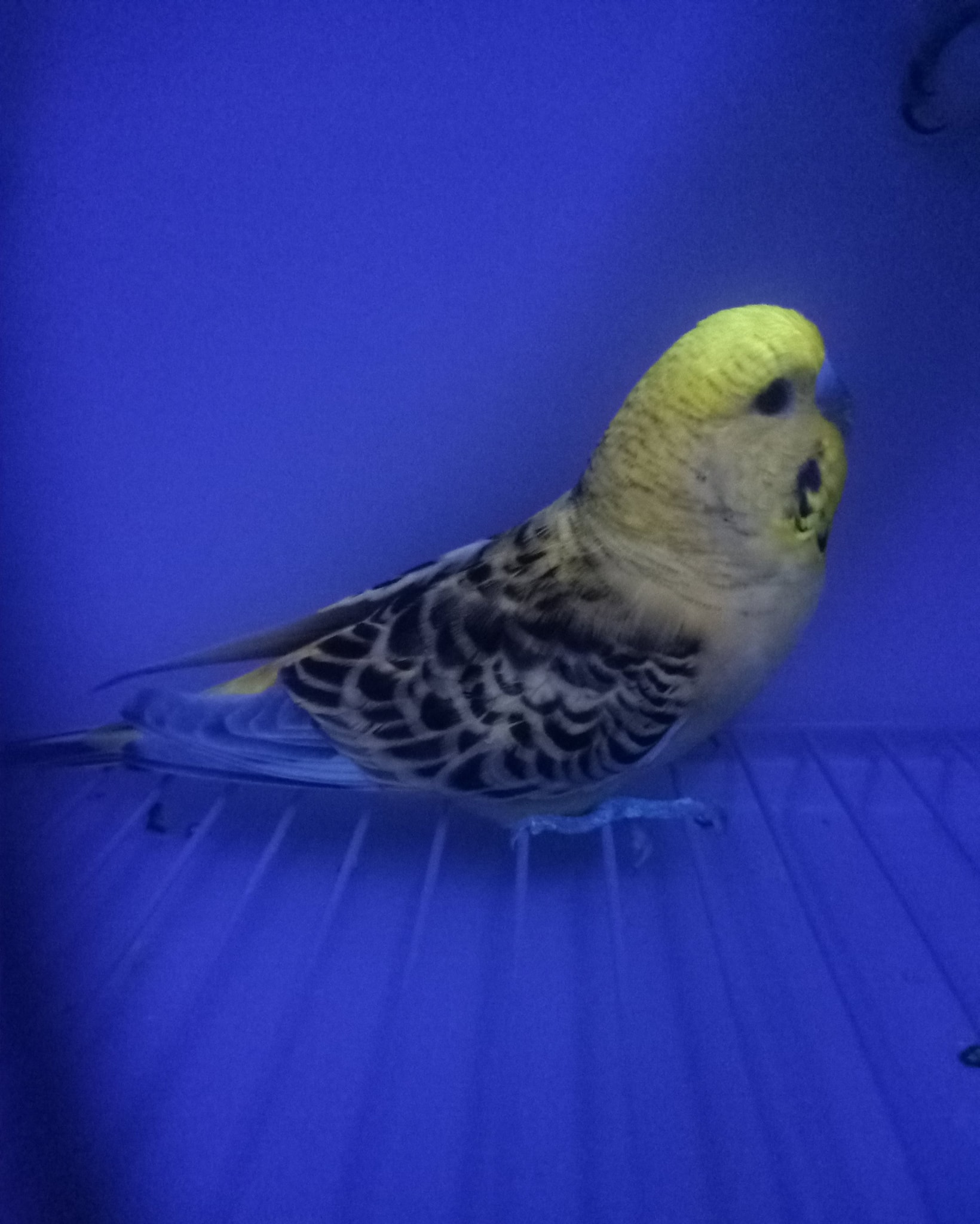
Under UV light, budgie plumage looks different. Specifically, the feathers fluoresce — they reflect UV wavelengths and appear to glow in patterns that are invisible to us but clearly visible to the birds. The forehead, crown, and cheek patches in particular are heavily involved in these UV reflective patterns.
When budgies cannot see UV — because the lighting in their environment does not include it — they are essentially looking at each other with part of the picture missing. The feather patterns they use to assess health, reproductive condition, and genetic compatibility are not visible. The social and sexual signalling that depends on these patterns is disrupted.
Research has shown that female budgies given a choice between males under normal light and males under UV light almost always show stronger, clearer mate preferences under UV. Under standard light only, mate selection becomes less discriminating — the birds cannot fully read the signals they evolved to rely on.
For a single pet budgie this matters less acutely in terms of breeding. But the visual impoverishment is real regardless of whether breeding is intended, and the physiological effects of UV deprivation — particularly the vitamin D3 and calcium issue — apply equally to all budgies, paired or single, male or female.
Practical Setup — What a Good UV Arrangement Looks Like
Let me make this concrete. Here is what a practical, effective UV setup looks like for a UK indoor budgie.
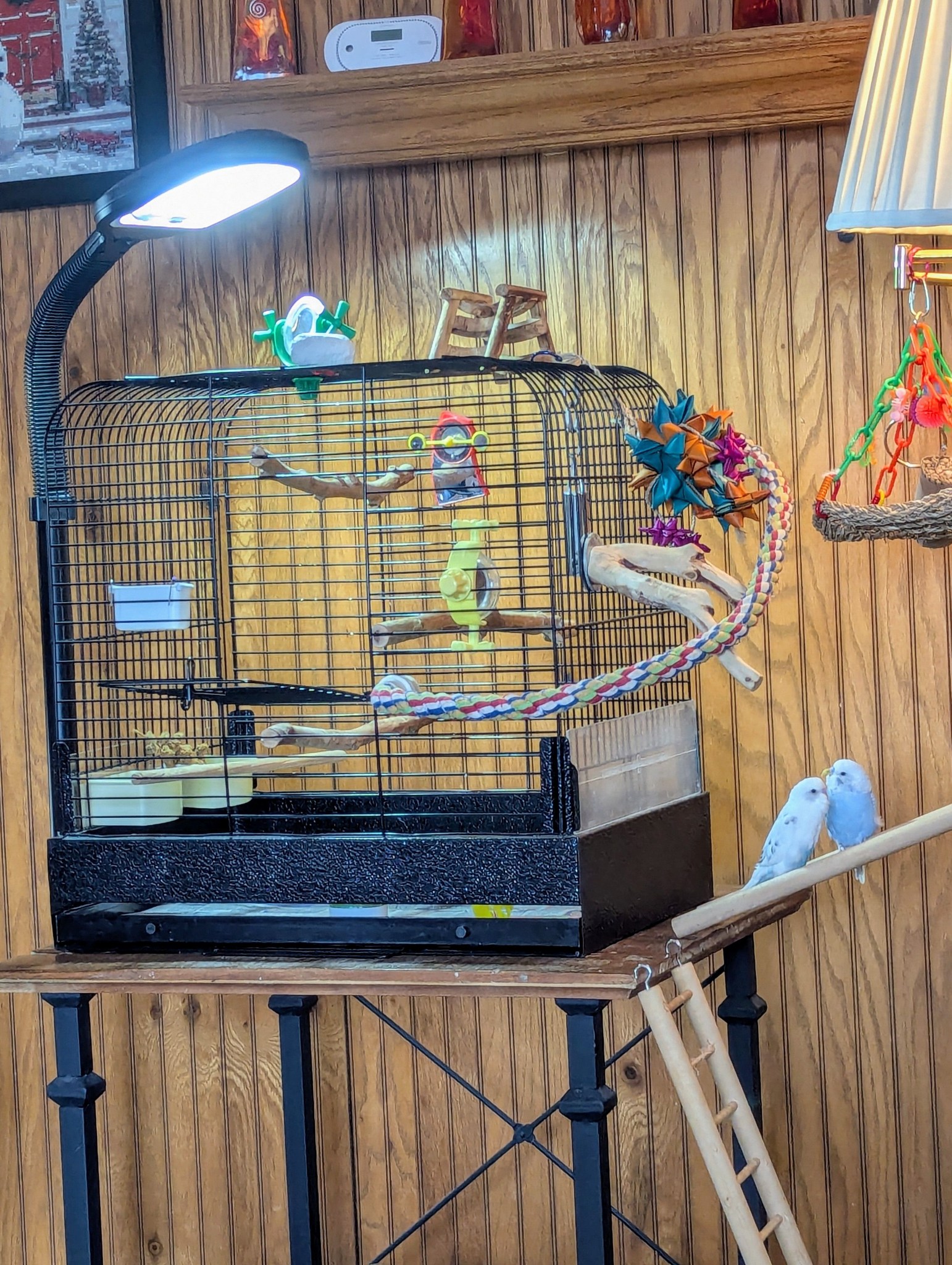
- Choose a bird-specific full-spectrum UV lamp.
Brands like Arcadia, Mega-Ray, and similar bird-specialist manufacturers produce appropriate lamps. Avoid reptile lamps unless they are specifically rated for birds — UV-B output levels differ. Your avian vet or a knowledgeable pet shop can advise on specific products. - Position it correctly.
The lamp needs to be within the effective range for UV output — typically 30cm to 50cm from where the bird perches most often. Check the manufacturer’s distance guidance; UV intensity drops significantly with distance. Mount it so the bird perches naturally under or near it, but can always move away if it chooses. - No barriers between lamp and bird.
No glass, no plastic cover, nothing that filters the light before it reaches the bird. UV does not penetrate these materials. - Run it on a natural cycle.
A timer that switches the lamp on at roughly dawn and off at roughly dusk — ten to twelve hours in summer, eight to ten in winter — mirrors natural day length. This supports healthy circadian rhythm as well as providing UV. - Replace the bulb regularly.
UV output degrades long before visible light output does. Most bird UV bulbs should be replaced every six to twelve months. Mark the replacement date when you install it. A bulb that looks fine visually may be providing minimal UV. - Combine with outdoor access in summer where practical.
Even brief supervised outdoor time on warm days supplements what the lamp provides and gives the bird genuine natural sunlight experience.
What About Vitamin D3 Supplements — Do They Replace UV?
This is a reasonable question and one I get asked often when this topic comes up.
Vitamin D3 supplements for birds are available and can help address dietary deficiency. But they do not replace UV light, for two reasons.
First, the visual function of UV light — the UV-A wavelengths that allow budgies to see their full colour world — cannot be supplemented. You cannot put UV vision in a food bowl. The perceptual and social effects of UV deprivation are not addressed by dietary supplements at all.
Second, oral vitamin D3 supplementation carries a real risk of overdose. Vitamin D3 is fat-soluble, which means it accumulates in the body rather than being excreted when taken in excess. Too much vitamin D3 causes toxicity — excessive calcium absorption, organ calcification, and serious illness. Getting the dose right through supplementation requires veterinary guidance and monitoring. Allowing the bird to produce its own vitamin D3 through UV exposure is self-regulating — the bird synthesises what it needs and stops.
Supplements are a useful tool in specific circumstances — for a bird recovering from confirmed deficiency, for example, under vet guidance. They are not a routine substitute for appropriate lighting.
Frequently Asked Questions
Can budgies really see UV light?
Yes. Budgies, like most birds, have four types of photoreceptors in their eyes — humans have three. The fourth type is sensitive to ultraviolet wavelengths. This gives budgies vision that extends into the UV range, which is completely invisible to humans. It affects how they see each other, how they select mates, and how they interact socially.
Does a sunny window give my budgie enough UV light?
No. Standard window glass blocks essentially all UV light. A budgie sitting in a sunny window is receiving visible light and warmth but negligible UV. If UV exposure is your goal, the bird needs to be outside in unfiltered natural light, or under a UV lamp specifically designed for birds indoors.
Do I need UV lighting if my budgie seems happy and healthy?
The effects of UV deprivation are cumulative and gradual — they are not immediately obvious. A budgie that appears healthy may still be slowly developing calcium deficiency from inadequate vitamin D3 synthesis, and may be living in a visually impoverished environment without any visible sign of distress. I would recommend UV provision for all indoor budgies in the UK regardless of whether the bird currently appears well.
Are reptile UV lamps suitable for budgies?
Generally not without careful research. Reptile lamps are designed to produce UV-B intensities appropriate for reptiles, which have different UV requirements from birds. Some reptile lamps produce UV-B levels that may be too high for prolonged bird exposure. Look for lamps specifically designed and rated for birds, or ask a specialist for advice before using a reptile lamp for a bird.
How far away should the UV lamp be from the cage?
This depends on the specific lamp — check the manufacturer’s guidance for the product you are using. As a general principle, most bird UV lamps are effective within 30cm to 50cm of the bird. UV intensity drops significantly with distance, so the lamp needs to be close enough to work without being so close that the bird cannot avoid it. Always ensure the bird can move away from the lamp if it chooses.
Where can I get UV lighting advice for budgies in Swindon?
Come and see us at Paradise Pets, Manor Garden Centre, Cheney Manor Industrial Estate, Swindon SN2 2QJ. Or ring us on 01793 512400. We are happy to talk through UV lighting options and help you set up the right arrangement for your bird.
One Last Thing From Me
The customer who asked me the original question — the long-term budgie keeper who had read about UV light online — went away and set up a proper bird UV lamp above his cage within the week. He came back a month later.
He said the birds were visibly more active. More vocal. They interacted with each other differently. Whether that was directly from the UV or from the improved light environment generally, he could not say for certain. But the change was noticeable enough that he had ordered a second lamp for his other cage.
I have heard versions of that story multiple times since I started recommending UV provision seriously. The change is not always dramatic — sometimes it is subtle. But it is consistent. Birds in appropriate lighting behave more naturally than birds in inadequate lighting. Which, when you understand that they are seeing a fuller version of their world, makes complete sense.
If you have a budgie and you have never thought about UV lighting before — now you have. It is not expensive, it is not complicated, and the difference it makes to the bird’s visual world and physical health is real.
Come and talk to us if you want help getting it right.
Want to Get the Lighting Right for Your Budgie? Come In and We’ll Help
We stock budgies from trusted UK breeders and we take bird welfare seriously — that includes the environment they go home to. Come in and ask about UV lighting, cage setup, diet, or anything else. Free advice, no obligation. That is how we have always done things.