
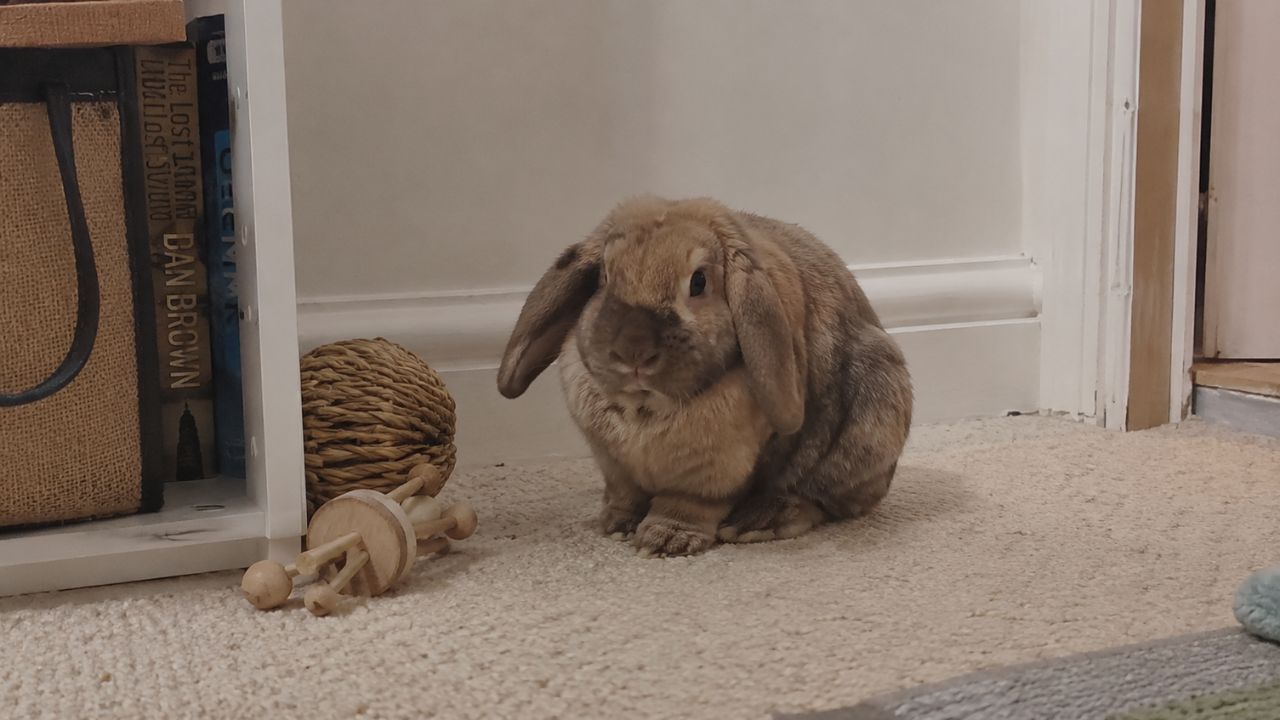

Neil has been keeping, breeding, and selling rabbits at Paradise Pets Swindon since 1988 — over 35 years of daily first-hand experience with these animals and the people who keep them. Night thumping is one of the most common rabbit complaints owners bring to the counter — and one of the most consistently mishandled. Most owners either ignore it, or try to stop it in ways that make it worse. This is his honest guide to why rabbits thump at night, what each cause looks like, and what actually helps.
A woman came into the shop on a Monday morning looking like she had not slept properly in several days. Her rabbit had been thumping every night — sometimes for twenty or thirty minutes at a stretch, sometimes repeatedly across the whole night. She had tried covering the hutch. She had tried moving it to a different room. She had tried going in to check on the rabbit, which had stopped the thumping briefly before it started again twenty minutes later.
I asked her where the hutch was.
In the kitchen, she said. Against the exterior wall. Near the back door.
I asked whether there was a cat that came into the garden at night.
She looked at me. Yes. The neighbour’s cat. It came over the fence most evenings.
That was the answer. The rabbit could hear — and almost certainly smell — a predator outside the wall it slept against, every single night. It was doing the only thing its instincts gave it to do in that situation. It was thumping. It was sounding the alarm. And the alarm was not going to stop until the predator threat stopped or the rabbit was moved somewhere it could no longer perceive it.
She moved the hutch to an interior room away from the exterior wall. The thumping stopped within two nights.
Not every case is that simple. But a significant proportion of them are — once you know what to look for.
Why Rabbits Thump — The Honest Explanation
Before I go through the specific triggers, I want to explain the biology of thumping — because understanding why rabbits do it at all changes how seriously owners respond to it and how intelligently they look for the cause.
In the wild, rabbits live in burrow systems with multiple occupants. When one rabbit detects a threat — a predator above ground, an unusual sound or vibration, an unfamiliar scent — it thumps its powerful hind legs against the ground. The vibration travels through the earth and alerts every other rabbit in the warren to danger. It is a warning system. It is also, in some contexts, a territorial or communicative signal between rabbits. But at its core, thumping is the rabbit’s alarm call — its way of saying that something is wrong.
Your domestic rabbit has the same hardwired system. The hutch is the burrow. You and your household are the warren. When the rabbit thumps, it is doing what millions of years of evolution have required it to do when it perceives a threat. It cannot evaluate the threat rationally. It cannot decide whether the cat outside the wall is actually inside the property. It detects danger and it responds.
- Thumping is not misbehaviour and it is not a bad habit — it is a hardwired survival response; trying to stop the thumping without addressing the trigger is both ineffective and unfair to the animal
- Rabbits thump in response to perceived threat — the threat does not have to be real or immediate; the perception is sufficient; a rabbit that can hear, smell, or sense a predator through a wall will thump regardless of whether the predator can actually reach it
- Night thumping is particularly common because rabbits are crepuscular — most active at dawn and dusk; their alertness peaks at night, which is when predator activity also peaks in the wild; the night hours are when the alarm system is most sensitised
- A rabbit that thumps repeatedly or persistently is a rabbit under chronic stress — not a rabbit with a behavioural problem; the distinction matters for how you respond

Once you understand this, the list of triggers and how to address them makes complete sense. And so does why covering the hutch and going in to check does not work — you are not addressing the trigger, you are just interrupting the signal.
The Main Causes of Night Thumping — In Order of How Often I See Them
Here is a complete breakdown of the causes, what each one looks like, and what the appropriate response is.
Predator Presence — The Most Common Cause
This is the cause I find most often and the one most owners have not considered — because the predator is outside, not in the house. Rabbits have exceptional hearing and a highly sensitive olfactory system. They can detect a cat, fox, or other predator through walls, through floors, and certainly through the wooden sides of a hutch.
- Cats in the garden at night — the most common predator trigger in UK domestic situations; a cat that regularly visits the garden, sits near the hutch, or moves along the exterior wall the hutch is positioned against will trigger thumping every time; the rabbit does not need to see it
- Foxes — increasingly common in suburban and urban UK environments; foxes are active at night and their scent is alarming to rabbits even at a distance; a fox that has moved through the garden within the past several hours may leave sufficient scent to trigger a thumping response when the rabbit becomes active at dusk
- Rats or mice near the hutch — rodents moving around the base of an outdoor hutch, or entering the shed or utility room where an indoor hutch is kept, register as a threat
- Birds of prey — owls hunting at night can trigger thumping even through a roof; the sound of wingbeats or the shadow of a large bird moving overhead is sufficient stimulus
- What to do — identify whether any of these animals are present in or near the rabbit’s environment at night; move the hutch or enclosure away from exterior walls and windows; use solid-sided hutch areas that block olfactory as well as visual access; secure the perimeter of any outdoor run against fox digging
Unfamiliar Sounds and Vibrations
Rabbits perceive vibration through their feet as well as hearing sound through their ears. The range of sounds and vibrations that can trigger a thumping response is broader than most owners expect.
- Road traffic and passing vehicles — a hutch positioned against a wall shared with a road will transmit the vibration of heavy vehicles; a rabbit on the other side of that wall perceives ground vibration and responds
- Boilers, heating systems, and appliances switching on at night — central heating systems that activate on a timer, boilers that click and rumble, washing machines on night cycles — all of these produce sounds and vibrations that a nearby rabbit may interpret as threat
- Neighbours and their animals — a dog barking next door, a cat flap opening and closing, footsteps on a shared wall — all audible to a rabbit at night
- Wind and weather — on particularly windy nights, external hutches flex and vibrate; unusual sounds from the roof or surroundings can be sufficient trigger
- What to do — consider where the hutch is positioned relative to noise sources; insulate the hutch base with deep bedding that absorbs vibration; move the hutch away from shared walls and appliances where practical

Fear, Stress, and Insufficient Security In The Sleeping Area
A rabbit that does not feel secure in its sleeping environment will be in a state of low-level chronic alertness that makes thumping more likely in response to even minor triggers. The design and placement of the sleeping area matters significantly.
- Insufficient hide space — rabbits need a fully enclosed hide area — not just a corner, but a covered space with solid walls on all sides and a roof — where they can retreat and feel genuinely concealed; a rabbit without adequate hide space cannot relax fully even when no active threat is present
- A hutch that is too small — stress in rabbits is directly linked to space; a rabbit that cannot move freely, cannot maintain distance from perceived threats, and cannot engage in normal locomotion is a chronically stressed rabbit; the minimum space for a single rabbit is significantly larger than most standard pet shop hutches provide
- A rabbit kept without a companion — rabbits are social animals; a solitary rabbit has no companion to help regulate its stress responses and share vigilance; solitary rabbits are on average more anxious and more reactive to perceived threats than paired or grouped rabbits
- A new rabbit still settling in — a rabbit that has recently moved to a new environment will be in a heightened state of alert for weeks; thumping during the settling-in period often resolves as the rabbit learns its environment and establishes what is normal
Pain and Physical Discomfort
This is the cause I tell every owner to consider before assuming an environmental trigger — because it is more common than expected and it is the one that needs veterinary attention rather than environmental adjustment.
 A rabbit in pain or physical discomfort will thump. Not as a communication of the pain directly, but because pain increases arousal and anxiety, which lowers the threshold for the alarm response. A rabbit that is hurting is a rabbit that is already on high alert — and it thumps at things that would not have triggered it when it was well.
- Dental disease — the most common health issue in domestic rabbits; rabbits’ teeth grow continuously and misalignment or overgrowth causes chronic pain that is often not visible to the owner; dental pain sufficient to disrupt sleep and lower the thumping threshold is not uncommon
- GI stasis and digestive discomfort — gastrointestinal issues cause pain and discomfort; a rabbit with GI stasis will be restless, uncomfortable, and prone to alarm responses; if thumping is accompanied by reduced droppings, loss of appetite, or a hunched posture, this is a same-day vet visit
- Arthritis in older rabbits — joint pain disturbs sleep and increases generalised arousal; an older rabbit that has started thumping when it did not before warrants a vet check to rule out musculoskeletal pain
- Ear mites or ear infection — ear problems cause significant discomfort, affect balance, and in some rabbits produce a generalised distress that includes thumping; check the ears for dark discharge or odour
- If thumping has started suddenly in a rabbit with no environmental changes — rule out pain before anything else; an avian vet visit — or in this case a rabbit-experienced vet — should be the first step
- Thumping has started suddenly in a rabbit whose environment has not changed
- Thumping is accompanied by reduced droppings, loss of appetite, or a hunched or uncomfortable posture — these signs alongside thumping indicate GI or other physical distress
- The rabbit is an older animal that has not thumped before — arthritis and other age-related conditions can be the cause
- The rabbit appears to be in pain when handled or is reluctant to move normally
- Head tilting, loss of balance, or ear discharge alongside thumping indicates an ear problem
- Any doubt — a vet check is always the right call before spending weeks adjusting the environment
Another Animal In The House
This one is frequently overlooked by owners who have had a dog or cat for years alongside their rabbit without apparent problems. The rabbit may have been tolerating the stress of cohabiting with a predator species without the owner realising how much it was affecting the rabbit’s baseline anxiety.
- Dogs that move around at night — a dog that is active at night, that passes near the rabbit’s enclosure, or that barks in response to something outside, will trigger thumping in a nearby rabbit reliably
- Cats that have access to the room where the rabbit is kept — even a cat that has never attacked the rabbit registers as a predator to the rabbit’s nervous system; the presence of cat scent in the rabbit’s sleeping area is sufficient to maintain elevated arousal
- A new animal introduced to the household — if thumping has started recently and a new pet has been introduced, the timing is almost certainly not coincidental
- What to do — ensure the rabbit’s sleeping area is genuinely separated from dogs and cats at night; the rabbit needs to be in a space where it cannot hear, smell, or perceive these animals; separation is not just visual — it needs to address scent and sound as well
Boredom, Frustration, and Attention-Seeking
This is the least common cause of genuine night thumping, but it is worth including because it does occur — particularly in rabbits that have learnt that thumping produces a human response.
- A rabbit that has learned that thumping brings the owner — if every time the rabbit thumps you go in to check, feed, or interact, the rabbit learns that thumping produces attention; this is a learned behaviour layered on top of the instinctive one, and it is created entirely by the owner’s response
- Distinguishing learned thumping from alarm thumping — learned thumping tends to start when the owner goes to bed or leaves the room; it stops when the owner appears; it is reliably produced by the owner’s absence rather than by any external stimulus; this is a different pattern from the sudden onset thumping that alarm calling produces
- The solution is the same as with other learned attention-seeking behaviours — do not reward the thumping with attention; wait for quiet and then go in; ensure the rabbit’s needs are genuinely met during the day so the thumping is not filling a real deprivation gap
- Check the basics before assuming this is the cause — a rabbit thumping for attention is a rabbit whose other needs — companionship, space, stimulation — are probably not being met; address those rather than just changing the response to the thumping

How To Work Out What Is Causing Your Rabbit’s Thumping
| What You Are Seeing | Most Likely Cause | What To Do |
|---|---|---|
| Thumping at the same time each night, especially dusk or late evening | Predator — fox or cat active in the garden at that time | Move hutch away from exterior walls; secure garden perimeter |
| Thumping when a specific sound occurs — boiler, traffic, dog barking | Sound or vibration trigger | Identify the sound source; move hutch or insulate against vibration |
| Thumping that started suddenly with no environmental change | Pain or illness | Vet visit — rule out dental disease, GI issues, ear problems |
| Thumping that started when a new pet arrived | New predator species in the household | Separate the rabbit’s sleeping area from the new animal entirely |
| Thumping when you go to bed, stops when you appear | Learned attention-seeking behaviour | Do not respond to thumping; reward quiet; address underlying social needs |
| Thumping plus reduced droppings or loss of appetite | GI distress or other illness | Vet visit same day — do not wait |
| Thumping in a rabbit kept alone in a bare hutch | Chronic stress from inadequate housing and social deprivation | Companion rabbit; larger space; enrichment; hide areas |
| Thumping in a recently acquired rabbit, settling in | Normal adjustment to new environment | Patience; provide good hide space; minimise additional stressors during settling period |
What Actually Helps — Practical Changes In Order of Impact
- Identify and remove the trigger — this is always the first step and it is the step most owners skip; every other measure is a workaround; removing the cause is the solution; spend a week systematically identifying what the rabbit is responding to before making changes
- Move the hutch away from exterior walls and windows — this single change resolves the majority of predator-triggered night thumping; distance and solid walls reduce both olfactory and acoustic access; even moving the hutch to an interior wall of the same room makes a significant difference
- Provide a genuinely enclosed hide space within the sleeping area — a solid-sided, roofed box that the rabbit can fully enter and feel concealed within; this is not optional for rabbit welfare and it directly reduces the baseline anxiety that makes thumping more likely
- Get a companion rabbit — a bonded companion is the single most impactful welfare improvement available to a solo rabbit; companionship reduces baseline anxiety, provides mutual security, and means the rabbit is not managing its threat responses alone; the reduction in stress-related behaviour including thumping in newly paired rabbits is often dramatic
- Ensure the space is adequate — a rabbit in a hutch that is too small is a stressed rabbit; stress lowers the thumping threshold; the Rabbit Welfare Association recommends a minimum of 3 metres by 2 metres of combined living space for a pair of rabbits; most standard hutches do not meet this
- Secure the garden perimeter against foxes — if an outdoor rabbit is being disturbed by foxes, fox-proofing the garden boundary reduces their access and over time reduces the frequency of fox presence near the hutch; L-shaped aprons of wire mesh buried at the base of fences prevent digging access
- Separate the rabbit from dogs and cats at night — a closed door between the rabbit’s sleeping area and any predator species in the household; this needs to address scent as well as presence; wash bedding and the rabbit’s area regularly to prevent scent accumulation from other animals

What Does Not Help — The Mistakes Most Owners Make
- Covering the hutch — reduces visual stimulus; does nothing about sound or scent; a rabbit alarmed by fox scent through a covered hutch will still thump; covering is not an effective solution and can also reduce ventilation
- Going in to check when the thumping starts — if the thumping is alarm calling, your appearance does not remove the threat; the thumping may pause when you are present and resume when you leave; if the thumping has a learned component, going in when it starts rewards the behaviour
- Moving the hutch to a noisier part of the house hoping the rabbit will habituate — increasing stimulation does not reduce alarm responses in prey animals; it typically increases them
- Punishing or tapping the hutch to stop the thumping — causes additional fear; does not address the cause; damages the rabbit’s trust in the owner
- Assuming it will resolve on its own without changes — a rabbit that is thumping because of a persistent environmental trigger will continue to thump until the trigger is removed; this does not self-resolve
Frequently Asked Questions
My rabbit only thumps at night. During the day it is completely calm. What does that mean?
Almost certainly a predator or environmental trigger that is specific to the night hours. Cats and foxes are most active at dawn, dusk, and through the night — which corresponds exactly to the hours your rabbit is thumping and the hours it is not. The fact that the rabbit is calm during the day tells you the environment is manageable during the day; something changes at night. Identify what that is — check whether cats or foxes visit the garden after dark, whether the boiler or heating system activates at a specific time, whether any other animal in the household moves around at night — and address it directly.
Could my rabbit be thumping because it is bored or lonely?
Possibly, but I would consider predator and pain causes first because they are more common. Loneliness and boredom contribute to generalised anxiety that lowers the thumping threshold, making the rabbit more reactive to triggers it might otherwise habituate to. They are rarely the direct cause of the thumping event itself. A rabbit kept alone without adequate space, enrichment, or companionship is a stressed rabbit — and a stressed rabbit thumps more readily. The solution is to address the underlying welfare deficit rather than just the thumping.
My rabbit has started thumping and it never did before. What has changed?
Two categories to consider: environmental change or health change. Environmental changes that can trigger new thumping include a new pet in the house, a change in the garden that has altered fox or cat access, a new neighbour with a dog, a change in your own routine that has altered when the rabbit is disturbed. Health changes — particularly dental disease in middle-aged rabbits — can cause sudden onset thumping through pain. If you cannot identify an obvious environmental change, book a vet visit before spending time adjusting the environment.
My rabbit thumps and then runs and hides. Is that different from just thumping?
Thumping followed by hiding is a more complete alarm sequence — the rabbit has sounded the warning and is now taking cover. This typically indicates a more significant perceived threat than thumping alone. It is the behaviour you would see if the rabbit had actually seen, heard, or smelled something genuinely alarming rather than just felt a minor vibration. Take this version more seriously and look carefully for a predator trigger.
Will getting a second rabbit stop the thumping?
If the thumping is driven by loneliness, generalised anxiety, or chronic social stress, yes — often significantly. A bonded companion reduces baseline anxiety and the mutual security of having another rabbit present reduces alarm responses to minor triggers. If the thumping is driven by a specific environmental trigger — a cat that sits outside the hutch every night — the second rabbit will thump too until the trigger is addressed. Companionship is the right answer for social and anxiety-related thumping; it is not a substitute for removing an active predator trigger.
Is night thumping bad for my rabbit’s health?
Chronic stress is bad for rabbit health, yes. A rabbit that thumps occasionally in response to a specific event is not being harmed by the thumping itself. A rabbit that is in a state of frequent or nightly alarm response is experiencing chronic stress — elevated cortisol, disrupted sleep, sustained arousal — and this has real health consequences over time. It suppresses the immune system, disrupts digestive function, and in some research is associated with shorter lifespan. This is another reason not to accept persistent night thumping as normal or harmless.
Where can I get help with a rabbit that thumps at night in Swindon?
Come in to Paradise Pets at Manor Garden Centre, Cheney Manor Industrial Estate, Swindon SN2 2QJ — or call us on 01793 512400. Tell me what is happening, when it happens, and what the rabbit’s environment is like. I will tell you honestly what I think is causing it and what to change. Free advice, no obligation. That is how we have done things here for 35 years.
One Last Thing From Me
The woman I described at the start — the one who had not been sleeping — came back into the shop about three weeks after moving the hutch. She looked entirely different. The rabbit had not thumped since the second night after the move.
She had also, in the time since, started thinking more carefully about the rabbit’s overall setup. The hutch had been a standard two-storey pet shop hutch. She had expanded the run. She was looking at getting a second rabbit. The thumping question had led her to look at the whole picture, and the rabbit’s life was going to be considerably better for it.
That is usually how it goes with rabbit problems. One issue that seems specific leads to a broader look at the setup, and the broader look reveals things that were quietly not right.
A rabbit that thumps at night is not a rabbit with a noise problem. It is a rabbit telling you, in the only language it has, that something in its world is not right. Sometimes the answer is simple — a cat on the other side of a wall, a hutch against the wrong surface. Sometimes it leads somewhere bigger.
But it always leads somewhere. Follow it.
Rabbit Thumping At Night And Not Sure Why? Come In And Talk It Through.
Tell me what is happening and I will give you my honest read on what is most likely causing it and what to change first. Bring the rabbit if you want a second opinion on its setup or condition. Free advice, no obligation. That is how we have done things here for 35 years.
⭐ Customer Reviews
Amazing Bird Selection
Had a lovley visit today,staff were very friendly and very helpful,such a great petshop,their selection of birds is incredible,really impressed,thank so much to the staff at Paradise Pets

Friendly Helpful Staff
I have been coming to this place for years and they have a great stock of food for all types of pets. Have a great selection of small mammals and a lot of birds. Staff are friendly and helpful.

Great Quality Hutch
Bought a guinea pigs hutch and run combo, very happy with the service, the hutch was put in my car for me without even asking for help. The wood quality is very good, the instructions easy to follow and we are extremely happy with the fully built hutch. A good size for 2 guinea pigs

Response from Paradise Pets | Wiltshire
Thank you Melanie Latus Nice to provide services to you.
Best Bird Shop Around
It’s the best pet shop in and around Swindon. They always have an amazing selection of birds and all you need to keep them happy. I keep birds myself and the guys there are happy to answer questions and really know their stuff. I have seen budgies etc. in chain pet shops in the area looking really unhealthy and ill – I wouldn’t go anywhere else than Paradise Pets for animals.

Highly Recommended Bird Shop
I could not praise this shop enough. Really helped my Grandson buy his first bird and he’s loving it. Travelled from Somerset and was welcomed with open arms.

Great Shop with Competitive Prices
Great shop with amazing selection for small animals, hamsters, mice ect, highly recommend!
Also has a great selection for dogs & cats too & very competitive prices! 💖

