


Neil has kept, bred, and sold hamsters at Paradise Pets Swindon since 1988 — over 35 years of watching UK families buy hamster cages and bring them home. In that time, he has come to a conclusion that most UK pet owners would find genuinely surprising — almost every hamster cage sold in the UK breaks the recommended cage size welfare rule, and most UK owners have no idea this rule exists. This is his honest, practical guide on what the rule is, why it matters more than most owners realise, and what UK families need to know today.
A father came in one Wednesday afternoon, holding a printed photograph of a hamster cage he had bought from a popular online retailer the previous week. He had set it up beautifully — bedding, wheel, water bottle, food bowl, a small house. He was proud of it. He had spent more than he originally planned on the setup, because he wanted to do things properly. He wanted to ask me if there was anything else he needed.
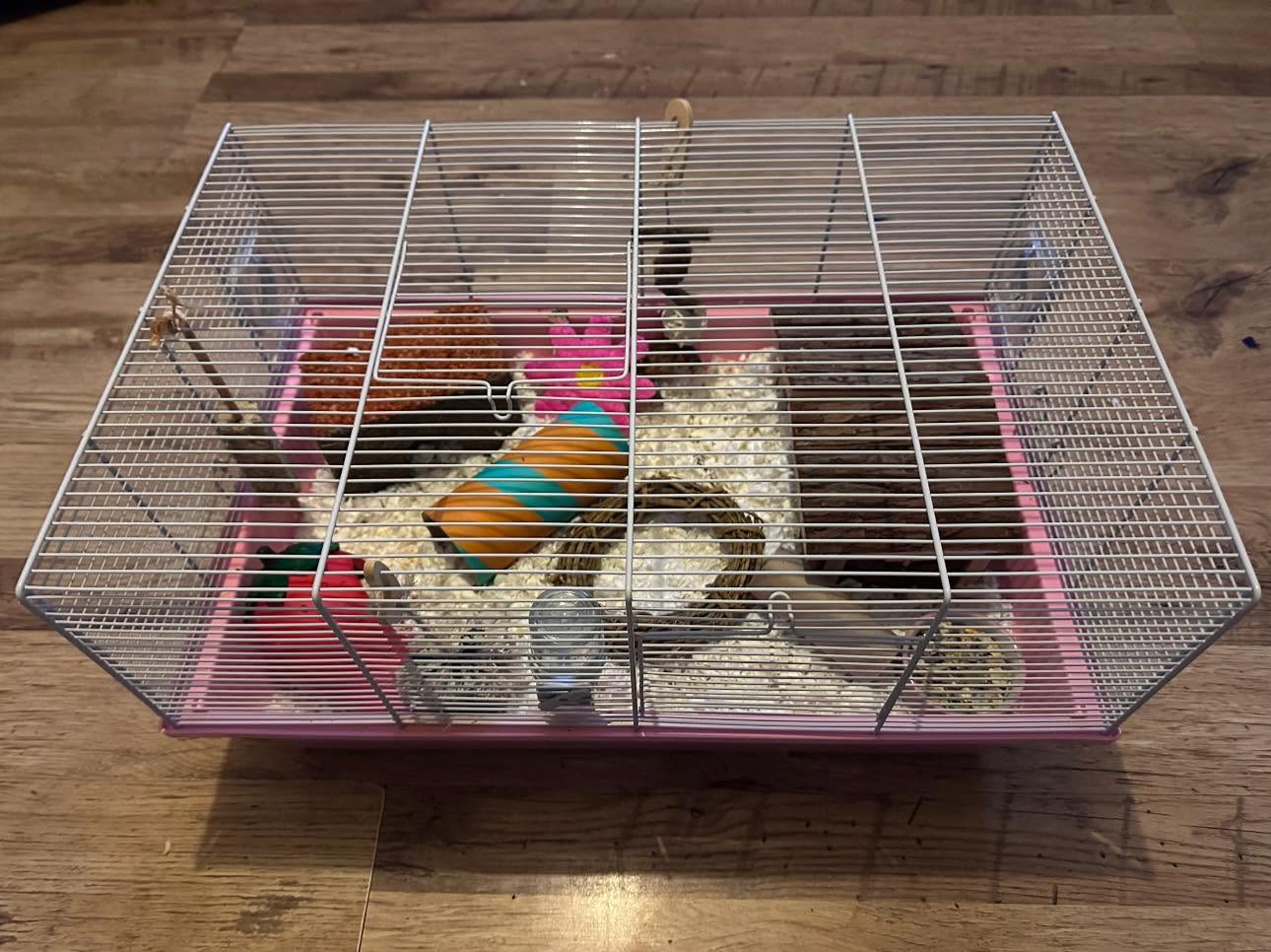
I looked at the photograph carefully. The cage was almost certainly around 70cm long by 35cm wide. The wheel was about 17cm in diameter. It was the standard UK pet shop “starter” hamster cage — pictured on the box with a happy-looking hamster, marketed as “spacious” and “ideal for one Syrian hamster.” It cost about £45. He had paired it with a £15 wheel.
His hamster was a Syrian he had bought from a chain pet shop the day after. The whole setup looked, by any reasonable visual standard, perfectly adequate.
I had to tell him the truth — what he had bought, despite being the standard equipment that 90% of UK hamster owners use, falls significantly below the recommended welfare standard for cage size. The cage was approximately one-third of the minimum recommended floor space. The wheel was too small for his hamster’s adult size. None of this was his fault. The retailer had sold him a product marketed as suitable. The pet shop had not flagged it. But the gap between what he had bought and what his Syrian hamster genuinely needs was real, and it would affect the animal’s welfare for the rest of its life.
He was, understandably, frustrated. Why had no one told him? Why was the standard pet shop hamster cage so far below the welfare recommendation? Why was a “rule” that almost no UK owners knew about even a rule?
This article is the conversation I have at the counter with frustrated UK families who have just discovered this gap. By the end of it, you will know exactly what the recommended cage size rule actually is, how most UK pet shop cages compare, why this matters more than most owners realise, what to do if your current cage breaks the rule, and how to set up genuinely welfare-standard hamster accommodation that gives your animal the life it actually needs.
First — What Is The Cage Size Rule?
The UK welfare-standard cage size recommendation for hamsters has been established by animal welfare organisations and research-led care guidance over the past decade. It is widely accepted by veterinary surgeons, the RSPCA, and species-specific organisations. It is rarely communicated to UK pet shop customers at point of purchase.
The current UK welfare-standard minimum cage size recommendation for hamsters:
- Syrian (golden) hamster — minimum 100cm long x 50cm wide unbroken floor space
- Dwarf, Roborovski and Chinese hamsters — Woodgreen’s care guide specifies 100cm by 50cm of floor space; enclosure height requirements vary by species.
- “Unbroken floor space” means single-level continuous floor — additional levels do not count toward the minimum
- Height should allow standing fully on hind legs — typically 40-50cm minimum
- Bedding depth of 15-25cm minimum — for proper burrowing behaviour
- Wheel size 28cm+ for Syrians, 20cm+ for dwarfs — to allow running with a straight back
- Larger is genuinely better — recommended sizes are minimums, not targets

For comparison, the typical UK pet shop hamster cage measures approximately 60-70cm long by 30-40cm wide — providing roughly 30-40% of the recommended floor space for a Syrian. Many “starter” hamster cages are even smaller. The standard wheels sold with these cages are usually 15-20cm in diameter, well below the recommended 28cm for Syrians.
This is not a small difference. The standard UK pet shop hamster cage provides genuinely about one-third of what current welfare guidance recommends. And almost every UK family that buys a hamster cage buys one of these standard cages, because they are what the shops sell.
Why Cage Size Matters More Than Most UK Owners Realise
For UK families who think cage size might be a minor welfare consideration — “as long as the hamster has food and water and a wheel, it should be fine” — here is the honest picture of what inadequate cage size genuinely does to a hamster’s life.
What happens when hamsters are kept in undersized cages:
- Chronic stress develops — measurable physiological effect from confinement
- Stereotypical behaviour emerges — bar-biting, repetitive route-pacing, food bowl flipping
- Welfare-related aggression appears — biting handlers, behavioural changes
- Obesity becomes nearly inevitable — insufficient exercise opportunity
- Spinal damage from undersized wheels — curved back becomes permanent posture issue
- Cheek pouch problems — inability to behave naturally with food
- Sleep disruption — no quiet retreat from disturbance
- Reduced cognitive engagement — bored hamsters develop welfare problems
- Shortened lifespan — chronic stress correlates with reduced lifespan in research

None of these effects are dramatic individually. None of them produce obvious immediate suffering that an owner would necessarily notice. They accumulate over the months and years of the hamster’s life, contributing to the gap between what hamsters are capable of as a species and what most UK pet hamsters actually experience.
The bar-biting that many UK owners assume is “just what hamsters do” is genuinely a welfare warning sign — a stereotypical behaviour that emerges from inadequate environment. The hamster pacing the same route around its cage repeatedly is not playing — it is showing distress. The hamster that becomes aggressive at handling is often responding to chronic stress accumulated from inadequate housing. These are not personality traits of hamsters. They are responses to environments that fall short of what the species needs.
For more on hamster welfare specifically, our article on how long hamsters really live and the truth behind the numbers covers how welfare gaps shorten lifespan, and our guide on the 60p hamster mistake that shortens lives covers another widely-overlooked welfare issue.
Why The Pet Trade Sells What It Sells
This is the question every UK owner asks me when they discover the gap between welfare standard and pet shop reality. The honest answer is uncomfortable but worth understanding because it explains why this situation has persisted.
Why the standard UK pet shop hamster cage is the size it is:
- The cages meet minimum legal requirements — UK welfare law sets very basic standards
- Larger cages cost more to manufacture, ship, and display — they take up more shelf space and selling space
- First-time buyers often choose by price — and smaller cages are cheaper
- The harm is delayed and distributed — owners do not connect future problems to the original cage choice
- Welfare standards have evolved faster than pet trade practice — what was acceptable 20-30 years ago is now known to be inadequate
- Marketing emphasises affordability and “convenience”, not the animal’s actual needs
- Without regulatory pressure, the trade lags behind welfare science
- Picture-perfect packaging shows the cage with a hamster appearing content
- Sales staff often do not know the welfare-standard recommendations
At Paradise Pets, we stopped selling the smallest standard hamster cages decades ago and have refused to bring them back despite customer requests. We always recommend proper-sized accommodation to anyone considering a hamster. Sometimes this loses us a sale to someone who wants the cheaper option. We are happy to lose those sales, because the alternative is selling families into accommodation we know is inadequate. After 35 years, that is not a trade-off I can make in good conscience.
How To Tell If Your Current Cage Breaks The Rule
For UK owners who already have a hamster and want to honestly assess whether their setup meets the welfare standard, here is the practical check. Be honest with yourself — most UK families discover their cage breaks the rule, and that is normal.
- Measure the unbroken floor space of your hamster’s cage
Length x width at the bottom level. Additional levels do not count. - Compare against the welfare-standard minimum
Woodgreen’s care guide gives a 100cm by 50cm footprint (5,000 cm²) for Syrian, Chinese, dwarf and Roborovski hamsters. Check its species-specific height guidance as well. - Measure your wheel diameter
The diameter (full distance across) should be 28cm+ for Syrians, 20cm+ for dwarfs. - Check the bedding depth
Should be 15-25cm minimum across most of the cage floor. - Watch your hamster on the wheel
Their back should be straight when running. If they curve their spine, the wheel is too small. - Watch for bar-biting
Bar-biting is a welfare indicator. Persistent bar-biting is a stress sign, not a habit. - Watch for stereotyped behaviour
Repetitive routes, food bowl flipping, repetitive climbing in the same spot. These suggest inadequate stimulation. - Is there room for multiple discrete areas?
Sleeping area, toilet area, eating area, exercise area — should all be possible.
If you answered “no” to two or more of these — your cage breaks the rule. The honest news is that this is genuinely the situation for most UK pet hamster owners. The good news is that upgrading is possible and worthwhile.
What Proper UK Hamster Accommodation Actually Looks Like
For UK owners ready to provide genuinely welfare-standard hamster housing, here are the realistic options that work for most households. None of them require unreasonable budgets. All of them work better than the standard pet shop cage.
1. Large DIY Bin Cage
This is one of the most accessible upgrades for UK owners on a budget. A large transparent plastic storage bin (typically 100-120 litres) can be converted into a welfare-standard hamster habitat at a fraction of the cost of buying a commercial cage of the same size.
Key features:
- 100-120 litre transparent storage bin from a UK retailer
- Mesh ventilation cut into the lid and one side
- Deep bedding allowed by tall sides
- Can be done for £30-£50 total cost
- Provides 100cm x 60cm or larger floor space
- Easy to clean and modify
- Visible from all sides — easy observation
Many UK hamster keepers have moved to bin cages specifically because commercial welfare-standard cages are difficult to find and expensive when located.
2. Detolf Conversion (IKEA Display Cabinet)
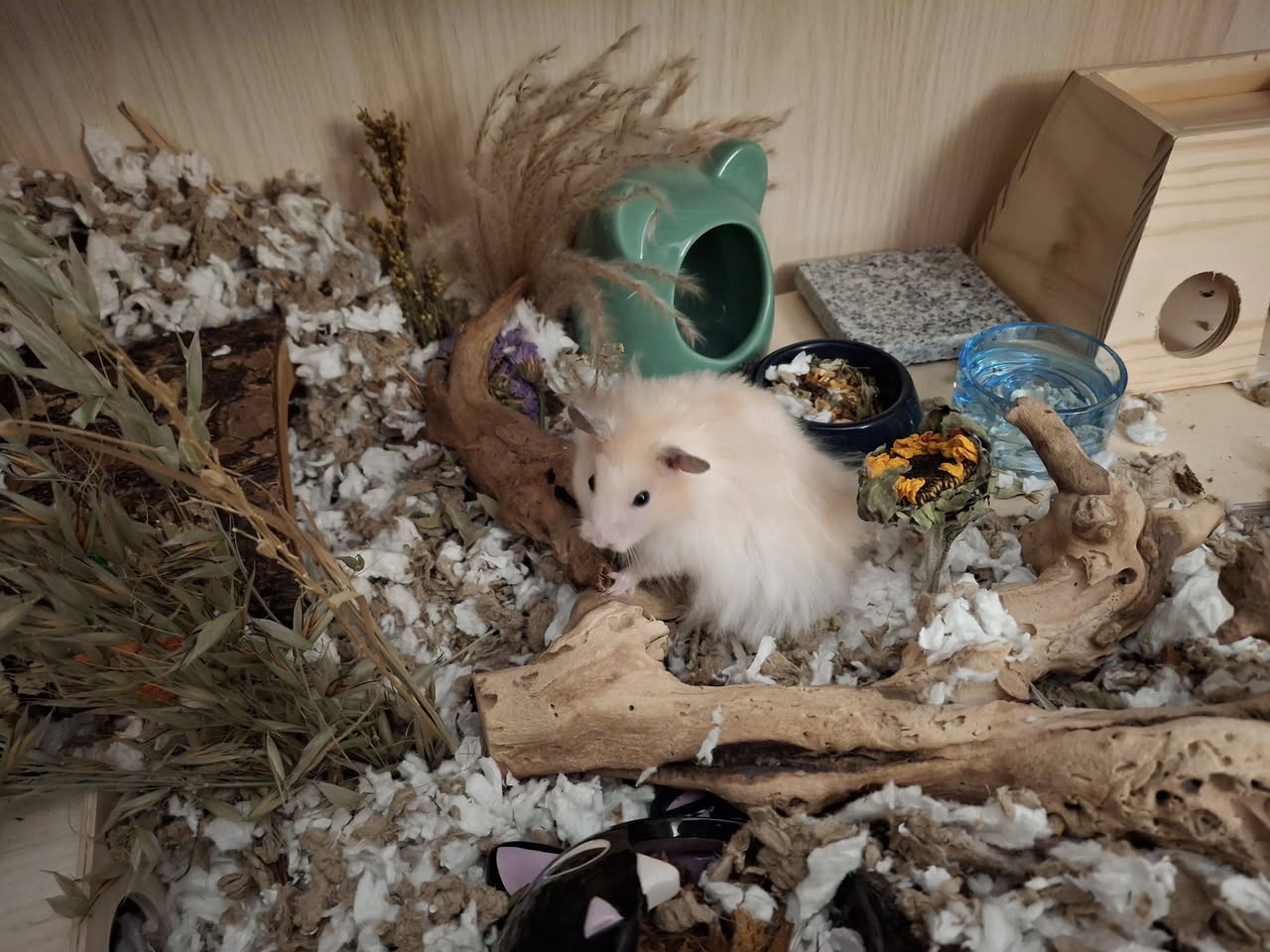
This is the popular solution among experienced UK hamster keepers. The IKEA Detolf is a glass display cabinet that, when laid on its side, provides excellent welfare-standard hamster accommodation.
Key features:
- Approximately 163cm long x 43cm wide when laid on side
- Exceeds welfare-standard minimum significantly
- Glass sides allow excellent visibility
- Reasonably affordable from IKEA (current pricing varies)
- Custom-made mesh lid required (typically £40-£80)
- Allows very deep bedding for burrowing
- Long-term durable solution

The Detolf has become the unofficial gold-standard hamster habitat among UK welfare-led keepers. The total setup cost is typically £150-£250 including the custom mesh lid, but provides excellent welfare for the hamster’s full lifetime.
3. Commercial Welfare-Standard Cages
A growing number of UK retailers now stock proper welfare-standard hamster cages — typically large enclosures of 100cm+ length. These are still less common than standard pet shop cages, and significantly more expensive (£150-£400 typical), but they exist as off-the-shelf options for UK families.
Key features:
- Built specifically for welfare-standard hamster keeping
- Often include proper-sized wheels and accessories
- Can be found at specialist UK retailers and online
- Premium pricing reflects the equipment
- Easier setup than DIY options
- Long-term investment for committed keepers
4. Modified Larger Cages
Some UK keepers combine two smaller cages, modify rabbit/guinea pig cages, or use repurposed aquariums and terrariums to create welfare-standard hamster space. Creative solutions work well when the basic principles (sufficient unbroken floor space, proper depth for bedding, adequate ventilation, predator/escape safety) are met.
What To Do If Your Current Cage Breaks The Rule
For UK families who have just realised their hamster’s cage is undersized, here is the practical immediate action plan. Do not panic — but do plan to upgrade as soon as is practical.
- Do not feel guilty — most UK owners are in this situation
The pet trade sold you what is standard. You did what was asked of you. Now you know more. - Plan the upgrade rather than rushing it
A well-planned upgrade in 4-8 weeks is better than a panicked one tomorrow. - Choose the option that fits your budget and home
Bin cage (budget-friendly), Detolf (mid-range), commercial welfare cage (premium). - Add more enrichment to the current cage while you plan
More tunnels, hiding places, foraging opportunities. Helps mitigate the gap while you upgrade. - Upgrade the wheel if it is too small
This can be done immediately — a proper-sized wheel costs £15-£30 and makes an instant welfare difference. - Provide supervised out-of-cage time daily
30-60 minutes in a safe playpen helps stretch the gap while you plan the proper solution. - Look at second-hand options
Used Detolfs, bin cages, and welfare-standard cages often appear in UK second-hand markets. - Make the transition smoothly
Transfer some used bedding to the new cage to retain scent. Add familiar accessories first.
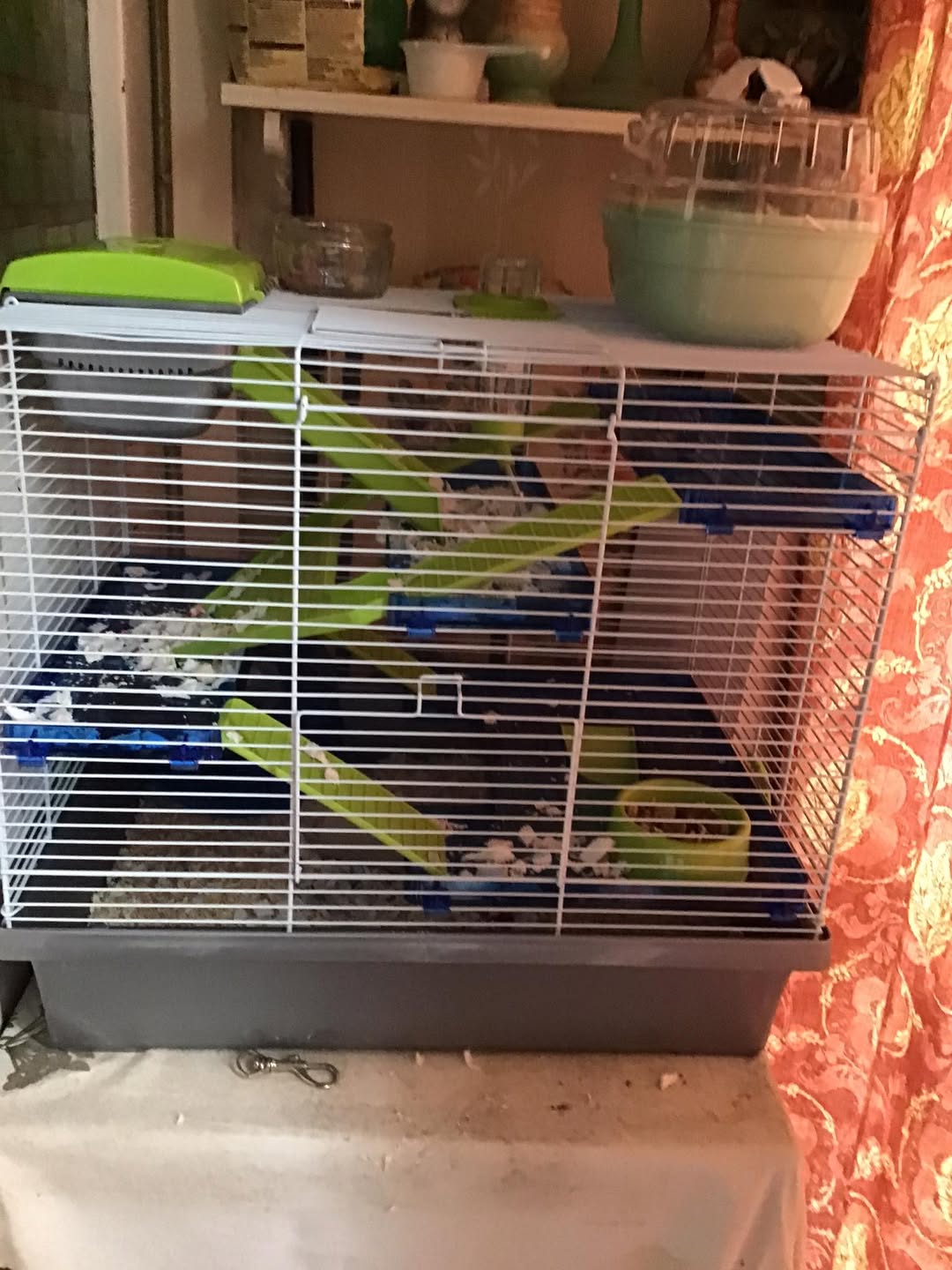
The goal is not perfection from day one. The goal is recognising the gap between what your hamster currently has and what it actually needs, then closing that gap as steadily as you can manage.
The Wheel Size Problem Most Owners Miss
The cage size rule is the most significant welfare issue, but the wheel size problem deserves its own section because it is genuinely serious and even more widely missed.
The standard wheel that comes with most UK hamster cages is 15-20cm in diameter. This is too small for a fully-grown Syrian hamster, and often too small even for dwarf species. The consequence is genuinely worrying.
Why an undersized wheel matters:
- The hamster’s back curves during use — visible spinal flexion
- Repeated curved-back running causes spinal damage over months and years
- Posture becomes permanently affected — hamsters develop hunched appearance
- Long-term mobility problems — affects quality of life as hamster ages
- Wire-rung wheels add foot injury risk — solid surface always preferable
- Standard wheels often poor quality — noisy, unstable, slow
The fix is straightforward and immediate. A proper-sized wheel — 28cm+ for Syrians, 20cm+ for dwarfs — with a solid running surface costs £15-£30 and can be added to your hamster’s setup today. If you are not yet able to upgrade the cage, you can still upgrade the wheel as a separate action. The welfare improvement is immediate and significant.
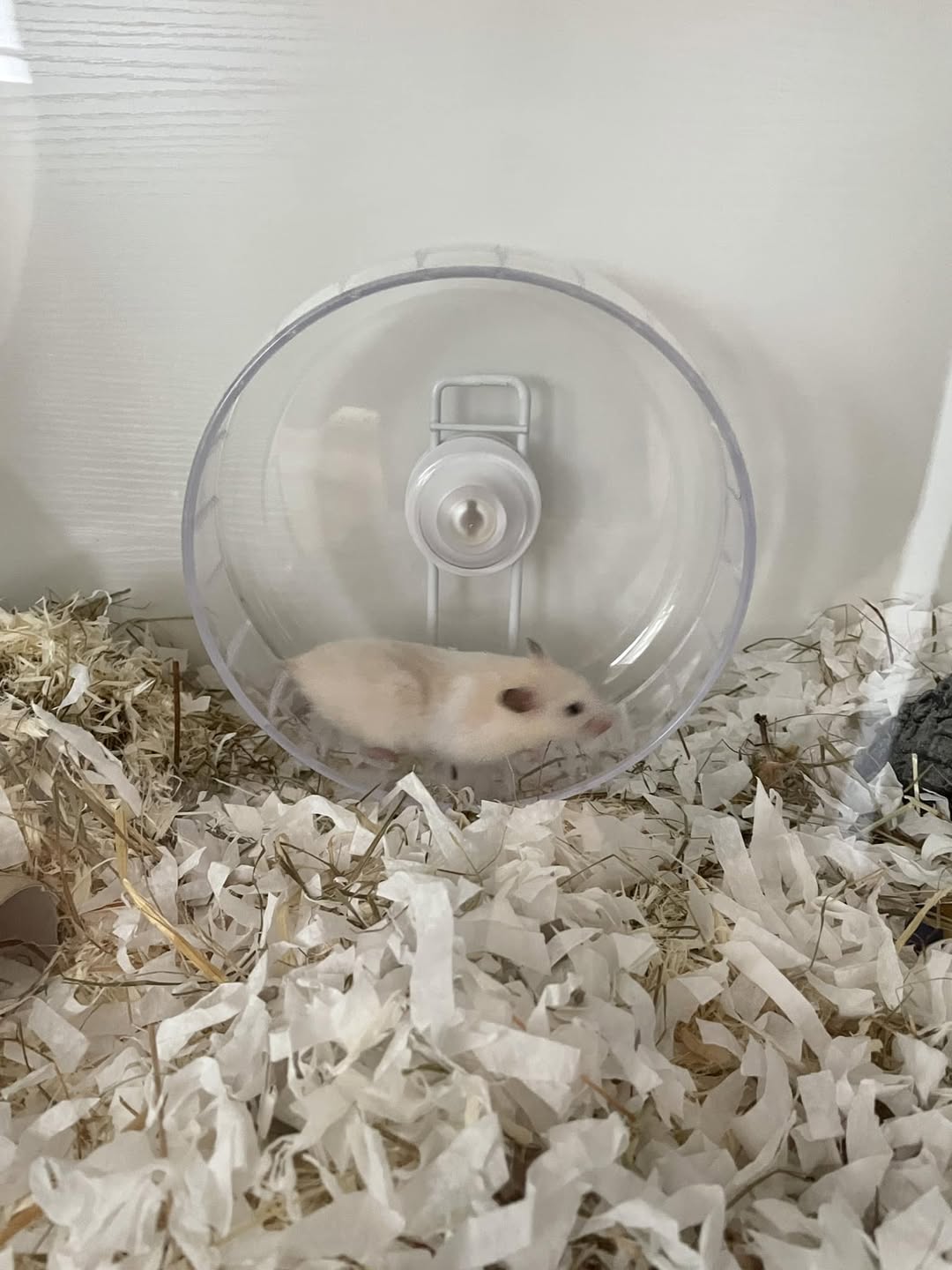
- Curved back when running on the wheel — too small
- Hamster reluctant to use the wheel — possibly too small or wrong type
- Visible foot injuries or sores — wire rungs causing damage
- Hamster developing hunched posture even off the wheel — possible long-term spinal damage
- Wheel wobbling, falling off, or unstable — quality issues
- Excessive noise from the wheel — quality issues, may disturb the hamster too
- Hamster only running in one direction — sometimes related to wheel issues
- Stopping use of wheel suddenly — possible injury or aversion developing
Common Mistakes UK Hamster Owners Make With Cage Size
For balance, here are the genuine mistakes I see at the counter when UK families discuss their hamster setups. Avoiding these helps you make better welfare-led choices.
- Trusting “starter cage” or “ideal for Syrian” marketing — almost always inadequate
- Adding multiple levels to count as “bigger” — only unbroken floor space matters for the rule
- Believing tubes and levels replace floor space — they do not
- Buying based on price without comparing welfare-standard options
- Assuming the pet shop sold the right size — usually it did not
- Ignoring the wheel size problem — often more urgent than cage upgrade
- Treating bar-biting as “just what hamsters do” — it is a welfare sign
- Adding ventilation reductions for warmth — proper cage size includes proper ventilation
- Putting two Syrian hamsters in one cage — they should never share housing
- Not providing enough bedding depth for burrowing — 15-25cm minimum
The single most common mistake I see is owners who trust the standard pet shop offerings without comparing them to welfare-standard recommendations. The gap is real, and it is on UK families to close it because the trade has been slow to lead.
The Honest Conversation Most UK Pet Shops Will Not Have
This article exists because most UK pet shops will sell families the cages they have on the shelf without flagging the welfare-standard gap. The conversation about whether what they are selling is actually adequate for the animal rarely happens at point of purchase.
This is not always malicious. Many UK pet shop staff are not aware of current welfare-standard recommendations themselves. Some shops know but do not want to lose sales. Some genuinely believe the cages they sell are adequate because that is what they have always sold.
At Paradise Pets, I have had thousands of conversations over 35 years where I have told UK families honestly that the hamster cage they were planning to buy was too small. Many of those families bought a larger setup. Some went elsewhere to buy the smaller cage despite my advice. A few were grateful for the honest information they had not been able to get anywhere else.
I am not saying every pet shop should operate this way. I understand the commercial pressures. But I am saying that UK hamster owners deserve to hear this conversation somewhere — and if your local pet shop will not have it with you, please read this article and have it with yourself before you decide your hamster’s accommodation.
For more on the broader pattern of UK welfare gaps in pet keeping, our article on why pet shop animals cost more than free ones covers how welfare standards differ between sources, and our article on the rabbit hutch mistake first-time owners make covers the parallel welfare gap in UK rabbit keeping.
Frequently Asked Questions
What is the minimum recommended cage size for a Syrian hamster?
The current UK welfare-standard minimum is 100cm long x 50cm wide of unbroken floor space — significantly larger than the standard UK pet shop hamster cage. This is the minimum recommendation, not the target. Larger is genuinely better. Additional levels and platforms do not count toward this minimum — only the continuous bottom floor space.
What about dwarf hamster cage sizes?
Woodgreen’s guide gives a floor area of 100cm by 50cm for dwarf and Roborovski hamsters, as well as Chinese hamsters. Provide a continuous floor area and check the guide’s species-specific enclosure height and spacing requirements.
Why is the welfare-standard size so different from what pet shops sell?
The honest answer is that UK welfare science has progressed faster than UK pet trade practice. Research and welfare guidance over the past 10-15 years have established that the previous standard cage sizes are inadequate for hamster welfare. The pet trade has been slow to update what it stocks, partly because larger cages cost more and take up more shelf space. The gap persists because there is no regulatory pressure to close it.
How important is wheel size really?
Genuinely important. The wheel diameter should be 28cm or larger for Syrian hamsters, and 20cm or larger for dwarfs. The hamster’s back should remain straight when running. A curved back during wheel use indicates a wheel that is too small, and over time this causes spinal damage and posture problems. The standard wheel that comes with most UK pet shop hamster cages is too small — replacing it is one of the most impactful single improvements an owner can make.
What if I cannot afford a welfare-standard cage right now?
The DIY bin cage option (large plastic storage bin converted to a hamster habitat) costs £30-£50 total and provides welfare-standard accommodation. This is often cheaper than the inadequate “starter” cages sold by pet shops. The Detolf conversion costs more (£150-£250) but lasts indefinitely. There are genuine budget-friendly routes to welfare-standard accommodation — they just require looking beyond the standard pet shop offerings.
My hamster has been in a small cage for months — has it been suffering?
Welfare issues from inadequate housing accumulate gradually rather than producing dramatic immediate suffering. Most UK pet hamsters in undersized cages develop chronic mild stress, behavioural changes, and reduced exercise opportunities over time. Upgrading the cage now will allow the hamster to start expressing more natural behaviours and likely improve its quality of life going forward. The gap between past care and current understanding is normal — what matters is what you do next.
Where can I get honest hamster cage advice in Swindon?
Come and see us at Paradise Pets, Manor Garden Centre, Cheney Manor, Swindon SN2 2QJ. We will give you honest advice on welfare-standard hamster accommodation — including budget-friendly DIY options, mid-range commercial options, and premium setups. Ring us on 01793 512400. Free advice based on 35 years of welfare-led hamster keeping.
One Last Thing From Me
“Is my hamster’s cage big enough?” is one of the most important questions a UK owner can ask, and one that most UK owners never think to ask because they trust what their pet shop sold them. The honest answer, after 35 years of selling hamsters, is — most UK hamster cages sold across British pet shops, garden centres, and online retailers are significantly below the welfare-standard recommended size. Most UK owners have no idea this is happening. The gap is real, the consequences for the animal accumulate over its lifetime, and the fix is genuinely accessible for most UK families willing to look beyond the standard offerings.
The father with the £45 cage photograph that Wednesday afternoon? He went home thoughtful rather than upset. Two weeks later he came back to show me his new setup — a 120-litre bin cage with a proper-sized wheel, deep substrate, and multiple hiding areas. Total cost about £55. His Syrian, named Biscuit, had transformed visibly within a week — more active, more natural behaviour, no more bar-biting, clearly happier. Six months later they came back again — Biscuit was thriving, still active, building elaborate burrows, and the father told me he wished someone had told him about the rule the day he bought the hamster instead of the day he bought a too-small cage.
That is exactly why I wrote this article. So that UK families do not have to discover this rule after the fact, when they are already disappointed and wondering why their hamster seemed less engaged than expected. The information should have been available to them at the point of purchase. It usually is not. So we have to share it elsewhere.
If you are reading this with a hamster at home, please measure your cage. Honestly. Compare it to the welfare-standard recommendation. If there is a gap — and there probably is — plan the upgrade. The bin cage option is genuinely affordable. The wheel upgrade can be done today. Your hamster will live a better, longer, more engaged life because of these changes.
If you are considering a first hamster and have not yet bought, please come and see us first. We will help you set up genuinely welfare-standard accommodation from day one. Better to start right than to upgrade later. After 35 years at the counter, I have come to see this honest pre-purchase conversation as one of the most important things any UK pet shop can offer.
Worried Your Hamster’s Cage Is Too Small? Come And See Me
We will give you the honest welfare-standard conversation about your specific setup — including affordable DIY options, mid-range solutions, and premium upgrades. Free advice based on 35 years of welfare-led hamster keeping. That is how we have done things since 1988.