
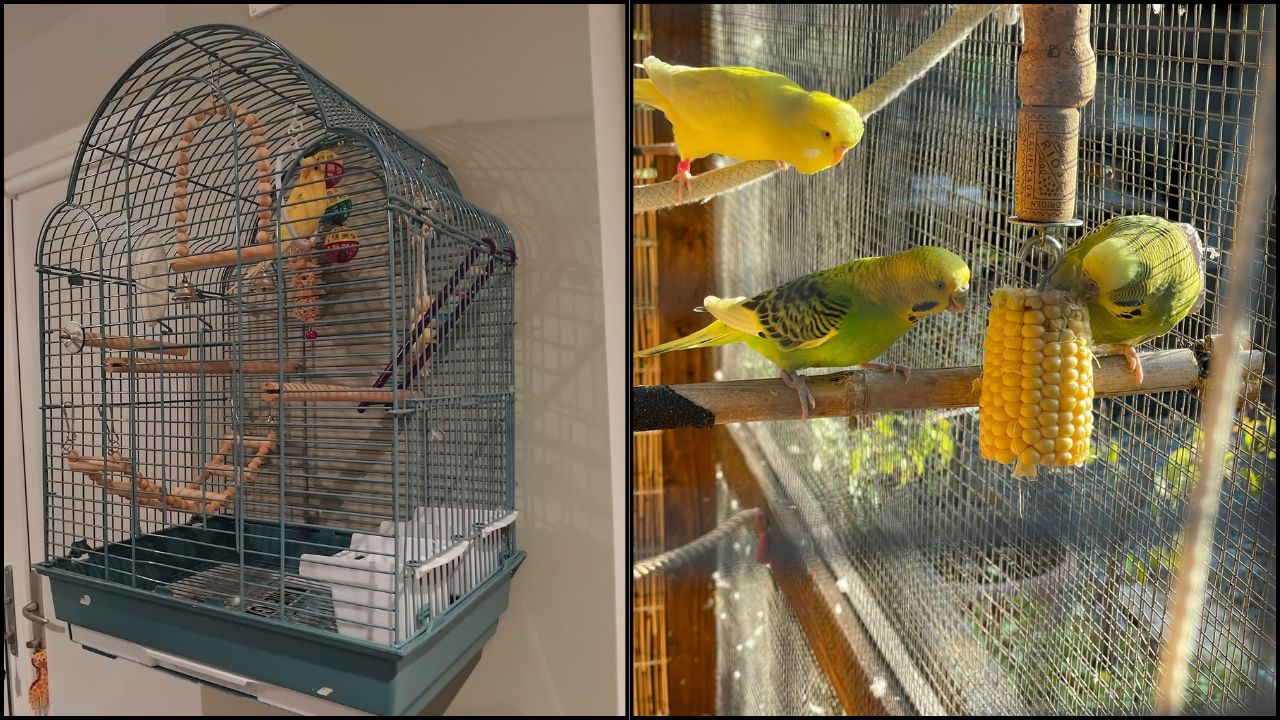
Neil has been keeping, breeding, and selling budgies at Paradise Pets Swindon since 1988 — over 35 years of watching what UK budgie housing actually looks like versus what it should look like. The RSPCA’s guidance on cage size for budgies is clear, specific, and based on genuine animal welfare evidence. It is also consistently ignored by the retail cage market, which means most UK budgie owners are keeping their birds in cages that fall short of it — often without ever having read what the guidance actually says. This article is that guidance, explained honestly, with what it means in practice for the birds in your care.
A customer came in about a year ago to replace a cage that had broken. He had owned budgies for about six years. He knew what he wanted — the same size cage he had always had, roughly 40 centimetres wide, the standard kind you see in most pet shops. He was, by his own description, a careful and attentive owner. He bought good food, kept the cage clean, had the birds out regularly. He was not, in any way he was aware of, doing anything inadequate.
I asked him whether he had ever read the RSPCA’s housing guidance for budgies.
He had not. He assumed that the cages sold in pet shops as budgie cages met whatever welfare standards existed. This is a reasonable assumption that is, unfortunately, almost entirely wrong.
The RSPCA’s guidance on budgie cage size — which is based on the animal welfare evidence about what a budgie’s body and biology actually need from its living space — sets out requirements that the standard retail budgie cage market in the UK consistently falls short of. This is not a new or updated rule. It is guidance that has been available for years, and that most UK budgie owners have simply never encountered directly.
What The RSPCA’s Guidance Actually Says
Let me be specific and clear about this, because the guidance is precise enough to be directly useful and most owners have never seen it.
The RSPCA states that if your bird spends most of their time in the cage, the height, width and depth of the cage should be at least twice their wingspan. A budgerigar’s wingspan is typically around 30cm, which means all three cage dimensions — height, width, and depth — should be a minimum of 60cm for a single bird spending most of its time caged.
For pairs of birds, the minimum width should be three times their combined wingspan. The minimum length should permit at least two wing beats between perches. Perches should be placed far enough from the ends of the cage to allow the birds to turn around without scraping their tail feathers against the cage.
For a group of more than two budgies in a cage, the cage should be at least twice the largest bird’s wingspan in all dimensions, with an additional 5 percent added for each bird over the first two.
Translated into plain numbers for a typical pet budgie:
- A single budgie spending most of its time caged — all three dimensions (height, width, depth) should be at minimum 60cm; most standard retail budgie cages are 40–45cm wide
- A pair of budgies — width should be at minimum 90cm (three times the combined wingspan of two birds); length should allow at least two full wing-beat distances between perches
- The width and length matter far more than height — budgies fly horizontally, not vertically; a tall narrow cage is largely wasted welfare space from a flight perspective
- The “at least two wing beats between perches” rule for length — a budgie’s wing beat covers roughly 15–20cm of horizontal distance; two wing beats means a minimum usable flight length of 30–40cm between perches; this is interior usable space, not overall cage dimension

Why Most UK Retail Budgie Cages Do Not Meet This Guidance
This is the uncomfortable but honest part of this article, and I think it is worth being direct about it.
The retail cage market in the UK produces and sells budgie cages based primarily on what is convenient to manufacture, what fits in a shop, and what is affordable at a price point most budgie buyers will accept. These are commercial considerations. They are not welfare considerations, and the guidance that governs what a budgie actually needs physically from its living space does not feature prominently in how most cages are designed or marketed.
As the RSPCA itself acknowledges, most cages are too small to allow birds to fly freely. A severe restriction of the bird’s ability to exercise and express normal behaviour will lead to poor welfare as a result of health problems including obesity, arthritis, and soft bones, as well as mental problems associated with boredom such as feather-damaging behaviour, screaming, aggression, and stereotypy.
That is a clear and significant statement from the organisation that sets the welfare benchmark. It is worth reading twice.
The practical result is that a UK owner who walks into a mainstream pet retailer, asks for a budgie cage, and buys what is sold to them as appropriate will almost always bring home something that falls short of the RSPCA’s own guidance. The cage is labelled for budgies. It may be sold alongside budgies. And it does not meet the welfare standard that the available evidence supports.

The Out-Of-Cage Alternative — When Cage Size Is Less Critical
I want to be careful to give an accurate and complete picture here, because the RSPCA’s guidance is not simply “buy a bigger cage or your bird is suffering.” There is a meaningful qualification.
A bird who is allowed free range of the household, spending only a small amount of time in the cage each day, can do well in a smaller cage than a similar-sized bird that spends most its time in the cage. If your bird spends most of their time outside the cage, the cage dimensions only need to be at least one and a half times their wingspan rather than twice.
The critical qualification is the time. Birds need at least six hours outside their cage every day with plenty of space in which to fly freely and safely indoors.
Six hours. Daily.
This is the honest trade-off. A smaller cage is acceptable by RSPCA standards only if the bird genuinely has six or more hours of free-flying time in a safe, bird-proofed indoor space every single day. Not occasionally. Not when convenient. Daily. If that is not happening — if the bird is spending most of its day in the cage — then the cage needs to meet the larger standard.
I ask every owner who comes in for a smaller cage whether they can genuinely provide six hours of daily free-flight time. Most of them, when they think about it honestly, cannot.

What This Means Practically — What To Do
- Measure your current cage honestly — width first, then depth; is the interior usable space at least 60cm in all three dimensions for a single budgie? Is the length sufficient for two wing-beat distances between perches? If the answer to either is no, and your bird is spending most of its time caged, the cage is undersized by RSPCA standards
- Consider a flight cage rather than a standard budgie cage — flight cages, typically 80–100cm or more in width, provide the horizontal space that the RSPCA guidance is built around; they are not dramatically more expensive than standard retail budgie cages, and the welfare improvement is significant
- Width matters more than height when choosing a larger cage — a cage that is taller but the same width does not meaningfully improve a budgie’s welfare; a cage that is wider and longer does; prioritise horizontal dimensions when upgrading
- If you cannot upgrade the cage size immediately, increase out-of-cage time — even in an undersized cage, consistent daily supervised free-flight in a bird-proofed room substantially reduces the welfare impact; the RSPCA’s six-hour recommendation is the target; more is better
- Bird-proof the flight room properly before increasing out-of-cage time — close windows, cover mirrors, remove hazards, ensure no toxic houseplants or open flames; the safety of out-of-cage time depends on the environment being appropriately prepared
- Position perches for maximum usable flight distance — within whatever cage you have, position perches to maximise the horizontal distance between them; perches at opposite ends of the cage rather than clustered together give the bird the most opportunity for real wing-use even in a limited space

The Aviary Option — What The RSPCA Considers Ideal
The RSPCA considers a large outdoor cage or enclosure — an aviary — the best way to house budgies. It states that being able to experience sunshine, light winds and rain will keep birds fit, mentally stimulated and in good condition, and that you can keep smaller species that usually live in groups, such as budgerigars, together in an aviary provided each bird has room to fly.
For the dimension guidance: the height, width and depth of an aviary must be four times the size of the largest bird’s flying wingspan or more, with an additional 20 percent added to the size for each new bird introduced.
An aviary is not a realistic option for every household, and I am not suggesting every budgie owner in Swindon should build one. But for anyone with garden space and more than two birds, an outdoor aviary represents the housing that most closely allows budgies to express the natural behaviours their biology evolved for — including sustained flight, which a cage of any reasonable indoor size cannot fully provide.

Bar Spacing — The Safety Dimension That Also Matters
Alongside cage size, bar spacing is the other cage specification that most owners have never checked and that matters more than they typically realise.
Bar spacing wider than half an inch (approximately 12–13mm) risks a budgie’s head, neck or body becoming trapped. This rule is non-negotiable, applying equally to small travel cages and large aviaries.
Many cages marketed for larger birds have bar spacing that is dangerous for budgies. If you are buying second-hand or upgrading to a larger cage, checking the bar spacing specifically — not estimating by eye, but checking the manufacturer’s specification — is essential.

What I Tell Owners Who Come In For A New Cage
After 35 years, the conversation I have at the counter about cage size has a consistent shape.
I ask how many hours a day the bird is genuinely out of the cage. I mean genuinely — not “it’s out sometimes on weekends” but daily, consistently, six or more hours of supervised free flight. If the honest answer is that the bird is in the cage for most of the day, the cage needs to be larger than what the standard retail market offers. If the honest answer is that the bird is out for significant daily periods in a properly bird-proofed room, a smaller cage is acceptable under the RSPCA’s own guidance, provided it still meets the reduced minimum dimensions.
The conversation is almost never about trying to make the owner feel inadequate. Most people are keeping their birds in undersized cages because they were sold an undersized cage and told it was appropriate. That is not a failure of care. It is a failure of information at the point of sale, and it is one of the things I try to address when someone comes in.
| Situation | RSPCA Minimum Cage Dimensions | Practical UK Equivalent |
|---|---|---|
| Single budgie, most of day in cage | All dimensions at least twice wingspan — approx 60cm × 60cm × 60cm | A flight cage, not a standard retail budgie cage |
| Single budgie, 6+ hours daily free flight | All dimensions at least 1.5 times wingspan — approx 45cm × 45cm × 45cm | Upper end of standard retail range — check specific dimensions |
| Pair of budgies, most of day in cage | Width at least 3× combined wingspan — approx 90cm wide, with flight length between perches | A wide flight cage — 80–100cm minimum width |
| Pair of budgies, 6+ hours daily free flight | Reduced standard — still significantly larger than most standard retail cages | A larger retail cage at the upper end of available sizing |
Frequently Asked Questions
Did the RSPCA update its budgie cage rules in 2026?
No — and I want to be honest about this rather than create a false urgency that does not exist. The RSPCA’s housing guidance for budgies is longstanding welfare-based guidance, not a new 2026 update. What is new is how many UK budgie owners have never actually read or been told what it says. The guidance has been clear and specific for years. Most of the UK retail cage market has never aligned with it. That is the honest situation, and it is worth knowing about regardless of whether anything changed this year.
Does my budgie’s cage meet RSPCA guidance?
Probably not, if it was bought from a mainstream pet retailer as a standard budgie cage. Measure the interior usable dimensions — width, depth, and height — and compare them against the wingspan-based standards in this article. Most standard retail budgie cages are 40–45cm wide. RSPCA guidance for a single caged budgie suggests a minimum of 60cm in all dimensions. The gap is real and common.
How much time does my budgie need outside its cage?
The RSPCA states birds need at least six hours outside their cage every day with plenty of space in which to fly freely and safely indoors. This is the standard against which the reduced cage-size minimum is calibrated. If your bird is genuinely out for six or more hours daily in a properly bird-proofed room, a smaller cage can be acceptable. If it is not, the cage needs to meet the larger standard.
What is a flight cage and is it different from a standard budgie cage?
A flight cage is a cage specifically designed to provide horizontal flight space — typically 80–100cm or more in width — rather than simply a place to perch. The design prioritises the longest dimension, which is the one relevant to wing-use and actual flight. Standard retail budgie cages prioritise what is convenient to display and sell. Flight cages are not dramatically more expensive than standard cages at many price points, and the welfare improvement they provide is significant.
What bar spacing is safe for budgies?
Bar spacing should be no wider than approximately 12–13mm (half an inch). Wider than this risks a budgie getting its head, neck, or body trapped. Check the manufacturer’s specification rather than estimating by eye. This applies equally to any cage, including larger flight cages or second-hand purchases — a cage that is large enough but has incorrect bar spacing is not safe.
Is it better to have a bigger cage or more out-of-cage time?
Ideally both. But between the two, consistent daily out-of-cage flight time in a properly bird-proofed room arguably matters more for physical health — because no indoor cage, however large, fully replicates the sustained flight a budgie’s cardiovascular system benefits from. The cage provides safety and structure. Free flight provides exercise. Both are genuinely important and they are not substitutes for each other.
Where can I see flight cages or get advice about housing my budgie in Swindon?
Come in to Paradise Pets at Manor Garden Centre, Cheney Manor Industrial Estate, Swindon SN2 2QJ — or call us on 01793 512400. We can show you what is available, talk through what the RSPCA guidance means for your specific number of birds, and give you an honest assessment of whether your current setup is adequate. The advice is always free.
One Last Thing From Me
The customer who came in to replace his broken cage had that conversation with me before he left with a new one. He did not buy the same size he had always had. He bought a flight cage — considerably wider, with the perches positioned at opposite ends to maximise usable flight distance. He came back a few weeks later, not because anything had gone wrong, but because he wanted to tell me that the difference in his birds’ behaviour was noticeable enough to be striking.
“They use the whole cage now,” he said. “It sounds obvious, but I’d never seen them actually fly inside the cage before. They just used to hop.”
That is the honest consequence of the gap between the cage the retail market sells as appropriate and the cage that gives a budgie enough space to do what its body is built for. It is not a dramatic welfare crisis in most cases. It is a quiet, persistent shortfall that produces birds that spend their lives hopping rather than flying, and that produces health and behavioural consequences that accumulate over years.
The guidance on what a budgie genuinely needs from its housing has been clear for a long time. The honest summary is that most UK budgie cages do not meet it, most UK owners have never been told this, and most of them would make different choices if they had been. This article is the information that should have been provided at the point of sale, and that I try to provide at this counter every time the question comes up.
Thinking About Upgrading Your Budgie’s Cage? Come And Talk To Us First
We can walk through the RSPCA guidance with you, tell you what it means for your specific birds and situation, and show you what options genuinely meet it. Free advice, no obligation. That is how we have done things here for 35 years.


