


Neil has been keeping, breeding, and selling cage and aviary birds at Paradise Pets Swindon since 1988 — over 35 years of daily first-hand experience with birds of all kinds. The ring-necked parakeet is a bird he has watched go from an exotic curiosity to a genuinely common sight across southern England during that time. He has kept them, sold them, and answered questions about them at the counter for decades. This article is his honest account of what this bird actually is, why it is spreading, what it is like to keep, and what UK owners should know before they buy one.
A customer came in one morning — not a regular, someone who had driven from about twenty miles away specifically because of something that had happened in his garden the previous weekend. He had been having breakfast when a large, bright green bird landed on his patio. Bold as you like. Ate from the bird feeder. Sat there for a good five minutes. He had absolutely no idea what it was.
“I thought it had escaped from somewhere,” he said. “I didn’t think birds like that just lived here.”
I told him it had not escaped from anywhere. It lived there. That bird — almost certainly a ring-necked parakeet — is as wild and established in that part of England as the wood pigeon that was probably sitting on the fence at the same time.
He found this difficult to believe. Most people do, the first time they encounter one.
The ring-necked parakeet — also called the rose-ringed parakeet, known scientifically as Psittacula krameri — is now the most numerous wild parrot species in Europe. It is established, breeding, and actively expanding its range across the south of England and into the Midlands. If you are reading this article because you have seen a bright green bird in your garden and cannot work out what it is, there is a very good chance you have just encountered one.
What Is The Ring-Necked Parakeet?
Before anything else, let me give you a clear picture of the bird itself — because most of the people who ask me about it have seen one but are not entirely sure what they were looking at.
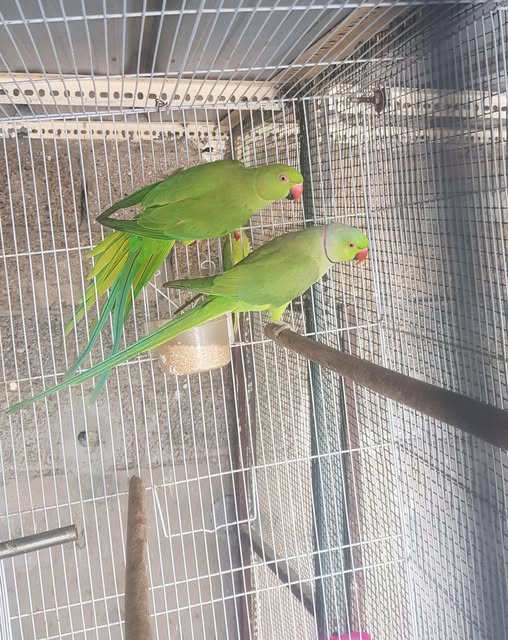
The ring-necked parakeet is a medium-sized parrot — roughly 40cm from beak to tail tip, though a significant proportion of that length is the long, tapered tail. The body is bright lime green. Adult males have a distinctive black and rose-pink ring around the neck — which gives the bird its name — and a red beak. Females and juveniles lack the neck ring and can be harder to identify at a distance, though the green colouring and distinctive silhouette are recognisable.
- Size — roughly the size of a rose-ringed dove but more slender; considerably larger than a budgie, noticeably smaller than an African grey
- Colour — vivid lime green body, long green tail, red beak; adult males with black and pink neck ring
- Sound — loud, penetrating, screeching calls; unmistakeable once heard; they are not quiet birds
- Flight — fast and direct, often in small flocks; the long tail gives them a distinctive silhouette in the air that is unlike any native UK bird
- Origin — native to a broad range from sub-Saharan Africa through South Asia; the birds established in the UK are primarily of the Indian subspecies

If you have seen a bright green, long-tailed, noisy parrot in your garden — this is almost certainly the bird.
How Did They Get Here?
This is the question I get asked most often about ring-necked parakeets, and there is a short answer and an honest answer. The short answer is: escaped or released cage birds, most likely beginning in the 1960s and 1970s. The honest answer is that nobody knows exactly how the founding population was established, and several competing stories exist.
The most persistent legend — that Jimi Hendrix released a pair in Carnaby Street in the 1960s, kick-starting the London population — is almost certainly not true, or at least not the whole story. The more probable explanation is a series of escapes or deliberate releases from aviaries, pet collections, and private owners over several decades, with the founding birds finding a surprisingly hospitable environment in south-east England.
What is clear is that the population was established and breeding by the 1970s, and has been growing consistently since. The ring-necked parakeet’s natural range includes climates considerably more challenging than a British winter, and the birds proved adaptable to UK conditions — supplemented, during cold periods, by garden feeding stations that the British public provides so reliably.
- The founding population — almost certainly escaped or released cage birds from the 1960s and 1970s; the precise origin is genuinely unknown
- Why they survived — the species is hardy, adaptable, a generalist feeder, and found the UK’s garden feeding culture enormously helpful during winter months
- Why the population grew — they nest in tree cavities in February and March, ahead of most native hole-nesting birds, giving them a competitive advantage; breeding pairs are productive; the UK has no natural predator that significantly controls them
- Current distribution — concentrated most heavily in Greater London, Surrey, Kent, and surrounding counties; established colonies in several other English regions; range actively expanding and sightings becoming more common in the Midlands and further north

Are They A Problem For UK Wildlife?
I want to address this honestly, because it is a question with a more complicated answer than either side of the debate usually presents.
Ring-necked parakeets are an introduced species. They were not part of the British ecosystem before humans brought them here, and their presence has effects on native wildlife — primarily through competition for nest sites with native hole-nesting species such as nuthatches, starlings, lesser spotted woodpeckers, and several bat species. They are large, aggressive at nest sites, and begin nesting very early in the year, which gives them a significant advantage over native species competing for the same cavities.
Research into the scale of this impact has produced mixed conclusions. Some studies suggest meaningful negative effects on certain native species in areas of high parakeet density. Others suggest the effects are less significant than feared. The honest position, after reviewing what is available, is that the concern is legitimate and the full scale of the impact is not yet fully understood.
- The genuine concern — competition for nest cavities with native hole-nesting birds; concentrated in areas of high parakeet density
- What is less established — the overall population-level effect on native species; studies are ongoing and conclusions vary
- What is clear — ring-necked parakeets are here, established, and protected under UK law; it is illegal to release them into the wild, but the existing wild population cannot be removed
- At the garden feeder level — they are dominant and will displace smaller birds; if you have a garden feeder that parakeets visit, smaller birds will often be driven off while the parakeets feed

I am not going to pretend this is not worth noting. It is. The ring-necked parakeet is a spectacular and fascinating bird that I genuinely enjoy seeing — but it arrived here as a result of human carelessness, and its effects on our native wildlife are a real consideration that honest people should acknowledge.
Attracting Them To Your Garden — And What To Expect
For the growing number of UK householders who have noticed ring-necked parakeets in the area and would like to see more of them — or who have a garden feeding station they would like to make more parakeet-friendly — here is the honest picture of what that involves.
- What they eat — fruit, berries, seeds, nuts, and grain; at garden feeders they are particularly attracted to sunflower seeds, peanuts, and fruit; halved apples, grapes, and pears are reliable attractants where parakeets are in the area
- What feeders work — they are large birds and need a feeder or platform with enough space to land and feed comfortably; hanging feeders designed for tits and finches are often too small; a flat platform feeder or a large seed tray is more suitable
- What to expect behaviourally — they are bold, loud, and dominant at feeders; they will often clear smaller birds from the feeding area when they arrive; they tend to visit in small groups, sometimes larger flocks, particularly in winter
- What you will hear before you see them — the call is loud, sharp, and carries a long distance; once you know it, you will hear parakeets approaching well before they land; it is unmistakeable
- They are not everywhere yet — if you are in Swindon or the wider Wiltshire and Berkshire area, parakeets are in the region but not as densely established as in Greater London; sightings are becoming more regular but a garden visit is not guaranteed; being in the right area and providing the right food improves the chances considerably

The Ring-Necked Parakeet As A Cage Bird
This is the section that most of my customers who ask about this bird are really interested in — because seeing a wild one in the garden and wanting to know if you can keep one as a pet are two questions that come paired more often than you might expect.
The honest answer is that ring-necked parakeets are kept as cage birds in the UK and have been for a very long time — they were popular aviary birds well before the wild population established itself. They are intelligent, long-lived, and capable of becoming remarkably tame and interactive birds in the right hands. Some learn to talk with clarity that rivals much larger parrot species.
They are also considerably more demanding than most people expect when they walk in having just spotted one on the patio.
- Intelligence — genuinely high; these are parrot-family birds and their cognitive demands reflect that; a bored ring-necked parakeet is a destructive and vocal ring-necked parakeet
- Talkativeness — they can learn extensive vocabularies; some individuals become exceptional talkers; the voice is clear and the vocabulary can be impressive
- Tameness — a hand-reared bird, worked with consistently from a young age, can become deeply tame; a poorly-socialised bird or one that has been neglected can be aggressive and very difficult to handle; the difference is almost entirely in early handling and consistent work
- Space requirements — significant; these are active, flying birds; a small cage is inappropriate; a proper aviary or a very large cage with substantial out-of-cage time is the minimum acceptable setup
- Noise — this requires honest emphasis; ring-necked parakeets are loud; the call is penetrating and carries; they will use it regularly; if you have neighbours in close proximity, this is a serious practical consideration before you commit
- Lifespan — 25 to 30 years in good captive conditions; this is not a short-term pet; it is a commitment that may outlast many other significant things in your life
- Legal note — ring-necked parakeets are not on the UK’s list of birds requiring a licence to keep; they can be kept as pets; however, it is illegal to release them into the wild

What Ring-Necked Parakeets Are Actually Like To Live With
I want to give you the honest daily picture — because the species description and the reality of living with one are sometimes quite different things.
A well-socialised, hand-reared ring-necked parakeet is one of the most engaging cage birds I know. They greet you. They learn your routine. They talk to you with a clarity that startles people who have not lived with a talking bird before. They are curious, they investigate everything, they have strong individual personalities, and the bond a tame bird forms with its primary carer is genuinely deep.
They are also, without question, the most demanding bird I sell in terms of what they require from their owner on a daily basis.
- Daily out-of-cage time is not optional — an active, intelligent parrot kept in a cage without substantial daily flight and interaction will develop behavioural problems; feather plucking, screaming, destructiveness, and aggression are all documented consequences of inadequate stimulation in this species
- They need mental engagement — foraging toys, puzzle feeders, rotating enrichment, novel objects to investigate; the same cage setup day after day is not adequate for a bird with this level of cognitive capacity
- They bite when stressed, frightened, or mishandled — a ring-necked parakeet bite is not trivial; the beak is powerful; it is not a reason to avoid the species, but it is a reason to take training and relationship-building seriously from the start
- They are not forgiving of neglect — a dog that is under-stimulated becomes lethargic; a ring-necked parakeet that is under-stimulated becomes increasingly problematic; the demands are daily and consistent
- The commitment is long-term in a way most owners do not fully anticipate — a bird that may live 25 to 30 years will need daily care through all the changes that happen in a human life over that period; this requires genuine thought before purchase
Is A Ring-Necked Parakeet Right For You?
I ask every person who comes in asking about keeping one to answer the same questions honestly before they decide.
| Question | What The Answer Means |
|---|---|
| Are you home for significant portions of the day? | A ring-necked parakeet needs daily substantial interaction; a bird alone all day every day will not thrive |
| Do you have close neighbours who would be affected by bird noise? | The call is loud and penetrating; this is a genuine practical and neighbourly consideration |
| Can you provide a proper aviary or very large cage with daily out-of-cage time? | Space and flight time are not optional for this species |
| Are you prepared for a 25 to 30 year commitment? | This is not a starter pet or a short-term decision; it will still be with you when other major life events have come and gone |
| Have you kept birds before? | A ring-necked parakeet is not an ideal first bird; some experience with cage birds makes the relationship much more manageable from the start |
| Are you drawn to it because you saw a wild one, or because you genuinely want a demanding, intelligent, long-lived companion bird? | The first reason produces regret fairly often; the second produces a genuinely rewarding relationship |
If the honest answers to those questions are mostly yes — come in and have a proper conversation. If several of them give you pause, a different species may be a better fit for your household and a better outcome for the bird.
Frequently Asked Questions
Are ring-necked parakeets native to the UK?
No. They are an introduced species — descended from escaped or released cage birds, most likely from the 1960s and 1970s. Their native range is across sub-Saharan Africa and South Asia. Despite this, the wild UK population is now large, established, and legally protected; it is a permanent part of the British landscape whether it was intended to be or not.
Are ring-necked parakeets protected in the UK?
Yes, under the Wildlife and Countryside Act 1981 — the same legislation that protects native British birds. It is illegal to harm, kill, or take wild ring-necked parakeets. It is also illegal to release captive birds into the wild. Captive-bred birds can be kept as pets without a licence.
Will ring-necked parakeets come to my garden feeder?
If they are in your area, yes — particularly with the right food. Sunflower seeds, peanuts, and fresh fruit are reliable attractants. They are bolder than most garden birds and will often arrive and displace smaller species. Whether they will visit depends significantly on where you are — the south-east of England has established populations; sightings in Wiltshire and the Midlands are increasing but less consistent.
Are ring-necked parakeets good pets?
For the right owner — yes, genuinely excellent. They are intelligent, they can talk clearly and with impressive vocabulary, and a well-socialised bird forms a deep bond with its carer. For an owner without the time, space, and experience they require, they become difficult and unhappy birds that are often rehomed. The difference is almost entirely in matching the bird to the right household.
How long do ring-necked parakeets live?
25 to 30 years in good captive conditions. Some live longer. This is one of the most important things to understand before buying one — it is a commitment measured in decades, not years. A bird bought today may still be with you in middle age if you are young, or may outlive you if you are older. This requires practical planning, including consideration of who would care for the bird if circumstances changed.
Do ring-necked parakeets talk?
Many do, and some are exceptional talkers. The voice is clear and some individuals develop large vocabularies. Talking ability varies significantly between individuals — some will learn dozens of words and phrases clearly, others will produce only a few. It is not guaranteed, and choosing a bird primarily for its talking potential is less reliable than choosing based on the overall relationship the species offers.
Are ring-necked parakeets aggressive?
They can be, particularly if they have not been properly socialised, if they are stressed or frightened, or if handling has been approached poorly. A well-handled bird from a good source, worked with consistently and patiently, is typically manageable. The beak is powerful and a bite is not trivial — respecting the bird’s communication and not pushing past its limits is important. They are not an aggressive species by nature; poor handling produces aggressive birds.
Where can I see ring-necked parakeets or buy one near Swindon?
For wild birds, the most reliable areas in our region are the larger parks and green spaces; sightings in the wider Swindon area are increasing. For captive birds, come in to Paradise Pets at Manor Garden Centre, Cheney Manor Industrial Estate, Swindon SN2 2QJ — or call us on 01793 512400. We can tell you what we have in stock and have an honest conversation about whether the species is the right fit for your household before you commit.
One Last Thing From Me
The customer who came in having seen the parakeet on his patio — the one who thought it had escaped from somewhere — went away knowing what he had seen and considerably more informed about what he had not expected to find in his Wiltshire garden. He was delighted by it, in the way that people often are when Britain turns out to be more exotic than they had accounted for.
He came back about three weeks later. He had been putting out halved apples and sunflower seeds. The bird had come back four times. He had started leaving a camera near the kitchen window.
“It’s become a bit of an event,” he said. “The whole family comes down for breakfast now in case it shows up.”
That is, honestly, one of the better outcomes I can think of from a chance garden encounter with a bird that should not technically be here but undeniably is. A family gathered at a kitchen window, watching a bright green parrot eat an apple on a Wiltshire patio on a Tuesday morning.
The ring-necked parakeet has been making that kind of impression on British people for half a century now. It will keep doing so. If you have not seen one yet, you probably will. And if you see one and find yourself wanting to know more — come in, and we will have the conversation properly.
Questions About Ring-Necked Parakeets — Wild Or As A Pet? Come And Talk To Us
Whether you have seen one in your garden, are thinking about keeping one, or just want to know more — come in or ring us. We have kept, sold, and advised on these birds for decades. Free advice, no obligation.