
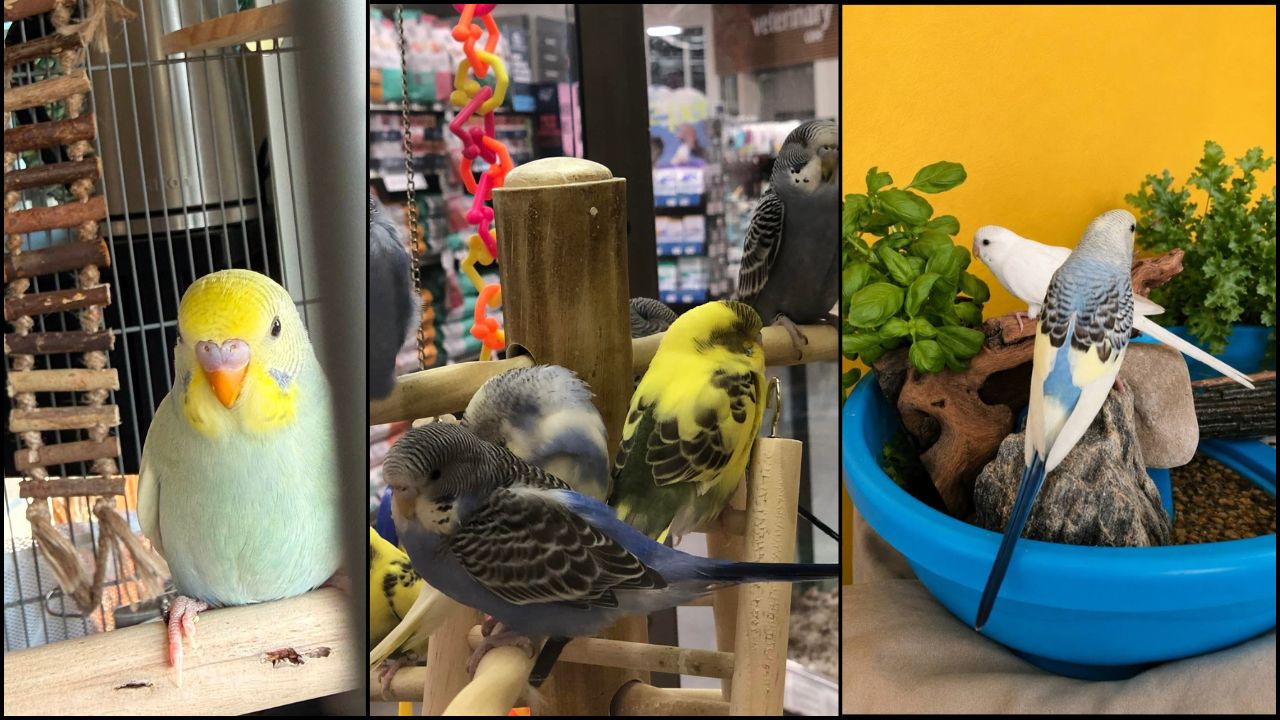

Neil has kept, bred, and sold budgerigars at Paradise Pets Swindon since 1988 — over 35 years of first-hand experience with budgies of every background, source, and quality. Baby budgies are widely available across the UK right now at prices between £40 and £50. This is his honest guide to why the price is almost the least important thing you should be thinking about.
A father came in with his daughter last week — she was about eight, and she had clearly been working on him for some time. She wanted a budgie. She had done her research, she told me gravely. She had found them online for £40. She wanted to know if ours were the same.
I told her they were similar in price and that the price was not really the point. Then I turned to her father and said the same thing more slowly. He looked slightly surprised — he had come in expecting to compare prices. Instead I took him through a five-minute conversation about what actually matters when you buy a baby budgie, none of which has much to do with the number on the price tag.
They bought a bird from us. They came back a fortnight later to tell me he had already started whistling. The daughter had named him Admiral.
That conversation — the one that shifts the focus from price to what actually matters — is the one I want to have with every person considering a budgie right now. Because summer is when the baby budgies arrive in volume, when prices are competitive, and when the temptation to make a quick decision based on cost is highest. And summer is also when the decisions that look economical in the moment produce the outcomes that are not economical at all — the bird that will not tame, the bird that was too young, the bird with health problems that emerged within weeks.
This article is my honest guide to what you should actually be looking at. The price can look after itself.
Why Summer Is The Season To Be Most Careful — Not Most Relaxed
There is a logic to buying a baby budgie in summer that feels compelling. The birds are available everywhere. Prices are competitive because supply is high. The longer school holidays mean children are home to help with the settling-in period. It feels like the natural time.
All of that is true. And all of it is also why summer is the season when the most rushed buying decisions happen, and when the consequences of those decisions arrive most visibly at my counter in autumn.
High supply means more birds from more sources, with more variable quality. Competitive pricing means pressure on breeders and suppliers to cut corners. The volume of interest means that shops, markets, and private sellers with less rigorous standards can move birds they might not otherwise be able to move — because buyers are in a buying mood and the friction of careful selection is lower.
I am not saying every £40 budgie is a problem. I am saying that £40 budgies exist across a very wide range of quality, health, and suitability — and that the price tells you almost nothing about where on that range any individual bird sits. What tells you that is the things I am going to describe below.
The Age Question — The Most Important Thing Most Buyers Never Check
The single most consequential decision in buying a baby budgie is whether the bird is the right age. Not the colour. Not the gender. Not the price. The age.
Budgies can be taken from their parents from around six weeks old, when they are independent and feeding on their own. But the ideal age for a new owner buying their first bird — or anyone who wants a bird that will tame readily — is eight to twelve weeks. In this window, the bird is young enough to bond easily with humans, is developmentally complete, and has not yet passed the period in which taming and socialisation comes most naturally.
Birds sold too young — under six weeks, still showing traces of crop feeding, not fully weaned — are at health risk and may not thrive in a new environment. Birds sold too old — over sixteen weeks, particularly if they have spent that time in a busy, high-stimulus shop environment without individual handling — are significantly harder to tame. The bird that looked appealing in the cage at five months may be a perfectly healthy budgie that will spend the next decade resisting every attempt to build a relationship.
How do you tell a budgie’s age? There are several reliable indicators.
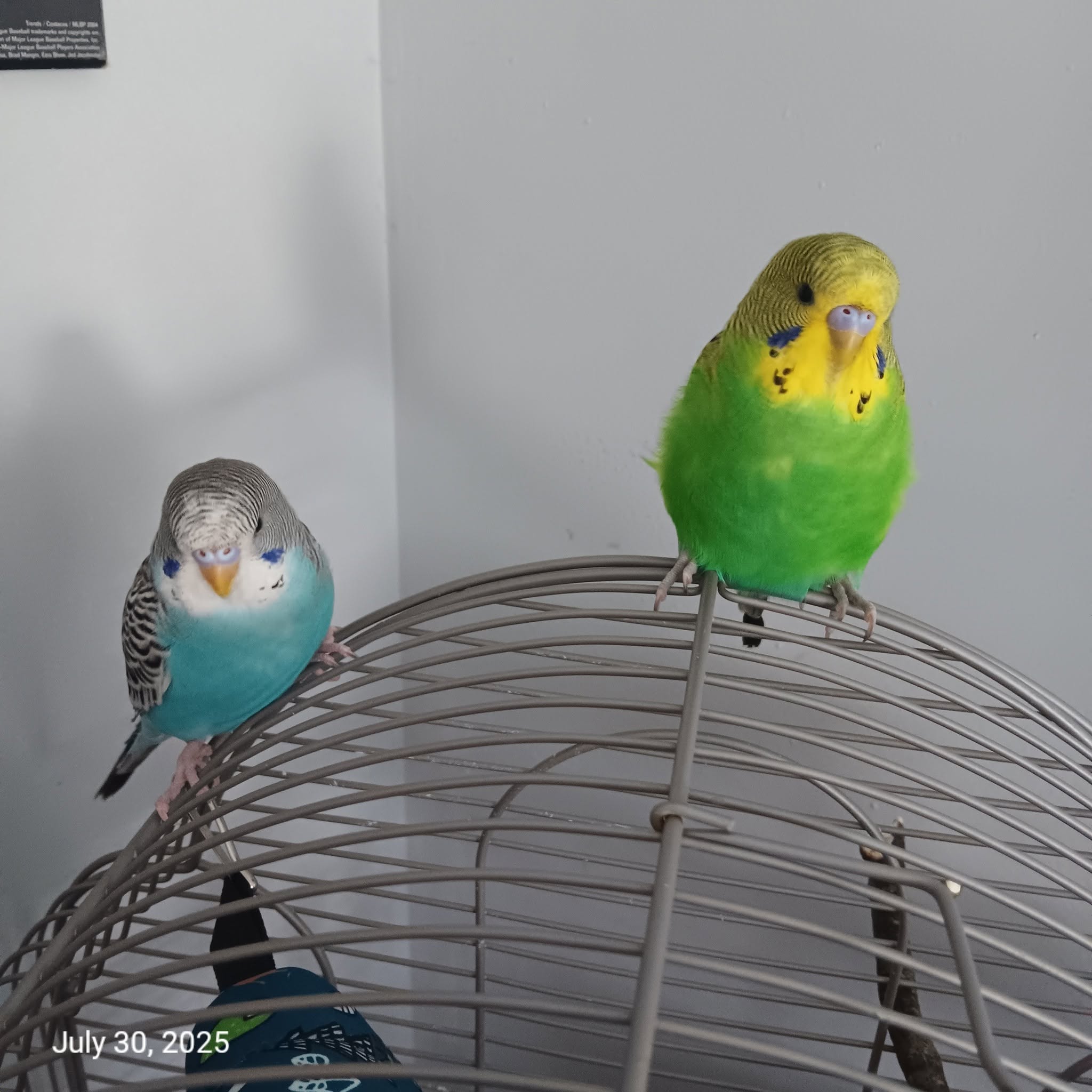
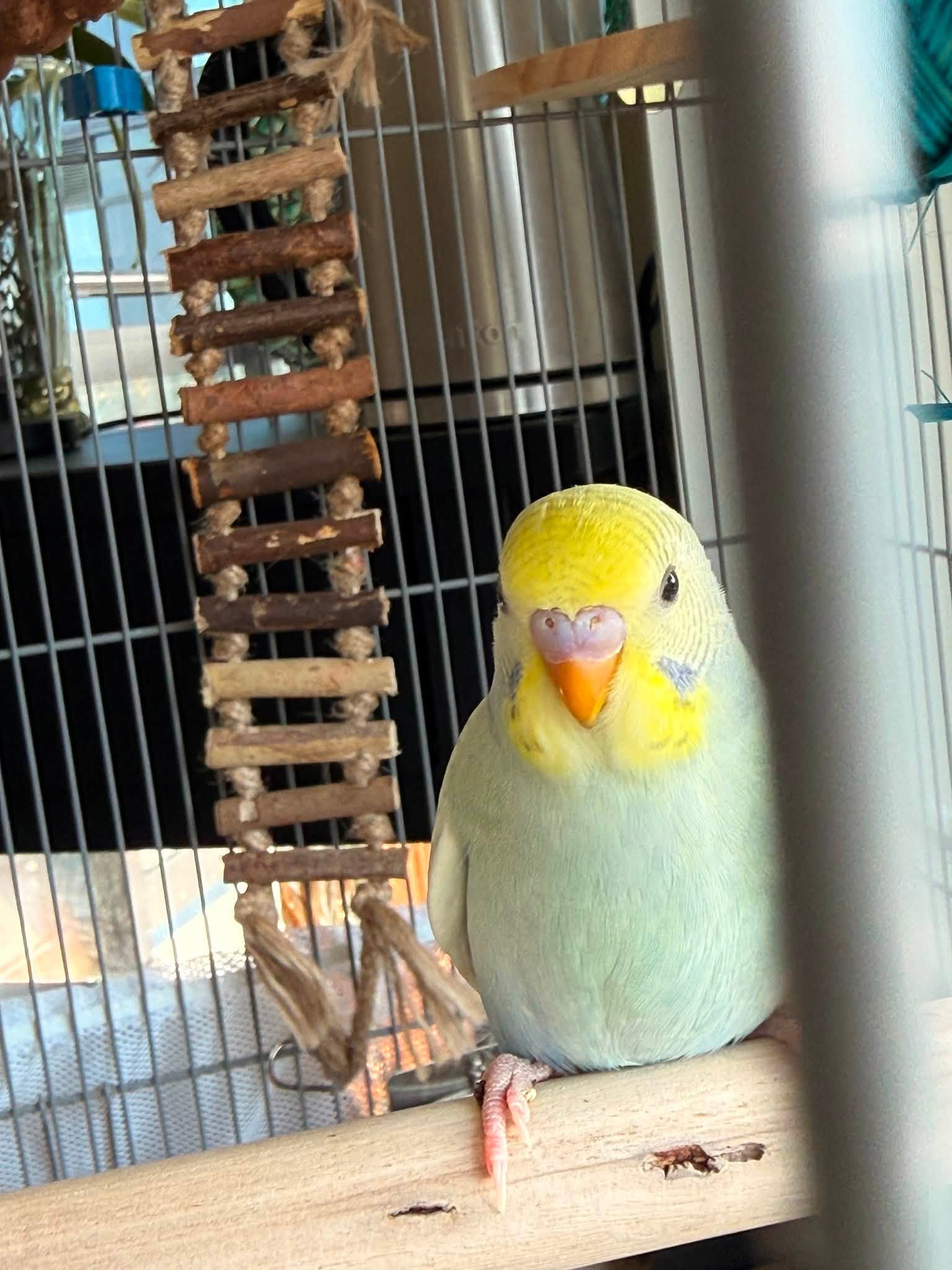
A young budgie — under four months — has barring on its forehead. This is the striped pattern on the forehead feathers that gives young budgies their distinctive appearance. These bars extend from the cere down toward the forehead. As the bird matures and goes through its first moult, these bars recede and the adult forehead colour — solid, without bars — emerges. A bird with full forehead barring is a young bird. A bird without barring has passed its first moult and is over four months.
The cere — the fleshy area at the base of the beak, above the nostrils — is another indicator. In young budgies, the cere has a characteristic pink or purplish-pink appearance regardless of the bird’s eventual adult colouring. As the bird matures, the cere develops its adult colouration: blue in adult males, brown or tan in adult females. A fully developed adult cere colour, combined with absent forehead barring, indicates a mature bird rather than a baby.
The eyes of a young budgie are entirely dark — fully black with no pale iris ring visible. The pale iris ring develops as the bird matures, typically becoming visible at around six to eight months. A bird with a completely dark, pupil-filling eye is young. A bird with a visible pale ring is older.
Ask the seller how old the bird is. Then look at the bird and see whether what you are being told is consistent with what you are seeing. A seller who cannot tell you the age, or whose stated age is inconsistent with the bird’s visible indicators, is a seller worth being cautious about.
Hand-Reared Versus Parent-Reared — What The Terms Actually Mean And Why It Matters
You will see these terms used across online listings and in shops, and the difference is real and significant — though the terms are sometimes used loosely in ways that muddy the picture.
A truly hand-reared budgie has been removed from the nest at a young age and fed by humans through the weaning process. These birds have had intensive human contact from the earliest stages of development, which typically makes them substantially easier to tame and handle. A genuinely hand-reared budgie will often step onto a hand with minimal hesitation because humans are, to that bird, a familiar and non-threatening presence from its earliest experience.
A parent-reared budgie has been raised in the normal way — fed by its parents, in the nest with siblings, with human contact being a feature of the environment rather than the central relationship. These birds can absolutely be tamed, and many of the most beloved pet budgies have been parent-reared. But the taming process requires more patience, more time, and more consistent work than a hand-reared bird.
The complication is that “hand-reared” is sometimes used loosely to mean “the breeder has handled the young birds” rather than “the breeder has fed and raised the bird by hand from early weaning.” The former is genuinely useful — frequent gentle handling of parent-reared chicks does make taming easier — but it is not the same as true hand-rearing, and a buyer who expects one and gets the other will find the experience different from what they anticipated.
Ask specifically: at what age was the bird removed from the nest, and was it fed by hand through the weaning process? A breeder who has genuinely hand-reared birds will be able to tell you this in detail. One who uses the term loosely will be vaguer.

What To Look At When You Are With The Bird — The Five-Minute Check
Before any money changes hands, spend five minutes looking at the bird you are considering. These are the things I look at, and that I walk customers through at the counter.
- Eyes. Bright, clear, fully open, and reactive. Not sunken, not cloudy, not half-closed when the bird is awake and active. Dull or half-closed eyes in a waking bird are a warning sign.
- Nostrils and cere. Clean and dry. No discharge, no crusting, no staining of the feathers around the nostrils. The cere should be smooth in a young bird — not rough or scaly, which would suggest mite activity.
- Feathers. Smooth and close to the body in a bird that is not cold. A bird sitting persistently fluffed in a warm environment is not well. Feathers should look complete and well-formed — no missing patches, no rough or ragged texture beyond the normal slightly unfinished appearance of very young birds still completing their juvenile plumage.
- Posture and activity level. A healthy young budgie in a warm, bright environment should be alert and active — looking around, moving on the perches, interacting with its environment. A bird sitting still and low on a perch, or on the cage floor, in a well-lit and active environment is not right.
- Droppings. Check the cage floor or tray. Normal budgie droppings are small, dark, and firm with a white urate portion. Watery, very dark, or absent droppings are worth noting and asking about.
- Breathing. Quiet, through the nostrils, with no visible effort. A bird breathing through its open beak, or one whose tail is visibly bobbing with each breath, has a respiratory issue.
- Response to you. Open the cage gently or ask the seller to. A young, well-socialised bird should show curiosity rather than blind panic. A bird that crashes against the cage bars in terror at your presence is one that has not had adequate human contact during its development.
None of these checks requires specialist knowledge. They require attention and willingness to look carefully at the animal you are about to commit to for a decade or more.
The Source Question — What A Good Seller Looks Like
The quality of the seller is the factor that most directly predicts the quality of the bird — more than price, more than colour, more than any single visible feature of the bird itself. A reputable, knowledgeable seller produces birds that have been well-fed, well-handled, correctly aged at sale, screened for obvious health issues, and appropriately socialised. These birds cost what they cost because producing them properly costs something.
Here is what a seller worth buying from can tell you:
They can tell you the bird’s age precisely, or at least approximately with a clear rationale. They know when the bird was hatched, when it was weaned, and what it has been eating. They can tell you what the parents look like and something about their history. They can describe what handling the bird has had and at what stages. If they have hand-reared the bird, they can tell you how — at what age weaning started and what the feeding process involved. They have a clear, specific answer to “what has this bird been eating?” and it is not just “budgie seed.”
A seller worth being cautious about gives you vague answers or no answers to these questions. They do not know when the bird was hatched. They describe all their birds as “tame” without any specific detail about what that means or how it was achieved. They are primarily focused on closing the sale rather than establishing whether this is the right bird for you.
The price difference between a good source and a less careful one is often small. The difference in outcome over the ten-plus years of the bird’s life is not.
The Health Guarantee Question — What It Does And Does Not Mean
Many sellers now offer health guarantees — a period, typically seven to fourteen days, during which the bird can be returned or exchanged if it develops a health problem. This is not nothing. It is a signal that the seller has enough confidence in their birds to make that commitment.
But it is also limited in ways that buyers should understand.
A health guarantee does not cover everything. It typically covers obvious illness that was present at sale and has manifested within the guarantee period — not the conditions that develop over weeks or months, not the long-term consequences of early-life nutritional deficiency, not the behavioural problems that emerge from inadequate socialisation. The guarantee is a backstop, not a substitute for the checks I described above.
It also does not mean that returning a bird you have had for a week is a straightforward experience for the buyer. You have spent a week with the bird. Your child has named it. The emotional distance required to return it and wait for a replacement is not trivial. Prevention — buying from a good source, checking the bird carefully before purchase — is worth infinitely more than the guarantee.
What The First Two Weeks Actually Cost — The Honest Full Picture
The £40 to £50 price of the bird is not the cost of having a budgie. I want to be clear about this, not to deter buyers, but because buyers who understand the full picture make better decisions.
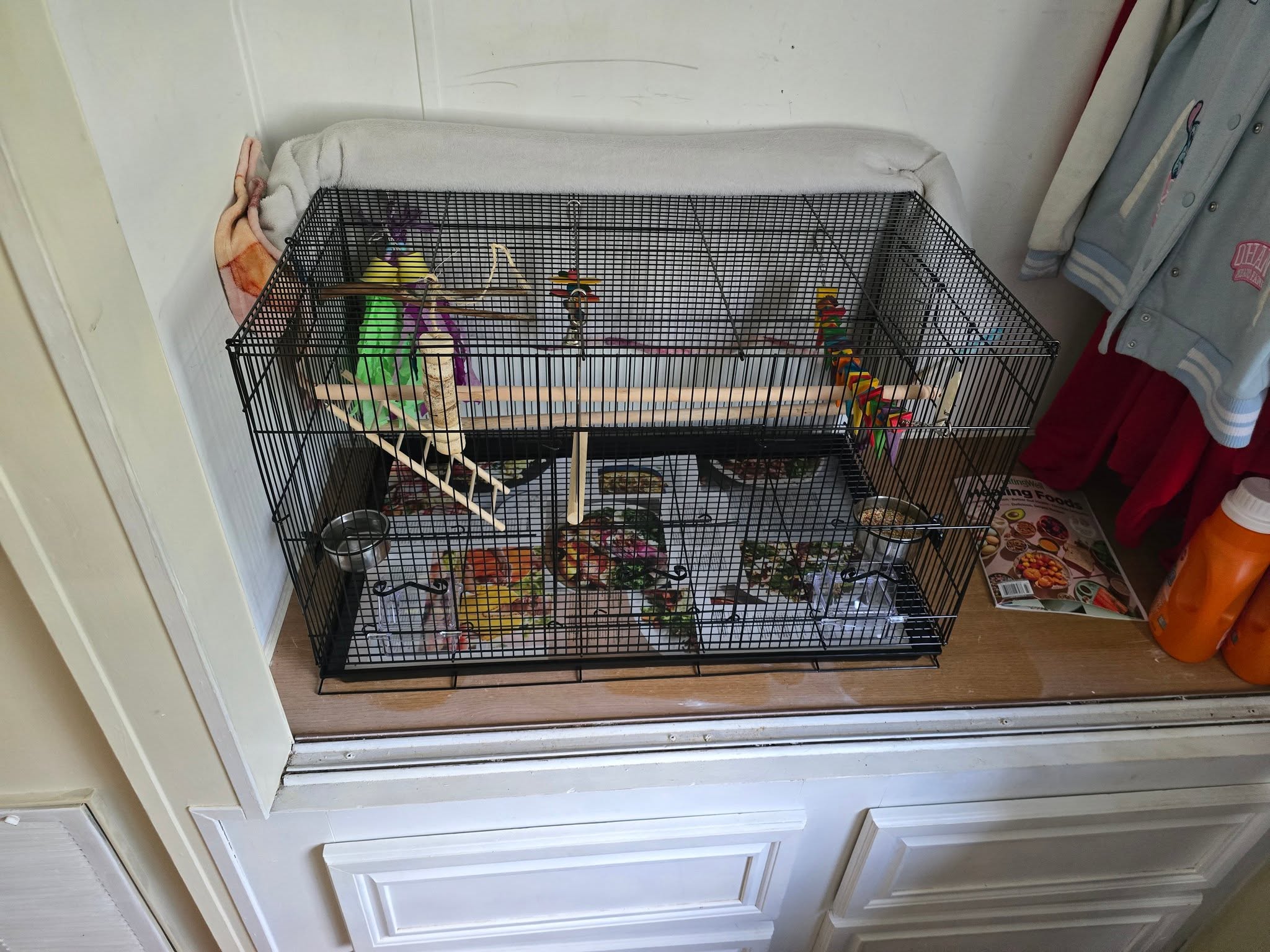
The cage is the first additional cost — and the cage that the bird genuinely needs is not the smallest or cheapest one available. A budgie needs room to move horizontally. A cage that is too small for a bird to stretch its wings or fly between perches is a cage that is inadequate regardless of its price. Budget for a cage that is genuinely appropriate, not the minimum.
The setup — perches, toys, food dishes, substrate — is an additional cost. Quality matters here too. Dowel perches of uniform diameter are worse for foot health than natural wood perches of varying thickness. The cheapest seed mix is nutritionally inferior to a quality varied mix. These differences show up in the bird’s long-term health.
The first vet visit — a new bird check with an avian vet — is a worthwhile cost that most new owners do not budget for but that I always recommend. An avian vet who examines a new bird can identify problems that are not obvious to an owner’s eye, establish a baseline of normal health, and advise on diet and care. The cost of this visit is modest compared to the cost of a veterinary crisis that might have been caught earlier.
And ongoing costs — quality seed, fresh food, supplements, enrichment, veterinary care as needed — are real and recurring. A budgie that lives twelve years will cost significantly more over its lifetime than the £40 purchase price suggested. That is not a reason not to get one. It is a reason to understand what you are committing to.
Quick Reference — What To Look At Before You Buy
| Factor | What To Check | Red Flag |
|---|---|---|
| Age | Forehead barring present, eyes fully dark, pink cere | No barring, iris ring visible — older than claimed |
| Eyes | Bright, clear, fully open | Dull, sunken, half-closed when awake |
| Cere and nostrils | Clean, dry, no discharge or crusting | Wet, crusted, rough or scaly texture |
| Feathers | Smooth, close to body, complete | Persistently fluffed in warm room, rough patches |
| Activity | Alert, moving, responding to environment | Sitting still, low on perch, on cage floor |
| Breathing | Quiet, through nostrils, no visible effort | Open beak, tail bobbing, any sounds |
| Seller knowledge | Specific answers to age, diet, handling questions | Vague, evasive, or no answers |
| Response to humans | Curious, not panicked by your approach | Crashes cage bars in terror — undersocialised |
Frequently Asked Questions
Is £40 to £50 a reasonable price for a baby budgie in the UK?
It is a common market price for a healthy, standard-colour young budgie from a reasonable source. It is not inherently either too cheap or too expensive. What matters is what you are getting for that price — the age, the health, the socialisation, and the quality of the source. A £40 bird from a good breeder who has handled the chicks from an early age and can tell you exactly when it hatched is a better purchase than a £35 bird from a source that cannot answer your questions. The five or ten pound difference is not the variable that matters.
Should I choose a budgie based on colour?
Colour can be a reasonable preference — there is nothing wrong with loving green or wanting a blue. But do not let colour override the health and age checks I have described. A beautiful bird that fails one of those checks is not the right bird. A less striking bird that passes them all is. Among the standard colours, there is no health or temperament correlation — a green budgie is not hardier than a blue one, or vice versa. Among the rarer mutations, some breeding lines that produce specific colour outcomes also carry known health vulnerabilities, which is worth being aware of for certain mutations.
Should I get one budgie or two?
This depends on your situation. Two budgies keep each other company and are less dependent on owner-provided stimulation — if you work long hours or cannot provide daily interaction, a pair is kinder. A single budgie, given adequate daily interaction, can bond more closely to its owner and can sometimes be easier to tame in the initial stages. If you want a bird that whistles and chatters primarily at you rather than at a companion, one bird is often the better starting point. If you are worried about the bird being lonely while you are at work, two is the more responsible choice. Do not mix an established bird with a new arrival directly — introduce them carefully over a period of time.
Male or female — does it matter?
Males are typically more likely to become good talkers and whistlers, and are generally considered slightly easier to tame on average. Females can be excellent pets but can sometimes be more independent and, during hormonal periods, more difficult to handle. In a young bird where the adult cere colour has not yet developed, sex determination is unreliable — any seller claiming to sex a bird under four months with certainty based on the cere alone is being overconfident. For a first bird, either sex is fine. Male is a reasonable default if you specifically want a bird more likely to talk.
Can I buy a budgie from a garden centre or market?
Birds are sold in many venues and quality varies enormously. The questions to ask — age, source, diet, handling history — are the same regardless of where you are buying. A market seller who can answer all of those questions clearly and whose birds pass the health checks I described is a reasonable source. One who cannot is not, regardless of the convenience or the price. I would always recommend finding an established, specialist source — a reputable pet shop or dedicated bird breeder — over a market stall or ad-hoc seller, because the consistent standards and accountability of an established business are genuine protections.
Where can I get honest budgie advice in Swindon?
Come and see us at Paradise Pets, Manor Garden Centre, Cheney Manor, Swindon SN2 2QJ. Or give us a ring on 01793 512400. We stock baby budgies and we will walk you through every check in this article before you commit to anything. The advice is free, the conversation is honest, and we have been doing this for 35 years.
One Last Thing From Me
Admiral — the budgie the eight-year-old named — came back two weeks after his purchase. His owner wanted to show me that he was already stepping up onto a finger. She held out her hand and he hopped onto it without any fuss at all.
That outcome did not happen because of the price. It happened because the bird was the right age, from a source that handled the young birds consistently, with confirmed health on the day of purchase, and into a home where the child had been prepared for the settling-in period and given clear, simple guidance on how to approach him in those first days.
Forty-seven pounds. Twelve-plus years of a good relationship, if he stays healthy.
Every pound of those forty-seven was worth spending on a bird that met the criteria above rather than on the cheapest available option that did not. That is the honest message from 35 years at this counter. The price is not what you should be looking at. Look at the bird, the age, the source, and the answers to the questions I have described. Get those right and the price takes care of itself.
Thinking About A Baby Budgie? Come And We Will Walk Through Everything Together
We stock baby budgies and we are happy to show you what we have — but we will also walk you through every check in this article before anything changes hands. The conversation is honest, the advice is free. That is how we have done things since 1988.