
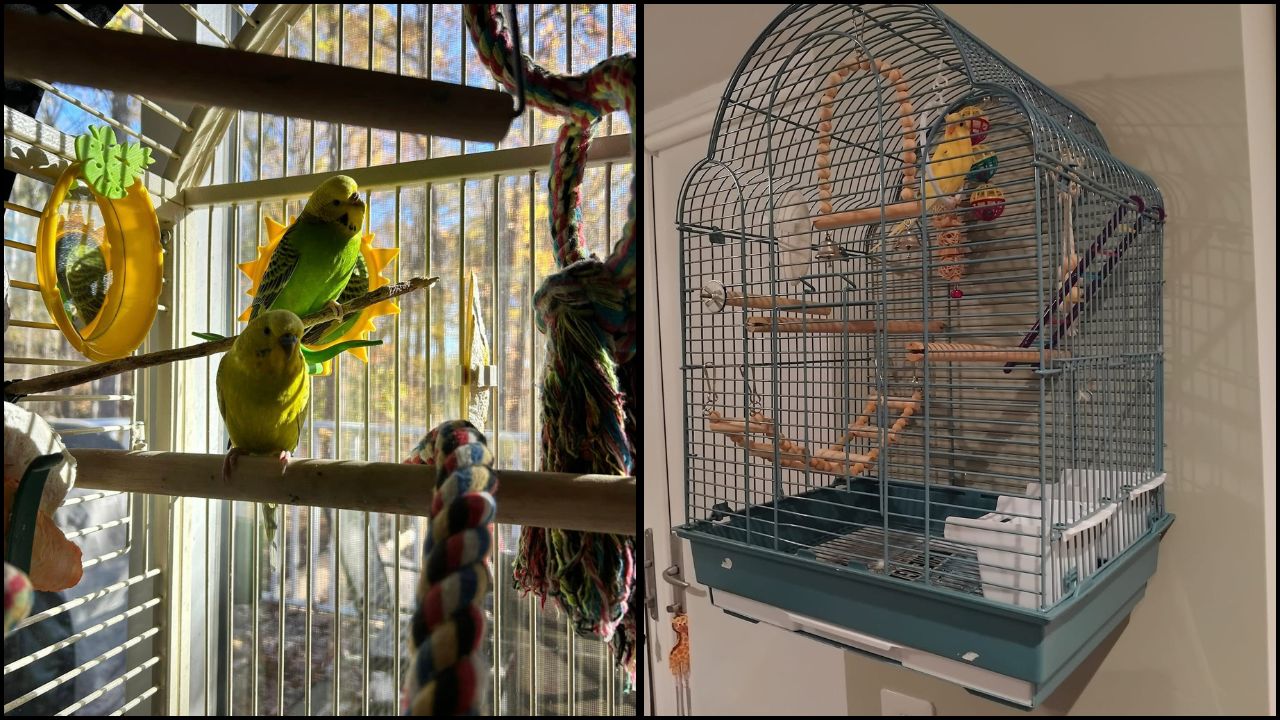

Neil has kept, bred, and sold birds at Paradise Pets Swindon since 1988 — over 35 years at the same counter, in the same town, watching the same mistake appear in front of him with a consistency that he finds both frustrating and, at this point, entirely predictable. This article is his account of that mistake — what it is, why it keeps happening, and what to do about it if you are making it right now.
People come in to buy seed.
That is the most common reason for a return visit. They bought the bird last month, or last year, or three years ago. Now they are back for seed, or millet, or vitamins, or a new perch. They come in carrying the bag or the box from the previous purchase. They mention the bird. Sometimes they show me a photo on their phone.
And almost every week, in that brief exchange, I see it.
The cage in the photo is too small.
Not dramatically too small. Not the kind of obvious, visible inadequacy that would shock someone who knew what they were looking at. It looks, to the untrained eye, like a normal, decent cage. The kind sold alongside the bird when the original purchase was made. The kind marketed with a description like “spacious” or “roomy” or “ideal for small birds.” The kind that comes in a flat box with a bag of seed taped to the front.
It is always too small. Every week. Without exception.
This is the mistake I see most consistently across 35 years of this work. Not the dangerous mistake — the avocado plant, the Teflon fumes, the toxic water source. Not the urgent mistake — the bird that has been ill for weeks and is finally being brought in. Not even the feeding mistake, the loneliness mistake, or the vet mistake, all of which I see regularly and have written about.
The cage mistake is the one I see every single week without fail, in the phones and the descriptions and the conversations at this counter, and I have been meaning to write about it plainly for a long time.
What the Cage That Comes With the Bird Actually Is
The standard starter cage sold alongside a budgie in most UK pet shops — the one in the box, with the seed attached — was not engineered to meet avian welfare guidelines. It was engineered to be an affordable, presentable unit that looks appropriate for a small bird, ships flat, and can be sold at a price point that makes the total budgie purchase feel accessible.
This is not a conspiracy. It is the logic of retail applied to pet birds, and it has produced a cage type that has been standard in the UK market for decades, despite the fact that avian welfare guidance has consistently said it is inadequate.
The minimum cage size recommended for a single budgie by the major UK avian welfare organisations is — at its most conservative — sixty centimetres wide, sixty centimetres deep, and sixty centimetres tall. This is a genuine minimum: the smallest space in which a single budgie can extend its wings fully, hop between perches with meaningful distance between them, and engage in the flight-related movement that maintains cardiovascular and muscular health.
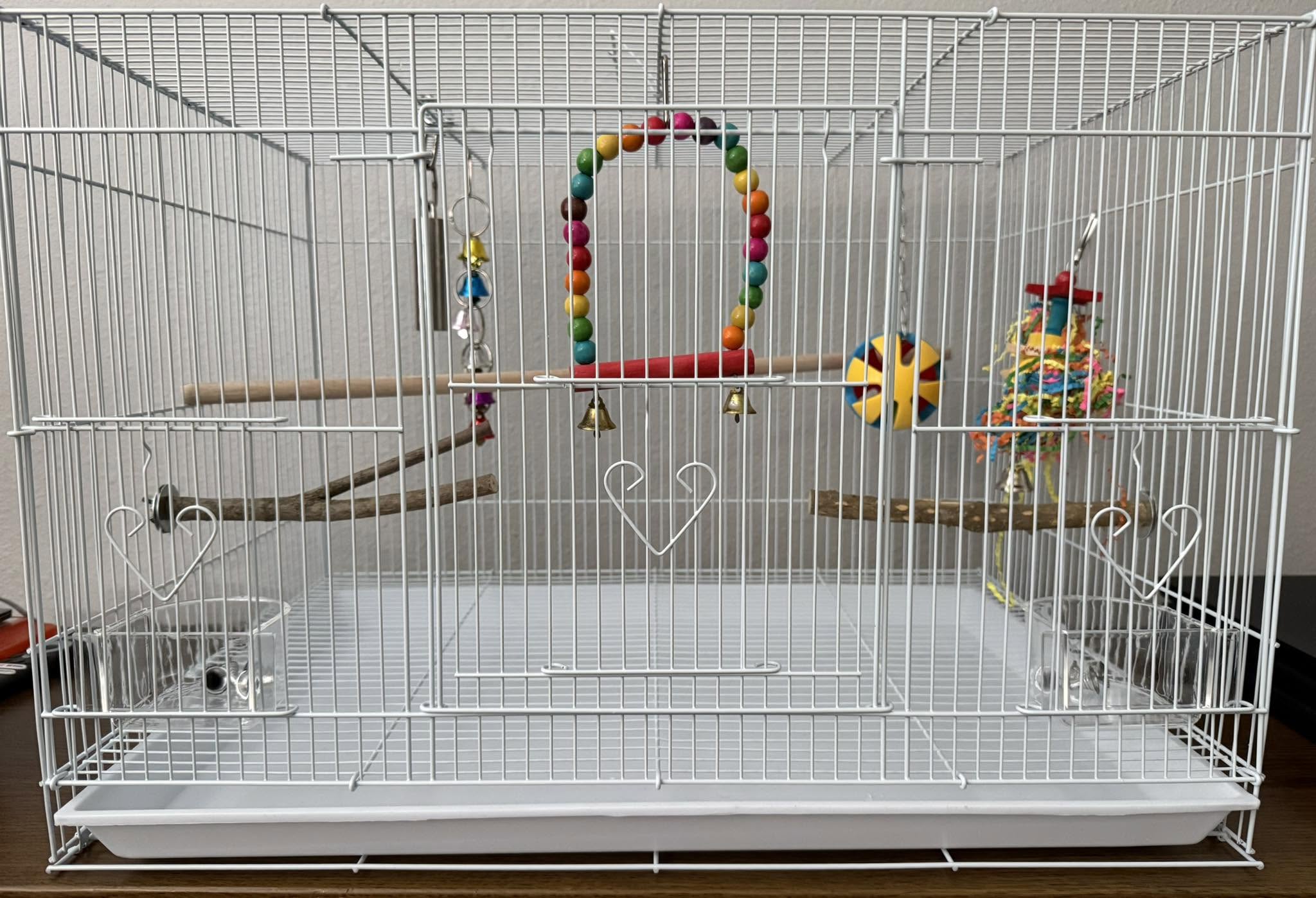
Most of the starter cages I see have dimensions in the range of thirty to forty centimetres wide. Sometimes less. They have two perches positioned close together — close enough that the bird can step from one to the other rather than fly between them. The bar spacing is often too wide for a budgie’s safety. The door is often small enough that accessing the interior for thorough cleaning is awkward. The food and water containers are often the bare minimum required to hold seed and water without tipping.
This cage will keep a budgie alive. It will not give a budgie a good life.
Why the Cage Size Matters — More Than Most Owners Realise
I want to be specific about this because “the cage is too small” is advice that is easy to hear and easy to dismiss. It sounds like a general welfare concern. It sounds like something that would be nice to address if budget allows. It does not sound urgent.
It is urgent. Here is why.
Budgerigars are flying animals. This is not a metaphor or a way of saying they enjoy being out of the cage. They are animals whose cardiovascular system, muscular system, and skeletal structure have been shaped over millions of years for sustained flight. The heart and lungs of a budgie are calibrated for the demands of an animal that, in the wild, may fly twenty to thirty miles in a day in search of food and water, and that spends virtually all of its active waking hours in motion.
Put that animal in a cage where flight is not possible — where the distance between perches is a hop rather than a wingbeat — and the physical consequence is the same as it would be for any species denied the physical activity its body requires for normal function. The cardiovascular system deconditions. Muscle mass reduces. Body fat increases. Over months and years, the physiological consequences of chronic inadequate exercise compound.
The specific disease most directly linked to this sedentary life combined with a high-fat seed diet is hepatic lipidosis — fatty liver disease. It is one of the most common causes of early death in UK pet budgies. The mechanism is simple: a diet high in fat, a body that is not expending enough energy to metabolise that fat properly, and a liver that gradually accumulates fat deposits until its function is compromised.
The cage size is not separate from this. The cage size is a primary determinant of how much physical activity the bird can take. And the standard starter cage allows almost none of the activity the bird needs.
The Chronic Stress Connection
There is a second mechanism, less visible than the physical one, that makes inadequate cage size a welfare issue beyond the obvious physical limitations.
Space restriction in birds activates chronic stress responses. A bird that cannot behave normally — that cannot fly, cannot explore, cannot maintain the normal activity pattern of its species — experiences what is effectively permanent mild frustration. This activates the same physiological stress response as any other chronic stressor: elevated cortisol, suppressed immune function, disrupted digestion, and a general reduction in the resilience that allows the bird to fight off the diseases that would otherwise be contained.
The bird climbing the cage bars — which I have written about separately — is the most visible expression of this stress. The bird that is simply quieter and less active than it should be is the earlier, less visible expression of the same thing.
How I Know I Am Looking at a Too-Small Cage From a Phone Photo
I want to explain what I am seeing in these photos, because it is useful for owners to be able to assess their own cage against the same criteria.
The first thing I look at is the perch distance. In a cage that is too small, the perches are positioned close enough together that the bird steps between them rather than flying. Sometimes they are only a body length apart. In a cage of adequate size, the perches have enough separation that moving between them requires actual wing extension and a short flight.
The second thing I look at is whether the bird has room to turn around fully — to extend its wings in any direction without the feathers touching the bars. A budgie extending its wings tip-to-tip spans approximately thirty centimetres. A cage forty centimetres wide does not give it room to do this. The math is straightforward.
The third thing I look at is the number of objects in the cage versus the available space. An entry-level cage that comes with perches, a food container, a water bottle, and perhaps a small toy already has most of its interior occupied. Add the bird and there is very little navigable space left.
The fourth thing — which I cannot see in a photo but ask about — is whether the bird ever comes out. Daily out-of-cage time in a safe room is the most effective way to provide the physical activity that a too-small cage denies. But for most birds in small cages, in households where this question has never been consciously addressed, the answer is: rarely, or never.
Why This Mistake Happens — The Sales Environment Is Part of It
I want to say something about why this particular mistake is so consistent, because I think the answer is specific and worth naming.
The starter cage and the bird are almost always sold together, in the same transaction, by the same shop. The cage is the one the shop stocks for this purpose. It comes in the right price range. It ships flat and takes up minimal space on the shelf. The customer is focused on the bird — the choice of colour, the individual bird’s temperament, whether it is young enough to tame. The cage is the container the bird goes home in. It does not receive the same scrutiny.
Nothing in that transaction is designed to prompt the question: “Is this cage large enough for this bird’s long-term welfare?” The cage is sold as appropriate. The size is not discussed. The customer has no reference point for what would be better or why.
Then they go home. The bird goes in the cage. Weeks pass, months pass. The bird is alive, eating, making some noise. Nothing appears to be wrong. The cage is not reconsidered.
This is not the customer’s failure. It is a failure of the information environment at the point of purchase. I have been at this counter for 35 years and I have not always made this conversation happen at every sale. The cage should be the first conversation. Instead it is usually not a conversation at all.
The RSPCA Guidance — What the Numbers Actually Say
The RSPCA’s guidelines on budgerigar housing give specific minimum dimensions. For a single budgie kept alone: a cage at least sixty centimetres wide, sixty centimetres deep, and sixty centimetres tall. For a pair: substantially larger, with the emphasis that the minimum measurements are for a single bird and that pairs need correspondingly more space to establish territory and move without conflict.
The bar spacing recommendation for budgies is between eight and twelve millimetres. Many starter cages have wider spacing — sometimes the bar spacing on a starter cage is designed for a small parrot rather than a budgerigar, and a budgie can trap a foot or a head in bars that are too widely spaced.
The RSPCA also recommends that birds have access to the widest possible flight space and that out-of-cage time in a safe room is provided daily. These are not aspirational guidelines. They are the informed assessment of what a budgie requires to maintain normal behavioural function.
The cage in most of those phone photos does not meet the width minimum for a single bird, let alone a pair.
What to Do If You Are Making This Mistake Right Now
I want to make this specific rather than general, because vague advice to “get a bigger cage” is not always immediately actionable.
First: assess your current cage. Measure it. The width is the most critical dimension — it determines how much horizontal flight distance is available, which is the main determinant of physical activity. If your cage is under sixty centimetres wide, it is under the minimum for a single budgie.
Second: if the cage is inadequate, begin looking for a replacement rather than waiting for a convenient moment. Cages appropriate for budgies are available at a range of price points and the difference in cost between an entry-level starter cage and a properly sized flight cage is genuinely not large. We stock a range of cage sizes here and I am happy to show you what the difference looks like in person.
Third: in the interim, increase out-of-cage flight time. If your bird has adequate time each day in a safe, plant-free, hazard-assessed room where it can fly freely — at least an hour, ideally more — this partially compensates for cage inadequacy. It does not fully replace appropriate cage size, but it provides the physical activity that the cage does not. This is a manageable interim measure while the cage situation is being addressed.
Fourth: if you have two birds in an inadequately sized cage, address this first rather than second. Two birds in a small cage compounds the problem — each bird has less than half the already inadequate space, and conflict over territory in a confined space adds chronic stress to chronic physical limitation.
- Minimum width for a single budgie: 60cm. Width is the critical dimension — it determines available flight distance.
- Minimum depth for a single budgie: 60cm. Depth gives room for perch positioning at genuinely separate distances.
- Minimum height for a single budgie: 60cm. Height allows vertical movement — budgies use height actively.
- For a pair: Significantly larger in all dimensions. Two birds require correspondingly more territory and flight space.
- Bar spacing: 8–12mm. Bars too wide allow feet and heads to become trapped. Check this before buying any cage.
- The most common starter cage: Approximately 35–45cm wide. Under the minimum for a single bird. Under by a significant margin.
The Cage and the Other Mistakes — How They Compound
I want to say something about how the cage size mistake connects to the other welfare issues I have written about across this site, because the connection is direct and matters for understanding why the cage is such a significant first step.
A bird in a too-small cage on a seed-only diet is experiencing two of the four main life-shortening factors simultaneously. The cage restricts the physical activity needed to metabolise the high-fat seed diet. The seed diet provides the nutrients for the bird’s activities that the cage does not allow it to perform. The two problems reinforce each other.
A lone bird in a too-small cage is experiencing three of the four factors simultaneously. The social deprivation elevates chronic cortisol. The cage restriction adds physical stress. The diet adds nutritional compromise. The compounding effect is not additive — it is multiplicative.
The cage is not a separate issue from everything else I discuss on this site. It is a foundational condition that determines how much resilience the bird has to manage everything else. A bird in an appropriate cage, eating a varied diet, with a companion, is a bird whose baseline health is strong enough to fight off the conditions that kill UK budgies at five or six years old. A bird in a too-small cage, alone, on seed only, is a bird with almost no reserve.
The cage is where I start this conversation. Not because the cage is the only thing that matters — it is not. Because it is the first thing, the foundational thing, and the thing most consistently wrong in the birds I see every week.
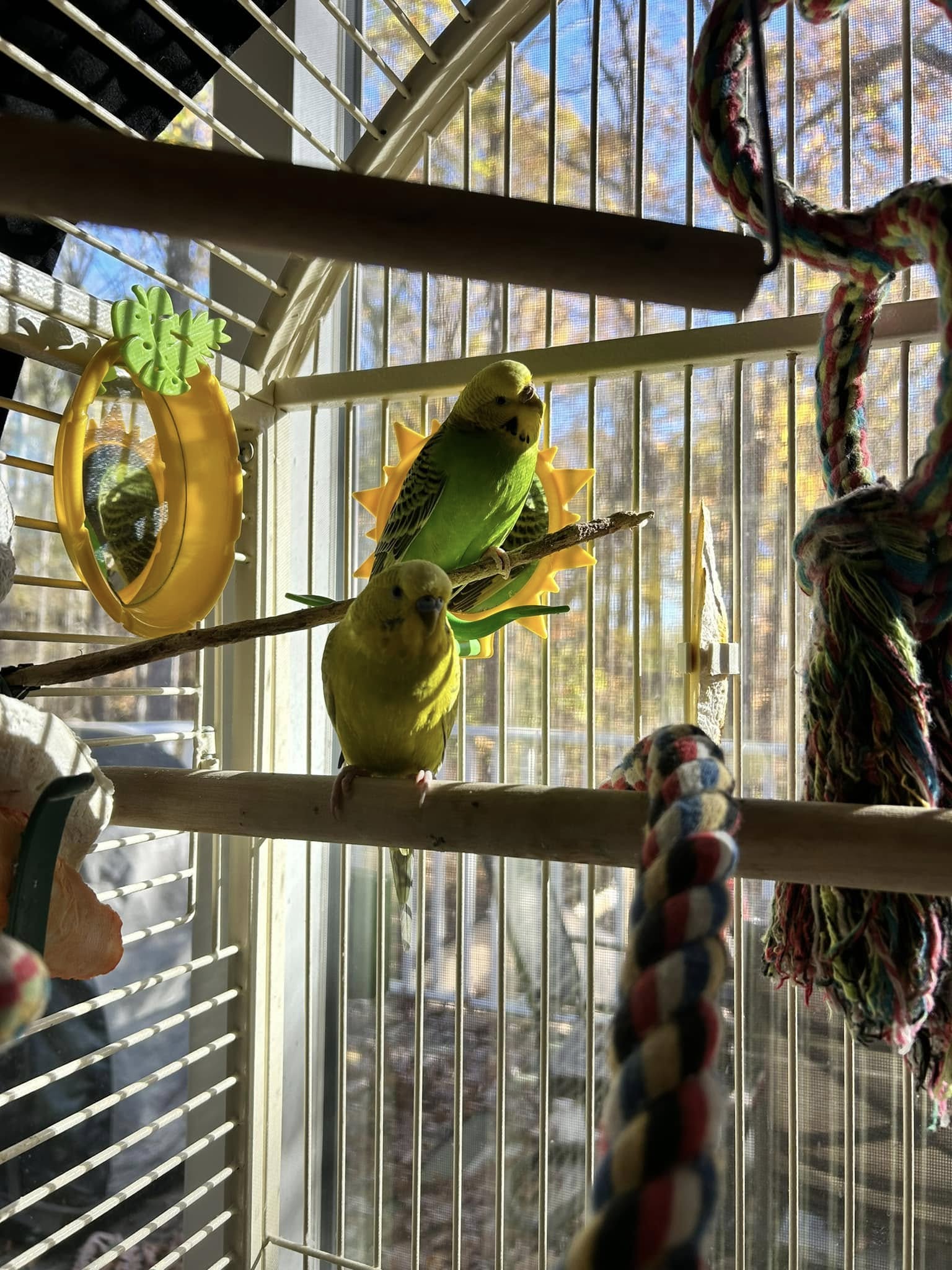
Quick Reference — Cage Size Comparison
| Cage Type | Typical Dimensions | Assessment | What It Means |
|---|---|---|---|
| Standard UK starter cage (sold with bird) | 30–45cm wide, 30–40cm deep, 40–50cm tall | Inadequate for a single bird | No meaningful flight possible. Perches too close. Below RSPCA minimum on all measurements. |
| Mid-range cage | 50–60cm wide, 45–55cm deep, 55–65cm tall | Borderline — acceptable at the higher end for a single bird | Possible to meet minimum on width at 60cm. Still limited for a pair. Adequate if daily out-of-cage time is provided consistently. |
| Flight cage — single bird | 70–90cm wide, 50–60cm deep, 65–80cm tall | Appropriate for a single bird | Meaningful flight distance between perches. Wing extension possible. Better physical health maintenance. |
| Flight cage — pair | 90cm+ wide, 60cm+ deep, 80cm+ tall | Appropriate for a pair | Adequate territory for two birds to establish space without conflict. Flight possible without the birds constantly obstructing each other. |
| Indoor aviary / very large cage | 120cm+ wide, 60cm+ deep, 150cm+ tall | Excellent | Approaches the flight conditions that produce the best physical health. Best option where space allows. |
Frequently Asked Questions
What is the minimum cage size for a budgie in the UK?
The RSPCA recommends a minimum of sixty centimetres wide, sixty centimetres deep, and sixty centimetres tall for a single budgie. This is a genuine minimum — the smallest space in which a bird can extend its wings fully and have meaningful perch distance. Most starter cages sold alongside budgies in UK pet shops are substantially below this minimum, typically thirty-five to forty-five centimetres wide. If your cage is under sixty centimetres wide, it is below the recommended minimum for a single bird.
My budgie seems fine in its current cage — does size really matter?
The consequences of inadequate cage size develop over months and years rather than days and weeks. A bird in a too-small cage appears to function — it eats, it moves around the available space, it vocalises. The physiological consequences of chronic inadequate exercise and chronic mild stress accumulate invisibly over time and manifest most obviously in the reduced lifespan that UK pet budgies typically experience compared to their biological potential. The bird that seems fine in a small cage is the same bird that may develop liver disease or reduced immune function two to three years earlier than it should.
Can out-of-cage time compensate for a small cage?
Partially, and meaningfully. A bird that gets an hour or more of genuine supervised flight time in a safe room each day is getting physical exercise that the cage does not provide, and this partially compensates for cage inadequacy. It is not a complete substitute — the cage is also where the bird spends the majority of its waking and sleeping hours, and a space it can genuinely navigate and explore is better than one it simply occupies. But daily out-of-cage time is a significant welfare improvement that I recommend as standard regardless of cage size.
What bar spacing should a budgie cage have?
Eight to twelve millimetres is the recommended bar spacing for budgies. Wider than twelve millimetres creates the risk of a foot or head becoming trapped between the bars — a risk that is not theoretical and that produces genuine injury. Many starter cages have bar spacing designed for larger birds, making them unsuitable for budgies on safety grounds independent of the size issue.
I have a pair of budgies in a cage that might be too small for even one — what should I do?
Address this as soon as practically possible. Two birds in an inadequate space are experiencing compounded welfare problems — each bird has less than half the already insufficient space, and conflict over perches, food, and territory in a confined space adds chronic stress to chronic physical limitation. Come in and let me show you what the appropriate options look like. The cost difference between a starter cage and a properly sized flight cage is genuinely not large, and the welfare difference is significant.
Where can I buy an appropriate cage for a budgie in Swindon?
Come and see us at Paradise Pets — Manor Garden Centre, Cheney Manor, Swindon SN2 2QJ. I stock a range of cage sizes and I am happy to show you what the minimum looks like versus what is genuinely better, and what the price difference actually is. This is one conversation I always want to have before the bird goes home rather than after. Call 01793 512400 before visiting.
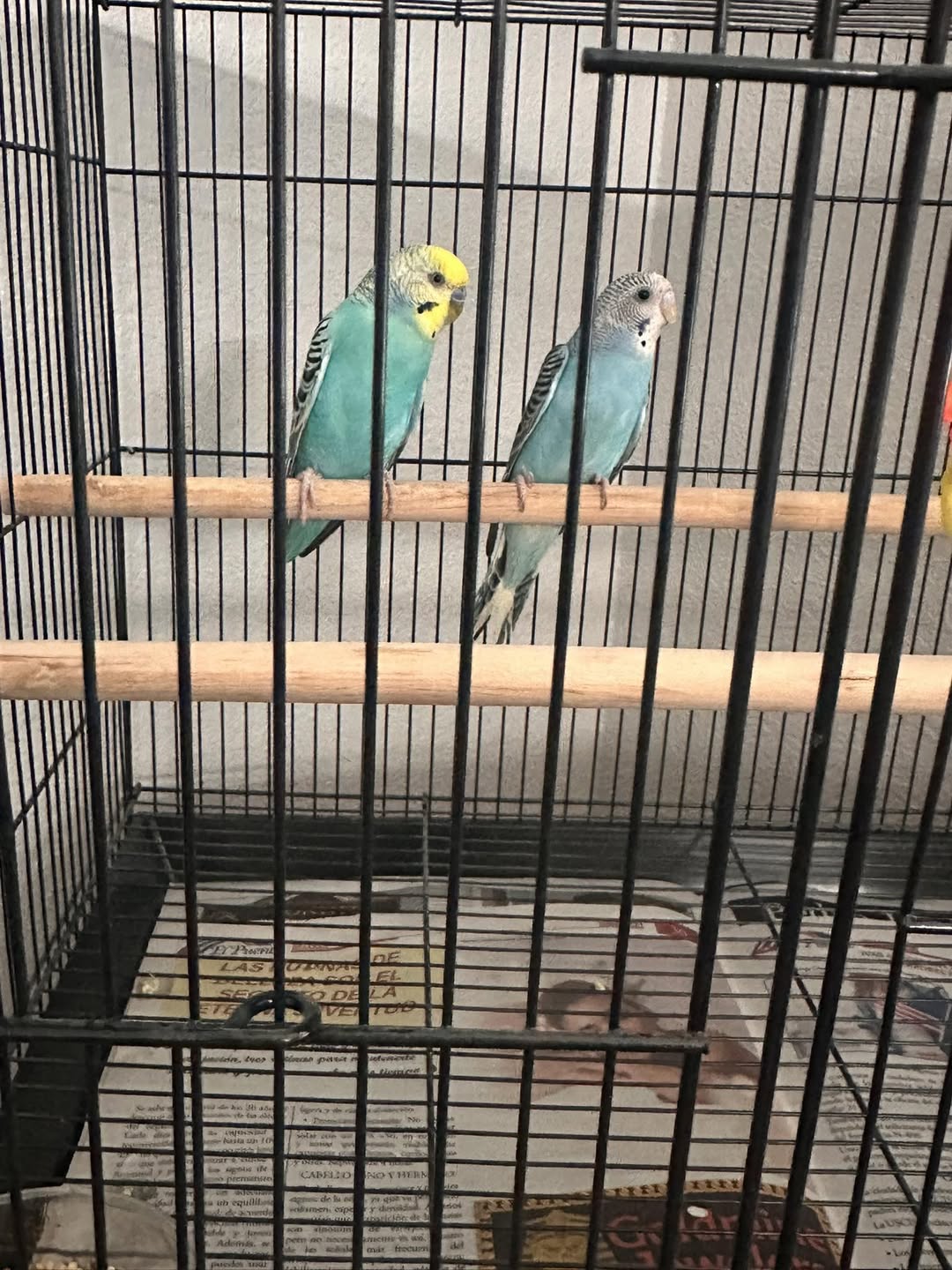
Think Your Cage Might Be Too Small? Come in and Let’s Look at It Honestly
If you are reading this and the description fits the cage your bird is in — come in. We can talk through the options, what the difference looks like, and what the realistic cost is of getting it right. I would rather have this conversation with you now than hear about a bird that struggled through five years instead of twelve.
⭐ Customer Reviews
Amazing Bird Selection
Had a lovley visit today,staff were very friendly and very helpful,such a great petshop,their selection of birds is incredible,really impressed,thank so much to the staff at Paradise Pets

Friendly Helpful Staff
I have been coming to this place for years and they have a great stock of food for all types of pets. Have a great selection of small mammals and a lot of birds. Staff are friendly and helpful.

Great Quality Hutch
Bought a guinea pigs hutch and run combo, very happy with the service, the hutch was put in my car for me without even asking for help. The wood quality is very good, the instructions easy to follow and we are extremely happy with the fully built hutch. A good size for 2 guinea pigs

Response from Paradise Pets | Wiltshire
Thank you Melanie Latus Nice to provide services to you.
Best Bird Shop Around
It’s the best pet shop in and around Swindon. They always have an amazing selection of birds and all you need to keep them happy. I keep birds myself and the guys there are happy to answer questions and really know their stuff. I have seen budgies etc. in chain pet shops in the area looking really unhealthy and ill – I wouldn’t go anywhere else than Paradise Pets for animals.

Highly Recommended Bird Shop
I could not praise this shop enough. Really helped my Grandson buy his first bird and he’s loving it. Travelled from Somerset and was welcomed with open arms.

Great Shop with Competitive Prices
Great shop with amazing selection for small animals, hamsters, mice ect, highly recommend!
Also has a great selection for dogs & cats too & very competitive prices! 💖

