
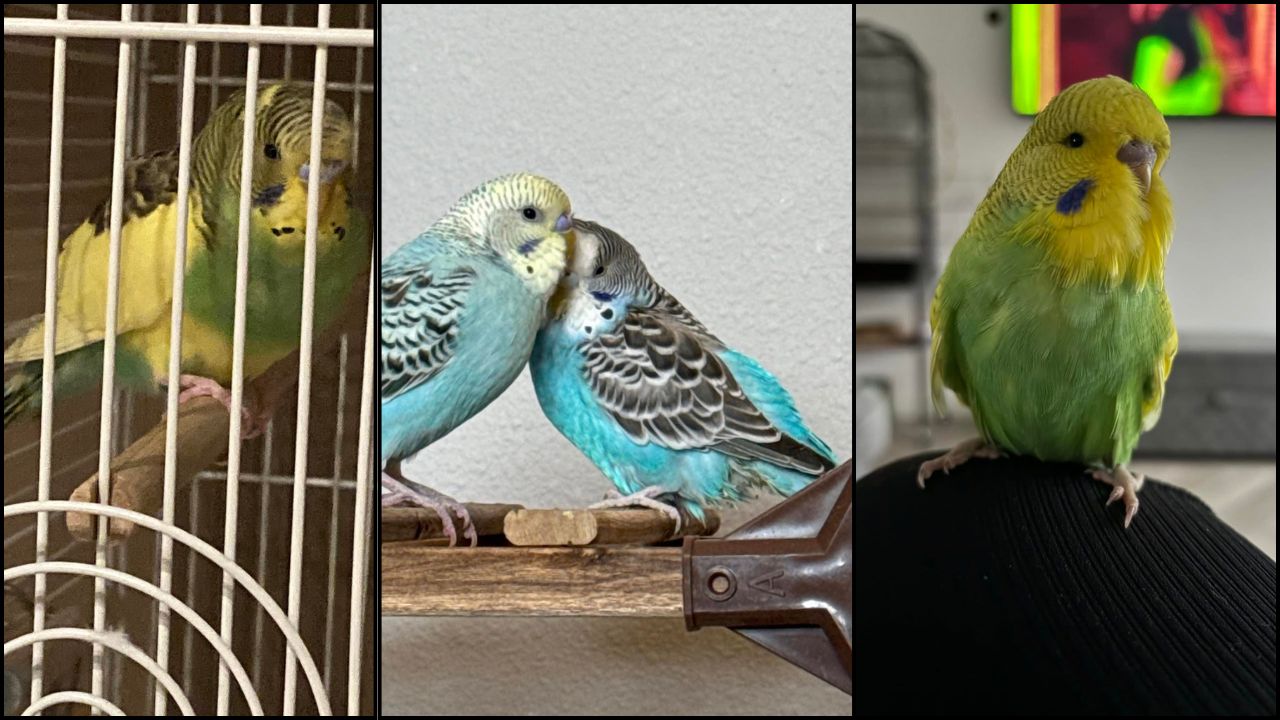

Neil has been keeping, breeding, and selling budgies at Paradise Pets Swindon since 1988 — over 35 years of daily first-hand experience with these birds and the people who love them. This is one of the hardest articles he has written, because the people who need it most are frightened and often already grieving before they have even confirmed what is happening. This is his honest, direct guide to the signs that a budgie is critically unwell or dying — what they look like, what still might be treatable, and how to know the difference.
A woman phoned the shop late on a Tuesday evening, her voice unsteady. Her budgie — twelve years old, a bird she had had since she was a teenager — had been declining for several days. She described what she was seeing, and I could hear in the way she was speaking that she already knew, somewhere underneath the question she was asking, what the answer was likely to be. She wanted someone to either confirm it or tell her there was still time.
I asked her to describe exactly what the bird was doing, in as much detail as she could manage.
Fluffed continuously, even overnight when the cage cover was off in the morning. Sitting on the cage floor rather than the perch. Eyes mostly closed. Not eating, not drinking that she had seen. Breathing visible, the tail moving with each breath. Unresponsive when she gently touched the cage.
I told her, as gently and honestly as I could, that based on what she was describing, her bird was very likely in the final stage of its life, and that the most important thing she could do right now was get it to an emergency vet — not because there was a guarantee of recovery, but because only a vet could tell her with certainty whether anything could still be done, and because if the answer was no, a vet could also help her bird’s final hours be free of unnecessary suffering.
She went. The vet confirmed what I had suspected. Her bird had advanced organ failure, almost certainly linked to age and a lifetime on a seed-heavy diet that had not been understood as a risk when she was a teenager bringing the bird home in the 1990s. The vet was able to ensure the bird was comfortable and free from distress in its final hours, and she was able to be with it.
She told me afterwards that what had helped most was knowing, clearly and honestly, what she was looking at — rather than the uncertain hoping and not-knowing that had characterised the previous few days.
This article exists because that clarity matters, and because too many owners spend their bird’s final days in confused uncertainty when honest information could have helped them act, or simply be present, sooner.
Why This Is Difficult To Write About Clearly — And Why I Am Doing It Anyway
Before going through the specific signs, I want to explain the approach I have taken in this article, because it differs slightly from most of what I write.
Budgies are prey animals with an exceptionally strong instinct to hide weakness and illness. This instinct does not weaken as the bird becomes more seriously unwell — if anything, the bird continues attempting to mask its condition for as long as it is physically capable of doing so. This means that by the time the signs described in this article become visible, the underlying condition has often been present and progressing for a considerable period already. It also means that a bird showing these signs is, in the great majority of cases, seriously unwell — not mildly affected by something minor.
I am writing this directly rather than softening it, because softened information does not help an owner who needs to make a decision about whether to seek emergency veterinary care tonight or whether to wait until tomorrow. The honest answer, almost always, is tonight.
- This article is not designed to frighten owners unnecessarily — many of the individual signs described below, in isolation and briefly, can have less serious explanations; the combination and persistence of multiple signs together is what indicates a genuinely critical situation
- This article is also not designed to offer false reassurance — if your bird is showing several of these signs together, the situation is serious and needs immediate professional assessment, not home monitoring
- An avian vet, not this article, is the only source that can give you a definitive answer about your specific bird — what follows is information to help you recognise when that call needs to be made urgently, not a substitute for making it
- Some conditions that produce these signs are treatable if caught in time — this is the central reason urgency matters; a bird showing early or moderate versions of these signs may still have a meaningful chance of recovery with prompt veterinary treatment, even though the same signs, left unaddressed, may progress to a point where recovery is no longer possible
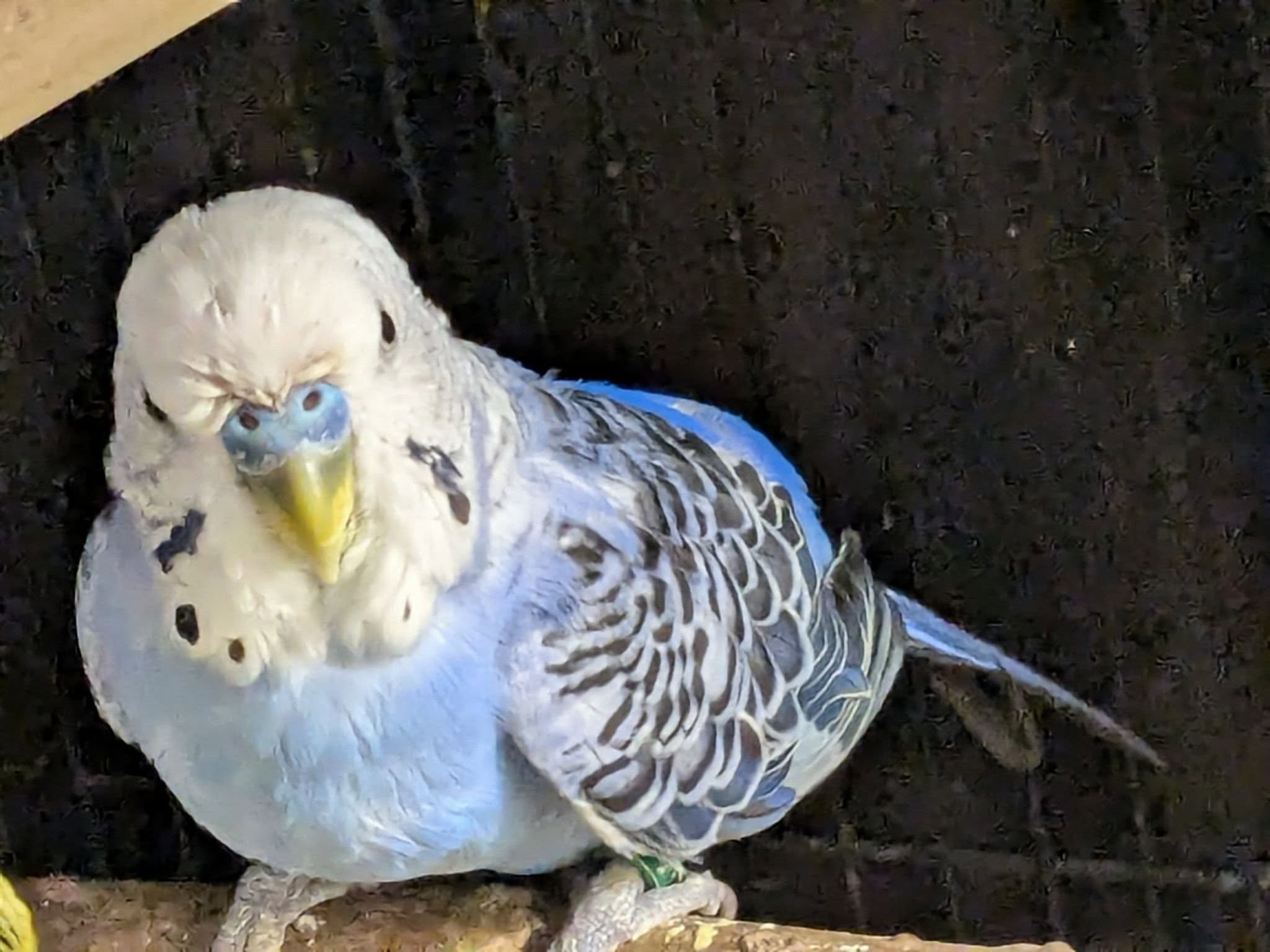
The Signs — What A Critically Unwell Or Dying Budgie Actually Looks Like
Persistent Fluffing That Does Not Resolve
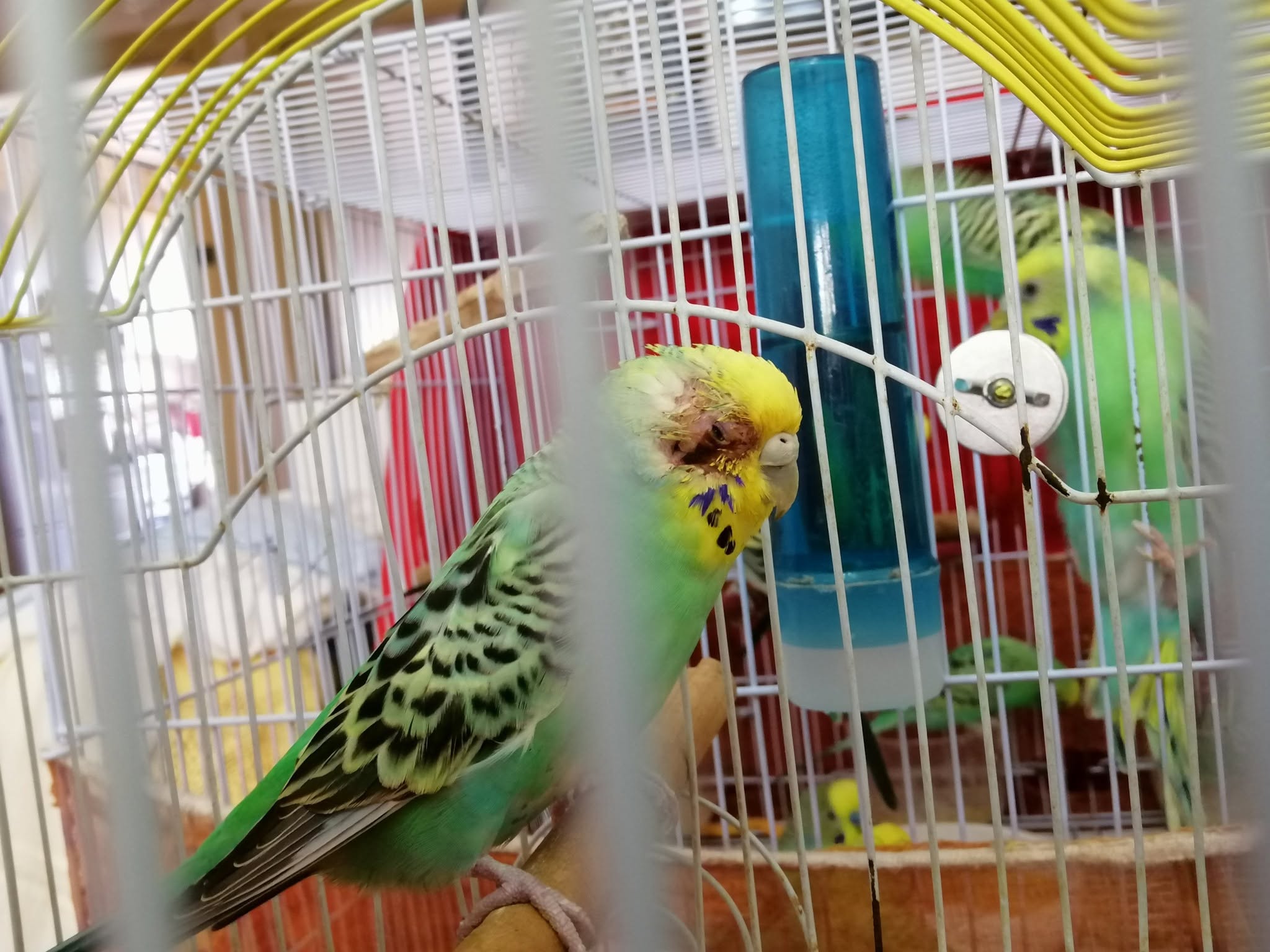
A budgie fluffs its feathers to conserve body heat, and brief fluffing — particularly during sleep, or briefly after a bath, or while resting — is entirely normal. The sign that matters here is fluffing that is continuous, including during the hours the bird should be alert and active, and that does not resolve when the bird is warmed or given time.
- Fluffed continuously through the day, not just at rest periods — a healthy bird’s fluffing comes and goes with its activity cycle; a critically unwell bird remains fluffed because it cannot maintain normal body temperature regulation
- Fluffing combined with a hunched, drawn-in posture — the body appears smaller and more compact than the bird’s normal silhouette, even accounting for the fluffed feathers
- No improvement when the bird is moved to a warmer environment — if cold were the explanation, warmth should produce visible improvement within a reasonable time; persistent fluffing despite adequate warmth points to an internal cause rather than an environmental one
Sitting On The Cage Floor
This is one of the clearest and most urgent signs a budgie can show. Budgies are instinctively driven to perch — height and elevation are central to their sense of safety as prey animals. A budgie that has moved to the cage floor and remains there has typically lost the physical strength to maintain a normal perched position.
- Sitting on the floor for an extended period, rather than briefly investigating something — a bird that hops down momentarily to explore and returns to its perch is behaving normally; a bird that remains on the floor is not
- Often combined with fluffing and reduced responsiveness — the floor-sitting bird typically shows several of the other signs in this list simultaneously, which together indicate a serious decline in physical capability
- This is one of the signs I take most seriously at the counter — in 35 years I have very rarely seen a healthy budgie choose the floor over a perch during waking hours
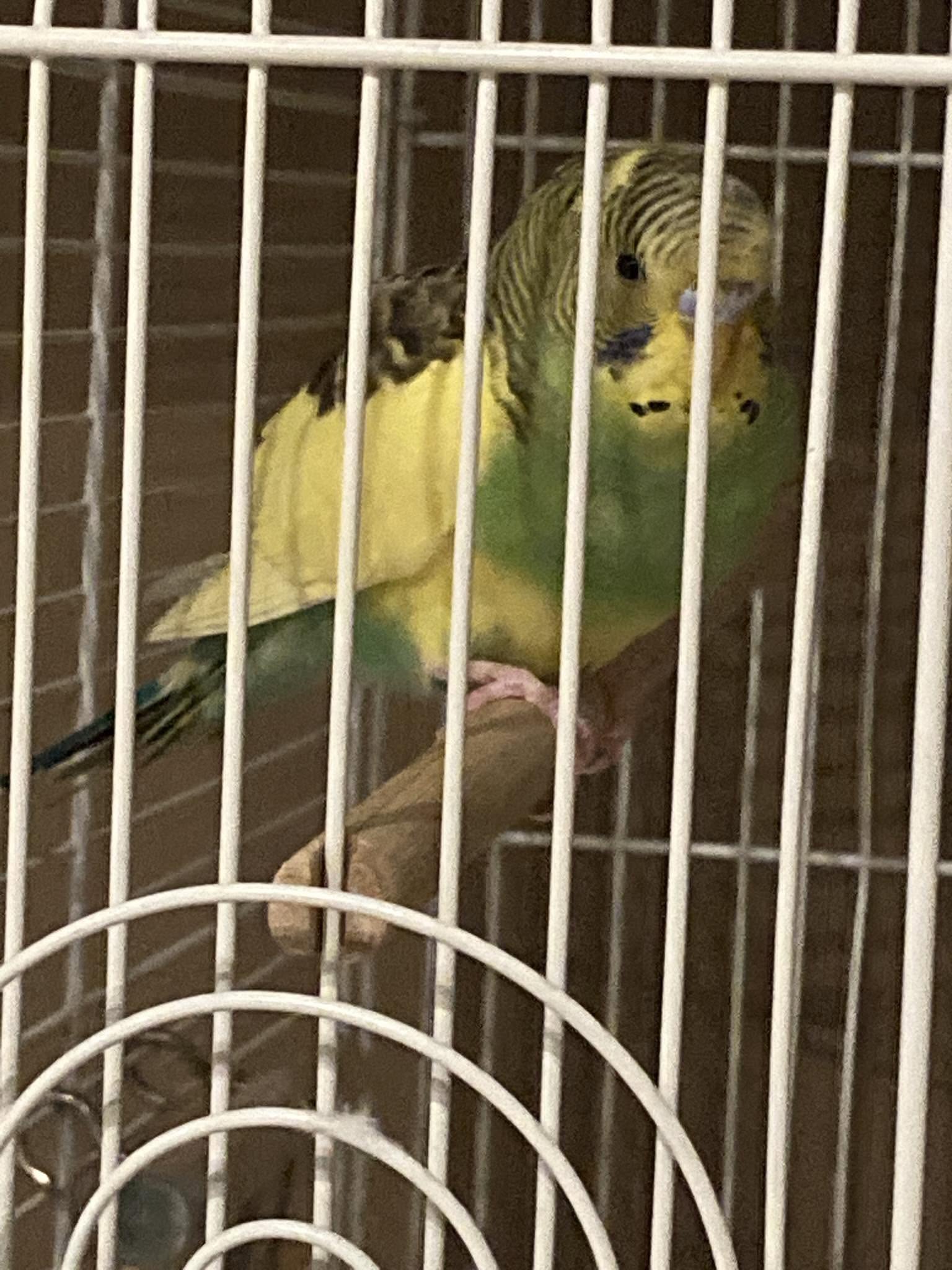
Laboured Or Visible Breathing
A healthy budgie’s breathing at rest should not be visible. When breathing becomes visibly effortful, the body is working hard simply to maintain basic oxygen exchange.
- Tail bobbing rhythmically up and down while the bird is sitting still — this is one of the clearest physical signs of respiratory distress; the tail movement reflects the effort being put into each breath
- Open-beak breathing at rest, when the bird is not overheated or recently active — the bird is unable to get sufficient air through normal nasal breathing alone
- Audible breathing — clicking, wheezing, or rasping sounds — indicates obstruction or significant inflammation within the airways
- Stretching the neck upward repeatedly — an attempt to open the airway further to ease breathing effort
Loss Of Appetite And Extreme Lethargy
A budgie that has stopped eating entirely, or that is eating only minimally despite food being available, is in a critical state. Budgies have very limited fat reserves relative to their size and cannot survive without food for extended periods, particularly when the body is also fighting illness.
- No interest in food, even favourite treats — a bird that will not respond to millet or other foods it has previously been enthusiastic about is showing a profound loss of normal drive
- No movement toward food or water even when both are easily accessible — the bird is no longer engaging with its basic needs
- Extreme lethargy — minimal or absent response to sounds, movement, or your presence near the cage — a healthy budgie is alert to its environment; a critically unwell bird may show little to no reaction to things that would normally produce immediate interest or alarm
- Eyes closed or barely open for extended periods during the day — energy is being conserved at a fundamental level
Significant Weight Loss
Weight loss in budgies is often invisible to the eye because the feathers conceal the body shape underneath them. By the time weight loss is visible without handling the bird, it is typically significant.
- A prominent, sharp keel bone with little or no muscle on either side — gently feeling along the centre of the chest reveals the breastbone; in a healthy bird there is a small padding of muscle either side; a sharp, exposed keel indicates substantial weight loss
- The body appearing visibly smaller or thinner than the owner’s memory of the bird’s normal shape — though feathers conceal much of this, significant weight loss can still produce a visible change in the overall silhouette
- Weight loss combined with continued or worsening lethargy — the two together indicate the body’s reserves are being depleted faster than they can be replenished
Changes In Droppings
The droppings are one of the most informative indicators of internal health, and significant or persistent changes are often present in the final stages of serious illness.
- A complete absence of droppings, or very scanty production — indicates the digestive system has slowed dramatically or stopped, often linked to the bird no longer eating
- Watery, discoloured, or abnormal droppings persisting over multiple days — yellow or green urates indicate liver involvement; consistently watery droppings indicate kidney stress or digestive illness
- Blood visible in the droppings — a serious sign requiring immediate veterinary attention regardless of any other symptoms present
Unresponsiveness And Lack Of Coordination
In the final stages, neurological and physical coordination can be significantly affected.
- Tremors, twitching, or visible shaking — indicates the nervous system is significantly affected
- Inability to grip the perch or maintain balance — falling repeatedly, or being unable to right itself if it has fallen onto its side
- Minimal or absent response to gentle touch or sound near the cage — a level of unresponsiveness well beyond normal sleepiness or rest
- Seizure-like activity — uncontrolled movement, rigidity, or loss of consciousness; this requires emergency veterinary attention immediately
- Contact an avian vet immediately — phone ahead, describe exactly what you are seeing, and ask to be seen as an emergency; most avian-experienced practices will prioritise this presentation appropriately
- Keep the bird warm while you arrange care — a small, dark, secure container maintained around 27 to 30 degrees Celsius helps stabilise a weak bird; do not delay travel trying to achieve perfect conditions
- Minimise handling beyond what is necessary — a critically weak bird does not need additional stress from being repeatedly picked up and examined at home
- Do not attempt home treatment of any kind — there is no safe or effective intervention available at home for the conditions that produce these combined signs
- If the bird has already died, or if a vet confirms nothing further can be done, allow yourself to grieve; this is a genuine loss and it is appropriate to treat it as one
What May Still Be Treatable — And Why Speed Matters
I want to be clear that not every bird showing some of these signs is beyond help. The honest reality is that a number of the conditions that produce these symptoms — bacterial and fungal infections, certain reproductive emergencies such as egg binding, some forms of nutritional deficiency, and some respiratory conditions — are genuinely treatable, particularly when caught before the bird has reached the most severe stage of decline.
- A bird that is fluffed and quiet but still eating something, still producing droppings, and still responsive to your presence is in a different category from a bird that has stopped eating entirely and is unresponsive — the earlier presentation has a meaningfully better prognosis with prompt treatment
- Infections, in particular, often respond well to appropriate antibiotic or antifungal treatment if started before the bird’s systems are severely compromised — this is the central reason that acting on early or moderate signs, rather than waiting for the full critical picture to develop, matters so much
- Egg binding, while a genuine emergency, is treatable in many cases with prompt veterinary intervention — a hen straining, with a swollen abdomen, sitting fluffed and low, needs emergency assessment, not assumption that nothing can be done
- Nutritional deficiencies, while they can produce serious symptoms, are often reversible with the correct combination of supportive care and dietary correction if caught before organ damage becomes irreversible
- The single most important factor in outcome, across almost all of these conditions, is how early professional treatment begins — this is why the consistent message throughout this article, and throughout everything I tell owners at the counter, is to seek veterinary assessment promptly rather than waiting to see how things develop
When The Outcome Cannot Be Changed — What To Focus On Instead
There are situations — advanced age combined with organ failure, very advanced disease, or conditions where treatment is genuinely no longer able to alter the outcome — where the most honest and kind path forward is not aggressive treatment but ensuring the bird’s remaining time is as free from distress as possible. A vet is the right person to make this assessment with you, not a guess made alone at home.
- A vet can confirm whether anything further can realistically be done, and can also confirm if the answer is no — this clarity, even when it is painful, is genuinely valuable; it ends the uncertain hoping and not-knowing that many owners describe as one of the hardest parts of this experience
- Euthanasia, when a vet recommends it as the kindest option, is an act of care, not failure — preventing unnecessary suffering at the end of life is one of the most important responsibilities an owner has, and it is not a lesser form of love than trying to extend life at any cost
- Keep the bird warm, calm, and as comfortable as possible in its final hours if it is at home — a quiet, dimly lit, warm space, with minimal handling and disturbance, is the kindest environment if the bird is in its final stage and a vet has confirmed there is nothing further to be done medically
- Being present matters, if you choose to be — many owners find comfort in being with their bird at the end; there is no correct or required way to handle this, only what feels right for you and what is kindest for the bird
Frequently Asked Questions
My budgie is showing some of these signs but is still eating a little. Should I still go to the vet immediately?
Yes. The presence of any of these signs, even if the bird is still eating something, warrants prompt veterinary assessment rather than a wait-and-see approach. A bird that is still eating but also fluffed, sitting low, or showing breathing changes is in an earlier stage of a serious process — and this earlier stage is exactly when intervention has the best chance of changing the outcome. Do not wait for the bird to stop eating entirely before seeking help; by that point the situation has typically progressed significantly further.
How do I know if my budgie is dying or just unwell and treatable?
You genuinely cannot know this with certainty without veterinary assessment, and this is the central message of this article. The signs described here indicate a serious situation, but the specific underlying cause — and whether it is treatable — can only be determined by an avian vet through examination and, often, diagnostic testing. The honest answer to uncertainty is to seek that assessment rather than guessing at home, in either direction.
Is it normal for an old budgie to show these signs as it approaches the natural end of its life?
In some cases, yes — a very elderly budgie, often well into its second decade, may show a gradual decline that ultimately reaches this point as part of a natural end of life process. Even in this situation, veterinary assessment is valuable: a vet can confirm that this is what is happening rather than a treatable acute condition, can ensure the bird is not in unnecessary pain, and can advise on what to expect and how to provide the most comfortable remaining time.
My budgie died suddenly with no warning signs at all. Could I have done anything?
Sometimes, genuinely, no. Budgies hide illness so effectively that some conditions are not visibly apparent until a very late stage, and some causes of sudden death — certain cardiac events, acute toxin exposure, sudden ruptures related to conditions like tumours — can occur with very little or no preceding warning that an owner could reasonably have detected. If your bird died suddenly and you are wondering whether you missed something, please know that this is an extremely common and understandable feeling, and it is very often not an accurate reflection of what was actually possible to detect or prevent.
Should I get my other budgies checked if one has died or become critically ill?
This is sensible, particularly if the cause was infectious or unclear. An avian vet can advise on whether the other birds in the household need assessment, monitoring, or any preventive treatment, depending on what is found to have affected the unwell bird. This is a reasonable and caring step to take for the wellbeing of any remaining birds.
Where can I get support after losing a budgie in Swindon?
Come in to Paradise Pets at Manor Garden Centre, Cheney Manor Industrial Estate, Swindon SN2 2QJ — or call us on 01793 512400. I am happy to talk, whether that means answering practical questions about what happened, or simply being someone who understands what the loss of a bird means. That is part of what we are here for, alongside everything else.
One Last Thing From Me
The woman who phoned on that Tuesday evening came back into the shop about a month later. She told me she had been replaying the previous few days in her mind, wondering whether she should have called sooner.
I told her what I believe to be true, and what I want to say to anyone reading this in a similar position. The instinct to hope, to wait and see, to not want to believe that something serious is happening to an animal you love, is completely natural and completely human. It is not a failure of care. It is what love does in the face of uncertainty.
What I hope this article offers is not guilt about what was not known before, but clarity for whatever comes next — whether that is recognising the early signs in time to seek treatment that helps, or recognising the advanced signs clearly enough to seek the comfort and honesty of veterinary guidance rather than continuing to hope alone.
Budgies give a great deal to the people who keep them well — years of companionship, genuine connection, daily moments of real joy. The end of that relationship, when it comes, deserves the same honesty and care that the rest of it did.
If you are reading this because you are worried about your bird right now, please do not wait for confirmation here. Call an avian vet. That is always the right next step.
Worried About Your Budgie’s Health? Call An Avian Vet First.
If your bird is showing any of the signs described in this article, please seek veterinary assessment without delay. Once you have done that, or if you simply need someone to talk to about a bird you have lost, come and find us. That is what we are here for, alongside everything else.