
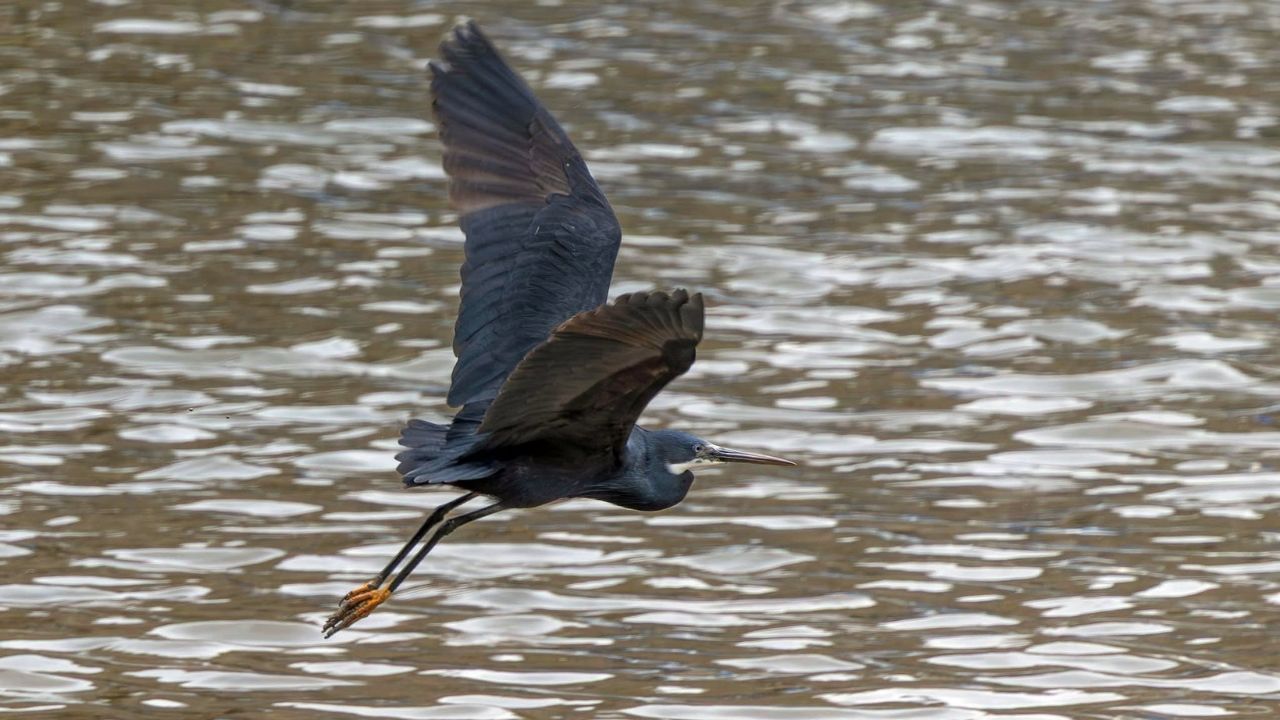

Neil has watched birds — wild, caged, and everything in between — for over 35 years at Paradise Pets Swindon. When a genuinely extraordinary wild bird event happens in Britain, he pays attention. The arrival of a western reef heron in North Wales in June 2026 is, in his view, one of the more remarkable wild bird stories of recent years — and one worth explaining properly to anyone who wants to understand what it means.
There are moments in birdwatching that people talk about for years.
Not just because the bird is rare — rare birds turn up in Britain fairly regularly, and the community that follows them is well practised at responding. But occasionally something happens that sits in a different category from the ordinary excitement of a rare visitor. A bird that has never been seen on these islands before. A genuine first for Britain.
That happened on the morning of Saturday the sixth of June this year, on the coast of North Wales.
An ornithologist named Simon Hugheston-Roberts was at Y Foryd — a bay just outside Caernarfon — when he noticed a grey-blue heron feeding alongside a group of little egrets. The bird was slightly larger than the egrets. Its colouring was different. He looked more carefully, drew on his field experience from West Africa and the Middle East, and recognised what he was looking at.
He was looking at a western reef heron. Egretta gularis. A bird whose normal range stretches from West Africa to the Indian subcontinent, whose usual habitat is tropical and subtropical coastline, and which had never — not once in recorded British ornithological history — been seen in the United Kingdom.
He alerted a birdwatching group. Within hours, birdwatchers were driving to Caernarfon from across the country. By the afternoon, approximately three hundred people had gathered to see it. By the next day, it had relocated to Caernarfon Harbour itself, feeding among the boats in the shadow of the town’s mediaeval castle — and the crowd of birdwatchers had grown considerably larger.
What Is a Western Reef Heron?
For anyone who has not encountered this species before — which is almost everyone in Britain, for obvious reasons — it is worth explaining what this bird actually is and what makes it distinctive.
The western reef heron is a medium-sized heron, roughly comparable in overall dimensions to a little egret, though slightly larger and more robust. It belongs to the genus Egretta — the same group that includes the little egret and the great white egret, both of which have become increasingly familiar to British birdwatchers in recent decades.
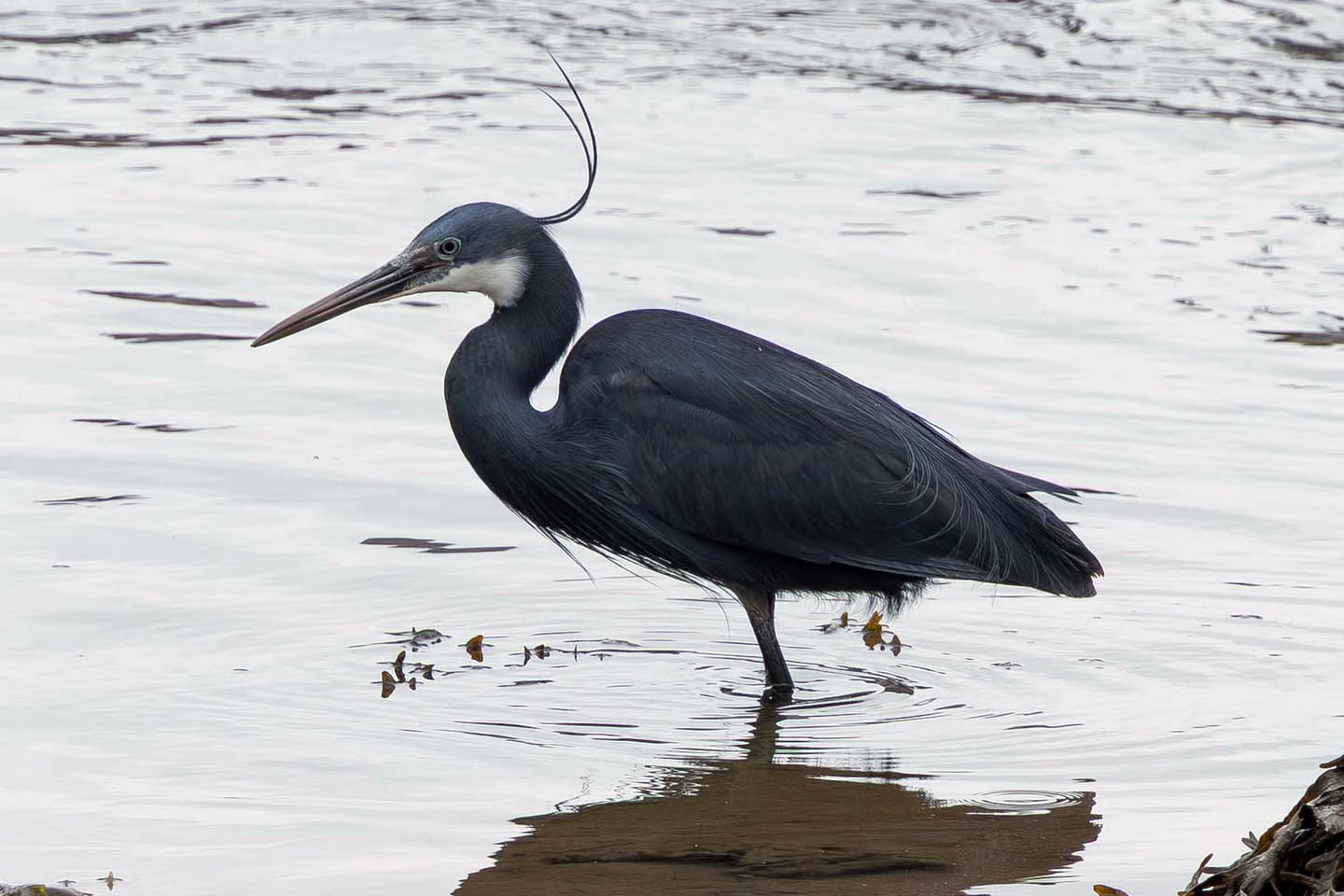
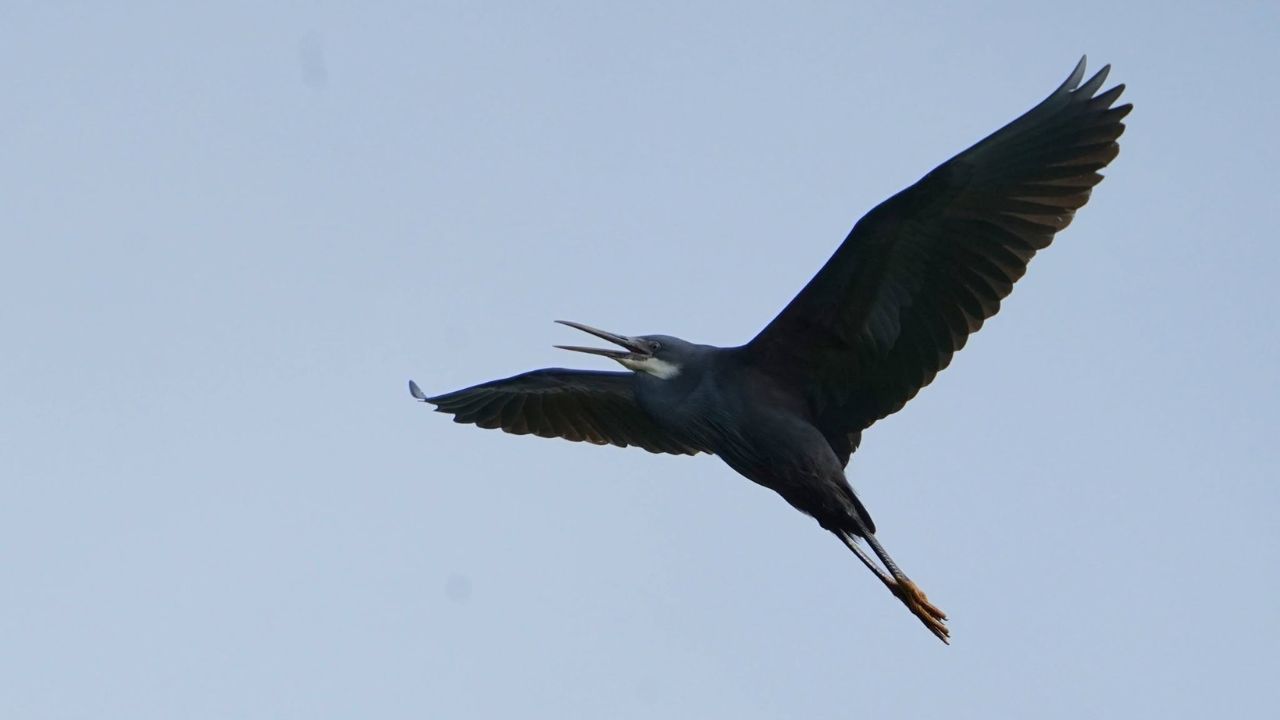
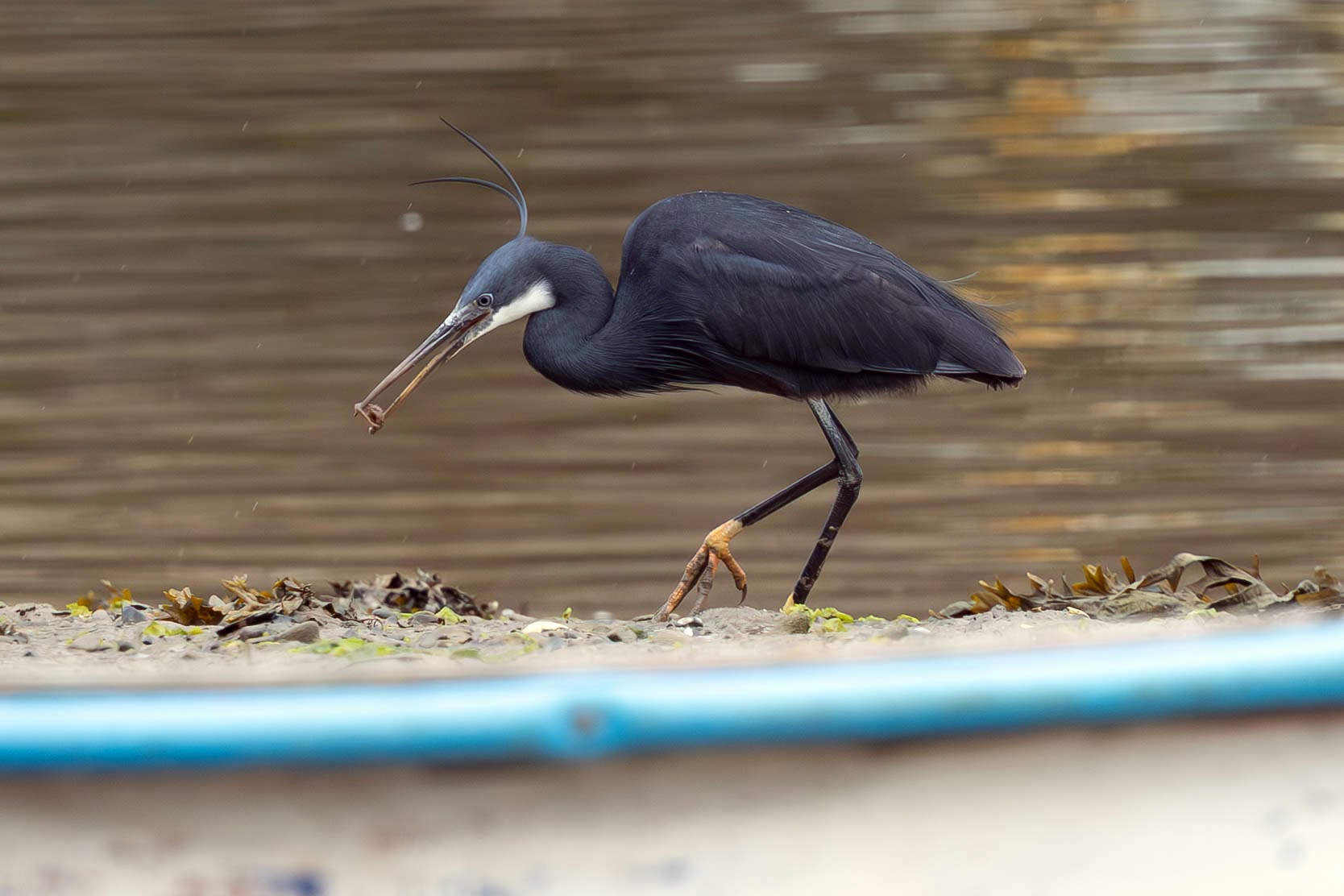
There are two colour morphs of the western reef heron. The dark morph — which is what appeared in Wales — is a uniform dark grey-blue in plumage, with yellow feet and a dull yellowish bill. The overall impression is of a slate-coloured wading bird: compact, purposeful, quite different from the brilliant white of the little egret that would most commonly be seen alongside it. The white morph, more prevalent in populations further east toward the Red Sea and the Indian Ocean, is entirely white and more easily confused with other egret species.
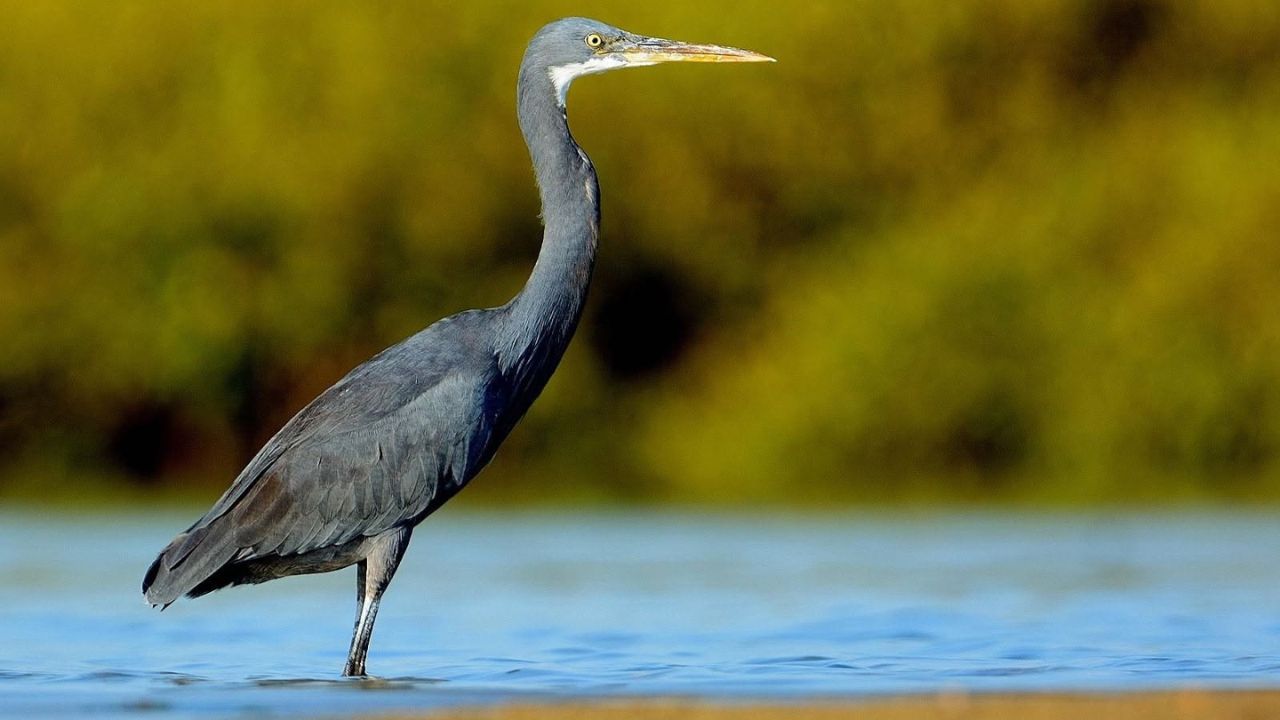
In its normal range, the western reef heron is a coastal specialist — found on rocky shores, reef margins, estuaries, and harbours throughout West Africa, the Mediterranean coastline, and into Asia. It feeds on fish, crustaceans, and invertebrates in the shallow water of these coastal habitats, using the patient, watchful hunting technique characteristic of herons.
Its normal range and Britain’s northern latitudes would appear to have nothing in common. That the bird was here at all requires an explanation.
How Did It Get Here?
This is the question that birdwatchers and ornithologists have been discussing since the sighting was confirmed, and the answer — as with most vagrant birds — involves a combination of established movement patterns, specific meteorological conditions, and a degree of the unpredictable that is the permanent feature of rare bird watching.
The western reef heron’s appearance in Britain was not entirely without precedent in the sense that records across southern Europe have been increasing in recent years, with regular sightings in Spain, France, and Italy. The year 2026 in particular produced sightings further north than usual in France, with one bird seen near La Rochelle in relatively recent weeks before the British record.
The birds reaching southern Europe are thought to come from the West African population — the population that is almost entirely composed of dark-morph individuals, matching exactly what appeared in Wales. A pattern appears to be developing, slowly, of West African reef herons extending their northward range along the Atlantic coast of Europe, following the coastline in a direction that, given sufficient persistence and the right wind conditions, eventually reaches the British Isles.
Experts have noted that powerful southerly winds during migration are likely to have played a role in carrying the bird further north than usual. This is the standard explanation for how vagrancy works in birds — an individual that is already pushing northward along a coastline catches a sustained southerly airstream and is carried significantly beyond where it might otherwise have stopped. The bird lands, finds food, and stays.
It later emerged that the bird had probably been in Wales for longer than initially known — photographs submitted to a bird identification group identified what was believed to be the same individual in Pembrokeshire nearly a month before the Caernarfon sighting, making this the first confirmed record of the species in the UK. The bird had been quietly present on the Welsh coast before anyone formally identified it — which is how many rare bird records work.
The Scene at Caernarfon
I want to describe this, because for those of us who follow British birding from a distance, the human side of a first for Britain is almost as interesting as the bird itself.
At Caernarfon, the western reef heron gave superb views as it fed among the boats in the harbour, only a stone’s throw from the town’s famous mediaeval castle. The setting, by any account, was extraordinary — a tropical African bird fishing among the lobster pots and moored vessels of a Welsh harbour, with the stone walls of one of Edward I’s greatest fortifications rising in the background.
By the afternoon of the first day of confirmed sightings, about 300 ornithologists had arrived in the town hoping to catch sight of the bird. Some enthusiasts travelled from as far as Essex, with others arranging overnight accommodation to continue their observations.
Macclesfield resident Mike Barth described dropping everything after hearing the “mega rare” bird had been sighted in the UK, adding: “It was a very satisfying trip, more often than not birds are found on work days and usually gone by the time the weekend comes around. So to get a mega rarity on a Saturday morning within two hours was very unusual in itself, let alone a first for Britain.”
The community aspect of an event like this is genuine. Birdwatching is sometimes portrayed as a solitary or eccentric pursuit, and it can be either. But a first for Britain draws people together around a shared experience in a way that has its own particular quality. Three hundred people standing beside a Welsh harbour in the early June sunshine, watching an African heron feed among the boats — that is not a niche activity. It is a celebration of something genuinely rare and genuinely wonderful, and the people who got there for it will be talking about it for a long time.
What This Tells Us About British Birds in 2026
The western reef heron’s arrival is part of a pattern that anyone paying attention to British ornithology over the past two decades will have noticed. Species that would have been extraordinary or impossible here thirty years ago are appearing with increasing regularity, and in some cases establishing themselves.
The little egret is the most familiar example — once a vagrant, now a common breeding bird in Britain. The great white egret has followed a similar trajectory. Spoonbills have colonised. Cattle egrets breed. Mediterranean gulls are now routine. The list of species that have expanded their range northward into Britain in recent decades is significant and growing.
Some of this reflects genuine range expansion driven by changing climatic conditions making British latitudes more hospitable to warm-climate species. Some reflects increased birdwatcher coverage — more people in more places, with better equipment and better communication networks, finding birds that were always occasionally present but previously went undetected. Both factors are real.
Naturalist and broadcaster Iolo Williams noted that despite the sighting occurring after record-breaking temperatures in Wales, experts do not link this specific event to climate change directly — powerful southerly winds during migration are the more immediate explanation. But the broader context — the increasing frequency of West African species in southern Europe and the northward push of Mediterranean species into Britain — is part of a real, ongoing process.
Whether a western reef heron will ever breed in Britain is not a question anyone can answer yet. What is clear is that it is no longer unthinkable. A decade ago it would have been. Five years ago, perhaps. Today, a bird that was not in the British ornithological record at all is feeding in a Welsh harbour, being watched by hundreds of people, and suggesting — as these birds always suggest — that the edges of what is possible are somewhat further out than they were.
Why Events Like This Matter to Anyone Who Cares About Birds
I want to say something about why stories like this one are worth paying attention to, even for people who would not describe themselves as birdwatchers.
The western reef heron’s arrival is, at one level, a piece of good news in a natural history context where good news is not always easy to find. Britain’s breeding bird populations have declined significantly in the past fifty years — farmland birds, seabirds, many woodland species. The overall trajectory of British wildlife through the twentieth century was not positive.
Against that backdrop, the ongoing expansion of new species into Britain — egrets breeding, herons appearing, the gradual northward movement of species that are finding British conditions increasingly suitable — is a genuine and notable counter-narrative. It does not offset the losses. But it is evidence that bird life is dynamic, that movement and adaptation are continuous, and that there is still the possibility of surprise.
The kind of surprise that three hundred people drove to Caernarfon to witness on a June weekend. The kind of surprise that makes people who have spent decades watching birds call something a “mega rarity” with genuine emotion in their voice. The kind of surprise that reminds everyone who cares about natural history that the world is still capable of producing moments that feel, for a few minutes in a Welsh harbour, genuinely extraordinary.
The Bird at the Centre of It All
I want to end with the bird itself rather than the human story around it, because it is the bird that deserves the last word.
A western reef heron from West Africa. A species that evolved for tropical coastlines, for mangrove edges and rocky reefs, for the warm shallow waters of a climate nothing like the Irish Sea. An individual bird that somehow — through wind, through instinct, through the unpredictable mechanics of migration — ended up feeding among lobster pots in Caernarfon Harbour on a Saturday morning in June.
It did not know it was a first for Britain. It was, by all accounts, feeding contentedly, managing the Welsh coastal environment with apparent ease, and showing no particular interest in the growing crowd of observers maintaining respectful distances around it.
Which is, I think, the right way to leave it. The remarkable thing about the western reef heron’s arrival in Britain is not the human excitement it generated — though that was genuine and understandable. It is the bird itself. The fact that it exists. The fact that it made it here. The fact that, when it appeared, it simply got on with being a heron.
Frequently Asked Questions
What is the western reef heron?
The western reef heron (Egretta gularis) is a medium-sized heron belonging to the same genus as the little egret and great white egret. It exists in two colour forms: a dark grey-blue morph, which is what appeared in Wales, and a white morph found more commonly in eastern populations. Its normal range extends from West Africa eastward across the tropical coastlines of the Indian subcontinent. Prior to June 2026, it had never been recorded in the United Kingdom.
Where and when was the western reef heron spotted in the UK?
The first western reef heron ever seen in Britain was reported at Y Foryd in Caernarfon, North Wales, on Saturday 6 June 2026, by ornithologist Simon Hugheston-Roberts. The bird subsequently moved to Caernarfon Harbour, where it was seen by hundreds of birdwatchers over the following days. It later emerged that the same bird had probably been present on the Pembrokeshire coast nearly a month earlier.
Why did hundreds of birdwatchers travel to see it?
Because it was a first for Britain — a species never previously recorded in the UK. In the birdwatching community, a first for Britain is one of the rarest and most sought-after events. The combination of its status, its extended stay, and its excellent visibility at Caernarfon Harbour made this one of the most significant British birding events in recent years.
Is the western reef heron likely to be seen in Britain again?
Possibly. Records of western reef herons have been increasing in southern Europe in recent years, with regular sightings in Spain, France, and Italy. The year 2026 has produced sightings significantly further north than usual in France. The trend of West African birds pushing northward along the Atlantic coast of Europe appears to be strengthening, and another British record in coming years would not be surprising given this trajectory.
Is this related to climate change?
Experts do not directly link this specific sighting to climate change — powerful southerly winds during migration are considered the more immediate explanation for the bird’s arrival in Wales. However, the broader increase in warm-climate species appearing in Britain and southern Europe is a wider trend that researchers continue to monitor.
Where can I find out more about rare bird sightings in Britain?
BirdGuides is the primary source for real-time rare bird sighting information in the UK, and their website and app provide alerts when significant birds are found. The RSPB and the British Birds Rarities Committee are also authoritative sources for confirmed rare bird records. At Paradise Pets, we stock wild bird food and accessories, and we are always happy to talk about birds — caged, wild, or extraordinary visitors from West Africa. Come and see us at Manor Garden Centre, Cheney Manor, Swindon SN2 2QJ, or call 01793 512400.
Interested in Wild Birds? Come and Talk — We Stock Wild Bird Food and More
Whether you are an experienced birdwatcher or simply someone who has been following the story of Britain’s first western reef heron with curiosity — come in. We stock a full range of wild bird food, feeders, and accessories, and the conversation about birds — of any kind — is always welcome. We are at Manor Garden Centre, Cheney Manor, Swindon.
⭐ Customer Reviews
Amazing Bird Selection
Had a lovley visit today,staff were very friendly and very helpful,such a great petshop,their selection of birds is incredible,really impressed,thank so much to the staff at Paradise Pets

Friendly Helpful Staff
I have been coming to this place for years and they have a great stock of food for all types of pets. Have a great selection of small mammals and a lot of birds. Staff are friendly and helpful.

Great Quality Hutch
Bought a guinea pigs hutch and run combo, very happy with the service, the hutch was put in my car for me without even asking for help. The wood quality is very good, the instructions easy to follow and we are extremely happy with the fully built hutch. A good size for 2 guinea pigs

Response from Paradise Pets | Wiltshire
Thank you Melanie Latus Nice to provide services to you.
Best Bird Shop Around
It’s the best pet shop in and around Swindon. They always have an amazing selection of birds and all you need to keep them happy. I keep birds myself and the guys there are happy to answer questions and really know their stuff. I have seen budgies etc. in chain pet shops in the area looking really unhealthy and ill – I wouldn’t go anywhere else than Paradise Pets for animals.

Highly Recommended Bird Shop
I could not praise this shop enough. Really helped my Grandson buy his first bird and he’s loving it. Travelled from Somerset and was welcomed with open arms.

Great Shop with Competitive Prices
Great shop with amazing selection for small animals, hamsters, mice ect, highly recommend!
Also has a great selection for dogs & cats too & very competitive prices! 💖

