


Neil has kept, bred, and sold budgies at Paradise Pets Swindon since 1988 — over 35 years of first-hand experience with these birds. One budgie picking on another is one of the most common multi-bird problems he sees — and one of the most consistently misread. Most owners either miss it entirely, or mistake normal hierarchy for bullying. This guide draws the line clearly and explains what to do on either side of it.
Someone comes in and describes their two budgies. They have been together for several months, they seem fine most of the time, but one chases the other occasionally and the owner is not sure whether to be concerned.
I ask a few questions. Then I ask the one question that most owners have not thought to check.
When did you last weigh both birds separately?
The answer, almost always, is never. And in that gap — between what the owner assumes is fine and what is actually happening between those two birds — is where budgie bullying most often lives. Not in the dramatic fights that are impossible to miss. In the quiet, daily erosion of the subordinate bird’s access to food, to perches, to rest, to its own wellbeing — happening in plain sight, unnoticed, until the bird is significantly underweight or visibly unwell.
This guide covers everything I have learned in thirty-five years about how to read what is actually happening between two budgies kept together — and what to do about it.
Normal Hierarchy vs Actual Bullying — The Line Most Owners Cannot See
Before anything else, I want to establish what is normal. Because not every dominant behaviour between two budgies is bullying, and treating it as such leads owners to interfere with a healthy, natural social structure that the birds have worked out perfectly well themselves.
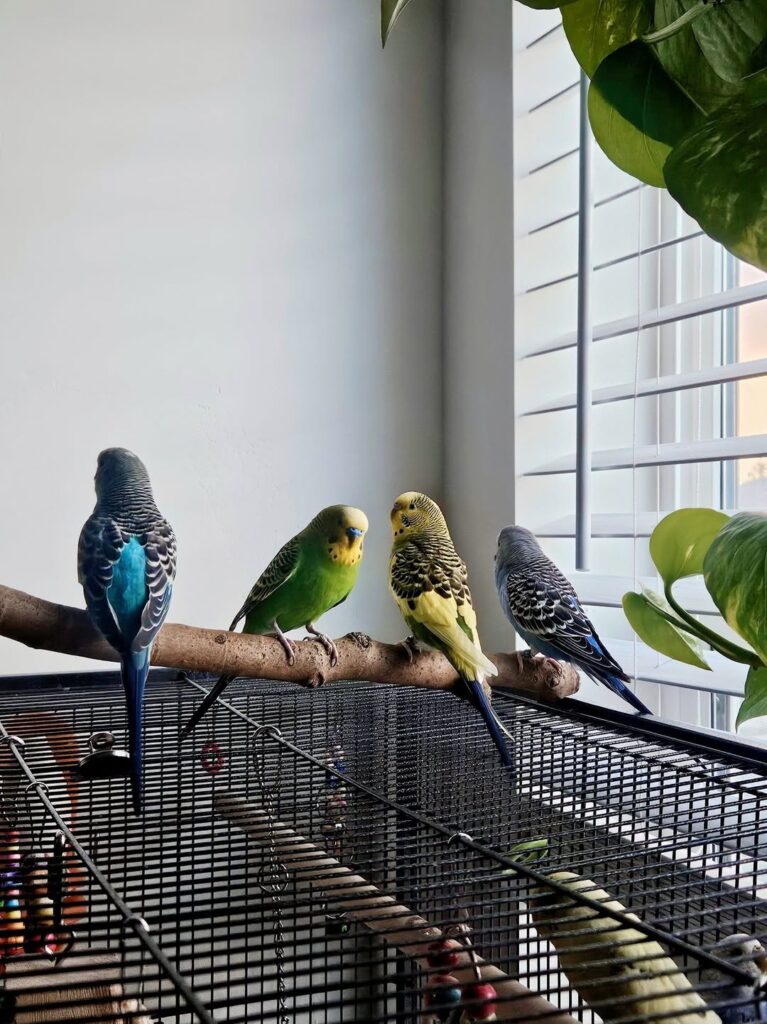
Two budgies kept together will always establish a hierarchy. One bird will be dominant. It will choose the best perch first. It will approach the food bowl first. It will displace the other bird from a favoured spot with a shoulder-barge or a brief chase. The subordinate bird will defer — move away, find another perch, wait its turn.
This is normal. It happens in every bonded pair and every small group. The dominant bird is not bullying the subordinate one. It is exercising the social structure that budgies have maintained for millions of years. The subordinate bird is not suffering — it is operating within a hierarchy it understands, and it will have its own food, water, and rest without persistent obstruction.
The line between normal hierarchy and actual bullying is not about whether one bird displaces another. It is about whether the subordinate bird can live adequately despite the displacement.
Normal hierarchy: the subordinate bird is displaced occasionally, finds another perch or food station, eats and drinks adequately, maintains its weight, and spends significant time in close proximity to the dominant bird — often grooming each other, sleeping together.
Bullying: the dominant bird consistently prevents the subordinate from eating, drinking, or resting adequately. The subordinate loses weight. It cannot access the food bowl without being chased off. It is always on the lowest perch, always in the worst position, always on alert. The dominant bird does not settle into normal companionship — it maintains persistent pressure on the other bird throughout the day.
The distinction is in the outcome for the subordinate bird, not in the existence of the hierarchy.
The Signs UK Owners Miss
These are the indicators of real bullying that consistently go unnoticed until the subordinate bird is already in difficulty.
Weight difference between the two birds. This is the big one, and it is almost never checked. An owner with two budgies typically looks at the food bowl — if it empties, they assume both birds are eating. But a dominant bird that controls the food bowl, eating freely while the subordinate only manages brief access, will maintain or gain weight while the subordinate slowly loses it. Weighing both birds on a kitchen scale once a week, and noting each weight separately, turns this invisible problem visible. A budgie losing two to three grams per week while its companion maintains weight is a budgie being prevented from eating adequately.
The subordinate bird always on the lowest perch. Budgies feel more secure at height. A subordinate bird that is consistently on the lowest perch — or on the cage floor — is a bird that has been displaced from every higher position and has nowhere left to go. This is not the same as a bird that sometimes chooses a lower perch. It is a bird that is always there, never higher, with no access to the positions it would choose freely.
Feather damage on the back and head. A subordinate bird being over-preened or feather-pulled by a dominant one develops patchy feather loss on the back of the head and along the back — areas it cannot reach itself to defend. This can look like normal moulting at first glance, particularly on the back. But moult is gradual and symmetrical. Feather damage from a cage mate is patchy, specifically located on areas the bird cannot see, and does not grow back evenly while the birds remain together.
The subordinate bird does not eat when you watch. Many owners observe their birds at mealtimes and see both birds near the food. What they are actually seeing is often the dominant bird eating and the subordinate bird waiting nearby, unable to access the bowl. When the owner stops watching, the pattern continues — the dominant bird finishes, moves away, and the subordinate gets its brief window. The owner sees both birds near the food and concludes both are eating. The weights tell a different story.
The subordinate bird is always alert, never fully relaxed. A bird that is under constant social pressure does not nap. It does not stretch. It does not groom at length. It remains semi-alert throughout the day, monitoring the dominant bird, ready to move when required. The contrast with a well-matched pair — both birds napping together, both stretching, both grooming each other in turn — is significant once you know to look for it.

Why Bullying Happens — The Real Causes
Understanding why the problem has developed helps identify what needs to change.
Introduction done incorrectly. The most common origin of persistent budgie aggression is two birds that were introduced by simply being placed in the same cage without a proper introduction process. Two unfamiliar adult budgies put directly into the same space are not a bonded pair — they are two strangers forced to share territory, and one of them will establish dominance through pressure rather than through the gradual familiarity that a correct introduction builds. A pair introduced this way may manage for weeks or months, but the hierarchy established through force rather than familiarity is less stable and more likely to become problematic.
Incompatible personalities. Not every two budgies will bond well. Some pairs simply do not suit each other — one bird is significantly more dominant than the other will tolerate, or the temperaments are mismatched in ways that produce persistent rather than occasional hierarchy pressure. This is not anyone’s fault. It is the reality of pairing animals with individual personalities.
Cage too small. A cage that does not provide the subordinate bird with adequate space to move away from the dominant one converts normal hierarchy pressure into inescapable harassment. I cover this in more detail in the next section.
Insufficient resources. One food bowl, one water station, one sleeping perch at the top of the cage. When resources are limited, competition for them is constant. The dominant bird does not need to be aggressive to prevent the subordinate from eating — it simply needs to be present at the food bowl consistently, which a dominant bird naturally is.
Hormonal changes. A pair that was compatible for months can become significantly more contentious during hormonal season. Increased testosterone in males and hormonal nesting behaviour in females can turn a tolerant relationship fractious. I cover this specifically below.

The Cage Is Almost Always Part of the Problem
I have said this about many budgie problems, and I will say it here too: when I see a bullying situation that has become serious, the cage is almost always contributing.
The subordinate bird in any pair needs somewhere to go when it wants to create distance from the dominant one. It needs perches at multiple heights and positions. It needs access to food and water that does not require passing through the dominant bird’s territory. It needs physical space to move, fly, and be somewhere other than immediately adjacent to a bird that is pressuring it.
In a cage that is 40 centimetres wide — which is smaller than I recommend for a single bird, let alone a pair — none of this is possible. The dominant bird is always within displacement range. There are no separate territories. There is no escape route. Normal hierarchy becomes relentless because there is nowhere to go.
The fix is not complicated: a larger cage with at least 80 centimetres of width for a pair, multiple perches at multiple heights, and two separate food and water stations positioned at different ends of the cage. These changes do not eliminate the hierarchy — they give the subordinate bird enough space to live within it adequately.
I have written about cage sizing in detail in our complete UK budgie cage guide. If you have a bullying situation and your cage is undersized, upgrading the cage is the first practical intervention — before separating the birds, before trying to manage the interaction directly.

Hormonal Aggression — When a Previously Fine Pair Falls Out
This is the version that surprises owners most. Two birds that have lived together without significant conflict for months — sometimes over a year — suddenly become contentious in spring. One is chasing the other more. The subordinate bird looks stressed. The dynamic has changed.
Seasonal hormonal changes affect both sexes. Males become more territorial and display-oriented. Females in breeding condition become more protective of space they have claimed as a nesting site. The combination, in a pair, can significantly increase the pressure on the subordinate bird from the dominant one.
In most cases, this is temporary. The hormonal phase passes — typically over four to eight weeks — and the pair’s previous equilibrium largely returns. But temporary does not mean harmless if the subordinate bird is losing weight or being prevented from eating during the phase. Management is needed regardless of the expected duration.
What helps during a hormonal phase: reduce light exposure to twelve hours per day, which helps dampen the hormonal response. Remove any enclosed spaces or dark corners that a female might adopt as a nest site — nesting behaviour intensifies aggression significantly. Add a second food station immediately if you have not already done so. Monitor both birds’ weights weekly throughout the phase.
If the aggression during a hormonal phase is severe enough that the subordinate bird cannot eat adequately even with two food stations — temporary separation is appropriate until the phase passes. Separate, watch for the hormonal behaviour to settle, then reintroduce carefully.
When Two Birds Simply Do Not Get On
Sometimes the problem is not the cage, not the resources, not the season. Sometimes two budgies are simply not compatible, and the pair that seemed fine in the first weeks has revealed, over months, that one bird will not tolerate the other adequately.
The signals that this is what you are dealing with, rather than a manageable hierarchy or a hormonal phase: the aggression is consistent year-round, not seasonal. Increasing the cage size and adding resources makes no difference to the pattern. The subordinate bird continues to lose weight or to show signs of chronic stress regardless of what changes are made to the environment.
This is the situation where separation is not a last resort — it is the appropriate, animal-welfare-driven choice. Two birds that are genuinely incompatible are not going to become compatible through the passage of time or through environmental management. Keeping them together because the idea of separating them feels like a failure is prioritising the owner’s feelings over the subordinate bird’s wellbeing.
Separation does not mean the separated birds live in isolation. Each bird needs a new companion — one introduced correctly, through the split-cage method, with appropriate time and patience. Come and talk to us before you make changes to the pairing. We can help you find appropriate companions and talk through the introduction process properly.
What to Do — From Immediate Changes to Long-Term Solutions
Here is the practical response, in order of what to do first.
Today: add a second food station and a second water source. Position them at different ends of the cage, at different heights. This single change immediately reduces resource competition and gives the subordinate bird access to food and water that does not require displacing the dominant bird. Do this before anything else.
This week: weigh both birds separately. If you do not have a kitchen scale, buy one. Weigh each bird, note the weights, and weigh again in seven days. If the subordinate bird has lost two grams or more, the food-access problem is real regardless of how the bowl looks.
Assess the cage size. Is it 80 centimetres wide or more? Does it have perches at multiple different heights and positions? Does the subordinate bird have somewhere to go that is not immediately within displacement range of the dominant one? If not, a larger cage is the next step.
Monitor for hormonal phase. Is it spring? Has the behaviour changed recently after a period of relative stability? Is a female showing nesting behaviour? If the aggression is seasonal, manage it through the phase with the steps above.
If weight loss is significant or the subordinate bird is showing clear signs of chronic stress: consider temporary separation. Place the two cages adjacent to each other so the birds can see and hear each other — this maintains the social bond without the physical harassment. Reintroduce when the dominant bird’s behaviour has settled.
If separation makes no long-term improvement and both birds consistently stress each other: permanent separate housing with new companions introduced correctly. This is the appropriate outcome for genuinely incompatible pairs.
When Separation Is the Right Answer
Owners resist this. They have two birds they are attached to, they bought them as a pair, and separating them feels like giving up or admitting something has gone wrong.
I understand that. I also understand that a subordinate bird living in a state of chronic stress, unable to eat adequately, always alert, always displaced — is not a bird whose welfare is being prioritised. The goal of keeping two budgies is for both birds to thrive. If that is not what is happening for one of them, the arrangement needs to change.
Separation is not failure. It is an honest acknowledgment that this particular pairing does not work for both animals, and a commitment to finding a situation that does. A separated bird introduced to an appropriate new companion, through a correct introduction, will almost always settle into a better relationship than the one that was causing it harm.
The practical approach: separate the cages but keep them in the same room so both birds maintain social awareness of each other. This reduces the stress of sudden isolation. Then source appropriate companions — ideally young birds under twelve weeks old, which adult budgies generally accept more readily than other adults — and introduce through the split-cage method with patience.
Come and see us before you make any changes to the pairing. We can advise on the right companion choice and walk you through the introduction process in a way that gives it the best chance of succeeding.
- “They’re best friends — they’re always together” — Two budgies that are always together is not always evidence of a happy pair. A subordinate bird that cannot create distance from the dominant one — because the cage is too small, or because the dominant bird will not permit it — may appear to always be close because it has no choice. Watch whether the closeness looks mutual and relaxed, or whether one bird always looks slightly alert and positioned slightly below the other.
- “The bowl empties every day so they must both be eating” — The most consistently wrong assumption in multi-bird households. One bird eating twice as much as it needs empties a bowl just as surely as two birds eating normally. Weigh both birds separately. The bowl tells you nothing on its own.
- “The chasing only lasts a few seconds — it’s fine” — Brief chasing as part of normal hierarchy is fine. Brief chasing repeated fifty times a day, around every food access attempt by the subordinate bird, is not fine even if each individual episode lasts only a second. Frequency matters as much as duration.
- “We’ve had them together for a year so they can’t be incompatible” — Incompatibility can emerge gradually. A pair that managed adequately in their first year may become problematic as hormonal cycles increase aggression, as the cage becomes too small for both birds as they mature, or simply as the dominant bird’s tolerance decreases. Duration of cohabitation does not protect against emerging incompatibility.
- “If we separate them now they’ll be lonely” — A bird in a state of chronic stress from living with an incompatible bird is not better off than a bird living briefly alone while a new companion is found and introduced. Loneliness is a short-term manageable situation. Chronic social stress is a sustained welfare problem. Source the new companion promptly, but do not keep two incompatible birds together as the alternative.
What I Tell Owners at the Counter
- Have you weighed both birds separately in the last two weeks?
This is always first. If not — weigh them today. The weight comparison between the two birds is the most reliable single indicator of whether the dominant bird’s behaviour is causing real harm to the subordinate one. Everything else is context. The weights are data. - How wide is the cage?
If the cage is under 80 centimetres wide, the size is contributing to the problem regardless of what the birds’ individual personalities are like. A larger cage does not solve incompatibility, but it does convert inescapable harassment into manageable hierarchy in many cases where the birds are not fundamentally incompatible. - How many food and water stations do you have?
One of each is insufficient. Two food stations at different positions, two water sources at different heights. This is the baseline for any multi-bird cage. If you have one of each, add a second today before you do anything else. - Has the behaviour changed recently, or has it been consistent since the beginning?
Recent change suggests hormonal phase or an environmental trigger. Consistent from the beginning suggests introduction done incorrectly, or fundamental incompatibility. These require different responses. - Does the subordinate bird look well — alert, full plumage, normal droppings?
A subordinate bird that is alert, eating adequately, maintaining weight, and engaging normally with its environment is managing within the hierarchy. A subordinate bird that is quiet, puffed, losing weight, or showing feather damage is not managing. The first situation needs monitoring. The second needs intervention.
If you are concerned about your birds’ dynamic and want a second opinion before you make any changes, come in. Bring both birds if you can, or describe the situation as specifically as possible. We are at Manor Garden Centre, Cheney Manor Industrial Estate, Swindon, SN2 2QJ — open every day. Or call us on 01793 512400.

Visit Us at Paradise Pets Swindon
We stock budgies year-round — all UK-bred, all handled from a young age. We sell bonded pairs where possible and are always happy to help match compatible companions for existing birds. If you are dealing with a bullying situation and want advice on whether to separate, or how to introduce a new companion, come and talk to us before you decide.
We also stock a full range of cockatiels, canaries, and finches, alongside guinea pigs, rabbits, and gerbils and hamsters.
⭐ Customer Reviews
Amazing Bird Selection
Had a lovley visit today,staff were very friendly and very helpful,such a great petshop,their selection of birds is incredible,really impressed,thank so much to the staff at Paradise Pets

Friendly Helpful Staff
I have been coming to this place for years and they have a great stock of food for all types of pets. Have a great selection of small mammals and a lot of birds. Staff are friendly and helpful.

Great Quality Hutch
Bought a guinea pigs hutch and run combo, very happy with the service, the hutch was put in my car for me without even asking for help. The wood quality is very good, the instructions easy to follow and we are extremely happy with the fully built hutch. A good size for 2 guinea pigs

Response from Paradise Pets | Wiltshire
Thank you Melanie Latus Nice to provide services to you.
Best Bird Shop Around
It’s the best pet shop in and around Swindon. They always have an amazing selection of birds and all you need to keep them happy. I keep birds myself and the guys there are happy to answer questions and really know their stuff. I have seen budgies etc. in chain pet shops in the area looking really unhealthy and ill – I wouldn’t go anywhere else than Paradise Pets for animals.

Highly Recommended Bird Shop
I could not praise this shop enough. Really helped my Grandson buy his first bird and he’s loving it. Travelled from Somerset and was welcomed with open arms.

Great Shop with Competitive Prices
Great shop with amazing selection for small animals, hamsters, mice ect, highly recommend!
Also has a great selection for dogs & cats too & very competitive prices! 💖

