


Neil has kept, bred, and sold budgies at Paradise Pets Swindon since 1988 — over 35 years of first-hand experience with these birds. A budgie falling off its perch is one of the more alarming things an owner can witness. Whether it requires emergency action or a simple environmental fix depends entirely on one question. This guide starts there.
The call comes in, or the owner appears at the counter, and the first thing they say is: “My budgie fell off its perch.”
Sometimes they have seen it happen. Sometimes they found the bird on the cage floor and worked out what had happened. Sometimes it has occurred more than once. The level of urgency in their voice varies — sometimes calm confusion, sometimes clear distress.
My first question is always the same.
Was it during the day or during the night?
That answer divides every budgie-falling-off-perch situation into two very different categories — with very different causes, very different implications, and very different responses. Getting into the right category quickly is what determines whether this is a five-minute conversation about night lights or a same-day vet visit.
Here is the full picture across both categories — and everything in between.
The First Question — Was It Day or Night?
This is not a throwaway question. The answer changes everything.
A fall that happened in the dark — in the middle of the night, or in the early hours before the household was awake — has a high probability of being a night fright. Night frights are common, manageable, and cause no lasting harm if addressed correctly. They are the most frequent cause of budgie falls I see, and they are almost entirely preventable.
A fall that happened during daylight hours — while the bird was active, while you were watching, or one you witnessed directly during normal waking hours — is a different situation. A bird that loses its grip and falls from a perch while awake and active is a bird whose body has failed to do something it should be able to do automatically. That failure has a cause. And that cause almost always needs investigation.
A fall that happened with accompanying signs — a twitching or convulsing bird, a bird that was disoriented after the fall, a bird that has fallen more than once in a short period — is urgent regardless of the time of day.
Read the section that applies to your situation. If you are not sure which one, read both.
Night Falls — Night Frights and What to Do About Them
Night frights are the most common cause of falls I see in budgies, and one of the most underknown hazards in pet bird keeping. Most owners have never heard of them until their bird has one.
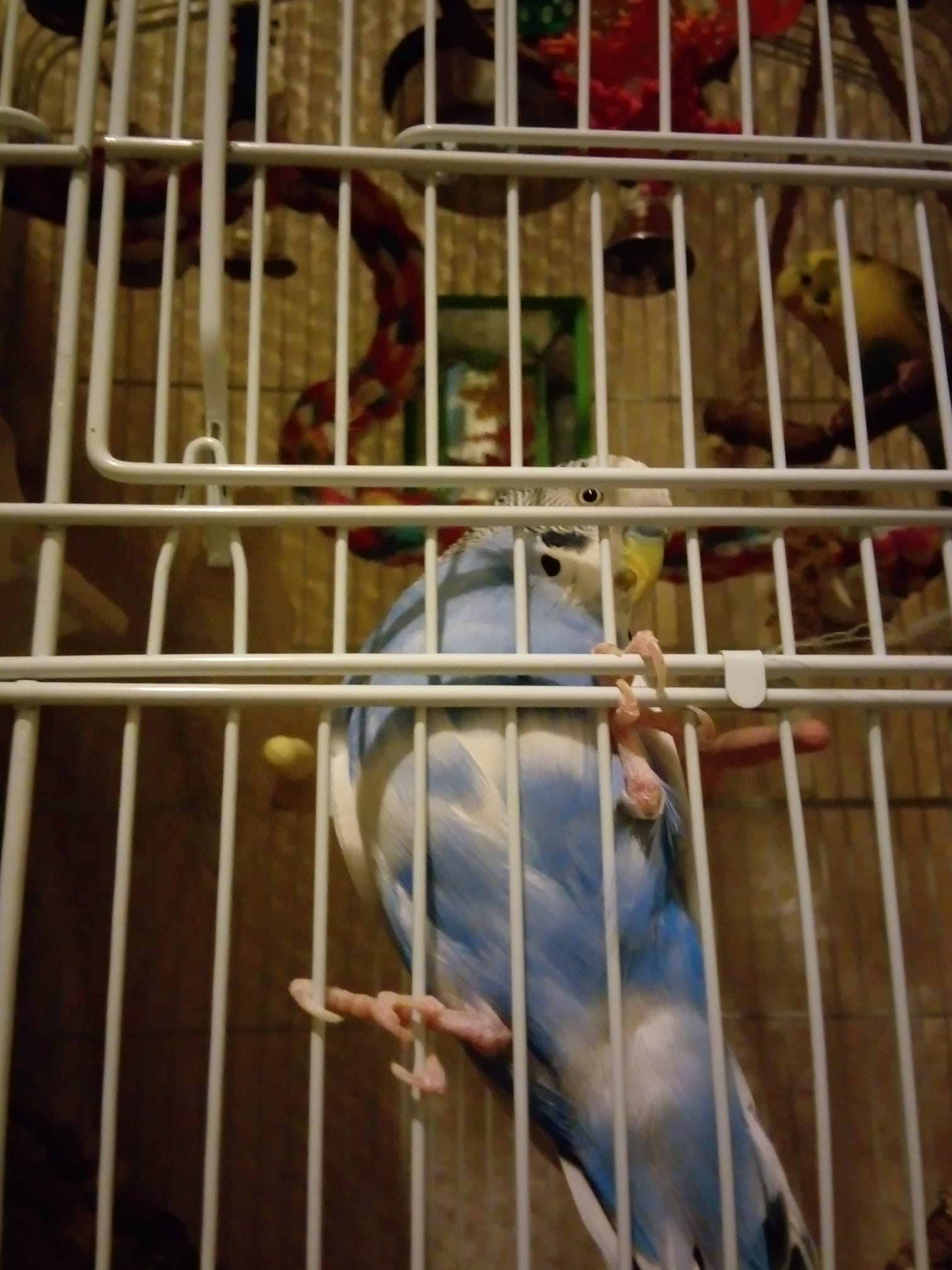
What happens: a budgie that is sleeping on its perch — eyes closed, sometimes in light REM sleep — is suddenly startled by a sound, a light, a shadow, or any sudden stimulus. It wakes in a panic. Without the visual information it uses to navigate during the day, the bird thrashes wildly — wings beating, feet scrabbling — and falls from the perch. In a small cage it may hit the bars, the floor, or the toys around it before settling. The noise is alarming and the aftermath can look distressing.
If you have found your bird on the cage floor in the morning, or been woken by a sudden crash from the bird room — this is almost certainly what happened.
The common triggers: a car alarm outside, a fox bark, headlights sweeping across the ceiling of the room, a door slamming elsewhere in the house. Any sudden sound or light source that the sleeping bird did not anticipate.
The fix is straightforward: a small night light near the cage. Not a bright light — a soft, low-level light that allows the bird to see its surroundings if startled awake. A bird that wakes in partial darkness and can see where it is will not thrash. A bird that wakes in total darkness and cannot immediately orient itself will. A small LED night light plugged into a socket near the cage eliminates most night frights almost entirely.
The other preventive measure: cage position. A cage positioned where it is exposed to exterior light sweeps — headlights from a road, lights from a neighbour’s security system — is more vulnerable than one positioned against a solid wall, away from windows. If night frights are recurring, assess whether the cage position is contributing.
Daytime Falls — Why This Is Always Worth Taking Seriously
A healthy budgie grips its perch automatically. Even during sleep, the flexor tendons in a bird’s leg lock the toes around the perch without conscious effort — it is a reflex, not something the bird has to maintain actively. A sleeping bird does not fall because the grip does not require wakefulness to maintain.
When a bird falls from its perch during the day — while it is active, while it was apparently functioning normally — something has disrupted that system. The disruption always has a cause.
I want to be clear about this because the instinct of many owners, when they see something alarming happen once, is to watch and wait to see if it happens again. With daytime falls, waiting is not the right approach. One fall during waking hours, in an otherwise active bird, is enough reason to assess what caused it — and if you cannot identify an obvious environmental cause immediately, it is enough reason to call a vet.
The causes of daytime falls range from very treatable to very serious. The only way to know which category you are in is to assess the bird promptly. Small birds decline quickly. The window for effective intervention is often measured in hours, not days.
Illness and Weakness — The Most Common Daytime Cause
A bird that is significantly unwell — fighting an infection, managing organ disease, in the late stages of an illness it has been hiding — may lose its ability to maintain its grip as its energy reserves deplete. Falling from a perch during the day is often the moment when a bird that has been concealing illness can no longer sustain the concealment.
This is why daytime falls are serious. The fall is not the beginning of the problem. It is the point at which the problem has progressed to the stage where the bird’s body can no longer maintain normal function. By the time a bird falls off its perch, the illness behind it has usually been present for some time.
What to look for alongside the fall: is the bird puffed up? Is it sitting on the floor or on a low perch rather than its usual high sleeping spot? Has its appetite changed in the last few days? Have its droppings been different? Is it quieter than usual? Does it seem less responsive to your voice or presence than normal?
These are the earlier signs that may have been present before the fall but not noticed. They are worth thinking back over carefully.
A bird that has fallen during the day and is showing any of these additional signs needs a vet today. Not tomorrow. Not in a few days. Today.
Seizures and Neurological Events — The One That Looks Most Alarming
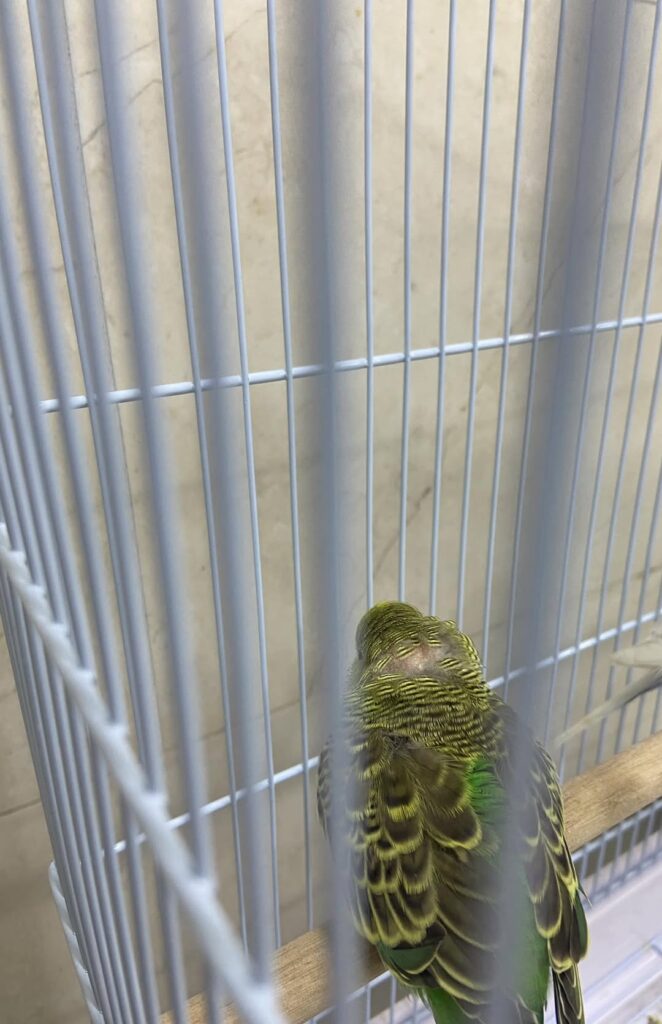
Some budgie falls involve more than a loss of grip. The bird may twitch or convulse as it falls, or continue to convulse on the cage floor after landing. It may appear disoriented after the fall — unable to right itself, moving in circles, not responding normally to its environment. It may seem conscious but completely uncoordinated.
These are neurological events — seizures, in most practical terms — and they are among the more frightening things a budgie owner can witness.
The causes of seizures in budgies are several. Toxin exposure — particularly PTFE fumes from non-stick cookware — can cause neurological collapse rapidly. Vitamin deficiency, particularly B vitamins, can cause seizure activity. Infections that have reached the central nervous system can produce neurological symptoms. Head trauma from a fall, a collision with a window, or a night fright that caused the bird to hit the cage bars can cause neurological signs. And in some cases, epilepsy — idiopathic seizure disorder not linked to any other cause — does occur in budgies.
What to do if you witness a seizure: do not try to hold the bird still. Keep the cage environment dark and quiet. Remove other cage items that could cause injury if the bird convulses against them. Keep the bird warm. And call a vet immediately — describe what you saw in as much detail as possible, including any possible toxin exposures in the hours before the event.
If PTFE or any other fume exposure is a possibility — cooking was happening, cleaning products were used, anything was burned or overheated — get the bird into fresh air immediately and call the vet on the way.
Foot Problems — When the Grip Itself Is the Issue
Sometimes the fall is not about the bird’s general health. It is specifically about the feet.
Bumblefoot — pressure sores on the pads of the foot caused by uniform-diameter perches and insufficient perch variety — can become severe enough to make gripping painful. A bird with painful feet will avoid gripping firmly, which compromises the security of its perch contact and increases the risk of falls.
Overgrown nails can catch between bars or on the surface of a perch, causing the bird to become momentarily caught and then lurch when it pulls free — sometimes resulting in a fall. Check the nails: in a healthy bird with appropriate perching, they should not grow long enough to curl around beneath the perch or catch on surfaces. If they have, a vet can trim them safely.
Arthritis, which can develop in older birds, reduces the joint flexibility in the foot and leg and makes maintaining perch grip more difficult — particularly in cold conditions. An older bird that falls more frequently in winter than in summer may have arthritic changes that are exacerbated by cold stiffness.
For foot-related falls: switch to natural wood perches of varying diameter, add a soft rope perch for a surface that requires less precise grip, and ensure the cage is warm enough — particularly for older birds. If bumblefoot is suspected, a vet check is appropriate to assess the severity and discuss treatment.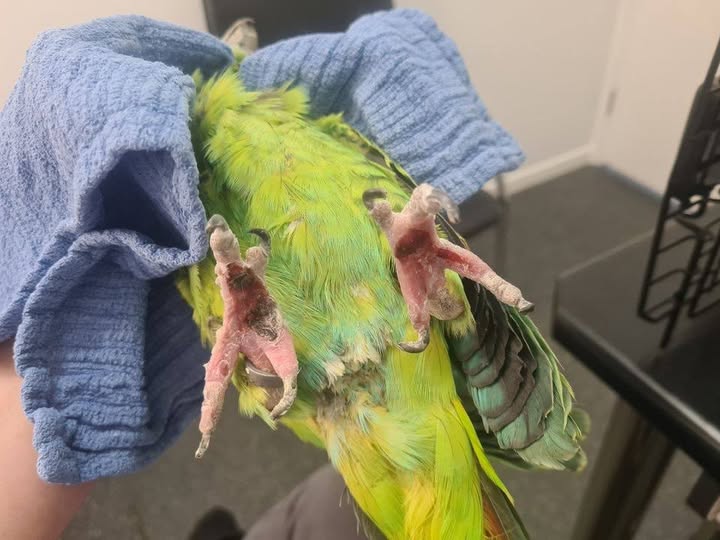
Toxin Exposure — When Speed Is Everything
I want to say this separately from the seizure section because toxin exposure — particularly PTFE from non-stick cookware — moves fast enough that it needs its own response protocol.
A bird that has been exposed to PTFE fumes may fall from its perch as part of a rapid deterioration. The sequence is often: apparently normal bird, then sudden disorientation or weakness, then falling, then death — within minutes in severe cases. There may be no warning, or the warning may be so brief it is not registered.
If cooking has happened in or near the bird’s location within the last few hours, and the bird has suddenly fallen from its perch and appears disoriented, weak, or is showing any respiratory distress — get the bird into fresh air immediately. Open windows, move the cage away from the kitchen, and call a vet while doing this.
If the bird is already on the cage floor and not responding normally: warmth, fresh air, and a vet call all simultaneously. Do not wait.
This is also a reminder, if you needed one: non-stick cookware and budgies in the same household is a risk that needs to be managed with permanent vigilance, not just caution. Stainless steel or cast iron for cooking. The cage positioned well away from the kitchen. I have covered this in detail in the article on the biggest mistake UK bird owners make.
Old Age and Weakening Grip — Natural Decline
Older budgies — those from about five or six years onwards — may begin to fall from their perches more occasionally as age reduces their physical capability. Muscle weakness, joint changes, and general physiological decline mean that the grip which was automatic in a young bird requires more effort in an old one.
A bird that is clearly elderly and falls occasionally — once every week or two, at night or when it shifts position in sleep — and is otherwise eating, vocalising, and maintaining its normal behaviour may simply be showing normal age-related change. Not every fall in an old bird is a health emergency.
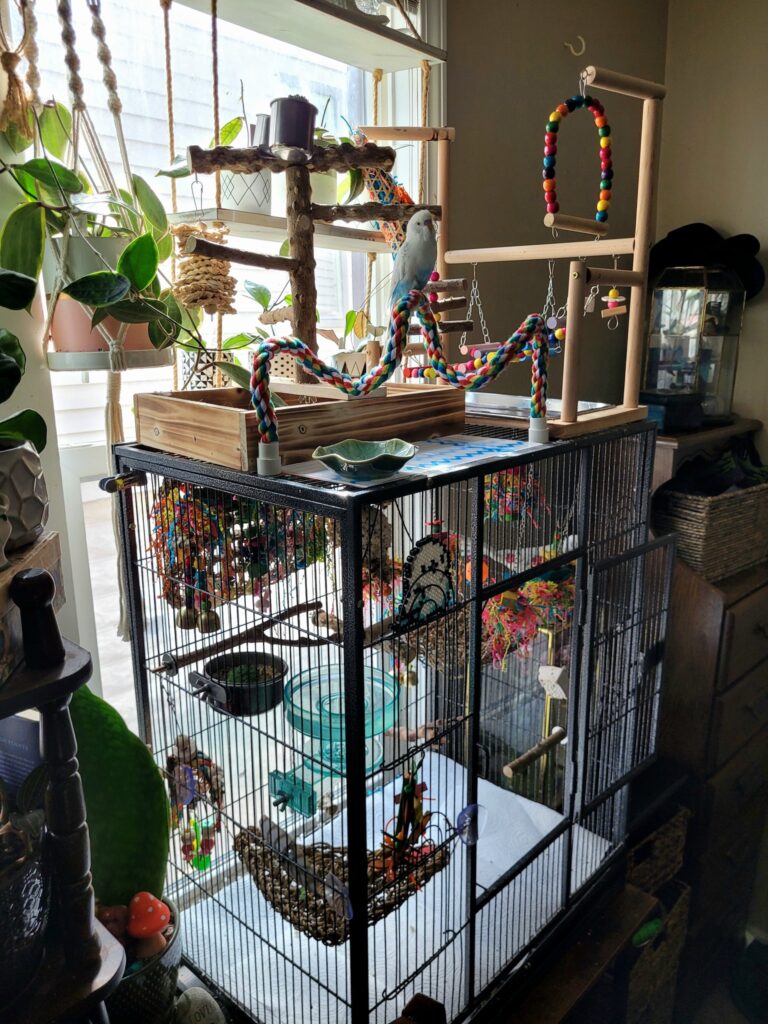
What to do: add a wider, softer perch lower in the cage so the bird has an easier surface to grip and a shorter distance to fall if it loses its hold. Add a soft landing area at the cage floor — some clean, soft substrate or a padded mat beneath the usual sleeping position. Ensure the cage is warm. Maintain the normal diet and routine.
Watch for changes beyond the falls themselves. A bird that is falling AND losing weight, or falling AND eating less, or falling AND becoming significantly quieter — that needs a vet regardless of age. Old age is not a diagnosis for decline. It is a context.
After a Fall — What to Do Right Now
Regardless of what caused the fall, here is what to do immediately when you find your bird on the cage floor or witness a fall.
Keep the bird warm. A bird that has fallen — particularly one that is on the cage floor — is often in a state of physiological stress. Warmth is critical. Place a heat lamp at one end of the cage, or put a warm water bottle wrapped in a towel against one side. Keep the other side cooler so the bird can move away from the heat if needed. Temperature around 30 to 32 degrees Celsius is appropriate for a bird in distress. Normal cage temperature is around 20 to 22 degrees — an unwell bird needs more.
Lower the perches or add floor-level food and water. A bird that has fallen and is struggling to regain a perch needs food and water accessible without having to climb. Place a small bowl of seed and water on the cage floor immediately. Do not assume the bird will make it back to the normal bowl.
Minimise disturbance. Cover the cage partially, reduce noise and light, keep other pets away. A stressed, post-fall bird needs calm more than it needs investigation from concerned owners.
Assess what you can see. Is the bird breathing normally? Is it upright? Can it grip when it reaches a surface? Is it alert and responsive? Can it move all its limbs? These observations are what you tell the vet. Note them down if you can.
Call a vet. For any daytime fall. For any fall with accompanying symptoms. For any fall in a bird that seems unable to recover its normal posture or grip within a few minutes. Call ahead — describe what you saw, when, and any other symptoms. This helps the vet triage how urgently you need to be seen.
- “It only happened once so I’ll wait and see” — For night falls in an otherwise healthy bird, watching and waiting while adding a night light is a reasonable response. For daytime falls, or any fall with additional symptoms, waiting is the wrong decision. One daytime fall is enough to prompt same-day assessment. The bird has one small body and very limited reserves — time matters.
- “It fell but it seemed fine after — it must have just slipped” — Birds that fall during the day do not slip in the way a human might slip on a wet floor. Their feet grip automatically and do not release without a cause. A bird that “seemed fine” after a daytime fall may have recovered enough composure to appear normal while still having the underlying issue that caused the fall. Appearing fine is not the same as being fine.
- “I put a towel on the floor so it has a softer landing — that’s enough” — The soft landing is helpful and worth doing. It is not the same as addressing the cause. The towel does not tell you why the bird fell or prevent it happening again. It reduces the injury risk from the fall itself. That is useful but not sufficient.
- “She’s old — I expect she’ll fall sometimes at her age” — Occasional falls in a genuinely elderly bird at night may be within the range of normal ageing. Regular falls, or falls during the day, or falls with any other health changes — those are symptoms in an old bird exactly as they are in a young one. Old age does not change what falls mean during the day.
- “The vet won’t be able to do anything for a small bird” — This reflects the experience of seeing a vet without bird experience. A vet with avian experience can do a great deal — diagnose illness, treat infections, assess neurological status, advise on supportive care. General practice vets vary in their confidence with birds. Seek out one who sees birds regularly.
When to See a Vet — The Honest Summary
- Bird found on floor in the morning, otherwise completely normal, night was disrupted by a noise or light event.
Night fright. Add a small night light near the cage. Review cage position if it is exposed to exterior light sweeps. Monitor. No vet needed unless falls continue despite the night light, or if the bird shows any other symptoms. - Bird fell during the day while active, but seems recovered and is eating and behaving normally.
Still warrants a call to a vet today to describe what happened and get their assessment. A daytime fall in an otherwise normal bird may have a minor cause — but identifying it is important. Do not assume everything is fine because the bird recovered quickly. - Bird fell during the day and is now on the cage floor, puffed up, or not eating normally.
Vet today. Keep the bird warm in the interim. Call ahead and describe the fall, when it happened, and current symptoms. This is not a wait-until-tomorrow situation. - Bird fell with twitching, convulsing, or seizure activity, or is disoriented after the fall.
Vet today, urgently. Call ahead. Describe exactly what you saw — duration of the seizure if there was one, any possible toxin or fume exposure, and the bird’s current state. If PTFE or chemical exposure is possible, fresh air first, vet call second. - Bird has fallen more than once in a short period — same day or within a few days.
Vet today regardless of the time of day each fall occurred. Repeated falls are a pattern, and patterns have causes that need identifying. - Elderly bird falling occasionally at night, otherwise eating, vocalising, and maintaining normal daytime behaviour.
Add a night light, add a lower wide perch, add soft landing at floor level, ensure warmth. Monitor closely. Vet check is appropriate to confirm there is no treatable cause being attributed to age. If the falls increase in frequency or if any other symptoms appear, vet promptly.
What I Tell Owners at the Counter
When someone comes in about a budgie that has fallen off its perch, the first five minutes of the conversation are almost always enough to identify whether we are dealing with night frights or something more serious.
The questions I ask: when did it happen — day or night? Was there any noise or light disturbance before it? Has the bird seemed normal otherwise in the days before the fall? Is it eating? Is it on the floor now or has it regained its perch? Did you see the fall happen, and if so, did the bird twitch or seem disoriented?
The answers create a picture quickly. A night fall after an obvious disturbance in a bird that is otherwise completely normal is almost certainly a night fright. A daytime fall in a bird that has been slightly quieter for the last few days is almost certainly illness. A fall with twitching is a vet-today situation regardless of any other factors.
The thing I always emphasise: do not assume a fall is minor because the bird seems to have recovered. Small birds have extraordinary resilience in the short term — they can appear almost normal while managing something significant. The fall is the signal. What matters is what caused it.
Come in and talk to us if you are not sure what you are looking at. We are at Manor Garden Centre, Cheney Manor Industrial Estate, Swindon, SN2 2QJ — open every day. Or call us on 01793 512400. If the situation seems urgent, call a vet directly — but if you want a second opinion on what you are seeing before you decide, we are here.
Visit Us at Paradise Pets Swindon
We stock budgies year-round — all UK-bred, all handled from a young age. If your budgie has fallen from its perch and you are not sure what to do next, call us or come in. We have seen this situation many times and we are always happy to help owners assess what they are dealing with.
We also stock a full range of cockatiels, canaries, and finches, alongside guinea pigs, rabbits, and gerbils and hamsters.
⭐ Customer Reviews
Amazing Bird Selection
Had a lovley visit today,staff were very friendly and very helpful,such a great petshop,their selection of birds is incredible,really impressed,thank so much to the staff at Paradise Pets

Friendly Helpful Staff
I have been coming to this place for years and they have a great stock of food for all types of pets. Have a great selection of small mammals and a lot of birds. Staff are friendly and helpful.

Great Quality Hutch
Bought a guinea pigs hutch and run combo, very happy with the service, the hutch was put in my car for me without even asking for help. The wood quality is very good, the instructions easy to follow and we are extremely happy with the fully built hutch. A good size for 2 guinea pigs

Response from Paradise Pets | Wiltshire
Thank you Melanie Latus Nice to provide services to you.
Best Bird Shop Around
It’s the best pet shop in and around Swindon. They always have an amazing selection of birds and all you need to keep them happy. I keep birds myself and the guys there are happy to answer questions and really know their stuff. I have seen budgies etc. in chain pet shops in the area looking really unhealthy and ill – I wouldn’t go anywhere else than Paradise Pets for animals.

Highly Recommended Bird Shop
I could not praise this shop enough. Really helped my Grandson buy his first bird and he’s loving it. Travelled from Somerset and was welcomed with open arms.

Great Shop with Competitive Prices
Great shop with amazing selection for small animals, hamsters, mice ect, highly recommend!
Also has a great selection for dogs & cats too & very competitive prices! 💖

