
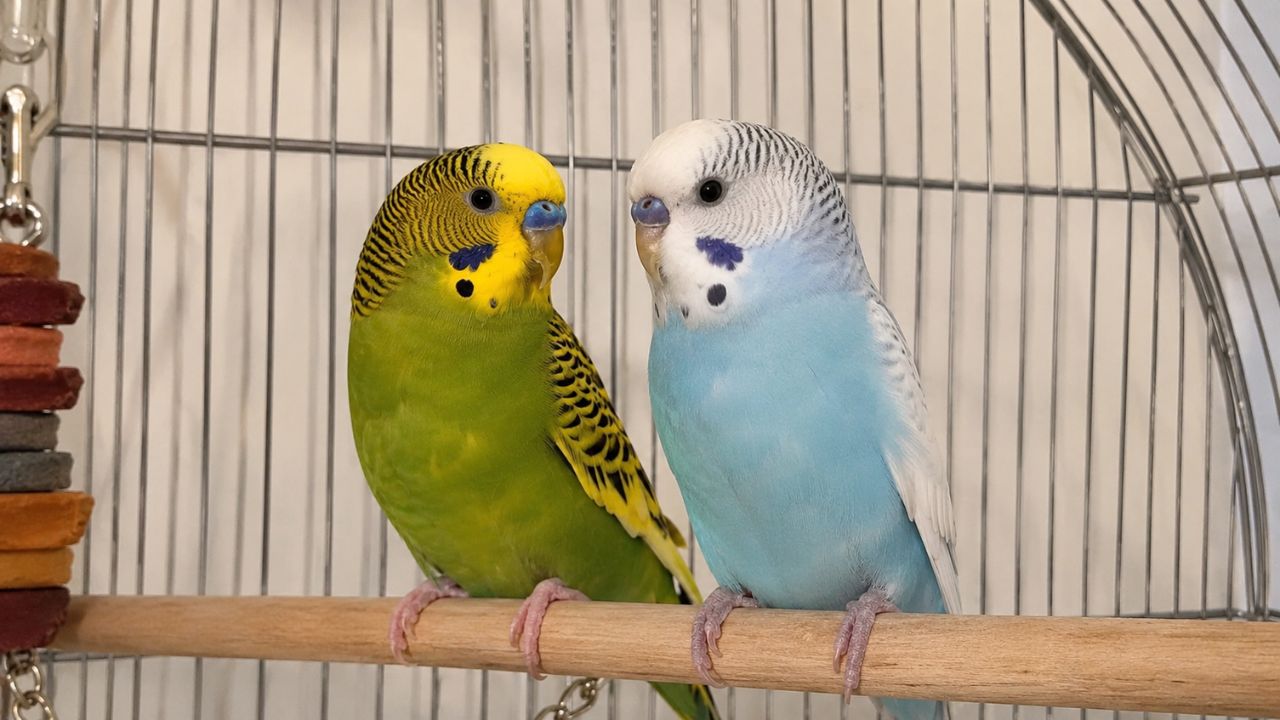

Neil has kept, bred, and sold budgies at Paradise Pets Swindon since 1988 — over 35 years of first-hand experience with these birds. He sells more budgies than any other species, and the question of which type to buy is one he answers multiple times a week. This guide is everything he tells first-time buyers before they choose.
Someone comes in, usually with a child or two in tow, and asks: “Which breed of budgie is best for beginners?”
It is a sensible question. The problem is that the word “breed” does not quite apply to budgies in the way it applies to dogs or cats — and giving someone the wrong answer, or an oversimplified one, sends them home with a bird that does not match what they were hoping for.
So before I answer, I explain what I mean. And then I give them the real answer, which is not quite what most online guides say.
This is the version of that conversation I have been having for thirty-five years.
First, Let’s Be Honest About the Word “Breed”
Budgies — budgerigars — are a single species: Melopsittacus undulatus. Originally from Australia. One species, one bird.
What exists within that species is a range of varieties — different sizes, different feather types, different colour mutations. Some of these distinctions matter practically for beginners. Most of them do not. The budgie industry has a habit of presenting colour varieties as though they are meaningfully different birds, and beginners sometimes go home having chosen a bird based on colour when the things that actually determine how their experience goes — age, handling, sex, individual personality — were never discussed.
In the UK, the distinction that matters most for beginners is between two broad types: the standard budgie, which is the bird you see in most pet shops, and the English budgie, which is larger, calmer, and less commonly stocked. Everything beyond that — colour, feather type, pattern — is aesthetics. It does not change the bird’s temperament, trainability, or suitability for a first-time owner.
Let me go through both types properly, and then cover the factors that actually determine how your first budgie experience goes.
The Standard Budgie — The Bird Most People Start With
The standard budgie — sometimes called the Australian budgie or the common budgie — is the bird you grew up seeing in pet shops. Small, lively, quick-moving, vocal. Around 18 centimetres from beak to tail. The wild-type colouring is green and yellow, though decades of selective breeding have produced hundreds of colour mutations in UK captive populations.
These are active, intelligent birds. A well-tamed standard budgie is a genuinely rewarding pet — curious, interactive, capable of learning words and tricks, and entertaining to watch for hours. I have sold thousands of them over the years, and the ones that go to households that understand what they are buying usually do very well.
The key word is “well-tamed.” A standard budgie that has not been handled from a young age is a quick, flighty bird that will not sit on your finger, will not talk, and will spend most of its time at the back of the cage trying to avoid you. The bird is not the problem in those cases. The expectations were set wrong, or the bird was bought too old, or the taming process was not followed.
If you are buying a standard budgie as a first bird, buy young — under twelve weeks old, ideally. Get one that has been handled regularly by the seller. And budget the time to tame it properly in the first few weeks. Do that, and a standard budgie will give you everything you were hoping for.
The English Budgie — Bigger, Calmer, and Worth Knowing About
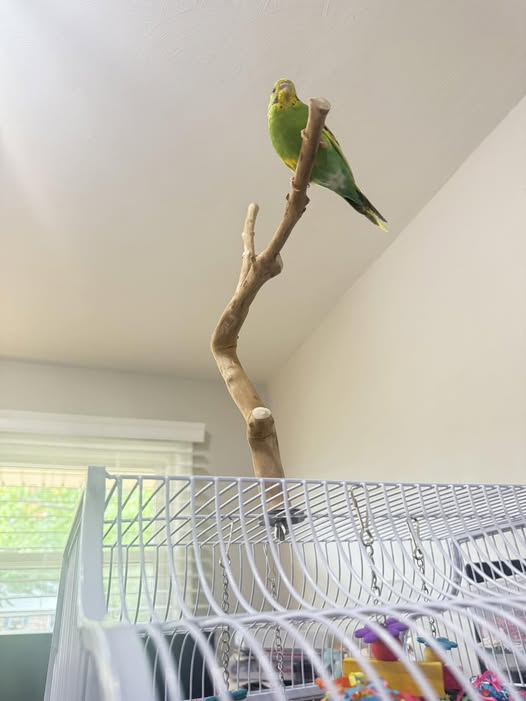
The English budgie — also called the exhibition budgie or the show budgie — is a different experience. Same species, very different bird.
English budgies are substantially larger than standard budgies — sometimes nearly twice the size, with a rounder, fuller head, a more upright posture, and longer feathers around the face and crown. They were developed in the UK through selective breeding for the show circuit, and the result is an animal that looks and behaves quite differently from its Australian ancestor.
The temperament difference is significant, and it is what I emphasise most when someone is choosing between the two. English budgies are calmer. They are less flighty, less quick, less reactive to movement and noise. They sit more steadily on a perch. They are generally easier to handle for children and for adults who are new to birds. If someone comes in and says they want a budgie they can actually hold and interact with from early on, without months of painstaking taming work, my first suggestion is usually an English budgie.
They are also often better talkers. Not in every case — individual personality varies — but the calmer disposition of an English budgie seems to translate to a bird that is more relaxed around people and more inclined to vocalise in their presence. Some of the most impressive talking birds I have seen over the years have been English budgies.
The downsides are real. English budgies are not as commonly stocked as standard budgies — we have them at Paradise Pets, but many shops do not. They are more expensive. And they can be more prone to certain health issues associated with their distinctive head and feather shape. These are manageable considerations, not disqualifiers — but worth knowing before you decide.
If you are a first-time buyer who wants a genuinely handleable bird without an extended taming period, an English budgie is worth serious consideration.
What About Colour? Does It Actually Matter?
I am asked this constantly, particularly by children who have decided they want a blue one, or a white one, or a yellow one.
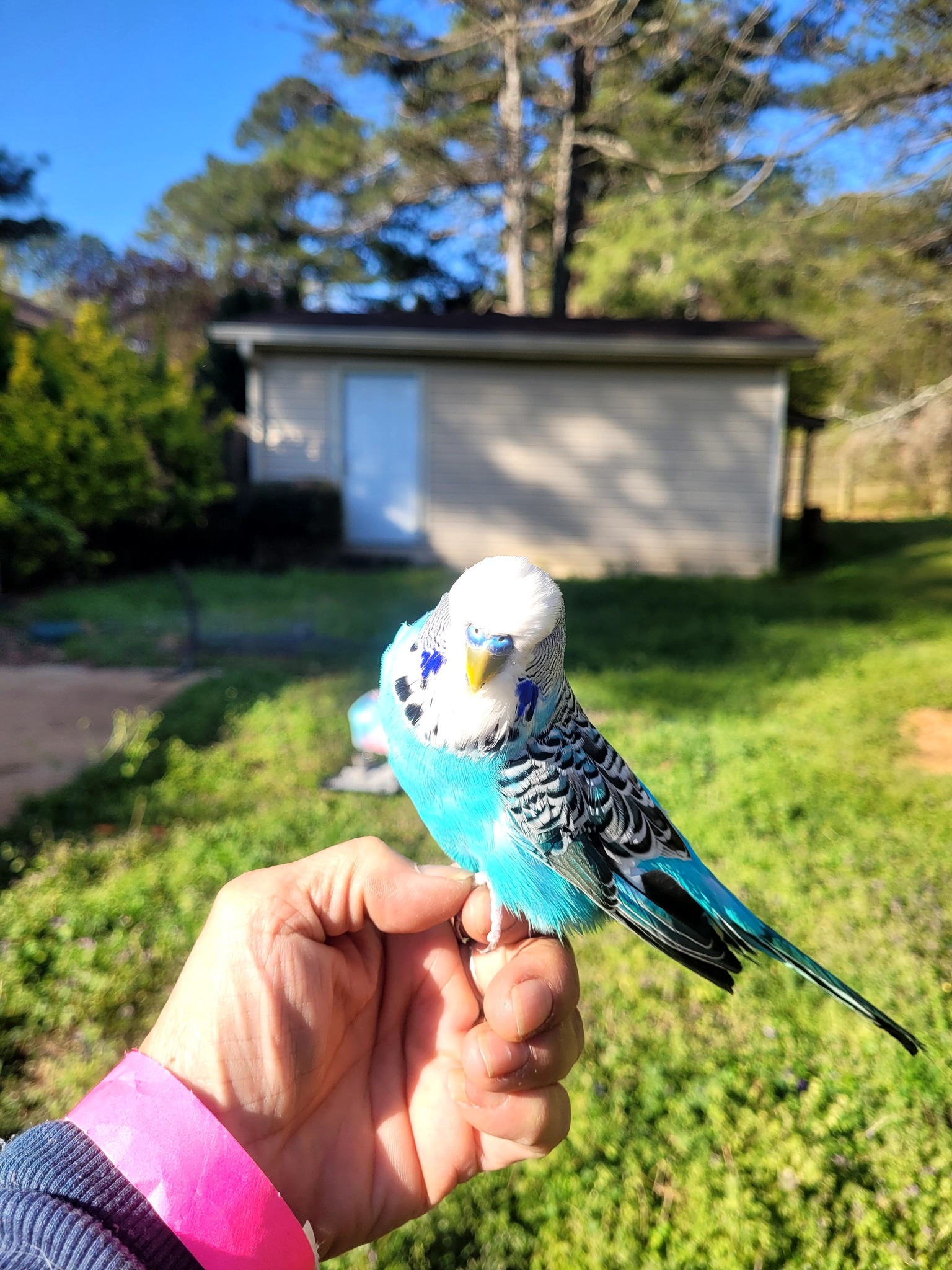
The honest answer is: colour does not affect temperament, trainability, or suitability for beginners. Not at all. A blue budgie and a green budgie are the same bird in different clothes. The colour tells you nothing about how handleable it will be, whether it will talk, or how long it will live.
What colour does affect is how easy it is to monitor your bird’s health. A pale or white budgie shows certain signs of illness — changes in feather condition, discolouration around the cere — more visibly than a darker bird. This is a minor practical consideration, not a reason to avoid pale-coloured birds.
There are a few feather mutations worth knowing about, because they do have practical implications.
Lutinos — all-yellow birds with red eyes — can occasionally have vision impairment associated with the mutation. It is not universal, but it is worth being aware of. A lutino that bumps into things, or seems hesitant to fly to lower perches, may have reduced vision.
Spangles and clearwings are visual mutations that do not affect health or temperament.
Feather duster budgies — a mutation that produces abnormally long, curly feathers — are birds I do not sell, and I would advise strongly against buying one. They have serious health problems associated with the mutation and rarely live more than a year. If you see one, do not be tempted by the novelty.
Beyond those caveats, choose the colour you like. The decision that matters far more is the bird’s age and how it has been handled.
Hand-Reared or Aviary-Raised — This Is the Decision That Actually Changes Everything
More than type, more than colour, more than almost anything else — whether your budgie has been handled from a young age is the single factor that most determines how your first experience as a budgie owner goes.
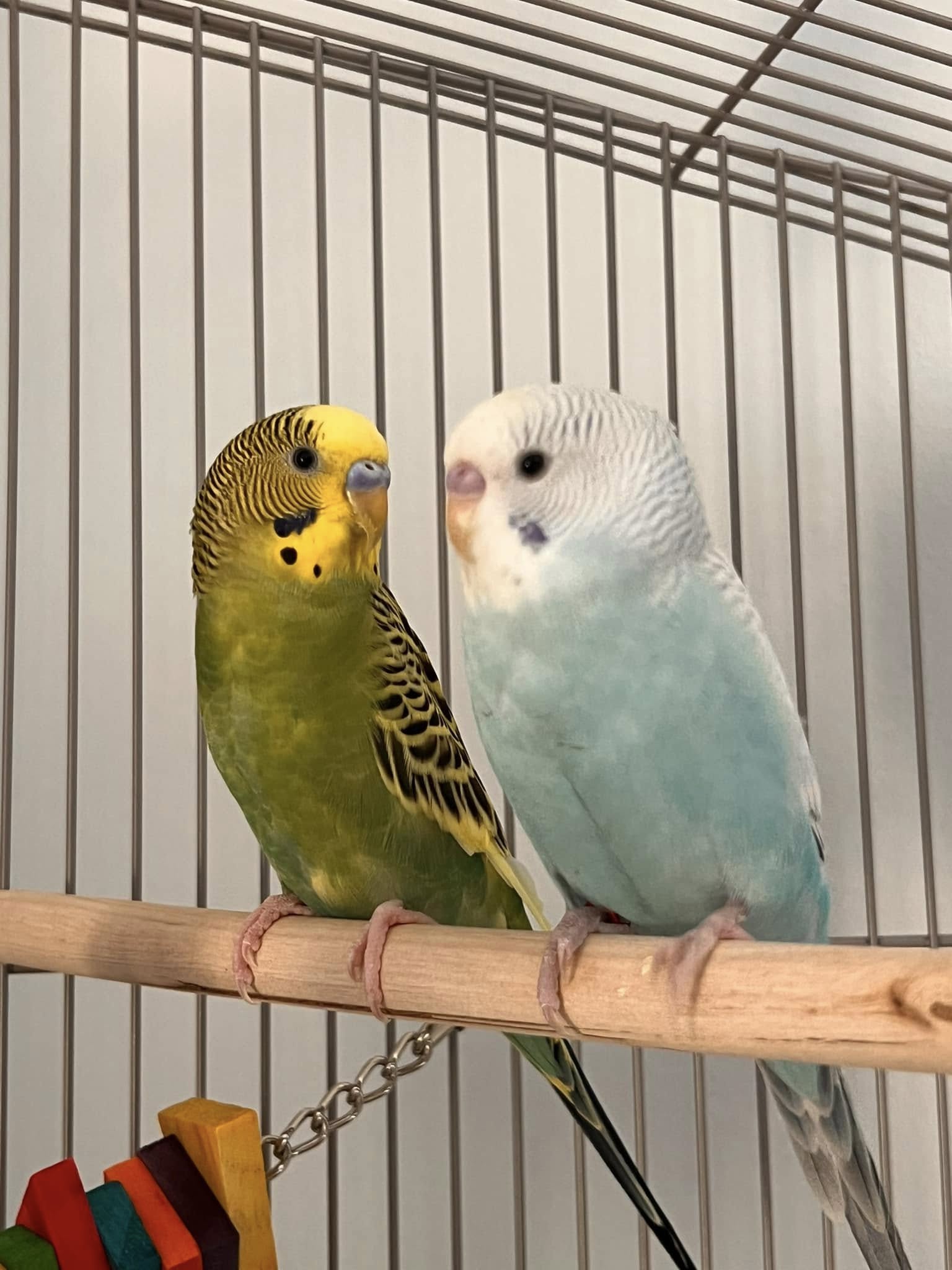
A hand-reared budgie, or one that has been handled daily by its breeder or seller from the earliest weeks of its life, arrives in your home already comfortable with human contact. It will step onto a finger more readily. It will vocalise in your presence rather than retreat from it. The taming process, which with an unhandled bird can take months of patient daily work, is either abbreviated or largely already done.
An aviary-raised budgie that has had little human contact from a young age is a different situation. It is not untrainable — budgies are intelligent birds and most will come around with consistent, patient handling over time. But it takes longer, it requires more knowledge, and it is more likely to lead to disappointment for a first-time owner who was expecting a bird that steps up and talks within a few weeks.
At Paradise Pets, every budgie we sell has been handled regularly from a young age. I will not sell a bird that has not been. But if you are buying from elsewhere, ask directly: has this bird been handled? By whom, and how often? If the seller cannot answer clearly, that tells you something.
Male or Female — Which Is Better for a First Budgie?
This is a question I answer the same way every time: for most first-time owners, a male is the better choice.
Male budgies are generally easier to tame. They are typically more sociable, more curious, and more inclined to engage with people. They are also significantly more likely to learn to mimic words and sounds — not guaranteed, but the odds are substantially better with a male than a female. Most of the famous talking budgies you hear about are males.
Female budgies are not worse pets. They have their own qualities — often slightly more independent, sometimes more spirited in their behaviour. But for a first-time owner whose primary goals are a bird that tames well and potentially talks, a male is the more reliable choice.
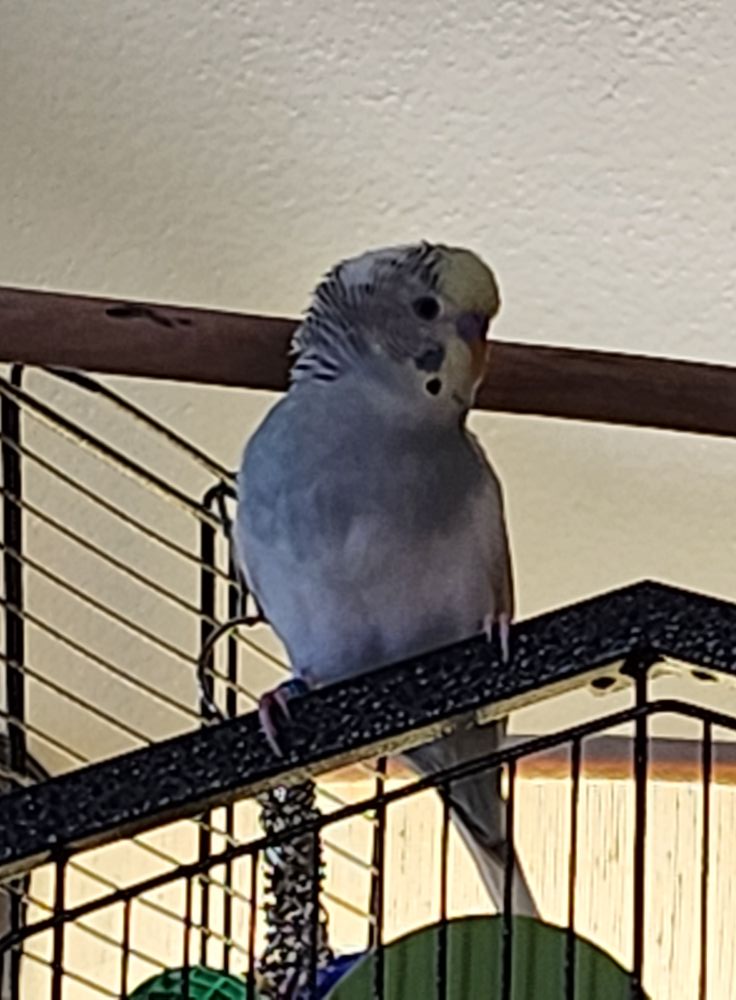
You can tell the sex of a budgie by the colour of the cere — the fleshy area above the beak. In adult budgies, males have a blue or purplish-blue cere. Females have a brown, white, or tan cere. In very young birds under twelve weeks, both sexes have a pinkish cere and sex can be harder to determine — in which case, ask the seller.
- “We want a talking breed — which one talks the most?” — There is no talking breed. Talking ability in budgies depends on sex (males are more likely), age at which taming began, how much time the owner spends speaking to the bird, and individual personality. No colour or variety guarantees talking.
- “The rarer the colour, the better the bird” — Rarity in budgie colour mutations reflects breeding programme choices, not quality. An unusual colour does not mean a healthier, more intelligent, or more tameable bird. In some cases — such as the feather duster mutation — unusual appearance signals a bird with serious health problems.
- “English budgies are lazy — standard ones are more lively” — Calmer and lazier are not the same thing. English budgies are less frenetic, but they are still active, curious, playful birds. For many households — particularly those with young children or first-time owners — a calmer disposition is exactly what makes the experience positive.
- “Two budgies are easier than one” — Two budgies will bond with each other before they bond with you. A single budgie, given enough time and interaction, tames far more readily because it looks to its owner for company. If you want a bird that interacts with people, start with one. If you want birds that entertain each other, two is fine — but adjust your expectations about handling accordingly.
- “Budgies are starter pets — easy, no-commitment” — A well-kept budgie lives seven to ten years. It needs daily interaction, a properly sized cage, a varied diet, and an owner who will notice when something is wrong. I have written about how long budgies live in detail — read it before you buy, not after.
- “Green is the original wild colour so it must be hardier” — The green colouring of wild budgerigars is the result of a combination of pigments. In UK captive budgies, green birds are common but not meaningfully hardier than blue or yellow ones. Hardiness comes from healthy breeding lines, not colour.
What I Actually Tell Beginners at the Counter
When a first-time buyer comes in, I spend a few minutes asking questions before I show them the birds. Not to complicate things — to make sure the bird they go home with is the right one for their household.
- What are you hoping to get from the bird?
If the answer is “a bird that talks and sits on my shoulder,” I lean toward a young male English budgie, well-handled. If the answer is “something interesting to watch that will be active and entertaining,” a pair of standard budgies may be the better fit. The goal shapes the choice. - How much time does the household realistically spend at home?
Budgies need daily interaction. A single budgie in a house where everyone is out all day is going to struggle. Either a pair — accepting that they will be more bonded to each other than to you — or a realistic commitment to daily one-to-one time. There is no right or wrong, but there is an honest answer. - How old are the children who will be handling the bird?
Young children and budgies can work well, but it requires proper supervision and some patience. A calm English budgie is usually a better starting point for younger children than a quick, flighty standard budgie. I talk through what appropriate handling looks like and make sure parents understand the bird needs to be approached on its own terms. - Have you kept birds before?
First-time bird owners get more of my time. Not because budgies are complicated — they are not — but because the first few weeks of taming set the tone for the whole relationship. Getting that right from the start makes a real difference to how things go. - What size cage are you planning?
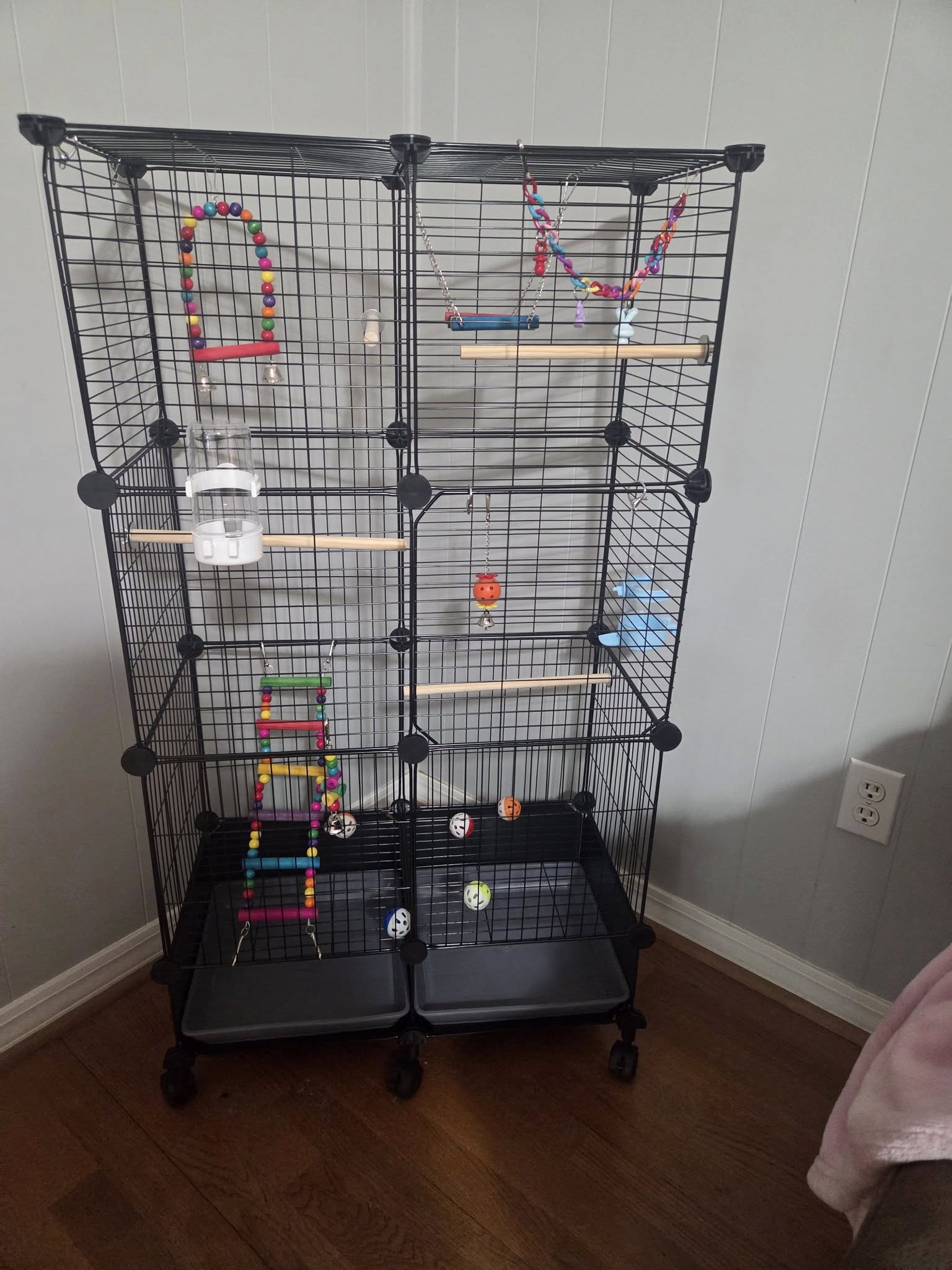
The answer tells me a lot. A budgie needs a cage wide enough to stretch and flap its wings — minimum 60cm wide for a single bird, wider for a pair. Many cages sold as budgie cages are not large enough. I would rather have this conversation now than hear about it three months later when the bird is bored and pulling its feathers. I have written more about budgie feather plucking and what causes it — often the setup.
The Budgies We Stock at Paradise Pets
We stock both standard budgies and English budgies year-round — all bred in the UK, all handled regularly from a young age. We do not import birds from abroad, and we do not sell birds that have not been properly handled and checked before they go to a new home.
Standard budgies are available in a wide range of colours depending on what our breeding pairs are producing at any given time. English budgies are available in smaller numbers — call ahead on 01793 512400 if you have a preference for a specific type or colour, and we will let you know what we have.
If you are not sure which type is right for you, come in and spend some time with the birds. Seeing the difference between a standard and an English budgie in person makes the decision much clearer than any description I can give.
Visit Us at Paradise Pets Swindon
We stock standard and English budgies year-round — all UK-bred, all handled from a young age. Come in and see what we have, or call ahead if you are looking for a specific type or colour. We are always happy to spend time helping first-time buyers make the right choice.
We also stock cockatiels, finches, canaries, and a wide selection of cage and aviary birds throughout the year. Alongside our birds, we carry a full range of cages, accessories, and seed mixes for every species we sell.
⭐ Customer Reviews
Amazing Bird Selection
Had a lovley visit today,staff were very friendly and very helpful,such a great petshop,their selection of birds is incredible,really impressed,thank so much to the staff at Paradise Pets

Friendly Helpful Staff
I have been coming to this place for years and they have a great stock of food for all types of pets. Have a great selection of small mammals and a lot of birds. Staff are friendly and helpful.

Great Quality Hutch
Bought a guinea pigs hutch and run combo, very happy with the service, the hutch was put in my car for me without even asking for help. The wood quality is very good, the instructions easy to follow and we are extremely happy with the fully built hutch. A good size for 2 guinea pigs

Response from Paradise Pets | Wiltshire
Thank you Melanie Latus Nice to provide services to you.
Best Bird Shop Around
It’s the best pet shop in and around Swindon. They always have an amazing selection of birds and all you need to keep them happy. I keep birds myself and the guys there are happy to answer questions and really know their stuff. I have seen budgies etc. in chain pet shops in the area looking really unhealthy and ill – I wouldn’t go anywhere else than Paradise Pets for animals.

Highly Recommended Bird Shop
I could not praise this shop enough. Really helped my Grandson buy his first bird and he’s loving it. Travelled from Somerset and was welcomed with open arms.

Great Shop with Competitive Prices
Great shop with amazing selection for small animals, hamsters, mice ect, highly recommend!
Also has a great selection for dogs & cats too & very competitive prices! 💖

