

Neil has kept, bred, and sold guinea pigs at Paradise Pets Swindon since 1988 — over 35 years of watching what happens when guinea pig owners get the diet right and when they do not. Vitamin C deficiency is the single most preventable cause of serious illness in pet guinea pigs. It is also one of the most consistent causes of suffering that owners do not recognise until the damage is already done. This guide explains what every guinea pig owner needs to know about it.
There is a question I ask every new guinea pig owner before they leave the shop. Not the same question I ask rabbit buyers — a different one. I ask: do you know that guinea pigs cannot make their own vitamin C?
Most people do not. And the ones who have heard it often do not fully understand what it means in practice — what happens to an animal that is not getting enough, how quickly the deficiency can develop, how the signs present, and how easily the whole thing is prevented with the right diet.
The gap between knowing the fact and understanding its implications is where most of the vitamin C problems I see originate. Someone knows guinea pigs need vitamin C. They give their animal a bowl of pellets that says vitamin C on the label. They assume that is enough. It is often not — for reasons I will explain — and the animal suffers a slow, painful deterioration over months that could have been avoided with a handful of the right vegetables each day.
This is the guide I want every guinea pig owner to have before they need it.
Why Guinea Pigs Cannot Make Vitamin C — The Biology
Most mammals synthesise their own vitamin C internally. Dogs do it. Cats do it. Rabbits do it. The biochemical pathway that converts glucose to ascorbic acid — vitamin C — is present and functional in the majority of mammalian species, which means those animals do not need to source it from their diet because they manufacture it continuously as required.
Guinea pigs cannot do this. They share a specific genetic mutation — a non-functional version of the enzyme L-gulonolactone oxidase, the final step in the vitamin C synthesis pathway — with humans, other primates, and a small number of other species. Without that enzyme, the synthesis pathway is broken. No vitamin C is produced internally, regardless of what the animal eats.
This means that every molecule of vitamin C in a guinea pig’s body came from its diet. There is no internal reserve being continuously replenished. There is only what was eaten recently — and vitamin C is water-soluble, meaning it is not stored in fat the way fat-soluble vitamins are. It is used or excreted. The supply needs to be continuous.
The daily requirement for a guinea pig is approximately 10 to 30 milligrams of vitamin C per day for a healthy adult — rising to 30 to 50 milligrams during pregnancy, illness, or recovery. These are not large amounts in absolute terms. They are entirely achievable through diet. But they need to come from the diet every day, without gaps, for the animal’s entire life.
How Quickly Deficiency Develops — The Timeline Owners Miss
This is the part of the conversation that most consistently surprises new owners, because the assumption is that deficiency is something that develops slowly, over months, with plenty of time to notice and correct.
In guinea pigs, it is not. The timeline is weeks.
A guinea pig with no dietary vitamin C intake — receiving only pellets, hay, and no fresh food — will begin showing early signs of deficiency in approximately two weeks. Within three to four weeks, those signs become clinically significant. Without correction, the progression continues to serious systemic illness over the following weeks.
The reason the timeline is so compressed in guinea pigs compared to humans — where clinical scurvy takes months to develop — is primarily body size and metabolic rate. A guinea pig’s metabolic rate is significantly higher than a human’s relative to body weight. The daily turnover of vitamin C is proportionally faster. The depletion of available stores happens correspondingly faster.
This matters practically because it means that a dietary mistake — a period of relying only on pellets, an extended time when fresh food was not being offered, a new bag of pellets that was already several months old — can produce deficiency in a timeframe that does not give the owner the warning window they might expect.
A guinea pig that is eating pellets and no fresh food is a guinea pig that may be on the edge of deficiency right now, regardless of how healthy it appears. The early signs are subtle and easy to miss.
The Signs of Vitamin C Deficiency — What to Look For
Vitamin C — ascorbic acid — is essential for the synthesis of collagen, the structural protein that holds connective tissue together. Without adequate collagen synthesis, the structural integrity of blood vessels, joints, gums, skin, and organ tissue begins to break down. The signs of deficiency in guinea pigs reflect this — they are the signs of tissue that is not being maintained correctly.
The early signs are easy to overlook. A guinea pig that is slightly less active than usual. One that moves more stiffly, or seems reluctant to move when it previously moved readily. One that is eating but with slightly less enthusiasm. One that winces or vocalises when touched or handled around the joints or the back legs. One that has begun to lose a small amount of weight without an obvious dietary explanation.
These early signs are often attributed to other causes — the animal being tired, the weather, a bad day, getting older. They are not specific enough to immediately suggest vitamin C deficiency unless the owner knows to look for them in that context.
As deficiency progresses, the signs become more pronounced and more specific. The gums begin to look pale and the tissue around the base of the teeth becomes inflamed and bleeds easily. The joints — particularly in the hind legs — become swollen, painful, and show visible signs of haemorrhage under the skin. The animal begins to move with a distinctive hobbling gait, reluctant to bear weight on painful limbs. The coat may begin to look rough and the skin fragile. The animal begins to lose weight more significantly as eating becomes painful due to gum involvement.
In advanced deficiency, the animal is in serious pain, unable to move normally, eating poorly, and losing condition rapidly. At this stage, recovery is possible but takes time and requires veterinary involvement alongside immediate dietary correction.
The progression from early subtle signs to advanced deficiency can happen in two to three weeks in an animal receiving no vitamin C. In an animal receiving some but not enough — pellets only, for example, where the vitamin C content has degraded significantly — the progression is slower but still measurable over weeks rather than months.
Why Pellets Alone Are Not Enough
This is the single most common source of vitamin C inadequacy I see in pet guinea pigs, and it is one that surprises owners because the pellets they are buying almost certainly say vitamin C on the label.
They do contain vitamin C. The problem is what happens to that vitamin C between manufacture and the moment the guinea pig eats it.
Vitamin C is inherently unstable. It degrades rapidly in the presence of light, air, heat, and moisture — all of which are present once a bag of pellets is opened. Studies of commercially available guinea pig pellets have found that vitamin C content drops significantly within six weeks of opening the bag, with some formulations losing over half their initial vitamin C content in that time. By the time a bag of pellets has been open for two to three months — which is common in a household with one or two guinea pigs eating through the bag slowly — the vitamin C content may be negligible regardless of what the label stated at the point of manufacture.
Additionally, the vitamin C in pellets was calculated to meet requirements when the pellets were fresh. An animal receiving nothing but pellets that have been open for two months is not receiving the vitamin C the pellet label implies it is.
Pellets have a place in the guinea pig diet as a concentrated source of other nutrients. But they cannot be relied upon as the primary vitamin C source. Fresh food cannot be replaced by pellets for this purpose, and assuming otherwise is one of the most consistent routes to deficiency I see.
What Does Provide Enough Vitamin C — The Reliable Sources
The good news — and there is a great deal of good news in this picture — is that providing adequate vitamin C through diet is genuinely simple and inexpensive. The foods that provide it well are widely available in any UK supermarket, most guinea pigs find them highly palatable, and the quantities required are small.
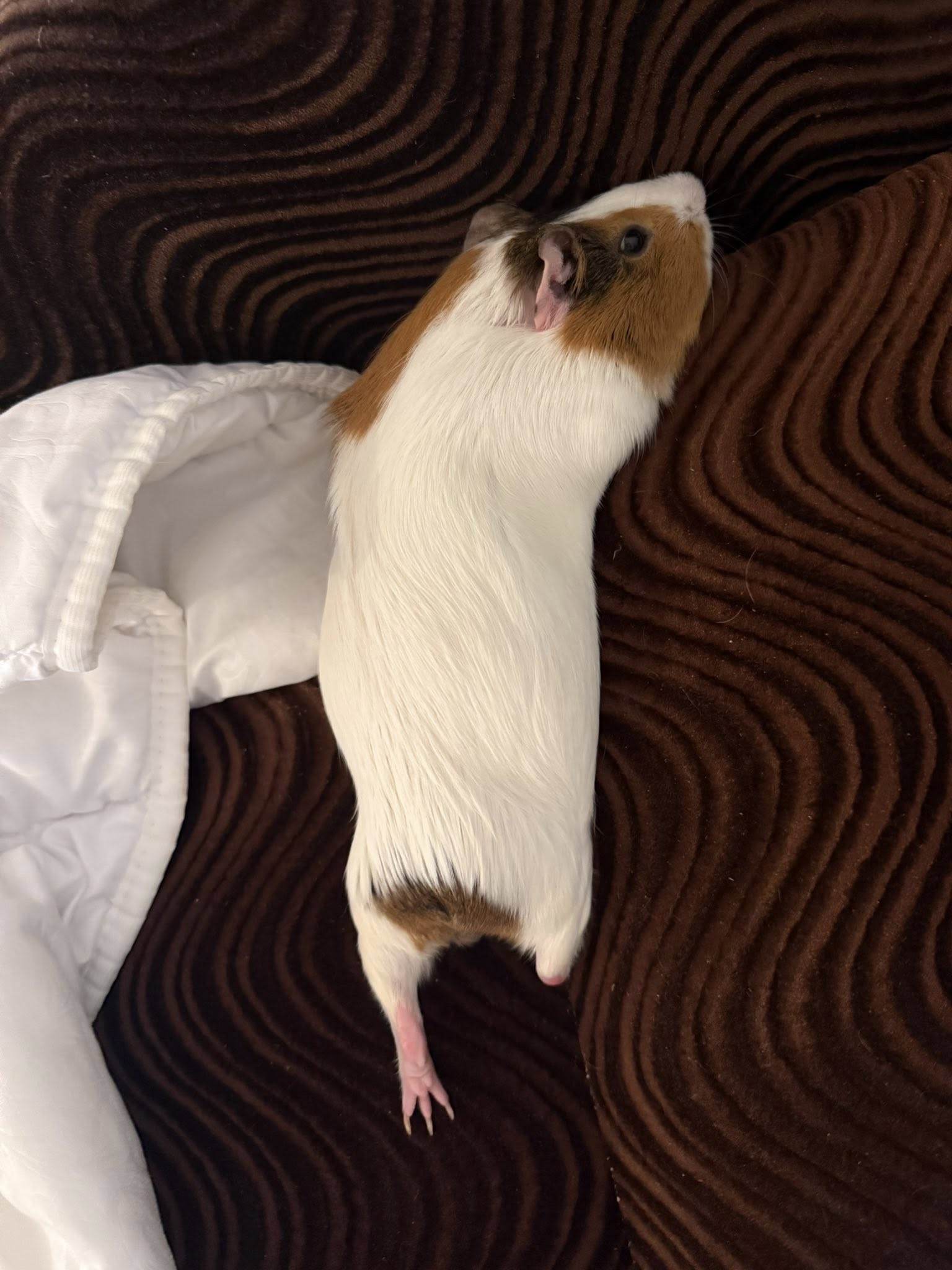
Red bell pepper is the standout. It contains more vitamin C per gram than oranges — approximately 190mg per 100g — and most guinea pigs eat it enthusiastically. A strip of red bell pepper the length of a finger, offered daily, provides a significant portion of the daily requirement. Green and yellow peppers also contain vitamin C but at lower concentrations than red.
Leafy greens are the foundation of daily fresh food provision and contribute meaningfully to vitamin C intake. Romaine lettuce, curly kale, spring greens, and coriander are all good sources and are appropriate daily foods. Spinach and Swiss chard are high in vitamin C but also high in oxalic acid and should be offered in rotation rather than daily.
Fresh parsley — both flat-leaf and curly — is an excellent vitamin C source and one that most guinea pigs enjoy. A few sprigs daily is a straightforward contribution.
What to avoid or limit: iceberg lettuce, which is mostly water and provides minimal nutrition. Fruit, which contains vitamin C but also high sugar and should be an occasional treat rather than a daily staple. Any wilted, yellowing, or frozen-then-thawed produce — vitamin C degrades rapidly in wilted or damaged vegetables and is largely destroyed by freezing and thawing.
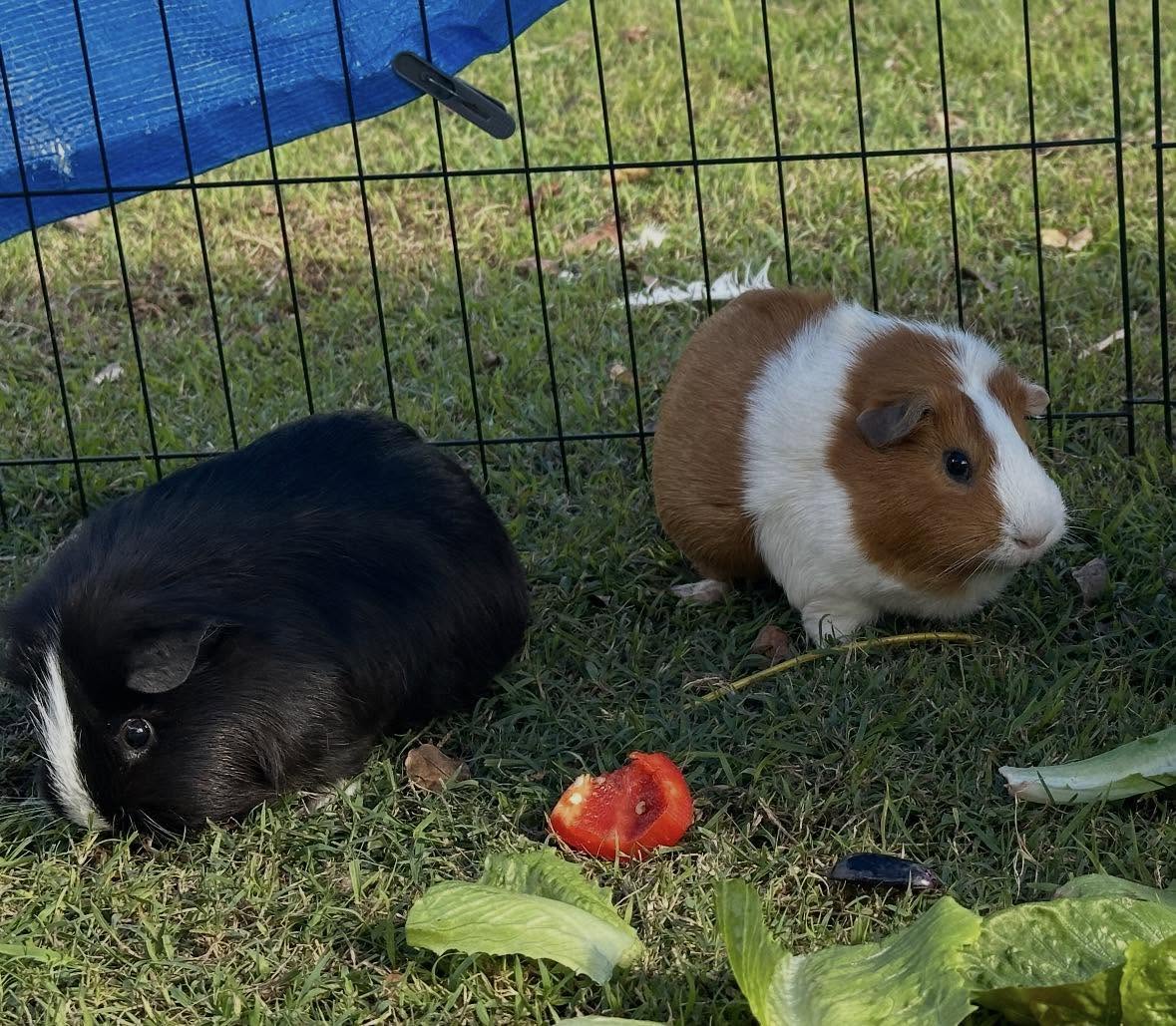
The practical daily provision that covers the requirement: a strip of red bell pepper and a small handful of mixed leafy greens, offered fresh each day. This is not complex. It does not require specialist knowledge or specialist shopping. It is the routine that keeps a guinea pig adequately supplied with the one nutrient it cannot produce for itself.
Vitamin C Supplements — Where They Help and Where They Do Not
The question of supplementation comes up regularly at the counter, and the answer is more nuanced than a simple yes or no.
Water-soluble vitamin C added to the drinking water is often recommended and commonly used. The problem is that vitamin C in water degrades rapidly — the ascorbic acid oxidises within hours of being dissolved, particularly in a water bottle where it is exposed to air and light. By the time the guinea pig drinks the water at the end of the day, a significant proportion of the vitamin C added to it in the morning may already have degraded to a form the body cannot use. Water-based supplementation is better than nothing, but it is not reliable as the sole means of supplementation and requires fresh preparation daily.
Vitamin C drops added directly to water or administered directly by dropper — dosed according to body weight — are a more reliable form of supplementation when used correctly, but they are still a supplement rather than a substitute for fresh dietary sources.
The most reliable approach is always fresh food. Supplements have a role as a backup, during recovery from deficiency, during pregnancy when requirements are higher, or during periods when fresh food availability is reduced. They should not be the primary strategy when fresh food is available and the animal is eating normally.
A guinea pig that has developed deficiency may need higher-dose supplementation under veterinary guidance alongside immediate dietary correction — the recovery requirement is higher than the maintenance requirement, and the vet-recommended doses during recovery may be significantly above the standard daily maintenance level.
Vitamin C During Pregnancy and Illness — When Requirements Rise
The standard daily requirement of 10 to 30 milligrams applies to a healthy adult guinea pig at maintenance. There are specific circumstances in which the requirement increases significantly and the dietary provision needs to reflect that.
Pregnancy places a very high demand on vitamin C — the developing young require it for their own collagen synthesis, and the mother’s supply is drawn on for both her needs and theirs. A pregnant guinea pig needs 30 to 50 milligrams of vitamin C daily, and deficiency during pregnancy has serious consequences for both the mother and the litter. If you have a pregnant guinea pig, increase the fresh food provision immediately and consider discussing supplementation with a vet.
Illness increases the body’s metabolic demand for vitamin C — the repair processes involved in recovery consume more than maintenance requires. A guinea pig that is unwell for any reason should receive increased fresh food provision as a matter of course, not reduced provision on the assumption that a sick animal cannot manage fresh food.
Recovery from vitamin C deficiency itself requires elevated intake until normal tissue condition is restored. This is a situation where veterinary guidance on supplementation level is appropriate — the dose required to correct an established deficiency is higher than the dose required to maintain adequate levels once corrected.
What I Tell Guinea Pig Owners at the Counter
When I explain the vitamin C situation to a new owner, the response is almost always the same. They did not know it was this important. They thought the pellets had it covered. They were planning to give vegetables as a treat rather than as a daily requirement.
That is where the conversation needs to go — from treats to daily requirement. The fresh food is not optional enrichment for a guinea pig. It is the primary delivery mechanism for a nutrient the animal cannot live without. Getting that distinction right from the start is the difference between an animal that thrives and one that quietly deteriorates in a way the owner does not initially understand.
The practical message I leave every owner with is this: red bell pepper and leafy greens, every day, fresh, in quantities the animal will eat. Not as an extra. As part of the daily routine that is as non-negotiable as the hay and the water.
It costs pennies a day. It takes thirty seconds to prepare. It prevents one of the most painful and most preventable conditions in pet guinea pig keeping. There is almost no other investment of that size that produces that return for an animal’s welfare.
Come in if you have any questions about guinea pig diet or if you are concerned about a guinea pig that may not have been getting enough vitamin C. We are at Manor Garden Centre, Cheney Manor Industrial Estate, Swindon, SN2 2QJ — open every day. Or call us on 01793 512400.
- “The pellets have vitamin C on the label so they’re covered” — Vitamin C in pellets degrades rapidly after the bag is opened — significantly within six weeks, substantially within three months. Pellets that were manufactured with adequate vitamin C may provide very little by the time the animal eats them. The label reflects the content at manufacture, not the content at the time of feeding. Fresh food is not replaceable by pellets for vitamin C provision.
- “I put vitamin C drops in the water so that’s taken care of” — Vitamin C dissolved in water oxidises within hours, particularly in a plastic bottle exposed to light. The vitamin C added to the water bottle in the morning may be largely degraded by the time the animal drinks in the evening. Water supplementation is better than nothing but is not reliable as the primary strategy. Fresh food provides stable, reliably available vitamin C.
- “It’s been fine for two years on pellets — it clearly doesn’t need vegetables” — An animal that has been managing on inadequate vitamin C for two years may be in subclinical deficiency — not yet showing dramatic signs but with compromised connective tissue integrity that is quietly progressing. The absence of obvious illness is not evidence of adequate vitamin C status. Many deficiency cases I see are in animals whose owners believed they were fine because the signs had not yet become obvious.
- “Oranges are the best vitamin C source — I give it orange every day” — Oranges do contain vitamin C, but the sugar content makes them inappropriate as a daily food. Red bell pepper contains more vitamin C per gram than oranges and has a sugar content that makes it appropriate for daily feeding. Use bell pepper as the primary fresh vitamin C source and reserve fruit for occasional treats.
- “If it was really that important the vet would have told me” — Vets see animals when they are brought in — which often means the deficiency is already established by the time the conversation happens. The vitamin C requirement is an established fact of guinea pig biology and husbandry. The information exists and is accurate. The responsibility for acting on it sits with the owner, from the day the animal comes home.
- Healthy adult guinea pig on a balanced diet including daily fresh food.
Continue daily provision of red bell pepper and leafy greens. This is the maintenance strategy. No supplementation needed if fresh food is being provided and eaten consistently. - Guinea pig on pellets only, no regular fresh food, apparently healthy.
Start fresh food provision immediately — red bell pepper and mixed leafy greens daily. Do not wait for signs to appear. The deficiency may already be subclinical. Fresh food from today. - Guinea pig showing stiffness, reluctance to move, weight loss, or gum changes — possible early deficiency.
Vet visit this week alongside immediate dietary correction. Early deficiency is treatable but needs to be identified and addressed before it progresses. Do not wait to see if the dietary change alone is enough. - Guinea pig showing joint swelling, bleeding gums, significant weight loss, and movement difficulty.
Vet today. This is established deficiency requiring veterinary-guided supplementation alongside dietary correction. The recovery dose required is higher than the maintenance dose and needs professional guidance. - Pregnant guinea pig.
Increase fresh food provision immediately to support the elevated requirement of 30-50mg daily. Consider discussing supplementation with a vet. Deficiency during pregnancy has serious consequences for both mother and litter. - Guinea pig recovering from illness of any kind.
Increase fresh food provision during recovery. The metabolic demand for vitamin C rises during illness and repair. Do not reduce fresh food access on the assumption a sick animal cannot manage it.
Visit Us at Paradise Pets Swindon
We stock guinea pigs year-round alongside a full range of small animals — all UK-bred, properly fed, and sold with the dietary information owners need to keep them well. If you have a question about guinea pig diet, vitamin C, or any aspect of their care, come in and talk to us.
We also stock rabbits, gerbils and hamsters, and a full range of cage and aviary birds.