

Updated : Replaced sensational incident framing with practical buzzard-safety and protected-bird guidance.
If a bird of prey repeatedly approaches people on a path, put distance between yourself and the bird, avoid returning to that spot and tell the land manager about the location. Do not approach a nest to investigate. This guide explains practical next steps and links to wildlife, legal and medical guidance; it is not a report of a current incident in Swindon.
First steps for walkers and dog owners
- Leave the immediate area and choose another permitted route where available. Follow local signs and advice from the site manager.
- Keep children with you and keep your dog under control and away from wildlife. Do not encourage a dog to chase a bird.
- Do not feed, chase, capture or throw objects at the bird. Do not climb towards a nest or try to move it.
- Record the location and time once you are safely away. Report repeated approaches or contact to the landowner, site manager or local council so they can assess the situation.
The Countryside Code for England and Wales advises giving wild animals space, avoiding disturbance, following local signs and keeping dogs under effective control. This general approach is more useful than guessing a fixed safe distance or assuming a problem will end on a particular date.
Make sure the bird has been identified correctly
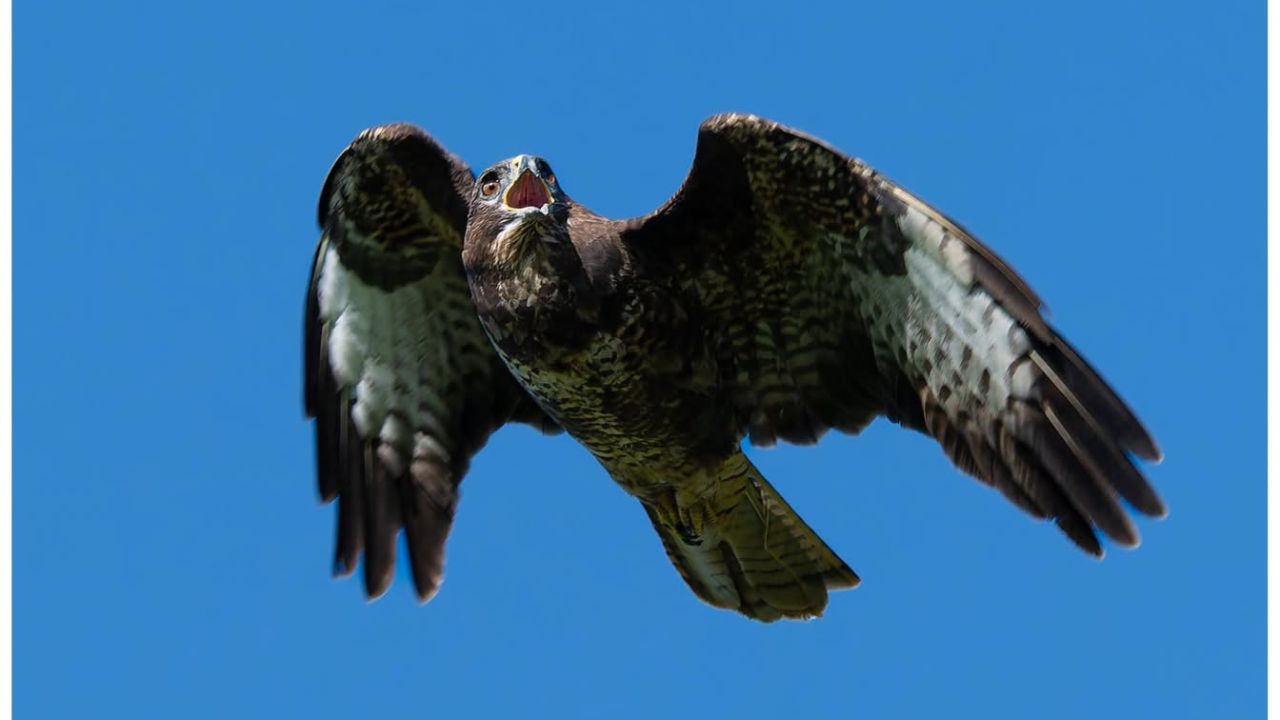
A large bird circling overhead is not enough to establish its identity or explain its behaviour. The RSPB’s Common Buzzard guide describes its broad wings, variable plumage and short, unforked tail. Common Buzzards and Honey Buzzards are different species.
If you already have a photograph taken safely from a distance, it may help with identification. Do not return to a problem location or approach a nest to obtain one. Describe what you observed without assuming that every flight overhead was an attack.
Wild-bird protection in England
Natural England’s guidance explains the general protection of wild birds, eggs and nests. This includes restrictions on intentionally killing, injuring or taking birds and damaging a nest while it is in use or being built. Certain species have additional Schedule 1 protection.
Correction: the earlier version of this page incorrectly called the Common Buzzard a Schedule 1 species. The RSPB’s guide to the schedules lists the Honey Buzzard, a different species. The correction does not remove the Common Buzzard’s general legal protection.
Licensing and exceptions depend on the circumstances. A safety concern is a reason to seek advice from the relevant authority, not permission to remove a bird or nest yourself. The England guidance linked here should not be treated as a complete account of the law elsewhere in the UK.
If someone is injured
Get to a safe place and assess the injury. The NHS cuts and grazes guidance explains when to clean and cover a wound and when medical help is needed. Seek urgent advice from NHS 111 for a dirty wound or signs of infection. Call 999 or go to A&E for uncontrolled bleeding, a very large or deep wound, or other serious injury. Do not dismiss a wound because the bird has flown away.
Who can help?
Contact the landowner or site manager about the affected route; the local council can help identify the appropriate team for a public-path concern. Use Natural England for questions about protected-bird licensing in England and NHS services for injuries. Paradise Pets is a pet retailer: this article signposts those specialist services rather than offering wildlife-control, legal or medical advice.
Sources checked: 24 September 2026. Revised to replace an old sensational news account with safety signposting and to correct the species-protection error.
