

Neil has been keeping, breeding, and selling budgies at Paradise Pets Swindon since 1988 — over 35 years of daily first-hand experience with these birds and the people who keep them. Wing spreading is one of those behaviours that owners ask about because they are not sure whether it is normal, healthy, a sign of illness, or something they should be doing something about. The answer depends entirely on the context. This is his honest guide to every reason a budgie opens its wings, what each one means, and the one context where it is worth taking seriously.
A man came into the shop one afternoon looking genuinely puzzled. His budgie had been spreading its wings out — both wings, held away from the body — for several seconds at a time, a few times each day. It had been doing it for about a week. The bird was eating normally. It was active. But he had looked it up online and read enough conflicting things that he was not sure whether he was watching healthy behaviour or the early signs of something wrong.
I asked him one question.
“When does it do it?”
He thought about it. Mostly in the morning, he said. After the cage cover came off. Sometimes after eating. Once or twice when it had been sitting in a patch of sunlight near the window.
I told him his budgie was perfectly fine. What he was describing was a healthy bird stretching, warming up, and regulating its temperature — entirely normal behaviour that most budgie owners see every day without ever worrying about it.
He looked visibly relieved.
Then I told him the other side of it — because there is another context in which wing spreading means something different entirely, and he deserved to know what to look for so he would recognise it if it ever appeared.
That is what this guide covers. All of the reasons a budgie opens its wings, what each one looks like, what it means, and the one version that warrants attention.
Why Context Is Everything With Wing Behaviour
Before I go through each specific reason, I want to explain why the same physical behaviour — wings held away from the body — can mean completely different things depending on when and how it happens. Because without that understanding, owners either panic about perfectly normal behaviour or miss the one version that actually matters.
A budgie’s wings are not just for flying. They are for thermoregulation, communication, exercise, stretching, display, and balance. The muscles involved in wing movement are among the most metabolically active in the bird’s body. Budgies use their wings constantly — not just in flight, but in a range of postural and communicative behaviours that happen while the bird is perched.
The wing spread that means nothing of concern looks different from the wing spread that means something is wrong. Different posture, different timing, different accompanying behaviour. Once you know what to look for in each case, distinguishing between them takes seconds.
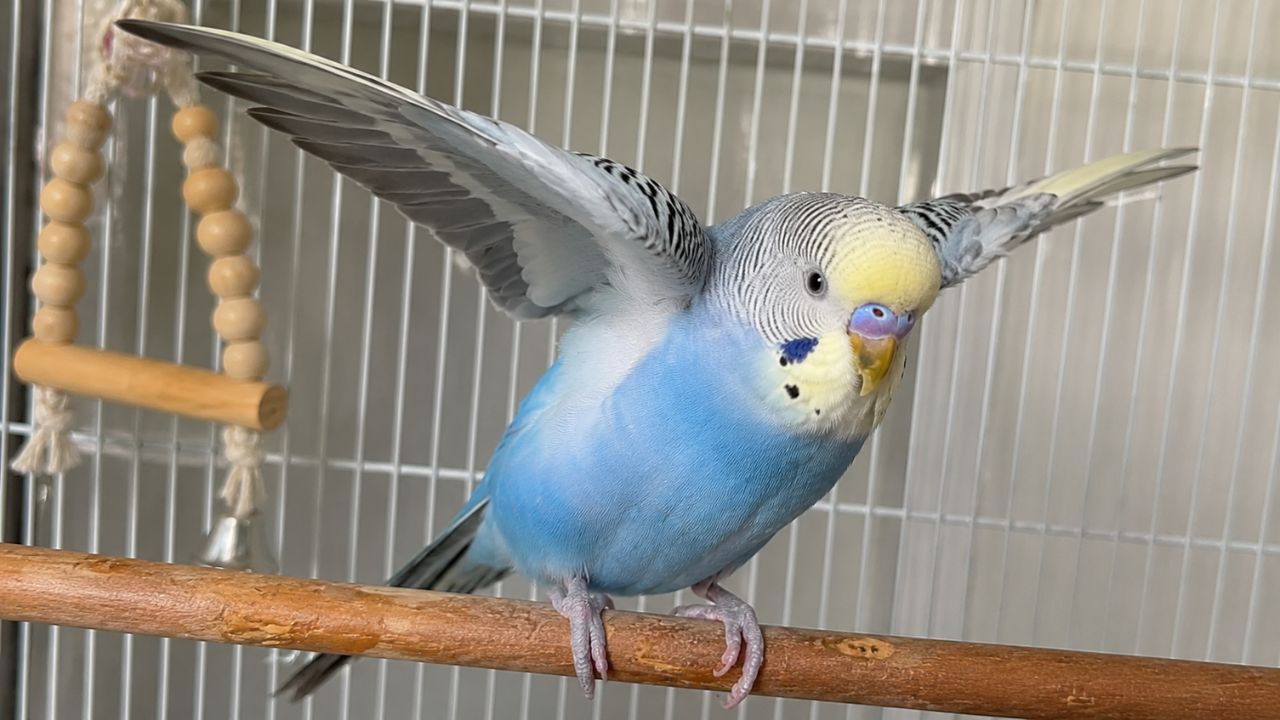
- Wing spreading as a stretch — deliberate, momentary, one or both wings extended fully then folded back; often accompanied by a simultaneous leg stretch on the same side; happens after rest
- Wing spreading as thermoregulation — wings held slightly away from the body, often with feathers slightly raised; happens in warm conditions or after sunlight exposure
- Wing spreading as display or communication — wings partially or fully extended toward another bird or toward the owner; often accompanied by other display behaviours
- Wing spreading as exercise — rapid flapping while on the perch, or wings extended during flight practice; healthy and desirable
- Wing drooping as illness — this is the one that matters; wings hanging lower than normal from the body at rest, without active extension; accompanied by other signs of being unwell

The last item on that list is where I want owners to pay attention — not because it is the most common cause of wing behaviour, but because it is the most important to recognise and the most frequently confused with the harmless causes above it.
Reason One — Stretching
This is the most common reason a budgie owner observes wing spreading, and it is entirely normal, entirely healthy, and in fact a positive sign that the bird is comfortable and relaxed in its environment.
Budgies stretch regularly — after sleeping, after sitting still for a period, after eating, and often first thing in the morning when the cage cover comes off. The stretch typically involves one or both wings extended outward and downward, sometimes with the leg on the same side extended simultaneously. It lasts two to three seconds and the wings are folded neatly back against the body immediately afterwards.
- Both wings at once or one wing at a time — both are normal; the one-wing-one-leg stretch on the same side is particularly characteristic and is one of the more charming things budgies do
- Happens most commonly after rest and in the morning — the same way a human stretches after sleeping; the muscles have been inactive and the bird extends them before the active period begins
- The stretch is deliberate and complete — the wing is fully extended, held briefly, and folded back cleanly; the bird continues with its normal activity immediately after
- A bird that stretches regularly is a bird that is comfortable — stretching requires a degree of physical and psychological relaxation; a stressed or unwell bird does not typically stretch in this way
- No action required — this is healthy behaviour; enjoy it
Reason Two — Thermoregulation
Budgies originated in the warm, arid interior of Australia. They are designed to manage heat, and one of the mechanisms they use is wing posture. When a bird is slightly too warm, it holds its wings slightly away from the body to allow air to circulate across the skin beneath the feathers. This dissipates body heat and cools the bird down.
- Wings held slightly out from the body — not fully extended as in a stretch, but noticeably away from the normal resting position; the feathers may also be slightly raised to allow air movement
- Happens in warm conditions — in summer, in a warm room, after sitting in a patch of sunlight, or after vigorous exercise; the timing tells you this is thermoregulation
- Typically resolves when the bird moves to a cooler location — if the cage has shade available and the bird can move away from the heat source, the wing position returns to normal; if it persists regardless of temperature, investigate further
- Distinguish from overheating — mild warmth produces the wing-out posture; genuine overheating produces open-beak breathing, visible distress, and lethargy; if you see open-beak breathing alongside wings held out, move the bird to a cooler location immediately
- Check the cage position regularly in summer — a cage in direct sunlight through a window can reach temperatures that are dangerous even when the room feels comfortable; always ensure shade is available

Reason Three — Display and Communication
Budgies are social, communicative birds and wings are part of their vocabulary. Wing spreading as display or communication looks different from stretching or thermoregulation — it is directed toward something or someone, and it is accompanied by other communicative behaviours.
- Display toward another bird — a budgie spreading or flapping its wings toward a companion bird is asserting itself, displaying fitness, or engaging in courtship behaviour; this is most commonly seen in male budgies and is a normal part of social interaction
- Display toward the owner — some budgies spread wings or flap toward their owner as a greeting, as a request for attention, or as part of play behaviour; this is a sign of a confident, engaged bird
- Courtship wing spreading — during breeding condition, male budgies will spread and quiver their wings as part of courtship display toward a female or toward a mirror companion; this is typically accompanied by regurgitation attempts, head bobbing, and general heightened activity
- Threat display — occasionally a budgie will spread wings to appear larger as a warning toward a perceived threat; this is accompanied by a forward-leaning posture, raised feathers on the back of the head, and sometimes a hissing sound
- All of these are normal communicative behaviours — the wing spreading in these contexts is part of a broader behavioural picture; it does not occur in isolation and is clearly directed

Reason Four — Exercise and Wing Conditioning
Budgies are active birds that need to exercise their wings even when they are not in free flight. Perch flapping — vigorous wing flapping while remaining on the perch — and brief wing extensions are normal exercise behaviours that help maintain flight muscle condition.
- Perch flapping is completely normal — the bird grips the perch and flaps its wings vigorously; this is exercise; a bird that flap-exercises regularly is a bird with good muscle tone and appropriate energy levels
- Wing extension during landing and balance — budgies extend their wings briefly during landing, when adjusting their position on an uneven perch, or when their balance is momentarily disrupted; this is a normal motor behaviour
- Wing stretching and flapping after extended periods in a small space — a bird that has been caged for a while and then has access to a larger space will often flap and extend its wings enthusiastically; this is the bird using its muscles after they have been restricted
- Out-of-cage time is important for wing health — a bird that only ever lives in a cage cannot adequately exercise its flight muscles; regular out-of-cage time in a safe, supervised environment is important for the bird’s physical and mental wellbeing
Reason Five — The One That Matters: Wing Drooping as Illness
This is the version of abnormal wing behaviour that owners need to be able to recognise, and it is genuinely different from everything described above — once you know what to look for.
A sick budgie will often hold its wings lower than normal. Not spread outward as in a stretch or display — but drooping downward, hanging away from the body at a lower angle than the normal tight, neat fold. The wings look as if the bird has partially lost the muscular tension required to hold them in their correct resting position.
This happens because illness reduces the bird’s energy and muscular tone. The same mechanism that keeps the feathers perfectly groomed and the posture upright requires energy — and a bird that is unwell does not have spare energy for postural maintenance.
- Wing drooping looks different from stretching — a stretch is deliberate, brief, complete, and followed by normal posture; drooping is a resting position the bird maintains passively without active extension
- Wing drooping is almost always accompanied by other signs of illness — fluffed feathers, sitting low on the perch, reduced activity, changes in droppings, reduced appetite; the wings rarely droop in isolation in a genuinely sick bird
- Drooping after injury — a bird that has injured a wing — from impact during flight, from catching on cage bars, from a fall — may hold the injured wing lower than the other; asymmetrical wing position is a sign worth investigating; compare the position of both wings at rest
- Drooping in young birds learning to perch — very young birds that have recently fledged sometimes hold their wings slightly out while they are developing their balance and perching confidence; this resolves as the bird matures and is not a concern in otherwise healthy young birds
- If wings are drooping and the bird has other symptoms — fluffing, tail bobbing, lowered perch position, reduced appetite — this is a same-day avian vet visit; do not wait

- Healthy wing spreading is active and deliberate — the bird initiates it, completes it, and returns to normal posture; the bird is otherwise alert, normally postured, and engaged with its environment
- Illness wing drooping is passive — the wings hang lower at rest without the bird actively extending them; the posture looks tired or collapsed rather than deliberate
- Check whether both wings are affected symmetrically — asymmetrical wing position at rest (one wing lower than the other) suggests injury to the lower wing rather than systemic illness
- Look at the whole bird — a healthy bird that is stretching or displaying looks healthy everywhere else; a sick bird with drooping wings will show other signs of being unwell if you look carefully
- Time of day matters — healthy wing spreading happens most in the morning and in active periods; persistent wing drooping throughout the day, including during periods when the bird should be active, is the concerning version
Reading Wing Behaviour — A Practical Reference
| What You Are Seeing | When It Happens | What It Means | What To Do |
|---|---|---|---|
| Full wing extension, brief, then folded back cleanly | After rest, morning, after eating | Normal stretch — healthy behaviour | Nothing — enjoy it |
| One wing and one leg extended simultaneously | After rest, any time | Normal full-body stretch | Nothing — this is a good sign |
| Wings slightly held out from body, feathers slightly raised | Warm room, sunlight, after exercise | Thermoregulation — bird is slightly warm | Check cage temperature; ensure shade is available |
| Wings out plus open-beak breathing | Warm conditions | Overheating — urgent | Move to cooler location immediately; offer water; vet if no improvement in 15 minutes |
| Wing spreading directed at another bird | Social interaction | Display, courtship, or assertion | Normal — monitor social dynamics between birds |
| Vigorous flapping on the perch | Any time, particularly morning | Wing exercise — healthy behaviour | Nothing — ensure the bird has regular out-of-cage time too |
| Wings drooping lower than normal at rest, passively | Throughout the day, not after rest or heat | Illness or injury — needs investigation | Check for other symptoms; avian vet if other signs are present |
| One wing lower than the other asymmetrically | Persistent, not associated with stretching | Possible wing injury | Avian vet — wing injuries need assessment |
What Healthy Wing Behaviour Tells You About Your Budgie
This is the part of the topic that does not get enough attention. Wing behaviour is not just something to monitor for problems — it is one of the most informative windows into a budgie’s overall wellbeing, and learning to read it gives you genuinely useful daily information about how the bird is doing.
- A budgie that stretches regularly is a budgie that is relaxed and comfortable — stretching requires a baseline of physical and psychological ease; a stressed, fearful, or unwell bird does not stretch freely
- A budgie that exercises its wings on the perch has good energy levels — perch flapping in a healthy bird is energetic and enthusiastic; a bird that is never seen to flap or exercise is a bird worth watching
- Wing and feather condition together tell you a great deal — well-maintained wings with clean, correctly structured feathers indicate a bird that is well-nourished, well-rested, and healthy enough to groom properly; damaged, unkempt, or dull wing feathers tell a different story
- The absence of normal wing behaviour can be as significant as abnormal wing behaviour — a bird that has stopped stretching, stopped exercising, stopped engaging in the normal wing behaviours you used to observe regularly is a bird that has changed; change in a bird’s baseline behaviour is worth noting and investigating if it persists
Frequently Asked Questions
My budgie spreads both wings out and holds them for a few seconds. Is this normal?
Yes, in the vast majority of cases. A deliberate, held wing spread followed by a neat fold-back is a stretch. It is one of the most normal things a budgie does and it is a positive sign — a relaxed, comfortable bird that has been sitting still and is extending its muscles before the active period begins. If the bird is otherwise alert and normal and the wing spreading is happening in the morning or after rest, there is nothing to be concerned about.
My budgie opens one wing and one leg at the same time. What is that?
This is a full-body stretch — one of the most characteristic postures healthy budgies make. The wing and leg on the same side extend together, held for a second or two, and then fold back. It is completely normal and entirely healthy. Some owners describe it as the bird doing yoga. The comparison is not entirely inaccurate — it is a deliberate, satisfying stretch of the full lateral musculature on one side.
My budgie is holding its wings slightly away from its body. Should I be concerned?
Check the room temperature first. If the cage is warm, in sunlight, or the room is hot, this is thermoregulation — the bird is dissipating heat. Move the cage to a cooler spot and provide shade and the posture should resolve. If the room is at a normal temperature, the bird is not near a heat source, and the wings are being held passively away from the body along with other signs like fluffing or lethargy, investigate further and consider a vet visit.
How do I know if my budgie’s wings are drooping because of illness or just because it is tired?
Look at the whole picture. A tired bird after exercise may briefly hold its wings slightly loose — but it recovers quickly, returns to normal posture, and is otherwise alert. Illness-related wing drooping persists at rest, is present throughout the day including when the bird should be fully active, and is accompanied by other signs of being unwell — fluffed feathers, lowered position on the perch, reduced vocalisation, changes in droppings. The drooping alone is not diagnostic; it is the drooping in context that tells you what you are looking at.
My budgie flaps its wings really hard while on the perch. Is this normal?
Yes. Perch flapping is wing exercise and it is healthy behaviour. Budgies need to exercise their flight muscles even when they are not flying, and perch flapping is how they do it. A bird that flap-exercises regularly has better muscle tone and more appropriate energy than one that never does. It is also a sign of a bird that has enough energy and wellbeing to engage in vigorous physical activity — a positive sign rather than a cause for concern.
My budgie spread its wings at me when I put my hand near the cage. What does that mean?
Context-dependent, but probably a mild threat display or assertion of space. A budgie that spreads its wings, leans slightly forward, and raises the feathers at the back of its head is saying that it does not welcome the approach. This is more common in untamed birds or birds that are not yet comfortable with hand contact. It is not aggression in the serious sense — it is communication. The appropriate response is to withdraw and respect the bird’s signal rather than pushing through it. Continued trust-building work will reduce this response over time as the bird becomes more comfortable with your presence.
Where can I get help understanding my budgie’s behaviour in Swindon?
Come in to Paradise Pets at Manor Garden Centre, Cheney Manor Industrial Estate, Swindon SN2 2QJ — or call us on 01793 512400. If you are not sure what you are looking at — whether something is normal behaviour or a sign of a problem — describe it to me or show me a video and I will tell you honestly what I think. Free advice, no obligation. That is how we have done things here for 35 years.
One Last Thing From Me
The man who came in worried about his budgie spreading its wings — the one I described at the start — came back a few months later. He had, in the time since, become a much more attentive observer of his bird’s behaviour. He had learnt the difference between a stretch and a droop. He had watched the morning routine carefully enough to know what his bird’s normal baseline looked like.
He said something that I thought was exactly right.
“I used to just see the bird. Now I actually watch it.”
That is the shift that makes a good budgie owner. Not specialist knowledge. Not equipment or expensive food. Just attention — the habit of actually watching the bird rather than just seeing it, so that when something changes, you notice the change against a background of what is normal for that specific bird.
Wing behaviour is one of the best daily indicators available to you. Stretch, flap, display, thermoregulate — these are the signs of a bird that is well. Drooping, asymmetry, loss of the normal wing behaviours you used to see — these are the signs worth acting on.
The difference, once you know what to look for, is not subtle. And the knowing costs nothing.
Not Sure Whether Your Budgie’s Wing Behaviour Is Normal? Come In And Ask.
Describe what you are seeing or show me a video and I will tell you honestly what I think. If it needs a vet, I will tell you that too. Free advice, no obligation. That is how we have done things here for 35 years.